Isaiah 43:6

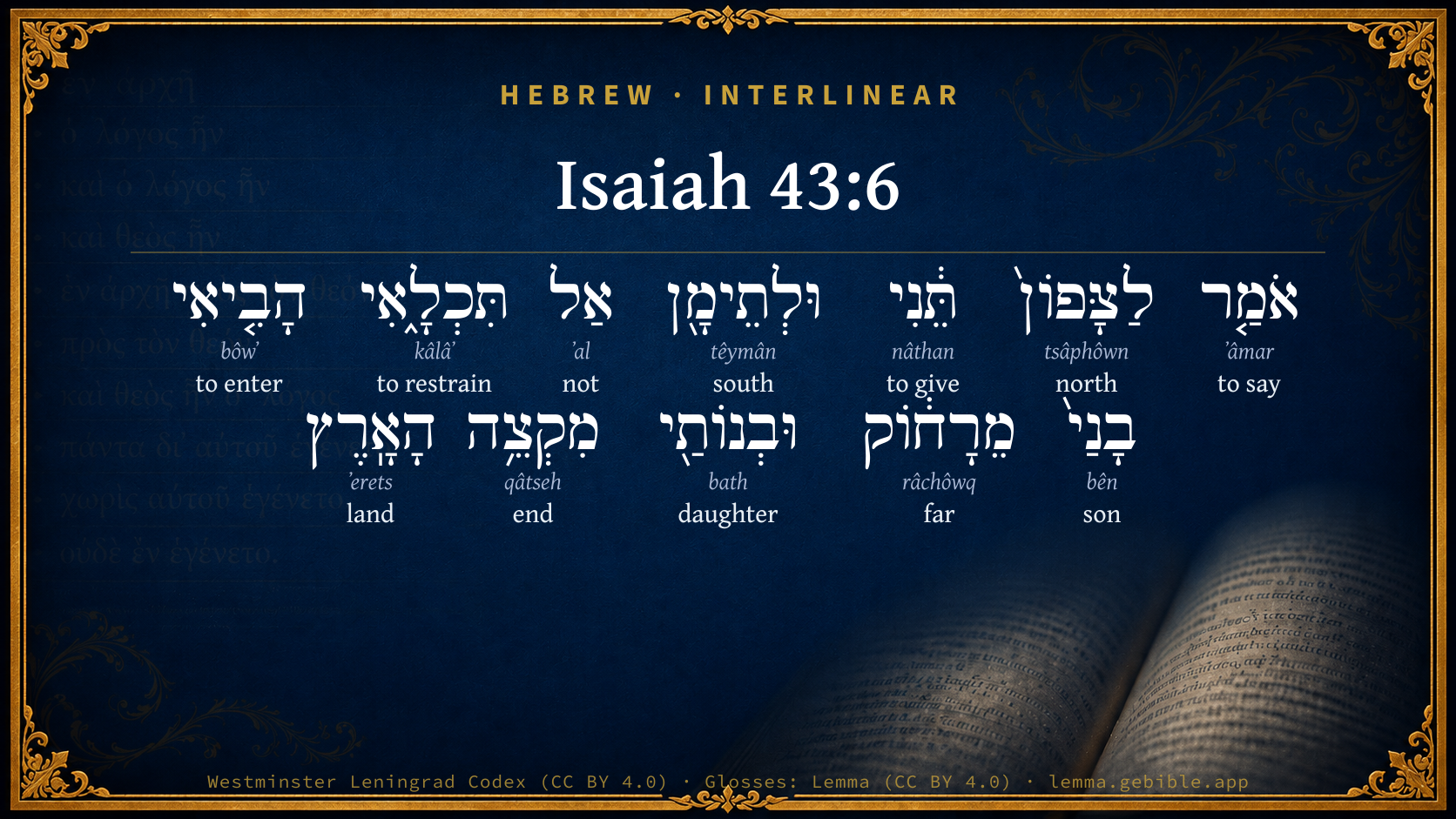
Hebrew (Westminster Leningrad Codex) Isaiah 43:6 appears in the Hebrew Old Testament. The text above is from the Westminster Leningrad Codex. Each word links to its Strong’s number, a concise gloss, and parsing drawn from the Open Scriptures Hebrew Bible morphology. Click any word for its full Brown-Driver-Briggs (BDB) entry.
Download image
Cite this verse

Isaiah 43:6 (World English Bible). Public Domain. Lemma interlinear Bible study tool, https://lemma.gebible.app/v/isaiah/43/6.

Show BibTeX & RIS
BibTeX
RIS
English Translation
I will tell the north, Give up; and to the south, Don't keep back; bring my sons from far, and my daughters from the end of the earth;
World English Bible · Public Domain
Download a study sheet

One document with this verse’s original text, its word-by-word gloss line, the meaning frame, cross-references with their text, attributed commentary, and full source and license credits — printable, and it pastes into notes with its structure intact.

This verse Autodidact and up

Study sheet (.html) Plain text (.txt)

A passage Seminary Student

Up to 50 verses in one chapter. A passage sheet keeps up to 6 commentary sources and 12 cross-references per verse, in the order this page ranks them, and says so on the sheet whenever that leaves anything out. Ask for a single verse and you get the Autodidact verse sheet above.

Everything on this page stays free to read, with no account — the sheet is a download of what is already on screen, not access to it.

Want to remove ads? Support Godless Engineer
Compare translations 3

The same verse in 3 English versions, stacked beneath the original-language interlinear above. Click any original word for its lexicon entry.

Each is an independent rendering of the whole verse — the interlinear is not word-aligned to these translations.

Highlighted words mark where these versions differ — a whole-verse word diff, not a word-by-word alignment.

  • World English Bible Public Domain
    I will tell the north, Give up; and to the south, Don't keep back; bring my sons from far, and my daughters from the end of the earth;
  • King James Version Public Domain
    I will say to the north, Give up; and to the south, Keep not back: bring my sons from far, and my daughters from the ends of the earth;
  • unfoldingWord Literal Text CC BY-SA 4.0
    I will say to the north, ‘Give,’ and to the south, ‘May you not keep back. Bring my sons from afar and my daughters from the end of the earth,

unfoldingWord Literal Text — © unfoldingWord, licensed CC BY-SA 4.0. Word-aligned USFM3 via Door43 (git.door43.org/unfoldingWord/en_ult).

Versions to compare (up to 4)

3 of 4 selected

Show all 18 translations

Every available English version of this verse, each an independent rendering of the whole verse.

  • World English Bible Public Domain
    I will tell the north, Give up; and to the south, Don't keep back; bring my sons from far, and my daughters from the end of the earth;
  • Berean Standard Bible Public Domain
    I will say to the north, ‘Give them up!’ and to the south, ‘Do not hold them back!’ Bring My sons from afar, and My daughters from the ends of the earth—
  • Majority Standard Bible Public Domain
    I will say to the north, ‘Give them up!’ and to the south, ‘Do not hold them back!’ Bring My sons from afar, and My daughters from the ends of the earth—
  • King James Version Public Domain
    I will say to the north, Give up; and to the south, Keep not back: bring my sons from far, and my daughters from the ends of the earth;
  • American Standard Version (1901) Public Domain
    I will say to the north, Give up; and to the south, Keep not back; bring my sons from far, and my daughters from the end of the earth;
  • Revised Version (1885) Public Domain
    I will say to the north, Give up; and to the south, Keep not back; bring my sons from far, and my daughters from the end of the earth;
  • Geneva Bible (1599) Public Domain
    I will say to the North, Giue: and to the South, Keepe not backe: bring my sonnes from farre, and my daughters from the ends of the earth.
  • Douay-Rheims (1899) Public Domain
    I will say to the north: Give up: and to the south: Keep not back: bring my sons from afar, and my daughters from the ends of the earth.
  • Young's Literal Translation Public Domain
    I am saying to the north, `Give up,' And to the south, `Restrain not.' Bring in My sons from afar, And My daughters from the end of the earth.
  • Literal Standard Version CC BY-SA 4.0
    I am saying to the north, “Give up,” || And to the south, “Do not restrain.” Bring in My sons from afar, || And My daughters from the end of the earth.
  • Unlocked Literal Bible CC BY-SA 4.0
    I will say to the north, 'Hand them over;' and to the south, 'Do not hold any back;' Bring my sons from afar, and my daughters from the remote regions of the earth,
  • unfoldingWord Literal Text CC BY-SA 4.0
    I will say to the north, ‘Give,’ and to the south, ‘May you not keep back. Bring my sons from afar and my daughters from the end of the earth,
  • Darby Bible Public Domain
    I will say to the north, Give up; and to the south, Keep not back: bring my sons from afar, and my daughters from the end of the earth,
  • World Messianic Bible Public Domain
    I will tell the north, ‘Give them up!’ and tell the south, ‘Don’t hold them back! Bring my sons from far away, and my daughters from the ends of the earth—
  • Webster's Bible Public Domain
    I will say to the north, Give up; and to the south, Keep not back: bring my sons from far, and my daughters from the ends of the earth;
  • Free Bible Version CC BY-SA 4.0
    I will tell the north, ‘Hand them over!’ and the south, ‘Don't stop them!’ Bring my sons back from far away and my daughters from distant lands.
  • Bible in Basic English Public Domain
    I will say to the north, Give them up; and to the south, Do not keep them back; send back my sons from far, and my daughters from the end of the earth;
  • JPS Tanakh (1917) Public Domain
    I will say to the north: 'Give up,' and to the south: 'Keep not back, bring My sons from far, and My daughters from the end of the earth;

Literal Standard Version (2020), Covenant Press — licensed CC BY-SA 4.0. Text via the HelloAO Bible API (eBible.org). Unlocked Literal Bible (unfoldingWord) — licensed CC BY-SA 4.0. Text via the HelloAO Bible API (eBible.org). unfoldingWord Literal Text — © unfoldingWord, licensed CC BY-SA 4.0. Word-aligned USFM3 via Door43 (git.door43.org/unfoldingWord/en_ult). Free Bible Version, Dr. Jonathan Gallagher — licensed CC BY-SA 4.0. Text via the HelloAO Bible API (eBible.org).

Word by word

More ways to search: Search by grammar → Find every occurrence → Compare this word →

Practice this passage: Drill this verse → Learn its vocabulary →

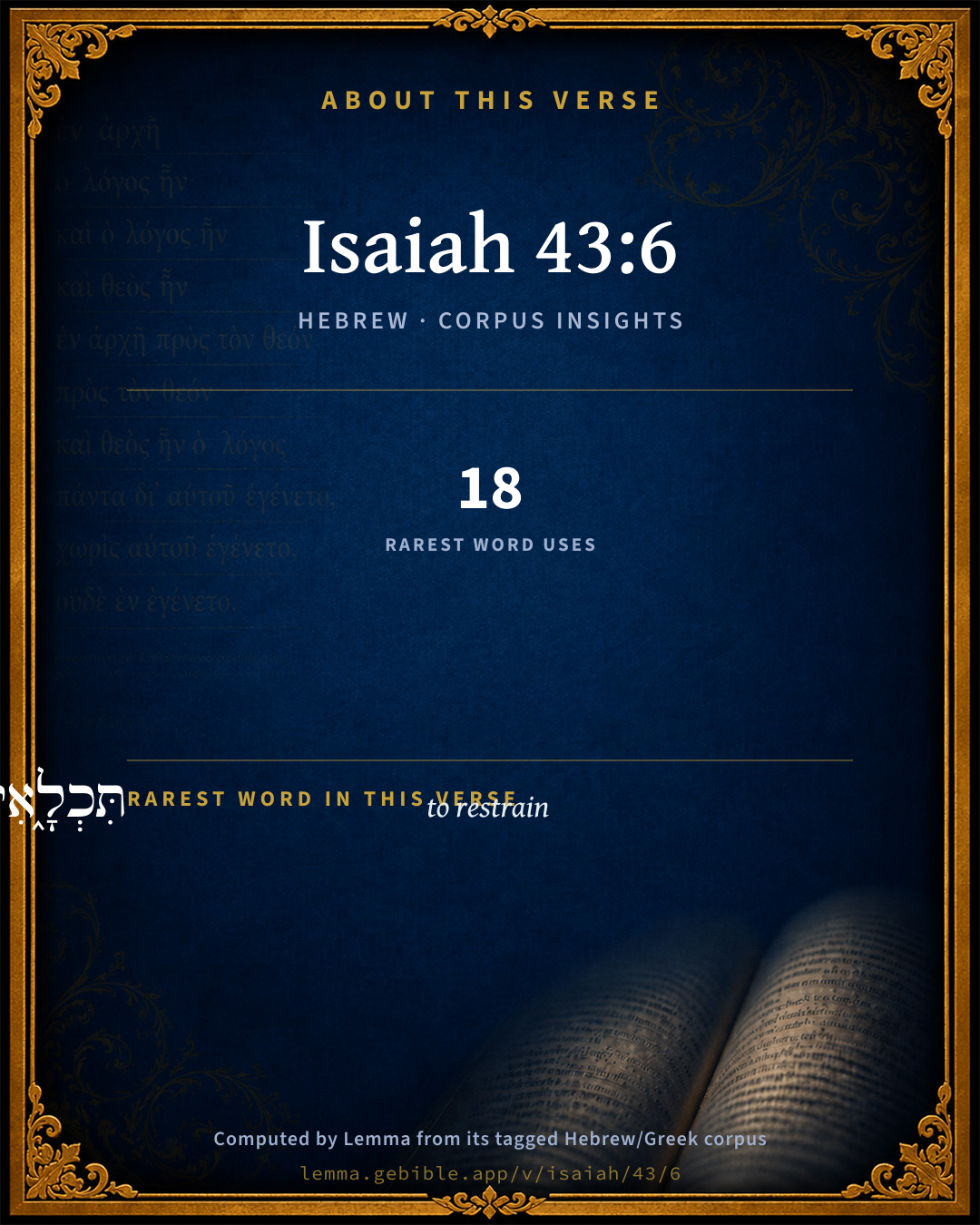
תִּכְלָ֑אִי
kâlâʼ
H3607
“to restrain”
Verb, Qal, Jussive, 2nd Person, Feminine, Singular
Part of Speech
Verb
Stem
Qal
Form
Jussive
Person
2nd Person
Gender
Feminine
Number
Singular
Full BDB Definition

Origin: a primitive root

TWOT: 980

to restrict, restrain, withhold, shut up, keep back, refrain, forbid - (Qal) - to shut up - to restrain - to withhold - (Niphal) to be restrained - (Piel) to finish
  1. אֹמַ֤ר ʼâmar H559 “to say” Verb, Qal, Imperfect, 1st Person, Common, Singular
  2. לַצָּפוֹן֙ tsâphôwn H6828 “to/for the · north” Preposition, Determined + Noun, Common, Feminine, Singular, Absolute
  3. תֵּ֔נִי nâthan H5414 “give” Verb, Qal, Imperative, 2nd Person, Feminine, Singular
  4. וּלְתֵימָ֖ן têymân H8486 “and · to/for · south” Conjunction + Preposition + Noun, Common, Feminine, Singular, Absolute
  5. אַל ʼal H408 “not” Particle, Negative
  6. הָבִ֤יאִי bôwʼ H935 “enter” Verb, Hiphil, Imperative, 2nd Person, Feminine, Singular
  7. בָנַי֙ bên H1121 “sons · my” Noun, Common, Masculine, Plural, Construct + Suffix, Personal, 1st Person, Common, Singular
  8. מֵרָח֔וֹק râchôwq H7350 “from · far” Preposition + Adjective, Adjective, Masculine, Singular, Absolute
  9. וּבְנוֹתַ֖י bath H1323 “and · daughters · my” Conjunction + Noun, Common, Feminine, Plural, Construct + Suffix, Personal, 1st Person, Common, Singular
  10. מִקְצֵ֥ה qâtseh H7097 “from · end of” Preposition + Noun, Common, Both, Singular, Construct
  11. הָאָֽרֶץ ʼerets H776 “the · land” Particle, Definite Article + Noun, Common, Both, Singular, Absolute

About this verse

These counts appear in no published source. They are computed here, from the morphology-tagged text and Lemma’s own curated glosses. What Lemma adds →

12
words
12
distinct lemmas
Prophets
section

Notable vocabulary

The rarest word here is תִּכְלָ֑אִי to restrain H3607 — appearing just 18 times in the whole Hebrew Bible.

Shared distinctive vocabulary

תִּכְלָ֑אִי to restrain H3607 occurs in 17 verses of the Hebrew Bible. Also found in:

Grammatical profile

  • 4 verbs
  • 6 nouns
  • 1 adjective
  • 1 particle

Verb forms

  • אֹמַ֤ר Qal · Imperfect
  • תֵּ֔נִי Qal · Imperative
  • תִּכְלָ֑אִי Qal · Jussive
  • הָבִ֤יאִי Hiphil · Imperative

Hebrew & Septuagint length

In English translation the verse runs 28 words from the Hebrew and 31 from the Septuagint (LXX English) — closely comparable.

A rough comparison of the two English renderings, which tokenize alike — not a word-level alignment.

Word counts can differ between the Hebrew and the Greek without any difference in meaning — e.g. the Hebrew direct-object marker אֵת has no separate Greek word, and Greek often adds the article ὁ.

Cross-references

9

Topical passages linked to Isaiah 43:6 in the Treasury of Scripture Knowledge — connected by theme and wording, ordered by reader-vote popularity; previews shown in the World English Bible.

  • 2 Corinthians 6:17–18 Therefore, "'Come out from among them, And be separate,' says the Lord, 'Touch no unclean thing. I will receive you.
  • Jeremiah 3:14 Return, backsliding children, says Yahweh; for I am a husband to you: and I will take you one of a city, and two of a family, and I will bring you to Zion:
  • Jeremiah 3:18–19 In those days the house of Judah shall walk with the house of Israel, and they shall come together out of the land of the north to the land that I gave for an inheritance to your fathers.
  • Hosea 1:10–11 Yet the number of the children of Israel will be as the sand of the sea, which can't be measured nor numbered; and it will come to pass that, in the place where it was said to them, 'You are not my people,' they will be called 'sons of the living God.'
  • Romans 9:7–8 Neither, because they are Abraham's seed, are they all children. But, "In Isaac will your seed be called."
  • Galatians 3:26–29 For you are all children of God, through faith in Christ Jesus.
  • Psalms 107:3 And gathered out of the lands, From the east and from the west, From the north and from the south.
  • Isaiah 18:7 In that time shall a present be brought to Yahweh of Hosts [from] a people tall and smooth, even from a people awesome from their beginning onward, a nation that measures out and treads down, whose land the rivers divide, to the place of the name of Yahweh of Hosts, Mount Zion.
  • Romans 9:25–26 As he says also in Hosea, "I will call them 'my people,' which were not my people; And her 'beloved,' who was not beloved."

Cross-references courtesy of OpenBible.info (CC BY 4.0).

Hebrew and Greek witnesses Masoretic Hebrew ↔ Greek Septuagint

The same verse in the two great witnesses to the Old Testament, shown verse-for-verse.

These are two independent witnesses, not word-aligned to each other, and the Septuagint is shown in lemma (dictionary) form.

Hebrew Isaiah 43:6 Masoretic · Westminster Leningrad Codex

אֹמַ֤ר לַצָּפוֹן֙ תֵּ֔נִי וּלְתֵימָ֖ן אַל תִּכְלָ֑אִי הָבִ֤יאִי בָנַי֙ מֵרָח֔וֹק וּבְנוֹתַ֖י מִקְצֵ֥ה הָאָֽרֶץ

I will tell the north, Give up; and to the south, Don't keep back; bring my sons from far, and my daughters from the end of the earth;

World English Bible · Public Domain

Greek LXX Isaiah 43:6 Septuagint · lemma form

εἶπον ὁ βορέας ἄγω καί ὁ λίψ μή κωλύω ἄγω ὁ υἱός ἐγώ ἀπό γῆ πόρρωθεν καί ὁ θυγάτηρ ἐγώ ἀπό ἄκρος ὁ γῆ

I will say to the north, Bring; and to the south, Keep not back; bring my sons from the land afar off, and my daughters from the ends of the earth;

LXX2012 (modern English Septuagint) · Public Domain

Hebrew: Westminster Leningrad Codex (CC BY 4.0). Greek: Septuagint (public domain); English from LXX2012 (modern English Septuagint) (Public Domain). How the Septuagint differs from the Hebrew →

Targum (Aramaic paraphrase)

1

The Targum is the ancient Jewish Aramaic paraphrase of the Hebrew Scriptures — an interpretive translation, not the Hebrew text itself. Onkelos (literal) and Pseudo-Jonathan (expansive) render the Torah, and Jonathan the Prophets. Coverage is partial: where no permissively-licensed English translation exists for a verse, only the Aramaic is shown. This is verse-level text, not a word-by-word alignment to the Hebrew.

  1. Targum Jonathan Prophets (Joshua–Malachi)
    אֲמַר לְצִפוּנָא אַיְתָא וּלְדָרוֹמָא לָא תְעַכֵּב אַיְתוּ בָנַי מֵרָחִיק וְגַלְוַת עַמִי מִסְיָפֵי אַרְעָא:

    I will say to the north, Bring; and to the south, Keep not back: bring my sons from afar, and the captivity of my people from the ends of the earth.

    Targum Jonathan — Aramaic: “Mikraot Gedolot” (public domain). English: “Sefaria Community Translation” (CC0 1.0 (public-domain dedication)); “London "Chaldee Paraphrase," 1871” (public domain). Text via Sefaria.

Commentary

Notes on Isaiah 43:6 from classic Christian and Jewish commentators (each source and its license shown beneath its notes). The classic Christian expositions comment on the surrounding passage and are grouped to its opening verse, so a note may address several verses; the Jewish commentaries on the Tanakh (Rashi and others) are per-verse, so they appear only where the commentator wrote on this verse.

Lemma curates 59 commentaries, every one of them public domain or Creative Commons licensed, each selected and text-cleaned for this edition rather than reprinted as found. About our sources →

Trapp's Complete Commentary

John Trapp

Isa 43:6 I will say to the north, Give up; and to the south, Keep not back: bring my sons from far, and my daughters from the ends of the earth;

Ver. 6. I will say to the north, Give up.] I will do it with a word of my mouth, Ipse dixit, et facta sunt. He himself said and is was done. {a}

Bring my sons from far, and my daughters.] That is, say some, my stronger and also weaker children, of what size or sex soever. Souls have no sexes.

{a} Oecolamp.

John Trapp, A Commentary or Exposition upon All the Books of the Old and New Testament (1647–1656) — public domain. Text from a community e-Sword module.

The Biblical Illustrator

Joseph S. Exell

Isa_43:6

I will say to the north, Give up

A double challenge

My intention is rather to utilise than to expound the text.

I. The first counsel is--GIVE UP.

1. With some of you it is imperative that you give up your prejudices. So have you mis-estimated true religion, that you have been accustomed to denounce it as cant, and to declaim the professors of it as hypocrites. Give up this blind bias, and give the Gospel a fair hearing. Should it turn out to be an imposture, you will at least be the better able to expose its fictions, after having studied its facts; but should it happen to be genuine and true, how ill will it be for you if you continue to despise it!

2. Give up in like manner your selfrighteousness.

3. Give up your sins. You cannot be saved from their consequence if you cling to their company.

4. Give up delays.

5. I might well say to some, give up quibbling. You have never yet come to the point with your own conscience. You have always been so deft at finding out knots and raising questions. What is the good of it? If you are never saved till you get every problem solved, you will never be saved at all. If a vessel were breaking in pieces on yonder shore, and the rocket apparatus had fired a rope into the middle of the vessel, would you not think the crew to be insane if they said to one another, We do not understand how it is that the rocket apparatus manages this? Oh but they just twist the rope round the mast, get a holdfast, and begin to swing themselves ashore.

6. Give up, you troubled ones; give up despondency; give up the thought that there is no hope; give up the suspicion that Jesus cannot forgive.

II. KEEP NOT BACK.

1. Keep not back from attending the means of grace.

2. When you do attend the house of the Lord, keep not back from a simple obedience of the Gospel.

3. When you have looked to Christ, keep not back from the mercyseat. You will begin to pray, perhaps, and find yourself stammering and trembling, but keep not back. Your old sins will half choke you in the recollection of them, but keep not back. If anybody saw you trying to pray they would say, What you, you old wretch, you trying to pray! Oh! but keep not back. Tis mercy calls you; come and pray.

4. When you have really trusted in Christ, and have learned to pray, then Keep not back from coming forward and making a profession of your faith in Jesus. Be prompt, if you would be precise in serving the Lord. I made haste, said David, and delayed not to keep Thy commandments.

5. To those who are saved, and have avowed their conversion, let me say, Keep not back from the Lords service. (C. H. Spurgeon.)

Bring My sons from far

The Church encouraged and exhorted

These words were spoken with the view of encouraging the Church: Fear not; for I am with thee: I will bring thy seed from the east, etc. The Lord loves His Church, and He loves to see her full of courage and confidence. He intends that His cause and kingdom shall prosper in the world. God has leisure.

I. THE LORD HAS CHILDREN FAR AWAY. Bring My sons from far, and My daughters from the ends of the earth

1. Some are far away in the matter of locality. They are not dwelling where the Gospel is preached; some of them are where roads have not as yet been made, and the commerce of civilisation has not come.

2. He also has many sons and daughters who are far off in a worse sense than this; they are far off as to character, as opposed to God as darkness is to light.

3. There are some who are far off in another sense; it is not so much character that puts them far off from God, as their not being in the way of hearing the Gospel. The kingdom of God has come nigh to most of you. But there are great numbers of persons, even in our own land, who are not in the way of hearing the Gospel. It happens, sometimes, that the more unlikely ones are the first to be converted.

4. The Lord Jesus Christ saves by His grace some who are far off in their own apprehension. It is not really true that they have been more sinful than others, but they think they have. So you see that the Lord has children who are far off from Him in several senses. What does a father or a mother do when the son is a long way off? Why, they like to hear all they can about him; especially, they love to hear from him,--to get a letter or a message from their boy himself. Well, now, our Heavenly Father watches over all His poor wandering children.

II. THE LORD IS BRINGING HOME SOME OF THESE FAR-OFF ONES. In our text He gives this command, Bring My sons from far. To whom is this command spoken? I think we shall be right if we say that it is spoken much in the same way in which the Lord said, Let there be light, and there was light. His fiat did the deed. So God says, Bring My sons from far, and therefore we may be sure that they will be brought to Him.

1. Providence obeys this command. Everything that happens in the mysterious movements of Providence is operating for the bringing in of His chosen. The world is all scaffolding; the Church of Christ is the true building. The like is true on a small scale. All manner of afflictions that come to men are sent to touch their conscience, and to bring them back to God.

2. This seems to me to be a charge given to all Gods people, as well as to providence, Bring My sons from far. You know Me; you love Me; so, look after My wandering children.

3. But this command would be of no force unless my text were a fiat. In consistency with this command, the Holy Spirit goes forth, in ways known to Himself, and He brings Gods sons from far, and His daughters from the ends of the earth.

III. THIS IS SAID FOR THE ENCOURAGEMENT OF GODS CHURCH.

1. This command has a very intimate connection with Christs Church. Our text says, Bring My sons and My daughters; but the 5 th verse says, I will bring thy seed. Then, saved souls are the seed of the Church as well as the sons and daughters of God. God puts a wonderful honour upon human instrumentality.

2. The Church of Christ has a further interest in these far-off sons and daughters from the fact that not only are they her seed, but they are coming home to her. They will help to strengthen the true Church of God.

3. These far-off ones, who are being brought home, will greatly help us when they do come. Read the 7 th verse: Even every one that is called by My name: for I have created him for My glory. That is the kind of converts that we want, those who are created for Gods glory. But, say some of the older friends, these young converts are so imprudent. Bless them! The Lord increase their imprudence, for that is one of the grandest things in the world when it is sanctified. It was most imprudent, on the part of the Apostle Paul, to go into those cities where he was stoned, and dragged out, and left for dead. It was most imprudent of him to lose all his reputation and his standing among men simply that he might preach Jesus Christ and Him crucified. But, sir, say the objectors, these young people, who are coming into the Church, do not know much. For the matter of that, we do not know much either, so we cannot keep them out on that ground. But they have zeal without knowledge. Yes, and it is quite possible to have knowledge without zeal. Both of those things are bad when alone; but if you have the knowledge, and they bring the zeal, you have only to trade with them a little in the way of barter to your mutual benefit. (C. H. Spurgeon.)

The Biblical Illustrator, edited by Joseph S. Exell (c. 1880s–1900s) — public domain. Text from a community e-Sword module.

The Preacher's Complete Homiletical Commentary

Joseph S. Exell (gen. ed.)

GOD’S CALL, OUR DIRECTORY

(Missionary Sermon.)

Isa_43:6. I will say to the south, Keep not back.

I. THE GRANDEUR OF THE SPEAKER. “I will say.” Who is He? The tone He assumes is that of one who need only speak to be heard, felt, and obeyed through all nature. It is He who is the great I AM; in comparison with whom the universe, with all its furniture, is as nothing, &c. Such an agent, such a friend, one so high and unspeakable, suffices you. But what will He say? or, what will He do? He promises to interest Himself in the conversions of the heathen, to bless our attempts for their conversion. How divinely pleasant and supporting! What more do you ask? But how will He speak? Not merely to the understanding, but to the conscience and heart; to all the secret springs of our nature; so as to make converts not to the sect of the Nazarenes, but to righteousness; not to Christianity only, but to Christ. Take two or three instances: St. Matthew, St. Paul. Are you converted to Christ? Without it, perish you must everlastingly (Mat_18:3, &c.) We see the grandeur of the speaker in these and all similar instances.

1. Does the ineffable JEHOVAH Himself promise to speak in this manner? Then, let us not regret the want of miracles to convert the heathen. The promise suffices alone. What greater miracle than conversion itself? Be content with these miracles, and expect them from Him who says, “I will say,” &c.

2. Does He promise His efficiency in converting the heathen, on the supposition that we become His organ? Then, let us no longer blame Him for the partial communication of the Gospel. As was said by the Israelites to Pharaoh, “The fault is in thine own people.” The Gospel is committed to us in trust.

You whisper, “But if success is thus indefinitely assured to Gospel missions, none can fail of effect.” I answer—

(1.) None do fail altogether.

(2.) The promise in the text, and every similar one, implies that, though God will command success, it shall be through a fit instrument.

(3.) God will work in a way worthy His infinite wisdom as well as goodness. Duty is our province; events of time, &c., belong to Him.

II. THE GLORY OF THE THING SPOKEN.

“I will say to the south.” No particular country is specified. Better so, than otherwise. “The south,” amongst the cardinal points of the world—the east, west, north. In those verses (5, 6) we have a grand promise of universal conversion.

“I will say to the south, Keep not back.” This implies—

1. Something divinely tender and affecting. “I am your Maker and Saviour—essential love; and wait upon you, to unite you to myself and to all the flower of being in the universe,” &c. Can infidelity propose a greater good to mankind than the Gospel?

2. He will say to the south as He says to us, “Bring out your dead, deliver up all your vices, keep none of them back.” The design of Jesus Christ is to redeem from all iniquity.

3. That there is a disposition in the south to do the contrary. They have not only the common corruption of our nature to contend with, but the prejudice of ages to keep them back from the Gospel. Then, every exertion on our part is necessary. The natural and strong predilection of the heathen for their own ancient system.

In this work nothing can be lost. Nothing less will be gained than eternal glory, for millions upon millions in the South Seas will be won.—T. Prutycross, A.M.: The Pulpit, vol. v. pp. 161–172.

The Preacher's Complete Homiletical Commentary (gen. ed. Joseph S. Exell; Funk & Wagnalls, c. 1892) — public domain (pre-1929). A full-Bible homiletical/sermon-outline anthology covering 65 of 66 books (2 John is absent from the source module). Text from a community e-Sword module.

Jamieson, Fausset & Brown

Robert Jamieson, A. R. Fausset & David Brown

Give up--namely, My people.

sons . . . daughters--The feminine joined to the masculine expresses the complete totality of anything (Zac 9:17).

Jamieson, Fausset & Brown — Commentary Critical and Explanatory on the Whole Bible (1871) — public domain (CC PDM 1.0). Text via the HelloAO Bible API.

Ellicott's Commentary for English Readers

(6) Bring my sons . . .—The words imply an escort of honour, given by the heathen nations to the returning exiles.

A Bible Commentary for English Readers, edited by Charles John Ellicott (1878–1897) — public domain. Text from a community e-Sword module.

The Cambridge Bible for Schools and Colleges

gen. ed. J. J. S. Perowne

6. my sons … my daughters] see ch. Isa_1:1. The individual Israelites are the children of the marriage between Jehovah and the nation (Hos_2:2; Hos_2:5; Eze_16:20, &c.).

The Cambridge Bible for Schools and Colleges (gen. ed. J. J. S. Perowne; Cambridge University Press, 1878–1918) — public domain. Text from a community e-Sword module.

John Gill's Exposition

I will say to the north, give up: and to the south, keep not back,.... That is, give up, and not retain, those that belong to the Lord; here the winds are spoken to by a personification; or the inhabitants of the northern and southern climates are called upon to deliver up the Lord's people to him, for whose sake the Gospel was sent into these parts, to find them out, and bring them home; by the "north" may be meant the Goths, Swedes, Muscovites, and those northern isles of ours, with others; and by the "south" the Egyptians, Africans, and Ethiopians. Manasseh ben Israel (h) thinks the passage is thus expressed, which he supposes refers to the universal gathering of the Jews in the latter day to the holy land; because Media, Persia, and China, lie to the east of it; Tartary and Scythia to the north; the kingdom of the Abyssines to the south; and Europe to the west:

bring my sons from far, and my daughters from the ends of the earth; such whom the Lord had predestinated to the adoption of children, and had taken into his family, and whom he regenerated by his Spirit and grace, of either sex; to whom he beareth the strongest love and affection, as a parent to his children; and of whom he takes the utmost care, so that not one shall be lost; let them be in ever so distant a part of the world, he will send his Gospel to them, his ministers after them, and his Spirit shall accompany them, to bring them to himself, his Son, and his churches. Manasseh, before mentioned, understands this of America, and of the Jews there; but may be much better applied to converted Gentiles there; for God has many sons and daughters in those parts.

(h) Spes Israelis, sect. 24. p. 76.

John Gill's Exposition of the Whole Bible (1746–1763) — public domain (CC PDM 1.0). Text via the HelloAO Bible API.

Albert Barnes' Notes on the Bible

I will say to the north, Give up - Give up my people, or restore them to their own land.

Bring my sons ... - Bring all my people from the distant lands where they have been driven in their dispersion. This is a beautiful passage. As if all lands were under the control of God, and he could at once command and they would obey, he calls on them to yield up his people to their own country. He issues a commandment which is heard in all quarters of the globe, and the scattered people of God come flocking again to their own land.

Albert Barnes' Notes on the Bible (1834–1885) — public domain. Text from a community e-Sword/MySword module.

Haydock's Catholic Bible Commentary

North. Assyria. --- South. Egypt. The captives returned from these countries under Cyrus, Alexander the Great, &c., so that before the coming of Christ, Judea was as well peopled as ever. (Calmet)

George Leo Haydock (1774–1849), Haydock's Catholic Family Bible and Commentary, 1859 edition — public domain. Excludes Psalms (Douay-Rheims chapter numbering differs from Protestant) and Deuterocanonical books (Catholic canon only).

Matthew Poole's English Annotations

Give up; thou who hast so long had and held my people in bondage, resign them to me, and permit them to return to their own land. He speaks either to the countries themselves by a prosopopoeia, or to the inhabitants of them. Bring my sons; do not only permit, but assist and further, their return.

Matthew Poole's English Annotations on the Holy Bible (1683–1685) — public domain. Text from a community e-Sword/MySword module.

The Pulpit Commentary

Bring my sons. The nations are called upon, not merely to "let Israel go," but to conduct and escort them from the places of their abode to their own country. (On the need of such escort, see Ezr_8:22, Ezr_8:31. On the actual furnishing of an escort in one case by a Persian king, see Neh_2:7, Neh_2:8)

The Pulpit Commentary (1880–1919), ed. H.D.M. Spence-Jones & Joseph S. Exell — public domain. Text from a community e-Sword module.

J. A. Alexander on Isaiah

Joseph Addison Alexander

“I will say to the north, Give, and to the south, Withhold not; let my sons come from far, and my daughters from the end of the earth.” This is a poetical amplification of the promise in the foregoing verse. As it was there declared that God would bring and gather the whole seed of Israel, so here he represents himself as calling on the north and the south to execute his purpose.

Joseph Addison Alexander, The Prophecies of Isaiah (1846–1847; New York: Scribner, 1870–1878) — public domain. Text from a community e-Sword module.

unfoldingWord translationNotes

Door43 World Missions Community

General Information:

Yahweh continues speaking to the people of Israel.

say to the north ... to the south

Yahweh speaks to "the north" and "the south" as if commanding the nations in those locations. (See: Personification and Metonymy)

my sons ... my daughters

Yahweh speaks of the people who belong to him as if they were his children. (See: Metaphor)

everyone who is called by my name

Here to be called by someone's name represents belonging to that person. This can be stated in active form. AT: "everyone whom I have called by my name" or "everyone who belongs to me" (See: Metonymy and Active or Passive)

whom I have formed, yes, whom I have made

Both of these mean the same thing and emphasize that it is God who made the people of Israel. (See: Doublet)

translationWords

hand

son

earth

name

create

glory

unfoldingWord translationNotes — © Distant Shores Media and the Door43 World Missions Community, licensed CC BY-SA 4.0. Source: git.door43.org/Door43/en_tn.

Rashi

Rabbi Shlomo Yitzchaki (Rashi)

I will say to the north wind, “Give the exiles who are in the north.”

and to the south which is a strong wind, “Do not refrain from blowing strongly to bring My exiles.” Similarly (Song 4: 16), “Awaken, O north wind, and come, O south wind.” Since the north wind is weak, it needs strengthening. Therefore, it is written, “Awaken,” “Give.” But concerning the south wind which does not need straightening, it is written, “Come,” as it is, and so, “Do not refrain.”

Rashi on the Tanakh — English translations: “The Judaica Press complete Tanach with Rashi, translated by A. J. Rosenberg” (CC BY 4.0); “Pentateuch with Rashi's commentary by M. Rosenbaum and A.M. Silbermann, 1929-1934” (public domain); “The Metsudah Tanach series, Lakewood, N.J” (CC BY 4.0); and “The Book of Joshua, Metsudah Publications, 1997” (CC BY 4.0). Text via Sefaria.

Ibn Ezra

Rabbi Abraham ibn Ezra

Give up my children.

ולתימן And to the south, תימן is derived from ימין the right.—He will bring them together from the four corners of the earth.

My sons, my daughters. The males and females.

Ibn Ezra on the Tanakh — English translations: “Sefaria Community Translation” (CC0 1.0 (public-domain dedication)); “Yalkut, Sifsei Chachomim Chumash, Metsudah Publications, 2009” (CC BY 4.0); and “Commentary of Ibn Ezra on Isaiah - trans. by M. Friedlander, 1873” (public domain). Text via Sefaria.

Lesson kit

Teaching starters — assembled from the data on this page, not authored interpretation. Every prompt links to the verse data it draws on. Edit before teaching.

Isaiah, in the Prophets, opens this verse with 12 words (12 distinct Hebrew lemmas). Its most distinctive word is kâlâʼ (“to restrain”). A historical commentator’s framing appears above. Read the whole chapter for the surrounding context.

Discussion questions

  1. What does “to restrain” (kâlâʼ) contribute to the verse as a whole?
  2. Genesis 8:2 shares the word «to restrain» with this verse. How do the two illuminate each other?
  3. These translations render this verse differently. What is at stake in choosing one wording over another?
  4. The verb «אֹמַ֤ר» is Qal Imperfect. How does its form color the action?
  5. Reading how Trapp's Complete Commentary and The Biblical Illustrator read this verse, where do the two commentators agree and where do they part?

Things to notice

Reading settings

Reading text

Shown beneath each verse's original-language words.

Old Testament
Old Testament edition

Read the OT as the Masoretic Hebrew (MT) or the Greek Septuagint (LXX).

English shown for the Greek Septuagint (in the Hebrew ↔ Greek comparison).

Comparing translations? Open the Compare panel on any verse page to stack up to four side by side.