

Numbers 23:13

Hebrew (Westminster Leningrad Codex) Numbers 23:13 appears in the Hebrew Old Testament. The text above is from the Westminster Leningrad Codex. Each word links to its Strong’s number, a concise gloss, and parsing drawn from the Open Scriptures Hebrew Bible morphology. Click any word for its full Brown-Driver-Briggs (BDB) entry.
Download image
Cite this verse

Numbers 23:13 (World English Bible). Public Domain. Lemma interlinear Bible study tool, https://lemma.gebible.app/v/numbers/23/13.

Show BibTeX & RIS
BibTeX
RIS
English Translation
Balak said to him, Please come with me to another place, from whence you may see them; you shall see but the utmost part of them, and shall not see them all: and curse me them from there.
World English Bible · Public Domain
Download a study sheet

One document with this verse’s original text, its word-by-word gloss line, the meaning frame, cross-references with their text, attributed commentary, and full source and license credits — printable, and it pastes into notes with its structure intact.

This verse Autodidact and up

Study sheet (.html) Plain text (.txt)

A passage Seminary Student

Up to 50 verses in one chapter. A passage sheet keeps up to 6 commentary sources and 12 cross-references per verse, in the order this page ranks them, and says so on the sheet whenever that leaves anything out. Ask for a single verse and you get the Autodidact verse sheet above.

Everything on this page stays free to read, with no account — the sheet is a download of what is already on screen, not access to it.

Want to remove ads? Support Godless Engineer
Compare translations 3

The same verse in 3 English versions, stacked beneath the original-language interlinear above. Click any original word for its lexicon entry.

Each is an independent rendering of the whole verse — the interlinear is not word-aligned to these translations.

Highlighted words mark where these versions differ — a whole-verse word diff, not a word-by-word alignment.

  • World English Bible Public Domain
    Balak said to him, Please come with me to another place, from whence you may see them; you shall see but the utmost part of them, and shall not see them all: and curse me them from there.
  • King James Version Public Domain
    And Balak said unto him, Come, I pray thee, with me unto another place, from whence thou mayest see them: thou shalt see but the utmost part of them, and shalt not see them all: and curse me them from thence.
  • unfoldingWord Literal Text CC BY-SA 4.0
    And Balak said to him, “Please come with me to another place from which you will see him. You will only see his edge, but all of him you will not see. And curse him for me from there.”

unfoldingWord Literal Text — © unfoldingWord, licensed CC BY-SA 4.0. Word-aligned USFM3 via Door43 (git.door43.org/unfoldingWord/en_ult).

Versions to compare (up to 4)

3 of 4 selected

Show all 18 translations

Every available English version of this verse, each an independent rendering of the whole verse.

  • World English Bible Public Domain
    Balak said to him, Please come with me to another place, from whence you may see them; you shall see but the utmost part of them, and shall not see them all: and curse me them from there.
  • Berean Standard Bible Public Domain
    Then Balak said to him, “Please come with me to another place where you can see them. You will only see the outskirts of their camp—not all of them. And from there, curse them for me.”
  • Majority Standard Bible Public Domain
    Then Balak said to him, “Please come with me to another place where you can see them. You will only see the outskirts of their camp—not all of them. And from there, curse them for me.”
  • King James Version Public Domain
    And Balak said unto him, Come, I pray thee, with me unto another place, from whence thou mayest see them: thou shalt see but the utmost part of them, and shalt not see them all: and curse me them from thence.
  • American Standard Version (1901) Public Domain
    And Balak said unto him, Come, I pray thee, with me unto another place, from whence thou mayest see them; thou shalt see but the utmost part of them, and shalt not see them all: and curse me them from thence.
  • Revised Version (1885) Public Domain
    And Balak said unto him, Come, I pray thee, with me unto another place, from whence thou mayest see them; thou shalt see but the utmost part of them, and shalt not see them all: and curse me them from thence.
  • Geneva Bible (1599) Public Domain
    And Balak sayde vnto him, Come, I pray thee, with mee vnto another place, whence thou mayest see them, and thou shalt see but the vtmost part of them, and shalt not see them all: therefore curse them out of that place for my sake.
  • Douay-Rheims (1899) Public Domain
    Balac therefore said: Come with me to another place from whence thou mayest see part of Israel, and canst not see them all: curse them from thence.
  • Young's Literal Translation Public Domain
    And Balak saith unto him, `Come, I pray thee, with me unto another place, whence thou dost see it, only its extremity thou dost see, and all of it thou dost not see, and pierce it for me thence;'
  • Literal Standard Version CC BY-SA 4.0
    And Balak says to him, “Come! Come to another place with me, from where you see it—you see only its extremity, and you do not see all of it, and pierce it for me there”;
  • Unlocked Literal Bible CC BY-SA 4.0
    So Balak said to him, “Please come with me to another place where you can see them. You will only see the nearest of them, not all of them. There you will curse them for me.”
  • unfoldingWord Literal Text CC BY-SA 4.0
    And Balak said to him, “Please come with me to another place from which you will see him. You will only see his edge, but all of him you will not see. And curse him for me from there.”
  • Darby Bible Public Domain
    And Balak said to him, Come, I pray thee, with me to another place, from whence thou wilt see them; thou shalt see only the extremity of them and shalt not see them all, and curse me them from thence.
  • World Messianic Bible Public Domain
    Balak said to him, “Please come with me to another place, where you may see them. You shall see just part of them, and shall not see them all. Curse them from there for me.”
  • Webster's Bible Public Domain
    And Balak said to him, Come, I pray thee, with me to another place, from whence thou mayest see them: thou shalt see but the utmost part of them, and shalt not see them all: and from thence curse them for me.
  • Free Bible Version CC BY-SA 4.0
    Then Balak said to him, “Please come with me to another place where you can see them. But you'll only see a part of their camp—you won't see all of them. You can curse them for me from there.”
  • Bible in Basic English Public Domain
    And Balak said to him, Come with me now into another place from which you will not be able to see them all, but only the outskirts of them; and you will send curses on them from there.
  • JPS Tanakh (1917) Public Domain
    And Balak said unto him: 'Come, I pray thee, with me unto another place, from whence thou mayest see them; thou shalt see but the utmost part of them, and shalt not see them all; and curse me them from thence.'

Literal Standard Version (2020), Covenant Press — licensed CC BY-SA 4.0. Text via the HelloAO Bible API (eBible.org). Unlocked Literal Bible (unfoldingWord) — licensed CC BY-SA 4.0. Text via the HelloAO Bible API (eBible.org). unfoldingWord Literal Text — © unfoldingWord, licensed CC BY-SA 4.0. Word-aligned USFM3 via Door43 (git.door43.org/unfoldingWord/en_ult). Free Bible Version, Dr. Jonathan Gallagher — licensed CC BY-SA 4.0. Text via the HelloAO Bible API (eBible.org).

Word by word

More ways to search: Search by grammar → Find every occurrence → Compare this word →

Practice this passage: Drill this verse → Learn its vocabulary →

וְקָבְנוֹ
qâbab
H6895
“and · curse · him”
Conjunction + Verb, Qal, Imperative, 2nd Person, Masculine, Singular + Suffix, Personal, 3rd Person, Masculine, Singular
Part of Speech
Conjunction + Verb
Stem
Qal
Form
Imperative
Person
2nd Person
Gender
Masculine
Number
Singular
Full BDB Definition

Origin: a primitive root

TWOT: 1978

to curse, utter a curse against - (Qal) to curse
  1. וַיֹּ֨אמֶר ʼâmar H559 “and · to say” Conjunction + Verb, Qal, Sequential Imperfect, 3rd Person, Masculine, Singular
  2. אֵלָ֜יו ʼêl H413 “to · him” Preposition + Suffix, Personal, 3rd Person, Masculine, Singular
  3. בָּלָ֗ק Bâlâq H1111 “Balak” Noun, Proper
  4. לך yâlak H3212 “walk” Verb, Qal, Imperative, 2nd Person, Masculine, Singular
  5. לְכָה hâlak H1980 “walk” Verb, Qal, Imperative, 2nd Person, Masculine, Singular + Suffix, h
  6. נָּ֨א yâlak H3212 “to walk” Particle, Interjection
  7. אִתִּ֜י ʼêth H854 “with · me” Preposition + Suffix, Personal, 1st Person, Common, Singular
  8. אֶל ʼêl H413 “to” Preposition
  9. מָק֤וֹם mâqôwm H4725 “place” Noun, Common, Masculine, Singular, Absolute
  10. אַחֵר֙ ʼachêr H312 “other” Adjective, Adjective, Masculine, Singular, Absolute
  11. אֲשֶׁ֣ר ʼăsher H834 “which” Particle, Relative
  12. תִּרְאֶ֣נּוּ râʼâh H7200 “to see · him” Verb, Qal, Imperfect, 2nd Person, Masculine, Singular + Suffix, Personal, 3rd Person, Masculine, Singular
  13. מִשָּׁ֔ם shâm H8033 “from · there” Preposition + Adverb
  14. אֶ֚פֶס ʼepheç H657 “end” Noun, Common, Masculine, Singular, Absolute
  15. קָצֵ֣הוּ qâtseh H7097 “end · his” Noun, Common, Both, Singular, Construct + Suffix, Personal, 3rd Person, Masculine, Singular
  16. תִרְאֶ֔ה râʼâh H7200 “to see” Verb, Qal, Imperfect, 2nd Person, Masculine, Singular
  17. וְכֻלּ֖וֹ kôl H3605 “and · all · his” Conjunction + Noun, Common, Masculine, Singular, Construct + Suffix, Personal, 3rd Person, Masculine, Singular
  18. לֹ֣א lôʼ H3808 “not” Particle, Negative
  19. תִרְאֶ֑ה râʼâh H7200 “to see” Verb, Qal, Imperfect, 2nd Person, Masculine, Singular
  20. מִשָּֽׁם shâm H8033 “from · there” Preposition + Adverb

About this verse

These counts appear in no published source. They are computed here, from the morphology-tagged text and Lemma’s own curated glosses. What Lemma adds →

22
words
16
distinct lemmas
Pentateuch
section

Notable vocabulary

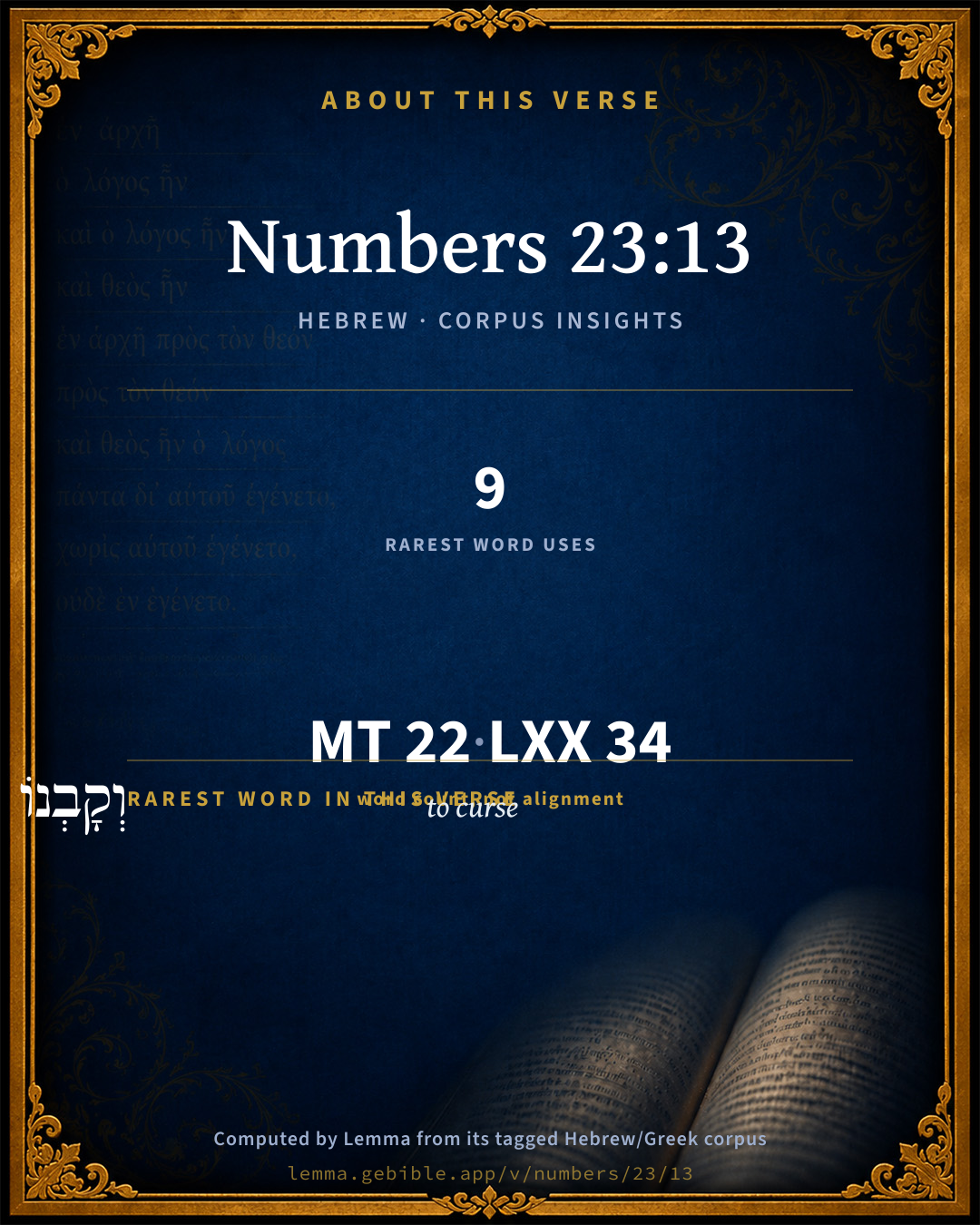
The rarest word here is וְקָבְנוֹ to curse H6895 — appearing just 9 times in the whole Hebrew Bible.

Shared distinctive vocabulary

וְקָבְנוֹ to curse H6895 occurs in 9 verses of the Hebrew Bible. Also found in:

Grammatical profile

  • 7 verbs
  • 5 nouns
  • 1 adjective
  • 4 prepositions
  • 2 adverbs
  • 3 particles

Verb forms

  • וַיֹּ֨אמֶר Qal · Sequential Imperfect
  • לך Qal · Imperative
  • לְכָה Qal · Imperative
  • תִּרְאֶ֣נּוּ Qal · Imperfect
  • תִרְאֶ֔ה Qal · Imperfect
  • תִרְאֶ֑ה Qal · Imperfect
  • וְקָבְנוֹ Qal · Imperative

Repetition

Words recur within this verse — often emphatic in Hebrew:

  • תִּרְאֶ֣נּוּ to see H7200 ×3
  • לך to walk H3212 ×2
  • מִשָּׁ֔ם there H8033 ×2
  • אֵלָ֜יו to H413 ×2

Hebrew & Septuagint length

In English translation the verse runs 38 words from the Hebrew and 40 from the Septuagint (LXX English) — closely comparable.

A rough comparison of the two English renderings, which tokenize alike — not a word-level alignment.

Word counts can differ between the Hebrew and the Greek without any difference in meaning — e.g. the Hebrew direct-object marker אֵת has no separate Greek word, and Greek often adds the article ὁ.

In the original languages it is 22 Hebrew tokens and 34 Greek tokens — but the two are counted differently (Hebrew bundles its prefixes and suffixes into one token; the Greek is in lemma form), so that isn’t a like-for-like length.

Cross-references

7

Topical passages linked to Numbers 23:13 in the Treasury of Scripture Knowledge — connected by theme and wording, ordered by reader-vote popularity; previews shown in the World English Bible.

  • Psalms 109:17 Yes, he loved cursing, and it came to him. He didn't delight in blessing, and it was far from him.
  • James 3:9–10 With it we bless our God and Father, and with it we curse men, who are made in the image of God.
  • Numbers 22:41 It happened in the morning, that Balak took Balaam, and brought him up into the high places of Baal; and he saw from there the utmost part of the people.
  • Joshua 24:9 Then Balak the son of Zippor, king of Moab, arose and fought against Israel: and he sent and called Balaam the son of Beor to curse you;
  • 1 Kings 20:23 The servants of the king of Syria said to him, Their god is a god of the hills; therefore they were stronger than we: but let us fight against them in the plain, and surely we shall be stronger than they.
  • 1 Kings 20:28 A man of God came near and spoke to the king of Israel, and said, Thus says Yahweh, Because the Syrians have said, Yahweh is a god of the hills, but he is not a god of the valleys; therefore will I deliver all this great multitude into your hand, and you shall know that I am Yahweh.
  • Micah 6:5 My people, remember now what Balak king of Moab devised, And what Balaam the son of Beor answered him from Shittim to Gilgal, That you may know the righteous acts of Yahweh."

Cross-references courtesy of OpenBible.info (CC BY 4.0).

Hebrew and Greek witnesses Masoretic Hebrew ↔ Greek Septuagint

The same verse in the two great witnesses to the Old Testament, shown verse-for-verse.

These are two independent witnesses, not word-aligned to each other, and the Septuagint is shown in lemma (dictionary) form.

Hebrew Numbers 23:13 Masoretic · Westminster Leningrad Codex

וַיֹּ֨אמֶר אֵלָ֜יו בָּלָ֗ק לך לְכָה נָּ֨א אִתִּ֜י אֶל מָק֤וֹם אַחֵר֙ אֲשֶׁ֣ר תִּרְאֶ֣נּוּ מִשָּׁ֔ם אֶ֚פֶס קָצֵ֣הוּ תִרְאֶ֔ה וְכֻלּ֖וֹ לֹ֣א תִרְאֶ֑ה וְקָבְנוֹ לִ֖י מִשָּֽׁם

Balak said to him, Please come with me to another place, from whence you may see them; you shall see but the utmost part of them, and shall not see them all: and curse me them from there.

World English Bible · Public Domain

Greek LXX Numbers 23:13 Septuagint · lemma form

καί εἶπον πρός αὐτός βαλακ δεῦρο ἔτι μετά ἐγώ εἰς τόπος ἄλλος ἐκ ὅς οὐ ὁράω αὐτός ἐκεῖθεν ἀλλά ἤ μέρος τις αὐτός ὁράω πᾶς δέ οὐ μή ὁράω καί καταἀράομαι ἐγώ αὐτός ἐκεῖθεν

And Balac said to him, Come yet with me to another place where you shall not see the people, but only you shall see a part of them, and shall not see them all; and curse me them from thence.

LXX2012 (modern English Septuagint) · Public Domain

On this verse, The Pulpit Commentary discusses the Septuagint’s reading. Read the note in Commentary ↓

Hebrew: Westminster Leningrad Codex (CC BY 4.0). Greek: Septuagint (public domain); English from LXX2012 (modern English Septuagint) (Public Domain). How the Septuagint differs from the Hebrew →

Targum (Aramaic paraphrase)

2

The Targum is the ancient Jewish Aramaic paraphrase of the Hebrew Scriptures — an interpretive translation, not the Hebrew text itself. Onkelos (literal) and Pseudo-Jonathan (expansive) render the Torah, and Jonathan the Prophets. Coverage is partial: where no permissively-licensed English translation exists for a verse, only the Aramaic is shown. This is verse-level text, not a word-by-word alignment to the Hebrew.

  1. Targum Onkelos Torah (Genesis–Deuteronomy)
    וַאֲמַר לֵיהּ בָּלָק אִיתָא כְעַן עִמִי לַאֲתַר אוֹחֲרָן דְתֶחֱזִנֵיהּ מִתַּמָן לְחוֹד קְצָתֵיהּ תֶּחֱזֵי וְכוּלֵיהּ לָא תֶחֱזֵי וּתְלוּטֵיהּ לִי מִתַּמָן

    (no public-domain English translation for this verse)

    Targum Onkelos — Aramaic: “Onkelos Genesis” (public domain); “Onkelos Exodus” (public domain); “Onkelos Leviticus” (public domain); “Onkelos Numbers” (public domain); “Onkelos Deuteronomy” (public domain). English: “Sefaria Community Translation” (CC0 1.0 (public-domain dedication)); “J.W. Etheridge. The Targums of Onkelos and Jonathan Ben Uzziel on the Pentateuch. London: Longmans, Green, 1862” (public domain). Text via Sefaria.

  2. Targum Pseudo-Jonathan Torah (Genesis–Deuteronomy)
    וַאֲמַר לֵיהּ בָּלָק אִיתָא כְדוֹן עִמִי לַאֲתַר חוֹרַן דְתַחֲמִינֵיהּ מִתַּמָן לְחוֹד מַשִׁרְיָתָא דִמְהַלֵךְ בְּקַצְתֵּיהּ תֶחֱמֵי וְכֻלְהוֹן מַשִׁרְיָיתוֹי לֵית אֶפְשַׁר דְתֶחֱמֵי וּתְלוֹטֵיהּ לִי מִתַּמָן

    And Balak said to him, Come now with me where thou mayest see him from another place. Thou shalt see only the camp that goeth in his rear, but not all their camps; and curse him for me there.

    Targum Pseudo-Jonathan — Aramaic: “Targum Jonathan on Genesis” (public domain); “Targum Jonathan on Exodus” (public domain); “Targum Jonathan on Leviticus” (public domain); “Targum Jonathan on Numbers” (public domain); “Targum Jonathan on Deuteronomy” (public domain). English: “The Targum of Jonathan ben Uzziel, trans. J. W. Etheridge, London, 1862” (public domain). Text via Sefaria.

Commentary

Notes on Numbers 23:13 from classic Christian and Jewish commentators (each source and its license shown beneath its notes). The classic Christian expositions comment on the surrounding passage and are grouped to its opening verse, so a note may address several verses; the Jewish commentaries on the Tanakh (Rashi and others) are per-verse, so they appear only where the commentator wrote on this verse.

Lemma curates 59 commentaries, every one of them public domain or Creative Commons licensed, each selected and text-cleaned for this edition rather than reprinted as found. About our sources →

Matthew Henry's Commentary

Here is, I. Preparation made the second time, as before, for the cursing of Israel. 1. The place is changed, Num 23:13. Balak fancied that Balaam, having so full a prospect of the whole camp of Israel, from the top of the rocks (Num 23:9), was either so enamoured with the beauty of it that he would not curse them or so affrighted with the terror of it that he durst not; and therefore he would bring him to another place, form which he might see only some part of them, which would appear more despicable, and that part at least which would lie in view he hoped he might obtain leave to curse, and so by degrees he should get ground against them, intending, no doubt, if he had gained this point, to make his attack on that part of the camp of Israel which Balaam now had in his eye, and into which he was to throw the fireballs of his curses. See how restless and unwearied the church's enemies are in their malicious attempts to ruin it; they leave no stone unturned, no project untried, to compass it. O that we were as full of contrivance and resolution in prosecuting good designs for the glory of God! 2. The sacrifices are repeated, new altars are built, a bullock and a ram offered on every altar, and Balak attends his sacrifice as closely as ever, Num 23:14, Num 23:15. Were we thus earnest to obtain the blessing as Balak was to procure a curse (designedly upon Israel, but really upon himself and his people), we should not grudge the return both of the charge and of the labour of religious exercises. 3. Balaam renews his attendance on God, and God meets him the second time, and puts another word into his mouth, not to reverse the former, but to ratify it, Num 23:16, Num 23:17. If God said not to Balaam, Seek in vain, much less will he say so to any of the seed of Jacob, who shall surely find him, not only as Balaam, their instructor and oracle, but their bountiful rewarder. When Balaam returned Balak was impatient to know what message he had: "What hath the Lord spoken? Are there any better tidings yet, any hopes of speeding?" This should be our enquiry when we come to hear the word of God. See Jer 23:35.

II. A second conversion of the curse into a blessing by the overruling power of God; and this blessing is both larger and stronger than the former, and quite cuts off all hopes of altering it. Balak having been so forward to ask what the Lord had spoken (Num 23:17), Balaam now addresses himself particularly to him (Num 23:18): Rise up, Balak, and hear. It was a message from God that he had to deliver, and it is required of Balak, though a king, that he attend (hear and hearken, with a close application of mind, let not a word slip), and also that he attend with reverence: Rise up, and hear. His successor Eglon, when he was to receive a message from God, rose out of his seat, Jdg 3:20.

1. Two things Balaam in this discourse informs Balak of, sorely to his grief and disappointment: -

(1.) That he had no reason to hope that he should ruin Israel.

[1.] It would be to no purpose to attempt to ruin them, and he would deceive himself if he expected it, for three reasons: -

First, Because God is unchangeable: God is not a man that he should lie, Num 23:19. Men change their minds, and therefore break their words; they lie, because they repent. But God does neither. He never changes his mind, and therefore never recalls his promise. Balaam had owned (Num 23:8) that he could not alter God's counsel, and thence he infers here that God himself would not alter it; such is the imperfection of man, and such the perfection of God. It is impossible for God to lie, Heb 6:18. And, when in scripture he is said to repent, it is not meant of any change of his mind (for he is in one mind, and who can turn him?) but only of the change of his way. This is a great truth, that with God there is no variableness nor shadow of turning. Now here, 1. He appeals to Balak himself concerning it: "Hath he said, and shall he not do it? Said it in his own purpose, and shall he not perform it in his providence, according to the counsel of his will? Hath he spoken in his word, in his promise, and shall he not make it good? Can we think otherwise of God than that he is unchangeably one with himself and true to his word? All his decrees are unalterable, and all his promises inviolable." 2. He applies this general truth to the case in hand (Num 23:20): He hath blessed and I cannot reverse it, that is, "I cannot prevail with him to reverse it." Israel were of old a blessed people, a seed that the Lord had blessed; the blessing of Abraham came upon them; they were born under the blessing of the covenant, and born to the blessing of Canaan, and therefore they could not be cursed, unless you could suppose that the God of eternal truth should break his word, and become false to himself and his people.

Secondly, Because Israel are at present unblamable: he has not beheld iniquity in Jacob, Num 23:21. Not but that there was iniquity in Jacob, and God saw it; but, 1. There was not such a degree of iniquity as might provoke God to abandon them and give them up to ruin. As bad as they were, they were not so bad as this. 2. There was no idolatry among them, which is in a particular manner called iniquity and perverseness; we have found nothing of that kind in Israel since the golden calf, and therefore, though they were in other instances very provoking, yet God would not cast them off. Balaam knew that nothing would separate between them and God but sin. While God saw no reigning sin among them, he would send no destroying curse among them; and therefore, as long as they kept in with God, he despaired of ever doing them any mischief. Note, While we keep from sin we keep from harm. Some give another sense of those words; they read it thus: He has not beheld wrong offered to Jacob, nor will he see any grievance done to Israel, that is, "He has not nor will he permit it, or allow it; he will not see Israel injured, but he will right them, and avenge their quarrel." Note, God will not bear to see any injury done to his church and people; for what is done against them he takes as done against himself, and will reckon for it accordingly.

Thirdly, Because the power of both was irresistible. He shows Balak that there was no contending with them, it was to no purpose to attempt it; for, 1. They had the presence of God with them: "The Lord his God is with him in a particular manner, and not provoked to withdraw from him." 2. They had the joy of that presence, and were always made to triumph in it: The shout or alarm of a king is among them. They shout against their enemies, as sure of victory and success, glorying continually in God as their King and conqueror for them. 3. They had had the experience of the benefit of God's presence with them, and his power engaged for them; for God brought them out of Egypt, Num 23:22. The power which had done that could never be restrained, never resisted; and, having begun so gloriously, he would no doubt finish gloriously. 4. While they had God's presence with them they had the strength of a unicorn, able to make head against all that opposed them. See Num 24:8. Such is the strength which the God of Israel gives unto his people.

[2.] From all this he infers that it was to no purpose for him to think of doing them a mischief by all the arts he could use, Num 23:23. First, He owns himself baffled. Surely there is no enchantment against Jacob so as to prevail. The curses of hell can never take place against the blessings of heaven. Not but that attempts of this kind would be made, but they would certainly be fruitless and ineffectual. Some observe that Jacob denotes the church low and afflicted, Israel denotes it prosperous and advanced; but be the church high or low, be her friends few or many, let second causes smile or frown, it comes all to one: no weapon formed against it shall prosper. Note, God easily can, and certainly will, baffle and disappoint all the devices and designs of the powers of darkness against his church, so that they shall not prevail to destroy it. Secondly, He foresees that this would be remembered in time to come. According to this time, that is, with reference to this we are now about, it shall be said concerning Jacob and Israel, and said by them, What hath God wrought! What great things hath God done for his people! It shall be said with wonder, joy, and thankfulness, and a challenge to the neighbouring nations to produce any similar instances of the care of their gods for them. Note, The defeating of the designs of the church's enemies ought to be had in everlasting remembrance to the glory of God. There is none like unto the God of Jeshurun. What Balaam says here concerning the pre-eminence of the God of Israel above all the gods of the Gentiles perhaps Moses refers to when he says (Deu 32:31), Their rock is not as our rock, even our enemies themselves being judges, Balaam particularly. Balak therefore has no hopes of ruining Israel. But,

(2.) Balaam shows him that he had more reason to fear being ruined by them, for they were likely to make bloody work among his neighbours; and, if he and his country escaped, it was not because he was too great for them to meddle with, but because he fell not within their commission Num 23:24. Behold, and tremble; the people that now have lain for some time closely encamped do but repose themselves for a while like a lion couchant, but shortly they shall rise up as a great lion, a lion rampant, that shall not lie down till he eat of the prey, and drink the blood of the slain. This seems to point at the victories he foresaw they would obtain over the Canaanites, that they would never lay down their arms till they had made a complete conquest of the land they had now in view; and, when his neighbour's house was on fire, he had reason to think his own in danger.

2. Now what was the issue of this disappointment?

(1.) Balak and Balaam were both of them sick of the cause. [1.] Balak is now willing to have his conjurer silenced. Since he cannot say what he would have him, he wishes him to say nothing: "Neither curse them at all nor bless them at all, Num 23:25. If thous canst not curse them, I beseech thee not to bless them. If thou canst no assist and encourage my forces, yet do not oppose and dispirit them" Note, God can make those that depart from him weary of the multitude of their counsels, Isa 47:13; Isa 57:10. [2.] Balaam is still willing to own himself overruled, and appeals to what he had said in the beginning of this enterprise (Num 22:38): All that the Lord speaketh, that I must do, Num 23:26. This sows, First, In general, that the way of man is not in himself; there are many devices in man's heart, but God's counsels shall stand. Secondly, In particular, that, as no weapon formed against the church shall prosper, so every tongue that rises against her in judgment god will control and condemn, Isa 54:17.

(2.) Yet they resolve to make another attempt. They think it scorn to be baffled, and therefore pursue the design, though it be only to their further confusion. And now the third time, [1.] They change the place. Balak is at last convinced that it is not Balaam's fault, on whom, before, he had laid the blame, but that really he was under a divine check, and therefore now he hopes to bring him to a place whence God might at least permit him to curse them, v. 27. Probably he and Balaam were the more encouraged thus to repeat their attempt because God had the second time allowed Balaam to go, though he had forbidden him the first time. Since by repeated trials they had carried that point, they hope in like manner to carry this. Thus because sinners are borne with, and sentence against their evil works is not executed speedily, their hearts are the more fully set in them to do evil. The place to which Balak now took Balaam was the top of Peor, the most eminent high place in all his country, where, it is probable, Baal was worshipped, and it was thence called Baal-peor. He chose this place with a hope, either, First, That it being the residence (as he fancied) of Baal, the god of Moab, Jehovah the God of Israel would not, or could not, come hither to hinder the operation; or, Secondly, That, it being a place acceptable to his god, it would be so to the Lord, and there he would be brought into a good humour. Such idle conceits have foolish men of God, and so vain are their imaginations concerning him. Thus the Syrians fancied the Lord to be God of the hills, but not of the valleys (Kg1 20:28), as if he were more powerful in one place than he is in every place. [2.] They repeat their sacrifice, seven bullocks and seven rams, upon seven altars, v. 29, 30. Thus do they persevere in their expensive oblations, though they had no promise on which to build their hopes of speeding. Let not us therefore, who have a promise that the vision at the end shall speak and not lie, be discouraged by delays, but continue instant in prayer, and not faint, Luk 18:1.

Matthew Henry's Commentary on the Whole Bible (1708–1710) — public domain (CC PDM 1.0). Text via the HelloAO Bible API.

Trapp's Complete Commentary

John Trapp

Num 23:13 And Balak said unto him, Come, I pray thee, with me unto another place, from whence thou mayest see them: thou shalt see but the utmost part of them, and shalt not see them all: and curse me them from thence.

Ver. 13. From whence thou mayest see them.] And over-look them, as they say witches do, Bασκαινειν quasi φαεσι καινειν; Nescio quis teneros, &c. In Hebrew the same word signifies both an eye and a fountain; to show, that from the eye, as a fountain, flows both sin and misery.

John Trapp, A Commentary or Exposition upon All the Books of the Old and New Testament (1647–1656) — public domain. Text from a community e-Sword module.

Whedon's Commentary on the Bible

Daniel D. Whedon

THE SECOND PROPHECY, Num_23:13-26.

13. But the utmost part — Balak attributes the failure of Balaam’s first effort to the fact that the magnitude of Israel’s encampment, taken in at one sweep of his eyes, had influenced his mind and changed the curse to a blessing. He is now taken to a place from which only one edge of the camp can be seen.

Daniel D. Whedon (gen. ed.), Commentary on the Old and New Testaments (1874–1909) — public domain. Text from a community e-Sword module.

Tyndale Open Study Notes

Tyndale Open Resources

23:13-26 Balak hoped that he would get different results if he changed the venue. The precise location of the plateau of Zophim on Pisgah Peak is unknown, though Pisgah is part of the ridgeline that overlooks the plains of Moab (Deut 34:1) in the vicinity of Bamoth-baal (Num 22:41) and Mount Peor (23:28).

Tyndale Open Study Notes — © Tyndale Open Resources, licensed CC BY-SA 4.0. Text via the HelloAO Bible API.

Jamieson, Fausset & Brown

Robert Jamieson, A. R. Fausset & David Brown

Come, . . . with me unto another place, from whence thou mayest see them--Surprised and disappointed at this unexpected eulogy on Israel, Balak hoped that, if seen from a different point of observation, the prophet would give utterance to different feelings; and so, having made the same solemn preparations, Balaam retired, as before, to wait the divine afflatus.

Jamieson, Fausset & Brown — Commentary Critical and Explanatory on the Whole Bible (1871) — public domain (CC PDM 1.0). Text via the HelloAO Bible API.

Adam Clarke's Commentary

Verse 13. Thou shalt see but the utmost part of them] Balak thought that the sight of such an immense camp had intimidated Balaam, and this he might gather from what he said in the tenth verse: Who can count the dust of Jacob, c. he thought therefore that he might get Balaam to curse them in detached parties, till the whole camp should be devoted to destruction by successive execrations.

Adam Clarke's Commentary on the Bible (1810–1826) — public domain. Text from a community e-Sword/MySword module.

Ellicott's Commentary for English Readers

(13) Thou shalt see but the utmost part of them . . . —If this rendering be correct, it strongly confirms that interpretation of Num_22:41 according to which Balaam saw the whole host of Israel from Bamoth-Baal. The words may, however, be rendered thus: Thou seest (i.e., here) but the utmost part of them, and thou dost not see them all. If the interpretation of Num_22:41 is adopted, which restricts the view from Bamoth-Baal to the extremity of the host of Israel, the meaning of this verse would seem to be that if Balaam could obtain a full view of the entire army he would not only perceive the ground which existed for Balak’s alarm, but would be induced to put forth more strenuous efforts to deliver him from so formidable an invasion. On the other hand, if that interpretation of Num_22:41 be adopted, which implies that from Bamoth-Baal Balaam had a view of the whole of the host of Israel from one extremity of their camps to the other, the meaning of this verse would be that although the sight of so vast and orderly a mass produced so powerful an effect upon Balaam that he was unable to utter the curses which he had desired to pronounce upon Israel, such an effect would not be equally likely to be produced if only a portion of the camps was visible at the same time.

A Bible Commentary for English Readers, edited by Charles John Ellicott (1878–1897) — public domain. Text from a community e-Sword module.

The Cambridge Bible for Schools and Colleges

gen. ed. J. J. S. Perowne

13. unto another place] It was a not infrequent practice with soothsayers, if they were unable to obtain an omen according to their wishes, to try several times in hopes of better success. Balak thought that if Balaam went to a more favourable spot, Jehovah might be persuaded to change His mind!

thou shalt see but the extremity of them … not see them all] The words are difficult, because Balaam has already seen only the end of the Israelite host; see Num_22:41. If the words are genuine, they may perhaps mean that Balaam would be taken to a spot whence he would still be able to see only a small part of them, but if that failed, he could finally go to a place whence he could see them all. But many writers assign the words to an editor.

The Cambridge Bible for Schools and Colleges (gen. ed. J. J. S. Perowne; Cambridge University Press, 1878–1918) — public domain. Text from a community e-Sword module.

John Gill's Exposition

And Balak said unto him,.... Seemingly satisfied with his answer, however, he could not help himself, and was willing to make the best of him he could, and try what he could do with him another time and elsewhere:

come, I pray thee, with me unto another place, from whence thou mayest see them; for he had a mighty notion that both the sight of the people, and the place from whence they were seen, would greatly contribute to answer the end he had in view, cursing the people:

thou shall see but the utmost part of them, and shalt not see them all; for he thought, either that he was so charmed with so glorious a sight as the regular encampment of such a body of people was, that he could not find in his heart to curse them; or that he was so terrified at the sight of such a vast number of people, that he dared not attempt it; and therefore Balak proposed to have him to a place where he could only see a part of them and not the whole:

and curse me them from thence: that part, hoping that when he had cursed them he would gradually go on till he had cursed them all: but there is this objection to our version, and the sense it directs to, that Balaam had been brought to a place already, where he had seen the utmost part of the people, Num 22:41 wherefore some read (h) the middle clause in a parenthesis, and in the past tense "(for thou hast seen but the utmost part of them, and hast not seen them all)"; and therefore would have him come to a place where he might see them all, and curse them from thence.

(h) So Vatablus.

John Gill's Exposition of the Whole Bible (1746–1763) — public domain (CC PDM 1.0). Text via the HelloAO Bible API.

Albert Barnes' Notes on the Bible

Balak seems to hope that the prophet’s words in Num 23:10 reflected the impression conveyed by the scene before him at the moment of the augury; and so that the sight of a mere few straggling Israelites in the utmost part of the camp might induce a different estimate of their resources and prospects.

Albert Barnes' Notes on the Bible (1834–1885) — public domain. Text from a community e-Sword/MySword module.

Haydock's Catholic Bible Commentary

Thence. He has a mind to try a new experiment. We have observed, that the object of malediction was to be in view, chap. xxii. 41. But Balac, supposing perhaps that the multitude made too deep an impression upon the soothsayer, judged it expedient to place him in another situation, where he might see only a part of Israel. Some, however, imagine that he had only seen a fourth part, or the uttermost part of the people, who lay nearest to him before; (ver. 10, and chap. xxii. 41) and hence, would have him to take now a distinct view of the whole; and, in this sense, the Samaritan and Glassius translate from whence, &c., thus, "for thou hast seen only part of Israel, and couldst not see them all." (Calmet) --- By a similar superstition, the Syrians imagined that the God of Israel was a God of the hills, and that they could more easily conquer his people on the plain country, 3 Kings xx. 23. (Menochius)

George Leo Haydock (1774–1849), Haydock's Catholic Family Bible and Commentary, 1859 edition — public domain. Excludes Psalms (Douay-Rheims chapter numbering differs from Protestant) and Deuterocanonical books (Catholic canon only).

Matthew Poole's English Annotations

He thought the sight of the people necessary both to excite Balaam’s passions, and to strengthen and direct his conjurations; but he would now have him see but a part of the people, and not all, because the sight of all of them might dismay and discourage him, and, as it did before, raise his fancy to an admiration of the multitude and of the felicity of the people, Num 23:9,10.

Matthew Poole's English Annotations on the Holy Bible (1683–1685) — public domain. Text from a community e-Sword/MySword module.

The Pulpit Commentary

Come... unto another place. Balak attributed the miscarriage of his enterprise thus far to something inauspicious in the locality. Thou shalt see but the utmost part of them harti Whxq spa. Both the meaning of the nouns and the tense of the verb are disputed. By some "e ephes katsehu (the end of the last of them) is held equivalent to "the whole of them," which seems to contradict the next clause even if defensible in itself. The ordinary rendering is favoured by the Septuagint (all h merov ti autou oqei ) and by the Targums. On the other hand, some would read the verb in the present tense, and understand Balak"s words to refer to the place they were leaving. This is in accordance with the statement in Num_22:41, and it would certainly seem as if Balak and Balaam moved each time nearer to that encampment which was for different masons the center of attraction to them both.

Vers. 13-26. The second prophecy. Balak"s state of mind.

Balaam has cursed where he was expected to bless, he has said things very hard to listen to and keep presence of mind, but Balak has not by any means lost faith in Balaam and his resources. He rather takes the blame to himself than to Balaam. If there be wrath in his heart with the speaker, who, instead of cursing Israel, has blessed it altogether, he manages to conceal the wrath. He cannot afford to quarrel with Balaam, the only known resource he has. He suggests, therefore, as the great cause of failure that the place of cursing has been badly chosen. Remove the cause, and the effect will disappear. Let the prophet come away from the top of the rocks to where his mind will not be filled with the presence of this bewildering multitude; and Balaam, whatever his private thoughts, consents to the experiment. It is the way of the blind, deluded world; all reasons for failure are accepted and acted on save the right one. Balak cannot yet see, will not see for a while, perhaps will never really see, that there is no place on earth where such requests can be granted. He is showing himself now, as Balaam had done before, unsatisfied with the first intimation. Balaam had been told plainly at the very first that Israel was blessed, yet here he is dabbling in superstitions, in enchantments and divinations, with no clear perception of the nature and character of God. Thus, all the narrative through, we see what egregious and scarcely credible blunders men make when they are left to themselves to make discoveries of God. What a proof that revelation in all the large extent of its Scriptural fullness is absolutely indispensable! God must not only give us the truth concerning himself, and the proper relation of men to him, but must also open our hearts and our eyes, and give us light whereby we may see the truth already given. How constantly we should remember the inevitable ignorance of those to whom gospel truth, light, and perceptive power have not yet penetrated! Take pity on them and help them such darkened minds as you think of Balak stumbling from one blunder to another, from one discredited resource to another, from one disappointment to another, only to find at last that all his schemes are vanity. And now we advance to consider the second prophecy. It is not only spoken in Balak"s hearing, but is a direct appeal to himself. We are to imagine Balak standing with strained and eager look, already full of excitement and expectation, before ever a word is spoken. But this is not enough; he must be solemnly exhorted to attention.

"Things are about to be said directly concerning you, and it may be that when you have heard them, and allowed them to have full effect on your mind, you will cease from these foolish attacks on the established purpose and counsel of Jehovah." That this call upon Balak for attention was not a superfluous one is shown by the fact, that after hearing the prophecy he nevertheless made a third attempt, modified indeed, but still such as to show that he had not taken in the prophecy to anything like its full extent. We know how the Scriptures abound in expressions of which "He that hath ears to hear, let him hear," and "Verily, verily, I say unto you," are representative. Such expressions do not make truth any truer, but they do throw on us a great responsibility, and involve us in unquestionable blame for neglect of the things which belong to our salvation.

I THE PROPHECY BEGINS BY CORRECTING BALAK"S FATAL MISAPPREHENSIONS CONCERNING GOD. Balak having failed the first time he tried Balaam, succeeded the second; having failed the first time he tries Jehovah, it is natural for him to think he may succeed the second. Hitherto he has known only the idols of Moab, and these of course only in such aspects as the priests presented them. As the priests were, so were the gods; and Balak, having experienced Balaam"s final compliance, might excusably argue from Balaam to that Being whom he took to be Balaam"s God. And now there falls out of a holier sphere some unexpected and much-needed knowledge for poor Balak, whose chief experience had been of equivocating, vacillating, unstable men. "God is not what you think him to he; he is true and steadfast, neither changing his purposes nor failing in them." Notice the way in which this all-important statement is put. God puts himself in contrast with his fallen, unfaithful, and disgraced creature, man. "God is not a man;" and, as if to emphasize this matter, he speaks the word of truth concerning his own truth through lying lips. "Men change their minds, and therefore break their words; they lie because they repent." What a hint then for us all to change from deceitful hearts to sincere ones, from lying lips to truthful ones, from vain purposes that must some day be relinquished, engendered as they are in our own selfishness and folly, to such purposes as are inspired by the unchanging God himself! Changing thus, we shall get into a state partaking somewhat of God"s own steadfastness; or, rather, the only change will be from good to better and better to best. Man may become such that it shall no longer be his reproach that he lies, either carelessly, ignorantly, or maliciously, and repents, playing the weathercock to every wind that blows. God, we may be sure, desires the day to come when, instead of finding in man this awful and humiliating contrast to himself, he will rather be able to say, "Man is now true, clear from all belief in lies, from all deception and evasion, and steadfast in all the ways of righteousness, holiness, and love.

II THE PROPHECY GOES ON TO REVEAL STILL MORE OF ISRAEL"S STRENGTH. The unchangeable God, having purposed to bless Israel, must go on blessing them. lie does it in word continually through the great official channel, (Num_6:22-27) and now it is Balaam"s lot (strange expositor of the Divine goodness!) to show clearly that the blessing of God is anything but a nominal or a secondary one. Much has been done to show this in the first prophecy, but a great deal more is done in the second. God has not only put Israel by themselves and made them into this vast multitude, which was a great deal to do, for Jacob"s posterity is likened to the dust in number; but now through Balaam he shows quality as well as quantity. The people are not only separated outwardly and visibly, but separated still more by some great peculiarity in their inward life. Their vast numbers are but the most easily perceptible result of the vigorous, abundant vitality within. When Balaam got his first glance from the top of the rocks he saw the most obvious fruit of Israel"s peculiar relation to God. Now in the second survey he comes as it were nearer, and sees the root and trunk and branches, the sap and substance whence these fruits take their origin.

1. There is the righteousness of the people. God, who searches into all secrets, and to whom the darkness and the light are both alike, has beheld no iniquity in Jacob, no wrong in Israel; that is to say, putting the thing plainly, there was no iniquity in Jacob. And though it seems a strange thing to say, considering God"s late dealings with the people, we feel at once that it must not only be true, but very important, or it would not be put so prominently forward. God looks upon the ideal Israel which lies yet undeveloped in the midst of all the unbelief and carnality of the present generation. Though at the present moment any dozen Israelites might be as debased as any dozen Moabites, yet in Israel there was a seed of holiness, a sure beginning of the perfect and the blessed, which was not to be found anywhere in Moab. God, bear in mind, sees what we cannot see. God is not a man, that he should lie; neither is he a man that his eye should be stopped by the surface and first appearance of things. Jesus sought a solid ground for the future of his saving work in the world, and he found it not amidst the world"s wisdom, but where we assuredly should never have looked among the stumbling, ignorant disciples whom he gathered in Galilee. Looking with other eyes than men, and where proud men never look, he finds what they never find.

2. There is the presence of God with them, and that not only as God, but as King. "When you attack Israel, O Balak, you attack the kingdom of God. You, the king of Moab, appeal to the King of Israel to curse his own people." His sanctuary is also his throne, and where he is worshipped, there he also rules. Every act of worship is also an expression of loyalty. Balak described Israel as a people come out of Egypt; (Num_22:5) he is now to learn that they came because they were brought; because that very God brought them whose curse he had so laboriously and patiently sought to invoke. "Does it stand to reason, O Balak, that God can have brought them so far now to leave them for the sake of your sacrifices and Balaam"s enchantments?" Thus also we may gather that as God in all the fullness of his being, Father, Son, and Spirit, has so long given his indubitable presence to his Church, he will assuredly for this very reason continue it to the end. God indeed looks on that Church in its actual coldness, indolence, and carnality, and the Israel of God to-day is quite as far away from the fullness of its privileges, the perfection of its faith, and the exactness of its service as was Israel in the wilderness, but he regards the ideal still. It is through the believers in Christ alone, the spiritual children of the faithful Abraham, that the nations are to be truly blessed. The ideal believer is the ideal man. Where the faithful and true God finds germs of faithfulness and truth in man, there he will abide and never depart.

3. There is strength for all required service and toil. "He hath as it were the strength of the unicorn (or buffalo). "Much increase is by the strength of the ox", (Pro_14:4) but an animal stronger even than the ordinary ox is needed to set forth the extent of Israel"s advantages. We may take it that the figure here is intended to set forth strength pure and simple. Israel will have power to do whatever the course of events, nay bring to be done. It is strong to do God"s work as long as it is left to the peaceful pursuit of that work, and it is also strong to make a complete defense whenever it may be attacked. "Rouse Israel by your attacks, and the force that has hitherto been used for internal progress will become a wall against you; and not only so, but you,nay be swept away in the rush of the roused and maddened unicorn." There is thus a warning to Balak not to provoke. It is when the Church has been provoked by persecution that her true strength has been shown to the world. What a mockery of this world"s boasted resources, when all its persuasions, cajoleries, threats, and torments have failed to shake the faith of humble believers! It can burn, but it cannot convert. It is marvelous, the strength, energy, and patience which God has bestowed on some of his servants. Paul toiling on among infirmities and persecutions is a proverb; but, to come nearer home, consider John Wesley, hardly ever out of the saddle except when he was in the pulpit, amply furnished for all the weariness of travel and the work of incessant preaching till long past his eightieth year; and in matters of defense so wonderfully strengthened with the strength of the unicorn that he passed unharmed through all physical perils and social opposition. It is one of the most remarkable of all his remarkable experiences that he could say in his seventy-fourth year, "I have traveled all roads by day and by night these forty years, and never was interrupted yet.

4. God gives his people certain, authoritative, regular knowledge as to his will and favour. He does not leave them to auguries and divination. These things indeed were not only useless, but forbidden. (Lev_19:26) Whatever he has to say he says through appointed and recognized channels, and confirms and illustrates it by suitable acts. There was place and need for lawgivers, prophets, and priests in Israel, but no room for men like Balaam, augurs, magicians, and priestcraft in general. Enchantments and divination had been the mainstay of Balak"s hope, and though Balaam"s experience may have prevented him from trusting so fully in them, he nevertheless considered them a very important element in propitiating Jehovah. Man"s ways of reaching God are all vanity. God himself has to come down and lay a way very clearly marked and strictly prescribed. In that way, and in that alone, there is certainty and sufficiency of knowledge, safety, and blessedness of life. "The law of his God is in his heart; none of his steps shall slide". (Psa_37:31)

III THE PROPHECY CLOSES BY INDICATING HOW THERE WILL BE IN ISRAEL THE SPIRIT OF DESTRUCTION AND THE STRENGTH TO DESTROY. Israel has not only the strength of the buffalo, but the spirit and propensities of the lion. This is the first intimation of threatening. The prophecy closes with, as it were, a growl and menace from the lion of the tribe of Judah. Up to this time God has told Balak to go round about Zion and tell the towers thereof, and mark well her bulwarks, (Psa_48:12, Psa_48:13) that he might see how God"s ideal people are invulnerable to all enemies. But now the defensive is suddenly turned into the offensive. Israel is a lion. We know from the frequent references to the lion in the Old Testament that this figure must have been a very impressive one to Balak. In Isaiah"s prophecy concerning Moab we find these words: "I will bring lions upon him that escapeth of Moab". (Isa_15:9) The roar, the spring, the resistless attack, the sudden and complete collapse of the victim, all rise to our minds the moment this majestic animal is mentioned. The idea of defense scarcely enters into our minds in connection with the lion. His resources are those of attack. What shall Balak do if he has to meet a foe whose strength is that of the unicorn, and whose ardour is that of the lion? The figure, remember, is suitable to the occasion. There is a time to compare the people of God to the sheep whom the shepherd leads out and in, and gathers within the protecting fold, but there is also a time to compare them to the restless lion, seeking for his prey, and not lying down till he drinks its blood. The Church of Christ is a destroying institution, and this part of its work must not be concealed and softened down to suit the prejudices of the world. The claws of the lion must not be clipped when it is dealing with vested interests and established iniquities. As it is not the way of the lion to make compromises with its prey, so neither must we make compromises with any evil. We have nothing to do with evil, save, in the name of the God of righteousness, to destroy it as soon as we can. Nor need there be any fear of carrying the comparison too far. He who has taken in the meaning of those words, "Be wise as serpents, and harmless as doves," will well understand how to be ardent, enthusiastic, uncompromising, almost fierce and lion-like, against monster evils, yet at the same time gentle as the lamb, pitiful as God himself, towards the men whose hearts have been hardened and their consciences blinded by the way in which their temporal interests have become intimately mixed with wrong. Wilberforce was one of the most gentle, affectionate, and considerate of men, always on the alert to say a word or write a letter for the spiritual good of others, yet his greatest work took the form of destroying evil. For many long years he had to look in the sight of the world a combatant more than anything else. When the slave trade was abolished in 1807 it is reported of him that he asked his friend Thornton, "What shall we abolish next?" a playful question, of course, but capable of a very serious meaning. No sooner does one great evil vanish from the scene than another becomes conspicuous. Evil seems continually growing as well as good. It is perhaps not without significance that so many associations clamouring for the attention of good and patriotic men have in the names of them such words as these: "abolition," "repression," "prevention. It must needs be so, even to the end. The devil well knows how to make the selfish interests of one half the world dependent on the sufferings and miseries of the other half. Y.

The Pulpit Commentary (1880–1919), ed. H.D.M. Spence-Jones & Joseph S. Exell — public domain. Text from a community e-Sword module.

John Wesley's Explanatory Notes

Thou shalt not see them all - Perhaps he thought the sight of all them might discourage him, or as it did before, raise his fancy to an admiration of the multitude and felicity of the people.

John Wesley, Explanatory Notes Upon the Whole Bible (1754–1765) — public domain. Text via the GEBible commentary corpus.

unfoldingWord translationNotes

Door43 World Missions Community

There you will curse them for me

"There you will curse the Israelites for me"

field of Zophim

Translators may add a footnote that says: "The word 'Zophim' means 'to watch' or 'to spy.'" (See: How to Translate Names)

Mount Pisgah

This is the name of a mountain. See how you translated this in Numbers 21:20. (See: How to Translate Names)

translationWords

altar

cow

ewe

burnt offering

Yahweh

unfoldingWord translationNotes — © Distant Shores Media and the Door43 World Missions Community, licensed CC BY-SA 4.0. Source: git.door43.org/Door43/en_tn.

Rashi

Rabbi Shlomo Yitzchaki (Rashi)

וקבנו לי — The verb is the imperative: CURSE THEM FOR ME (cf. Rashi on v. 27).

Rashi on the Tanakh — English translations: “The Judaica Press complete Tanach with Rashi, translated by A. J. Rosenberg” (CC BY 4.0); “Pentateuch with Rashi's commentary by M. Rosenbaum and A.M. Silbermann, 1929-1934” (public domain); “The Metsudah Tanach series, Lakewood, N.J” (CC BY 4.0); and “The Book of Joshua, Metsudah Publications, 1997” (CC BY 4.0). Text via Sefaria.

Lesson kit

Teaching starters — assembled from the data on this page, not authored interpretation. Every prompt links to the verse data it draws on. Edit before teaching.

Numbers, in the Pentateuch, opens this verse with 22 words (16 distinct Hebrew lemmas). Its most distinctive word is qâbab (“to curse”). A historical commentator’s framing appears above. Read the whole chapter for the surrounding context.

Discussion questions

  1. The word qâbab carries the sense “to curse.” How does it shape the verse?
  2. How does Numbers 22:11, which shares the word «to curse», read alongside this verse?
  3. What does the repetition of “to see” (3× in this one verse) do in this verse?
  4. The translations on this page render this verse differently — a whole-verse word diff, not a word-by-word alignment. What might account for the different wordings?
  5. «וַיֹּ֨אמֶר» is a Qal Sequential Imperfect verb. How does that grammatical form shape the action described?
  6. Compare how Matthew Henry's Commentary and Trapp's Complete Commentary read this verse. Where do they agree or differ?

Things to notice

Reading settings

Reading text

Shown beneath each verse's original-language words.

Old Testament
Old Testament edition

Read the OT as the Masoretic Hebrew (MT) or the Greek Septuagint (LXX).

English shown for the Greek Septuagint (in the Hebrew ↔ Greek comparison).

Comparing translations? Open the Compare panel on any verse page to stack up to four side by side.