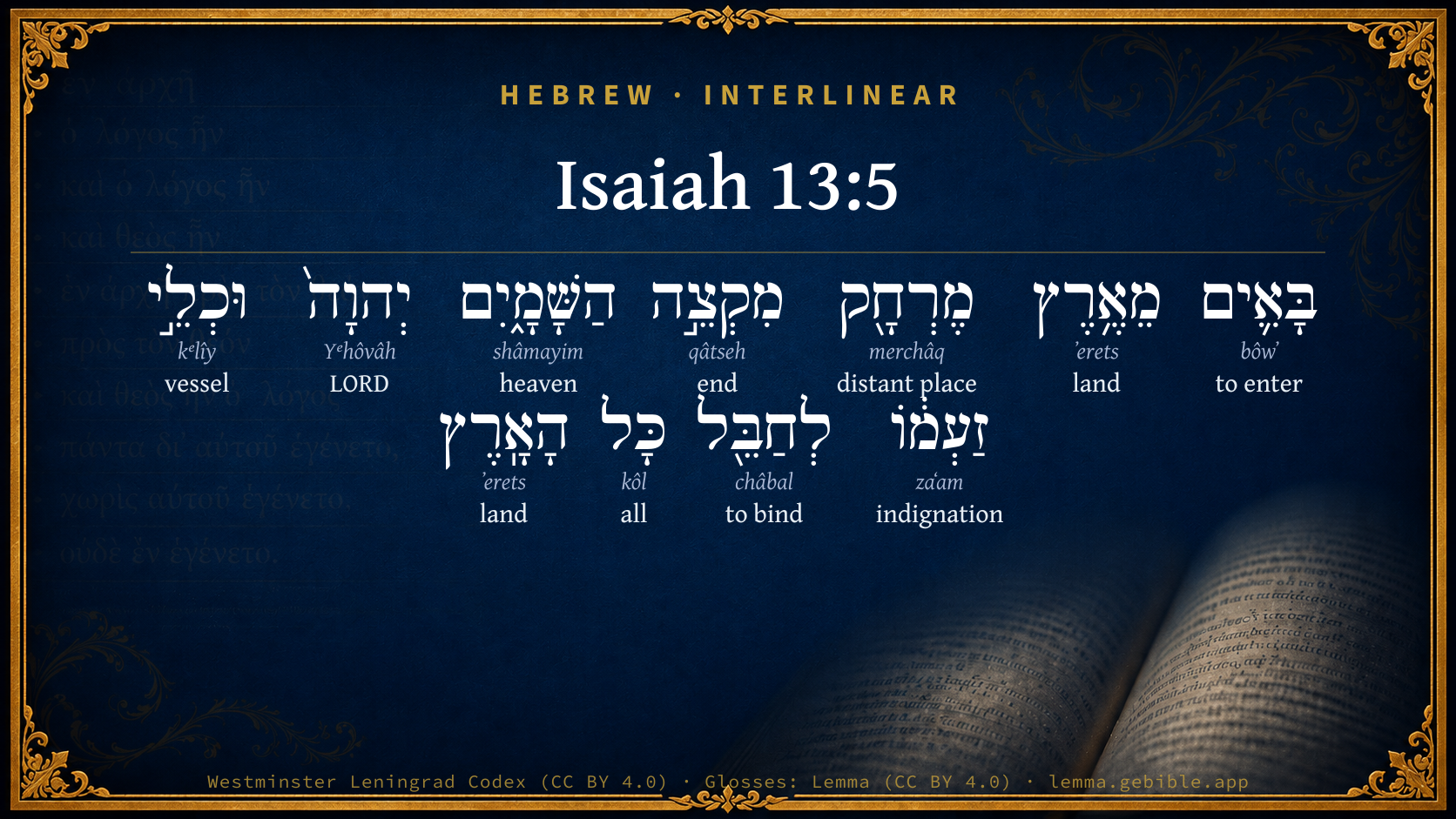
Isaiah 13:5

Hebrew (Westminster Leningrad Codex) Isaiah 13:5 appears in the Hebrew Old Testament. The text above is from the Westminster Leningrad Codex. Each word links to its Strong’s number, a concise gloss, and parsing drawn from the Open Scriptures Hebrew Bible morphology. Click any word for its full Brown-Driver-Briggs (BDB) entry.
Download image
Cite this verse

Isaiah 13:5 (World English Bible). Public Domain. Lemma interlinear Bible study tool, https://lemma.gebible.app/v/isaiah/13/5.

Show BibTeX & RIS
BibTeX
RIS
English Translation
They come from a far country, from the uttermost part of heaven, even Yahweh, and the weapons of his indignation, to destroy the whole land.
World English Bible · Public Domain
Download a study sheet

One document with this verse’s original text, its word-by-word gloss line, the meaning frame, cross-references with their text, attributed commentary, and full source and license credits — printable, and it pastes into notes with its structure intact.

This verse Autodidact and up

Study sheet (.html) Plain text (.txt)

A passage Seminary Student

Up to 50 verses in one chapter. A passage sheet keeps up to 6 commentary sources and 12 cross-references per verse, in the order this page ranks them, and says so on the sheet whenever that leaves anything out. Ask for a single verse and you get the Autodidact verse sheet above.

Everything on this page stays free to read, with no account — the sheet is a download of what is already on screen, not access to it.

Want to remove ads? Support Godless Engineer
Compare translations 3

The same verse in 3 English versions, stacked beneath the original-language interlinear above. Click any original word for its lexicon entry.

Each is an independent rendering of the whole verse — the interlinear is not word-aligned to these translations.

Highlighted words mark where these versions differ — a whole-verse word diff, not a word-by-word alignment.

  • World English Bible Public Domain
    They come from a far country, from the uttermost part of heaven, even Yahweh, and the weapons of his indignation, to destroy the whole land.
  • King James Version Public Domain
    They come from a far country, from the end of heaven, even the LORD, and the weapons of his indignation, to destroy the whole land.
  • unfoldingWord Literal Text CC BY-SA 4.0
    coming from a land of distance, from the end of the heavens, Yahweh and the weapons of his indignation, to destroy all of the land. q1

unfoldingWord Literal Text — © unfoldingWord, licensed CC BY-SA 4.0. Word-aligned USFM3 via Door43 (git.door43.org/unfoldingWord/en_ult).

Versions to compare (up to 4)

3 of 4 selected

Show all 18 translations

Every available English version of this verse, each an independent rendering of the whole verse.

  • World English Bible Public Domain
    They come from a far country, from the uttermost part of heaven, even Yahweh, and the weapons of his indignation, to destroy the whole land.
  • Berean Standard Bible Public Domain
    They are coming from faraway lands, from the ends of the heavens—the LORD and the weapons of His wrath—to destroy the whole country.
  • Majority Standard Bible Public Domain
    They are coming from faraway lands, from the ends of the heavens—the LORD and the weapons of His wrath—to destroy the whole country.
  • King James Version Public Domain
    They come from a far country, from the end of heaven, even the LORD, and the weapons of his indignation, to destroy the whole land.
  • American Standard Version (1901) Public Domain
    They come from a far country, from the uttermost part of heaven, even Jehovah, and the weapons of his indignation, to destroy the whole land.
  • Revised Version (1885) Public Domain
    They come from a far country, from the uttermost part of heaven, even the LORD, and the weapons of his indignation, to destroy the whole land.
  • Geneva Bible (1599) Public Domain
    They come from a farre countrey, from the end of the heauen: euen the Lord with the weapons of his wrath to destroy the whole land.
  • Douay-Rheims (1899) Public Domain
    To them that come from a country afar off, from the end of heaven: tile Lord and the instruments of his wrath, to destroy the whole land.
  • Young's Literal Translation Public Domain
    They are coming in from a land afar off, From the end of the heavens, Jehovah and the instruments of His indignation, To destroy all the land.
  • Literal Standard Version CC BY-SA 4.0
    They are coming in from a far-off land, || From the end of the heavens, || YHWH and the instruments of His indignation, || To destroy all the land.
  • Unlocked Literal Bible CC BY-SA 4.0
    They come from a far country, from way over the horizon. It is Yahweh with his instruments of judgment, to destroy the whole land.
  • unfoldingWord Literal Text CC BY-SA 4.0
    coming from a land of distance, from the end of the heavens, Yahweh and the weapons of his indignation, to destroy all of the land. q1
  • Darby Bible Public Domain
    They come from a far country, from the end of the heavens -- Jehovah, and the weapons of his indignation -- to destroy the whole land.
  • World Messianic Bible Public Domain
    They come from a far country, from the uttermost part of heaven, even the LORD, and the weapons of his indignation, to destroy the whole land.
  • Webster's Bible Public Domain
    They come from a far country, from the end of heaven, even the LORD, and the weapons of his indignation, to destroy the whole land.
  • Free Bible Version CC BY-SA 4.0
    They are coming from distant lands, from beyond the far horizons—the Lord and the weapons of his fury—coming to destroy the whole country.
  • Bible in Basic English Public Domain
    They come from a far country, from the farthest part of heaven, even the Lord and the instruments of his wrath, with destruction for all the land.
  • JPS Tanakh (1917) Public Domain
    They come from a far country, from the end of heaven, even the LORD, and the weapons of His indignation, to destroy the whole earth.

Literal Standard Version (2020), Covenant Press — licensed CC BY-SA 4.0. Text via the HelloAO Bible API (eBible.org). Unlocked Literal Bible (unfoldingWord) — licensed CC BY-SA 4.0. Text via the HelloAO Bible API (eBible.org). unfoldingWord Literal Text — © unfoldingWord, licensed CC BY-SA 4.0. Word-aligned USFM3 via Door43 (git.door43.org/unfoldingWord/en_ult). Free Bible Version, Dr. Jonathan Gallagher — licensed CC BY-SA 4.0. Text via the HelloAO Bible API (eBible.org).

Word by word

More ways to search: Search by grammar → Find every occurrence → Compare this word →

Practice this passage: Drill this verse → Learn its vocabulary →

מֶרְחָ֖ק
merchâq
H4801
“distant place”
Noun, Common, Masculine, Singular, Absolute
Part of Speech
Noun
Type
Common
Gender
Masculine
Number
Singular
State
Absolute
Full BDB Definition

Origin: from H7368

TWOT: 2151c

distant place, distance, far country
  1. בָּאִ֛ים bôwʼ H935 “entering” Verb, Qal, Participle Active, Masculine, Plural, Absolute
  2. מֵאֶ֥רֶץ ʼerets H776 “from · land of” Preposition + Noun, Common, Both, Singular, Construct
  3. מִקְצֵ֣ה qâtseh H7097 “from · end of” Preposition + Noun, Common, Both, Singular, Construct
  4. הַשָּׁמָ֑יִם shâmayim H8064 “the · heaven(s)” Particle, Definite Article + Noun, Common, Masculine, Plural, Absolute
  5. יְהוָה֙ Yᵉhôvâh H3068 “LORD” Noun, Proper
  6. וּכְלֵ֣י kᵉlîy H3627 “and · vessels of” Conjunction + Noun, Common, Masculine, Plural, Construct
  7. זַעְמ֔וֹ zaʻam H2195 “indignation · his” Noun, Common, Masculine, Singular, Construct + Suffix, Personal, 3rd Person, Masculine, Singular
  8. לְחַבֵּ֖ל châbal H2254 “to bind” Preposition + Verb, Piel, Infinitive Construct
  9. כָּל kôl H3605 “all of” Noun, Common, Masculine, Singular, Construct
  10. הָאָֽרֶץ ʼerets H776 “the · land” Particle, Definite Article + Noun, Common, Both, Singular, Absolute

About this verse

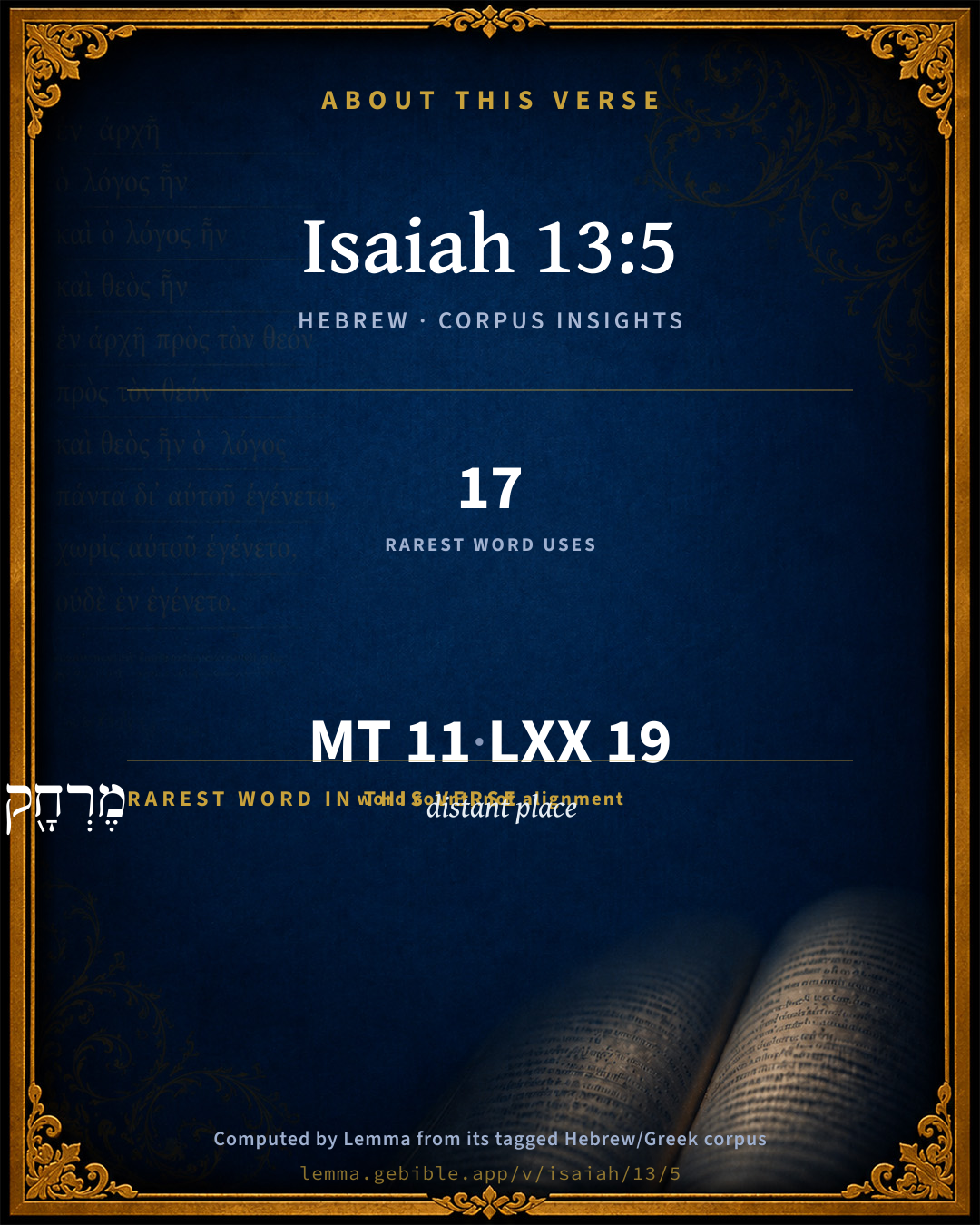
These counts appear in no published source. They are computed here, from the morphology-tagged text and Lemma’s own curated glosses. What Lemma adds →

11
words
10
distinct lemmas
Prophets
section

Notable vocabulary

The rarest word here is מֶרְחָ֖ק distant place H4801 — appearing just 17 times in the whole Hebrew Bible.

Shared distinctive vocabulary

מֶרְחָ֖ק distant place H4801 occurs in 17 verses of the Hebrew Bible. Also found in:

Grammatical profile

  • 2 verbs
  • 9 nouns

Verb forms

  • בָּאִ֛ים Qal · Participle Active
  • לְחַבֵּ֖ל Piel · Infinitive Construct

Repetition

A word recurs within this verse — often emphatic in Hebrew:

  • מֵאֶ֥רֶץ land H776 ×2

Hebrew & Septuagint length

In English translation the verse runs 25 words from the Hebrew and 25 from the Septuagint (LXX English) — the same length.

A rough comparison of the two English renderings, which tokenize alike — not a word-level alignment.

Word counts can differ between the Hebrew and the Greek without any difference in meaning — e.g. the Hebrew direct-object marker אֵת has no separate Greek word, and Greek often adds the article ὁ.

In the original languages it is 11 Hebrew tokens and 19 Greek tokens — but the two are counted differently (Hebrew bundles its prefixes and suffixes into one token; the Greek is in lemma form), so that isn’t a like-for-like length.

Cross-references

8

Topical passages linked to Isaiah 13:5 in the Treasury of Scripture Knowledge — connected by theme and wording, ordered by reader-vote popularity; previews shown in the World English Bible.

  • Jeremiah 50:9 For, behold, I will stir up and cause to come up against Babylon a company of great nations from the north country; and they shall set themselves in array against her; from there she shall be taken: their arrows shall be as of an expert mighty man; none shall return in vain.
  • Jeremiah 51:20–46 You are my battle-axe and weapons of war: and with you will I break in pieces the nations; and with you will I destroy kingdoms;
  • Matthew 24:31 He will send out his angels with a great sound of a trumpet, and they will gather together his chosen ones from the four winds, from one end of the sky to the other.
  • Isaiah 5:26 He will lift up a banner to the nations from far, And he will whistle for them from the end of the earth. Behold, they will come speedily and swiftly.
  • Isaiah 13:17 Behold, I will stir up the Medes against them, who shall not regard silver, and as for gold, they shall not delight in it.
  • Isaiah 24:1 Behold, Yahweh makes the earth empty, and makes it waste, and turns it upside down, and scatters abroad the inhabitants of it.
  • Jeremiah 50:3 For out of the north there comes up a nation against her, which shall make her land desolate, and none shall dwell therein: they are fled, they are gone, both man and animal.
  • Jeremiah 51:11 Make sharp the arrows; hold firm the shields: Yahweh has stirred up the spirit of the kings of the Medes; because his purpose is against Babylon, to destroy it: for it is the vengeance of Yahweh, the vengeance of his temple.

Cross-references courtesy of OpenBible.info (CC BY 4.0).

Hebrew and Greek witnesses Masoretic Hebrew ↔ Greek Septuagint

The same verse in the two great witnesses to the Old Testament, shown verse-for-verse.

These are two independent witnesses, not word-aligned to each other, and the Septuagint is shown in lemma (dictionary) form.

Hebrew Isaiah 13:5 Masoretic · Westminster Leningrad Codex

בָּאִ֛ים מֵאֶ֥רֶץ מֶרְחָ֖ק מִקְצֵ֣ה הַשָּׁמָ֑יִם יְהוָה֙ וּכְלֵ֣י זַעְמ֔וֹ לְחַבֵּ֖ל כָּל הָאָֽרֶץ

They come from a far country, from the uttermost part of heaven, even Yahweh, and the weapons of his indignation, to destroy the whole land.

World English Bible · Public Domain

Greek LXX Isaiah 13:5 Septuagint · lemma form

ἔρχομαι ἐκ γῆ πόρρωθεν ἀπό ἄκρος θεμέλιον ὁ οὐρανός κύριος καί ὁ ὁπλομάχος αὐτός ὁ καταφθείρω ὁ οἰκέω ὅλος

to come from a land afar off, from the utmost foundation of heaven; the Lord and his warriors are coming to destroy all the world.

LXX2012 (modern English Septuagint) · Public Domain

On this verse, Trapp's Complete Commentary discusses the Septuagint’s reading. Read the note in Commentary ↓

Hebrew: Westminster Leningrad Codex (CC BY 4.0). Greek: Septuagint (public domain); English from LXX2012 (modern English Septuagint) (Public Domain). How the Septuagint differs from the Hebrew →

Targum (Aramaic paraphrase)

1

The Targum is the ancient Jewish Aramaic paraphrase of the Hebrew Scriptures — an interpretive translation, not the Hebrew text itself. Onkelos (literal) and Pseudo-Jonathan (expansive) render the Torah, and Jonathan the Prophets. Coverage is partial: where no permissively-licensed English translation exists for a verse, only the Aramaic is shown. This is verse-level text, not a word-by-word alignment to the Hebrew.

  1. Targum Jonathan Prophets (Joshua–Malachi)
    אָתָן מֵאַרְעָא רְחִיקָא מִסְיָפֵי אַרְעָא יְיָ וּמָנֵי כָס דִלְוָט קֳדָמוֹהִי לְחַבָּלָא כָּל רִשְׁעֵי אַרְעָא:

    They are coming from a far country, from the ends of the earth: the Lord and the vessels of the cup of cursing before Him, to destroy all the wicked of the earth.

    Targum Jonathan — Aramaic: “Mikraot Gedolot” (public domain). English: “Sefaria Community Translation” (CC0 1.0 (public-domain dedication)); “London "Chaldee Paraphrase," 1871” (public domain). Text via Sefaria.

Commentary

Notes on Isaiah 13:5 from classic Christian and Jewish commentators (each source and its license shown beneath its notes). The classic Christian expositions comment on the surrounding passage and are grouped to its opening verse, so a note may address several verses; the Jewish commentaries on the Tanakh (Rashi and others) are per-verse, so they appear only where the commentator wrote on this verse.

Lemma curates 59 commentaries, every one of them public domain or Creative Commons licensed, each selected and text-cleaned for this edition rather than reprinted as found. About our sources →

Trapp's Complete Commentary

John Trapp

Isa 13:5 They come from a far country, from the end of heaven, [even] the LORD, and the weapons of his indignation, to destroy the whole land.

Ver. 5. They come from a far country.] Heb., From a land of longinquity.

Even the Lord, and the weapons of his indignation.] ’Oπολομαχους, "Vessels of wrath," the Septuagint render them; but in another sense, then, the apostle useth that expression concerning reprobates designed to destruction.

To destroy the whole land.] Or, The whole world, for so the Chaldees, in the pride of their empire, styled it. The Romans did the like. {Luk 2:1} The Turks do the same at this day, such is their ambition.

John Trapp, A Commentary or Exposition upon All the Books of the Old and New Testament (1647–1656) — public domain. Text from a community e-Sword module.

Tyndale Open Study Notes

Tyndale Open Resources

13:5 Just as Assyria was the rod of his anger (9:4; 10:5, 15), other nations serve as the Lord’s weapons and carry out his will. The Medes and Persians conquered Babylon in 539 BC. • God’s wrath is an expression of his justice as well as his intent to restore order to the world by obliterating evildoers (10:25-26; see Lam 2:22; Ezek 7:19).

Tyndale Open Study Notes — © Tyndale Open Resources, licensed CC BY-SA 4.0. Text via the HelloAO Bible API.

Geneva Bible (1599)

Geneva Bible translators

The army of the Medes and the Persians against Babylon.

Geneva Bible (1599) marginal notes — public domain. Text via Bolls.life.

Jamieson, Fausset & Brown

Robert Jamieson, A. R. Fausset & David Brown

They--namely, "Jehovah," and the armies which are "the weapons of His indignation."

far country--Media and Persia, stretching to the far north and east.

end of heaven--the far east (Psa 19:6).

destroy--rather, "to seize" [HORSLEY].

Jamieson, Fausset & Brown — Commentary Critical and Explanatory on the Whole Bible (1871) — public domain (CC PDM 1.0). Text via the HelloAO Bible API.

Adam Clarke's Commentary

Verse 5. They come from a far country] The word מארץ meerets is wanting in one MS. and in the Syriac: "They come from afar."

From the end of heaven] Kimchi says, Media, "the end of heaven," in Scripture phrase, means, the EAST.

Adam Clarke's Commentary on the Bible (1810–1826) — public domain. Text from a community e-Sword/MySword module.

Ellicott's Commentary for English Readers

(5) They come from a far country . . .—The same phrase is used of Cyrus in Isa_46:11, and in Isa_39:3 of Babylon itself in relation to Jerusalem. The “end of heaven” represents the thoughts of Isaiah’s time, the earth as an extended plain, and the skies rising like a great vault above. The phrase represents (Deu_4:32; Psa_19:6), as it were, the ultima Thule of discovery. For the “whole land,” the Hebrew noun hovers, as often elsewhere, between the meanings of “earth,” or “country.” The LXX. favours the former meaning.

A Bible Commentary for English Readers, edited by Charles John Ellicott (1878–1897) — public domain. Text from a community e-Sword module.

The Cambridge Bible for Schools and Colleges

gen. ed. J. J. S. Perowne

5. The host is now seen in motion, advancing under the guidance of Jehovah to its appointed goal.

the whole land] Rather, the whole earth. The judgment is directed against the Babylonian Empire, which from the writer’s point of view was practically co-extensive with the civilised world.

The Cambridge Bible for Schools and Colleges (gen. ed. J. J. S. Perowne; Cambridge University Press, 1878–1918) — public domain. Text from a community e-Sword module.

John Gill's Exposition

They come from a far country, from the end of heaven,.... The east, as Kimchi observes; the Targum is, from the ends of the earth; the furthermost parts of it, as Persia and Media were: the former is bounded on the south side by the main ocean; and the latter, part of it by the Caspian sea; and between Babylon and these kingdoms lay the large kingdom of Assyria; so that this army might be truly said to come from a far country:

even the Lord, and the weapons of his indignation; the Medes and Persians, who were the instruments of his wrath and vengeance against Babylon; just as Assyria is called the rod of his anger, Isa 10:5 with these he is said to come, because this army was of his gathering, mustering, ordering, and directing, in his providence; the end and design of which was,

to destroy the whole land; not the whole world, as the Septuagint render it; but the whole land of Chaldea, of which Babylon was the metropolis. The Targum is,

"to destroy all the wicked of the earth.''

John Gill's Exposition of the Whole Bible (1746–1763) — public domain (CC PDM 1.0). Text via the HelloAO Bible API.

Albert Barnes' Notes on the Bible

They come - That is, ‘Yahweh and the weapons of his indignation’ - the collected armies come. The prophet sees these assembled armies with Yahweh, as their leader, at their head.

From a far country - The country of the Medes and Persians. These nations, indeed, bordered on Babylonia, but still they stretched far to the north and east, and, probably, occupied nearly all the regions to the east of Babylon which were then known.

From the end of heaven - The Septuagint renders this, Ἀπ ̓ ἄκρου θεμελίου τοῦ οὐρανοῦ Ap' akrou themeliou tou ouranou - ‘From the “extreme foundation” of the heaven.’ The expression in the Hebrew, ‘From the end, or extreme peri of heaven,’ means, the distant horizon by which the earth appears to be bounded, where the sky and the land seem to meet. In Psa 19:6, the phrase, ‘from the end of the heaven’ denotes the east, where the sun appears to rise; and ‘unto the ends of it’ denotes the west:

His going forth is from the end of the heaven;

And his circuit unto the ends of it.

It is here synonymous with the phrase, ‘the end of the earth,’ in Isa 5:26.

Even the Lord - The word ‘even,’ introduced here by the translators, weakens the three of this verse. The prophet means to say that Yahweh is coming at the head of those armies, which are the weapons of his indignation.

The weapons of his indignation - The assembled armies of the Medes and Persians, called ‘the weapons of his indignation,’ because by them he will accomplish the purposes of his anger against the city of Babylon (see the note at Isa 10:5).

To destroy the whole land - The whole territory of Babylonia, or Chaldea. Not only the city, but the nation and kingdom.

Albert Barnes' Notes on the Bible (1834–1885) — public domain. Text from a community e-Sword/MySword module.

Haydock's Catholic Bible Commentary

Heaven. Where it seems to touch the horizon. Thus the countries beyond the Euphrates are often designated.

George Leo Haydock (1774–1849), Haydock's Catholic Family Bible and Commentary, 1859 edition — public domain. Excludes Psalms (Douay-Rheims chapter numbering differs from Protestant) and Deuterocanonical books (Catholic canon only).

Matthew Poole's English Annotations

From the end of heaven; from the ends of the earth under heaven, as Mat 24:30; which is not to be understood strictly and properly, but popularly and hyperbolically, as such expressions are commonly used in sacred and profane authors. And yet in some respects this might be truly said of Persia, which on the south side was bounded by the main ocean; as for the same reason Sheba, a part of Arabia, is called

the utmost parts of the earth, Mat 12:42.

The weapons of his indignation; the Medes and Persians, who were but a rod in God’s hand, and the instruments of his anger, as was said of the Assyrian, Isa 10:5.

To destroy the whole land, to wit, of Babylon, of which he is now speaking.

Matthew Poole's English Annotations on the Holy Bible (1683–1685) — public domain. Text from a community e-Sword/MySword module.

Whedon's Commentary on the Bible

Daniel D. Whedon

5. From a far country… end of heaven — A region but dimly definite to the mind, so very distant is it, extending out to the lowest horizon. The prophet sees the mustering hosts actually coming from the remotest point of sight.

The Lord… weapons… indignation — The armies are under his guidance, and unconsciously become instruments of punishing (literally, seizing) the whole land, — Septuagint, the whole world — which means Babylonia as a symbol or type of all human opposition to divine authority. Isa_14:7; Isa_14:9; Isa_14:16.

Daniel D. Whedon (gen. ed.), Commentary on the Old and New Testaments (1874–1909) — public domain. Text from a community e-Sword module.

The Pulpit Commentary

They come from a far country. (comp. Isa_46:11) Both Media and Persia were "far countries" to the Hebrews, Persia especially. There is no indication that they knew of any countries more remote towards the East. Hence the expression which follows, "from the end of heaven the heaven being supposed to end where the earth ended. Isaiah, like the other sacred writers, conforms his language on cosmical subjects to the opinions of his day. Even the Lord. With a most effective anthropomorphism, Jehovah is made to march with the army that he has mustered (ver. 4) against the land that has provoked his wrathi.e. Babylonia. The weapons. (comp. Isa_10:15 Jer_1:2-5 Jer_51:20) To destroy the whole land. Many critics would render ha-arets by "the earth" here. It may be granted that the language of the prophecy goes beyond the occasion in places (especially vers. 11 and 13), and passes from Babylon to that wicked world of which Babylon is a type; but, where the context permits, it seems better to restrict than to expand the meaning of the words employed.

The Pulpit Commentary (1880–1919), ed. H.D.M. Spence-Jones & Joseph S. Exell — public domain. Text from a community e-Sword module.

John Wesley's Explanatory Notes

Thy come - From the ends of the earth under heaven, which is not to be understood strictly. The weapons - The Medes and Persians, who were but a rod in God's hand, and the instruments of his anger. Land - Of Babylon.

John Wesley, Explanatory Notes Upon the Whole Bible (1754–1765) — public domain. Text via the GEBible commentary corpus.

J. A. Alexander on Isaiah

Joseph Addison Alexander

“Coming from a distant land (literally, a land of distance), from the (visible or apparent) end of the heavens, Jehovah and the instruments (or weapons) of His wrath, to lay waste (or destroy) the whole land (of Babylonia).” ‘The end of heaven’ is a strong but natural hyperbole. The best explanation is that the Prophet refers to the horizon or bounding line of vision. He is not deliberately stating from what region they set out, but from what point he sees them actually coming, viz. from the remotest point in sight. This view of the expression, not as a geographical description, but as a vivid representation of appearances, removes the necessity of explaining how Media or Persia could be called a distant land or the extremity of heaven. The host which Jehovah was before said to be mustering is now represented as consisting of Himself and the weapons of His wrath. This intimation of His presence, His co-operation, and even His incorporation, with the invading host, adds greatly to the force of the threatening. The Hebrew word translated implements includes instruments and vessels. It has here the active sense of weapons, while in Rom 9:22, Paul employs a corresponding Greek phrase in the passive sense of vessels, weapons of wrath are the weapons which execute it, vessels of wrath the vessels which contain it.

Joseph Addison Alexander, The Prophecies of Isaiah (1846–1847; New York: Scribner, 1870–1878) — public domain. Text from a community e-Sword module.

Rashi

Rabbi Shlomo Yitzchaki (Rashi)

and the weapons of His fury They are the mighty men of Media and Persia.

to destroy all the land of Babylonia.

Rashi on the Tanakh — English translations: “The Judaica Press complete Tanach with Rashi, translated by A. J. Rosenberg” (CC BY 4.0); “Pentateuch with Rashi's commentary by M. Rosenbaum and A.M. Silbermann, 1929-1934” (public domain); “The Metsudah Tanach series, Lakewood, N.J” (CC BY 4.0); and “The Book of Joshua, Metsudah Publications, 1997” (CC BY 4.0). Text via Sefaria.

Ibn Ezra

Rabbi Abraham ibn Ezra

They come from a far country. They come from the country of Elam. From the end of heaven. As if they came from the extremity of heaven; that is, they come from a great distance.

The Lord cometh. The decrees of the Lord are coming, they will soon be fulfilled. And the weapons of His indignation. Persia and Media.

Ibn Ezra on the Tanakh — English translations: “Sefaria Community Translation” (CC0 1.0 (public-domain dedication)); “Yalkut, Sifsei Chachomim Chumash, Metsudah Publications, 2009” (CC BY 4.0); and “Commentary of Ibn Ezra on Isaiah - trans. by M. Friedlander, 1873” (public domain). Text via Sefaria.

Lesson kit

Teaching starters — assembled from the data on this page, not authored interpretation. Every prompt links to the verse data it draws on. Edit before teaching.

Isaiah, in the Prophets, opens this verse with 11 words (10 distinct Hebrew lemmas). Its most distinctive word is merchâq (“distant place”). A historical commentator’s framing appears above. Read the whole chapter for the surrounding context.

Discussion questions

  1. How does “distant place” (merchâq) shape what this verse is saying?
  2. Psalms 138:6 shares the word «distant place» with this verse. How do the two illuminate each other?
  3. “land” occurs 2× in this one verse. What is the effect of the repetition?
  4. These translations render this verse differently. What is at stake in choosing one wording over another?
  5. The verb «בָּאִ֛ים» is Qal Participle Active. How does its form color the action?
  6. Reading how Trapp's Complete Commentary and Tyndale Open Study Notes read this verse, where do the two commentators agree and where do they part?

Things to notice

Reading settings

Reading text

Shown beneath each verse's original-language words.

Old Testament
Old Testament edition

Read the OT as the Masoretic Hebrew (MT) or the Greek Septuagint (LXX).

English shown for the Greek Septuagint (in the Hebrew ↔ Greek comparison).

Comparing translations? Open the Compare panel on any verse page to stack up to four side by side.