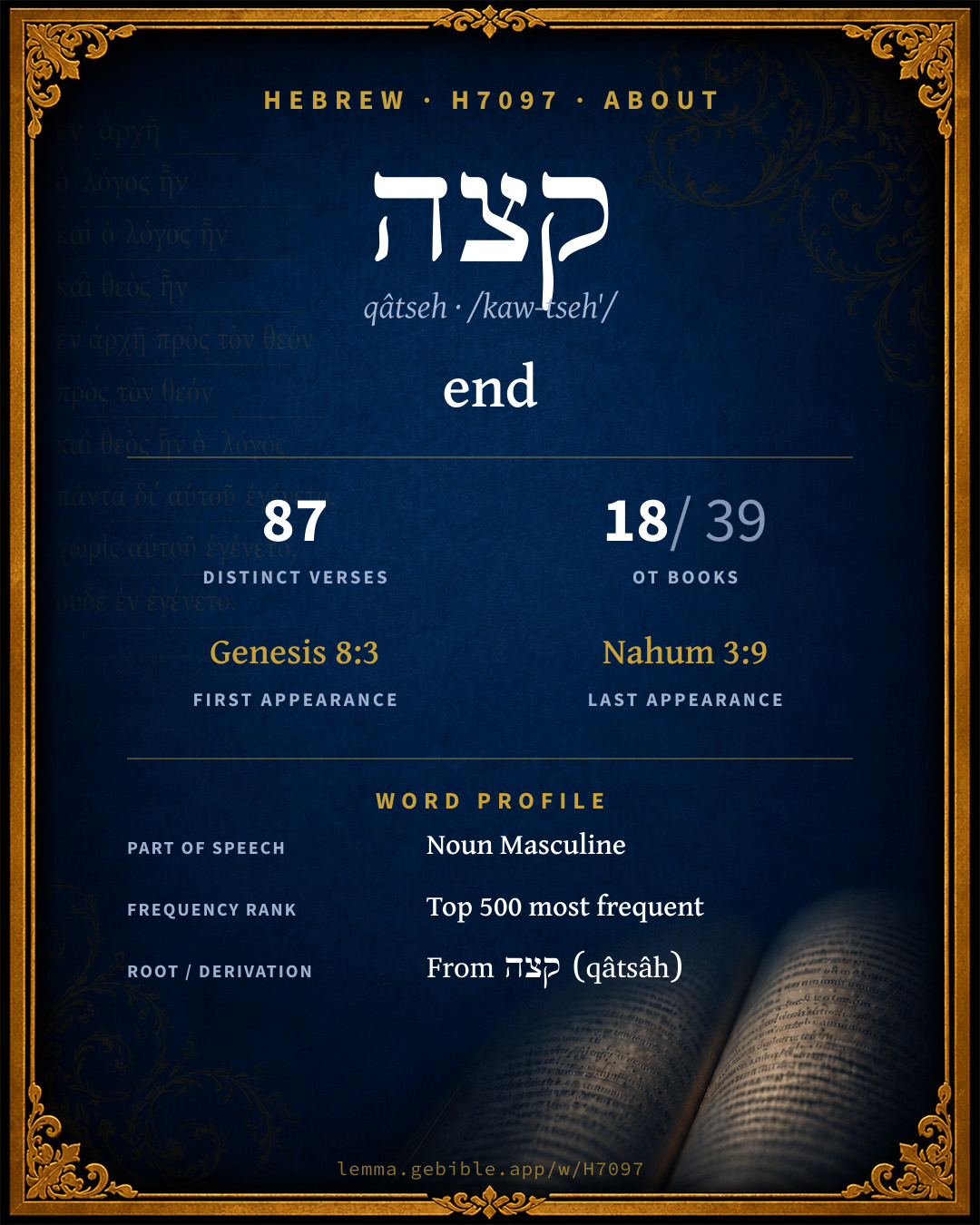
קצה
end
‘end’ is one of 5 main senses fuller range ↓
Full lexicon entry — Brown-Driver-Briggs (BDB)
From Brown-Driver-Briggs (BDB)
Where this word appears
Grammar key — what these labels mean
Part of speech
- Noun
- A naming word — a person, place, thing, or idea.
Noun type
- Common
- A common noun — a general class of person, place, or thing (“king,” “city,” “water”), not a specific name.
State
- Construct
- A noun bound to a following noun in a possessive / “of” relationship (the construct chain).
- Absolute
- The independent form of a noun, not bound to a following word.
Gender
- Both
- Attested as both masculine and feminine.
Number
- Singular
- One.
- Plural
- More than one (in Hebrew, generally three or more).
Every verse where H7097 appears in the Book of Psalms — 5 distinct verses. Click any verse to open its interlinear word-by-word view. Verse text shown in the World English Bible for context — . Each verse’s Hebrew form is shown with its reference; the English is not keyword-highlighted, since the data carries no word-level English alignment. Use “Compare translations” on any verse to read it across multiple English versions. This concordance covers the Hebrew Bible; Septuagint (Greek Old Testament) occurrences are not indexed here.
Psalms
- Psalms 19:4 וּ/בִ/קְצֵ֣ה conj + prep + n c bs cs Their voice has gone out through all the earth, Their words to the end of the world. In them he has set a tent for the sun,
- Psalms 19:6 מִ/קְצֵ֤ה prep + n c bs cs His going forth is from the end of the heavens, His circuit to its ends; There is nothing hidden from its heat.
- Psalms 46:9 קְצֵ֪ה n c bs cs He makes wars cease to the end of the earth. He breaks the bow, and shatters the spear. He burns the chariots in the fire.
- Psalms 61:2 מִ/קְצֵ֤ה prep + n c bs cs From the end of the earth, I will call to you, when my heart is overwhelmed. Lead me to the rock that is higher than I.
- Psalms 135:7 מִ/קְצֵ֪ה prep + n c bs cs Who causes the clouds to rise from the ends of the earth; Who makes lightnings with the rain; Who brings forth the wind out of his treasuries;
About this entry
At a glance — auto-summarized from this page’s data, not written by a person. Every figure links to its source below. This summary describes the numbers; it doesn’t interpret them.
קצה (qâtseh) is a Hebrew noun most often rendered “end.” Older and newer Bibles part ways — “end” in the King James Version, “end of” (unfoldingWord Literal Text) in modern versions. See the renderings breakdown. It turns up in 87 verses across 18 books, a moderately common footprint. Scripture first uses it in Genesis 8:3. Not a single-sense word: explore its full sense range. For the data behind this summary, explore the sense tree and the renderings breakdown below.
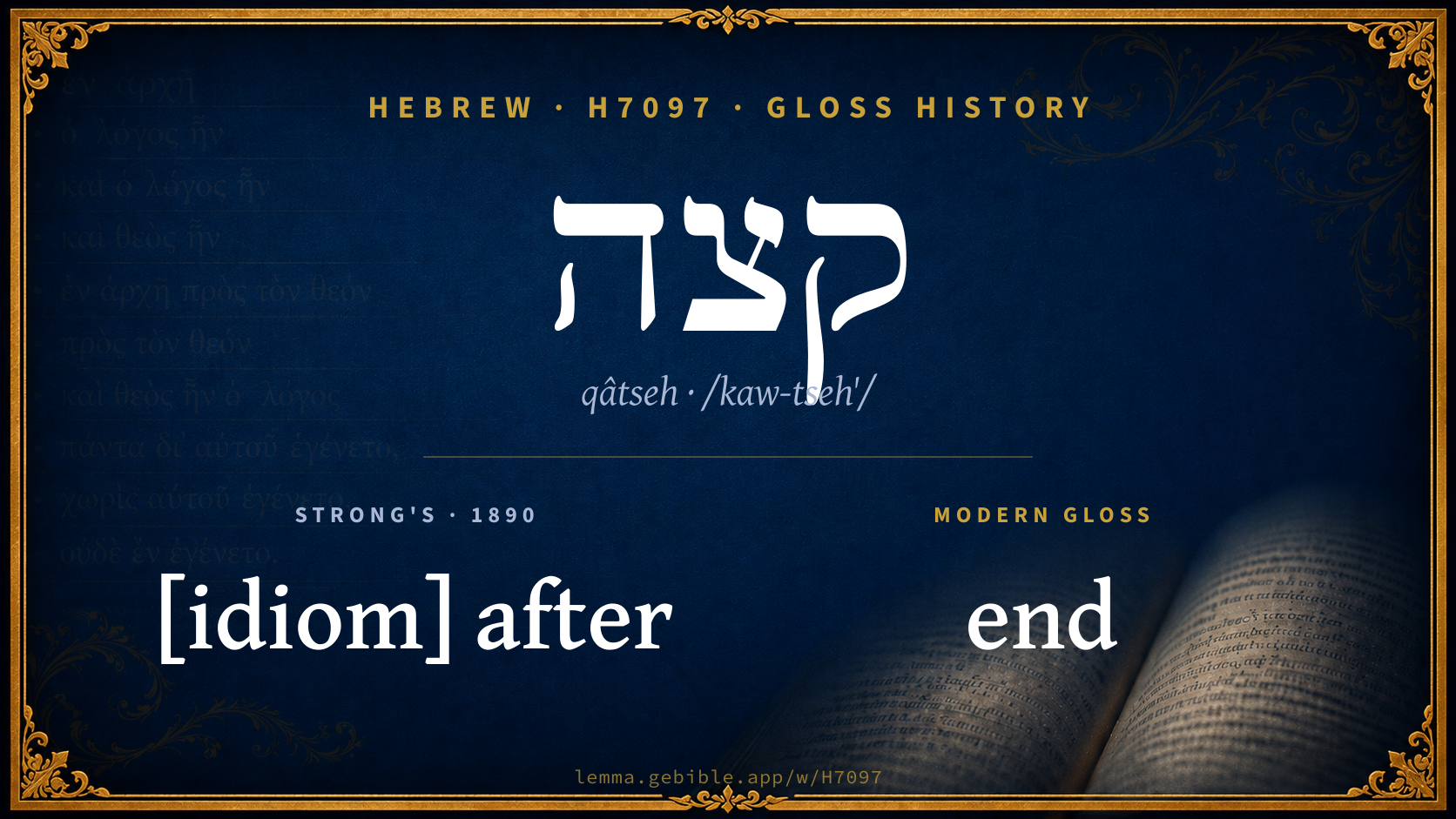
Gloss history
Strong's 1890 vs modern scholarship
About this word
Strong's H7097 catalogs a Hebrew word from the Hebrew Old Testament.
These counts are not copied from any lexicon or concordance. They are computed here, from the morphology-tagged Hebrew Old Testament. What Lemma adds →
- 87
- distinct verses
- The word appears in 87 distinct verses.
- 18 / 39
- OT books
- The word appears in 18 of 39 Old Testament books.
- #432
- by frequency
- Top 500 most frequent Hebrew words (rank 432 of 8,640 Hebrew words by occurrence).
View all 87 occurrences in the concordance →
By section of the Old Testament
By traditional corpus
Conventional, traditional groupings — biblical authorship is debated, so this is a traditional corpus grouping, not an authorship claim. Each share is this word’s portion of its verses in that division of the Hebrew canon. Each figure is a share of the word’s 87 distinct verses.
- Prophets (Nevi'im) 53 verses · 61%
- Torah (Pentateuch) 26 verses · 30%
- Writings (Ketuvim) 8 verses · 9%
How translations render this word
Counts come from each version’s own published word-to-Strong’s tagging or interlinear alignment — an approximate guide to how each version renders this word, not a word-level alignment the data otherwise carries. Because each total is that version’s own tagged count, the per-version totals vary from one another and need not match the appearance or distinct-verse counts above. These counts may also differ from a printed concordance because Lemma counts each distinctly tagged rendering and does not collapse phrase taggings into a single head-word total. This is a fixed set of word-tagged versions (KJV, ASV, BSB, ULT) and does not change with the reading translation you choose elsewhere. Each version’s license is shown beside its name below (and on Sources).
BDB lists this Strong’s number as 2 distinct words (homographs). Each count above pools all of them and is not split by sense — see the Senses section below. A low-frequency rendering may belong to a different one of those words, not the primary meaning.
- King James Version†: End 26×, One end 6×, Ends 5×
- American Standard Version†: End 24×, One end 6×, Uttermost 5×
- Berean Standard Bible†: End 19×, Ends 13×, Edge 9×
- unfoldingWord Literal Text†: End of 42×, Edge of 12×, End 11×
King James Version Public Domain
Renders H7097 across 95† tagged occurrences — most commonly:
Plus other, less common renderings. Plus 25 renderings that appear only once — usually multi-word phrases or single function words the recovered tagging swept in, not distinct renderings. Not rendered by a distinct English word in 1 further occurrence.
American Standard Version Public Domain
Renders H7097 across 95† tagged occurrences — most commonly:
Plus other, less common renderings. Plus 33 renderings that appear only once — usually multi-word phrases or single function words the recovered tagging swept in, not distinct renderings.
Berean Standard Bible Public Domain
Renders H7097 across 88† tagged occurrences — most commonly:
Plus 17 renderings that appear only once — usually multi-word phrases or single function words the recovered tagging swept in, not distinct renderings. Not rendered by a distinct English word in 9 further occurrences.
unfoldingWord Literal Text CC BY-SA 4.0
Renders H7097 across 108† tagged occurrences — most commonly:
Plus 12 renderings that appear only once — usually multi-word phrases or single function words the recovered tagging swept in, not distinct renderings.
Senses in the full BDB
What do BDB’s symbols mean?
BDB uses these scholarly abbreviations:
| Symbol | Meaning |
|---|---|
| 𝔊 | the Septuagint (the ancient Greek translation, LXX) |
| 𝔙 | the Vulgate (the Latin translation) |
| 𝔖 | the Syriac version (the Peshitta) |
| 𝔗 | the Targum (the Aramaic translation) |
| ψ | the Psalms |
| √ | root (the underlying root or stem) |
| ‖ | parallel passage (a synonymous or contrasted parallel) |
| † | the dagger: every passage where the word occurs is cited |
The 4 senses and sub-senses the full Brown-Driver-Briggs lexicon distinguishes for this word, in lexicon order (not ranked by frequency), with BDB’s own verbatim wording and sub-sense lettering. Shown in Hebrew script with BDB’s own scholarly abbreviations. The condensed entry is in the Lexicon Entry tab. See also the Forms in the corpus table below.
קצה I [m.] end, extremity, only sg.
- 1. end, of staff Ju 6:21, rod 1 S 14:27, 43, curtains Ex 26:5 = 36:12 (P; cf. קָצָה); of conduit Is 7:3, river, = mouth v 18 (prob.), Jos 15:5(×2); 18:19; of field Gn 23:9, valley Jos 15:8, tribe v 21, sea v 2 Nu 34:3 (all P); of territory (גְּבוּל) Nu 20:16 (JE; just without), 22:36 (E; just within), cf. Ez 25:9 (al. sub 3); מִק׳ גְּבוּל־מִצְרַיִם וְעַד־קָצֵהוּ Gn 47:21 (J); cf. מִן־הַקּ׳ אֶל־הַקּ׳ Ex 26:28 = 36:33 (of side of tabern.); מִקְצֵה צָפ֫וֹנָה Ez 48:1 at the northern extremity, cf. מִק׳ תֵימָן Jos 15:1 (P); of earth, מִק׳ (הָ)אָרֶץ Is 5:26; 43:6; Dt 28:49 (all ‖ מֵרָחוֹק), Is 42:10 + 4 times; + phr. מִק׳ (הָ)אָרֶץ וְעַד־ק׳ הָאָרֶץ Dt 13:8; 28:64; Je 25:33, of land 12:12 (cf. Is 26:15); of earth, abbrev. עַד־ק׳ הָא׳ 25:31; Is 48:20; 49:6 ψ 46:10, אֶל־ק׳ הָא׳ Is 62:11; of earth, בִּק׳־אָ֑רֶץ Pr 17:24, בִּק׳ תֵּבֵל ψ 19:5; מִק׳ הַשָּׁמַיִם Is 13:5 (‖ מֵאֶרֶץ מֶרְחָק), ψ 19:7 (‖ עַל־קְצוֹתָם), בִּק׳ הַשּׂ׳ Dt 30:4 = Ne 1:9; לְמִק׳ הַשּׁ׳ וְעַד־ק׳ הַשּׁ׳ Dt 4:32. e.g. Judges 6:21
- 2. border, outskirts, of city 1 S 9:27; 14:2 Jos 4:19; 18:15, camp Nu 11:1 (JE); especially to one approaching Ju 7:17, 19; 2 K 7:5, 8, so of armed force Ju 7:11, people Nu 22:41 (E), 23:13 (JE; emphat. אֶפֶם ק׳, opp. כֻּלּוֹ), mt. Ex 19:12 (E), Jos 18:16 (JE); see also 3:8 (D), v 15 (JE), Ex 13:20 = Nu 33:6; Ex 16:35; Nu 33:37; Jos 13:27 (all P), Ru 3:7. e.g. 1 Samuel 9:27
- 3. condensed term for what is included within extremities, = the whole: מִק׳ אֶחָיו Gn 47:2 (J), cf. Ez 33:2; abs. מִקָּצֶה Gn 19:4 (J) = in (its) entirety; = on all sides, Je 51:31 + 50:26 (מִקָּצֶה for מִקֵּץ, Gie); so מִקָּצֵהוּ Is 56:11 Di, but om. מִקּ׳ 𝔊 Du Che Marti. e.g. Genesis 47:2
- 4. מִקְצֵה at the end of a certain time Jos 9:16 (JE), 2 S 24:8 + 8 times. e.g. Joshua 9:16
קצה II (Baer קֶצֶה) n.[m.] end (on
Senses from the full Brown-Driver-Briggs lexicon (Brown, Driver, Briggs; Oxford 1906 — public domain), digitized via Sefaria, supplemented by the OpenScriptures HebrewLexicon (CC BY 4.0). Full attribution on Sources.
Word origin
I. n.[m.] end, extremity, only sg.: abs. ק׳ Gn 19:4 + 3 times; cstr. קְצֵה Ju 6:21 +; sf. קָצֵ֫הוּ Gn 47:21 + 4 times; (םִ)קְצֵיהֶם Ez 33:2 (sg.; Ges§ 93 ss); pl. (cstr.) supplied by קְצוֹת, v. foll.;—
I. (Baer קֶצֶה) n.[m.] end (on—ֵBaNB § 12 a, and [on ה] Köii. 1, 65);—only אֵין ק׳, usually + ל, no end to (of), Is 2:7(×2) Na 2:10; 3:3; abs. אֵין קֵ֑צֶה v 9.
— Brown-Driver-Briggs (Oxford 1906, public domain), digitized via Sefaria, supplemented by the OpenScriptures HebrewLexicon (CC BY 4.0). See Sources.
Derived from קצה (qâtsâh) (H7096) — to cut off.
Jastrow Dictionary
A second Hebrew/Aramaic lexicon for comparison, covering Aramaic and post-biblical (Talmudic, Targumic, Midrashic) usage that the biblical-Hebrew BDB does not. Matched by lemma rather than by Strong’s number, so a lemma may carry more than one Jastrow headword (shown separately below), and the entries cover usage well beyond the Bible.
קָצָה
- , v. קצי
קצה
- , Pesik. Vayhi, p. 9ᵃ בר ק׳, v. קצְרָה I
קצי
- (b. h.)
- 1. to scrape. Sifra M’tsorʿa, Neg., ch. IV, Par. 7 חולץ וקוֹצֶה וטח he must tear out (the leprous stone) and scrape (the wall) and plaster, v. קָצַע.
- 2. (of figs) to cut, dry, and store; to harvest. Maasr. II, 7 השוכר … לִקְצוֹת עמו וכ׳ if a man hires a laborer to help him in the fig harvest. Ib. III, 1 המעביר … לקצות if a person brings figs over to his court to prepare them for storage. Y. ib. II, 50ᵃ bot. להיות … וקוֹצִין אחת that they eat nine portions and store one; a. fr.—V. מוּקְצֶה.
- 3. to separate, set aside. Nidd. X, 7 (71ᵇ) קוֹצָה לה חלה she may separate the priest’s share of the dough; Y. Ber. VIII, 12ᵃ; a. e.
- 4. to carry off, reduce, level a hill. Cant. R. to V, 11 the fool says, מי יכול לקצות את זה who can level this (mound)?; הריני קוֹצֶה וכ׳ I will carry off two loads to-day …, until I have levelled the entire mound; Lev. R. s. 19 לקצות … קוצץ; (Yalk. Cant. 989 לפנות … קודח).
- to be cut off, separated. Tosef. B. Bath. III, 5 החורשין המוּקְצִין בפני עצמן the forests (near a township) which are isolated (a plantation detached from the town); B. Bath. 68ᵇ המוקצין לה which are separate but opening into it; corrected המוקצין ממנה separated from it; Y. ib. IV, 14ᶜ bot. החורשים המוקצין ממנה (not הטרשים; corr. quot. s. v. טֶרֶשׁ).—Esp. to be set aside, be designated for a special purpose and forbidden for any other use (v. מוּקְצֶה). Sabb. 45ᵃ הואיל וה׳ למצותו ה׳ לאיסורו as the oil was set aside for its religious purpose (for the Sabbath light), it was at the same time set aside as an object prohibited to be used otherwise (during the Sabbath day). Ib. ולית ליה ה׳ למצותו and does he (R. Simon) not adopt the opinion that an object set aside for a religious act is forbidden for any other use (for the time being)?; a. e.—Part. מוּקְצֶה q. v.
A Dictionary of the Targumim, the Talmud Babli and Yerushalmi, and the Midrashic Literature (Marcus Jastrow; London, Luzac, 1903) — Public Domain. Digitized via Sefaria. Digitized via Sefaria. Full attribution on Sources.
Forms in the corpus
The 37 distinct written forms H7097 takes in the Hebrew Bible, most frequent first — each parse links to that state’s occurrences in the concordance. Hebrew forms include their vowel points and cantillation, so a single lemma takes many written forms.
Same root — word family
Other BDB entries built from the same root as H7097, grouped by Strong’s listed origin. These share a root / origin per the lexicon — not necessarily a shared meaning. Each links to that word’s own entry.
Derives from
Shares the same root
Derived from this word
Compare all same-root words → Showing 4 of 6 — not the complete family. They share a root, not necessarily a meaning.
Septuagint verse parallels
This word appears in 84 verses that also exist in the Greek Old Testament (Septuagint), out of the 87 Hebrew verses it occurs in. You can read those verses in Greek by switching the Old Testament edition to the Septuagint.
Read these verses in the Septuagint
- Genesis 8:3
- Exodus 13:20
- Numbers 11:1
- Deuteronomy 4:32
- Joshua 3:2
- Judges 6:21
- Ruth 3:7
- 1 Samuel 9:27
- 2 Samuel 24:8
- 1 Kings 9:10
- 2 Kings 7:5
- Psalms 19:4
This is a verse-level parallel only — the same verses exist in both the Hebrew and Greek Old Testaments. No word-level Hebrew↔Greek correspondence is claimed: the data carries no such alignment, so no Greek word is shown as this Hebrew word’s translation. Coverage is not total — the Septuagint omits the deuterocanon and renumbers the Psalms, so some Hebrew verses have no direct Greek parallel.