
Jeremiah 51:16

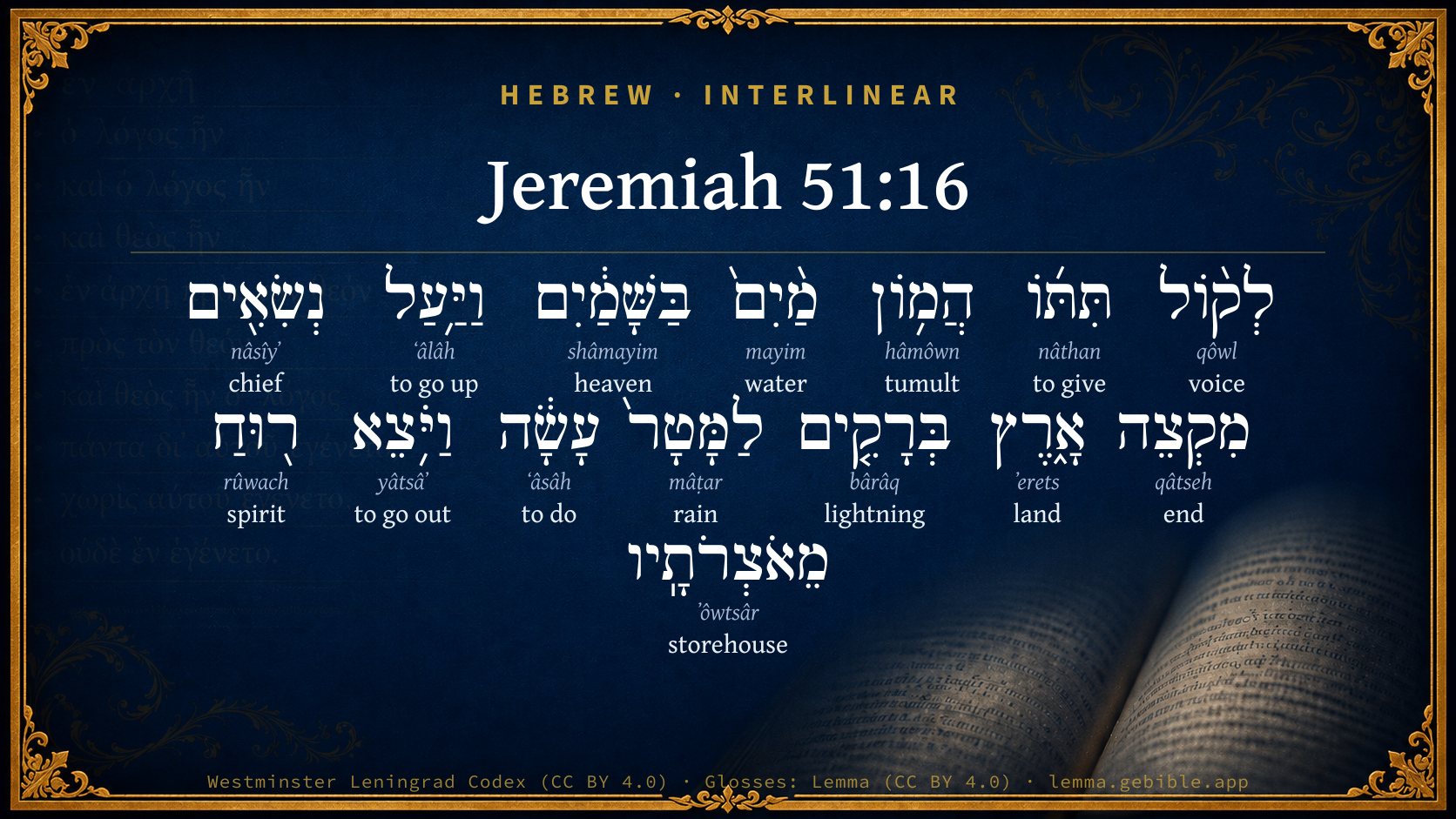
Hebrew (Westminster Leningrad Codex) Jeremiah 51:16 appears in the Hebrew Old Testament. The text above is from the Westminster Leningrad Codex. Each word links to its Strong’s number, a concise gloss, and parsing drawn from the Open Scriptures Hebrew Bible morphology. Click any word for its full Brown-Driver-Briggs (BDB) entry.
Download image
Cite this verse

Jeremiah 51:16 (World English Bible). Public Domain. Lemma interlinear Bible study tool, https://lemma.gebible.app/v/jeremiah/51/16.

Show BibTeX & RIS
BibTeX
RIS
English Translation
when he utters his voice, there is a tumult of waters in the heavens, and he causes the vapors to ascend from the ends of the earth; he makes lightnings for the rain, and brings forth the wind out of his treasuries.
World English Bible · Public Domain
Download a study sheet

One document with this verse’s original text, its word-by-word gloss line, the meaning frame, cross-references with their text, attributed commentary, and full source and license credits — printable, and it pastes into notes with its structure intact.

This verse Autodidact and up

Study sheet (.html) Plain text (.txt)

A passage Seminary Student

Up to 50 verses in one chapter. A passage sheet keeps up to 6 commentary sources and 12 cross-references per verse, in the order this page ranks them, and says so on the sheet whenever that leaves anything out. Ask for a single verse and you get the Autodidact verse sheet above.

Everything on this page stays free to read, with no account — the sheet is a download of what is already on screen, not access to it.

Want to remove ads? Support Godless Engineer
Compare translations 3

The same verse in 3 English versions, stacked beneath the original-language interlinear above. Click any original word for its lexicon entry.

Each is an independent rendering of the whole verse — the interlinear is not word-aligned to these translations.

Highlighted words mark where these versions differ — a whole-verse word diff, not a word-by-word alignment.

  • World English Bible Public Domain
    when he utters his voice, there is a tumult of waters in the heavens, and he causes the vapors to ascend from the ends of the earth; he makes lightnings for the rain, and brings forth the wind out of his treasuries.
  • King James Version Public Domain
    When he uttereth his voice, there is a multitude of waters in the heavens; and he causeth the vapours to ascend from the ends of the earth: he maketh lightnings with rain, and bringeth forth the wind out of his treasures.
  • unfoldingWord Literal Text CC BY-SA 4.0
    When he thunders, there is the roar of waters in the heavens, for he brings up the mist from the ends of the earth. He makes lightning for rain and sends out wind from his storehouses.

unfoldingWord Literal Text — © unfoldingWord, licensed CC BY-SA 4.0. Word-aligned USFM3 via Door43 (git.door43.org/unfoldingWord/en_ult).

Versions to compare (up to 4)

3 of 4 selected

Show all 18 translations

Every available English version of this verse, each an independent rendering of the whole verse.

  • World English Bible Public Domain
    when he utters his voice, there is a tumult of waters in the heavens, and he causes the vapors to ascend from the ends of the earth; he makes lightnings for the rain, and brings forth the wind out of his treasuries.
  • Berean Standard Bible Public Domain
    When He thunders, the waters in the heavens roar; He causes the clouds to rise from the ends of the earth. He generates the lightning with the rain and brings forth the wind from His storehouses.
  • Majority Standard Bible Public Domain
    When He thunders, the waters in the heavens roar; He causes the clouds to rise from the ends of the earth. He generates the lightning with the rain and brings forth the wind from His storehouses.
  • King James Version Public Domain
    When he uttereth his voice, there is a multitude of waters in the heavens; and he causeth the vapours to ascend from the ends of the earth: he maketh lightnings with rain, and bringeth forth the wind out of his treasures.
  • American Standard Version (1901) Public Domain
    when he uttereth his voice, there is a tumult of waters in the heavens, and he causeth the vapors to ascend from the ends of the earth; he maketh lightnings for the rain, and bringeth forth the wind out of his treasuries.
  • Revised Version (1885) Public Domain
    when he uttereth his voice, there is a tumult of waters in the heavens, and he causeth the vapours to ascend from the ends of the earth; he maketh lightnings for the rain, and bringeth forth the wind out of his treasuries.
  • Geneva Bible (1599) Public Domain
    Hee giueth by his voyce the multitude of waters in the heauen, and he causeth the cloudes to ascend from the endes of the earth: he turneth lightnings to raine, and bringeth forth the winde out of his treasures.
  • Douay-Rheims (1899) Public Domain
    When he uttereth his voice the waters are multiplied in heaven: he lifteth up the clouds from the ends of the earth, he hath turned lightning into rain: and hath brought forth the wind out of his treasures.
  • Young's Literal Translation Public Domain
    At the voice He giveth forth, A multitude of waters `are' in the heavens, And He causeth vapours to come up from the end of the earth, Lightnings for rain He hath made, And He bringeth out wind from His treasures.
  • Literal Standard Version CC BY-SA 4.0
    At the voice He gives forth, || A multitude of waters [are] in the heavens, || And He causes vapors to come up from the end of the earth, || He has made lightnings for rain, || And He brings out wind from His treasures.
  • Unlocked Literal Bible CC BY-SA 4.0
    When he thunders, there is the roar of waters in the heavens, for he brings up the mist from the ends of the earth. He makes lightning for rain and sends out wind from his storehouses.
  • unfoldingWord Literal Text CC BY-SA 4.0
    When he thunders, there is the roar of waters in the heavens, for he brings up the mist from the ends of the earth. He makes lightning for rain and sends out wind from his storehouses.
  • Darby Bible Public Domain
    When he uttereth his voice, there is a tumult of waters in the heavens, and he causeth the vapours to ascend from the end of the earth; he maketh lightnings for the rain, and bringeth forth the wind out of his treasures.
  • World Messianic Bible Public Domain
    When he utters his voice, there is a roar of waters in the heavens, and he causes the vapors to ascend from the ends of the earth. He makes lightning for the rain, and brings the wind out of his treasuries.
  • Webster's Bible Public Domain
    When he uttereth his voice, there is a multitude of waters in the heavens; and he causeth the vapors to ascend from the ends of the earth: he maketh lightnings with rain, and bringeth forth the wind out of his treasures.
  • Free Bible Version CC BY-SA 4.0
    The waters of the heavens rain down with a roar at his command. He makes the clouds to rise all over the earth. He makes lightning to accompany rain, and sends the wind from his storehouses.
  • Bible in Basic English Public Domain
    At the sound of his voice there is a massing of the waters in the heavens, and he makes the mists go up from the ends of the earth; he makes the thunder-flames for the rain and sends out the wind from his store-houses.
  • JPS Tanakh (1917) Public Domain
    At the sound of His giving a multitude of waters in the heavens, He causeth the vapours to ascend from the ends of the earth; He maketh lightnings at the time of the rain, and bringeth forth the wind out of His treasuries;

Literal Standard Version (2020), Covenant Press — licensed CC BY-SA 4.0. Text via the HelloAO Bible API (eBible.org). Unlocked Literal Bible (unfoldingWord) — licensed CC BY-SA 4.0. Text via the HelloAO Bible API (eBible.org). unfoldingWord Literal Text — © unfoldingWord, licensed CC BY-SA 4.0. Word-aligned USFM3 via Door43 (git.door43.org/unfoldingWord/en_ult). Free Bible Version, Dr. Jonathan Gallagher — licensed CC BY-SA 4.0. Text via the HelloAO Bible API (eBible.org).

Word by word

More ways to search: Search by grammar → Find every occurrence → Compare this word →

Practice this passage: Drill this verse → Learn its vocabulary →

בְּרָקִ֤ים
bârâq
H1300
“lightnings”
Noun, Common, Masculine, Plural, Absolute
Part of Speech
Noun
Type
Common
Gender
Masculine
Number
Plural
State
Absolute
Full BDB Definition

Origin: from H1299

TWOT: 287a

lightning - lightnings, lightning flashes - of flashing arrow-head (figuratively)
  1. לְק֨וֹל qôwl H6963 “to/for · voice of” Preposition + Noun, Common, Masculine, Singular, Construct
  2. תִּתּ֜וֹ nâthan H5414 “to give · him” Verb, Qal, Infinitive Construct + Suffix, Personal, 3rd Person, Masculine, Singular
  3. הֲמ֥וֹן hâmôwn H1995 “tumult of” Noun, Common, Masculine, Singular, Construct
  4. מַ֨יִם֙ mayim H4325 “water(s)” Noun, Common, Masculine, Plural, Absolute
  5. בַּשָּׁמַ֔יִם shâmayim H8064 “in/at the · heaven(s)” Preposition, Determined + Noun, Common, Masculine, Plural, Absolute
  6. וַיַּ֥עַל ʻâlâh H5927 “and · to go up” Conjunction + Verb, Hiphil, Sequential Imperfect, 3rd Person, Masculine, Singular
  7. נְשִׂאִ֖ים nâsîyʼ H5387 “chiefs” Noun, Common, Masculine, Plural, Absolute
  8. מִקְצֵה qâtseh H7097 “from · end of” Preposition + Noun, Common, Both, Singular, Construct
  9. אָ֑רֶץ ʼerets H776 “land” Noun, Common, Both, Singular, Absolute
  10. לַמָּטָר֙ mâṭar H4306 “to/for the · rain” Preposition, Determined + Noun, Common, Masculine, Singular, Absolute
  11. עָשָׂ֔ה ʻâsâh H6213 “to do” Verb, Qal, Perfect, 3rd Person, Masculine, Singular
  12. וַיֹּ֥צֵא yâtsâʼ H3318 “and · to go out” Conjunction + Verb, Hiphil, Sequential Imperfect, 3rd Person, Masculine, Singular
  13. ר֖וּחַ rûwach H7307 “spirit” Noun, Common, Both, Singular, Absolute
  14. מֵאֹצְרֹתָֽיו ʼôwtsâr H214 “from · storehouses · his” Preposition + Noun, Common, Masculine, Plural, Construct + Suffix, Personal, 3rd Person, Masculine, Singular

About this verse

These counts appear in no published source. They are computed here, from the morphology-tagged text and Lemma’s own curated glosses. What Lemma adds →

15
words
15
distinct lemmas
Prophets
section

Notable vocabulary

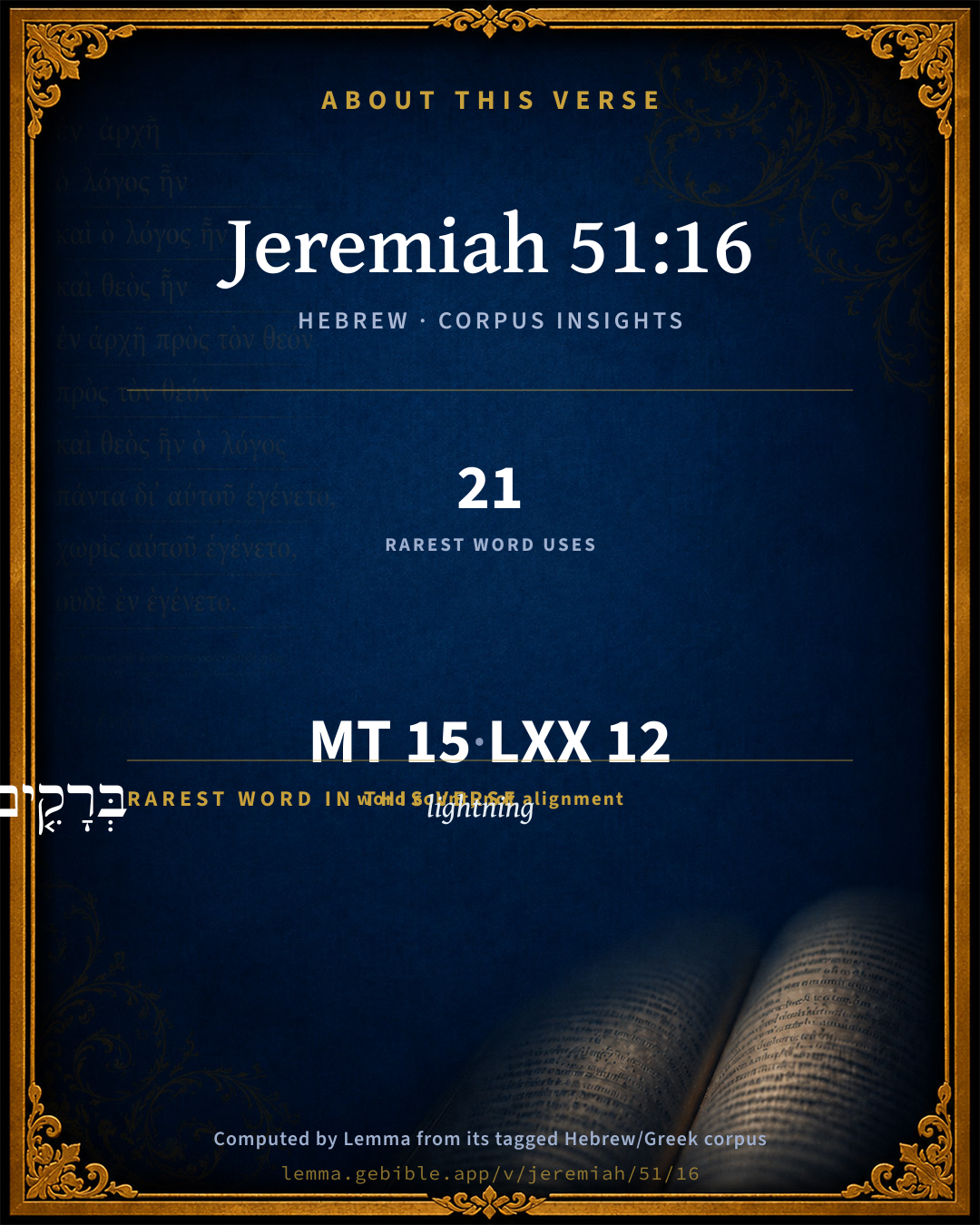
The rarest word here is בְּרָקִ֤ים lightning H1300 — appearing just 21 times in the whole Hebrew Bible.

Shared distinctive vocabulary

בְּרָקִ֤ים lightning H1300 occurs in 21 verses of the Hebrew Bible. Also found in:

Grammatical profile

  • 4 verbs
  • 11 nouns

Verb forms

  • תִּתּ֜וֹ Qal · Infinitive Construct
  • וַיַּ֥עַל Hiphil · Sequential Imperfect
  • עָשָׂ֔ה Qal · Perfect
  • וַיֹּ֥צֵא Hiphil · Sequential Imperfect

Hebrew & Septuagint length

In the original languages it is 15 Hebrew tokens and 12 Greek tokens — but the two are counted differently (Hebrew bundles its prefixes and suffixes into one token; the Greek is in lemma form), so that isn’t a like-for-like length.

Cross-references

24

Topical passages linked to Jeremiah 51:16 in the Treasury of Scripture Knowledge — connected by theme and wording, ordered by reader-vote popularity; previews shown in the World English Bible.

  • Psalms 135:7 Who causes the clouds to rise from the ends of the earth; Who makes lightnings with the rain; Who brings forth the wind out of his treasuries;
  • Psalms 18:13 Yahweh also thundered in the sky, The Most High uttered his voice: Hailstones and coals of fire.
  • Jonah 1:4 But Yahweh sent out a great wind on the sea, and there was a mighty tempest on the sea, so that the ship was likely to break up.
  • Jeremiah 10:12–13 He has made the earth by his power, he has established the world by his wisdom, and by his understanding has he stretched out the heavens:
  • Genesis 8:1 God remembered Noah, all the animals, and all the cattle that were with him in the ark; and God made a wind to pass over the earth. The waters subsided.
  • Exodus 10:13 Moses stretched forth his rod over the land of Egypt, and Yahweh brought an east wind on the land all that day, and all the night; and when it was morning, the east wind brought the locusts.
  • Exodus 10:19 Yahweh turned an exceeding strong west wind, which took up the locusts, and drove them into the Red Sea. There remained not one locust in all the borders of Egypt.
  • Exodus 14:21 Moses stretched out his hand over the sea, and Yahweh caused the sea to go back by a strong east wind all the night, and made the sea dry land, and the waters were divided.
  • Job 36:26–33 Behold, God is great, and we don't know him. The number of his years is unsearchable.
  • Job 37:2–11 Hear, oh, hear the noise of his voice, The sound that goes out of his mouth.
  • Job 37:13 Whether it is for correction, or for his land, Or for loving kindness, that he causes it to come.
  • Job 38:22 Have you entered the treasuries of the snow, Or have you seen the treasures of the hail,
  • Job 38:34–38 "Can you lift up your voice to the clouds, That abundance of waters may cover you?
  • Job 40:9 Or have you an arm like God? Can you thunder with a voice like him?
  • Psalms 29:3–10 Yahweh's voice is on the waters. The God of glory thunders, even Yahweh on many waters.
  • Psalms 46:6 The nations raged. The kingdoms were moved. He lifted his voice, and the earth melted.
  • Psalms 68:33 To him who rides on the heaven of heavens, which are of old; Behold, he utters his voice, a mighty voice.
  • Psalms 78:26 He caused the east wind to blow in the sky. By his power he guided the south wind.
  • Psalms 104:7 At your rebuke they fled. At the voice of your thunder they hurried away.
  • Psalms 147:18 He sends out his word, and melts them. He causes his wind to blow, and the waters flow.
  • Ezekiel 10:5 The sound of the wings of the cherubim was heard even to the outer court, as the voice of God Almighty when he speaks.
  • Amos 9:7 Are you not like the children of the Ethiopians to me, children of Israel?" says Yahweh. "Haven't I brought up Israel out of the land of Egypt, and the Philistines from Caphtor, and the Syrians from Kir?
  • Jonah 4:8 It happened, when the sun arose, that God prepared a sultry east wind; and the sun beat on Jonah's head, so that he fainted, and requested for himself that he might die, and said, "It is better for me to die than to live."
  • Matthew 8:26–27 He said to them, "Why are you fearful, oh you of little faith?" Then he got up, rebuked the wind and the sea, and there was a great calm.

Cross-references courtesy of OpenBible.info (CC BY 4.0).

Hebrew and Greek witnesses Masoretic Hebrew ↔ Greek Septuagint

The same verse in the two great witnesses to the Old Testament, shown verse-for-verse.

These are two independent witnesses, not word-aligned to each other, and the Septuagint is shown in lemma (dictionary) form.

Hebrew Jeremiah 51:16 Masoretic · Westminster Leningrad Codex

לְק֨וֹל תִּתּ֜וֹ הֲמ֥וֹן מַ֨יִם֙ בַּשָּׁמַ֔יִם וַיַּ֥עַל נְשִׂאִ֖ים מִקְצֵה אָ֑רֶץ בְּרָקִ֤ים לַמָּטָר֙ עָשָׂ֔ה וַיֹּ֥צֵא ר֖וּחַ מֵאֹצְרֹתָֽיו

when he utters his voice, there is a tumult of waters in the heavens, and he causes the vapors to ascend from the ends of the earth; he makes lightnings for the rain, and brings forth the wind out of his treasuries.

World English Bible · Public Domain

Greek LXX Structure differs

In the Septuagint, Jeremiah is about an eighth shorter than the Hebrew and arranges its material differently — the Oracles Against the Nations (Hebrew chapters 46–51) appear in the middle of the Greek book, after 25:13. Because the chapter and verse boundaries do not line up, a verse-for-verse comparison with the Hebrew is not shown.

A verse-for-verse comparison isn’t shown here because the chapters and verses don’t line up. Switch to the LXX edition with the MT / LXX toggle above to read the Greek directly.

Hebrew: Westminster Leningrad Codex (CC BY 4.0). Greek: Septuagint (public domain); English from a public-domain English Septuagint. How the Septuagint differs from the Hebrew →

Targum (Aramaic paraphrase)

1

The Targum is the ancient Jewish Aramaic paraphrase of the Hebrew Scriptures — an interpretive translation, not the Hebrew text itself. Onkelos (literal) and Pseudo-Jonathan (expansive) render the Torah, and Jonathan the Prophets. Coverage is partial: where no permissively-licensed English translation exists for a verse, only the Aramaic is shown. This is verse-level text, not a word-by-word alignment to the Hebrew.

  1. Targum Jonathan Prophets (Joshua–Malachi)
    לְקַל מִתְּנֵיהּ רִכְפַת דְמַיִין בִּשְׁמַיָא וּמַסֵיק עֲנָנִין מִסְיָפֵי אַרְעָא בַּרְקִין לִזְמַן מִטְרָא עָבִיד וּמַפִּיק רוּחִין מִבֵּית גִנְזוֹהִי:

    (no public-domain English translation for this verse)

    Targum Jonathan — Aramaic: “Mikraot Gedolot” (public domain). English: “Sefaria Community Translation” (CC0 1.0 (public-domain dedication)); “London "Chaldee Paraphrase," 1871” (public domain). Text via Sefaria.

Commentary

Notes on Jeremiah 51:16 from classic Christian and Jewish commentators (each source and its license shown beneath its notes). The classic Christian expositions comment on the surrounding passage and are grouped to its opening verse, so a note may address several verses; the Jewish commentaries on the Tanakh (Rashi and others) are per-verse, so they appear only where the commentator wrote on this verse.

Lemma curates 59 commentaries, every one of them public domain or Creative Commons licensed, each selected and text-cleaned for this edition rather than reprinted as found. About our sources →

Trapp's Complete Commentary

John Trapp

Jer 51:16 When he uttereth [his] voice, [there is] a multitude of waters in the heavens; and he causeth the vapours to ascend from the ends of the earth: he maketh lightnings with rain, and bringeth forth the wind out of his treasures.

Ver. 16. When he uttereth his voice, &c.] See Jer 10:13.

John Trapp, A Commentary or Exposition upon All the Books of the Old and New Testament (1647–1656) — public domain. Text from a community e-Sword module.

Adam Clarke's Commentary

Verse 16. When he uttereth his voice] Sends thunder.

There is a multitude of waters] For the electric spark, by decomposing atmospheric air, converts the hydrogen and oxygen gases, of which it is composed, into water; which falls down in the form of rain.

Causeth the vapours to ascend] He is the Author of that power of evaporation by which the water is rarified, and, being lighter than the air, ascends in form of vapour, forms clouds, and is ready to be sent down again to water the earth by the action of his lightnings, as before. And by those same lightnings, and the agency of heat in general, currents of air are formed, moving in various directions, which we call winds.

Adam Clarke's Commentary on the Bible (1810–1826) — public domain. Text from a community e-Sword/MySword module.

John Calvin's Commentaries

This, then, is the reason why the Prophet, after having briefly touched on what we have seen, adds, as evidences of God’s power and wisdom, those things which appear to us in their various changes. He then says, that by his voice alone he gives abundance of waters in the heavens, and then that he raises vapors from the extremity of the earth, that he creates lightnings and the rain, which yet seem to be contrary things. At last he says, that he brings the winds out of his treasures Philosophers indeed mention the causes of these things, but we ought to come to the fountain itself, and the original cause, even this, that things are so arranged in the world, that though there are intermediate and subordinate causes, yet the primary cause ever appears eminently, even the wisdom and power of God. Winds arise from the earth, even because exhalations proceed from it; but exhalations, by whom are they created? not by themselves: it hence follows, that God is their sole author. And he calls hidden places treasures: as when one draws out this or that from his storehouse, so he says that winds come forth from hidden places, not of themselves, but through God, who holds them as though they were shut up. I pass by these things by only touching on them, because I have already reminded you that we have before explained, in the tenth chapter (Jeremiah 10), what is here literally repeated. It now follows, —

John Calvin's Commentaries (1540-1563) — public domain. Text from the Calvin Translation Society English edition (1840s-50s) via the Christian Classics Ethereal Library (ccel.org). Calvin's coverage is partial (roughly two-thirds of the Bible); uncommented books and verses are honest gaps, never fabricated. The 19th-century editor's footnotes and remarks are omitted so the notes are faithfully Calvin's own voice.

The Cambridge Bible for Schools and Colleges

gen. ed. J. J. S. Perowne

16. his voice] in thunder. Cp. Jer_10:13.

The Cambridge Bible for Schools and Colleges (gen. ed. J. J. S. Perowne; Cambridge University Press, 1878–1918) — public domain. Text from a community e-Sword module.

John Gill's Exposition

When he uttereth his voice, there is a multitude of waters in the heavens; and he causeth the vapours to ascend from the ends of the earth: he maketh lightnings with rain, and bringeth forth the wind out of his treasures. See Gill on Jer 10:13.

.

Jeremiah 51:17

jer 51:17

jer 51:17

jer 51:17Every man is brutish by his knowledge; every founder is confounded by the graven image: for his molten image is falsehood,

and there is no breath in them. See Gill on Jer 10:14.

John Gill's Exposition of the Whole Bible (1746–1763) — public domain (CC PDM 1.0). Text via the HelloAO Bible API.

Haydock's Catholic Bible Commentary

Rain. Thunder and lightning are usually followed by showers. (Calmet)

George Leo Haydock (1774–1849), Haydock's Catholic Family Bible and Commentary, 1859 edition — public domain. Excludes Psalms (Douay-Rheims chapter numbering differs from Protestant) and Deuterocanonical books (Catholic canon only).

Lesson kit

Teaching starters — assembled from the data on this page, not authored interpretation. Every prompt links to the verse data it draws on. Edit before teaching.

Jeremiah, in the Prophets, opens this verse with 15 words (15 distinct Hebrew lemmas). Its most distinctive word is bârâq (“lightning”). A historical commentator’s framing appears above. Read the whole chapter for the surrounding context.

Discussion questions

  1. The word bârâq carries the sense “lightning.” How does it shape the verse?
  2. Exodus 19:16 shares the word «lightning» with this verse. How do the two illuminate each other?
  3. These translations render this verse differently. What is at stake in choosing one wording over another?
  4. The verb «תִּתּ֜וֹ» is Qal Infinitive Construct. How does its form color the action?
  5. Reading how Trapp's Complete Commentary and Adam Clarke's Commentary read this verse, where do the two commentators agree and where do they part?

Things to notice

Reading settings

Reading text

Shown beneath each verse's original-language words.

Old Testament
Old Testament edition

Read the OT as the Masoretic Hebrew (MT) or the Greek Septuagint (LXX).

English shown for the Greek Septuagint (in the Hebrew ↔ Greek comparison).

Comparing translations? Open the Compare panel on any verse page to stack up to four side by side.