
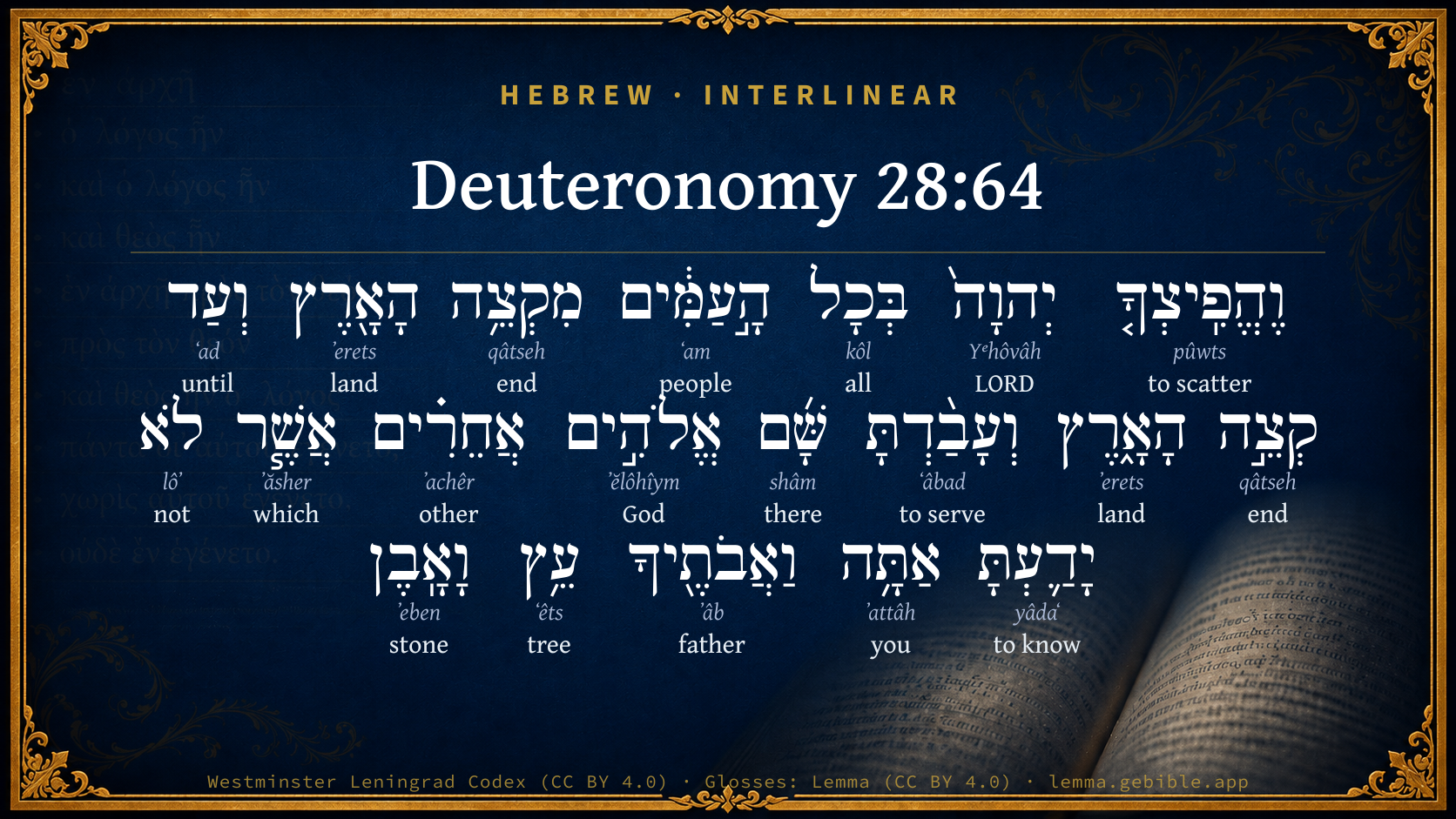
Deuteronomy 28:64

Hebrew (Westminster Leningrad Codex) Deuteronomy 28:64 appears in the Hebrew Old Testament. The text above is from the Westminster Leningrad Codex. Each word links to its Strong’s number, a concise gloss, and parsing drawn from the Open Scriptures Hebrew Bible morphology. Click any word for its full Brown-Driver-Briggs (BDB) entry.
Download image
Cite this verse

Deuteronomy 28:64 (World English Bible). Public Domain. Lemma interlinear Bible study tool, https://lemma.gebible.app/v/deuteronomy/28/64.

Show BibTeX & RIS
BibTeX
RIS
English Translation
Yahweh will scatter you among all peoples, from the one end of the earth even to the other end of the earth; and there you shall serve other gods, which you have not known, you nor your fathers, even wood and stone.
World English Bible · Public Domain
Download a study sheet

One document with this verse’s original text, its word-by-word gloss line, the meaning frame, cross-references with their text, attributed commentary, and full source and license credits — printable, and it pastes into notes with its structure intact.

This verse Autodidact and up

Study sheet (.html) Plain text (.txt)

A passage Seminary Student

Up to 50 verses in one chapter. A passage sheet keeps up to 6 commentary sources and 12 cross-references per verse, in the order this page ranks them, and says so on the sheet whenever that leaves anything out. Ask for a single verse and you get the Autodidact verse sheet above.

Everything on this page stays free to read, with no account — the sheet is a download of what is already on screen, not access to it.

Want to remove ads? Support Godless Engineer
Compare translations 3

The same verse in 3 English versions, stacked beneath the original-language interlinear above. Click any original word for its lexicon entry.

Each is an independent rendering of the whole verse — the interlinear is not word-aligned to these translations.

Highlighted words mark where these versions differ — a whole-verse word diff, not a word-by-word alignment.

  • World English Bible Public Domain
    Yahweh will scatter you among all peoples, from the one end of the earth even to the other end of the earth; and there you shall serve other gods, which you have not known, you nor your fathers, even wood and stone.
  • King James Version Public Domain
    And the LORD shall scatter thee among all people, from the one end of the earth even unto the other; and there thou shalt serve other gods, which neither thou nor thy fathers have known, even wood and stone.
  • unfoldingWord Literal Text CC BY-SA 4.0
    And Yahweh will scatter you among all the peoples from end of the earth and to the end of the earth, and there you will serve other gods of wood and stone that you have not known, you or your fathers.

unfoldingWord Literal Text — © unfoldingWord, licensed CC BY-SA 4.0. Word-aligned USFM3 via Door43 (git.door43.org/unfoldingWord/en_ult).

Versions to compare (up to 4)

3 of 4 selected

Show all 18 translations

Every available English version of this verse, each an independent rendering of the whole verse.

  • World English Bible Public Domain
    Yahweh will scatter you among all peoples, from the one end of the earth even to the other end of the earth; and there you shall serve other gods, which you have not known, you nor your fathers, even wood and stone.
  • Berean Standard Bible Public Domain
    Then the LORD will scatter you among all the nations, from one end of the earth to the other, and there you will worship other gods, gods of wood and stone, which neither you nor your fathers have known.
  • Majority Standard Bible Public Domain
    Then the LORD will scatter you among all the nations, from one end of the earth to the other, and there you will worship other gods, gods of wood and stone, which neither you nor your fathers have known.
  • King James Version Public Domain
    And the LORD shall scatter thee among all people, from the one end of the earth even unto the other; and there thou shalt serve other gods, which neither thou nor thy fathers have known, even wood and stone.
  • American Standard Version (1901) Public Domain
    And Jehovah will scatter thee among all peoples, from the one end of the earth even unto the other end of the earth; and there thou shalt serve other gods, which thou hast not known, thou nor thy fathers, even wood and stone.
  • Revised Version (1885) Public Domain
    And the LORD shall scatter thee among all peoples, from the one end of the earth even unto the other end of the earth; and there thou shalt serve other gods, which thou hast not known, thou nor thy fathers, even wood and stone.
  • Geneva Bible (1599) Public Domain
    And the Lord shall scatter thee among all people, from the one ende of the worlde vnto the other, and there thou shalt serue other gods, which thou hast not knowen nor thy fathers, euen wood and stone.
  • Douay-Rheims (1899) Public Domain
    The Lord shall scatter thee among all people, from the farthest parts of the earth to the ends thereof: and there thou shalt serve strange gods, which both thou art ignorant of and thy fathers, wood and stone.
  • Young's Literal Translation Public Domain
    and Jehovah hath scattered thee among all the peoples, from the end of the earth even unto the end of the earth; and thou hast served there other gods which thou hast not known, thou and thy fathers -- wood and stone.
  • Literal Standard Version CC BY-SA 4.0
    and YHWH has scattered you among all the peoples, from the end of the earth even to the [other] end of the earth; and you have served other gods there which you have not known, you and your fathers—wood and stone.
  • Unlocked Literal Bible CC BY-SA 4.0
    Yahweh will scatter you among all peoples from the one end of the earth to the other end of the earth; there you will worship other gods that you have not known, neither you nor your ancestors, gods of wood and stone.
  • unfoldingWord Literal Text CC BY-SA 4.0
    And Yahweh will scatter you among all the peoples from end of the earth and to the end of the earth, and there you will serve other gods of wood and stone that you have not known, you or your fathers.
  • Darby Bible Public Domain
    And Jehovah will scatter thee among all peoples, from one end of the earth even unto the other end of the earth; and thou shalt there serve other gods, whom thou hast not known, neither thou nor thy fathers, wood and stone.
  • World Messianic Bible Public Domain
    The LORD will scatter you among all peoples, from one end of the earth to the other end of the earth. There you will serve other gods which you have not known, you nor your fathers, even wood and stone.
  • Webster's Bible Public Domain
    And the LORD shall scatter thee among all people from the one end of the earth even to the other; and there thou shalt serve other gods, which neither thou nor thy fathers have known, even wood and stone.
  • Free Bible Version CC BY-SA 4.0
    The Lord will scatter you among the nations all over the earth, and there you will worship other gods, gods made of wood and stone, which you and your fathers had never heard of.
  • Bible in Basic English Public Domain
    And the Lord will send you wandering among all peoples, from one end of the earth to the other: there you will be servants to other gods, of wood and stone, gods of which you and your fathers had no knowledge.
  • JPS Tanakh (1917) Public Domain
    And the LORD shall scatter thee among all peoples, from the one end of the earth even unto the other end of the earth; and there thou shalt serve other gods, which thou hast not known, thou nor thy fathers, even wood and stone.

Literal Standard Version (2020), Covenant Press — licensed CC BY-SA 4.0. Text via the HelloAO Bible API (eBible.org). Unlocked Literal Bible (unfoldingWord) — licensed CC BY-SA 4.0. Text via the HelloAO Bible API (eBible.org). unfoldingWord Literal Text — © unfoldingWord, licensed CC BY-SA 4.0. Word-aligned USFM3 via Door43 (git.door43.org/unfoldingWord/en_ult). Free Bible Version, Dr. Jonathan Gallagher — licensed CC BY-SA 4.0. Text via the HelloAO Bible API (eBible.org).

Word by word

More ways to search: Search by grammar → Find every occurrence → Compare this word →

Practice this passage: Drill this verse → Learn its vocabulary →

וֶהֱפִֽיצְךָ֤
pûwts
H6327
“and · to scatter · you”
Conjunction + Verb, Hiphil, Sequential Perfect, 3rd Person, Masculine, Singular + Suffix, Personal, 2nd Person, Masculine, Singular
Part of Speech
Conjunction + Verb
Stem
Hiphil
Form
Sequential Perfect
Person
3rd Person
Gender
Masculine
Number
Singular
Full BDB Definition

Origin: a primitive root

TWOT: 1745 , 1746 , 1800

to scatter, be dispersed, be scattered - (Qal) to be dispersed, be scattered - (Niphal) - to be scattered - to be spread abroad - (Hiphil) to scatter - Hithpael) scatter - (Qal) to flow, overflow - to break - (Polel) to shatter - (Pilpel) to dash to pieces
  1. יְהוָה֙ Yᵉhôvâh H3068 “LORD” Noun, Proper
  2. בְּכָל kôl H3605 “in/at · all of” Preposition + Noun, Common, Masculine, Singular, Construct
  3. הָ֣עַמִּ֔ים ʻam H5971 “the · peoples” Particle, Definite Article + Noun, Common, Masculine, Plural, Absolute
  4. מִקְצֵ֥ה qâtseh H7097 “from · end of” Preposition + Noun, Common, Both, Singular, Construct
  5. הָאָ֖רֶץ ʼerets H776 “the · land” Particle, Definite Article + Noun, Common, Both, Singular, Absolute
  6. וְעַד ʻad H5704 “and · until” Conjunction + Preposition
  7. קְצֵ֣ה qâtseh H7097 “end of” Noun, Common, Both, Singular, Construct
  8. הָאָ֑רֶץ ʼerets H776 “the · land” Particle, Definite Article + Noun, Common, Both, Singular, Absolute
  9. וְעָבַ֨דְתָּ ʻâbad H5647 “and · to serve” Conjunction + Verb, Qal, Sequential Perfect, 2nd Person, Masculine, Singular
  10. שָּׁ֜ם shâm H8033 “there” Adverb
  11. אֱלֹהִ֣ים ʼĕlôhîym H430 “God(s)” Noun, Common, Masculine, Plural, Absolute
  12. אֲחֵרִ֗ים ʼachêr H312 “other” Adjective, Adjective, Masculine, Plural, Absolute
  13. אֲשֶׁ֧ר ʼăsher H834 “which” Particle, Relative
  14. לֹא lôʼ H3808 “not” Particle, Negative
  15. יָדַ֛עְתָּ yâdaʻ H3045 “to know” Verb, Qal, Perfect, 2nd Person, Masculine, Singular
  16. אַתָּ֥ה ʼattâh H859 “you” Pronoun, Personal, 2nd Person, Masculine, Singular
  17. וַאֲבֹתֶ֖יךָ ʼâb H1 “and · fathers · your” Conjunction + Noun, Common, Masculine, Plural, Construct + Suffix, Personal, 2nd Person, Masculine, Singular
  18. עֵ֥ץ ʻêts H6086 “tree” Noun, Common, Masculine, Singular, Absolute
  19. וָאָֽבֶן ʼeben H68 “and · stone” Conjunction + Noun, Common, Feminine, Singular, Absolute

About this verse

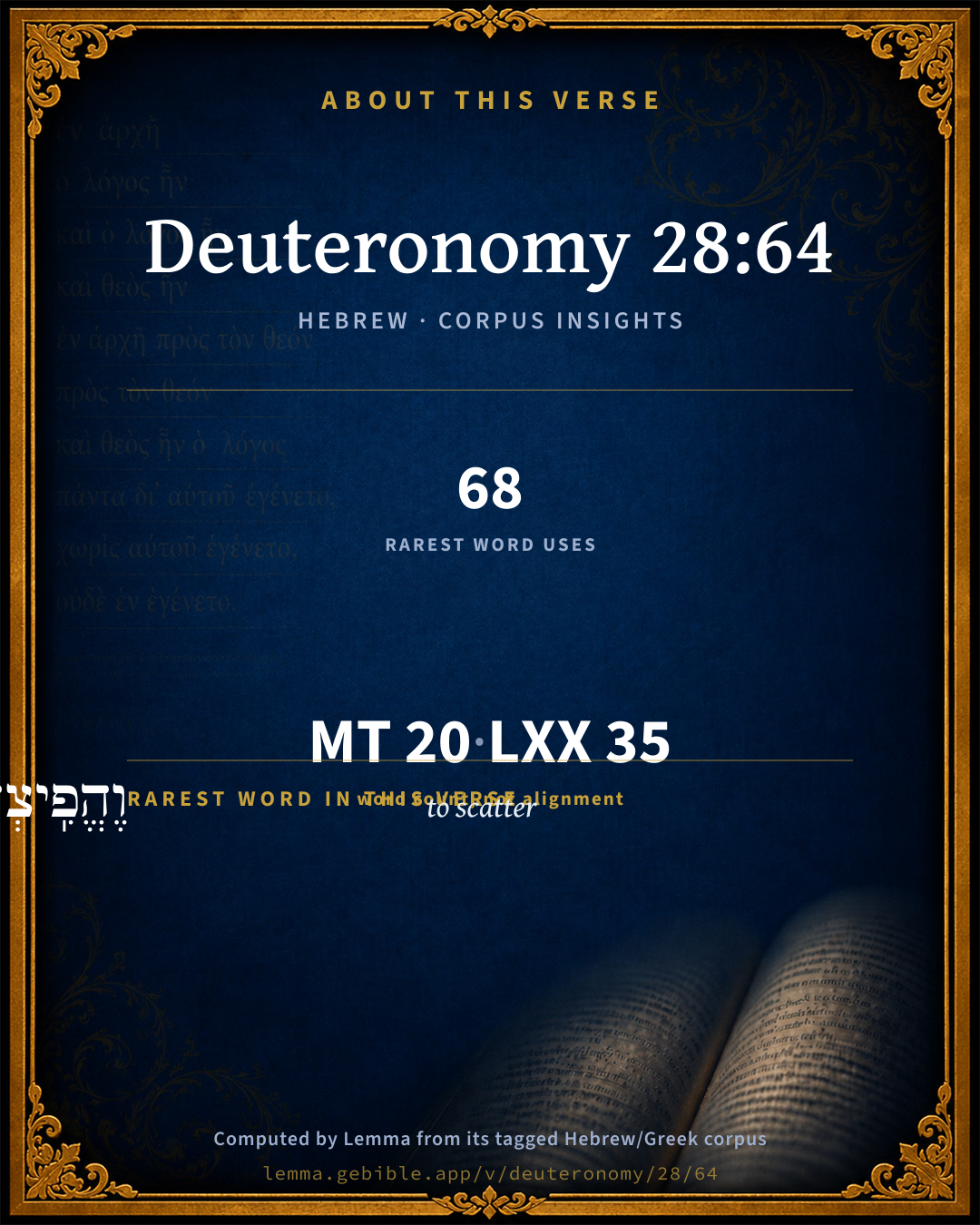
These counts appear in no published source. They are computed here, from the morphology-tagged text and Lemma’s own curated glosses. What Lemma adds →

20
words
18
distinct lemmas
Pentateuch
section

Grammatical profile

  • 3 verbs
  • 11 nouns
  • 1 adjective
  • 1 pronoun
  • 1 preposition
  • 1 adverb
  • 2 particles

Verb forms

  • וֶהֱפִֽיצְךָ֤ Hiphil · Sequential Perfect
  • וְעָבַ֨דְתָּ Qal · Sequential Perfect
  • יָדַ֛עְתָּ Qal · Perfect

Repetition

Words recur within this verse — often emphatic in Hebrew:

  • מִקְצֵ֥ה end H7097 ×2
  • הָאָ֖רֶץ land H776 ×2

Hebrew & Septuagint length

In English translation the verse runs 42 words from the Hebrew and 38 from the Septuagint (LXX English) — closely comparable.

A rough comparison of the two English renderings, which tokenize alike — not a word-level alignment.

Word counts can differ between the Hebrew and the Greek without any difference in meaning — e.g. the Hebrew direct-object marker אֵת has no separate Greek word, and Greek often adds the article ὁ.

In the original languages it is 20 Hebrew tokens and 35 Greek tokens — but the two are counted differently (Hebrew bundles its prefixes and suffixes into one token; the Greek is in lemma form), so that isn’t a like-for-like length.

Cross-references

8

Topical passages linked to Deuteronomy 28:64 in the Treasury of Scripture Knowledge — connected by theme and wording, ordered by reader-vote popularity; previews shown in the World English Bible.

  • Leviticus 26:33 I will scatter you among the nations, and I will draw out the sword after you: and your land will be a desolation, and your cities shall be a waste.
  • Deuteronomy 4:27–28 Yahweh will scatter you among the peoples, and you shall be left few in number among the nations, where Yahweh shall lead you away.
  • Deuteronomy 28:36 Yahweh will bring you, and your king whom you shall set over you, to a nation that you have not known, you nor your fathers; and there shall you serve other gods, wood and stone.
  • Nehemiah 1:8 Remember, I beg you, the word that you commanded your servant Moses, saying, If you trespass, I will scatter you abroad among the peoples:
  • Jeremiah 16:13 therefore will I cast you forth out of this land into the land that you have not known, neither you nor your fathers; and there shall you serve other gods day and night; for I will show you no favor.
  • Jeremiah 50:17 Israel is a hunted sheep; the lions have driven him away: first, the king of Assyria devoured him; and now at last Nebuchadrezzar king of Babylon has broken his bones.
  • Luke 21:24 They will fall by the edge of the sword, and will be led captive into all the nations. Jerusalem will be trampled down by the Gentiles, until the times of the Gentiles are fulfilled.
  • Ezekiel 11:16–17 Therefore say, Thus says the Lord Yahweh: Whereas I have removed them far off among the nations, and whereas I have scattered them among the countries, yet will I be to them a sanctuary for a little while in the countries where they are come.

Cross-references courtesy of OpenBible.info (CC BY 4.0).

Hebrew and Greek witnesses Masoretic Hebrew ↔ Greek Septuagint

The same verse in the two great witnesses to the Old Testament, shown verse-for-verse.

These are two independent witnesses, not word-aligned to each other, and the Septuagint is shown in lemma (dictionary) form.

Hebrew Deuteronomy 28:64 Masoretic · Westminster Leningrad Codex

וֶהֱפִֽיצְךָ֤ יְהוָה֙ בְּכָל הָ֣עַמִּ֔ים מִקְצֵ֥ה הָאָ֖רֶץ וְעַד קְצֵ֣ה הָאָ֑רֶץ וְעָבַ֨דְתָּ שָּׁ֜ם אֱלֹהִ֣ים אֲחֵרִ֗ים אֲשֶׁ֧ר לֹא יָדַ֛עְתָּ אַתָּ֥ה וַאֲבֹתֶ֖יךָ עֵ֥ץ וָאָֽבֶן

Yahweh will scatter you among all peoples, from the one end of the earth even to the other end of the earth; and there you shall serve other gods, which you have not known, you nor your fathers, even wood and stone.

World English Bible · Public Domain

Greek LXX Deuteronomy 28:64 Septuagint · lemma form

καί διασπείρω σύ κύριος ὁ θεός σύ εἰς πᾶς ὁ ἔθνος ἀπό ἄκρος ὁ γῆ ἕως ἄκρος ὁ γῆ καί δουλεύω ἐκεῖ θεός ἕτερος ξύλον καί λίθος ὅς οὐ ἐπίσταμαι σύ καί ὁ πατήρ σύ

And the Lord your God shall scatter you among all nations, from one end of the earth to the other; and you shall there serve other gods, wood and stone, which you have not known, nor your fathers.

LXX2012 (modern English Septuagint) · Public Domain

Hebrew: Westminster Leningrad Codex (CC BY 4.0). Greek: Septuagint (public domain); English from LXX2012 (modern English Septuagint) (Public Domain). How the Septuagint differs from the Hebrew →

Targum (Aramaic paraphrase)

2

The Targum is the ancient Jewish Aramaic paraphrase of the Hebrew Scriptures — an interpretive translation, not the Hebrew text itself. Onkelos (literal) and Pseudo-Jonathan (expansive) render the Torah, and Jonathan the Prophets. Coverage is partial: where no permissively-licensed English translation exists for a verse, only the Aramaic is shown. This is verse-level text, not a word-by-word alignment to the Hebrew.

  1. Targum Onkelos Torah (Genesis–Deuteronomy)
    וִיבַדְרִנָךְ יְיָ בְּכָל עַמְמַיָא מִסְיָפֵי אַרְעָא וְעַד סְיָפֵי אַרְעָא וְתִפְלַח תַּמָן לְעַמְמַיָא פָּלְחֵי טַעֲוָתָא דִי לָא יְדַעְתְּ אַתְּ וַאֲבָהָתָךְ אָעָא וְאַבְנָא

    (no public-domain English translation for this verse)

    Targum Onkelos — Aramaic: “Onkelos Genesis” (public domain); “Onkelos Exodus” (public domain); “Onkelos Leviticus” (public domain); “Onkelos Numbers” (public domain); “Onkelos Deuteronomy” (public domain). English: “Sefaria Community Translation” (CC0 1.0 (public-domain dedication)); “J.W. Etheridge. The Targums of Onkelos and Jonathan Ben Uzziel on the Pentateuch. London: Longmans, Green, 1862” (public domain). Text via Sefaria.

  2. Targum Pseudo-Jonathan Torah (Genesis–Deuteronomy)
    וִיבַדְרְכוֹן יְיָ בֵּינֵי כָּל עַמְמַיָא מִסְיָיפֵי אַרְעָא וְעַד סְיָיפֵי אַרְעָא וְתֶהֱווֹן מְסַק אַרְנוֹנָא לְפַלְחֵי טַעֲוָותָא דְלָא יְדַעְתּוּן אַתְּ וְאַבְהָתָךְ דְמִן קִיסִין וְאַבְנִין

    And the Lord will disperse you among all nations, from one end of the earth to the other, and you shall be tributaries to the worshippers of idols of wood and stone which neither thou nor thy fathers have known.

    Targum Pseudo-Jonathan — Aramaic: “Targum Jonathan on Genesis” (public domain); “Targum Jonathan on Exodus” (public domain); “Targum Jonathan on Leviticus” (public domain); “Targum Jonathan on Numbers” (public domain); “Targum Jonathan on Deuteronomy” (public domain). English: “The Targum of Jonathan ben Uzziel, trans. J. W. Etheridge, London, 1862” (public domain). Text via Sefaria.

Commentary

Notes on Deuteronomy 28:64 from classic Christian and Jewish commentators (each source and its license shown beneath its notes). The classic Christian expositions comment on the surrounding passage and are grouped to its opening verse, so a note may address several verses; the Jewish commentaries on the Tanakh (Rashi and others) are per-verse, so they appear only where the commentator wrote on this verse.

Lemma curates 59 commentaries, every one of them public domain or Creative Commons licensed, each selected and text-cleaned for this edition rather than reprinted as found. About our sources →

Trapp's Complete Commentary

John Trapp

Deu 28:64 And the LORD shall scatter thee among all people, from the one end of the earth even unto the other; and there thou shalt serve other gods, which neither thou nor thy fathers have known, [even] wood and stone.

Ver. 64. And the Lord shall scatter thee.] The Jews are to this day a miserable, dejected, and dispersed people, abhorred of God and men, and exiled out of the world, as it were, by a common consent of nations.

John Trapp, A Commentary or Exposition upon All the Books of the Old and New Testament (1647–1656) — public domain. Text from a community e-Sword module.

Joseph Benson's Commentary

Deu 28:64. The Lord shall scatter thee among all people — According to Nehemiah, (Neh 1:8-9,) these words were fulfilled in the Babylonish captivity; but they have been far more amply fulfilled since the great dispersion of the Jews by the Romans. “What people have been scattered so far and wide as they? And where is the nation that is a stranger to them, or to which they are strangers? They swarm in many parts of the East, are spread through most of the countries of Europe and Africa, and there are several families of them in the West Indies. They circulate through all parts, and are, as one may say, the brokers of the whole world.” — Bp. Newton.

Joseph Benson's Commentary on the Old and New Testaments (1811–1818) — public domain. Text from a community e-Sword module.

Tyndale Open Study Notes

Tyndale Open Resources

28:64 foreign gods: This phrase does not suggest the actual existence of other deities. The Old Testament is clear that there is only one God, the Lord. However, the pagans among whom Israel would live did worship other gods; the danger was that Israel would adopt the same practices.

Tyndale Open Study Notes — © Tyndale Open Resources, licensed CC BY-SA 4.0. Text via the HelloAO Bible API.

Geneva Bible (1599)

Geneva Bible translators

Signifying that it is a singular gift of God to be in a place whereas we may worship God purely, and declare our faith and religion.

Geneva Bible (1599) marginal notes — public domain. Text via Bolls.life.

Jamieson, Fausset & Brown

Robert Jamieson, A. R. Fausset & David Brown

the Lord shall scatter thee among all people--There is, perhaps, not a country in the world where Jews are not to be found. Who that looks on this condition of the Hebrews is not filled with awe, when he considers the fulfilment of this prophecy?

Jamieson, Fausset & Brown — Commentary Critical and Explanatory on the Whole Bible (1871) — public domain (CC PDM 1.0). Text via the HelloAO Bible API.

Adam Clarke's Commentary

Verse 64. The Lord shall scatter thee among all people] How literally has this been fulfilled! The people of the Jews are scattered over every nation under heaven.

Adam Clarke's Commentary on the Bible (1810–1826) — public domain. Text from a community e-Sword/MySword module.

Ellicott's Commentary for English Readers

(64) And the Lord shall scatter thee among all people.—Fulfilled, literally, in this last dispersion.

Thou shalt serve other gods.—We do not know of Israel’s falling into actual idolatry in dispersion, except in Egypt (Jer_44:17), and possibly in Babylon (Eze_14:22-23. Comp. Deu_33:25). But they were slaves to the worshippers of other gods.

A Bible Commentary for English Readers, edited by Charles John Ellicott (1878–1897) — public domain. Text from a community e-Sword module.

The Cambridge Bible for Schools and Colleges

gen. ed. J. J. S. Perowne

64. Cp. Deu_4:27 f., in the Pl. address. From the one end, etc., Deu_13:7 (8). On other gods, etc., Deu_13:6 (7); wood and stone, Deu_4:28.

The Cambridge Bible for Schools and Colleges (gen. ed. J. J. S. Perowne; Cambridge University Press, 1878–1918) — public domain. Text from a community e-Sword module.

John Gill's Exposition

And the Lord shall bring thee into Egypt again with ships,.... Either into a state of hard bondage and slavery, like that their fathers were in, in Egypt; or rather, strictly and literally, should be brought into Egypt again, since it is said to be "with" or "in ships". This does not respect the going of those Jews into Egypt who were left in the land of Judea, after the destruction of Jerusalem by Nebuchadnezzar; for that was against the express command of God, Jer 42:13. There were several movings of them into Egypt after that time; an Heathen historian (w) tells us, that not a few thousands of Jews went into Egypt and Phoenicia, because of the sedition in Syria after the death of Alexander; and where, it seems, in process of time, they became slaves: for we are told by Josephus (x), that 120,000 slaves were set free by Ptolemy Philadelphus; but what is chiefly respected here is their case in the times of the Romans, and by their means. Now when Jerusalem was taken by Titus, those above seventeen years of age were sent by him to the works, or mines, in Egypt, as the same historian relates (y); and after their last overthrow by Adrian many thousands were sold, and what could not be sold were transported into Egypt, and perished by "shipwreck", or famine, or were slaughtered by the people (z) whereby this prophecy was literally and exactly fulfilled, and which is owned by the Jews themselves. Manasseh Ben Israel (a) observes, that though Vespasian banished the Jews into various countries, Egypt is only mentioned by way of reproach, as if it had been said, ye shall go captives into the land from which ye went out triumphant:

by the way whereof I spake unto thee, thou shall see it no more again; the Targum of Jonathan is,"the Word of the Lord shall bring thee into Egypt again in ships;''even the same divine Word, the Son of God, that brought them out of it, and went before them in a pillar of cloud and fire, now provoked by their rejection of him, would lead them back again thither; the paraphrast adds,"through the midst of the Red sea, in the path in which ye passed;''as if they were carried over into Egypt in ships, just in that part of the sea in which they had passed before; but that was an unknown and unseen path, after the waters were closed up, and never to be seen more, and which is here meant; for not Egypt, but the way in which they passed, was to be seen no more:

and there ye shall be sold unto your enemies for bondmen and for bondwomen, and no man shall buy you; that is, there in Egypt they would be offered to sale, and so many would be sold until the market was glutted with them, and there would be no buyers. The Targum of Jonathan is,"ye shall be sold there at first to your enemies, at a dear price, as artificers, and afterwards at a mean price as servants and handmaids, until ye become despised, and be brought to serve for nothing, and there be none to take you in.''Jarchi interprets it of they themselves being desirous, and seeking to be sold, to avoid cruelties and death; which agrees with the sense of the word, which may be rendered, "ye shall offer yourselves for sale"; but there will be no buyer, because their enemies will determine upon the slaughter and consumption of them; and to the same purpose Aben Ezra. There were such numbers of them to be sold both at Egypt and at Rome, that the sellers of them had but a poor market for them; and it seems not only because of their number, but the ill opinion had of them as servants. Hegesippus (b) says,"there were many to be sold, but there were few buyers; for the Romans despised the Jews for service, nor were there Jews left to redeem their own.''It is said (c), that thirty were sold for a penny; a just retaliation to them, who had sold their Messiah for thirty pieces of silver.

(w) Hecataeus apud Joseph. contr. Apion, l. 1. sect. 22. (x) Antiqu. l. 12. c. 2. sect. 1. (y) De Bello Jud. l. 6. c. 9. sect. 2. (z) Hieron. in Zech. ii. fol. 120. I. (a) De Termino Vitae, l. 3. sect. 3. p. 131, 132. (b) De excidio Urb. Hieros. l. 5. c. 47. p. 645. (c) Ib. p. 680.

Next: Deuteronomy Chapter 29

John Gill's Exposition of the Whole Bible (1746–1763) — public domain (CC PDM 1.0). Text via the HelloAO Bible API.

Whedon's Commentary on the Bible

Daniel D. Whedon

64. The Lord shall scatter thee — Comp. Deu_4:27; also Lev_26:33; Neh_1:8; Jer_16:13; also Josephus’s Jewish War, Deu_6:9; Deu_6:2.

Daniel D. Whedon (gen. ed.), Commentary on the Old and New Testaments (1874–1909) — public domain. Text from a community e-Sword module.

The Pulpit Commentary

Those of them that survived the plagues that should come upon them, and the horrors of the siege, should be scattered amongst all nations to the ends of the earth, and there subjugated to the utmost indignities and sufferings.

The Pulpit Commentary (1880–1919), ed. H.D.M. Spence-Jones & Joseph S. Exell — public domain. Text from a community e-Sword module.

Rashi

Rabbi Shlomo Yitzchaki (Rashi)

ועבדתם שם אלהים אחרים AND YE WILL SERVE THERE OTHER GODS — Understand this as the Targum does: (ye will serve the peoples that worship idols); not actually that they shall serve idols, but they will have to pay tribute and poll-taxes to the priests of the idols.

Rashi on the Tanakh — English translations: “The Judaica Press complete Tanach with Rashi, translated by A. J. Rosenberg” (CC BY 4.0); “Pentateuch with Rashi's commentary by M. Rosenbaum and A.M. Silbermann, 1929-1934” (public domain); “The Metsudah Tanach series, Lakewood, N.J” (CC BY 4.0); and “The Book of Joshua, Metsudah Publications, 1997” (CC BY 4.0). Text via Sefaria.

Lesson kit

Teaching starters — assembled from the data on this page, not authored interpretation. Every prompt links to the verse data it draws on. Edit before teaching.

Deuteronomy, in the Pentateuch, opens this verse with 20 words (18 distinct Hebrew lemmas). Its most distinctive word is pûwts (“to scatter”). A historical commentator’s framing appears above. Read the whole chapter for the surrounding context.

Discussion questions

  1. The word pûwts carries the sense “to scatter.” How does it shape the verse?
  2. How does Leviticus 26:33, which shares this passage’s theme, read alongside this verse?
  3. What does the repetition of “end” (2× in this one verse) do in this verse?
  4. The translations on this page render this verse differently — a whole-verse word diff, not a word-by-word alignment. What might account for the different wordings?
  5. «וֶהֱפִֽיצְךָ֤» is a Hiphil Sequential Perfect verb. How does that grammatical form shape the action described?
  6. Compare how Trapp's Complete Commentary and Joseph Benson's Commentary read this verse. Where do they agree or differ?

Things to notice

Reading settings

Reading text

Shown beneath each verse's original-language words.

Old Testament
Old Testament edition

Read the OT as the Masoretic Hebrew (MT) or the Greek Septuagint (LXX).

English shown for the Greek Septuagint (in the Hebrew ↔ Greek comparison).

Comparing translations? Open the Compare panel on any verse page to stack up to four side by side.