
Ezekiel 33:2

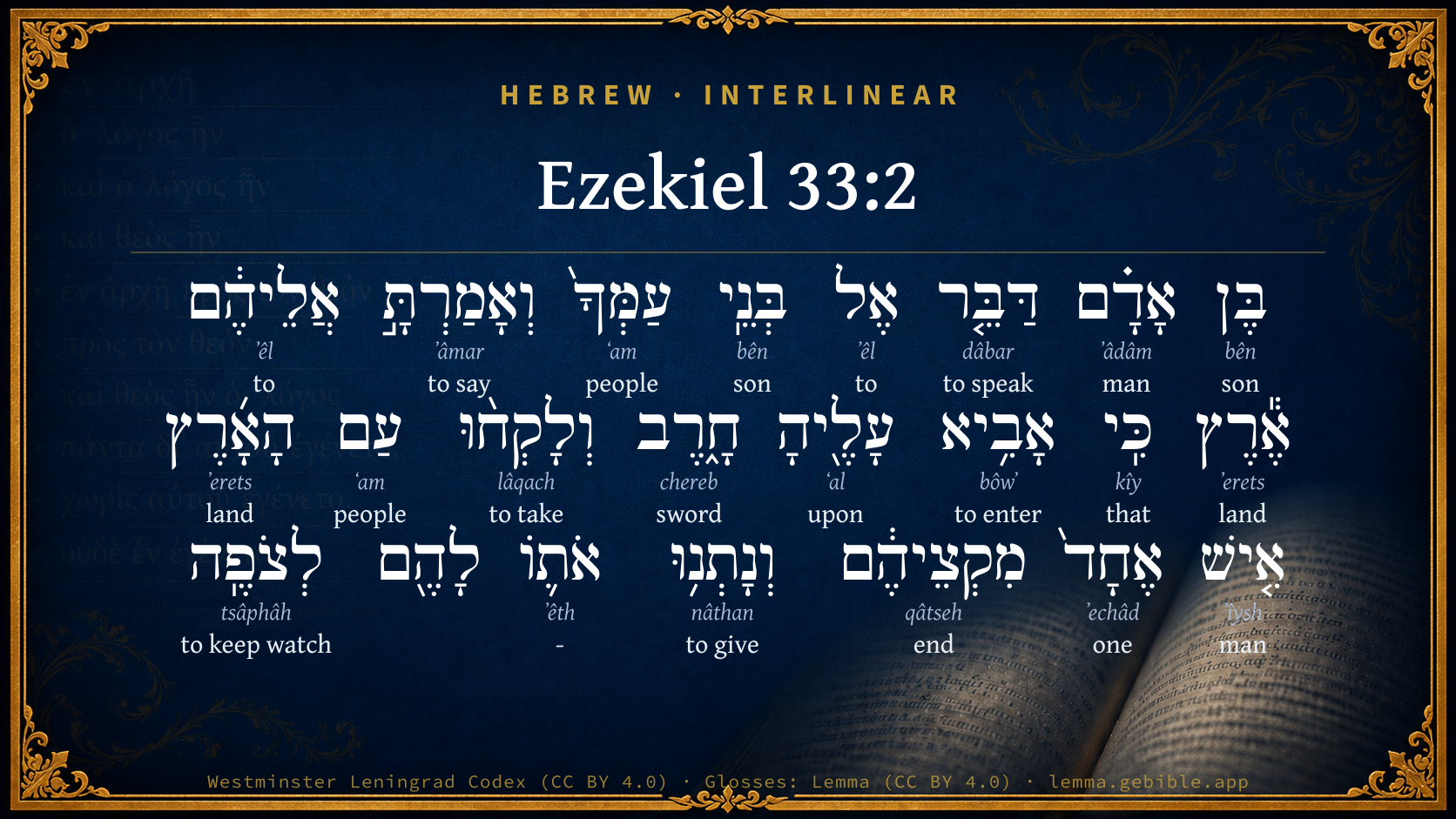
Hebrew (Westminster Leningrad Codex) Ezekiel 33:2 appears in the Hebrew Old Testament. The text above is from the Westminster Leningrad Codex. Each word links to its Strong’s number, a concise gloss, and parsing drawn from the Open Scriptures Hebrew Bible morphology. Click any word for its full Brown-Driver-Briggs (BDB) entry.
Download image
Cite this verse

Ezekiel 33:2 (World English Bible). Public Domain. Lemma interlinear Bible study tool, https://lemma.gebible.app/v/ezekiel/33/2.

Show BibTeX & RIS
BibTeX
RIS
English Translation
Son of man, speak to the children of your people, and tell them, When I bring the sword on a land, and the people of the land take a man from among them, and set him for their watchman;
World English Bible · Public Domain
Download a study sheet

One document with this verse’s original text, its word-by-word gloss line, the meaning frame, cross-references with their text, attributed commentary, and full source and license credits — printable, and it pastes into notes with its structure intact.

This verse Autodidact and up

Study sheet (.html) Plain text (.txt)

A passage Seminary Student

Up to 50 verses in one chapter. A passage sheet keeps up to 6 commentary sources and 12 cross-references per verse, in the order this page ranks them, and says so on the sheet whenever that leaves anything out. Ask for a single verse and you get the Autodidact verse sheet above.

Everything on this page stays free to read, with no account — the sheet is a download of what is already on screen, not access to it.

Want to remove ads? Support Godless Engineer
Compare translations 3

The same verse in 3 English versions, stacked beneath the original-language interlinear above. Click any original word for its lexicon entry.

Each is an independent rendering of the whole verse — the interlinear is not word-aligned to these translations.

Highlighted words mark where these versions differ — a whole-verse word diff, not a word-by-word alignment.

  • World English Bible Public Domain
    Son of man, speak to the children of your people, and tell them, When I bring the sword on a land, and the people of the land take a man from among them, and set him for their watchman;
  • King James Version Public Domain
    Son of man, speak to the children of thy people, and say unto them, When I bring the sword upon a land, if the people of the land take a man of their coasts, and set him for their watchman:
  • unfoldingWord Literal Text CC BY-SA 4.0
    “Son of man, declare this to your people; say to them, ‘When I bring a sword against any land, then the people of that land take one man from among themselves and make him a watchman for them.

unfoldingWord Literal Text — © unfoldingWord, licensed CC BY-SA 4.0. Word-aligned USFM3 via Door43 (git.door43.org/unfoldingWord/en_ult).

Versions to compare (up to 4)

3 of 4 selected

Show all 18 translations

Every available English version of this verse, each an independent rendering of the whole verse.

  • World English Bible Public Domain
    Son of man, speak to the children of your people, and tell them, When I bring the sword on a land, and the people of the land take a man from among them, and set him for their watchman;
  • Berean Standard Bible Public Domain
    “Son of man, speak to your people and tell them: ‘Suppose I bring the sword against a land, and the people of that land choose a man from among them, appointing him as their watchman,
  • Majority Standard Bible Public Domain
    “Son of man, speak to your people and tell them: ‘Suppose I bring the sword against a land, and the people of that land choose a man from among them, appointing him as their watchman,
  • King James Version Public Domain
    Son of man, speak to the children of thy people, and say unto them, When I bring the sword upon a land, if the people of the land take a man of their coasts, and set him for their watchman:
  • American Standard Version (1901) Public Domain
    Son of man, speak to the children of thy people, and say unto them, When I bring the sword upon a land, and the people of the land take a man from among them, and set him for their watchman;
  • Revised Version (1885) Public Domain
    Son of man, speak to the children of thy people, and say unto them, When I bring the sword upon a land, if the people of the land take a man from among them, and set him for their watchman:
  • Geneva Bible (1599) Public Domain
    Sonne of man, speake to the children of thy people, and say vnto them, When I bring the sworde vpon a lande, if the people of the lande take a man from among them, and make him their watchman,
  • Douay-Rheims (1899) Public Domain
    Son of man, speak to the children of thy people, and say to them: When I bring the sword upon a land, if the people of the land take a man, one of their meanest, and make him a watchman over them:
  • Young's Literal Translation Public Domain
    `Son of man, speak unto the sons of thy people, and thou hast said unto them: A land -- when I bring in against it a sword, And the people of the land have taken one man out of their borders, And made him to them for a watchman.
  • Literal Standard Version CC BY-SA 4.0
    “Son of man, speak to the sons of your people, and you have said to them: When I bring a sword on a land, || And the people of the land have taken one man out of their borders, || And made him their watchman,
  • Unlocked Literal Bible CC BY-SA 4.0
    “Son of man, declare this to your people; say to them, 'When I bring a sword against any land, then the people of that land take one man from among themselves and make him a watchman for them.
  • unfoldingWord Literal Text CC BY-SA 4.0
    “Son of man, declare this to your people; say to them, ‘When I bring a sword against any land, then the people of that land take one man from among themselves and make him a watchman for them.
  • Darby Bible Public Domain
    Son of man, speak to the children of thy people, and say unto them, When I bring the sword upon a land, and the people of the land take one man from among them all, and set him for their watchman:
  • World Messianic Bible Public Domain
    “Son of man, speak to the children of your people, and tell them, ‘When I bring the sword on a land, and the people of the land take a man from among them, and set him for their watchman,
  • Webster's Bible Public Domain
    Son of man, speak to the children of thy people, and say to them, When I bring the sword upon a land, if the people of the land take a man of their borders, and set him for their watchman:
  • Free Bible Version CC BY-SA 4.0
    “Son of man, tell your people: If I brought an army to attack a country, the people there would choose one of them to be their watchman.
  • Bible in Basic English Public Domain
    Son of man, give a word to the children of your people, and say to them, When I make the sword come on a land, if the people of the land take a man from among their number and make him their watchman:
  • JPS Tanakh (1917) Public Domain
    'Son of man, speak to the children of thy people, and say unto them: When I bring the sword upon a land, if the people of the land take a man from among them, and set him for their watchman;

Literal Standard Version (2020), Covenant Press — licensed CC BY-SA 4.0. Text via the HelloAO Bible API (eBible.org). Unlocked Literal Bible (unfoldingWord) — licensed CC BY-SA 4.0. Text via the HelloAO Bible API (eBible.org). unfoldingWord Literal Text — © unfoldingWord, licensed CC BY-SA 4.0. Word-aligned USFM3 via Door43 (git.door43.org/unfoldingWord/en_ult). Free Bible Version, Dr. Jonathan Gallagher — licensed CC BY-SA 4.0. Text via the HelloAO Bible API (eBible.org).

Word by word

More ways to search: Search by grammar → Find every occurrence → Compare this word →

Practice this passage: Drill this verse → Learn its vocabulary →

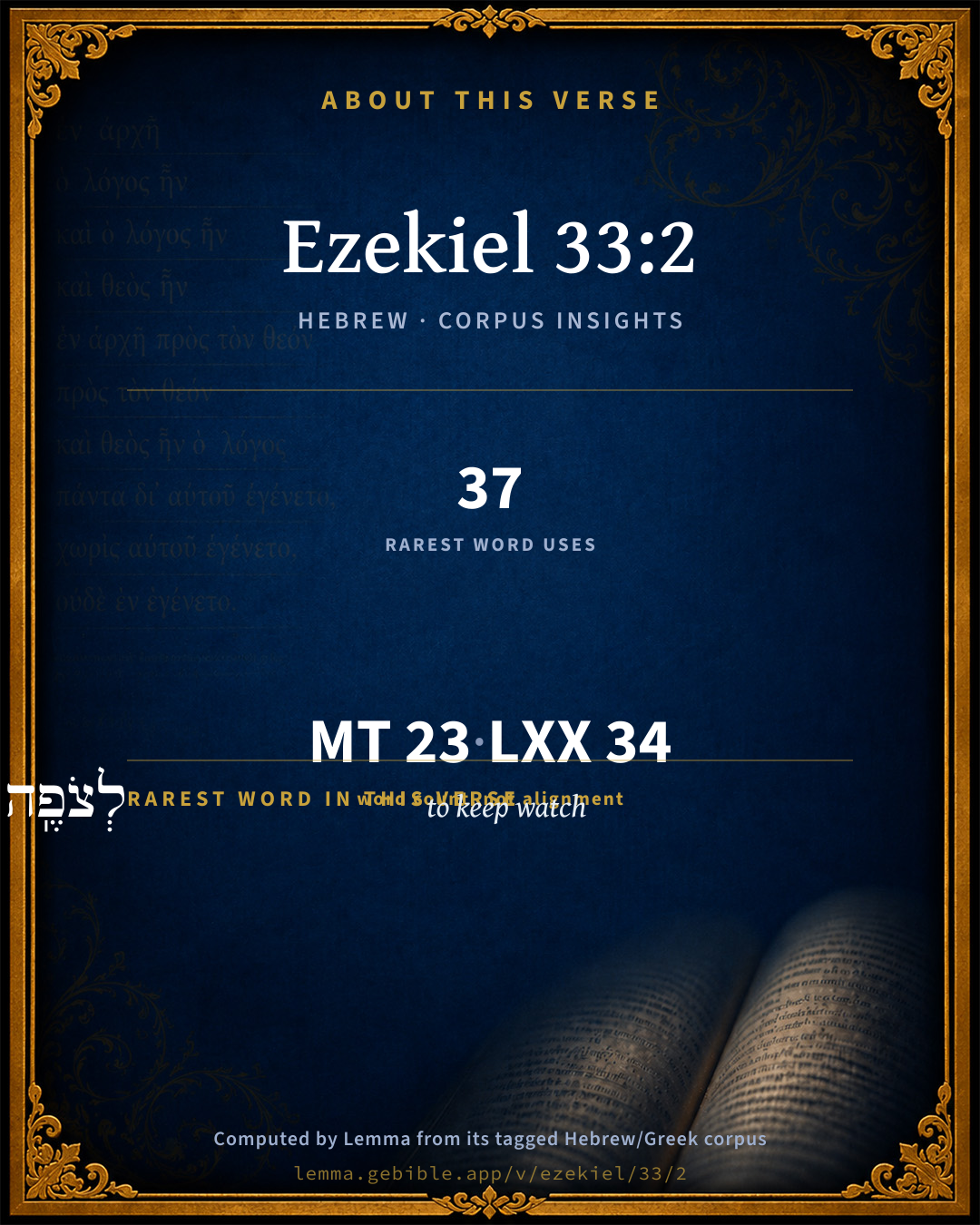
לְצֹפֶֽה
tsâphâh
H6822
“to/for · keeping watch”
Preposition + Verb, Qal, Participle Active, Masculine, Singular, Absolute
Part of Speech
Preposition + Verb
Stem
Qal
Form
Participle Active
Gender
Masculine
Number
Singular
State
Absolute
Full BDB Definition

Origin: a primitive root

TWOT: 1950

to look out or about, spy, keep watch, observe, watch - (Qal) to keep watch, spy - (Piel) to watch, watch closely
  1. בֶּן bên H1121 “son of” Noun, Common, Masculine, Singular, Construct
  2. אָדָ֗ם ʼâdâm H120 “man” Noun, Common, Masculine, Singular, Absolute
  3. דַּבֵּ֤ר dâbar H1696 “speak” Verb, Piel, Imperative, 2nd Person, Masculine, Singular
  4. אֶל ʼêl H413 “to” Preposition
  5. בְּנֵֽי bên H1121 “sons of” Noun, Common, Masculine, Plural, Construct
  6. עַמְּךָ֙ ʻam H5971 “people · your” Noun, Common, Masculine, Singular, Construct + Suffix, Personal, 2nd Person, Masculine, Singular
  7. וְאָמַרְתָּ֣ ʼâmar H559 “and · to say” Conjunction + Verb, Qal, Sequential Perfect, 2nd Person, Masculine, Singular
  8. אֲלֵיהֶ֔ם ʼêl H413 “to · them” Preposition + Suffix, Personal, 3rd Person, Masculine, Plural
  9. אֶ֕רֶץ ʼerets H776 “land” Noun, Common, Both, Singular, Absolute
  10. כִּֽי kîy H3588 “that” Conjunction
  11. אָבִ֥יא bôwʼ H935 “to enter” Verb, Hiphil, Imperfect, 1st Person, Common, Singular
  12. עָלֶ֖יהָ ʻal H5921 “upon · her” Preposition + Suffix, Personal, 3rd Person, Feminine, Singular
  13. חָ֑רֶב chereb H2719 “sword” Noun, Common, Feminine, Singular, Absolute
  14. וְלָקְח֨וּ lâqach H3947 “and · to take” Conjunction + Verb, Qal, Sequential Perfect, 3rd Person, Common, Plural
  15. עַם ʻam H5971 “people of” Noun, Common, Masculine, Singular, Construct
  16. הָאָ֜רֶץ ʼerets H776 “the · land” Particle, Definite Article + Noun, Common, Both, Singular, Absolute
  17. אִ֤ישׁ ʼîysh H376 “man” Noun, Common, Masculine, Singular, Absolute
  18. אֶחָד֙ ʼechâd H259 “one” Adjective, Cardinal number, Masculine, Singular, Absolute
  19. מִקְצֵיהֶ֔ם qâtseh H7097 “from · ends · their” Preposition + Noun, Common, Both, Plural, Construct + Suffix, Personal, 3rd Person, Masculine, Plural
  20. וְנָתְנ֥וּ nâthan H5414 “and · to give” Conjunction + Verb, Qal, Sequential Perfect, 3rd Person, Common, Plural
  21. אֹת֛וֹ ʼêth H853 “- · him” Particle, Direct Object + Suffix, Personal, 3rd Person, Masculine, Singular

About this verse

These counts appear in no published source. They are computed here, from the morphology-tagged text and Lemma’s own curated glosses. What Lemma adds →

23
words
18
distinct lemmas
Prophets
section

Shared distinctive vocabulary

לְצֹפֶֽה to keep watch H6822 occurs in 33 verses of the Hebrew Bible. Also found in:

Grammatical profile

  • 6 verbs
  • 10 nouns
  • 1 adjective
  • 4 prepositions
  • 1 conjunction
  • 1 particle

Verb forms

  • דַּבֵּ֤ר Piel · Imperative
  • וְאָמַרְתָּ֣ Qal · Sequential Perfect
  • אָבִ֥יא Hiphil · Imperfect
  • וְלָקְח֨וּ Qal · Sequential Perfect
  • וְנָתְנ֥וּ Qal · Sequential Perfect
  • לְצֹפֶֽה Qal · Participle Active

Repetition

Words recur within this verse — often emphatic in Hebrew:

  • בֶּן son H1121 ×2
  • עַמְּךָ֙ people H5971 ×2
  • אֶ֕רֶץ land H776 ×2
  • אֶל to H413 ×2

Hebrew & Septuagint length

In English translation the verse runs 39 words from the Hebrew and 41 from the Septuagint (LXX English) — closely comparable.

A rough comparison of the two English renderings, which tokenize alike — not a word-level alignment.

Word counts can differ between the Hebrew and the Greek without any difference in meaning — e.g. the Hebrew direct-object marker אֵת has no separate Greek word, and Greek often adds the article ὁ.

In the original languages it is 23 Hebrew tokens and 34 Greek tokens — but the two are counted differently (Hebrew bundles its prefixes and suffixes into one token; the Greek is in lemma form), so that isn’t a like-for-like length.

Cross-references

25

Topical passages linked to Ezekiel 33:2 in the Treasury of Scripture Knowledge — connected by theme and wording, ordered by reader-vote popularity; previews shown in the World English Bible.

  • Ezekiel 33:30 As for you, son of man, the children of your people talk of you by the walls and in the doors of the houses, and speak one to another, everyone to his brother, saying, Please come and hear what is the word that comes forth from Yahweh.
  • Ezekiel 3:11 Go, get you to them of the captivity, to the children of your people, and speak to them, and tell them, Thus says the Lord Yahweh; whether they will hear, or whether they will forbear.
  • Ezekiel 14:17 Or if I bring a sword on that land, and say, Sword, go through the land; so that I cut off from it man and animal;
  • Ezekiel 33:17 Yet the children of your people say, The way of the Lord is not equal: but as for them, their way is not equal.
  • Isaiah 62:6 I have set watchmen on your walls, Jerusalem; they shall never hold their peace day nor night: you who call on Yahweh, take no rest,
  • Jeremiah 15:2–3 It shall happen, when they tell you, Where shall we go forth? then you shall tell them, Thus says Yahweh: Such as are for death, to death; and such as are for the sword, to the sword; and such as are for the famine, to the famine; and such as are for captivity, to captivity.
  • Ezekiel 3:27 But when I speak with you, I will open your mouth, and you shall tell them, Thus says the Lord Yahweh: He who hears, let him hear; and he who forbears, let him forbear: for they are a rebellious house.
  • Zechariah 13:7 "Awake, sword, against my shepherd, And against the man who is close to me," says Yahweh of Hosts. Strike the shepherd, and the sheep will be scattered; And I will turn my hand against the little ones.
  • Leviticus 26:25 I will bring a sword upon you, that will execute the vengeance of the covenant; and you will be gathered together within your cities: and I will send the pestilence among you; and you will be delivered into the hand of the enemy.
  • 2 Samuel 18:24–27 Now David was sitting between the two gates: and the watchman went up to the roof of the gate to the wall, and lifted up his eyes, and looked, and, behold, a man running alone.
  • 2 Kings 9:17–20 Now the watchman was standing on the tower in Jezreel, and he spied the company of Jehu as he came, and said, I see a company. Joram said, Take a horseman, and send to meet them, and let him say, Is it peace?
  • Isaiah 21:6–9 For thus has the Lord said to me, Go, set a watchman: let him declare what he sees:
  • Isaiah 56:9–10 All you animals of the field, come to devour, [yes], all you animals in the forest.
  • Jeremiah 12:12 Destroyers are come on all the bare heights in the wilderness; for the sword of Yahweh devours from the one end of the land even to the other end of the land: no flesh has peace.
  • Jeremiah 25:31 A noise shall come even to the end of the earth; for Yahweh has a controversy with the nations; he will enter into judgment with all flesh: as for the wicked, he will give them to the sword, says Yahweh.
  • Jeremiah 47:6–7 You sword of Yahweh, how long will it be before you be quiet? put up yourself into your scabbard; rest, and be still.
  • Jeremiah 51:12 Set up a standard against the walls of Babylon, make the watch strong, set the watchmen, prepare the ambushes; for Yahweh has both purposed and done that which he spoke concerning the inhabitants of Babylon.
  • Ezekiel 6:3 and say, You mountains of Israel, hear the word of the Lord Yahweh: Thus says the Lord Yahweh to the mountains and to the hills, to the watercourses and to the valleys: Behold, I, even I, will bring a sword on you, and I will destroy your high places.
  • Ezekiel 11:8 You have feared the sword; and I will bring the sword on you, says the Lord Yahweh.
  • Ezekiel 14:21 For thus says the Lord Yahweh: How much more when I send my four sore judgments on Jerusalem, the sword, and the famine, and the evil animals, and the pestilence, to cut off from it man and animal!
  • Ezekiel 21:9–16 Son of man, prophesy, and say, Thus says Yahweh: Say, A sword, a sword, it is sharpened, and also furbished;
  • Ezekiel 33:7 So you, son of man, I have set you a watchman to the house of Israel; therefore hear the word at my mouth, and give them warning from me.
  • Ezekiel 33:12 You, son of man, tell the children of your people, The righteousness of the righteous shall not deliver him in the day of his disobedience; and as for the wickedness of the wicked, he shall not fall thereby in the day that he turns from his wickedness; neither shall he who is righteous be able to live thereby in the day that he sins.
  • Ezekiel 37:18 When the children of your people shall speak to you, saying, Will you not show us what you mean by these?
  • Hosea 9:8 A prophet watches over Ephraim with my God. A fowler's snare is on all of his paths, And hostility in the house of his God.

Cross-references courtesy of OpenBible.info (CC BY 4.0).

Hebrew and Greek witnesses Masoretic Hebrew ↔ Greek Septuagint

The same verse in the two great witnesses to the Old Testament, shown verse-for-verse.

These are two independent witnesses, not word-aligned to each other, and the Septuagint is shown in lemma (dictionary) form.

Hebrew Ezekiel 33:2 Masoretic · Westminster Leningrad Codex

בֶּן אָדָ֗ם דַּבֵּ֤ר אֶל בְּנֵֽי עַמְּךָ֙ וְאָמַרְתָּ֣ אֲלֵיהֶ֔ם אֶ֕רֶץ כִּֽי אָבִ֥יא עָלֶ֖יהָ חָ֑רֶב וְלָקְח֨וּ עַם הָאָ֜רֶץ אִ֤ישׁ אֶחָד֙ מִקְצֵיהֶ֔ם וְנָתְנ֥וּ אֹת֛וֹ לָהֶ֖ם לְצֹפֶֽה

Son of man, speak to the children of your people, and tell them, When I bring the sword on a land, and the people of the land take a man from among them, and set him for their watchman;

World English Bible · Public Domain

Greek LXX Ezekiel 33:2 Septuagint · lemma form

υἱός ἄνθρωπος λαλέω ὁ υἱός ὁ λαός σύ καί εἶπον πρός αὐτός γῆ ἐπί ὅς ἄν ἐπιἄγω ῥομφαία καί λαμβάνω ὁ λαός ὁ γῆ ἄνθρωπος εἷς ἐκ αὐτός καί δίδωμι αὐτός ἑαυτοῦ εἰς σκοπός

Son of man, speak to the children of your people, and you shall say to them, On whatever land I shall bring a sword, and the people of the land take one man of them, and set him for their watchman:

LXX2012 (modern English Septuagint) · Public Domain

Hebrew: Westminster Leningrad Codex (CC BY 4.0). Greek: Septuagint (public domain); English from LXX2012 (modern English Septuagint) (Public Domain). How the Septuagint differs from the Hebrew →

Targum (Aramaic paraphrase)

1

The Targum is the ancient Jewish Aramaic paraphrase of the Hebrew Scriptures — an interpretive translation, not the Hebrew text itself. Onkelos (literal) and Pseudo-Jonathan (expansive) render the Torah, and Jonathan the Prophets. Coverage is partial: where no permissively-licensed English translation exists for a verse, only the Aramaic is shown. This is verse-level text, not a word-by-word alignment to the Hebrew.

  1. Targum Jonathan Prophets (Joshua–Malachi)
    בַּר אָדָם אִתְנַבֵּי לִבְנֵי עַמָךְ וְתֵימַר לְהוֹן אַרְעָא אֲרֵי אַיְתֵי עֲלָהּ דְקַטְלִין בְּחַרְבָּא וְיִדְבְּרוּן עַמָא דְאַרְעָא גַבְרָא חַד מִבֵּינֵיהוֹן וִימַנוּן יָתֵיהּ לְהוֹן לְאַזְהָרָא:

    (no public-domain English translation for this verse)

    Targum Jonathan — Aramaic: “Mikraot Gedolot” (public domain). English: “Sefaria Community Translation” (CC0 1.0 (public-domain dedication)); “London "Chaldee Paraphrase," 1871” (public domain). Text via Sefaria.

Commentary

Notes on Ezekiel 33:2 from classic Christian and Jewish commentators (each source and its license shown beneath its notes). The classic Christian expositions comment on the surrounding passage and are grouped to its opening verse, so a note may address several verses; the Jewish commentaries on the Tanakh (Rashi and others) are per-verse, so they appear only where the commentator wrote on this verse.

Lemma curates 59 commentaries, every one of them public domain or Creative Commons licensed, each selected and text-cleaned for this edition rather than reprinted as found. About our sources →

Ellicott's Commentary for English Readers

(2) Set him for their watchman.—The same figure as in Eze_3:17. Eze_33:2-9 form the introduction to this renewed commission, and closely correspond to Eze_3:17-21. Yet these verses have also a distinct retrospective object, and explain to the people why he had hitherto spoken to them so much of judgments and in such warning tones; this had been his duty, both in obedience to God’s commands and in regard for their welfare, and it would still be his duty in the future. The passage is too clear to need comment.

A Bible Commentary for English Readers, edited by Charles John Ellicott (1878–1897) — public domain. Text from a community e-Sword module.

Trapp's Complete Commentary

John Trapp

Eze 33:2 Son of man, speak to the children of thy people, and say unto them, When I bring the sword upon a land, if the people of the land take a man of their coasts, and set him for their watchman:

Ver. 2. Speak to the children of thy people.] I say, "of thy people"; for I can scarce find in my heart to own them, they be so bad.

When I bring the sword upon a land.] The sword is of God’s sending; {Eze 14:17} and whencesoever it cometh, it is bathed in heaven. {Isa 34:5} Think the same of any other public calamity, {Amo 3:6} and therefore frame to a patient and peaceable behaviour under it. Among philosophers the most noted sect for patience was that of the Stoics, who ascribed all to fate.

John Trapp, A Commentary or Exposition upon All the Books of the Old and New Testament (1647–1656) — public domain. Text from a community e-Sword module.

Tyndale Open Study Notes

Tyndale Open Resources

33:2-4 watchman: See study note on 3:16-19. Here the message about the watchman is part of Ezekiel’s public proclamation, not a private commission. It puts more emphasis on the people who hear the watchman’s message; they are responsible to take action in response to it. Just as the people before the destruction of Jerusalem were unwilling to hear the message of destruction, so the people after the Exile could not believe the message of hope. In both cases, in having to face the rejection of what he was saying, Ezekiel was tempted to keep quiet. God warned him again that he could not.

Tyndale Open Study Notes — © Tyndale Open Resources, licensed CC BY-SA 4.0. Text via the HelloAO Bible API.

Geneva Bible (1599)

Geneva Bible translators

Or, of their coasts.

He showeth that the people ought to have continually governors and teachers which may have a care over them, and to warn them ever of the dangers which are at hand.

Geneva Bible (1599) marginal notes — public domain. Text via Bolls.life.

Adam Clarke's Commentary

Verse 2. Son of man - if the people of the land take a man] The first ten verses of this chapter are the same with Eze 3:17-22; and to what is said there on this most important and awful subject I must refer the reader. Here the PEOPLE choose the watchman; there, the Lord appoints him. When God chooses, the people should approve.

Adam Clarke's Commentary on the Bible (1810–1826) — public domain. Text from a community e-Sword/MySword module.

The Cambridge Bible for Schools and Colleges

gen. ed. J. J. S. Perowne

2. of their coasts] of their number, from among them, cf. 2Ki_9:17.

The Cambridge Bible for Schools and Colleges (gen. ed. J. J. S. Perowne; Cambridge University Press, 1878–1918) — public domain. Text from a community e-Sword module.

John Gill's Exposition

Son of man, speak to the children of thy people,.... The Jews, of whom the prophet was; and designs those who were with him in the captivity; and who, having behaved so ill, the Lord will not own them for his people, but calls them the prophet's people, and the children of them:

and say unto them, when I bring the sword upon a land; a foreign enemy with an army to invade it, or any other judgment; for there is no public calamity whatever that comes upon a people, but what is by the order, direction, or permission of the Lord. The Targum is,

"those that kill with the sword;''

an army of men that enter into a land sword in hand, with an intent to conquer and destroy: if the people of the land take a man of their coasts: that lives upon their borders, and so is acquainted with all the places where it is most likely an enemy should enter; or a man out of the midst of them, as the Targum; so this phrase sometimes signifies, Gen 47:2, one of their own people, who might be thought to have their good and safety at heart, and might be trusted:

and set him for their watchman: on some place of eminence; on the walls, or in a tower of a frontier town, from whence he might descry the enemy coming at a distance.

John Gill's Exposition of the Whole Bible (1746–1763) — public domain (CC PDM 1.0). Text via the HelloAO Bible API.

Haydock's Catholic Bible Commentary

Take. Before (chap. iii. 17.) God made the choice, (Calmet) as he does here, ver. 7. He confirms the authority of those who are appointed to govern. --- Meanest. Literally, "last," (Haydock) which seems to denote such as are chosen without regard to their dignity or obscurity in life, Genesis xlvii. 2., and 3 Kings xii. 31. (Calmet) --- Pastors are not excused from admonishing the people for fear of danger or despair of reclaiming them, as each one is bound to do his duty. (St. Jerome) (Worthington)

George Leo Haydock (1774–1849), Haydock's Catholic Family Bible and Commentary, 1859 edition — public domain. Excludes Psalms (Douay-Rheims chapter numbering differs from Protestant) and Deuterocanonical books (Catholic canon only).

Matthew Poole's English Annotations

The prophet, after three years’ silence enjoined him now hath his mouth opened by new commission.

To the chidldren of thy people; to the Jews in general, to who he had not spoken since what he spake in the 24th chapter,

Say unto them; propound a parable unto then

When; if at any time.

The sword; war, or any sore judgment.

Take a man; choose out a man who live on the borders, and knows the avenues and the ways the enemy will most likely come to assault them. Set him for their watchman; appoint him to watch the coasts, that they may not be surprised.

Matthew Poole's English Annotations on the Holy Bible (1683–1685) — public domain. Text from a community e-Sword/MySword module.

The Pulpit Commentary

Speak to the children of thy people. (On the force of the possessive pronoun, see note on Eze_3:1) The formula is carried on throughout the chapter (Vers. 12, 17, 30). Set him for their watchman . Ezekiel falls back upon the thought of Eze_3:17, but the image is expanded with characteristic fullness. The function of the watchman, in which he sees a parable of his own office, is to stand upon his tower. (2Sa_18:24, 2Sa_18:25; 2Ki_9:17; Hab_2:1) to keep his eye on the distant horizon, and as soon as the clouds of dust or the gleam of armor gives notice of the approach of the enemy, to sound the trumpet of alarm (Amo_3:6; Hos_8:1; Jer_4:5 Jer_6:1) that men may not be taken unawares. If he discharge that duty faithfully, then, as in Eze_3:17-21, the blood of those that perish through their own negligence shall rest on their own head.

The Pulpit Commentary (1880–1919), ed. H.D.M. Spence-Jones & Joseph S. Exell — public domain. Text from a community e-Sword module.

Rashi

Rabbi Shlomo Yitzchaki (Rashi)

as a lookout [Heb. לְצֹפֶה,] badete in O.F., sentry, watchman.

Rashi on the Tanakh — English translations: “The Judaica Press complete Tanach with Rashi, translated by A. J. Rosenberg” (CC BY 4.0); “Pentateuch with Rashi's commentary by M. Rosenbaum and A.M. Silbermann, 1929-1934” (public domain); “The Metsudah Tanach series, Lakewood, N.J” (CC BY 4.0); and “The Book of Joshua, Metsudah Publications, 1997” (CC BY 4.0). Text via Sefaria.

Lesson kit

Teaching starters — assembled from the data on this page, not authored interpretation. Every prompt links to the verse data it draws on. Edit before teaching.

Ezekiel, in the Prophets, opens this verse with 23 words (18 distinct Hebrew lemmas). Its most distinctive word is tsâphâh (“to keep watch”). A historical commentator’s framing appears above. Read the whole chapter for the surrounding context.

Discussion questions

  1. How does “to keep watch” (tsâphâh) shape what this verse is saying?
  2. How does Genesis 31:49, which shares the word «to keep watch», read alongside this verse?
  3. What does the repetition of “son” (2× in this one verse) do in this verse?
  4. These translations render this verse differently. What is at stake in choosing one wording over another?
  5. «דַּבֵּ֤ר» is a Piel Imperative verb. How does that grammatical form shape the action described?
  6. Compare how Ellicott's Commentary for English Readers and Trapp's Complete Commentary read this verse. Where do they agree or differ?

Things to notice

Reading settings

Reading text

Shown beneath each verse's original-language words.

Old Testament
Old Testament edition

Read the OT as the Masoretic Hebrew (MT) or the Greek Septuagint (LXX).

English shown for the Greek Septuagint (in the Hebrew ↔ Greek comparison).

Comparing translations? Open the Compare panel on any verse page to stack up to four side by side.