1 Kings 9:10

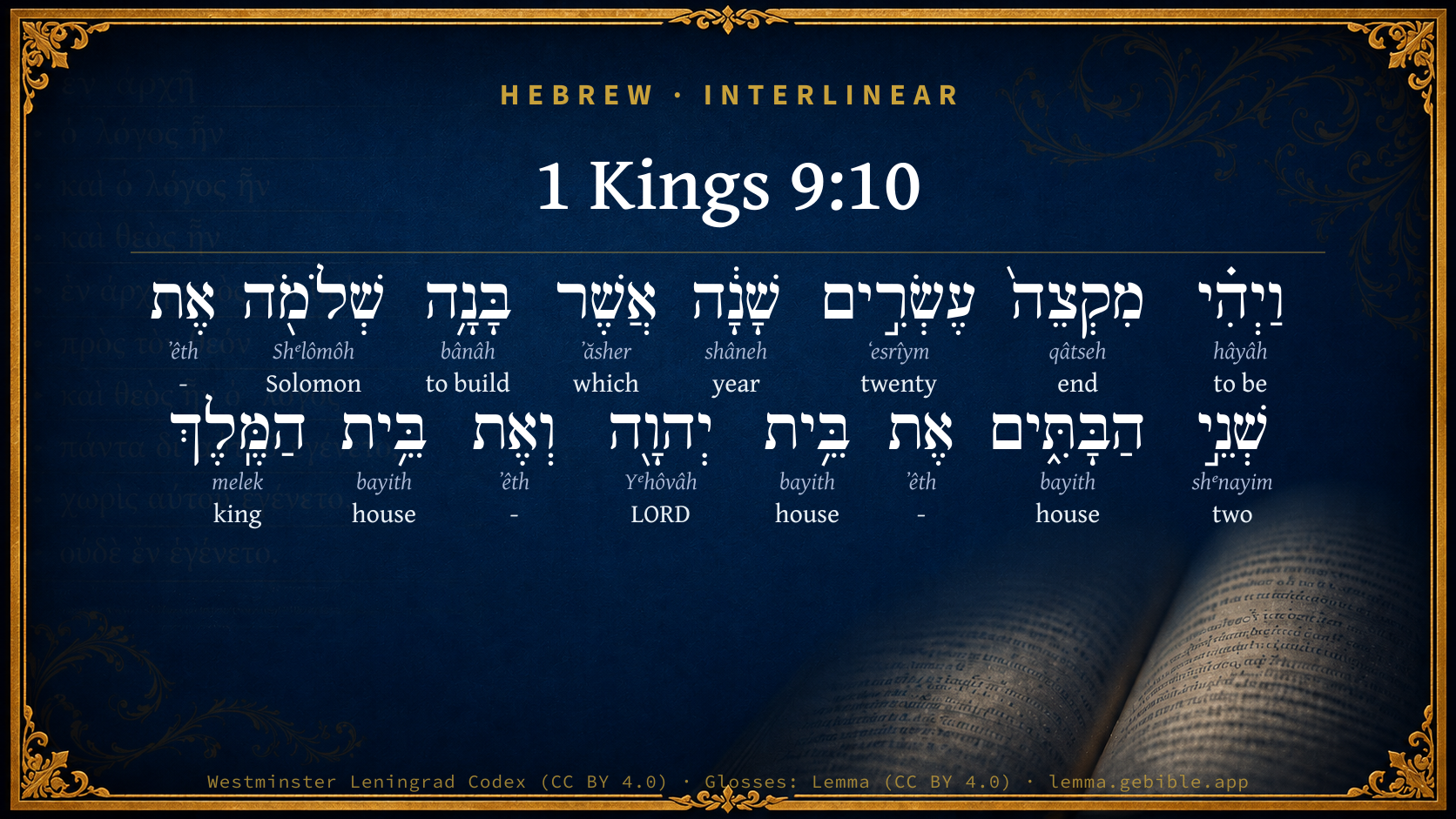
Hebrew (Westminster Leningrad Codex) 1 Kings 9:10 appears in the Hebrew Old Testament. The text above is from the Westminster Leningrad Codex. Each word links to its Strong’s number, a concise gloss, and parsing drawn from the Open Scriptures Hebrew Bible morphology. Click any word for its full Brown-Driver-Briggs (BDB) entry.
Download image
Cite this verse

1 Kings 9:10 (World English Bible). Public Domain. Lemma interlinear Bible study tool, https://lemma.gebible.app/v/1-kings/9/10.

Show BibTeX & RIS
BibTeX
RIS
English Translation
It happened at the end of twenty years, in which Solomon had built the two houses, the house of Yahweh and the king's house
World English Bible · Public Domain
Download a study sheet

One document with this verse’s original text, its word-by-word gloss line, the meaning frame, cross-references with their text, attributed commentary, and full source and license credits — printable, and it pastes into notes with its structure intact.

This verse Autodidact and up

Study sheet (.html) Plain text (.txt)

A passage Seminary Student

Up to 50 verses in one chapter. A passage sheet keeps up to 6 commentary sources and 12 cross-references per verse, in the order this page ranks them, and says so on the sheet whenever that leaves anything out. Ask for a single verse and you get the Autodidact verse sheet above.

Everything on this page stays free to read, with no account — the sheet is a download of what is already on screen, not access to it.

Want to remove ads? Support Godless Engineer
Compare translations 3

The same verse in 3 English versions, stacked beneath the original-language interlinear above. Click any original word for its lexicon entry.

Each is an independent rendering of the whole verse — the interlinear is not word-aligned to these translations.

Highlighted words mark where these versions differ — a whole-verse word diff, not a word-by-word alignment.

  • World English Bible Public Domain
    It happened at the end of twenty years, in which Solomon had built the two houses, the house of Yahweh and the king's house
  • King James Version Public Domain
    And it came to pass at the end of twenty years, when Solomon had built the two houses, the house of the LORD, and the king's house,
  • unfoldingWord Literal Text CC BY-SA 4.0
    And it happened at the end of 20 years that Solomon had built the two houses, the house of Yahweh and the house of the king.

unfoldingWord Literal Text — © unfoldingWord, licensed CC BY-SA 4.0. Word-aligned USFM3 via Door43 (git.door43.org/unfoldingWord/en_ult).

Versions to compare (up to 4)

3 of 4 selected

Show all 18 translations

Every available English version of this verse, each an independent rendering of the whole verse.

  • World English Bible Public Domain
    It happened at the end of twenty years, in which Solomon had built the two houses, the house of Yahweh and the king's house
  • Berean Standard Bible Public Domain
    Now at the end of the twenty years during which Solomon built these two houses, the house of the LORD and the royal palace,
  • Majority Standard Bible Public Domain
    Now at the end of the twenty years during which Solomon built these two houses, the house of the LORD and the royal palace,
  • King James Version Public Domain
    And it came to pass at the end of twenty years, when Solomon had built the two houses, the house of the LORD, and the king's house,
  • American Standard Version (1901) Public Domain
    And it came to pass at the end of twenty years, wherein Solomon had built the two houses, the house of Jehovah and the king's house,
  • Revised Version (1885) Public Domain
    And it came to pass at the end of twenty years, wherein Solomon had built the two houses, the house of the LORD and the king’s house,
  • Geneva Bible (1599) Public Domain
    And at the ende of twentie yeeres, when Salomon had buylded the two houses, the house of the Lord, and the Kings palace,
  • Douay-Rheims (1899) Public Domain
    And when twenty years were ended after Solomon had built the two houses, that is, the house of the Lord, and the house of the king,
  • Young's Literal Translation Public Domain
    And it cometh to pass, at the end of twenty years, that Solomon hath built the two houses, the house of Jehovah, and the house of the king.
  • Literal Standard Version CC BY-SA 4.0
    And it comes to pass, at the end of twenty years, that Solomon has built the two houses, the house of YHWH, and the house of the king.
  • Unlocked Literal Bible CC BY-SA 4.0
    It came about at the end of twenty years that Solomon had finished building the two buildings, the temple of Yahweh and the king's palace.
  • unfoldingWord Literal Text CC BY-SA 4.0
    And it happened at the end of 20 years that Solomon had built the two houses, the house of Yahweh and the house of the king.
  • Darby Bible Public Domain
    And it came to pass at the end of twenty years, when Solomon had built the two houses, the house of Jehovah and the king's house,
  • World Messianic Bible Public Domain
    At the end of twenty years, in which Solomon had built the two houses, the LORD’s house and the king’s house
  • Webster's Bible Public Domain
    And it came to pass at the end of twenty years, when Solomon had built the two houses, the house of the LORD, and the king's house,
  • Free Bible Version CC BY-SA 4.0
    It took twenty years for Solomon to construct the two buildings—the Temple of the Lord and his own palace. After this,
  • Bible in Basic English Public Domain
    Now at the end of twenty years, in which time Solomon had put up the two houses, the house of the Lord and the king's house,
  • JPS Tanakh (1917) Public Domain
    And it came to pass at the end of twenty years, wherein Solomon had built the two houses, the house of the LORD and the king's house —

Literal Standard Version (2020), Covenant Press — licensed CC BY-SA 4.0. Text via the HelloAO Bible API (eBible.org). Unlocked Literal Bible (unfoldingWord) — licensed CC BY-SA 4.0. Text via the HelloAO Bible API (eBible.org). unfoldingWord Literal Text — © unfoldingWord, licensed CC BY-SA 4.0. Word-aligned USFM3 via Door43 (git.door43.org/unfoldingWord/en_ult). Free Bible Version, Dr. Jonathan Gallagher — licensed CC BY-SA 4.0. Text via the HelloAO Bible API (eBible.org).

Word by word

More ways to search: Search by grammar → Find every occurrence → Compare this word →

Practice this passage: Drill this verse → Learn its vocabulary →

מִקְצֵה֙
qâtseh
H7097
“from · end of”
Preposition + Noun, Common, Both, Singular, Construct
Part of Speech
Preposition + Noun
Type
Common
Gender
Both
Number
Singular
State
Construct
Full BDB Definition

Origin: from H7096

TWOT: 2053a , 2053c

end, extremity - end, mouth, extremity - border, outskirts - the whole (condensed term for what is included within extremities) - at the end of (a certain time)
  1. וַיְהִ֗י hâyâh H1961 “and · to be” Conjunction + Verb, Qal, Sequential Imperfect, 3rd Person, Masculine, Singular
  2. עֶשְׂרִ֣ים ʻesrîym H6242 “twenty” Adjective, Cardinal number, Both, Plural, Absolute
  3. שָׁנָ֔ה shâneh H8141 “year” Noun, Common, Feminine, Singular, Absolute
  4. אֲשֶׁר ʼăsher H834 “which” Particle, Relative
  5. בָּנָ֥ה bânâh H1129 “to build” Verb, Qal, Perfect, 3rd Person, Masculine, Singular
  6. שְׁלֹמֹ֖ה Shᵉlômôh H8010 “Solomon” Noun, Proper
  7. אֶת ʼêth H853 “-” Particle, Direct Object
  8. שְׁנֵ֣י shᵉnayim H8147 “two” Adjective, Cardinal number, Masculine, Dual, Construct
  9. הַבָּתִּ֑ים bayith H1004 “the · houses” Particle, Definite Article + Noun, Common, Masculine, Plural, Absolute
  10. אֶת ʼêth H853 “-” Particle, Direct Object
  11. בֵּ֥ית bayith H1004 “house of” Noun, Common, Masculine, Singular, Construct
  12. יְהוָ֖ה Yᵉhôvâh H3068 “LORD” Noun, Proper
  13. וְאֶת ʼêth H853 “and · -” Conjunction + Particle, Direct Object
  14. בֵּ֥ית bayith H1004 “house of” Noun, Common, Masculine, Singular, Construct
  15. הַמֶּֽלֶךְ melek H4428 “the · king” Particle, Definite Article + Noun, Common, Masculine, Singular, Absolute

About this verse

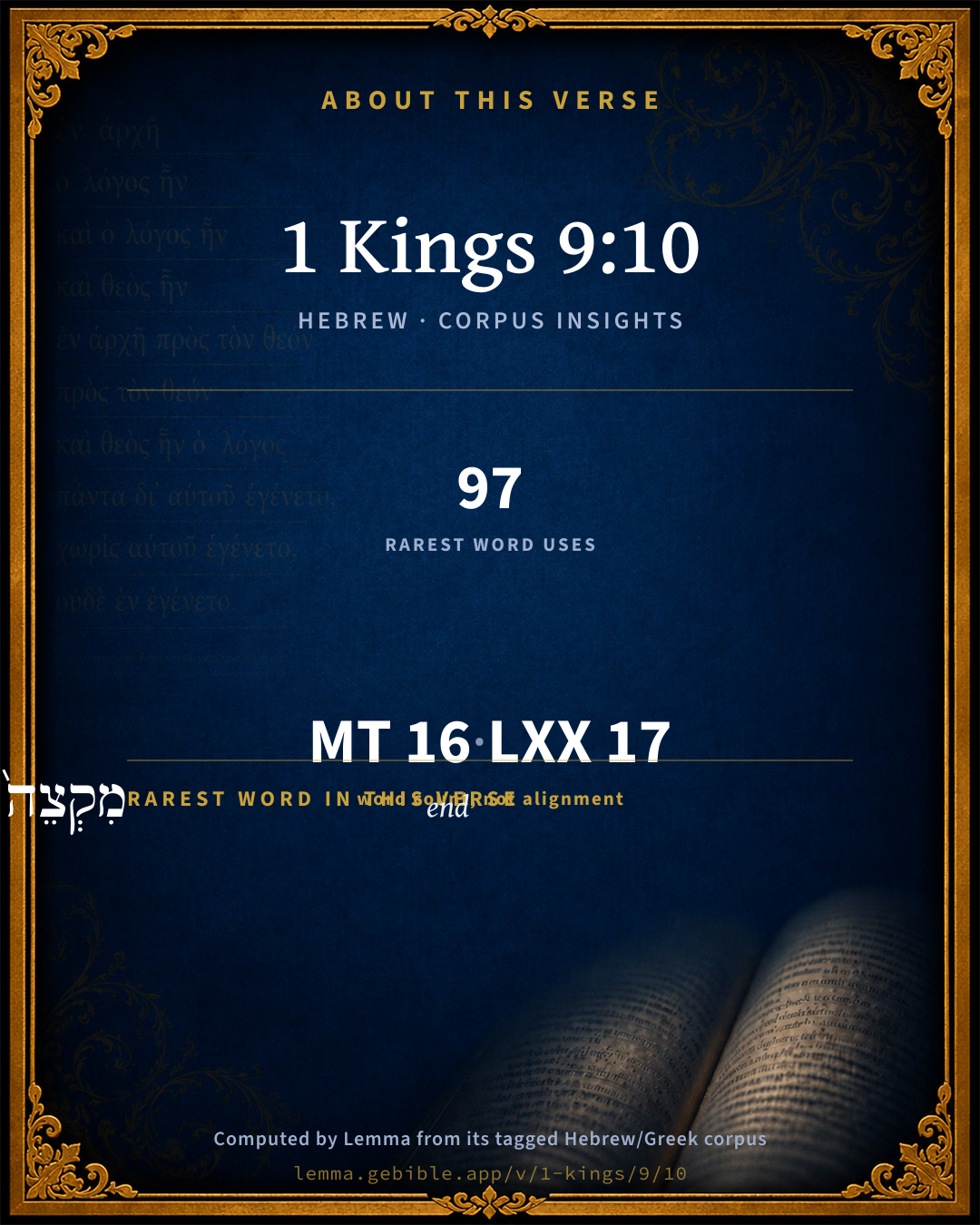
These counts appear in no published source. They are computed here, from the morphology-tagged text and Lemma’s own curated glosses. What Lemma adds →

16
words
12
distinct lemmas
Historical
section

Grammatical profile

  • 2 verbs
  • 8 nouns
  • 2 adjectives
  • 4 particles

Verb forms

  • וַיְהִ֗י Qal · Sequential Imperfect
  • בָּנָ֥ה Qal · Perfect

Repetition

A word recurs within this verse — often emphatic in Hebrew:

  • הַבָּתִּ֑ים house H1004 ×3

Hebrew & Septuagint length

In English translation the verse runs 24 words from the Hebrew and 22 from the Septuagint (LXX English) — closely comparable.

A rough comparison of the two English renderings, which tokenize alike — not a word-level alignment.

Word counts can differ between the Hebrew and the Greek without any difference in meaning — e.g. the Hebrew direct-object marker אֵת has no separate Greek word, and Greek often adds the article ὁ.

In the original languages it is 16 Hebrew tokens and 17 Greek tokens — but the two are counted differently (Hebrew bundles its prefixes and suffixes into one token; the Greek is in lemma form), so that isn’t a like-for-like length.

Cross-references

3

Topical passages linked to 1 Kings 9:10 in the Treasury of Scripture Knowledge — connected by theme and wording, ordered by reader-vote popularity; previews shown in the World English Bible.

  • 1 Kings 6:37–7:1 In the fourth year was the foundation of the house of Yahweh laid, in the month Ziv.
  • 1 Kings 9:1 It happened, when Solomon had finished the building of the house of Yahweh, and the king's house, and all Solomon's desire which he was pleased to do,
  • 2 Chronicles 8:1–18 It happened at the end of twenty years, in which Solomon had built the house of Yahweh, and his own house,

Cross-references courtesy of OpenBible.info (CC BY 4.0).

Hebrew and Greek witnesses Masoretic Hebrew ↔ Greek Septuagint

The same verse in the two great witnesses to the Old Testament, shown verse-for-verse.

These are two independent witnesses, not word-aligned to each other, and the Septuagint is shown in lemma (dictionary) form.

Hebrew 1 Kings 9:10 Masoretic · Westminster Leningrad Codex

וַיְהִ֗י מִקְצֵה֙ עֶשְׂרִ֣ים שָׁנָ֔ה אֲשֶׁר בָּנָ֥ה שְׁלֹמֹ֖ה אֶת שְׁנֵ֣י הַבָּתִּ֑ים אֶת בֵּ֥ית יְהוָ֖ה וְאֶת בֵּ֥ית הַמֶּֽלֶךְ

It happened at the end of twenty years, in which Solomon had built the two houses, the house of Yahweh and the king's house

World English Bible · Public Domain

Greek LXX 1 Kings 9:10 Septuagint · lemma form

εἴκοσι ἔτος ἐν ὅς οἰκοδομέω σαλωμών ὁ δύο οἶκος ὁ οἶκος κύριος καί ὁ οἶκος ὁ βασιλεύς

During twenty years in which Solomon was building the two houses, the house of the Lord, and the house of the king,

LXX2012 (modern English Septuagint) · Public Domain

On this verse, The Pulpit Commentary discusses the Septuagint’s reading. Read the note in Commentary ↓

Hebrew: Westminster Leningrad Codex (CC BY 4.0). Greek: Septuagint (public domain); English from LXX2012 (modern English Septuagint) (Public Domain). How the Septuagint differs from the Hebrew →

Targum (Aramaic paraphrase)

1

The Targum is the ancient Jewish Aramaic paraphrase of the Hebrew Scriptures — an interpretive translation, not the Hebrew text itself. Onkelos (literal) and Pseudo-Jonathan (expansive) render the Torah, and Jonathan the Prophets. Coverage is partial: where no permissively-licensed English translation exists for a verse, only the Aramaic is shown. This is verse-level text, not a word-by-word alignment to the Hebrew.

  1. Targum Jonathan Prophets (Joshua–Malachi)
    וַהֲוָה מִסוֹף עַשְׂרִין שְׁנִין דִי בְנָא שְׁלֹמֹה יַת תְּרֵין בָּתַּיָא יַת בֵּית מַקְדְשָׁא דַייָ וְיַת בֵּית מַלְכָּא:

    (no public-domain English translation for this verse)

    Targum Jonathan — Aramaic: “Mikraot Gedolot” (public domain). English: “Sefaria Community Translation” (CC0 1.0 (public-domain dedication)); “London "Chaldee Paraphrase," 1871” (public domain). Text via Sefaria.

Commentary

Notes on 1 Kings 9:10 from classic Christian and Jewish commentators (each source and its license shown beneath its notes). The classic Christian expositions comment on the surrounding passage and are grouped to its opening verse, so a note may address several verses; the Jewish commentaries on the Tanakh (Rashi and others) are per-verse, so they appear only where the commentator wrote on this verse.

Lemma curates 59 commentaries, every one of them public domain or Creative Commons licensed, each selected and text-cleaned for this edition rather than reprinted as found. About our sources →

Jamieson, Fausset & Brown

Robert Jamieson, A. R. Fausset & David Brown

THE MUTUAL PRESENTS OF SOLOMON AND HIRAM. (Kg1 9:10-23)

at the end of twenty years--Seven and a half years were spent in building the temple, and twelve and a half or thirteen in the erection of his palace (Kg1 7:1; Ch2 8:1). This verse is only a recapitulation of Kg1 9:1, necessary to recover the thread of connection in the narrative.

Jamieson, Fausset & Brown — Commentary Critical and Explanatory on the Whole Bible (1871) — public domain (CC PDM 1.0). Text via the HelloAO Bible API.

Trapp's Complete Commentary

John Trapp

1Ki 9:10 And it came to pass at the end of twenty years, when Solomon had built the two houses, the house of the LORD, and the king’s house,

Ver. 10. At the end of twenty years,] viz., From the beginning of the temple’s building.

John Trapp, A Commentary or Exposition upon All the Books of the Old and New Testament (1647–1656) — public domain. Text from a community e-Sword module.

Whedon's Commentary on the Bible

Daniel D. Whedon

SUNDRY NOTICES OF SOLOMON’S ACTS, 1Ki_9:10-28.

This section furnishes one of the most noticeable instances of the fragmentary manner in which some portions of the Old Testament history have been compiled. The writer evidently gathered excerpts from more complete historical and statistical documents, and arranged them in their present form of a rapidly sketched abridgment, the meaning of which is in some places hard to determine.

10. Twenty years — Seven in building the temple, (1Ki_6:38,) and thirteen on the palace. 1Ki_7:1.

Daniel D. Whedon (gen. ed.), Commentary on the Old and New Testaments (1874–1909) — public domain. Text from a community e-Sword module.

The Pulpit Commentary

CHAPTER 9:10-28.

SOLOMON"S BUILDINGS AND UNDERTAKINGS. So far the historian has spoken exclusively of the two greatest works of Solomon"s reign, the Temple and the Palace, and principally of the former. Even the message just related was, as we have seen, the response to the prayer offered when the temple was consecrated. But he now proceeds to mention other proofs of Solomon"s greatness, and of the prosperity of his reign doubtless because the glory of Israel then reached its climax, and the author would be tempted to linger over these details because of the dark contrast which his own time supplied and this leads him to speak of the means by which all these enterprises were accomplished. The particulars here given are but fragmentary, and are grouped together in a somewhat irregular manner. It would seem as if both this account and that of the chronicler had been compiled from much more copious histories, each writer having cited those particulars which appeared to him to be the most interesting and important. But the design of the historian in either case is evident, viz.,

(1) to recount the principal undertakings of this illustrious king, and

(2) to indicate the resources which enabled him to accomplish such ambitious and extensive designs.

These latter were

(1) the alliance with Hiram, which secured him the necessary materials (vers. 11-14);

(2) the forced labour of the subject races (vers. 20-23); and

(3) the voyages of his fleet (vers. 26-28).

And it came to pass at the end of twenty years, seven of which were occupied on the temple and thirteen on the palace (1Ki_7:1) when or, during which. LXX ejn oiv wjkodomhse. This may well be the meaning of hnB rva though rva qui, undoubtedly sometimes has the sense of quum Solomon had built the two houses, the house of the Lord and the king"s house. Observe how all the palaces are regarded as one house. (Note on 1Ki_7:1)

The Pulpit Commentary (1880–1919), ed. H.D.M. Spence-Jones & Joseph S. Exell — public domain. Text from a community e-Sword module.

The Preacher's Complete Homiletical Commentary

Joseph S. Exell (gen. ed.)

CRITICAL AND EXPLANATORY NOTES.—

1Ki_9:10. At the end of twenty years—Seven and a-half years spent in erecting temple, twelve and a-half upon his own house. This verse takes up again the suspended narrative (1Ki_9:1, supra). After Solomon, with the aid of Hiram, had completed his work, the king gave Hiram twenty cities, &c.

1Ki_9:11. Cities in the land of Galilee—Adjacent to Tyre (Josephus), until then unconquered, and occupied by the Canaanites.

1Ki_9:12-13. They pleased him not … he called them Cabul—Gesenius regards Cabul as a name of contempt; Keil considers the word to be a contraction from כְּהַבּוּל as a vacuity, a desolate region.

HOMILETICS OF 1Ki_9:10-14

QUESTIONABLE GENEROSITY

I. It is questionable generosity when a gift is tardily rendered. “And it came to pass at the end of twenty years—that then King Solomon gave Hiram twenty cities”—one city for every year of building. The charm of generosity is its promptness. That is well done that is done quickly. To give slowly is to give grudgingly. The Arabians are said to be remarkably lavish in their generosity. Gibbon relates that a dispute had arisen who, among the citizens of Mecca, was entitled to the prize of generosity, and a successive application was made to the three who were deemed most worthy of the trial. Abdallah, the son of Abbas, had undertaken a distant journey, and his foot was in the stirrup when he heard the voice of a suppliant, “O son of the uncle of the Apostle of God, I am a traveller, and in distress!” He instantly dismounted to present the pilgrim with his camel, her rich caparison, and a purse of four thousand pieces of gold, excepting only the sword, either for its intrinsic value, or as the gift of an honoured kinsman. The servant of Kais informed the second suppliant that his master was asleep; but he immediately added, “Here is a purse of seven thousand pieces of gold—it is all we have in the house—and here is an order that will entitle you to a camel and a slave.” The master, as soon as he awoke, praised and enfranchised his faithful steward, with a gentle reproof that by respecting his slumbers he had stinted his bounty. The third of these heroes, the blind Arabah, at the hour of prayer, was supporting his steps on the shoulders of two slaves—“Alas!” he replied, “My coffers are empty; but these you may sell: if you refuse, I renounce them.” At these words, pushing away the youthful slaves, he groped along the wall with his staff. There is a generosity that is questionable in its excess; when it surpasses the limits of discretion. A true generosity is regulated by justice.

II. It is questionable generosity where the right of disposal is doubtful. According to the law, Solomon had no right to give away these cities, or any part of the inheritance of Israel (Lev_25:23). But this was not the first nor last instance in which this great king stepped aside from the law of Moses. Already, contrary to the express commands of the law, he had multiplied horses and chariots. In the case before ns the appearance of transgression is somewhat modified when we remember that these cities, when given to Hiram, were not peopled by Israelites, but by heathens. Solomon may have regarded it as a prudent policy to hand over the government of these heathen cities, which were evidently of no great worth, to his friendly neighbour who had rendered him so much service in building the Lord’s house. It is worse than a questionable generosity, it is a positive injustice, for a man to give away in charity what ought to be paid in discharge of his just debts. It is easy for a man to be lavish with money that is not his own, but which in all fairness belongs to his creditors. It is the impulse of benevolence blinding the sense of justice.

III. It is questionable generosity where the gift creates disappointment rather than pleasure. “And Hiram came out of Tyre to see the cities which Solomon had given him; and they pleased him not” (1Ki_9:12). It is not always that a generous spirit meets with the appreciation and gratitude it merits; but it strives so to administer its gifts as to meet the wants and promote the happiness of the recipient. There is a way of bestowing benefits in which the giver makes himself appear as the obliged party. On the other hand, a gift may be so inadequate in comparison with the resources of the donor and the merits of the recipient as to produce chagrin and displeasure. Hiram might naturally have coveted some of Solomon’s coast towns—perhaps had cast his eyes on the noble bay of Acco or Ptolemais—and was therefore dissatisfied with the gift of a comparatively useless inland region. It would be well for us to have as light an esteem of all things temporal as Hiram had of these twenty cities!

IV. An act of questionable generosity need not interfere with a long-tried friendship. “And Hiram sent to the king six score talents of gold” (1Ki_9:14). Apparently to show that, although disappointed, he was rob offended. The sum sent was very large—above a million and a quarter of on money, according to Mr. Poole’s estimate of the weight of the Hebrew gold talent, or about £720,000 according to the estimate preferred by Mr. S. Clarke. At any rate, it was more than equal to a sixth part of Solomon’s regular revenue (chap. 1Ki_10:14). The cities despised by Hiram were restored to Solomon, who rebuilt and colonized them with Israelities (2Ch_8:2). No doubt Solomon compensated Hiram in some other way. Their friendship was not sacrificed by what might have been thought an act of parsimoniousness on the one hand, or an act of ungrateful contemptuousness on the other. In the dearest friendships, anomalies will occur which are difficult to reconcile. The conduct of a friend may seem questionable and blameworthy. Then is the time to exercise patience and forbearance, to put the best construction on the most unfavourable appearances, and wait calmly the issue of events. Many a valuable friendship has been wrecked by a single injudicious act; and a wound inflicted which has rankled in the heart for years. It is a bitter experience when the soul realizes for the first time the heartless infidelity of a long trusted friend!

Is all the counsel that we two have shared,

The sisters’ vows, the hours that we have spent

When we have chid the hasty-footed time

For parting us—O! is all forgot?

All school-days’ friendship, childhood innocence?

—And will you rend our ancient love asunder

To join with men in scorning your poor friend?

Midsummer Night’s Dream.

LESSONS:—

1. It requires great wisdom to be truly generous.

2. Generosity is often abused, both in the donor and in the recipient.

3. A genuine friendship is too valuable to be forfeited by trifles.

GERM NOTES ON THE VERSES

1Ki_9:10. The demeanor of Solomon and Hiram towards each other. I. Friends and neighbours should be of one mind, and mutually ready to help each other. II. Let not him who has kindly aided thee with his substance be long awaiting the proofs of thy gratitude, and render to him more rather than less, even if he need it not. III. Regard not so much the gift which thou receivest, as the disposition of the giver, remembering always, it is more blessed to give than to receive.

1Ki_9:10. A generous spirit.

1. Is careful in estimating.

2. Liberal in providing.

3. Prompt in giving.

4. Is one of the noblest fruits of Christianity.

1Ki_9:13. These twenty cities were mere villages, of course, and it is a genuine Eastern trick to dignify a small present with a pompous name. And so the remonstrance of Hiram with Solomon is very natural: “What cities are these which thou hast given me, my brother?” and then he fastens upon the gift a name of contempt—Cabul, vile or displeasing—a mode of expressing and of perpetuating dissatisfaction eminently Oriental.—The Land and the Book.

—From the heathen Hiram, many Christians may learn, even where real cause for dissatisfaction and just claims exist, to state the disproportion between gifts and recompenses with friendly words and in a kindly manner.

1Ki_9:14. Friends who through long years have aided each other must not be estranged, even when one thinks himself injured by the other, but must strive to come to a thorough understanding and agreement.—Lange.

The Preacher's Complete Homiletical Commentary (gen. ed. Joseph S. Exell; Funk & Wagnalls, c. 1892) — public domain (pre-1929). A full-Bible homiletical/sermon-outline anthology covering 65 of 66 books (2 John is absent from the source module). Text from a community e-Sword module.

Keil & Delitzsch

C. F. Keil & F. Delitzsch

The Means by which the Buildings were Erected. - In order that all which still remained to be said concerning Solomon's buildings might be grouped together, different notices are introduced here, namely, as to his relation to Hiram, the erection of several fortresses, and the tributary labour, and also as to his maritime expeditions; and these heterogeneous materials are so arranged as to indicate the resources which enabled Solomon to erect so many and such magnificent buildings. These resources were: (1) his connection with king Hiram, who furnished him with building materials (Kg1 9:10-14); (2) the tributary labour which he raised in his kingdom (Kg1 9:15-25); (3) the maritime expedition to Ophir, which brought him great wealth (Kg1 9:26-28). But these notices are very condensed, and, as a comparison with the parallel account in 2 Chron 8 shows, are simply incomplete extracts from a more elaborate history. In the account of the tributary labour, the enumeration of the cities finished and fortified (Kg1 9:15-19) is interpolated; and the information concerning the support which was rendered to Solomon in the erection of his buildings by Hiram (Kg1 9:11-14), is merely supplementary to the account already given in Kg1 9:5. Kg1 9:24, Kg1 9:25 point still more clearly to an earlier account, since they would be otherwise unintelligible. - In 2 Chron 8 the arrangement is a simpler one: the buildings are first of all enumerated in Ch2 8:1-6, and the account of the tributary labour follows in Ch2 8:7-11.

Kg1 9:10-14

The notices concerning Solomon's connection with Hiram are very imperfect; for Kg1 9:14 does not furnish a conclusion either in form or substance. The notice in 2 Chron 8; 1:1-2:18 is still shorter, but it supplies an important addition to the account before us.

Kg1 9:10-14

Kg1 9:10, Kg1 9:11 form one period. יתּן אז (then he gave) in Kg1 9:11 introduces the apodosis to מק ויהי (and it came to pass, etc.) in Kg1 9:10; and Kg1 9:11 contains a circumstantial clause inserted as a parenthesis. Hiram had supported Solomon according to his desire with cedar wood and cypress wood, and with gold; and Solomon gave him in return, after his buildings were completed, twenty cities in the land of Galil. But these cities did not please Hiram. When he went out to see them, he said, "What kind of cities are these (מה in a contemptuous sense) which thou hast given me, my brother?" אחו as in Kg1 20:32, 1 Macc. 10:18; 11:30, 2 Macc. 11:22, as a conventional expression used by princes in their intercourse with one another. "And he called the land Cabul unto this day;" i.e., it retained this name even to later times. The land of Galil is a part of the country which was afterwards known as Galilaea, namely, the northern portion of it, as is evident from the fact that in Jos 20:7; Jos 21:32, Kedes in the mountains of Naphtali, to the north-west of Lake Huleh, is distinguished from the kadesh in southern Palestine by the epithet בּגּליל. It is still more evident from Kg2 15:29 and Isa 9:1 and Galil embraced the northern part of the tribe of Naphtali; whilst the expression used by Isaiah, הגּוים גּליל, also shows that this district was for the most part inhabited by heathen (i.e., non-Israelites). The twenty cities in Galil, which Solomon gave to Hiram, certainly belonged therefore to the cities of the Canaanites mentioned in Sa2 24:7; that is to say, they were cities occupied chiefly by a heathen population, and in all probability they were in a very bad condition. Consequently they did not please Hiram, and he gave to the district the contemptuous name of the land of Cabul. Of the various interpretations given to the word Cabul (see Ges. Thes. p. 656), the one proposed by Hiller (Onomast. p. 435), and adopted by Reland, Ges., Maurer, and others, viz., that it is a contraction of כּהבּוּל, sicut id quod evanuit tanquam nihil, has the most to support it, since this is the meaning required by the context. At the same time it is possible, and even probable, that it had originally a different signification, and is derived from כּבל = חבל in the sense of to pawn, as Gesenius and Dietrich suppose. This is favoured by the occurrence of the name Cabul in Jos 19:27, where it is probably derivable from כּבל, to fetter, and signifies literally a fortress or castle; but in this instance it has no connection with the land of Cabul, since it is still preserved in the village of Cabul to the south-east of Acre (see the Comm. on Josh. l.c.). The "land of Cabul" would therefore mean the pawned land; and in the mouths of the people this would be twisted into "good for nothing." In this case ויּקרא would have to be taken impersonally: "they called;" and the notice respecting this name would be simply an explanation of the way in which the people interpreted it. Hiram, however, did not retain this district, but gave it back to Solomon, who then completed the cities (Ch2 8:2).

(Note: This simple method of reconciling the account before us with the apparently discrepant notice in the Chronicles, concerning which even Movers (die biblische Chronik, p. 159) observes, that the chronicler interpolated it from a second (?) source, is so natural, that it is difficult to conceive how Bertheau can object to it; since he admits that the accounts in the books of Kings and Chronicles are incomplete extracts from common and more elaborate sources.)

The only way in which we can give to Kg1 9:14 a meaning in harmony with the context, is by taking it as a supplementary explanation of וּבזּהב...נשּׂא...חירם in Kg1 9:11, and so rendering ויּשׁלח as a pluperfect, as in Kg1 7:13 : "Hiram had sent the king a hundred and twenty talents of gold." If we reckon the value of gold as being ten times the worth of silver, a hundred and twenty talents of gold would be 3,141, 600 thalers (about 471,240: Tr.). This is no doubt to be regarded as a loan, which Solomon obtained from Hiram to enable him to complete his buildings. Although David may have collected together the requisite amount of precious metals for the building of the temple, and Solomon had also very considerable yearly revenues, derived partly from tribute paid by subjugated nations and partly from trade, his buildings were so extensive, inasmuch as he erected a large number of cities beside the temple and his splendid palace (Kg1 9:15-19), that his revenues might not suffice for the completion of these costly works; and therefore, since he would not apply the consecrated treasures of the temple to the erection of cities and palaces, he might find himself compelled to procure a loan from the wealthy king Hiram, which he probably intended to cover by ceding to him twenty cities on the border of the Phoenician territory. But as these cities did not please the king of Tyre and he gave them back to Solomon, the latter will no doubt have repaid the amount borrowed during the last twenty years of his reign.

Kg1 9:15-23

Solomon's tribute service, and the building of the cities. (Cf. Ch2 8:3-10.) The other means by which Solomon made it possible to erect so many buildings, was by compelling the remnants of the Canaanitish population that were still in the land to perform tributary labour. המּס דּבר יד, "this is the case with regard to the tribute." For מס העלה compare Kg1 5:13. To the announcement of the object which Solomon had in view in raising tributary labourers, namely, to build, etc., there is immediately appended a list of all the buildings completed by him (Kg1 9:15-19); and it is not till Kg1 9:20 that we have more precise details concerning the tribute itself. Millo, the wall of Jerusalem, and the cities enumerated, are for the most part not new buildings, but simply fortifications, or the completion of buildings already in existence. David had already built the castle of Millo and the wall of Jerusalem (Sa2 5:9); so that Solomon's building was in both cases merely fortifying more strongly. On Millo see the fuller remarks at Sa2 5:9; and on the building of the wall, those at Kg1 3:1 and Kg1 11:27. As Solomon thereby closed the breach of the city of David according to Kg1 11:27, he probably extended the city wall so as to enclose the temple mountain; and he may possibly have also surrounded the lower city with a wall, since David had only built a fortification round about the upper city upon Zion (see at Sa2 5:9). - Hazor: an old royal city of the Canaanites above Lake Huleh, which has not yet been discovered (see at Jos 11:1). Megiddo, i.e., Lejun (see at Kg1 4:12). Gezer: also an old Canaanitish royal city, which stood close to the Philistian frontier, probably on the site of the present village of el Kubab (see at Jos 10:33).

Kg1 9:16

This city had been taken and burned down by the king of Egypt; its Canaanitish inhabitants had been put to death; and the city itself had been given as a marriage portion to his daughter who was married to Solomon. Nothing is known concerning the occasion and object of Pharaoh's warlike expedition against this city. The conjecture of Thenius, that the Canaanitish inhabitants of Gezer had drawn upon themselves the vengeance of Pharaoh, mentioned here, through a piratical raid upon the Egyptian coast, is open to this objection, that according to all accounts concerning its situation, Gezer was not situated near the sea-coast, but very far inland.

Kg1 9:17

This city Solomon built: i.e., he not only rebuilt it, but also fortified it. He did the same also to Lower Bethhoron, i.e., Beit-Ur Tachta, on the western slope of the mountains, four hours' journey from Gibeon. According to Ch2 8:5, Solomon also fortified Upper Bethhoron, which was separated by a deep wady from Lower Bethhoron, that lay to the west (see Comm. on Jos 10:10 and Jos 16:3). The two Bethhorons and Gezer were very important places for the protection of the mountainous country of Benjamin, Ephraim, and Judah against hostile invasions from the Philistian plain. The situation of Megiddo on the southern edge of the plain of Jezreel, through which the high road from the western coast to the Jordan ran, was equally important; and so also was Hazor as a border fortress against Syria in the northern part of the land.

Kg1 9:18

Solomon also built, i.e., fortified, Baalath and Tadmor in the desert. According to Jos 19:44, Baalath was a city of Dan, and therefore, as Josephus (Ant. viii. 6, 1) justly observes, was not far from Gezer; and consequently is not to be identified with either Baalgad or Baalbek in Coele-syria (Iken, ich. Rosenm.; cf. Robinson, Bibl. Res. p. 519). תמר (Chethb) is either to be read תּמר, or according to Ewald (Gesch. iii. p. 344) תּמּר, palm, a palm-city. The Keri requires תּדמר (Tadmor, after Ch2 8:4), a pronunciation which may possibly have simply arisen from Aramaean expansion, but which is still the name for the city current among the Arabs even in the present day (Arabic tadmur, locus palmarum ferax). The Greeks and Romans called it Palmyra. It was situated in what is certainly now a very desolate oasis of the Syrian desert, on the caravan road between Damascus and the Euphrates, - according to modern accounts, not more than seventeen hours' journey from that river; and there are still magnificent ruins which attest the former glory of this wealthy and, under queen Zenobia, very powerful city (cf. Ritter, Erdk. xvii. 2, p. 1486ff., and E. Osiander in Herzog's Cycl.). The correctness of this explanation of the name is placed beyond all doubt by the words "in the wilderness;" and consequently even Movers has given up his former opinion, viz., that it was the city of Thamar in southern Judah (Eze 47:19; Eze 48:28), which Thenius has since adopted, and has decided in favour of Palmyra, without being led astray by the attempt of Hitzig to explain the name from the Sanscrit (vid., Deutsche morgld. Ztschr. viii. p. 222ff.). The expression בּארץ appears superfluous, as all the cities named before were situated in the land or kingdom of Solomon, and Tadmor is sufficiently defined by בּמּדבּר (in the desert). The text is evidently faulty, and either the name of the land, namely Hamath (according to Ch2 8:4), has dropped out, or בּארץ is to be taken in connection with what follows (according to the Cod. Al. of the lxx), and the cop. ו before כּל־ערי את must be erased and inserted before בּארץ ("and in the land of all the magazine-cities").

Kg1 9:19-21

The "magazine-cities" (המּסכּנות ערי) were fortified cities, in which the produce of the land was collected, partly for provisioning the army, and partly for the support of the rural population in times of distress (Ch2 17:12; Ch2 32:28), similar to those which Pharaoh had built in the land of Goshen (Exo 1:11). If they were situated on the great commercial roads, they may also have served for storing provisions for the necessities of travellers and their beasts of burden. The cities for the war-chariots (הרכב) and cavalry (הפּרשׁים) were probably in part identical with the magazine-cities, and situated in different parts of the kingdom. There were no doubt some of these upon Lebanon, as we may on the one hand infer from the general importance of the northern frontier to the security of the whole kingdom, and still more from the fact that Solomon had an opponent at Damascus in the person of Rezin (Kg1 11:24), who could easily stir up rebellion in the northern provinces, which had only just been incorporated by David into the kingdom; and as we may on the other hand clearly gather from Ch2 16:4, according to which there were magazine-cities in the land of Naphtali. Finally, the words "and what Solomon had a desire to build" embrace all the rest of his buildings, which it would have occupied too much space to enumerate singly. That the words חשׁק את are not to be so pressed as to be made to denote simply "the buildings undertaking for pure pleasure," like the works mentioned in Ecc 2:4., as Thenius and Bertheau suppose, is evident from a comparison of Kg1 9:1, where all Solomon's buildings except the temple and palace, and therefore the fortifications as well as others, are included in the expression "all his desire." - Fuller particulars concerning the tributary workmen are given in Kg1 9:20. The Canaanitish population that was left in the land were made use of for this purpose, - namely, the descendants of the Canaanites who had not been entirely exterminated by the Israelites. "Their children," etc., supplies a more precise definition of the expression "all the people," etc., in Kg1 9:20.

Kg1 9:22-23

Solomon did not make Israelites into tributary slaves; but they were warriors, ministers, and civil and military officers. עבדים are the king's servants; שׂרים, the heads of the military and civil service; שׁלשׁים, royal adjutants (see at Sa2 23:8); וּפרשׁיו רכבּו שׂרי, captains over the royal war-chariots and cavalry. - For Kg1 9:23 compare Kg1 5:16.

Kg1 9:24-25

Kg1 9:24, Kg1 9:25 contain two notices, with which the account of Solomon's buildings is brought to a close. Both verses point back to Kg1 3:1-4 (viz., Kg1 9:24 to Kg1 3:1, and Kg1 9:25 to Kg1 3:2-4), and show how the incongruities which existed at the commencement of Solomon's reign were removed by his buildings. When Solomon married Pharaoh's daughter, he brought her into the city of David (Kg1 3:1), until he should have finished his palace and built her a house of her own within it. After this building was completed, he had her brought up from the city of David into it. עלה, came up, inasmuch as the palace stood upon the loftier summit of Zion. אך is to be connected with אז which follows, in the sense of only or just as: as soon as Pharaoh's daughter had gone up into the house built for her, Solomon built Millo.

(Note: Nothing certain can be gathered from this notice as to the situation of this castle. The remark made by Thenius, to the effect that it must have joined that portion of the palace in which the harem was, rests upon the assumption that Millo was evidently intended to shelter the harem, - an assumption which cannot be raised into a probability, to say nothing of a certainty. The building of Millo immediately after the entrance of Pharaoh's daughter into the house erected for her, may have arisen from the fact that David (? Solomon - Tr.) could not undertake the fortification of Jerusalem by means of this castle till after his own palace was finished, because he had not the requisite labour at command for carrying on all these buildings at the same time.)

Kg1 9:25

After the building of the temple, the practice of sacrificing upon the altars of the high places could be brought to an end (Kg1 3:2). Solomon now offered burnt-offerings and thank-offerings three times a year upon the altar which he had built to the Lord, i.e., upon the altar of burnt-offering in the temple, or as 2 Chron 8; 12 adds by way of explanation, "before the porch." "Three times in the year:" i.e., at the three great yearly feasts - passover, the feast of weeks, and the feast of tabernacles (Ch2 8:13). The words which follow, אתּו והקטיר, "and indeed burning (the sacrifice) at the (altar) which was before Jehovah," cannot be taken as parallel to the preceding clause, and understood as referring to the incense, which was offered along with the bleeding sacrifices, because הקטיר is not a preterite, but an inf. absol., which shows that this clause merely serves as an explanation of the preceding one, in the sense of, "namely, burning the sacrifices at the altar which was before Jehovah." חקטיר is the technical expression here for the burning of the portions of the sacrificial flesh upon the altar, as in Exo 29:18; Lev 1:9, etc. On the use of אשׁר after אתּו, which Thenius and Bttcher could not understand, and on which they built up all kinds of conjectures, see Ewald, 333, a., note. - את־הבּית ושׁלּם, "and made the house complete," i.e., he put the temple into a state of completion by offering the yearly sacrifices there from that time forward, or, as Bttcher explains it, gave it thereby its full worth as a house of God and place of worship. ושׁלּם is to be taken grammatically as a continuation of the inf. abs. הקטיר.

Kg1 9:26-28

He sends ships to Ophir. - Solomon built a fleet (אני is collective, ships or fleet; the nom. unitatis is אניּה) at Eziongeber, near Eloth, on the coast of the Red Sea (ים־סוּף: see at Exo 10:19), in the land of Edom; and Hiram sent in the fleet "shipmen that had knowledge of the sea" along with Solomon's servants to Ophir, whence they brought to king Solomon 420 talents of gold. Eziongeber, a harbour at the north-eastern end of the Elanitic Gulf, was probably the "large and beautiful town of Asziun" mentioned by Makrizi (see at Num 33:35), and situated on the great bay of Wady Emrag (see Rppell, Reisen in Nubien, pp. 252-3). Eloth (lit., trees, a grove, probably so named from the large palm-grove in the neighbourhood), or Elath (Deu 2:8; Kg2 14:22 : see at Gen 14:6), the Aila and Aelana of the Greeks and Romans, Arab. Aileh, was situated at the northern point of the (Elanitic) gulf, which took its name from the town; and in the time of the Fathers it was an important commercial town. It was not far from the small modern fortress of Akaba, where heaps of rubbish still show the spot on which it formerly stood (compare Rppell, Nub. p. 248, with plates 6 and 7, and Robinson, Pal. i. p. 251ff.). - The corresponding text, Ch2 8:17-18, differs in many respects from the account before us. The statement in the Chronicles, that Solomon went to Eziongeber and Elath, is but a very unimportant deviation; for the building of the fleet makes it a very probable thing in itself that Solomon should have visited on that account the two towns on the Elanitic Gulf, which were very near to one another, to make the requisite arrangements upon the spot for this important undertaking. There is apparently a far greater deviation in Kg1 9:27, where, in the place of the statement that Hiram sent בּאני, in the (or a) fleet, his servants as sailors who had knowledge of the sea, the chronicler affirms that Hiram sent by his servants ships and men who had knowledge of the sea. For the only way in which Hiram could send ships to Eziongeber was either by land or (as Ritter, Erdk. xiv. p. 365, supposes) out of the Persian Gulf, supposing that the Tyrians had a fleet upon that sea at so early a date as this. The statement in the Chronicles receives an apparent confirmation from Kg1 10:22, "The king had a Tarshish fleet upon the sea with the fleet of Hiram," if indeed this passage also refers to the trade with Ophir, as is generally supposed; for then these words affirm that Hiram sent ships of his own to Ophir along with those of Solomon. We do not think it probable, however that the words "Hiram sent ships by his own men" are to be so pressed as to be taken to mean that he had whole ships, or ships taken to pieces, conveyed to Eziongeber either from Tyre or out of the Mediterranean Sea, although many cases might be cited from antiquity in support of this view.

(Note: Thus, for example, according to Arriani exped. Alex. l. v. p. 329, and vii. p. 485 (ed. Blanc), Alexander the Great had ships transported from Phoenicia to the Euphrates, and out of the Indus into the Hydaspes, the ships being taken to pieces for the land transport (ἐτμήθησαν), and the pieces (τμήματα) afterwards joined together again. Plutarch relates (vita Anton. p. 948, ed. Frkf. 1620) that Cleopatra would have had her whole fleet carried across the isthmus which separates Egypt from the Red Sea, and have escaped by that means, had not the Arabs prevented the execution of her plan by burning the first ships that were drawn up on the land. According to Thucydides, bell. Pelop. iv. 8, the Peloponnesians conveyed sixty ships which lay at Corcyra across the Leucadian isthmus. Compare also Polyaeni strateg. v. 2, 6, and Ammian. Marcell. xxiv. 7, and from the middle ages the account of Makrizi in Burckhardt's Reisen in Syrien, p. 331.)

In all probability the words affirm nothing more than that Hiram supplied the ships for this voyage, that is to say, that he had them built at Eziongeber by his own men, and the requisite materials conveyed thither, so far as they were not to be obtained upon the spot. At any rate, Solomon was obliged to call the Tyrians to his help for the building of the ships, since the Israelites, who had hitherto carried in no maritime trade at all, were altogether inexperienced in shipbuilding. Moreover, the country round Eziongeber would hardly furnish wood adapted for the purpose, as there are only palms to be found there, whose spongy wood, however useful it may be for the inside of houses, cannot be applied to the building of ships. But if Hiram had ships built for Solomon by his own men and sent him sailors who were accustomed to the sea, he would certainly have some of his own ships engaged in this maritime trade; and this explains the statement in Kg1 10:22.

The destination of the fleet was Ophir, whence the ships brought 420 or (according to the Chronicles) 450 talents of gold. The difference between 420 and 450 may be accounted for from the substitution of the numeral letter נ (50) for כ (20). The sum mentioned amounted to eleven or twelve million dollars (from 1,600,000 to 1,800,000 - Tr.), and the question arises, whether this is to be taken as the result of one voyage, or as the entire profits resulting from the expeditions to Ophir. The words admit of either interpretation, although they are more favourable to the latter than to the former, inasmuch as there is no allusion whatever to the fact that they brought this amount all at once or on every voyage. (See also at Kg1 10:14, Kg1 10:22.) The question as to the situation of Ophir has given rise to great dispute, and hitherto no certain conclusion has been arrived at; in fact, it is possible that there are no longer any means of deciding it. Some have endeavoured to prove that it was in southern Arabia, others that it was on the eastern coast of Africa, and others again that it was in Hither India.

(Note: Compare the thorough examination of the different views concerning Ophir in C. Ritter's Erdk. xiv. pp. 348-431, with the briefer collection made by Gesenius in his Thes. p. 141f. and in the Allgem. Encyclop. der Wissenschaft u. Knste, 3 Sect. Bd. 4, p. 201ff., and by Pressel, art. "Ophir," in Herzog's Cyclopaedia. - We need not dwell upon the different opinions held by the earlier writers. But among modern authors, Niebuhr, Gesenius, Rosenmller, and Seetzen decide in favour of Arabia; Quatremre (Mmoire sur le pays d'Ophir in Mm. de l'Instit. roy. 1845, t. xv. P. ii. p. 350ff.) and Movers, who takes Ophir to be the name of an emporium on the eastern coast of Africa, in favour of Sofala; while Chr. Lassen (Indische Alterthumskunde, i. p. 537ff., ii. p. 552ff.) and C. Ritter are the principal supporters of India. On the other hand, Albr. Roscher (Ptolemus und die Handelsstrassen in Central-Africa, Gotha 1857, p. 57ff.) has attempted to connect together all these views by assuming that the seamen of Hiram and Solomon fetched the gold of Western Africa from the island of Dahlak in the Red Sea, and having taken it to India to exchange, returned at the end of a three years' voyage enriched with gold and the productions of India.)

The decision is dependent upon a previous question, whether Kg1 10:22, "The king had a Tarshish fleet upon the sea with the fleet of Hiram; once in three years came the Tarshish fleet, bringing gold, silver," etc., also applies to the voyage to Ophir. The expression "Tarshish fleet;" the word בּיּם ("on the sea"), which naturally suggests that sea to which the Israelites applied the special epithet היּם, namely the Mediterranean; and lastly, the difference in the cargoes, - the ships from Ophir bringing gold and algummim wood (Kg1 9:28 and Kg1 10:11), and the Tarshish fleet bringing gold, silver, ivory, apes, and peacocks (Kg1 10:22), - appear to favour the conclusion that the Tarshish fleet did not sail to Ophir, but upon the Mediterranean Sea to Tarshish, i.e., Tartessus in Spain; to which we may add the fact that תרשׁישׁ אני is reproduced in Ch2 9:21 by תּרשׁישׁ הלכות אניּות, "ships going to Tarshish." Nevertheless, however plausible these arguments may appear, after a renewed investigation of the subject I cannot regard them as having decisive weight: for (1) the expression "Tarshish fleet" is used in Kg1 22:49 in connection with ships that were intended to go to Ophir; (2) בּיּם (upon the sea) might receive its more precise definition from what precedes; and (3) the difference in the cargoes reduces itself to this, that in addition to the gold, which was the chief production of Ophir, there are a few other articles of trade mentioned, so that the account in Kg1 10:22 is more complete than that in Kg1 9:28 and Kg1 10:11. The statement concerning the Tarshish fleet in Kg1 10:22 contains a passing remark, like that in Kg1 10:11, from which we must infer that both passages treat in the same manner simply of the voyage to Ophir, and therefore that the term "Tarshish ships," like our Indiamen (Indienfahrer), was applied to ships intended for long voyages. If, in addition to the ships sailing to Ophir, Solomon had also had a fleet upon the Mediterranean Sea which sailed with the Phoenicians to Tartessus, this would certainly have been mentioned here (Kg1 9:27-28) at the same time as the Ophir voyage. On all these grounds we can come to no other conclusion than that the expression in Ch2 9:21, "ships going to Tarshish," is simply a mistaken exposition of the term "Tarshish fleet," - a mistake which may easily be explained from the fact, that at the time when the Chronicles were written, the voyages not only of the Israelites but also of the Tyrians both to Ophir and Tarshish had long since ceased, and even the geographical situation of these places was then unknown to the Jews (see my Introduction to the Old Test. p. 442, ed. 2).

The name Ophir occurs first of all in Gen 10:29 among the tribes of Southern Arabia, that were descended from Joktan, between Seba and Havilah, i.e., the Sabaeans and Chaulotaeans. Hence it appears most natural to look for the gold-land of Ophir in Southern Arabia. But as there is still a possibility that the Joktanide tribe of Ophir, or one branch of it, may subsequently have emigrated either to the eastern coast of Africa or even to Hither India, and therefore that the Solomonian Ophir may have been an Arabian colony outside Arabia, the situation of this gold country cannot be determined without further evidence from Gen 10:29 alone; but before arriving at an actual decision, we must first of all examine the arguments that may be adduced in support of each of the three countries named. Sofala in Eastern Africa, in the Mozambique Channel, has nothing in common with the name Ophir, but is the Arabic suflah (Heb. שׁפלה), i.e., lowland or sea-coast; and the old Portuguese accounts of the gold mines in the district of Fura there, as well as the pretended walls of the queen of Saba, have far too little evidence to support them, to have any bearing upon the question before us. The supposed connection between the name Ophir and the city of Σουπάρα mentioned by Ptolemaeus, or Οὔππαρα by Periplus (Geogr. min. i. p. 30), in the neighbourhood of Goa, or the shepherd tribe of Abhira, cannot be sustained. Σουπάρα or Sufra (Edrisi) answers to the Sanscrit Supara, i.e., beautiful coast (cf. Lassen, Ind. Alterthk. i. p. 107); and Οὔππαρα in Periplus is not doubt simply a false reading for Σουπάρα, which has nothing in common with אופיר. And the shepherd tribe of Abhira can hardly come into consideration, because the country which they inhabited, to the south-east of the mouths of the Indus, has no gold. - Again, the hypothesis that India is intended derives just as little support from the circumstance that, with the exception of Gen 10:29, the lxx have always rendered אופיר either Σωφιρά or Σουφίρ, which is, according to the Coptic lexicographers, the name used by the Copts for India, and that Josephus (Ant. viii. 6, 4), who used the Old Test. in the Alexandrian version, has given India as the explanation of Ophir, as it does from this supposed resemblance in the names. For, according to the geographical ideas of the Alexandrians and later Greeks, India reached to Ethiopia, and Ethiopia to India, as Letronne has conclusively proved (see his Mmoire sur une mission arienne, etc., in Mm. de l'Instit. Acad. des Inscript. et Bell. Lettres, t. x. p. 220ff.).

Greater stress has been laid upon the duration of the voyages to Ophir, - namely, that the Tarshish fleet came once in three years, according to Kg1 10:22, and brought gold, etc. But even Lassen, who follows Heeren, observes quite truly, that "this expression need not be understood as signifying that three whole years intervened between the departure and return, but simply that the fleet returned once in the course of three years." Moreover, the stay in Ophir is to be reckoned in as part of the time occupied in the voyage; and that this is not to be estimated as a short one, is evident from the fact that, according to Homer, Odyss. xv. 454ff., a Phoenician merchantman lay for a whole year at one of the Cyclades before he had disposed of his wares of every description, in return for their articles of commerce, and filled his roomy vessel. If we add to this the slowness of the voyage, - considering that just as at the present day the Arabian coasters go but very slowly from port to port, so the combined fleet of Hiram and Solomon would not be able to proceed with any greater rapidity, inasmuch as the Tyrians were not better acquainted with the dangerous Arabian Sea than the modern Arabians are, and that the necessary provisions for a long voyage, especially the water for drinking, could not be taken on board all at once, but would have to be taken in at the different landing-places, and that on these occasions some trade would be done, - we can easily understand how a voyage from Eziongeber to the strait of Bab el Mandeb and the return might occupy more than a year,

(Note: It is no proof to the contrary, that, according to the testimony of ancient writer, as collected by Movers (Phniz. ii. 3, p. 190ff.), the Phoenicians sailed almost as rapidly as the modern merchant ships; for this evident simply applies to the voyages on the Mediterranean Sea with which they were familiar, and to the period when the Phoenician navigation had reached its fullest development, so that it has no bearing upon the time of Solomon and a voyage upon the Arabian Sea, with which the Phoenicians were hitherto quite unacquainted. -

Keil & Delitzsch — Biblical Commentary on the Old Testament (1861–1891) — public domain (CC PDM 1.0). Text via the HelloAO Bible API. (Old Testament only.)

Tyndale Open Study Notes

Tyndale Open Resources

9:10-14 In Solomon’s business agreement with King Hiram, he exchanged wheat and olive oil for timber and gold (5:10-11). When Solomon became indebted to Hiram, he gave him twenty towns in . . . Galilee as compensation. However, Hiram was dissatisfied with the towns, so he returned them to Solomon’s control (see 2 Chr 8:2). The two friends settled upon other means of compensation and remained active allies and trading partners (1 Kgs 9:26-28; 10:22).

Tyndale Open Study Notes — © Tyndale Open Resources, licensed CC BY-SA 4.0. Text via the HelloAO Bible API.

Matthew Henry's Commentary

What agreement was made between Solomon and Hiram, when the building-work was to be begun, we read before, ch. 5. Here we have an account of their fair and friendly parting when the work was done. 1. Hiram made good his bargain to the utmost. He had furnished Solomon with materials for his buildings, according to all his desire (Kg1 9:11), and with gold, Kg1 9:15. So far was he from envying Solomon's growing greatness and reputation, and being jealous of him, that he helped to magnify him. Solomon's power, with Solomon's wisdom, needs not be dreaded by any of his neighbours. God honours him; therefore Hiram will. 2. Solomon, no doubt, made good his bargain, and gave Hiram food for his household, as was agreed, Kg1 5:9. But here we are told that, over and above that, he gave him twenty cities (small ones we may suppose, like those mentioned here, Kg1 9:19) in the land of Galilee, Kg1 9:11. It should seem, these were not allotted to any of the tribes of Israel (for the border of Asher came up to them, Jos 19:27, which intimates that it did not include them), but continued in the hands of the natives till Solomon made himself master of them, and then made a present of them to Hiram. It becomes those that are great and good to be generous. Hiram came to see these cities, and did not like them (Kg1 9:12): They pleased him not. He called the country the land of Cabul, a Phoenician word (says Josephus) which signifies displeasing, Kg1 9:13. He therefore returned them to Solomon (as we find, Ch2 8:2), who repaired them, and then caused the children of Israel to inhabit them, which intimates that before they did not; but, when Solomon received back what he had given, no doubt he honourably gave Hiram an equivalent in something else. But what shall we think of this? Did Solomon act meanly in giving Hiram what was not worth his acceptance? Or was Hiram humoursome and hard to please? I am willing to believe it was neither the one nor the other. The country was truly valuable, and so were the cities in it, but not agreeable to Hiram's genius. The Tyrians were merchants, trading men, that lived in fine houses, and became rich by navigation, but knew not how to value a country that was fit for corn and pasture (that was business that lay out of their way); and therefore Hiram desired Solomon to take them again, he knew not what to do with them, and, if he would please to gratify him, let it be in his own element, by becoming his partner in trade, as we find he did, Kg1 9:27. Hiram, who was used to the clean streets of Tyre, could by no means agree with the miry lanes in the land of Cabul, whereas the best lands have commonly the worst roads through them. See how the providence of God suits both the accommodation of this earth to the various dispositions of men and the dispositions of men to the various accommodations of the earth, and all for the good of mankind in general. Some take delight in husbandry, and wonder what pleasure sailors can take on a rough sea; others take as much delight in navigation, and wonder what pleasure husbandmen can take in a dirty country, like the land of Cabul. It is so in many other instances, in which we may observe the wisdom of him whose all souls are and all lands.

Matthew Henry's Commentary on the Whole Bible (1708–1710) — public domain (CC PDM 1.0). Text via the HelloAO Bible API.

Adam Clarke's Commentary

Verse 10. At the end of twenty years] He employed seven years and a half in building the temple, and twelve years and a half in building the king's house; see 1Kg 7:1; 2Ch 8:1.

Adam Clarke's Commentary on the Bible (1810–1826) — public domain. Text from a community e-Sword/MySword module.

Ellicott's Commentary for English Readers

(10) And it came to pass.—To this detailed account of the building and consecration of the Temple, ending at 1Ki_9:9, succeed, first, a notice of a visit of Hiram; and then a section of wholly different character, a series of brief notes (evidently official records), of the works and the government of Solomon, which continues—broken only by the episode of the visit of the Queen of Sheba—to the end of the next chapter.

A Bible Commentary for English Readers, edited by Charles John Ellicott (1878–1897) — public domain. Text from a community e-Sword module.

The Cambridge Bible for Schools and Colleges

gen. ed. J. J. S. Perowne

10–14. Solomon’s gift to Hiram king of Tyre (Not in Chronicles)

10. at the end of twenty years] See 1Ki_6:38 and 1Ki_7:1.

The Cambridge Bible for Schools and Colleges (gen. ed. J. J. S. Perowne; Cambridge University Press, 1878–1918) — public domain. Text from a community e-Sword module.

John Gill's Exposition

And it came to pass at the end of twenty years,.... From the time Solomon first began to build: when Solomon had built the two houses, the house of the Lord, and the king's house; the first was seven years in building, and the other thirteen; in all twenty.

And it came to pass at the end of twenty years,.... From the time Solomon first began to build: when Solomon had built the two houses, the house of the Lord, and the king's house; the first was seven years in building, and the other thirteen; in all twenty.

1 Kings 9:11

kg1 9:11

kg1 9:11

kg1 9:11(Now Hiram the king of Tyre had furnished Solomon with cedar trees and fir trees,.... For the building of both his houses; see Kg1 5:8,

and with gold, according to all his desire): which is not before mentioned, and accounts for it from whence Solomon had his gold; if he made no use, as some think he did not, of what his father left him; see Kg1 7:51 with which he covered several parts of the temple, and made several vessels in it. Hiram traded to Ophir, and had it from thence; and he could supply Solomon with it, and did, before he sent a navy thither:

that then Solomon gave Hiram twenty cities in the land of Galilee; that is, by or near it, for they were not in the land of Canaan; for then Solomon could not have disposed of them, being allotted and belonging to one of the tribes of Israel, and part of the Lord's inheritance; but they were upon the borders, particularly on the borders of Asher, if Cabul in Jos 19:27, can be thought to be the same with these; though some think that Solomon did not give Hiram the possession of these cities, but the royalties and revenues of them, their produce until the debt was paid: but they rather seem to be a gratuity, and a full grant of them, and might be cities which David had conquered, and taken out of the hands of the ancient inhabitants of them; and so Solomon had a right to dispose of them, being left him by his father; for it is plain as yet they were not inhabited by Israelites; see Ch2 8:2. They are by a Jewish writer (f) said to be twenty two, very wrongly.

(f) Gloss. in T. Bab. Sabbat, fol. 54. 1.

John Gill's Exposition of the Whole Bible (1746–1763) — public domain (CC PDM 1.0). Text via the HelloAO Bible API.

Albert Barnes' Notes on the Bible

The “twenty years” are to be counted from the fourth year of Solomon, the year when he commenced the building of the temple. They are made up of the seven years employed in the work of the temple 1Ki 6:38, and the thirteen years during which Solomon was building his own house 1Ki 7:1.

Albert Barnes' Notes on the Bible (1834–1885) — public domain. Text from a community e-Sword/MySword module.

Kretzmann's Popular Commentary

Paul E. Kretzmann

Solomon’s Resources and Power

v. 10. And it came to pass at the end of twenty years, when Solomon’s chief building operations had been brought to an end, when Solomon had built the two houses, the house of the Lord and the king’s house,

v. 11. (now Hiram, the king of Tyre, had furnished Solomon with cedar-trees and fir trees, cypress-trees, and with gold, according to all his desire,) that then King Solomon gave Hiram twenty cities in the land of Galilee, in the northern part, in the mountain country of Naphtali.

v. 12. And Hiram came out from Tyre to see the cities which Solomon had given him, to make a tour of inspection; and they pleased him not, they were not located in a prosperous part of the country.

v. 13. And he said, in a tone of contempt, What cities are these which thou hast given me, my brother? And he called them the Land of Cabul (closed, without an outlet) unto this day. So the district was later spoken of by people acquainted with the transaction. Hiram restored the cities to Solomon, 2Ch 8:2, who thereupon satisfied him in some other way, for their friendly relations were not disturbed.

v. 14. And Hiram sent to the king six score talents of gold, almost two and one half million dollars, evidently a loan to enable Solomon to complete his projected buildings and improvements.

v. 15. And this is the reason of the levy, literally, "as to the matter of the enforced labor," which King Solomon raised: for to build the house of the Lord, and his own house, and Millo, the fortifications, the citadel of the capital, and the wall of Jerusalem, and Hazor, and Megiddo, and Gezer, three cities which strategic reasons caused Solomon to fortify strongly.

v. 16. For Pharaoh, king of Egypt, had gone up, and taken Gezer, and burned it with fire, and slain the Canaanites that dwelt in the city, and given it for a present unto his daughter, Solomon’s wife. This fortified city now served to safeguard the southwestern boundary of the kingdom.

v. 17. And Solomon built Gezer, and Beth-horon, the nether, toward the Philistine country,

v. 18. and Baalath, also in the neighborhood of the Philistine country, and Tadmor in the wilderness, the ancient Palmyra, on an oasis between Damascus and the Euphrates, in the land,

v. 19. and all the cities of store that Solomon had, where he had large deposits of food and war-materials, and cities for his chariots, and cities for his horsemen, the cavalry of his standing army, and that which Solomon desired to build in Jerusalem, all the public improvements, and in Lebanon and in all the land of his dominion.

v. 20. And all the people that were left of the Amorites, Hittites, Perizzites, Hivites, and Jebusites, the heathen nations which had formerly occupied Palestine, which were not of the children of Israel,

v. 21. their children that were left after them in the land, whom the children of Israel also were not able utterly to destroy, Jos 15:63; Jos 17:12, upon those did Solomon Levy a tribute of bond-service unto this day, pressing them into service for the menial labor connected with his projects.

v. 22. But of the children of Israel did Solomon make no bondmen, but they were men-of-war, officials of the war department, and his servants, heads of the civil bureaus, and his princes, chief officers of the army, and his captains, royal adjutants, and rulers of his chariots and his horsemen, commanders of this department of the king’s army.

v. 23. These were the chief of the officers that were over Solomon’s work, five hundred and fifty, which bare rule over the people that wrought in the work, superintending the erection of the public buildings and improvements.

v. 24. But Pharaoh’s daughter came up out of the city of David, where she had resided until the completion of the new palace, unto her house which Solomon had built for her; then did he build Millo, the citadel intended to protect the upper city.

v. 25. And three times in a year, apparently on the three chief festivals, Passover, Pentecost, and the Feast of Tabernacles, did Solomon offer burnt offerings and peace-offerings upon the altar which he built unto the Lord; and he burned incense upon the altar that was before the Lord, presenting his meat-offering three times a year, through the priests, as well as his burnt and peace-offering. So he finished the house, it became all that it was designed for and intended to be, a house where men could communicate with Jehovah and enter into fellowship with Him.

v. 26. And King Solomon made a navy of ships in Ezion-geber, which is beside Eloth, on the shore of the Red Sea, on the Elanitic Gulf, in the land of Edom.

v. 27. And Hiram sent in the navy his servants, shipmen that had knowledge of the sea, trained seamen, with the servants of Solomon.

v. 28. And they came to Ophir, the location of which is not definitely decided, though some facts speak for Eastern Africa, and fetched from thence gold, four hundred and twenty talents, somewhat more than eight million dollars, and brought it to King Solomon. In this way Solomon took care of the welfare and security of his people. His kingdom is a type of the eternal kingdom of Christ with its spiritual and heavenly blessings.

Paul E. Kretzmann, Popular Commentary of the Bible (1921–1924) — public domain. Text from a community e-Sword module.

unfoldingWord translationNotes

Door43 World Missions Community

It came about

This phrase is used here to mark the beginning of a new part of the story. If your language has a way of doing this, you could consider using it here.

at the end of twenty years

"after 20 years"

Solomon had finished building

It might be best to translate so that the reader understands that other people helped Solomon do this. (See: Synecdoche)

translationWords

Solomon

king

palace

Tyre

cedar

gold

Galilee

unfoldingWord translationNotes — © Distant Shores Media and the Door43 World Missions Community, licensed CC BY-SA 4.0. Source: git.door43.org/Door43/en_tn.

Rashi

Rabbi Shlomo Yitzchaki (Rashi)

Twenty years. I.e., seven years [to build] the Beis Hamikdosh, and thirteen years [to build] his own palace, as mentioned above.

Rashi on the Tanakh — English translations: “The Judaica Press complete Tanach with Rashi, translated by A. J. Rosenberg” (CC BY 4.0); “Pentateuch with Rashi's commentary by M. Rosenbaum and A.M. Silbermann, 1929-1934” (public domain); “The Metsudah Tanach series, Lakewood, N.J” (CC BY 4.0); and “The Book of Joshua, Metsudah Publications, 1997” (CC BY 4.0). Text via Sefaria.

Lesson kit

Teaching starters — assembled from the data on this page, not authored interpretation. Every prompt links to the verse data it draws on. Edit before teaching.

1 Kings, in the Historical, opens this verse with 16 words (12 distinct Hebrew lemmas). Its most distinctive word is qâtseh (“end”). A historical commentator’s framing appears above. Read the whole chapter for the surrounding context.

Discussion questions

  1. What does “end” (qâtseh) contribute to the verse as a whole?
  2. How does 1 Kings 6:37–7:1, which shares this passage’s theme, read alongside this verse?
  3. What does the repetition of “house” (3× in this one verse) do in this verse?
  4. These translations render this verse differently; the difference is in the English rendering, not the original. What questions does that raise?
  5. «וַיְהִ֗י» is a Qal Sequential Imperfect verb. How does that grammatical form shape the action described?
  6. Compare how Jamieson, Fausset & Brown and Trapp's Complete Commentary read this verse. Where do they agree or differ?

Things to notice

Reading settings

Reading text

Shown beneath each verse's original-language words.

Old Testament
Old Testament edition

Read the OT as the Masoretic Hebrew (MT) or the Greek Septuagint (LXX).

English shown for the Greek Septuagint (in the Hebrew ↔ Greek comparison).

Comparing translations? Open the Compare panel on any verse page to stack up to four side by side.