Nahum 2:9

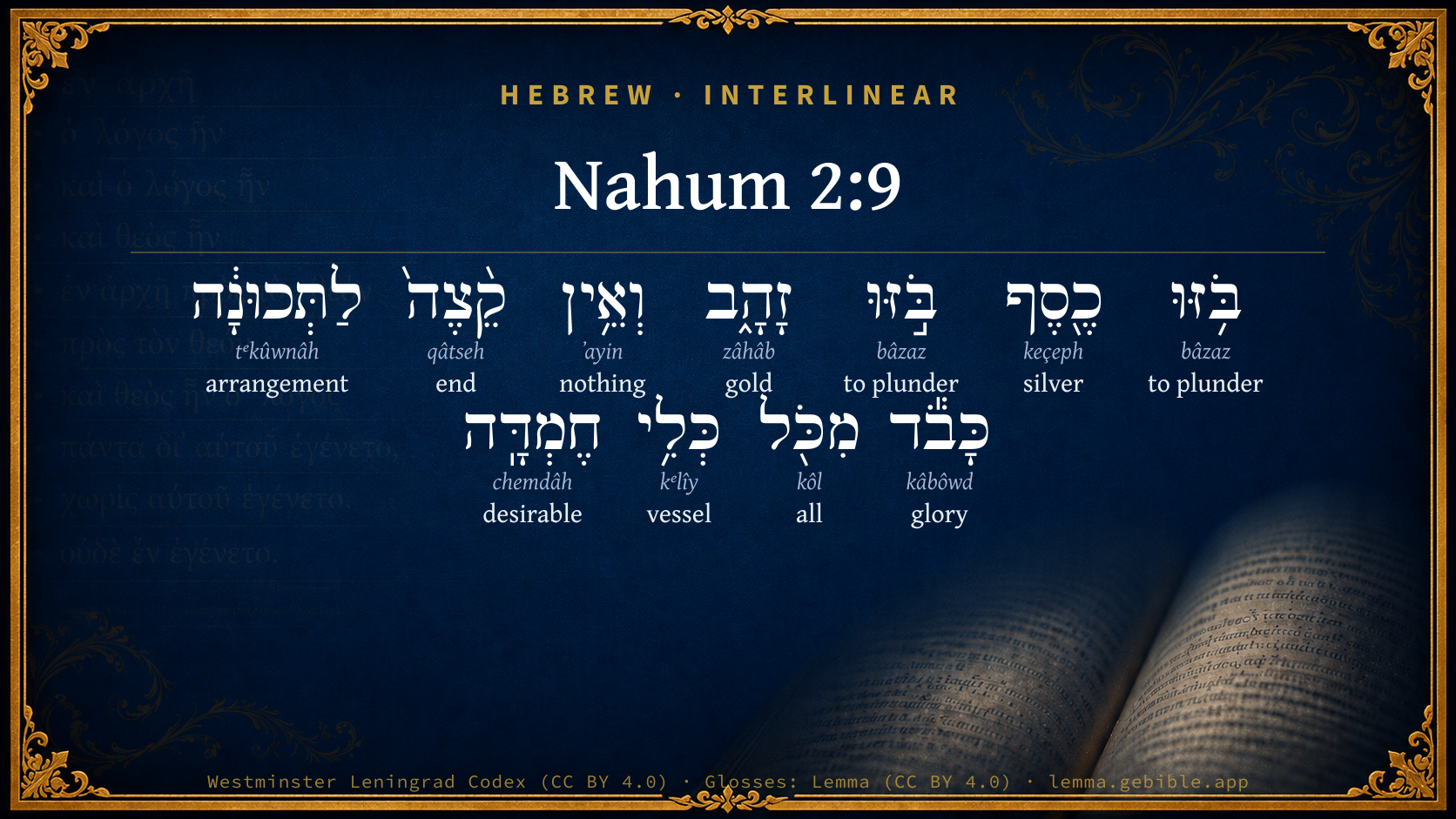
Hebrew (Westminster Leningrad Codex) Nahum 2:9 appears in the Hebrew Old Testament. The text above is from the Westminster Leningrad Codex. Each word links to its Strong’s number, a concise gloss, and parsing drawn from the Open Scriptures Hebrew Bible morphology. Click any word for its full Brown-Driver-Briggs (BDB) entry.
Download image
Cite this verse

Nahum 2:9 (World English Bible). Public Domain. Lemma interlinear Bible study tool, https://lemma.gebible.app/v/nahum/2/9.

Show BibTeX & RIS
BibTeX
RIS
English Translation
Take the spoil of silver. Take the spoil of gold, for there is no end of the store, the glory of all goodly furniture.
World English Bible · Public Domain
Download a study sheet

One document with this verse’s original text, its word-by-word gloss line, the meaning frame, cross-references with their text, attributed commentary, and full source and license credits — printable, and it pastes into notes with its structure intact.

This verse Autodidact and up

Study sheet (.html) Plain text (.txt)

A passage Seminary Student

Up to 50 verses in one chapter. A passage sheet keeps up to 6 commentary sources and 12 cross-references per verse, in the order this page ranks them, and says so on the sheet whenever that leaves anything out. Ask for a single verse and you get the Autodidact verse sheet above.

Everything on this page stays free to read, with no account — the sheet is a download of what is already on screen, not access to it.

Want to remove ads? Support Godless Engineer
Compare translations 3

The same verse in 3 English versions, stacked beneath the original-language interlinear above. Click any original word for its lexicon entry.

Each is an independent rendering of the whole verse — the interlinear is not word-aligned to these translations.

Highlighted words mark where these versions differ — a whole-verse word diff, not a word-by-word alignment.

  • World English Bible Public Domain
    Take the spoil of silver. Take the spoil of gold, for there is no end of the store, the glory of all goodly furniture.
  • King James Version Public Domain
    Take ye the spoil of silver, take the spoil of gold: for there is none end of the store and glory out of all the pleasant furniture.
  • unfoldingWord Literal Text CC BY-SA 4.0
    Plunder silver, plunder gold, for there is no end to the supply; a wealth of all things of delight.

unfoldingWord Literal Text — © unfoldingWord, licensed CC BY-SA 4.0. Word-aligned USFM3 via Door43 (git.door43.org/unfoldingWord/en_ult).

Versions to compare (up to 4)

3 of 4 selected

Show all 18 translations

Every available English version of this verse, each an independent rendering of the whole verse.

  • World English Bible Public Domain
    Take the spoil of silver. Take the spoil of gold, for there is no end of the store, the glory of all goodly furniture.
  • Berean Standard Bible Public Domain
    “Plunder the silver! Plunder the gold!” There is no end to the treasure, an abundance of every precious thing.
  • Majority Standard Bible Public Domain
    “Plunder the silver! Plunder the gold!” There is no end to the treasure, an abundance of every precious thing.
  • King James Version Public Domain
    Take ye the spoil of silver, take the spoil of gold: for there is none end of the store and glory out of all the pleasant furniture.
  • American Standard Version (1901) Public Domain
    Take ye the spoil of silver, take the spoil of gold; for there is no end of the store, the glory of all goodly furniture.
  • Revised Version (1885) Public Domain
    Take ye the spoil of silver, take the spoil of gold: for there is none end of the store, the glory of all pleasant furniture.
  • Geneva Bible (1599) Public Domain
    Spoyle ye the siluer, spoyle the golde: for there is none ende of the store, and glorie of all the pleasant vessels.
  • Douay-Rheims (1899) Public Domain
    Take ye the spoil of the silver, take the spoil of the gold: for there is no end of the riches of all the precious furniture.
  • Young's Literal Translation Public Domain
    Seize ye silver, seize ye gold, And there is no end to the prepared things, `To' the abundance of all desirable vessels.
  • Literal Standard Version CC BY-SA 4.0
    Seize silver, seize gold, || And there is no end to the prepared things, || [To] the abundance of all desirable vessels.
  • Unlocked Literal Bible CC BY-SA 4.0
    Take the silver plunder, take the gold plunder, for there is no end to it, to the splendor of all Nineveh's beautiful things.
  • unfoldingWord Literal Text CC BY-SA 4.0
    Plunder silver, plunder gold, for there is no end to the supply; a wealth of all things of delight.
  • Darby Bible Public Domain
    Plunder the silver, plunder the gold; for there is no end of the splendid store of all precious vessels.
  • World Messianic Bible Public Domain
    Take the plunder of silver. Take the plunder of gold, for there is no end of treasure, an abundance of every precious thing.
  • Webster's Bible Public Domain
    \\2:8\\But Nineveh is of old like a pool of water: yet they shall flee away. Stand, stand, shall they cry; but none shall look back.
  • Free Bible Version CC BY-SA 4.0
    Loot the silver! Loot the gold! There's an endless supply—an abundance of everything you could ever want.
  • Bible in Basic English Public Domain
    But Nineveh is like a pool of water whose waters are flowing away; Keep your place, they say; but no one is turning back.
  • JPS Tanakh (1917) Public Domain
    (2-10) Take ye the spoil of silver, take the spoil of gold; for there is no end of the store, rich with all precious vessels.

Literal Standard Version (2020), Covenant Press — licensed CC BY-SA 4.0. Text via the HelloAO Bible API (eBible.org). Unlocked Literal Bible (unfoldingWord) — licensed CC BY-SA 4.0. Text via the HelloAO Bible API (eBible.org). unfoldingWord Literal Text — © unfoldingWord, licensed CC BY-SA 4.0. Word-aligned USFM3 via Door43 (git.door43.org/unfoldingWord/en_ult). Free Bible Version, Dr. Jonathan Gallagher — licensed CC BY-SA 4.0. Text via the HelloAO Bible API (eBible.org).

Word by word

More ways to search: Search by grammar → Find every occurrence → Compare this word →

Practice this passage: Drill this verse → Learn its vocabulary →

לַתְּכוּנָ֔ה
tᵉkûwnâh
H8498
“to/for the · arrangement”
Preposition, Determined + Noun, Common, Feminine, Singular, Absolute
Part of Speech
Preposition + Noun
Type
Common
Gender
Feminine
Number
Singular
State
Absolute
Full BDB Definition

Origin: pass part of H8505

TWOT: 964e

arrangement, preparation, fixed place - arrangement, disposition - preparation - fixed place
  1. בֹּ֥זּוּ bâzaz H962 “plunder” Verb, Qal, Imperative, 2nd Person, Masculine, Plural
  2. כֶ֖סֶף keçeph H3701 “silver” Noun, Common, Masculine, Singular, Absolute
  3. בֹּ֣זּוּ bâzaz H962 “plunder” Verb, Qal, Imperative, 2nd Person, Masculine, Plural
  4. זָהָ֑ב zâhâb H2091 “gold” Noun, Common, Masculine, Singular, Absolute
  5. וְאֵ֥ין ʼayin H369 “and · nothing” Conjunction + Particle, Negative
  6. קֵ֨צֶה֙ qâtseh H7097 “end” Noun, Common, Both, Singular, Absolute
  7. כָּבֹ֕ד kâbôwd H3519 “glory” Noun, Common, Both, Singular, Absolute
  8. מִכֹּ֖ל kôl H3605 “from · all of” Preposition + Noun, Common, Masculine, Singular, Construct
  9. כְּלִ֥י kᵉlîy H3627 “vessel of” Noun, Common, Masculine, Singular, Construct
  10. חֶמְדָּֽה chemdâh H2532 “desirable” Noun, Common, Feminine, Singular, Absolute

About this verse

These counts appear in no published source. They are computed here, from the morphology-tagged text and Lemma’s own curated glosses. What Lemma adds →

11
words
10
distinct lemmas
Prophets
section

Notable vocabulary

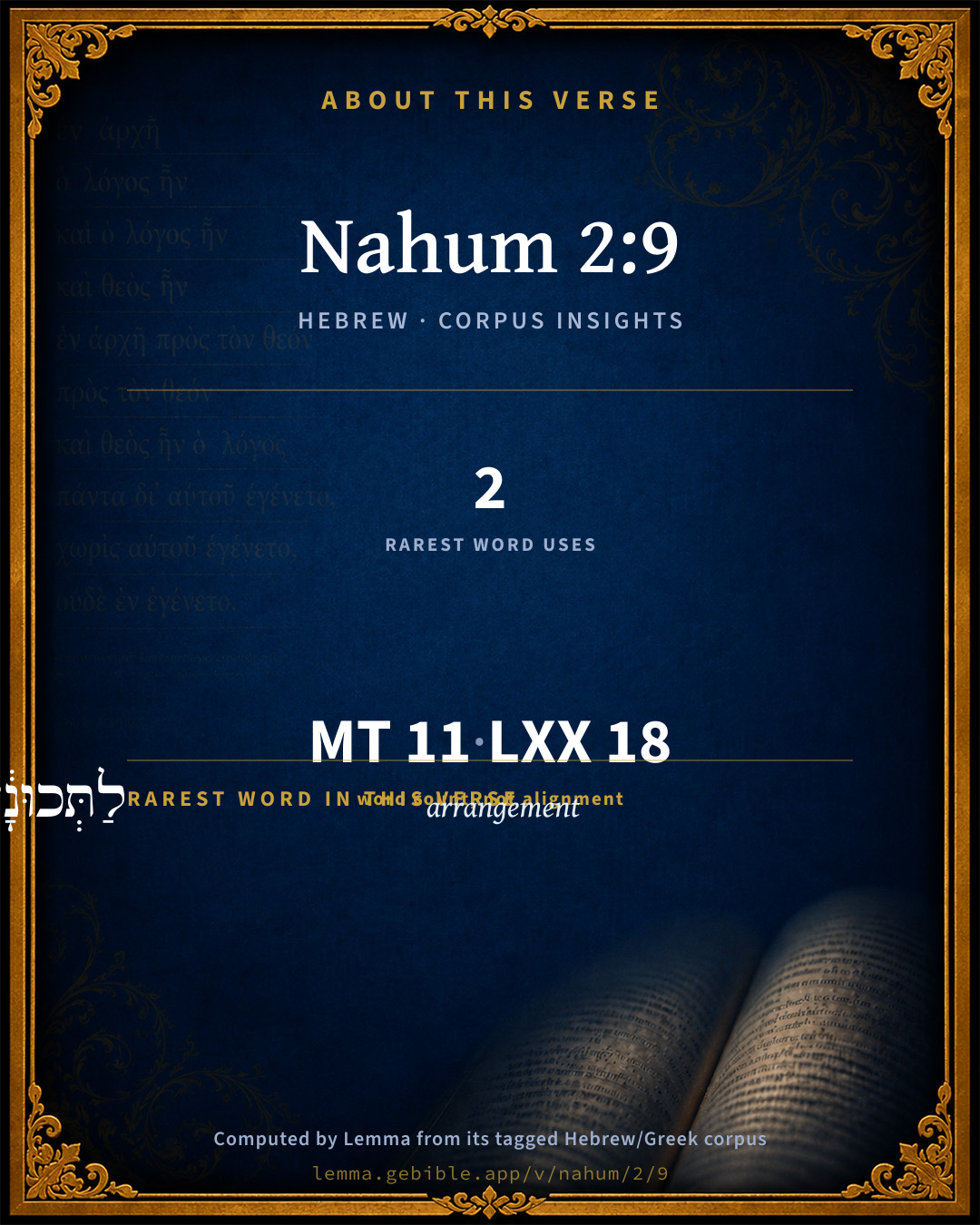
The rarest word here is לַתְּכוּנָ֔ה arrangement H8498 — appearing just 2 times in the whole Hebrew Bible.

Shared distinctive vocabulary

לַתְּכוּנָ֔ה arrangement H8498 occurs in 2 verses of the Hebrew Bible. Also found in:

Grammatical profile

  • 2 verbs
  • 8 nouns
  • 1 particle

Verb forms

  • בֹּ֥זּוּ Qal · Imperative
  • בֹּ֣זּוּ Qal · Imperative

Repetition

A word recurs within this verse — often emphatic in Hebrew:

  • בֹּ֥זּוּ to plunder H962 ×2

Hebrew & Septuagint length

In English translation the verse runs 24 words from the Hebrew and 26 from the Septuagint (LXX English) — closely comparable.

A rough comparison of the two English renderings, which tokenize alike — not a word-level alignment.

Word counts can differ between the Hebrew and the Greek without any difference in meaning — e.g. the Hebrew direct-object marker אֵת has no separate Greek word, and Greek often adds the article ὁ.

In the original languages it is 11 Hebrew tokens and 18 Greek tokens — but the two are counted differently (Hebrew bundles its prefixes and suffixes into one token; the Greek is in lemma form), so that isn’t a like-for-like length.

Cross-references

8

Topical passages linked to Nahum 2:9 in the Treasury of Scripture Knowledge — connected by theme and wording, ordered by reader-vote popularity; previews shown in the World English Bible.

  • 2 Chronicles 36:10 At the return of the year king Nebuchadnezzar sent, and brought him to Babylon, with the goodly vessels of the house of Yahweh, and made Zedekiah his brother king over Judah and Jerusalem.
  • Isaiah 33:4 Your spoil shall be gathered as the caterpillar gathers: as locusts leap shall men leap on it.
  • Jeremiah 25:34 Wail, you shepherds, and cry; and wallow [in ashes], you principal of the flock; for the days of your slaughter and of your dispersions are fully come, and you shall fall like a goodly vessel.
  • Jeremiah 51:56 for the destroyer is come on her, even on Babylon, and her mighty men are taken, their bows are broken in pieces; for Yahweh is a God of recompenses, he will surely requite.
  • Ezekiel 26:12 They shall make a spoil of your riches, and make a prey of your merchandise; and they shall break down your walls, and destroy your pleasant houses; and they shall lay your stones and your timber and your dust in the midst of the waters.
  • Daniel 11:8 Also their gods, with their molten images, [and] with their goodly vessels of silver and of gold, shall he carry captive into Egypt; and he shall refrain some years from the king of the north.
  • Nahum 2:12–13 The lion tore in pieces enough for his cubs, and strangled for his lionesses, and filled his caves with the kill, and his dens with prey.
  • Isaiah 33:1 Woe to you who destroy, and you weren't destroyed; and deal treacherously, and they didn't deal treacherously with you! When you have ceased to destroy, you shall be destroyed; and when you have made an end of dealing treacherously, they shall deal treacherously with you.

Cross-references courtesy of OpenBible.info (CC BY 4.0).

Hebrew and Greek witnesses Masoretic Hebrew ↔ Greek Septuagint

The same verse in the two great witnesses to the Old Testament, shown verse-for-verse.

These are two independent witnesses, not word-aligned to each other, and the Septuagint is shown in lemma (dictionary) form.

Hebrew Nahum 2:9 Masoretic · Westminster Leningrad Codex

בֹּ֥זּוּ כֶ֖סֶף בֹּ֣זּוּ זָהָ֑ב וְאֵ֥ין קֵ֨צֶה֙ לַתְּכוּנָ֔ה כָּבֹ֕ד מִכֹּ֖ל כְּלִ֥י חֶמְדָּֽה

Take the spoil of silver. Take the spoil of gold, for there is no end of the store, the glory of all goodly furniture.

World English Bible · Public Domain

Greek LXX Nahum 2:9 Septuagint · lemma form

καί νινευη ὡς κολυμβήθρα ὕδωρ ὁ ὕδωρ αὐτός καί αὐτός φεύγω οὐ ἵστημι καί οὐ εἰμί ὁ ἐπιβλέπω

They plundered the silver, they plundered the gold, and there was no end of their adorning; they were loaded with it upon all their pleasant vessels.

LXX2012 (modern English Septuagint) · Public Domain

On this verse, The Pulpit Commentary discusses the Septuagint’s reading. Read the note in Commentary ↓

Hebrew: Westminster Leningrad Codex (CC BY 4.0). Greek: Septuagint (public domain); English from LXX2012 (modern English Septuagint) (Public Domain). How the Septuagint differs from the Hebrew →

Targum (Aramaic paraphrase)

1

The Targum is the ancient Jewish Aramaic paraphrase of the Hebrew Scriptures — an interpretive translation, not the Hebrew text itself. Onkelos (literal) and Pseudo-Jonathan (expansive) render the Torah, and Jonathan the Prophets. Coverage is partial: where no permissively-licensed English translation exists for a verse, only the Aramaic is shown. This is verse-level text, not a word-by-word alignment to the Hebrew.

  1. Targum Jonathan Prophets (Joshua–Malachi)
    וְנִינְוֵה כְּבֵית כְּנִישַׁת מַיָא מִיוֹמֵי קֳדָם הִיא וְאִינוּן עֲרָקוּ קוּמוּ קוּמוּ וְלֵית דְמַפְנֵי לְמֵיקָם:

    (no public-domain English translation for this verse)

    Targum Jonathan — Aramaic: “Mikraot Gedolot” (public domain). English: “Sefaria Community Translation” (CC0 1.0 (public-domain dedication)); “London "Chaldee Paraphrase," 1871” (public domain). Text via Sefaria.

Commentary

Notes on Nahum 2:9 from classic Christian and Jewish commentators (each source and its license shown beneath its notes). The classic Christian expositions comment on the surrounding passage and are grouped to its opening verse, so a note may address several verses; the Jewish commentaries on the Tanakh (Rashi and others) are per-verse, so they appear only where the commentator wrote on this verse.

Lemma curates 59 commentaries, every one of them public domain or Creative Commons licensed, each selected and text-cleaned for this edition rather than reprinted as found. About our sources →

Trapp's Complete Commentary

John Trapp

Nah 2:9 Take ye the spoil of silver, take the spoil of gold: for [there is] none end of the store [and] glory out of all the pleasant furniture.

Ver. 9. Take ye the spoil of silver, take the spoil of gold] This is the voice of God to the Chaldeans; encouraging them to fall on, since they are sure of good booty, plenty of plunder, which he here freely bestoweth upon them. In like sort Mahomet, the Great Turk, the better to encourage his soldiers to storm Constantinople, caused proclamation to be made through his camp the day before, that he would freely give all the spoil of the city for three days unto them if they could win it. And for confirmation thereof, he solemnly swore the Turk’s great oath, &c. Now the love of money is Dεινος και παντολμος, saith a Father, daring and desperate.

For there is none end of the store] Fat plunder, as was at Constantinople; the wealth whereof the Turks themselves wondered at; and were therewith so enriched, that it is a proverb among them at this day, if any grow suddenly rich, to say, He hath been at the sacking of Constantinople. Neither did they more wonder at their wealth than derided their folly; for that possessing so much, they would part with so little to their emperor, for the defence of themselves and their country. And the like is reported of Heidelberg.

And glory out of all the pleasant furniture] Heb. Vessels, or utensils of desire; which are said to yield glory, because with men one hath so much glory and respect as he hath wealth and rich household stuff. See Gen 31:1. {See Trapp on "Gen 31:1"} 1Ki 10:23 2Ch 32:27. See here also the just judgment of God upon such as set their affections upon that costly vanity, rich furniture (Hezekiah smarted for it, Isa 39:2; Isa 39:6 2Ch 32:27), or rich attire, which is superbiae nidus, the nest of pride, saith one. The worst apparel is nature’s garment; the best but folly’s garnish, saith another.

John Trapp, A Commentary or Exposition upon All the Books of the Old and New Testament (1647–1656) — public domain. Text from a community e-Sword module.

Joseph Benson's Commentary

Nah 2:9-10. Take ye the spoil of silver, of gold — Here the Babylonians are addressed as if they had just entered the city; and are bid to take the spoil of it, there being none to make any resistance. We read in Diodorus, that Arbaces carried many talents of gold and silver to Ecbatana, the royal city of the Medes. For there is none end of the store, &c. — The Vulgate reads, There is no end of the riches, from all the desirable vessels. The sense of the Hebrew, however, is, The glory (namely, of their riches) is above all precious vessels; that is, beyond all that is generally esteemed precious; and greatly coveted. She is empty, and void, and waste — She is spoiled of every thing. And the heart melteth — The inhabitants have no heart, or courage, to defend themselves, but leave the city to be plundered and laid waste by the enemy. The knees smite together — They are quite overcome with fear.

Joseph Benson's Commentary on the Old and New Testaments (1811–1818) — public domain. Text from a community e-Sword module.

Tyndale Open Study Notes

Tyndale Open Resources

2:9 The vast, uncounted wealth of other nations poured into the Assyrian capital as trade, tribute, and spoils, but it was gone in an instant. Ruthless aggression and wickedness may succeed temporarily, but ultimately they will be destroyed (Prov 13:22; Obad 1:15; Luke 12:16-20).

Tyndale Open Study Notes — © Tyndale Open Resources, licensed CC BY-SA 4.0. Text via the HelloAO Bible API.

Geneva Bible (1599)

Geneva Bible translators

God commandeth the enemies to spoil Nineveh, and promiseth them infinite riches and treasures.

Geneva Bible (1599) marginal notes — public domain. Text via Bolls.life.

Jamieson, Fausset & Brown

Robert Jamieson, A. R. Fausset & David Brown

silver . . . gold--The conquerors are summoned to plunder the city. Nineveh's riches arose from the annual tribute paid by so many subject states, as well as from its extensive merchandise (Nah 3:16; Eze 27:23-24).

store--accumulated by the plunder of subject nations. It is remarkable, that while small articles of value (bronze inlaid with gold, gems, seals, and alabaster vases) are found in the ruins of Nineveh, there are is none of gold and silver. These, as here foretold, were "taken for spoil" before the palaces were set on fire.

glory out of all the pleasant furniture--or, "there is abundance of precious vessels of every kind" [MAURER].

Jamieson, Fausset & Brown — Commentary Critical and Explanatory on the Whole Bible (1871) — public domain (CC PDM 1.0). Text via the HelloAO Bible API.

Adam Clarke's Commentary

Verse 9. Take ye the spoil] Though the king burnt his treasures, vestments, c., he could not totally destroy the silver and the gold. Nor did he burn the riches of the city these fell a prey to the conquerors; and there was no end of the store of glorious garments, and the most costly vessels and furniture.

Adam Clarke's Commentary on the Bible (1810–1826) — public domain. Text from a community e-Sword/MySword module.

John Calvin's Commentaries

Here the Prophet, as it were, by the command and authority of God, gives up Nineveh to the will of its enemies, that they might spoil and plunder it. Some think that this address is made in the name of a general encouraging his soldiers; but we know that the Prophets assume the person of God, when they thus command any thing with authority; and it is a very emphatical mode of speaking. It is adopted, that we may know that the Prophets pour not forth an empty sound when they speak, but really testify what God here determined to do, and what he in due time will execute. As then we know, that this manner of speaking is common to the Prophets there is no reason to apply this to the person of Nebuchadnezzar or of any other. God then shows here that Nineveh was given up to ruin; and therefore he delivered it into the hands of enemies.

It is indeed certain, that the Babylonians, in plundering the city, did not obey God’s command; but yet it is true, that they punished the Assyrians through the secret influence of God: for it was his purpose to visit the Ninevites for the cruelty and avarice for which they had been long notorious, and especially for having exercised unexampled barbarity toward the Jews. This is the reason why God now gives them up to the Babylonians and exposes them to plunder. But as I have spoken at large elsewhere of the secret judgments of God, I shall only briefly observe here, — that God does not command the Babylonians and Chaldeans in order to render them excusable, but shows by his Prophet, that Nineveh was to be destroyed by her enemies, not by chance, but that it was his will to avenge the wrongs done to his people. At the same time, we must bear in mind what we have said elsewhere, — that the Prophets thus speak when the execution is already prepared; for God does not in vain or without reason terrify men, but he afterwards makes it manifest by the effect: as he created the world from nothing by his word, so also by his word he executes and fulfill his judgments. It is then no wonder, that the Prophet does here, as though he ruled the Chaldeans according to his will, thus address them, Take ye away, take ye away But this must be viewed as having a reference to the faithful; for the Babylonians, in plundering the city Nineveh, did not think that they obeyed God, nor did they give to God the praise due for the victory; but the faithful were thus reminded, that all this was done through the secret providence of God, and that it was also a clear, and, as it were, a visible evidence of God’s paternal love towards his Church, when he thus deigned to undertake the cause of his distressed people.

It then follows, There is no end of preparations: Some render תכונה, techune, treasure, or hidden wealth, and derive it from כון, cun, which is to prepare; but תכונה, tacune, is almost always taken for a measure. תכנות, tacanut, from תכון, tacun means a sum, for תכש, tacan, is to number or to count; and this meaning suits the passage. But there is no need of laboring much about this word; if we take it simply for place, the meaning would be, that there was no plot of ground in that city which was not as it were a gulf filled up; for it had amassed all the wealth of the nations: and this sense would harmonize well with the subject of the Prophet, — that the soldiers were to plunder until they were satiated; for the place was, as it were, a deep abyss.

He afterwards adds, There is glory from every desirable vessel. Those who think מ, mem, a particle of comparison in this place are much mistaken, and misapply the meaning of the Prophet; their rendering is, In comparison with every desirable vessel; but this, as all must see, is very frigid. The Prophet, I have no doubt, declares that the wealth of Nineveh consisted of every desirable vessel; for they had for a long time heaped together immense wealth, and that of every kind. The Hebrews call what is precious a desirable thing; and their vessels we include under the term furniture. We now then perceive what the Prophet means. Some take כבד, cabed, as a participle, and give this version, It is burdened, or adorned, (for it means both,) with every desirable vessel. But the simpler mode of speaking is what we have explained, — that its glory was from every desirable vessel.

And here the Prophet condemns what the Assyrians had done in heaping together so much wealth from all quarters; for they had committed indiscriminate plunder, and gathered for themselves all the riches of the nations. They had indeed plundered all their neighbors, yea, and wholly stripped them. The Prophet now shows, in order to expose them to ridicule, that other robbers would be made rich, whom the Lord would raise up against them. The same is said by Isaiah,

‘O thou plunderer, shalt not thou also be exposed to plunder?’ (Isaiah 33.)

So also the Prophet shows in this passage, that men foolishly burn with so much avidity for money, and with so much anxiety heap together great wealth; for God will find out some who in their turn will plunder those who have plundered. It follows—

John Calvin's Commentaries (1540-1563) — public domain. Text from the Calvin Translation Society English edition (1840s-50s) via the Christian Classics Ethereal Library (ccel.org). Calvin's coverage is partial (roughly two-thirds of the Bible); uncommented books and verses are honest gaps, never fabricated. The 19th-century editor's footnotes and remarks are omitted so the notes are faithfully Calvin's own voice.

Ellicott's Commentary for English Readers

(9) And glory.—Better, there is abundance of all precious vessels.

A Bible Commentary for English Readers, edited by Charles John Ellicott (1878–1897) — public domain. Text from a community e-Sword module.

The Cambridge Bible for Schools and Colleges

gen. ed. J. J. S. Perowne

9. All the wealth of the city is abandoned by the inhabitants, fleeing for their life, and the scene of plunder is pictured in the exclamations of the prophet, Spoil the silver!

and glory … furniture] and wealth of all precious vessels, but the term vessels means virtually “articles.” Jewels, rich apparel, costly vessels and whatever men think precious would be found in the rich capital in abundance (Zec_14:14). The enormous riches of Nineveh are frequently alluded to in the inscriptions; the treasures brought home by Assurbanipal’s army after the capture of Thebes or No (ch. Nah_3:8) were fabulous.

The Cambridge Bible for Schools and Colleges (gen. ed. J. J. S. Perowne; Cambridge University Press, 1878–1918) — public domain. Text from a community e-Sword module.

John Gill's Exposition

Take ye the spoil of silver, take the spoil of gold,.... Of which there was a great quantity in this rich and populous city: these are the words of the prophet, or of the Lord by the prophet, to the Medes and Chaldeans, to seize the spoil of the city, now fallen into their hands; suggesting that this was by the order and will of God, though they saw it not: or of the generals of the army of the Medes and Babylonians, giving leave to the common soldiers to take part of the plunder, there being enough for them all, officers and private men:

for there is none end of the store and glory out of all the pleasant furniture: no end of the wealth which had been hoarded up, and of their household goods and rich apparel, which their coffers, houses, and wardrobes, were full of, the value of which could not be told. The king of Assyria, perceiving that he, his family, and his wealth, were like to fall into the hands of the enemy, caused a pile of wood to be raised, and in it heaped his gold, silver, and royal apparel, and, enclosing himself, his eunuchs, and concubines in it, set fire to it, and destroyed himself and them. It is said (n) there were no less in this pile than a thousand myriads of talents of gold, which are about fourteen hundred millions sterling, and ten times as many talents of silver, together with apparel and furniture unspeakable; and yet, after all this, the princes of the Babylonians and Medes carried off vast quantities. The Babylonian prince loaded several ships with the ashes of the pile, and a large quantity of gold and silver, discovered to him by an eunuch, a deserter; and the Median prince, what of the gold and silver left out of the pile, which were many talents, that fell into his hands, he sent to Ecbatana, the royal city of Media (o).

(n) Athenaeus apud Rollin's Ancient History, &c. vol. 2. p. 31, 32. See the Universal History, vol. 4. p. 306. (o) Diodor. Sicul. l. 2. p. 114, 115.

John Gill's Exposition of the Whole Bible (1746–1763) — public domain (CC PDM 1.0). Text via the HelloAO Bible API.

Albert Barnes' Notes on the Bible

Take ye the spoil of silver, take the spoil of gold - Nineveh had not hearkened of old to the voice of the prophet, but had turned back to sin; it cannot hearken now, for fear. He turns to the spoiler to whom God’s judgments assigned her, and who is too ready to hear. The gold and silver, which the last Assyrian King had gathered into the palace which he fired, was mostly removed (the story says, treacherously) to Babylon. Arbaces is said to have borne this and to have removed the residue, to the amount of many talents, to Agbatana, the Median capital . “For there is none end of the store.” Nineveh had stored up from her foundation until then, but at last for the spoiler. “When thou shalt cease to spoil, thou shalt be spoiled” Isa 33:1. Many “perish and leave their wealth to others” Psa 49:10. “The wealth of the sinner is laid up for the just” Pro 13:22. “And glory out of all the pleasant furniture,” (literally as in the margin, “glory out of all vessels of desire”) i. e., however large the spoil, it would be but a portion only; yet all their wealth, though more than enough for the enemy and for them, could not save them. Her “glory,” was but a “weight” to weigh her down, that she should not rise again Zec 5:8; Exo 15:10. Their wealth brought on the day of calamity, availed not therein, although it could not be drawn dry even by the spoiler. Jerome: “They could not spoil so much as she supplied to be spoiled.”

Albert Barnes' Notes on the Bible (1834–1885) — public domain. Text from a community e-Sword/MySword module.

Matthew Poole's English Annotations

Take: God speaks by his prophet, commanding that it be done, and foretelling that it certainly shall be done; and Scythians, Medes, and Chaldeans, or whoever else did associate in the war, and sacking of Nineveh, may be supposed to encourage one another in the plundering of the city.

Ye, conquering soldiers, you that come together in hope of this booty.

For here is enough for you all; Nineveh hath been long gathering, and hath gathered much treasure, it is uncountable; therefore take all you can lay hands on: possibly it may be the foretelling of the chief commander, his giving his soldiers leave to take what they could, forasmuch as after all they would leave enough, a great treasure for him.

Store of all sorts, both for use and luxury, both for necessity and superfluity.

Glory; splendid and rich furniture in their temples, palaces, public edifices, and private houses; their rich vessels, costly hangings, and gaudy apparel in their wardrobes, in their closets, and in their shops; all delightful to the eye, and rich in the real value.

Matthew Poole's English Annotations on the Holy Bible (1683–1685) — public domain. Text from a community e-Sword/MySword module.

Whedon's Commentary on the Bible

Daniel D. Whedon

9, 10. The sack of the city. The prophet summons the victors to plunder.

Silver,… gold — Immense quantities of these were carried to Nineveh by the Assyrian kings.

None end of the store — The truth of this statement is established by the inscriptions, which enumerate again and again the enormous treasures brought to Nineveh by her victorious armies (see pp.

429f.).

Glory out of all the pleasant furniture — R.V., “the glory of all goodly furniture.” An obscure phrase, whose grammatical connection is not quite clear; perhaps it is to be understood as in apposition to the preceding “store.” If so, instead of “glory” we would better read with R.V. margin, “wealth.” “Furniture” also cannot be taken in the narrow sense of that term; it must include jewels, costly vessels, rich apparel — in fact, everything that men consider precious; all these will be found in great abundance. The peculiarity of the present Hebrew text has led Marti to emend it so as to read, “Take for yourselves the abundance of all kinds of precious things.” Nah_2:10 concludes the description.

Empty,… void,… waste — In the original a forceful play upon words, which cannot be reproduced in English (compare Zep_1:15; Isa_24:1). With these three words, similar in meaning and sound, the prophet depicts the utter desolation of Nineveh. The few who have remained behind are paralyzed with terror.

Heart melteth — Their courage gives out completely.

The knees smite together — Their whole body trembles as a result of terror.

Much pain — R.V., “anguish.”

Is in all loins — As in the case of a woman in childbirth (see on Mic_4:9; Isa_21:3).

The faces of them all gather blackness — R.V., “are waxed pale” (see on Joe_2:6).

Daniel D. Whedon (gen. ed.), Commentary on the Old and New Testaments (1874–1909) — public domain. Text from a community e-Sword module.

The Pulpit Commentary

Vers. 9-13. The city is plundered, and henceforth lies waste, in terrible contrast with its former excellency,

The prophet calls on the invaders to come and gather the spoil of the city, which God gives into their hands. Take ye the spoil. Fabulous stories are told of the amount of the precious metals stored in Nineveh and Babylon. "Sardanapalus is said to have placed a hundred and fifty golden beds, and as many tables of the same metal, on his funeral pile, besides gold and silver vases and ornaments in enormous quantities, and purple and many-coloured raiments (Athen., lib. 12.). According to Diodorus, the value of the gold taken from the temple of Bolus alone by Xerxes amounted to above 7350 Attic talents, of sterling money" (Layard, "Nineveh," 2:416, etc.; comp. Dan_3:1, where the size of the golden image or pillar, sixty cubits high and six cubits broad, shows how plentiful was gold in these countries). Bonomi: "The riches of Nineveh are inexhaustible, her vases and precious furniture are infinite, copper constantly occurs in their weapons, and it is most probable a mixture of it was used in the materials of their tools. They had acquired the art of making glass.... The well known cylinders are a sufficient proof of their skill in engraving gems. Many beautiful specimens of carving in ivory were also discovered .... The condition of the ruins is highly corroborative of the sudden destruction that came upon Nineveh by fire and sword .... It is evident from the ruins that both Khorsabad and Nimroud were sacked and then set on fire. Neither Botta nor Layard found any of that store of silver and gold and "pleasant furniture" which the palaces contained; scarcely anything, even of bronze, escaped the spoiler" ("Nineveh and its Discoveries," pp. 334, 336). There is none end of the store; Vulgate, Non finis est divitiarum; Septuagint, ouk hn perav tou kosmou authv , "There was no end of her ornament." And glory out of all the pleasant furniture; literally, vessels of desire. It is plainer to translate, There is abundance of all precious furniture.

The Pulpit Commentary (1880–1919), ed. H.D.M. Spence-Jones & Joseph S. Exell — public domain. Text from a community e-Sword module.

John Wesley's Explanatory Notes

Take - Thus the Chaldeans encourage one another in the plundering of the city.

John Wesley, Explanatory Notes Upon the Whole Bible (1754–1765) — public domain. Text via the GEBible commentary corpus.

Rashi

Rabbi Shlomo Yitzchaki (Rashi)

And Nineveh is like a pool of water - it is since days of yore—Since the day it was founded, it has been sitting tranquilly with no one disturbing it, like a pool of gathered water that does not move from its place.

and they—Now, out of their stress, they have learned to flee and are fleeing.

Halt! Halt!—They say to them, but no one turns his heart to listen and halt.

Rashi on the Tanakh — English translations: “The Judaica Press complete Tanach with Rashi, translated by A. J. Rosenberg” (CC BY 4.0); “Pentateuch with Rashi's commentary by M. Rosenbaum and A.M. Silbermann, 1929-1934” (public domain); “The Metsudah Tanach series, Lakewood, N.J” (CC BY 4.0); and “The Book of Joshua, Metsudah Publications, 1997” (CC BY 4.0). Text via Sefaria.

Lesson kit

Teaching starters — assembled from the data on this page, not authored interpretation. Every prompt links to the verse data it draws on. Edit before teaching.

Nahum, in the Prophets, opens this verse with 11 words (10 distinct Hebrew lemmas). Its most distinctive word is tᵉkûwnâh (“arrangement”). A historical commentator’s framing appears above. Read the whole chapter for the surrounding context.

Discussion questions

  1. How does “arrangement” (tᵉkûwnâh) shape what this verse is saying?
  2. Ezekiel 43:11 shares the word «arrangement» with this verse. How do the two illuminate each other?
  3. “to plunder” occurs 2× in this one verse. What is the effect of the repetition?
  4. These translations render this verse differently; the difference is in the English rendering, not the original. What questions does that raise?
  5. The verb «בֹּ֥זּוּ» is Qal Imperative. How does its form color the action?
  6. Reading how Trapp's Complete Commentary and Joseph Benson's Commentary read this verse, where do the two commentators agree and where do they part?

Things to notice

Reading settings

Reading text

Shown beneath each verse's original-language words.

Old Testament
Old Testament edition

Read the OT as the Masoretic Hebrew (MT) or the Greek Septuagint (LXX).

English shown for the Greek Septuagint (in the Hebrew ↔ Greek comparison).

Comparing translations? Open the Compare panel on any verse page to stack up to four side by side.