Isaiah 5:26

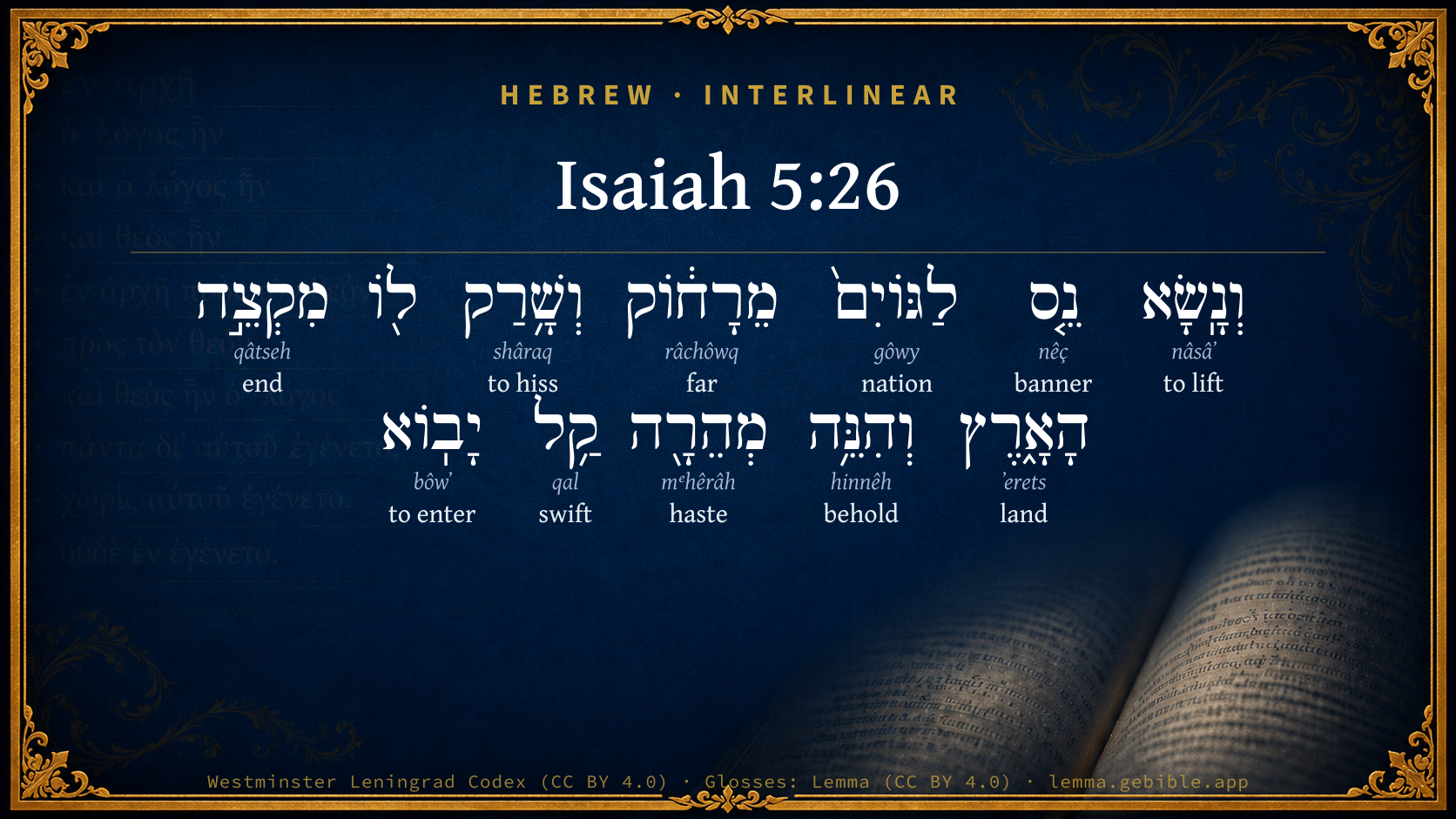
Hebrew (Westminster Leningrad Codex) Isaiah 5:26 appears in the Hebrew Old Testament. The text above is from the Westminster Leningrad Codex. Each word links to its Strong’s number, a concise gloss, and parsing drawn from the Open Scriptures Hebrew Bible morphology. Click any word for its full Brown-Driver-Briggs (BDB) entry.
Download image
Cite this verse

Isaiah 5:26 (World English Bible). Public Domain. Lemma interlinear Bible study tool, https://lemma.gebible.app/v/isaiah/5/26.

Show BibTeX & RIS
BibTeX
RIS
English Translation
He will lift up a banner to the nations from far, And he will whistle for them from the end of the earth. Behold, they will come speedily and swiftly.
World English Bible · Public Domain
Download a study sheet

One document with this verse’s original text, its word-by-word gloss line, the meaning frame, cross-references with their text, attributed commentary, and full source and license credits — printable, and it pastes into notes with its structure intact.

This verse Autodidact and up

Study sheet (.html) Plain text (.txt)

A passage Seminary Student

Up to 50 verses in one chapter. A passage sheet keeps up to 6 commentary sources and 12 cross-references per verse, in the order this page ranks them, and says so on the sheet whenever that leaves anything out. Ask for a single verse and you get the Autodidact verse sheet above.

Everything on this page stays free to read, with no account — the sheet is a download of what is already on screen, not access to it.

Want to remove ads? Support Godless Engineer
Compare translations 3

The same verse in 3 English versions, stacked beneath the original-language interlinear above. Click any original word for its lexicon entry.

Each is an independent rendering of the whole verse — the interlinear is not word-aligned to these translations.

Highlighted words mark where these versions differ — a whole-verse word diff, not a word-by-word alignment.

  • World English Bible Public Domain
    He will lift up a banner to the nations from far, And he will whistle for them from the end of the earth. Behold, they will come speedily and swiftly.
  • King James Version Public Domain
    And he will lift up an ensign to the nations from far, and will hiss unto them from the end of the earth: and, behold, they shall come with speed swiftly:
  • unfoldingWord Literal Text CC BY-SA 4.0
    And he will raise a banner for the nations from afar, and he will whistle for him from the end of the earth, and behold, hurriedly, swiftly, one will come.

unfoldingWord Literal Text — © unfoldingWord, licensed CC BY-SA 4.0. Word-aligned USFM3 via Door43 (git.door43.org/unfoldingWord/en_ult).

Versions to compare (up to 4)

3 of 4 selected

Show all 18 translations

Every available English version of this verse, each an independent rendering of the whole verse.

  • World English Bible Public Domain
    He will lift up a banner to the nations from far, And he will whistle for them from the end of the earth. Behold, they will come speedily and swiftly.
  • Berean Standard Bible Public Domain
    He lifts a banner for the distant nations and whistles for those at the ends of the earth. Behold—how speedily and swiftly they come!
  • Majority Standard Bible Public Domain
    He lifts a banner for the distant nations and whistles for those at the ends of the earth. Behold—how speedily and swiftly they come!
  • King James Version Public Domain
    And he will lift up an ensign to the nations from far, and will hiss unto them from the end of the earth: and, behold, they shall come with speed swiftly:
  • American Standard Version (1901) Public Domain
    And he will lift up an ensign to the nations from far, and will hiss for them from the end of the earth; and, behold, they shall come with speed swiftly.
  • Revised Version (1885) Public Domain
    And he will lift up an ensign to the nations from far, and will hiss for them from the end of the earth: and, behold, they shall come with speed swiftly:
  • Geneva Bible (1599) Public Domain
    And he will lift vp a signe vnto the nations a farre, and wil hisse vnto them from the ende of the earth: and beholde, they shall come hastily with speede.
  • Douay-Rheims (1899) Public Domain
    And he will lift up a sign to the nations afar off, and will whistle to them from the ends of the earth: and behold they shall come with speed swiftly.
  • Young's Literal Translation Public Domain
    And He lifted up an ensign to nations afar off, And hissed to it from the end of the earth, And lo, with haste, swift it cometh.
  • Literal Standard Version CC BY-SA 4.0
    And He lifted up an ensign to the far-off nations, || And hissed to it from the end of the earth, || And behold, with haste, it comes swiftly.
  • Unlocked Literal Bible CC BY-SA 4.0
    He will lift up a signal flag for far away nations and will whistle for those at the end of the earth. Look, they will come speedily and promptly.
  • unfoldingWord Literal Text CC BY-SA 4.0
    And he will raise a banner for the nations from afar, and he will whistle for him from the end of the earth, and behold, hurriedly, swiftly, one will come.
  • Darby Bible Public Domain
    And he will lift up a banner to the nations afar off, and will hiss for one from the end of the earth; and behold, it will come rapidly [and] lightly.
  • World Messianic Bible Public Domain
    He will lift up a banner to the nations from far away, and he will whistle for them from the end of the earth. Behold, they will come speedily and swiftly.
  • Webster's Bible Public Domain
    And he will lift up an ensign to the nations from afar, and will hiss to them from the end of the earth: and behold, they shall come with speed swiftly:
  • Free Bible Version CC BY-SA 4.0
    He will send a signal to the distant nations, and will whistle for those living at the ends of the earth. See how quickly they respond, how speedily they come!
  • Bible in Basic English Public Domain
    And he will let a flag be lifted up as a sign to a far-off nation, whistling to them from the ends of the earth: and they will come quickly and suddenly.
  • JPS Tanakh (1917) Public Domain
    And He will lift up an ensign to the nations from far, and will hiss unto them from the end of the earth; and, behold, they shall come with speed swiftly;

Literal Standard Version (2020), Covenant Press — licensed CC BY-SA 4.0. Text via the HelloAO Bible API (eBible.org). Unlocked Literal Bible (unfoldingWord) — licensed CC BY-SA 4.0. Text via the HelloAO Bible API (eBible.org). unfoldingWord Literal Text — © unfoldingWord, licensed CC BY-SA 4.0. Word-aligned USFM3 via Door43 (git.door43.org/unfoldingWord/en_ult). Free Bible Version, Dr. Jonathan Gallagher — licensed CC BY-SA 4.0. Text via the HelloAO Bible API (eBible.org).

Word by word

More ways to search: Search by grammar → Find every occurrence → Compare this word →

Practice this passage: Drill this verse → Learn its vocabulary →

וְשָׁ֥רַק
shâraq
H8319
“and · to hiss”
Conjunction + Verb, Qal, Sequential Perfect, 3rd Person, Masculine, Singular
Part of Speech
Conjunction + Verb
Stem
Qal
Form
Sequential Perfect
Person
3rd Person
Gender
Masculine
Number
Singular
Full BDB Definition

Origin: a primitive root

TWOT: 2468

to hiss, whistle, pipe - (Qal) to hiss (as a signal)
  1. וְנָֽשָׂא nâsâʼ H5375 “and · to lift” Conjunction + Verb, Qal, Sequential Perfect, 3rd Person, Masculine, Singular
  2. נֵ֤ס nêç H5251 “banner” Noun, Common, Masculine, Singular, Absolute
  3. לַגּוֹיִם֙ gôwy H1471 “to/for the · nations” Preposition, Determined + Noun, Common, Masculine, Plural, Absolute
  4. מֵרָח֔וֹק râchôwq H7350 “from · far” Preposition + Adjective, Adjective, Masculine, Singular, Absolute
  5. מִקְצֵ֣ה qâtseh H7097 “from · end of” Preposition + Noun, Common, Both, Singular, Construct
  6. הָאָ֑רֶץ ʼerets H776 “the · land” Particle, Definite Article + Noun, Common, Both, Singular, Absolute
  7. וְהִנֵּ֥ה hinnêh H2009 “and · behold” Conjunction + Particle, Demonstrative
  8. מְהֵרָ֖ה mᵉhêrâh H4120 “haste” Noun, Common, Feminine, Singular, Absolute
  9. קַ֥ל qal H7031 “swift” Adjective, Adjective, Masculine, Singular, Absolute
  10. יָבֽוֹא bôwʼ H935 “to enter” Verb, Qal, Imperfect, 3rd Person, Masculine, Singular

About this verse

These counts appear in no published source. They are computed here, from the morphology-tagged text and Lemma’s own curated glosses. What Lemma adds →

12
words
11
distinct lemmas
Prophets
section

Notable vocabulary

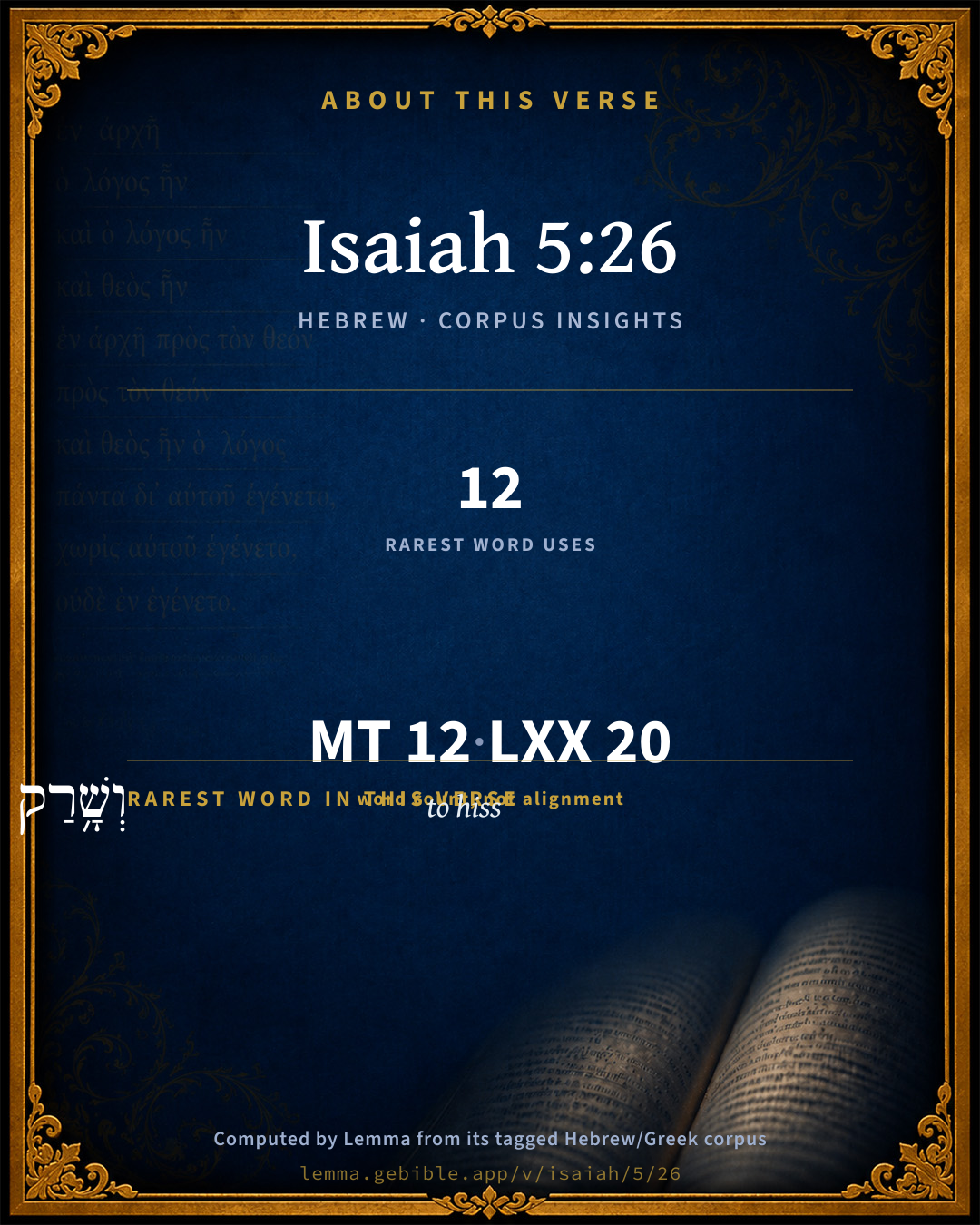
The rarest word here is וְשָׁ֥רַק to hiss H8319 — appearing just 12 times in the whole Hebrew Bible.

Shared distinctive vocabulary

וְשָׁ֥רַק to hiss H8319 occurs in 12 verses of the Hebrew Bible. Also found in:

Grammatical profile

  • 3 verbs
  • 5 nouns
  • 2 adjectives
  • 1 preposition
  • 1 particle

Verb forms

  • וְנָֽשָׂא Qal · Sequential Perfect
  • וְשָׁ֥רַק Qal · Sequential Perfect
  • יָבֽוֹא Qal · Imperfect

Hebrew & Septuagint length

In English translation the verse runs 30 words from the Hebrew and 31 from the Septuagint (LXX English) — closely comparable.

A rough comparison of the two English renderings, which tokenize alike — not a word-level alignment.

Word counts can differ between the Hebrew and the Greek without any difference in meaning — e.g. the Hebrew direct-object marker אֵת has no separate Greek word, and Greek often adds the article ὁ.

In the original languages it is 12 Hebrew tokens and 20 Greek tokens — but the two are counted differently (Hebrew bundles its prefixes and suffixes into one token; the Greek is in lemma form), so that isn’t a like-for-like length.

Cross-references

17

Topical passages linked to Isaiah 5:26 in the Treasury of Scripture Knowledge — connected by theme and wording, ordered by reader-vote popularity; previews shown in the World English Bible.

  • Zechariah 10:8 I will signal for them, and gather them; For I have redeemed them; And they will increase as they have increased.
  • Deuteronomy 28:49 Yahweh will bring a nation against you from far, from the end of the earth, as the eagle flies; a nation whose language you shall not understand;
  • Isaiah 7:18 It will happen in that day that Yahweh will whistle for the fly that is in the uttermost part of the rivers of Egypt, and for the bee that is in the land of Assyria.
  • Isaiah 18:3 All you inhabitants of the world, and you dwellers on the earth, when an ensign is lifted up on the mountains, look; and when the trumpet is blown, listen.
  • Isaiah 11:12 He will set up an ensign for the nations, and will assemble the outcasts of Israel, and gather together the dispersed of Judah from the four corners of the earth.
  • Malachi 1:11 For from the rising of the sun even to the going down of the same, my name is great among the nations, and in every place incense will be offered to my name, and a pure offering: for my name is great among the nations," says Yahweh of Hosts.
  • Psalms 72:8 He shall have dominion also from sea to sea, From the River to the ends of the earth.
  • Isaiah 13:2 Set up an ensign on the bare mountain, lift up the voice to them, wave the hand, that they may go into the gates of the nobles.
  • Isaiah 13:5 They come from a far country, from the uttermost part of heaven, even Yahweh, and the weapons of his indignation, to destroy the whole land.
  • Isaiah 30:16 but you said, No, for we will flee on horses; therefore shall you flee: and, We will ride on the swift; therefore shall those who pursue you be swift.
  • Isaiah 39:3 Then came Isaiah the prophet to king Hezekiah, and said to him, What said these men? and from whence came they to you? Hezekiah said, They are come from a far country to me, even from Babylon.
  • Jeremiah 4:13 Behold, he shall come up as clouds, and his chariots [shall be] as the whirlwind: his horses are swifter than eagles. Woe to us! for we are ruined.
  • Jeremiah 5:15 Behold, I will bring a nation on you from far, house of Israel, says Yahweh: it is a mighty nation, it is an ancient nation, a nation whose language you don't know, neither understand what they say.
  • Jeremiah 51:27 Set up a standard in the land, blow the trumpet among the nations, prepare the nations against her, call together against her the kingdoms of Ararat, Minni, and Ashkenaz: appoint a marshal against her; cause the horses to come up as the rough canker-worm.
  • Lamentations 4:19 Our pursuers were swifter than the eagles of the sky: They chased us on the mountains, they laid wait for us in the wilderness.
  • Joel 2:7 They run like mighty men. They climb the wall like warriors. They each march in his line, and they don't swerve off course.
  • Habakkuk 1:8 Their horses also are swifter than leopards, and are more fierce than the evening wolves. Their horsemen press proudly on. Yes, their horsemen come from afar. They fly as an eagle that hurries to devour.

Cross-references courtesy of OpenBible.info (CC BY 4.0).

Hebrew and Greek witnesses Masoretic Hebrew ↔ Greek Septuagint

The same verse in the two great witnesses to the Old Testament, shown verse-for-verse.

These are two independent witnesses, not word-aligned to each other, and the Septuagint is shown in lemma (dictionary) form.

Hebrew Isaiah 5:26 Masoretic · Westminster Leningrad Codex

וְנָֽשָׂא נֵ֤ס לַגּוֹיִם֙ מֵרָח֔וֹק וְשָׁ֥רַק ל֖וֹ מִקְצֵ֣ה הָאָ֑רֶץ וְהִנֵּ֥ה מְהֵרָ֖ה קַ֥ל יָבֽוֹא

He will lift up a banner to the nations from far, And he will whistle for them from the end of the earth. Behold, they will come speedily and swiftly.

World English Bible · Public Domain

Greek LXX Isaiah 5:26 Septuagint · lemma form

τοιγαροῦν αἴρω σύσσημον ἐν ὁ ἔθνος ὁ μακράν καί συρίζω αὐτός ἀπό ἄκρος ὁ γῆ καί ἰδού ταχύς κούφως ἔρχομαι

Therefore shall he lift up a signal to the nations that are afar, and shall hiss for them from the end of the earth; and, behold, they are coming very quickly.

LXX2012 (modern English Septuagint) · Public Domain

Hebrew: Westminster Leningrad Codex (CC BY 4.0). Greek: Septuagint (public domain); English from LXX2012 (modern English Septuagint) (Public Domain). How the Septuagint differs from the Hebrew →

Targum (Aramaic paraphrase)

1

The Targum is the ancient Jewish Aramaic paraphrase of the Hebrew Scriptures — an interpretive translation, not the Hebrew text itself. Onkelos (literal) and Pseudo-Jonathan (expansive) render the Torah, and Jonathan the Prophets. Coverage is partial: where no permissively-licensed English translation exists for a verse, only the Aramaic is shown. This is verse-level text, not a word-by-word alignment to the Hebrew.

  1. Targum Jonathan Prophets (Joshua–Malachi)
    וְיִזְקוֹף אָת לְעַמְמַיָא מֵרָחִיק וְיַכְלֵי לֵיהּ מִסְיָפֵי אַרְעָא וְהָא בִפְרִיעַ מְלַךְ בְּמַשִׁרְיָתֵיהּ כַּעֲנָנִין קַלִילִין יֵיתֵי:

    And He will lift up an ensign to the nations from far, and he will call him from the end of the earth: and, behold, a king with his army shall come swiftly, as light clouds.

    Targum Jonathan — Aramaic: “Mikraot Gedolot” (public domain). English: “Sefaria Community Translation” (CC0 1.0 (public-domain dedication)); “London "Chaldee Paraphrase," 1871” (public domain). Text via Sefaria.

Commentary

Notes on Isaiah 5:26 from classic Christian and Jewish commentators (each source and its license shown beneath its notes). The classic Christian expositions comment on the surrounding passage and are grouped to its opening verse, so a note may address several verses; the Jewish commentaries on the Tanakh (Rashi and others) are per-verse, so they appear only where the commentator wrote on this verse.

Lemma curates 59 commentaries, every one of them public domain or Creative Commons licensed, each selected and text-cleaned for this edition rather than reprinted as found. About our sources →

Jamieson, Fausset & Brown

Robert Jamieson, A. R. Fausset & David Brown

lift . . . ensign--to call together the hostile nations to execute His judgments on Judea (Isa 10:5-7; Isa 45:1). But for mercy to it, in Isa 11:12; Isa 18:3.

hiss-- (Isa 7:18). Bees were drawn out of their hives by the sound of a flute, or hissing, or whistling (Zac 10:8). God will collect the nations round Judea like bees (Deu 1:44; Psa 118:12).

end of the earth--the widely distant subject races of which the Assyrian army was made up (Isa 22:6). The ulterior fulfilment took place in the siege under Roman Titus. Compare "end of the earth" (Deu 28:49, &c.). So the pronoun is singular in the Hebrew, for "them," "their," "whose" (him, his, &c.), Isa 5:26-29; referring to some particular nation and person [HORSLEY].

Jamieson, Fausset & Brown — Commentary Critical and Explanatory on the Whole Bible (1871) — public domain (CC PDM 1.0). Text via the HelloAO Bible API.

Trapp's Complete Commentary

John Trapp

Isa 5:26 And he will lift up an ensign to the nations from far, and will hiss unto them from the end of the earth: and, behold, they shall come with speed swiftly:

Ver. 26. And he will lift up an ensign.] That is, by his secret providence he shall bring on the enemy’s army. The Roman forces are called God’s armies, {Mat 22:7} and Titus confessed that he only lent God his hand to execute his wrath on that rebellious people the Jews.

And will hiss unto them.] Bring them together with little ado, as pilots hiss for their ship boys, or shepherds whistle for their sheep to come about them.

From the end of the earth.] Rome was far remote from Jerusalem, and in the Roman army were likely many French, Spaniards, Italians, and perhaps Britons.

And behold they shall come with speed.] Sooner than those mockers imagined who said, "Let him make speed." {Isa 5:19} Hence the enemy is compared to a swift eagle. {Deu 28:49}

John Trapp, A Commentary or Exposition upon All the Books of the Old and New Testament (1647–1656) — public domain. Text from a community e-Sword module.

Joseph Benson's Commentary

Isa 5:26. And he will lift up an ensign to the nations — To call them together for his service. Here that decree of the divine severity, which had been spoken of in general terms in Isa 5:24, is explained. God is shown to be the supreme general or leader of the people, which were to come from far to execute his vengeance; they were to assemble at his setting up his ensign as a signal; and at his hissing — A metaphor taken from the practice of persons keeping bees; who used to draw them out of their hives into the fields, and lead them back again, συρισμασι, by hissing, whistling, or some sounds of that kind; as Cyril, Theodoret, and Bochart have shown. The meaning is, that God would collect the people, like bees, by the slightest indication of his will, and bring them into Judea to execute his vengeance. — Bishop Lowth and Dodd. It is not expressed particularly from whence they should be brought, but only said in general, 1st, That they should come from far — Which may be applied, either to the Assyrians, spoken of under this same character, (Isa 10:3,) and who, not long after, invaded Judea, and did much mischief in it; or to the Chaldeans, even Babylon being called a far country, Isa 39:3. 2d, That they should come from the ends of the earth — An expression hardly applicable either to the Assyrians or Chaldeans, but which exactly agrees to the Romans, and which undoubtedly received its final and most perfect accomplishment in the destruction brought on the Jews by them. In saying, they shall come with speed swiftly, the prophet refers to Isa 5:19. As the scoffers had challenged God to make speed, and to hasten his work of vengeance, so now they are assured, that with speed, and swiftly, it shall come.

Joseph Benson's Commentary on the Old and New Testaments (1811–1818) — public domain. Text from a community e-Sword module.

Whedon's Commentary on the Bible

Daniel D. Whedon

The foreign invaders summoned to execute judgment, Isa_5:26-30.

26-30. An ensign — A signal to nations from afar — Assyrians, Babylonians, Parthians, Scythians, perhaps, and finally Romans.

And will hiss — This illustrates the preceding words, and is an allusion to the practice of Orientals in managing bees. They hiss or whistle (Zec_10:8) in calling swarms from and to their hives. So shall the called armies from afar be obedient and powerful in action and speed. From across the whole earth they shall come swiftly. Their pace shall be without weariness, without demand for sleep, without stumbling, without impeding loosened girdle or sandals. On they come, with arrows sharp, bows bent, hoofs of horses rock proof, and chariots of war flying. On they come, with shouts, as if for certain victory, and they snatch away their prey at a single bound — no one resisting. All warring nations, from very early times, made large use of the horse, which to Israel was forbidden, in order to keep the nation religious and peaceful. But horses and mules came all at once into fashion in the reigns of David and Solomon. Horses, inured to rocky bridle paths, seldom fail of foot up and down mountain steeps. As anciently Israel and other world powers, so now Bedouins, Circassians, and Tartars, never shoe their horses, whose faint sense of feeling in their feet secures their surefootedness. The prey which these on-rushing armies are seeking is JUDAH; but it adds to the gloom of the prophecy that Judah is not mentioned. It seems hard for the prophet to let the word pass his lips.

30. In that day they shall roar — In this description the transitions are spirited and beautiful. First, the change is from the enemy’s rapid movement to his roaring in expectation of speedy victory; and now, from his roaring as a lion to a roaring as the sea. “Israel is threatened by the raging sea, and, looking landward, sees it growing dark there, until, after being fluctuating, the darkness becomes total.” — Alexander.

Daniel D. Whedon (gen. ed.), Commentary on the Old and New Testaments (1874–1909) — public domain. Text from a community e-Sword module.

Tyndale Open Study Notes

Tyndale Open Resources

5:26 The signal was a banner raised on a long pole and often placed on a high hill (see also 13:2; 18:3; 30:17). The expression signal to distant nations is common in Isaiah and might be a call for participation in battle (as here) or in salvation (11:10, 12; 49:22; 62:10). • Distant nations refers to the Assyrians and Babylonians, who served as instruments of God’s judgment on Israel (722 BC) and on Judah (586 BC). They were the wild “animals” (5:5) called in to trample the vineyard (5:1-7). They would fiercely attack Israel and Judah, not letting up until God’s judgment was complete (5:27-30).

Tyndale Open Study Notes — © Tyndale Open Resources, licensed CC BY-SA 4.0. Text via the HelloAO Bible API.

Geneva Bible (1599)

Geneva Bible translators

He will make the Babylonians to come against them at his beck, and to fight under his standard.

Geneva Bible (1599) marginal notes — public domain. Text via Bolls.life.

Adam Clarke's Commentary

Verse 26. He will - hiss - "He will hist"] "The metaphor is taken from the practice of those that keep bees, who draw them out of their hives into the fields, and lead them back again, συρισμασι, by a hiss or a whistle." - Cyril, on this place; and to the same purpose Theodoret, ib. In Isa 7:18, the metaphor is more apparent, by being carried farther, where the hostile armies are expressed by the fly and the bee: -

"JEHOVAH shall hist the fly

That is in the utmost parts of Egypt;

And the bee, that is in the land of Assyria."

On which place see De 1:44; Ps 118:12; and God calls the locusts his great army, Joe 2:25; Ex 23:28. See Huet, Quest. Alnet. ii. 12. שרק sharak or shrak, he shall whistle for them, call loud and shrill; he shall shriek, and they (their enemies) shall come at his call.

With speed] This refers to the nineteenth verse. As the scoffers had challenged God to make speed, and to hasten his work of vengeance, so now God assures them that with speed and swiftly it shall come.

Adam Clarke's Commentary on the Bible (1810–1826) — public domain. Text from a community e-Sword/MySword module.

Ellicott's Commentary for English Readers

(26) And he will lift up an ensign.—The banner on the summit of a hill indicated the meeting-place of a great army. In this case the armies are thought of as doing the work of Jehovah Sabaoth, and therefore as being summoned by Him. The same image meets us in Isa_11:10; Isa_11:12; Isa_13:2; Isa_18:3; Isa_49:22; Isa_62:10.

Will hiss unto them.—The verb meets us in a like context in Isa_7:18. It seems to describe the sharp shrill whistle which was to the ear what the banner was to the eye, the signal of a rendezvous. Possibly, as in Isa_7:18, the idea of the bees swarming at the whistling of the bee-master is already in the prophet’s thoughts.

From the end of the earth.—The words point to the Assyrians, the Euphrates being the boundary of Isaiah’s political geography.

A Bible Commentary for English Readers, edited by Charles John Ellicott (1878–1897) — public domain. Text from a community e-Sword module.

The Cambridge Bible for Schools and Colleges

gen. ed. J. J. S. Perowne

26. And he will lift up an ensign] i.e. a signal, set up on a hill (Isa_13:2, Isa_18:3, Isa_30:17; cf. Isa_11:10; Isa_11:12) as a point of rendezvous. (Mark the significant change to the future tense.) the nations from far] better, a nation from afar (cf. Amo_6:14). The singular is demanded by what follows, and is obtained by removing the last letter of one word to the beginning of the next, exactly as in Jer_5:15. will hiss] as in ch. Isa_7:18; Zec_10:8. The image is that of a bee-keeper alluring the swarm.

with speed swiftly] because it is Jehovah who calls. “They” should be “he,” to the end of the chapter, the nation being individualised.

26–29. A powerful description of the advance of the invaders, who however remain unnamed.

The Cambridge Bible for Schools and Colleges (gen. ed. J. J. S. Perowne; Cambridge University Press, 1878–1918) — public domain. Text from a community e-Sword module.

John Gill's Exposition

And he will lift up an ensign to the nations from far,.... Not to the Chaldeans or Babylonians, for they were not nations, but one nation, and were a people near; but to the Romans, who consisted of many nations, and were afar off, and extended their empire to the ends of the earth; these, by one providence or another, were stirred up to make an expedition into the land of Judea, and besiege Jerusalem: and this lifting up of an ensign is not, as sometimes, for the gathering and enlisting of soldiers, or to prepare them for the battle, or to give them the signal when to begin the fight; but as a direction to decamp and proceed on a journey, on some expedition:

and will hiss unto them from the end of the earth, or "to him" (i); the king, or general of them, wherever he is, even though at the end of the earth: and the phrase denotes the secret and powerful influence of divine Providence, in moving upon the hearts of the Romans, and their general, to enter upon such a design against the Jews; and which was as easily done as for one man to hiss or call to another; or as for a shepherd to whistle for his sheep; to which the allusion seems to be; the Lord having the hearts of all in his hands, and can turn them as he pleases, to do his will:

and, behold, they shall come with speed swiftly; or "he shall come"; the king with his army; and so the Targum paraphrases it;

"and behold, a king with his army shall come swiftly, as light clouds;''

this shows the swift and sudden destruction that should come upon the Jews; and is an answer to their scoffs, Isa 5:19.

(i) "ei", Vatablus; Montanus; "illi", Cocceius; "ad se", Junius & Tremellius.

John Gill's Exposition of the Whole Bible (1746–1763) — public domain (CC PDM 1.0). Text via the HelloAO Bible API.

Albert Barnes' Notes on the Bible

And he will lift up an ensign ... - The idea here is, that the nations of the earth are under his control, and that he can call whom he pleases to execute his purposes. This power over the nations he often claims; compare Isa 44:28; Isa 45:1-7; Isa 10:5-7; Isa 9:11; Isa 8:18. An “ensign” is the “standard,” or “flag” used in an army. The elevation of the standard was a signal for assembling for war. God represents himself here as simply raising the standard, expecting that the nations would come at once.

And will hiss unto them - This means that he would “collect” them together to accomplish his purposes. The expression is probably taken from the manner in which bees were hived. Theodoret and Cyril, on this place, say, that in Syria and Palestine, they who kept bees were able to draw them out of their hives, and conduct them into fields, and bring them back again, with the sound of a flute or the noise of hissing. It is certain also that the ancients had this idea respecting bees. Pliny (lib. xi. ch. 20) says: Gaudent plausu, atque tinnitu aeris, coque convocantur. ‘They rejoice in a sound, and in the tinkling of brass, and are thus called together.’ AElian (lib. v. ch. 13) says, that when they are disposed to fly away, their keepers make a musical and harmonious sound, and that they are thus brought back as by a siren, and restored to their hives. So Virgin says, when speaking of bees:

Tinnitusque cie, et Matris quate cymbala circum.

Georg. iv. 64.

‘On brazen vessels beat a tinkling sound,

And shake the cymbals of the goddess round;

Then all will hastily retreat, and fill

The warm resounding hollow of their cell.’

Addison

So Ovid:

Jamque erat ad Rhodopen Pangaeaque flumina ventum,

Aeriferae comitum cum crepuere manus.

Ecce! novae coeunt volucres tinnitibus actae

Quosque movent sonitus aera sequuntur apes.

Fastor, lib. iii., 739.

See also Columella, lib. x. ch. 7; Lucan, lib. ix. ver. 288; and Claudian, “Panegyric. in sextum consul. Honorii,” ver. 259; compare Bochart, “Hieroz.” P. ii. lib. iv. ch. x. pp. 506, 507. The prophets refer to that fact in several places, Isa 8:18; Zec 10:8. The simple meaning is, that God, at his pleasure; would collect the nations around Judea like bees, that is, in great numbers.

The end of the earth - That is, the remotest parts of the world. The most eastern nations known to them were probably the Babylonians, Medes, Persians, and perhaps the inhabitants of India. The general idea is, that he would call in the distant nations to destroy them. In Isa 7:18, Egypt and Assyria are particularly specified. This was in accordance with the prediction in Deu 28:49.

Albert Barnes' Notes on the Bible (1834–1885) — public domain. Text from a community e-Sword/MySword module.

Haydock's Catholic Bible Commentary

Off. Like a king, leading all his subjects to battle. (Calmet) --- Whistle. He alludes to the custom of leading forth bees by music, chap. vii. 18. (St. Cyprian) --- Earth. The Chaldeans, (chap. xli. 9., and Jeremias vi. 22.) and not the Romans, as some would suppose. --- Swiftly. Like an eagle, Daniel vii. 4., and Jeremias xlviii. 40.

George Leo Haydock (1774–1849), Haydock's Catholic Family Bible and Commentary, 1859 edition — public domain. Excludes Psalms (Douay-Rheims chapter numbering differs from Protestant) and Deuterocanonical books (Catholic canon only).

Matthew Poole's English Annotations

He will lift up an ensign, to call them together for his service, as generals used to do for the raising of armies, to

the nations from far; either,

1. To the Assyrians, of whom he speaks more particularly Isa 10, and that under this same character of a people that come from far, Isa 5:29 and who did not long after this prophecy invade Judea, and did much mischief in it. Although that part of the prediction, Isa 5:29,

They shall lay hold of the prey, and shall carry it away safe, and none shall deliver it, do not seem to agree to them, nor that invasion; for the Assyrians were forced to retreat with great shame and loss, and the Jews were delivered from them. Or,

2. To the Chaldeans; for even Babylon is called a far country, Isa 39:3. And he saith nations, because the Chaldean army was made up of several nations. Will hiss unto them; or, will whistle unto or for them; will gather them together by his word, as shepherds gather their sheep. He intimates how easily and speedily God can do this work. From the ends of the earth; which is not to be understood strictly, but popularly, and with a latitude, from very remote places; although part of the Chaldean army did come from places not very far distant from the end of that part of the world, so far as it was then known.

Matthew Poole's English Annotations on the Holy Bible (1683–1685) — public domain. Text from a community e-Sword/MySword module.

The Pulpit Commentary

And he will lift up an ensign. Mr. Cheyne translates, "a signal," and would so render the Hebrew word in Isa_11:10, 12 13:2 18:3 49:22 62:10. But "ensigns" or "standards" were in use both among the Egyptians (Rosellini, "Monumenti Civili," pl. 121.) and among the Assyrians ("Ancient Monarchies," vol. 1. p. 461) before the time of Isaiah, and are, therefore, likely to have been in use among the Hebrews. The standards, however, of this early period were not flags, as Jarchi supposes, but solid constructions of wood or metal, exhibiting some emblem or other. God lifts up his standard to draw the nations together, indicating thereby that they are to fight his battles. And will hiss. "Hissing" is said to have been practiced by bee-keepers to draw their bees out of the hives in the morning, and bring them home again from the fields at nightfall (Cyril, ad loc.). God will collect an army against Israel, as such persons collect their bees. (comp. Isa_7:18) From the end of the earth; i.e. "to bring them from the end of the earth." The nations are, or at least many of them are, extremely distant, as Elamites from the Persian Gulf, (Isa_22:6) and perhaps Medes from beyond Zagros. They shall come; literally, he cometh; showing that, though the nations are many, they are united under one head, which here is probably the Assyrian power. With speed swiftly. (comp. Joe_3:4) The reference is not so much to the speed with which the Assyrians marched, as to the immediate response which they would make to God"s call,

Vers. 26-30. Foreign invasion.

This powerful picture points to the threatened Assyrian invasion.

I THE IMAGE OF A WARLIKE ADVANCE. It is wrought out with singular boldness. Jehovah of hosts is conceived as lifting up a signal visible to the far-off nations, and sounding at the same time a whistle-cry, so that they swiftly gather together and come in troops from the horizon. Then rapid and unbroken is their march. Not a foot tires, not a warrior drowses or sleeps, or stays to rest. Not one looses his girdle, or the thong of his sandal, as the eager host presses on. The arrows are all sharpened, the bows all spanned. The sound of the horses" hoofs strike and flash like flint-stones, and the chariot-wheels roll on like the rush of a whirlwind. The air is full of a horrible roar, as of lions hastening to their unescaping prey. Such a picture is the faithful representation of the mood of the soul in its guilt and alarm. For nature reflects all our moods. Her sounds and sights are ever full of foreboding and terror to the self-condemned conscience. But the conscience at peace will throw forth its light upon all external gloom, and convert, what seem to others the sounds of hell broke loose, into the celestial times of eternal love.

II THE IMAGE OF THE EARTHQUAKE. The rage in the heavens will be like a tempest at sea. And when the stricken ones turn to the firm land, there is a darkness which only reflects the anguish of their souls thick darkness, and the light is hidden. No gloom we can conceive in nature, no sounds of overwhelming violence, nor sights that strike horror to every breast, can rival the terrors which the guilty soul may know. The soul is the real theatre of all these Divine dramas. So far as we can read the faces of men or look into their breasts, some stand for fear and some for hope; some the scenes of great quaking and terrors, some still conscious where the soft, still voice of the God of mercy is ever heard. As the vex humana stop may be used to sound the accents of prayer amidst a storm, so in trouble the psalms of the believer make a music of comfort. "God is our Refuge and Strength.... Therefore will we not fear, though the earth be removed, and the mountains be cast into the midst of the sea.... The Lord of hosts is with us; the God of Jacob is our Refuge." "He that dwelleth in the secret place of the Most High shall abide under the shadow of the Almighty. J.

The Pulpit Commentary (1880–1919), ed. H.D.M. Spence-Jones & Joseph S. Exell — public domain. Text from a community e-Sword module.

John Wesley's Explanatory Notes

An ensign - To call them together for his service. From far - To the Chaldeans; for even Babylon is called a far country, chap. xxxix, 3. And he saith nations, because the Chaldean army was made up of several nations. Will hiss - Or, will whistle unto, or for them: will gather them together by his word. as shepherds gather their sheep. He intimates how easily and speedily God can do this work. From the ends - Which is not to be understood strictly, but with a latitude, from very remote places.

John Wesley, Explanatory Notes Upon the Whole Bible (1754–1765) — public domain. Text via the GEBible commentary corpus.

Keil & Delitzsch

C. F. Keil & F. Delitzsch

Jehovah finds the human instruments of His further strokes, not in Israel and the neighbouring nations, but in the people of distant lands. "And lifts up a banner to the distant nations, and hisses to it from the end of the earth; and, behold, it comes with haste swiftly." What the prophet here foretold began to be fulfilled in the time of Ahaz. But the prophecy, which commences with this verse, has every possible mark of the very opposite of a vaticinium post eventum. It is, strictly speaking, only what had already been threatened in Deu 28:49. (cf., Deu 32:21.), though here it assumes a more plastic form, and is here presented for the first time to the view of the prophet as though coming out of a mist. Jehovah summons the nations afar off: haggōyim mērâchok signifies, as we have rendered it, the "distant nations," for mērâc is virtually an adjective both here and Isa 49:1, just as in Jer 23:23 it is virtually a substantive. The visible working of Jehovah presents itself to the prophet in two figures. Jehovah plants a banner or standard, which, like an optical telegraph, announces to the nations at a more remote distance than the horn of battle (shophâr) could possibly reach, that they are to gather together to war. A "banner" (nês): i.e., a lofty staff with flying colours (Isa 33:23) planted upon a bare mountain-top (Isa 13:2). נשׂא alternates with הרים in this favourite figure of Isaiah. The nations through whom this was primarily fulfilled were the nations of the Assyrian empire. According to the Old Testament view, these nations were regarded as far off, and dwelling at the end of the earth (Isa 39:3), not only inasmuch as the Euphrates formed the boundary towards the north-east between what was geographically known and unknown to the Israelites (Psa 72:8; Zac 9:10), but also inasmuch as the prophet had in his mind a complex body of nations stretching far away into further Asia. The second figure is taken from a bee-master, who entices the bees, by hissing or whistling, to come out of their hives and settle on the ground. Thus Virgil says to the bee-master who wants to make the bees settle, "Raise a ringing, and beat the cymbals of Cybele all around" (Georgics, iv 54). Thus does Jehovah entice the hosts of nations like swarms of bees (Isa 7:18), and they swarm together with haste and swiftness. The plural changes into the singular, because those who are approaching have all the appearance at first of a compact and indivisible mass; it is also possible that the ruling nation among the many is singled out. The thought and expression are both misty, and this is perfectly characteristic. With the word "behold" (hinnēh) the prophet points to them; they are approaching mehērâh kal, i.e., in the shortest time with swift feet, and the nearer they come to his view the more clearly he can describe them.

Keil & Delitzsch — Biblical Commentary on the Old Testament (1861–1891) — public domain (CC PDM 1.0). Text via the HelloAO Bible API. (Old Testament only.)

J. A. Alexander on Isaiah

Joseph Addison Alexander

The former stroke having been insufficient, a more effectual one is now impending, in predicting which the Prophet does not confine himself to figurative language, but presents the approaching judgment in its proper form, as the invasion and ultimate subjection of the country by a formidable enemy (vs. 26-30). In this verse he describes the approach of these invaders as invited by Jehovah, to express which idea he employs two figures not uncommon in prophecy, that of a signal-pole or flag, and that of a hiss or whistle, in obedience to which the last clause represents the enemy as rapidly advancing. “And He raises a signal to the nations from afar, and hisses (or whistles) for him from the ends of the earth; and behold in haste, swift, he shall come.” The essential idea is that the previous lighter judgments should be followed by another more severe and efficacious, by invasion and subjection. The terms are most emphatically applicable to the Romans. The hissing or whistling, probably alludes to the ancient mode of swarming bees, described at length by Cyril. In the last clause a substantive meaning ‘haste’, and an adjective meaning ‘light’, are both used adverbially in the sense of swiftly.

Joseph Addison Alexander, The Prophecies of Isaiah (1846–1847; New York: Scribner, 1870–1878) — public domain. Text from a community e-Sword module.

unfoldingWord translationNotes

Door43 World Missions Community

He will lift up a signal flag for far away nations and will whistle for those at the end of the earth

Isaiah says the same thing in two different ways. God causing the armies of nations that are far away from Judah to come and attack is spoken of as if he would raise a flag and whistle to call them to Judah AT: "He will call for the armies of nations that are far away from Judah and tell them to come" (See: Parallelism and Metaphor)

whistle

a loud, high pitched noise a person makes with their mouth to call a person or animal that is far away

they will come

"the enemy army will come"

speedily and promptly

These words mean basically the same thing and emphasize how quickly they will come. AT: "very quickly" (See: Doublet)

translationWords

nation

unfoldingWord translationNotes — © Distant Shores Media and the Door43 World Missions Community, licensed CC BY-SA 4.0. Source: git.door43.org/Door43/en_tn.

Rashi

Rabbi Shlomo Yitzchaki (Rashi)

And He shall raise i.e., the Holy One, blessed be He. an ensign to the nations and signal to them to gather and to come upon them. Raising an ensign (נֵס) is like a long pole (כְּלוּנָס), at the end of which they attach a cloth, [i.e., a flag,] and they climb to the top of a lofty mountain and see it from afar; and that is the sign for people to gather. Comp. (infra 49:22) “And to peoples I will raise My ensign (נִסִּי)”; comp. also (Numbers 21:8), “And set it upon a pole (נֵס),” meaning a pole (כְּלוּנָס), perche in French, but since it is for a sign, it is called נֵס.

And He will whistle sibler in O.F. This too is a sign for gathering.

from the end of the earth that they should come from afar to besiege Israel.

swiftly he will come The enemy [will come] upon them [swiftly,] as Scripture proceeds to explain.

Rashi on the Tanakh — English translations: “The Judaica Press complete Tanach with Rashi, translated by A. J. Rosenberg” (CC BY 4.0); “Pentateuch with Rashi's commentary by M. Rosenbaum and A.M. Silbermann, 1929-1934” (public domain); “The Metsudah Tanach series, Lakewood, N.J” (CC BY 4.0); and “The Book of Joshua, Metsudah Publications, 1997” (CC BY 4.0). Text via Sefaria.

Ibn Ezra

Rabbi Abraham ibn Ezra

And He will lift up, etc. It will be as if He lifted up a banner to all nations to come and to fight against Israel; the same is meant by And will hiss, etc.

בזמן קל ═ קל Swiftly; or it is an adjective, attribute to the subject contained in the verb יבא he, a swift one, will come, and this latter explanation is the right one.

Ibn Ezra on the Tanakh — English translations: “Sefaria Community Translation” (CC0 1.0 (public-domain dedication)); “Yalkut, Sifsei Chachomim Chumash, Metsudah Publications, 2009” (CC BY 4.0); and “Commentary of Ibn Ezra on Isaiah - trans. by M. Friedlander, 1873” (public domain). Text via Sefaria.

Lesson kit

Teaching starters — assembled from the data on this page, not authored interpretation. Every prompt links to the verse data it draws on. Edit before teaching.

Isaiah, in the Prophets, opens this verse with 12 words (11 distinct Hebrew lemmas). Its most distinctive word is shâraq (“to hiss”). A historical commentator’s framing appears above. Read the whole chapter for the surrounding context.

Discussion questions

  1. How does “to hiss” (shâraq) shape what this verse is saying?
  2. 1 Kings 9:8 shares the word «to hiss» with this verse. How do the two illuminate each other?
  3. The translations on this page render this verse differently — a whole-verse word diff, not a word-by-word alignment. What might account for the different wordings?
  4. The verb «וְנָֽשָׂא» is Qal Sequential Perfect. How does its form color the action?
  5. Reading how Jamieson, Fausset & Brown and Trapp's Complete Commentary read this verse, where do the two commentators agree and where do they part?

Things to notice

Reading settings

Reading text

Shown beneath each verse's original-language words.

Old Testament
Old Testament edition

Read the OT as the Masoretic Hebrew (MT) or the Greek Septuagint (LXX).

English shown for the Greek Septuagint (in the Hebrew ↔ Greek comparison).

Comparing translations? Open the Compare panel on any verse page to stack up to four side by side.