
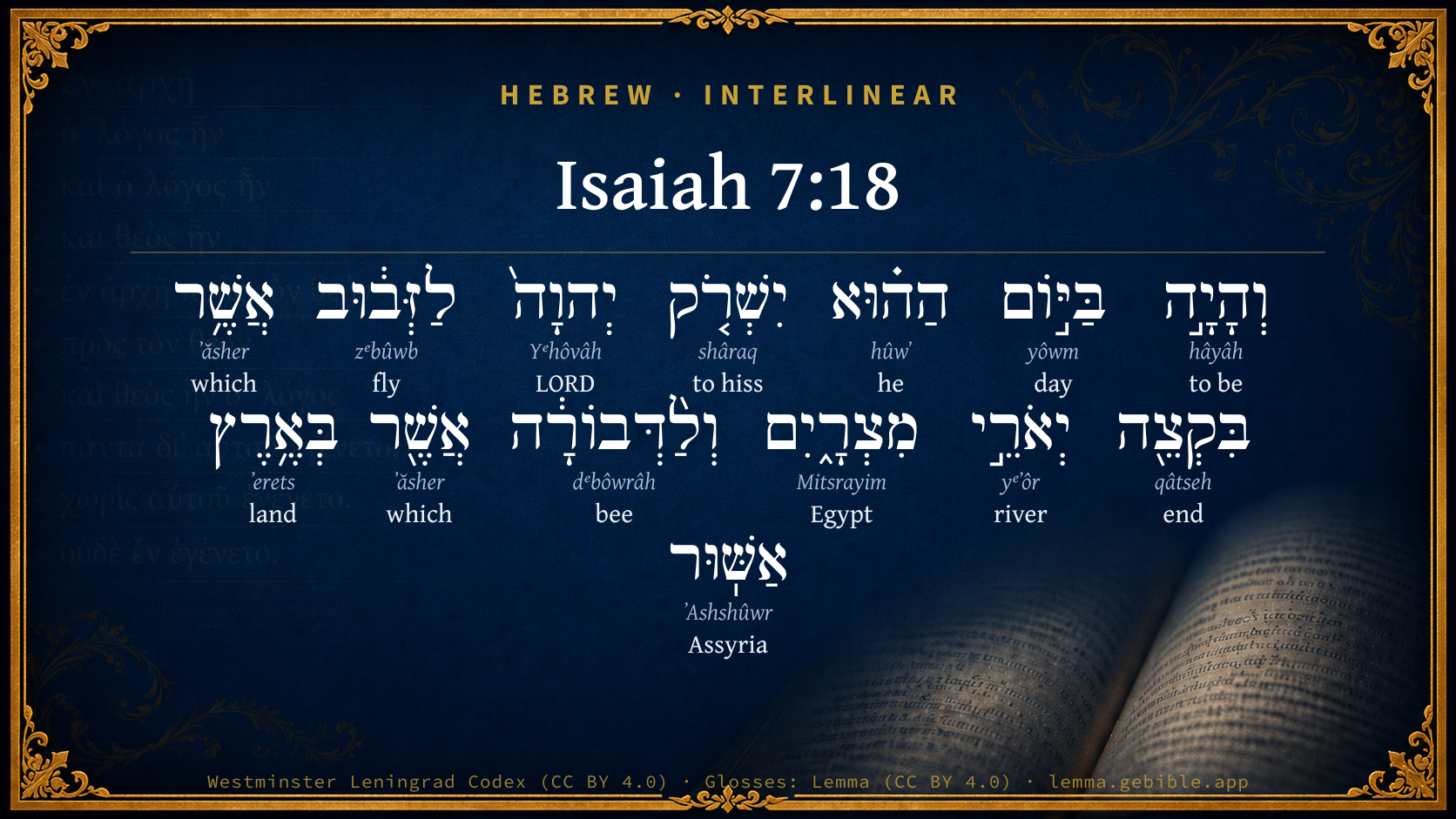
Isaiah 7:18

Hebrew (Westminster Leningrad Codex) Isaiah 7:18 appears in the Hebrew Old Testament. The text above is from the Westminster Leningrad Codex. Each word links to its Strong’s number, a concise gloss, and parsing drawn from the Open Scriptures Hebrew Bible morphology. Click any word for its full Brown-Driver-Briggs (BDB) entry.
Download image
Cite this verse

Isaiah 7:18 (World English Bible). Public Domain. Lemma interlinear Bible study tool, https://lemma.gebible.app/v/isaiah/7/18.

Show BibTeX & RIS
BibTeX
RIS
English Translation
It will happen in that day that Yahweh will whistle for the fly that is in the uttermost part of the rivers of Egypt, and for the bee that is in the land of Assyria.
World English Bible · Public Domain
Download a study sheet

One document with this verse’s original text, its word-by-word gloss line, the meaning frame, cross-references with their text, attributed commentary, and full source and license credits — printable, and it pastes into notes with its structure intact.

This verse Autodidact and up

Study sheet (.html) Plain text (.txt)

A passage Seminary Student

Up to 50 verses in one chapter. A passage sheet keeps up to 6 commentary sources and 12 cross-references per verse, in the order this page ranks them, and says so on the sheet whenever that leaves anything out. Ask for a single verse and you get the Autodidact verse sheet above.

Everything on this page stays free to read, with no account — the sheet is a download of what is already on screen, not access to it.

Want to remove ads? Support Godless Engineer
Compare translations 3

The same verse in 3 English versions, stacked beneath the original-language interlinear above. Click any original word for its lexicon entry.

Each is an independent rendering of the whole verse — the interlinear is not word-aligned to these translations.

Highlighted words mark where these versions differ — a whole-verse word diff, not a word-by-word alignment.

  • World English Bible Public Domain
    It will happen in that day that Yahweh will whistle for the fly that is in the uttermost part of the rivers of Egypt, and for the bee that is in the land of Assyria.
  • King James Version Public Domain
    And it shall come to pass in that day, that the LORD shall hiss for the fly that is in the uttermost part of the rivers of Egypt, and for the bee that is in the land of Assyria.
  • unfoldingWord Literal Text CC BY-SA 4.0
    And it will happen in that day, Yahweh will whistle for the fly that at the end of the streams of Egypt and for the bee that in the land of Assyria.

unfoldingWord Literal Text — © unfoldingWord, licensed CC BY-SA 4.0. Word-aligned USFM3 via Door43 (git.door43.org/unfoldingWord/en_ult).

Versions to compare (up to 4)

3 of 4 selected

Show all 18 translations

Every available English version of this verse, each an independent rendering of the whole verse.

  • World English Bible Public Domain
    It will happen in that day that Yahweh will whistle for the fly that is in the uttermost part of the rivers of Egypt, and for the bee that is in the land of Assyria.
  • Berean Standard Bible Public Domain
    On that day the LORD will whistle to the flies at the farthest streams of the Nile and to the bees in the land of Assyria.
  • Majority Standard Bible Public Domain
    On that day the LORD will whistle to the flies at the farthest streams of the Nile and to the bees in the land of Assyria.
  • King James Version Public Domain
    And it shall come to pass in that day, that the LORD shall hiss for the fly that is in the uttermost part of the rivers of Egypt, and for the bee that is in the land of Assyria.
  • American Standard Version (1901) Public Domain
    And it shall come to pass in that day, that Jehovah will hiss for the fly that is in the uttermost part of the rivers of Egypt, and for the bee that is in the land of Assyria.
  • Revised Version (1885) Public Domain
    And it shall come to pass in that day, that the LORD shall hiss for the fly that is in the uttermost part of the rivers of Egypt, and for the bee that is in the land of Assyria.
  • Geneva Bible (1599) Public Domain
    And in that day shall the Lord hisse for the flie that is at the vttermost part of the floods of Egypt, and for the bee which is in the lande of Asshur,
  • Douay-Rheims (1899) Public Domain
    And it shall come to pass in that day, that the Lord shall hiss for the fly, that is in the uttermost parts of the rivers of Egypt, and for the bee that is in the land of Assyria.
  • Young's Literal Translation Public Domain
    And it hath come to pass, in that day, Jehovah doth hiss for a fly that `is' in the extremity of the brooks of Egypt, And for a bee that `is' in the land of Asshur.
  • Literal Standard Version CC BY-SA 4.0
    And it has come to pass in that day, || YHWH hisses for a fly that [is] in the extremity of the brooks of Egypt, || And for a bee that [is] in the land of Asshur.
  • Unlocked Literal Bible CC BY-SA 4.0
    At that time Yahweh will whistle for a fly from the distant streams of Egypt, and for a bee from the land of Assyria.
  • unfoldingWord Literal Text CC BY-SA 4.0
    And it will happen in that day, Yahweh will whistle for the fly that at the end of the streams of Egypt and for the bee that in the land of Assyria.
  • Darby Bible Public Domain
    And it shall come to pass in that day, that Jehovah will hiss for the fly which is at the extremity of the streams of Egypt, and for the bee which is in the land of Assyria;
  • World Messianic Bible Public Domain
    It will happen in that day that the LORD will whistle for the fly that is in the uttermost part of the rivers of Egypt, and for the bee that is in the land of Assyria.
  • Webster's Bible Public Domain
    And it shall come to pass in that day, that the LORD will hiss for the fly that is in the uttermost part of the rivers of Egypt, and for the bee that is in the land of Assyria.
  • Free Bible Version CC BY-SA 4.0
    At that time the Lord will whistle to call flies from the distant rivers of Egypt and bees from the country of Assyria.
  • Bible in Basic English Public Domain
    And it will be in that day that the Lord will make a piping sound for the fly which is in the end of the rivers of Egypt, and for the bee which is in the land of Assyria.
  • JPS Tanakh (1917) Public Domain
    And it shall come to pass in that day, that the LORD shall hiss for the fly that is in the uttermost part of the rivers of Egypt, and for the bee that is in the land of Assyria.

Literal Standard Version (2020), Covenant Press — licensed CC BY-SA 4.0. Text via the HelloAO Bible API (eBible.org). Unlocked Literal Bible (unfoldingWord) — licensed CC BY-SA 4.0. Text via the HelloAO Bible API (eBible.org). unfoldingWord Literal Text — © unfoldingWord, licensed CC BY-SA 4.0. Word-aligned USFM3 via Door43 (git.door43.org/unfoldingWord/en_ult). Free Bible Version, Dr. Jonathan Gallagher — licensed CC BY-SA 4.0. Text via the HelloAO Bible API (eBible.org).

Word by word

More ways to search: Search by grammar → Find every occurrence → Compare this word →

Practice this passage: Drill this verse → Learn its vocabulary →

לַזְּב֔וּב
zᵉbûwb
H2070
“to/for the · fly”
Preposition, Determined + Noun, Common, Masculine, Singular, Absolute
Part of Speech
Preposition + Noun
Type
Common
Gender
Masculine
Number
Singular
State
Absolute
Full BDB Definition

Origin: from an unused root (meaning to flit)

TWOT: 523a

fly
  1. וְהָיָ֣ה hâyâh H1961 “and · to be” Conjunction + Verb, Qal, Sequential Perfect, 3rd Person, Masculine, Singular
  2. בַּיּ֣וֹם yôwm H3117 “in/at the · day” Preposition, Determined + Noun, Common, Masculine, Singular, Absolute
  3. הַה֗וּא hûwʼ H1931 “the · he” Particle, Definite Article + Pronoun, Personal, 3rd Person, Masculine, Singular
  4. יִשְׁרֹ֤ק shâraq H8319 “to hiss” Verb, Qal, Imperfect, 3rd Person, Masculine, Singular
  5. יְהוָה֙ Yᵉhôvâh H3068 “LORD” Noun, Proper
  6. אֲשֶׁ֥ר ʼăsher H834 “which” Particle, Relative
  7. בִּקְצֵ֖ה qâtseh H7097 “in/at · end of” Preposition + Noun, Common, Both, Singular, Construct
  8. יְאֹרֵ֣י yᵉʼôr H2975 “rivers of” Noun, Common, Masculine, Plural, Construct
  9. מִצְרָ֑יִם Mitsrayim H4714 “Egypt” Noun, Proper
  10. וְלַ֨דְּבוֹרָ֔ה dᵉbôwrâh H1682 “and · to/for the · bee” Conjunction + Preposition, Determined + Noun, Common, Feminine, Singular, Absolute
  11. אֲשֶׁ֖ר ʼăsher H834 “which” Particle, Relative
  12. בְּאֶ֥רֶץ ʼerets H776 “in/at · land of” Preposition + Noun, Common, Both, Singular, Construct
  13. אַשּֽׁוּר ʼAshshûwr H804 “Assyria” Noun, Proper

About this verse

These counts appear in no published source. They are computed here, from the morphology-tagged text and Lemma’s own curated glosses. What Lemma adds →

14
words
13
distinct lemmas
Prophets
section

Notable vocabulary

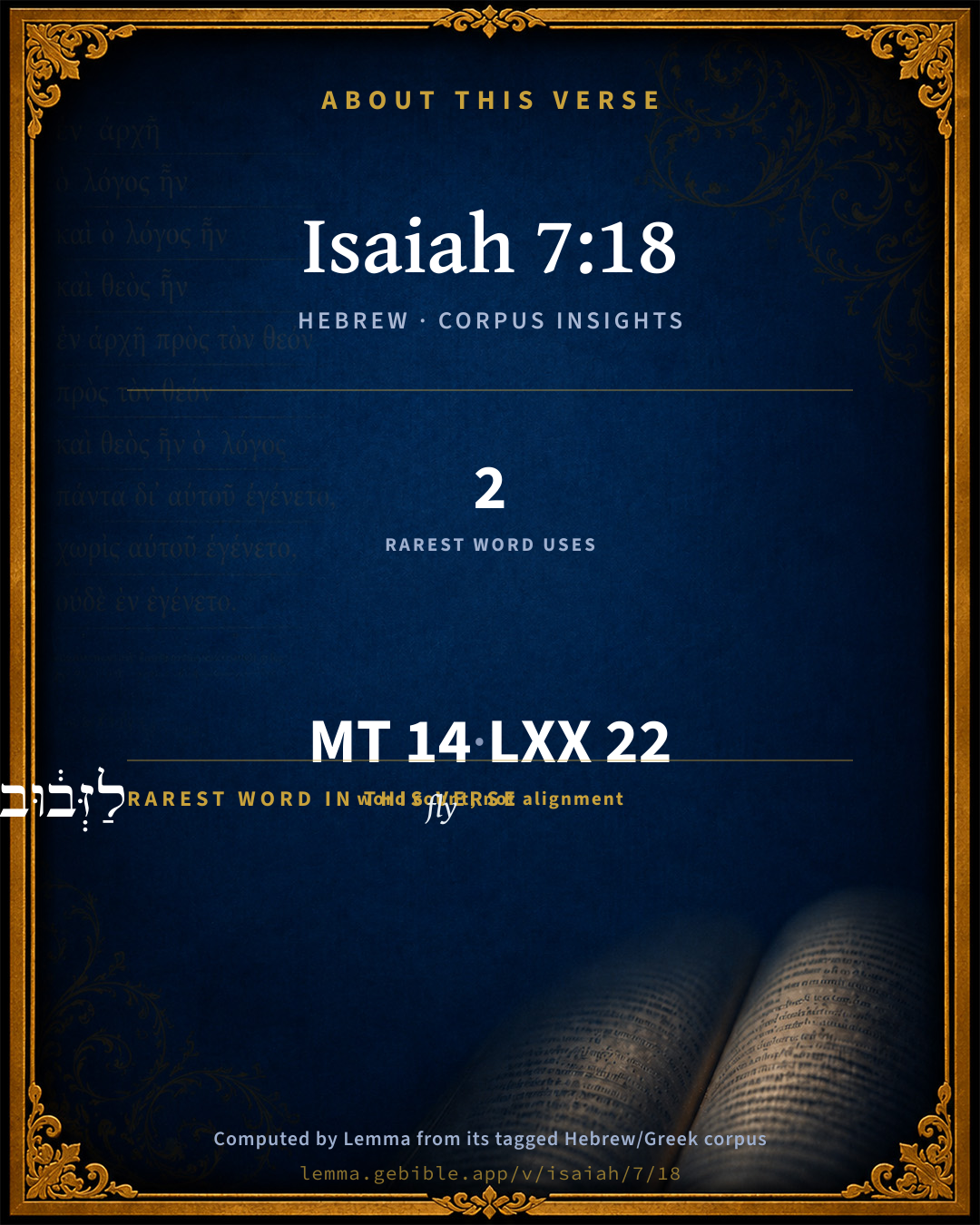
The rarest word here is לַזְּב֔וּב fly H2070 — appearing just 2 times in the whole Hebrew Bible.

Shared distinctive vocabulary

לַזְּב֔וּב fly H2070 occurs in 2 verses of the Hebrew Bible. Also found in:

Grammatical profile

  • 2 verbs
  • 9 nouns
  • 1 pronoun
  • 2 particles

Verb forms

  • וְהָיָ֣ה Qal · Sequential Perfect
  • יִשְׁרֹ֤ק Qal · Imperfect

Repetition

A word recurs within this verse — often emphatic in Hebrew:

  • אֲשֶׁ֥ר which H834 ×2

Hebrew & Septuagint length

In English translation the verse runs 35 words from the Hebrew and 41 from the Septuagint (LXX English) — closely comparable.

A rough comparison of the two English renderings, which tokenize alike — not a word-level alignment.

Word counts can differ between the Hebrew and the Greek without any difference in meaning — e.g. the Hebrew direct-object marker אֵת has no separate Greek word, and Greek often adds the article ὁ.

In the original languages it is 14 Hebrew tokens and 22 Greek tokens — but the two are counted differently (Hebrew bundles its prefixes and suffixes into one token; the Greek is in lemma form), so that isn’t a like-for-like length.

Cross-references

12

Topical passages linked to Isaiah 7:18 in the Treasury of Scripture Knowledge — connected by theme and wording, ordered by reader-vote popularity; previews shown in the World English Bible.

  • Isaiah 5:26 He will lift up a banner to the nations from far, And he will whistle for them from the end of the earth. Behold, they will come speedily and swiftly.
  • Deuteronomy 1:44 The Amorites, who lived in that hill-country, came out against you, and chased you, as bees do, and beat you down in Seir, even to Hormah.
  • Deuteronomy 7:20 Moreover Yahweh your God will send the hornet among them, until those who are left, and hide themselves, perish from before you.
  • Joshua 24:12 I sent the hornet before you, which drove them out from before you, even the two kings of the Amorites; not with your sword, nor with your bow.
  • Isaiah 31:1 Woe to those who go down to Egypt for help, and rely on horses, and trust in chariots because they are many, and in horsemen because they are very strong, but they don't look to the Holy One of Israel, neither seek Yahweh!
  • Exodus 8:21 Else, if you will not let my people go, behold, I will send swarms of flies on you, and on your servants, and on your people, and into your houses: and the houses of the Egyptians shall be full of swarms of flies, and also the ground whereon they are.
  • Exodus 8:24 Yahweh did so; and there came grievous swarms of flies into the house of Pharaoh, and into his servants' houses: and in all the land of Egypt the land was corrupted by reason of the swarms of flies.
  • 2 Kings 23:33–34 Pharaoh Necoh put him in bonds at Riblah in the land of Hamath, that he might not reign in Jerusalem; and put the land to a tribute of one hundred talents of silver, and a talent of gold.
  • Psalms 118:12 They surrounded me like bees. They are quenched like the burning thorns. In the name of Yahweh I cut them off.
  • Isaiah 7:17 Yahweh will bring on you, on your people, and on your father's house, days that have not come, from the day that Ephraim departed from Judah; even the king of Assyria.
  • Isaiah 13:5 They come from a far country, from the uttermost part of heaven, even Yahweh, and the weapons of his indignation, to destroy the whole land.
  • Isaiah 30:1–2 Woe to the rebellious children, says Yahweh, who take counsel, but not of me; and who make a league, but not of my Spirit, that they may add sin to sin,

Cross-references courtesy of OpenBible.info (CC BY 4.0).

Hebrew and Greek witnesses Masoretic Hebrew ↔ Greek Septuagint

The same verse in the two great witnesses to the Old Testament, shown verse-for-verse.

These are two independent witnesses, not word-aligned to each other, and the Septuagint is shown in lemma (dictionary) form.

Hebrew Isaiah 7:18 Masoretic · Westminster Leningrad Codex

וְהָיָ֣ה בַּיּ֣וֹם הַה֗וּא יִשְׁרֹ֤ק יְהוָה֙ לַזְּב֔וּב אֲשֶׁ֥ר בִּקְצֵ֖ה יְאֹרֵ֣י מִצְרָ֑יִם וְלַ֨דְּבוֹרָ֔ה אֲשֶׁ֖ר בְּאֶ֥רֶץ אַשּֽׁוּר

It will happen in that day that Yahweh will whistle for the fly that is in the uttermost part of the rivers of Egypt, and for the bee that is in the land of Assyria.

World English Bible · Public Domain

Greek LXX Isaiah 7:18 Septuagint · lemma form

καί εἰμί ἐν ὁ ἡμέρα ἐκεῖνος συρίζω κύριος μυῖα ὅς κυριεύω μέρος ποταμός αἴγυπτος καί ὁ μέλισσα ὅς εἰμί ἐν χώρα ἀσσύριος

And it shall come to pass in that day that the Lord shall hiss for the flies, which insect shall rule over a part of the river of Egypt, and for the bee which is in the land of the Assyrians.

LXX2012 (modern English Septuagint) · Public Domain

On this verse, John Gill's Exposition discusses the Septuagint’s reading. Read the note in Commentary ↓

Hebrew: Westminster Leningrad Codex (CC BY 4.0). Greek: Septuagint (public domain); English from LXX2012 (modern English Septuagint) (Public Domain). How the Septuagint differs from the Hebrew →

Targum (Aramaic paraphrase)

1

The Targum is the ancient Jewish Aramaic paraphrase of the Hebrew Scriptures — an interpretive translation, not the Hebrew text itself. Onkelos (literal) and Pseudo-Jonathan (expansive) render the Torah, and Jonathan the Prophets. Coverage is partial: where no permissively-licensed English translation exists for a verse, only the Aramaic is shown. This is verse-level text, not a word-by-word alignment to the Hebrew.

  1. Targum Jonathan Prophets (Joshua–Malachi)
    וִיהֵי בְּעִדָנָא הַהִיא יַכְלֵי יְיָ לְעַם קִטְרֵי מַשִׁרְיַת גִבָּרַיָא דְסַגִיאִין כִּדְבוּבַיָא וְיַיְתִינוּן מִסְיָפֵי אַרְעָא דְמִצְרַיִם וְלַעֲזִיזֵי מַשִׁרְיָתָא דְאִינוּן תַּקִיפִין כְּדַבַּרְיָתָא וְיַיְתִינוּן מִסְיָפֵי אַרְעָא דְאַתּוּר:

    And it shall come to pass at that time that the Lord shall call to a people, to bands of armies, mighty men, who are numerous as flies, and shall bring them from the ends of the land of Egypt; and to mighty armies, who are powerful as bees, and shall bring them from the uttermost parts of the land of Assyria.

    Targum Jonathan — Aramaic: “Mikraot Gedolot” (public domain). English: “Sefaria Community Translation” (CC0 1.0 (public-domain dedication)); “London "Chaldee Paraphrase," 1871” (public domain). Text via Sefaria.

Commentary

Notes on Isaiah 7:18 from classic Christian and Jewish commentators (each source and its license shown beneath its notes). The classic Christian expositions comment on the surrounding passage and are grouped to its opening verse, so a note may address several verses; the Jewish commentaries on the Tanakh (Rashi and others) are per-verse, so they appear only where the commentator wrote on this verse.

Lemma curates 59 commentaries, every one of them public domain or Creative Commons licensed, each selected and text-cleaned for this edition rather than reprinted as found. About our sources →

Trapp's Complete Commentary

John Trapp

Isa 7:18 And it shall come to pass in that day, [that] the LORD shall hiss for the fly that [is] in the uttermost part of the rivers of Egypt, and for the bee that [is] in the land of Assyria.

Ver. 18. The Lord will hiss for the fly, &c.] Out of Egypt and the confines. The people of which parts are fitly called flies, say expositors, for their numerosity, swiftness, stench, impudence, harsh language, ob vocis absonae stridorem. The country being hot, and lying low, aboundeth with flies aad gnats, such as proud Pharaoh was vexed with.

And for the bee that is in Assyria.] That country is full of woods, and so of bees, to which also the Assyrians are fitly compared, as for their numerousness, their military skill and comely marshalling of their forces; their golden armour, their industry and constance in battle; so for their force and fury especially. Virgil, speaking of bees, saith -

“ Illis ira modum superat, laesaeque venenum

Inspirant stimulis, et vitam in vulnere linquunt. ”

See the Babylonical fierceness and cruelty graphically described. {Jer 51:34} It was so much the greater, because sent for and set on they were by God’s hiss or whistle.

John Trapp, A Commentary or Exposition upon All the Books of the Old and New Testament (1647–1656) — public domain. Text from a community e-Sword module.

Joseph Benson's Commentary

Isa 7:18-19. In that day — Known to God, and appointed by him for the execution of these judgments; the Lord shall hiss for the fly — The flies, rather. Thus he calls these enemies, to signify either their great number, or their speedy march: see on Isa 5:26. As the word hiss carries with it a low idea, and does not properly express the meaning of the original word שׁרק, sherek, which properly signifies, sibilando advocare, to call by whistling, it seems desirable that it should not have been used here and Isa 5:26. Bishop Lowth renders it, Jehovah shall hist the fly, shall call them softly, bring them by a slight intimation of his will. In the uttermost part of the rivers, &c. — In their extremity, where they go out into the sea. The river Nile is undoubtedly intended, which may be called rivers, either for its greatness, or because toward the end of it it is divided into seven streams. When the Chaldeans had, in good measure, subdued the Egyptians, it is probable great numbers of the Egyptian soldiers listed themselves in the Chaldean army, and with them invaded the land of Judah. And for the bee, &c. — The Assyrian army, compared to bees, as for their numerous forces and orderly march, so for their fierce attempts and mischievous effects. In the land of Assyria — In the empire of Assyria or Babylon; for these two were united into one empire, and therefore in Scripture are promiscuously called sometimes by one title, and sometimes by the other. They shall come — The flies, and especially the bees. And shall rest all of them — They shall have an easy victory; few or none of them shall be slain in the attempt. In the desolate valleys — Such as they found very fruitful, but made desolate. And in the holes of the rocks — To which possibly the Israelites fled for refuge. Upon all bushes — Which he mentions, because flies and bees use frequently to rest there; and to intimate, that no place should escape their fury.

Joseph Benson's Commentary on the Old and New Testaments (1811–1818) — public domain. Text from a community e-Sword module.

Whedon's Commentary on the Bible

Daniel D. Whedon

18. It is not necessary to suppose that the piece of prophecy commencing here was delivered at the same time with the preceding, but it is on the same subject and in a similar strain. It is the more complete unfolding of the previously predicted calamities. That is, herein is explained what is said in Isa_7:15. God himself is represented as entering into the action.

In that day — In the days just threatened.

Shall hiss — Isa_5:26. The word signifies a kind of whistling. For (or to) the fly — See note on Isa_5:26.

Uttermost part of the rivers — The Nile branches and canals in the Delta. Pharaoh Necho, king of Egypt, it is supposed, mustered armies, mentioned here tropically by flies. The fly is an abundant nuisance in Egypt. Any traveller in Egypt, at this time, even in the winter season, may observe the fly carrying the ophthalmic virus from the eyes of one to another, among the children especially of the fellahs; and scarcely half the population are unaffected by the ophthalmic scourge.

The bee… of Assyria — The bee, because of its number in Assyria, or because of the keenness of its sting, is here taken as the symbol of the Assyrian armies. The scope of time covered by the fulfilment of Isa_7:18 is from Isaiah’s day to the end of Israel and Judah as nations: and the armies were headed by Pharaoh Necho of Egypt, and by Shalmanezer, Esarhaddon, and Nebuchadnezzar of Assyria and Babylon.

Daniel D. Whedon (gen. ed.), Commentary on the Old and New Testaments (1874–1909) — public domain. Text from a community e-Sword module.

Tyndale Open Study Notes

Tyndale Open Resources

7:18-25 The repetition of in that day referred to the yet future day of the Lord. Judah would experience the judgment already announced by Isaiah as a foretaste of an even greater judgment to come: exile in Babylon (586–538 BC).

Tyndale Open Study Notes — © Tyndale Open Resources, licensed CC BY-SA 4.0. Text via the HelloAO Bible API.

Geneva Bible (1599)

Geneva Bible translators

Meaning, the Egyptians: for by reason the country is hot and moist, it is full of flies, as Assyria is full of bees.

Geneva Bible (1599) marginal notes — public domain. Text via Bolls.life.

Jamieson, Fausset & Brown

Robert Jamieson, A. R. Fausset & David Brown

FATAL CONSEQUENCES OF AHAZ' ASSYRIAN POLICY. (Isa 7:17-25)

hiss--whistle, to bring bees to settle (see on Isa 5:26).

fly--found in numbers about the arms of the Nile and the canals from it (Isa 19:5-7; Isa 23:3), here called "rivers." Hence arose the plague of flies (Exo 8:21). Figurative, for numerous and troublesome foes from the remotest parts of Egypt, for example, Pharaoh-nechoh.

bee-- (Deu 1:44; Psa 118:12). As numerous in Assyria as the fly in marshy Egypt. Sennacherib, Esar-haddon, and Nebuchadnezzar fulfilled this prediction.

Jamieson, Fausset & Brown — Commentary Critical and Explanatory on the Whole Bible (1871) — public domain (CC PDM 1.0). Text via the HelloAO Bible API.

Adam Clarke's Commentary

Verse 18. Hiss for the fly - "Hist the fly"] See Clarke on Isa 5:26.

Egypt, and - Assyria.] Sennacherib, Esarhaddon, Pharaoh-necho, and Nebuchadnezzar, who one after another desolated Judea.

Adam Clarke's Commentary on the Bible (1810–1826) — public domain. Text from a community e-Sword/MySword module.

Ellicott's Commentary for English Readers

(18) The Lord shall hiss for the fly . . .—See for the phrase the Note on Isa_5:26. The legions of Egypt are represented by the flies that swarmed on the banks of the Nile (Exo_8:24, and possibly Isa_18:1), those of Assyria by the bees of their forests and their hills (Deu_1:44; Psa_118:12). The mention of Egypt indicates that some of the king’s counsellors were then, as afterwards (Isa_18:2; Isa_31:1), planning an Egyptian alliance, as others were relying on that with Assyria. The prophet tells them that each is fraught with danger. No help and much evil would come from such plans. Consistent in his policy from first to last, the one counsel he gives is that men should practise righteousness, and wait upon the Lord.

The uttermost part of the rivers of Egypt.—The phrase points to the whole extent of the Delta of the Nile, probably to the whole Egyptian course of the Nile itself. Historically the prophecy found its fulfilment in the invasion of Pharaoh Necho in the reign of Josiah (2Ki_23:29), or, nearer Isaiah’s time, in the movements of Tirhakah’s arms (2Ki_19:9).

A Bible Commentary for English Readers, edited by Charles John Ellicott (1878–1897) — public domain. Text from a community e-Sword module.

The Cambridge Bible for Schools and Colleges

gen. ed. J. J. S. Perowne

18. the Lord shall hiss …] See ch. Isa_5:26. The comparison of the Egyptians to flies and the Assyrians to bees is thoroughly appropriate, Egypt being infested with swarms of flies (Isa_18:1), while Assyria was pre-eminently a land of bees. Dangerous enemies are compared to bees in Deu_1:44; Psa_118:12. the uttermost part] (or “end”) naturally suggests the Ethiopians, who however did not become masters of Egypt till b.c. 728. the rivers (strictly “Nile-arms”) of Egypt] The word used is an Egyptian name for the Nile.

18, 19. Judah, as the theatre of the inevitable duel between Assyria and Egypt for the mastery of Asia, must endure all the horrors of the double invasion.

18–25. Further announcements (not addressed to Ahaz, but probably compiled from fragments of several of Isaiah’s prophecies) of the Assyrian invasion (18–20) and its consequences (21–25).

The Cambridge Bible for Schools and Colleges (gen. ed. J. J. S. Perowne; Cambridge University Press, 1878–1918) — public domain. Text from a community e-Sword module.

John Gill's Exposition

And it shall come to pass in that day,.... the time when those evil days before spoken of should take place:

that the Lord shall hiss for the fly that is in the uttermost part of the rivers of Egypt; or flies, as the Septuagint, Syriac, and Arabic versions render it; the Egyptians, so called because their country abounded with flies; and because of the multitude of their armies, and the swiftness of their march; this seems to have had its accomplishment when Pharaohnechoh king of Egypt slew Josiah, put his son Jehoahaz, that reigned after him, in bands, placed Eliakim his brother in his stead, and made the land of Judah tributary to him, Kg2 23:29 though some think either the Edomites or Philistines, that bordered on Egypt, are meant; who in Ahaz's time invaded Judah, and brought it low, Ch2 28:17 or else the Ethiopians, that inhabited on the furthermost borders of Egypt, and the rivers of it; who either came up separately against Judah, or served under Nebuchadnezzar; see Isa 18:1,

and for the bee that is in the land of Assyria; the Assyrian army, so called because the country abounded with bees; and because of the number of their armies, their military order and discipline, and their hurtful and mischievous nature. The Targum paraphrases the whole thus,

"and it shall be at that time that the Lord shall call to a people, bands of armies, of mighty men, who are numerous as flies, and shall bring them from the ends of the land of Egypt; and to mighty armies, who are powerful as bees, and shall bring them from the uttermost parts of the land of Assyria:''

hissing or whistling for them denotes the ease with which this should be done, and with what swiftness and readiness those numerous and powerful armies should come; and the allusion is to the calling of bees out of their hives into the fields, and from thence into their hives again, by tinkling of brass, or by some musical sound, in one way or another.

John Gill's Exposition of the Whole Bible (1746–1763) — public domain (CC PDM 1.0). Text via the HelloAO Bible API.

Albert Barnes' Notes on the Bible

In that day the Lord shall hiss - see the note at Isa 5:26.

For the fly - That is, for the army, or the multitude of people. The comparison of a numerous army with “flies” is not uncommon; see Homer’s “Iliad,” B. ii. 469, etc.

- Thick as insects play,

The wandering nation of a summer’s day.

That, drawn by milky streams at evening hours

In gathered swarms surround the rural bowers;

From pail to pail with busy murmur run

The gilded legions, glittering in the sun.

Pope.

The comparison is drawn probably from the “number,” but also is intended to indicate the troublesome character, of the invaders. Perhaps, also, there is an allusion here to the well-known fact that one of the ten plagues of Egypt was caused by numerous swarms of flies; Exo 8:21-24. An army would be brought up from that country as numerous, as troublesome, and as destructive as was that swarm of flies. The following description, by Bruce, of a species of flies in Abyssinia and the adjacent regions, will give an idea of the character of this calamity, and the force of the language used here:

‘This insect is called Zimb; it has not been described by any naturalist. It is, in size, very little larger than a bee, of a thicker proportion, and has wings, which are broader than those of a bee, placed separate, like those of a fly: they are of pure gauze, without color or spot upon them; the head is large, the upper jaw or lip is sharp, and has at the end of it a strong pointed hair, of about a quarter of an inch long; the lower jaw has two of these pointed hairs; and this pencil of hairs, when joined together, makes a resistance to the finger, nearly equal to that of a strong hog’s bristle; its legs are serrated in the inside, and the whole covered with brown hair or down. As soon as this plague appears, and their buzzing is heard, all the cattle forsake their food, and run wildly about the plain, until they die, worn out with fatigue, fright, and hunger. No remedy remains, but to leave the black earth, and hasten down to the sands of Atbara; and there they remain, while the rains last, this cruel enemy never daring to pursue them further.

Though his size be immense, as is his strength, and his body covered with a thick skin, defended with strong hair, yet even the camel is not capable to sustain the violent punctures the fly makes with his pointed proboscis. He must lose no time in removing to the sands of Atbara, for when once attacked by this fly, his body, head, and legs, break out into large bosses, which swell, break, and putrefy, to the certain destruction of the creature. Even the elephant and rhinoceros, who, by reason of their enormous bulk, and the vast quantity of food and water they daily need, cannot shift to desert and dry places as the season may require, are obliged to roll themselves in mud and mire, which, when dry, coats them over like armor, and enables them to stand their ground against this winged assassin; yet I have found some of these tubercles upon almost every elephant and rhinoceros that I have seen, and attribute them to this cause.

All the inhabitants of the seacoast of Melinda, down to Cape Gardefan, to Saba, and the south coast of the Red Sea, are obliged to put themselves in motion, and remove to the next sand, in the beginning of the rainy season, to prevent all their stock of cattle from being destroyed. This is not a partial emigration; the inhabitants of all the countries, from the mountains of Abyssinia northward, to the confluence of the Nile, and Astaboras, are once a year obliged to change their abode, and seek protection in the sand of Beja; nor is there any alternative, or means of avoiding this, though a hostile band were in their way, capable of spoiling them or half their substance. This fly has no sting, though he seemed to me to be rather of the bee kind; but his motion is more rapid and sudden than that of the bee, and resembles that of the gad-fly in England. There is something particular in the sound or buzzing of this insect; it is a jarring noise together with a humming, which induces me to believe it proceeds, at least in part, from a vibration made with the three hairs at his snout.’

The uttermost part of the rivers of Egypt - The remotest part of the land - that is, from the whole country. Egypt was watered by a single river; the Nile. But this river emptied into the Mediterranean by several mouths; and from this river also were cut numerous canals to water the land. These are intended by the “rivers” of Egypt; see the notes at Isa 19:6-7. Those canals would be stagnant for no small part of the year; and around them would be produced, as is usual near stagnant waters, great quantities of flies. This prophecy was fulfilled by the invasion of the land in subsequent times by the Egyptians; 2Ki 23:33-34; 2Ch 35:20, 2Ch 35:24; 2Ch 36:1-2.

And for the bee - That is, for the “army.” An army is compared to “bees” on account of their number; perhaps also on account of the pungency and severity of the sting. The comparison is common; see Deu 1:44; Deu 7:20; Psa 118:12. The Chaldee has rendered this verse, ‘The Lord shall call to a people girded with the armies of the brave, who are numerous as flies, and shall bring them from the ends of the land of Egypt; and strong armies, strong as bees, and shall bring them from the land of Assyria.’ No prophecy was ever more completely fulfilled than this by the successive invasions of Pharaoh-Necho, Esarhaddon and Nebuchadnezzar; see Isa. 36; 37; 2Ch 36:7-21.

Albert Barnes' Notes on the Bible (1834–1885) — public domain. Text from a community e-Sword/MySword module.

Haydock's Catholic Bible Commentary

Of Egypt. The Idumeans, &c., dwell on the borders, chap. v. 26. Yet many explain this of the victories of Nabuchodonosor and Nechas.

George Leo Haydock (1774–1849), Haydock's Catholic Family Bible and Commentary, 1859 edition — public domain. Excludes Psalms (Douay-Rheims chapter numbering differs from Protestant) and Deuterocanonical books (Catholic canon only).

Matthew Poole's English Annotations

In that day; known to God, and appointed by him for the execution of these judgments.

Shall hiss: See Poole "Isa 5:26".

The fly; the flies. So he calls these enemies, to imply either their great numbers, or their speedy march, or their unavoidable assault.

In the uttermost part; in, or near, or towards their extremity or end, where they go out into the sea.

Of the rivers; of the river Nilus, which may be called rivers, either for its greatness, for which cause the title of rivers is given also to Euphrates, Psa 137:1, and to Tigris, Nah 2:6; or because, towards the end of it, it is divided into seven famous streams, by which it emptieth itself into the midland sea, Isa 11:15. He seems plainly to design and describe the Egyptians, who were always dangerous neighbours to Judah, and did probably animate and assist the Philistines, and Edomites, and others against them, and at last made a formal invasion and conquest of their land, 2Ki 23:33, &c. Besides, when the Chaldeans had in good measure subdued the Egyptians, it is very probable that great numbers of the Egyptian soldiers did list themselves in the Chaldean army, and with them invade the land of Judah.

The bee; the bees, the Assyrian army, who are compared to bees, as for their numerous forces and orderly march, so for their fierce attempts and mischievous effects.

In the land of Assyria; in the empire of Assyria, or Babylon; for these two were united into one empire, and therefore in Scripture are promiscuously called sometimes by one title, and sometimes by the other.

Matthew Poole's English Annotations on the Holy Bible (1683–1685) — public domain. Text from a community e-Sword/MySword module.

The Pulpit Commentary

The Lord shall hiss. (see Isa_5:26, and note ad loc.) For the fly that is in the uttermost part of the rivers of Egypt. The "fly of Egypt," like the "bee of Assyria," represents the military force of the nation, which God summons to take part in the coming affliction of Judaea. The prophetic glance may be extended over the entire period of Judah"s decadence, and the flies" summoned may include those which clustered about Neco at Megiddo, and carried off Jehoahaz from Jerusalem. (2Ki_23:29-34) There may be allusion also to Egyptian ravages in the reigns ofSargon, Sennacherib, and Esar-haddon. In any general review of the period we shall find it stated that, from the time of Sargon to that of Cyrus, Judaea was the battle-ground upon which the forces of Assyria (or Assyro-Babylonia) and Egypt contended for the empire of western Asia. The desolation of the land during this period was produced almost as much by the Egyptian fly as by the Assyrian bee." The "rivers of Egypt" are the Nile, its branches, and perhaps the great canals by which its waters were distributed. The bee that is in the land of Assyria. The choice of the terms bee" and fly," to represent respectively the hosts of Assyria and Egypt, is not without significance. Egyptian armies were swarms, hastily levied, and very imperfectly disciplined. Assyrian were bodies of trained troops accustomed to war, and almost as well disciplined as the Romans.

Vers. 18-25. War-pictures.

I INVADING HOSTS. The armies of Egypt and Assyria are compared to swarms of bees. As the bee-master calls to his winged slaves with a peculiar sound, so at the call of Jehovah the swarms of Israel"s foes will come on, with swords that sting, and settle down in the low-lying pastures of the land, in the rock-clefts, the hedges of thorn, and the pastures. (For the image of the bees, compare Deu_1:44 Ps 118) In Joel 2. we find a splendid picture of locusts as pictorial of an invading army.

II DEVASTATION. Another striking image. The land, devoured by strangers, will be like a man clean shaven from top to toe of all his manly ornament of hair and beard. Like a keen razor will be the sweeping penal judgment of Jehovah on the holy laud. The rich vineyards will disappear. No pruning nor digging will go forward. Briers and thorns, quick usurpers of the neglected corn-fields, will flourish, and the courts of the houses will be weed-grown. (cf. Isa_5:6 Isa_32:13) Here and there will be seen a cow and a sheep or two, grazing as on a great common or desert. The farmer will disappear, or will return to the wild nomad life, living on the produce of his few cattle and on honey. Thorns and thistles will replace the vines, and the hunter will wander with bow and arrow where once the husbandman had been seen busy with spade or plough. The hoe will cease from its work, for, alas! with hope of fruit the "fear of thorns and thistles" has ceased; and the ox and the sheep will find free pasture everywhere. We have seen Landseer"s two striking pictures, "War" and "Peace," in the National Gallery, and can feel their pathos. To look out from peace and plenty upon a perspective of smoke, bloodshed, and desolation is that to which the prophet calls the king. Yet amidst the gloom appears the figure, mystically hinted, of the young Messiah. And, indeed, it was in the midst of down-trodden Galilee, over which armies had so often tramped, that Jesus appeared, and adopted the holy and comforting mission of the Messiah as his own. J. (Lu 4)

Vers. 18-25. National judgment for national sins.

In this latter part of the chapter we have one of those highly elaborate, intense, and suggestive pictures which are peculiar to the books of the prophets. The mighty Assyrian army sweeps over the land; the people flee before them; they fill every corner; they eat up all the food; they carry away all the flocks and herds; a man can barely save one cow and two sheep; they consume the fruits; they trample down the shrubs; they bear off the people captive; they leave behind them a wilderness; there is nobody to rent or till the land; the few scattered inhabitants are content to live on the spontaneous products, milk and curds and honey; agriculture is entirely stopped, and the wild beasts are again encroaching on the arable and pasture lands. William Jay, of Bath, was accustomed to say, "God can punish individuals in this life, and in the next; but he can only punish nations, as such, in this life." This may be further illustrated by reference to the Roman destruction of Jerusalem, which was a direct national judgment on their sins as a nation, culminating in the judicial murder of their Messiah. The shout had risen, "His blood be on us, and on our children;" and so it was. We suggest the following points for consecutive illustration:

I Some sins are distinctively national. Such as the high-handed dealings of modern nations with semi-civilized peoples.

II Some judgments are distinctly national. Such as Isaiah refers to: loss of statesmen; or of male population; war, etc.

III These are directly related, the one to the other, as are sowing and reaping.

IV They are thus fitted together, as outward and evident illustrations of the relations between sin and punishment, for the individual. R.T.

The Pulpit Commentary (1880–1919), ed. H.D.M. Spence-Jones & Joseph S. Exell — public domain. Text from a community e-Sword module.

John Wesley's Explanatory Notes

The fly - The flies. So he calls these enemies, to imply their great numbers. In - In their extremity, where they go out into the sea. Rivers - Of the river Nile, which may be called rivers, either for its greatness, or because towards the end of it, it is divided into seven streams. When the Chaldeans had in good measure subdued the Egyptians, it is probable great numbers of the Egyptian soldiers listed themselves in the Chaldean army, and with them invaded the land of Judah. The bee - The Assyrian army, compared to bees, as for their numerous forces and orderly march, so for their fierce attempts and mischievous effects. Assyria - In the empire of Assyria, or Babylon; for these two were united into one empire, and therefore in scripture are promiscuously called sometimes by one title, and sometimes by the other.

John Wesley, Explanatory Notes Upon the Whole Bible (1754–1765) — public domain. Text via the GEBible commentary corpus.

Keil & Delitzsch

C. F. Keil & F. Delitzsch

"And it comes to pass in that day, Jehovah will hiss for the fly which is at the end of the Nile-arms of Egypt, and the bees that are in the land of Asshur; and they come and settle all of them in the valleys of the slopes, and in the clefts of the rocks, and in all the thorn-hedges, and upon all grass-plats." The prophet has already stated, in Isa 5:26, that Jehovah would hiss for distant nations; and how he is able to describe them by name. The Egyptian nation, with its vast and unparalleled numbers, is compared to the swarming fly; and the Assyrian nation, with its love of war and conquest, to the stinging bee which is so hard to keep off (Deu 1:44; Psa 118:12). The emblems also correspond to the nature of the two countries: the fly to slimy Egypt with its swarms of insects (see Isa 18:1),

(Note: Egypt abounds in gnats, etc., more especially in flies (muscariae), including a species of small fly (nemâth), which is a great plague to men throughout all the country of the Nile (see Hartmann, Natur-geschichtlich-medicinische Skizze der Nillnder, 1865, pp. 204- 5).)

and the bee to the more mountainous and woody Assyria, where the keeping of bees is still one of the principal branches of trade. יאר, pl. יארים, is an Egyptian name (yaro, with the article phiaro, pl. yarōu) for the Nile and its several arms. The end of the Nile-arms of Egypt, from a Palestinian point of view, was the extreme corner of the land. The military force of Egypt would march out of the whole compass of the land, and meet the Assyrian force in the Holy Land; and both together would cover the land in such a way that the valleys of steep precipitous heights (nachalee habbattoth), and clefts of the rocks (nekikē hasselâ‛im), and all the thorn-hedges (nâ‛azūzı̄m) and pastures (nahalolim, from nihēl, to lead to pasture), would be covered with these swarms. The fact that just such places are named, as afforded a suitable shelter and abundance of food for flies and bees, is a filling up of the figure in simple truthfulness to nature. And if we look at the historical fulfilment, it does not answer even in this respect to the actual letter of the prophecy; for in the time of Hezekiah no collision really took place between the Assyrian and Egyptian forces; and it was not till the days of Josiah that a collision took place between the Chaldean and Egyptian powers in the eventful battle fought between Pharaoh-Necho and Nebuchadnezzar at Carchemish (Circesium), which decided the fate of Judah. That the spirit of prophecy points to this eventful occurrence is evident from Isa 7:20, where no further allusion is made to Egypt, because of its having succumbed to the imperial power of Eastern Asia.

Keil & Delitzsch — Biblical Commentary on the Old Testament (1861–1891) — public domain (CC PDM 1.0). Text via the HelloAO Bible API. (Old Testament only.)

J. A. Alexander on Isaiah

Joseph Addison Alexander

The evil times just threatened are here more explicitly described as arising from the presence and oppression of foreigners, especially Assyrians and Egyptians, whose number and vexatious impositions are expressed by comparing them to swarms of noxious and annoying insects, pouring into the country by divine command. “And it shall be (or come to pass) in that day (in the days just threatened) that Jehovah will hiss (or whistle) to (or for) the fly which (is) in the end (or edge) of the rivers of Egypt, and to (or for) the bee which is in Assyria.” The fly is peculiarly appropriate to Egypt, where the marshy grounds produce it in abundance, and there may be a reference to the plague of flies in Exodus. The end of the streams of Egypt evidently means something belonging to Egypt, viz. the arms of the Delta or the remotest streams, implying that the flies should come from the very extremities, or from the whole land. By rendering it brink or border, as the common version does in Jos 3:8; Exo 16:35, an equally good sense is obtained, viz. that the flies shall come from the banks of the streams, where they are most abundant. The hiss or whistle, denoting God’s control over these enemies of Judah, has the same sense as in Isa 5:26.

Assyria and Egypt are here named as the two great rival powers who disturbed the peace of Western Asia, and to whom the land of Israel was both a place and subject of contention. The reference is not exclusively to actual invasion, but to the annoying and oppressive occupation of the country by civil and military agents of these foreign powers. It was not merely attacked but infested, by the flies and bees of Egypt and Assyria.

Joseph Addison Alexander, The Prophecies of Isaiah (1846–1847; New York: Scribner, 1870–1878) — public domain. Text from a community e-Sword module.

unfoldingWord translationNotes

Door43 World Missions Community

At that time

before the child knows to refuse the evil and choose the good (Isaiah 7:15)

Yahweh will whistle for

"Yahweh will call" or "Yahweh will summon"

for a fly from the distant streams of Egypt, and for a bee from the land of Assyria

Here the armies of Egypt and Assyria are spoken of as if they are insects that will invade the land of Israel. This can be stated as a simile. AT: "for the armies of Egypt and Assyria, and their soldiers will be everywhere like flies and bees" (See: Metaphorand Simile)

translationWords

Egypt

Assyria

unfoldingWord translationNotes — © Distant Shores Media and the Door43 World Missions Community, licensed CC BY-SA 4.0. Source: git.door43.org/Door43/en_tn.

Rashi

Rabbi Shlomo Yitzchaki (Rashi)

the Lord shall whistle Shall signal them that they assemble.

to the “fly” Armies as numerous as flies, will come from Egypt with Sennacherib.

the canals of Egypt Since all the land of Egypt is made into canals, for rain does not fall there, but the Nile rises and waters it.

and to the “bee” An army of heroes who sting like bees.

Rashi on the Tanakh — English translations: “The Judaica Press complete Tanach with Rashi, translated by A. J. Rosenberg” (CC BY 4.0); “Pentateuch with Rashi's commentary by M. Rosenbaum and A.M. Silbermann, 1929-1934” (public domain); “The Metsudah Tanach series, Lakewood, N.J” (CC BY 4.0); and “The Book of Joshua, Metsudah Publications, 1997” (CC BY 4.0). Text via Sefaria.

Ibn Ezra

Rabbi Abraham ibn Ezra

The fly. The host is compared to a fly.

The rivers of Egypt. The king of Assyria conquered Egypt; therefore the Egyptians had to come to assist him.

Ibn Ezra on the Tanakh — English translations: “Sefaria Community Translation” (CC0 1.0 (public-domain dedication)); “Yalkut, Sifsei Chachomim Chumash, Metsudah Publications, 2009” (CC BY 4.0); and “Commentary of Ibn Ezra on Isaiah - trans. by M. Friedlander, 1873” (public domain). Text via Sefaria.

Lesson kit

Teaching starters — assembled from the data on this page, not authored interpretation. Every prompt links to the verse data it draws on. Edit before teaching.

Isaiah, in the Prophets, opens this verse with 14 words (13 distinct Hebrew lemmas). Its most distinctive word is zᵉbûwb (“fly”). A historical commentator’s framing appears above. Read the whole chapter for the surrounding context.

Discussion questions

  1. The word zᵉbûwb carries the sense “fly.” How does it shape the verse?
  2. How does Ecclesiastes 10:1, which shares the word «fly», read alongside this verse?
  3. What does the repetition of “which” (2× in this one verse) do in this verse?
  4. These translations render this verse differently; the difference is in the English rendering, not the original. What questions does that raise?
  5. «וְהָיָ֣ה» is a Qal Sequential Perfect verb. How does that grammatical form shape the action described?
  6. Compare how Trapp's Complete Commentary and Joseph Benson's Commentary read this verse. Where do they agree or differ?

Things to notice

Reading settings

Reading text

Shown beneath each verse's original-language words.

Old Testament
Old Testament edition

Read the OT as the Masoretic Hebrew (MT) or the Greek Septuagint (LXX).

English shown for the Greek Septuagint (in the Hebrew ↔ Greek comparison).

Comparing translations? Open the Compare panel on any verse page to stack up to four side by side.