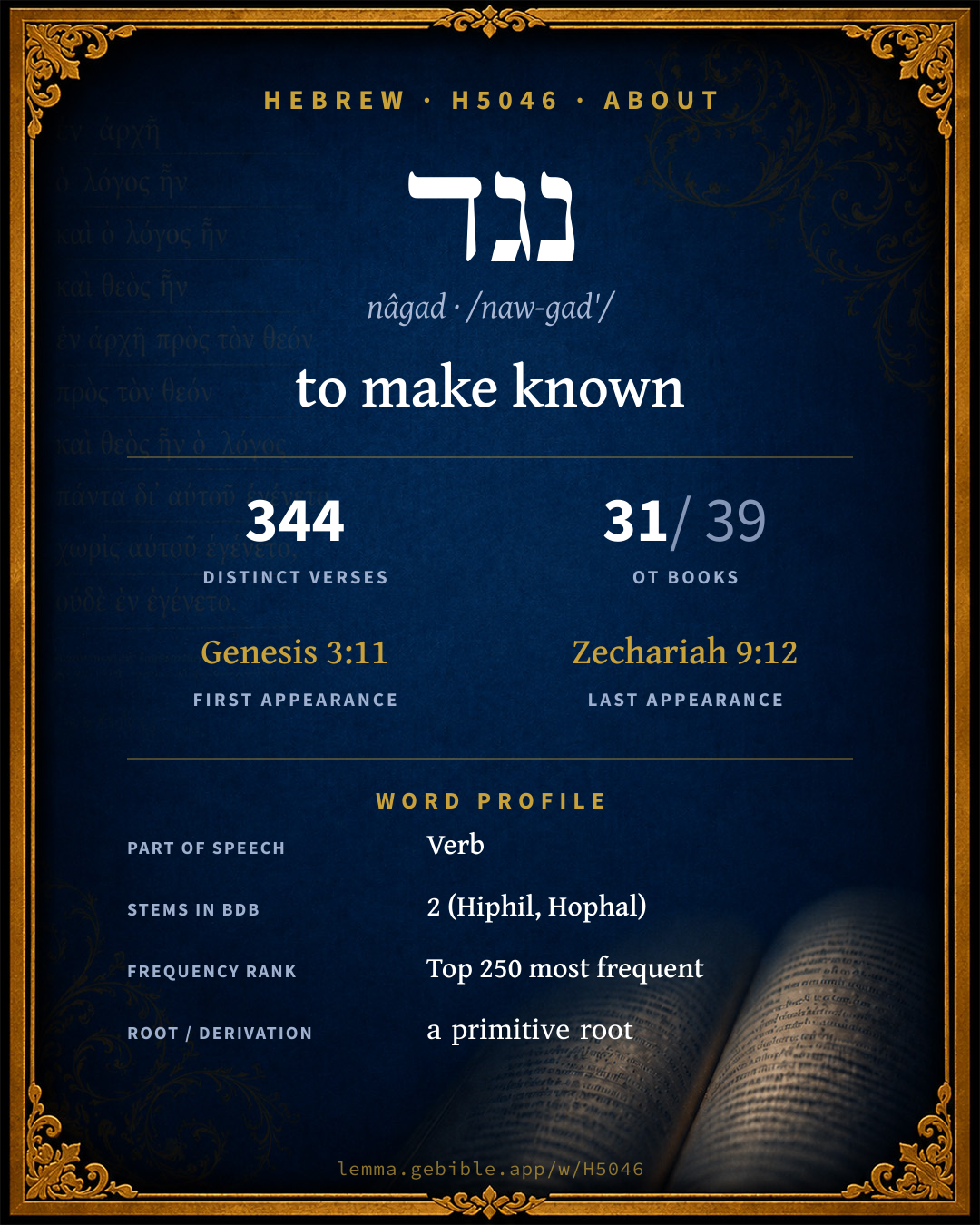
נָגַד
to make known
‘to make known’ is one of 3 main senses fuller range ↓
Full lexicon entry — Brown-Driver-Briggs (BDB)
From Brown-Driver-Briggs (BDB)
Where this word appears
See every Hiphil verb in the Hebrew Bible →
Grammar key — what these labels mean
Part of speech
- Verb
- An action or state-of-being word.
Stem
- Hiphil
- The causative active stem (“he caused / brought about”). Here: ‘tell’
- Hophal
- The passive counterpart of the Hiphil (“he was caused to…”).
Form
- Sequential Imperfect
- An imperfect with prefixed waw — the standard past-narrative form (waw-consecutive imperfect).
- Infinitive Construct
- A bound verbal noun, frequently with prepositions (“to write / in writing”).
- Perfect
- A completed action or state — Hebrew marks aspect (completeness) more than strict tense (“he wrote”).
- Imperfect
- An incomplete, ongoing, or future action (“he will / would write”).
- Imperative
- A direct command (“write!”).
- Participle Active
- A verbal adjective expressing ongoing or characteristic action (“writing / one who writes”).
- Infinitive Absolute
- An unbound verbal noun, often intensifying or standing in for a finite verb.
- Sequential Perfect
- A perfect with prefixed waw continuing a preceding imperfect or command (waw-consecutive perfect).
- Jussive
- A third- or second-person volitional form expressing wish or command (“let him write”).
- Cohortative
- A first-person volitional form expressing wish or resolve (“let me / let us write”).
State
- Absolute
- The independent form of a noun, not bound to a following word.
- Construct
- A noun bound to a following noun in a possessive / “of” relationship (the construct chain).
Person
- 3rd Person
- The one spoken about (“he / she / it / they”).
- 1st Person
- The speaker (“I / we”).
- 2nd Person
- The one addressed (“you”).
Gender
- Masculine
- Grammatically masculine.
- Common
- Either gender — not distinguished for this form.
- Feminine
- Grammatically feminine.
Number
- Singular
- One.
- Plural
- More than one (in Hebrew, generally three or more).
29 verses where H5046 appears in the Hiphil stem in the Book of Genesis. Filtered view — show all forms. Click any verse to open its interlinear word-by-word view. Verse text shown in the World English Bible for context — . Each verse’s Hebrew form is shown with its reference; the English is not keyword-highlighted, since the data carries no word-level English alignment. Use “Compare translations” on any verse to read it across multiple English versions. This concordance covers the Hebrew Bible; Septuagint (Greek Old Testament) occurrences are not indexed here.
Genesis
- Genesis 3:11 הִגִּ֣יד Hiphil pf 3ms God said, "Who told you that you were naked? Have you eaten from the tree that I commanded you not to eat from?"
- Genesis 9:22 וַ/יַּגֵּ֥ד conj + Hiphil wimpf 3ms Ham, the father of Canaan, saw the nakedness of his father, and told his two brothers outside.
- Genesis 12:18 הִגַּ֣דְתָּ Hiphil pf 2ms Pharaoh called Abram, and said, "What is this that you have done to me? Why didn't you tell me that she was your wife?
- Genesis 14:13 וַ/יַּגֵּ֖ד conj + Hiphil wimpf 3ms One who had escaped came and told Abram, the Hebrew. Now he lived by the oaks of Mamre, the Amorite, brother of Eshcol, and brother of Aner; and these were allies of Abram.
- Genesis 21:26 הִגַּ֣דְתָּ Hiphil pf 2ms Abimelech said, "I don't know who has done this thing. Neither did you tell me, neither did I hear of it, until today."
- Genesis 24:23 הַגִּ֥ידִי Hiphil impv 2fs and said, "Whose daughter are you? Please tell me. Is there room in your father's house for us to lodge in?"
- Genesis 24:28 וַ/תַּגֵּ֖ד conj + Hiphil wimpf 3fs The young lady ran, and told her mother's house about these words.
- Genesis 24:49 הַגִּ֣ידוּ הַגִּ֣ידוּ Hiphil impv 2mp Hiphil impv 2mp Now if you will deal kindly and truly with my master, tell me. If not, tell me. That I may turn to the right hand, or to the left."
- Genesis 26:32 וַ/יַּגִּ֣דוּ conj + Hiphil wimpf 3mp It happened the same day, that Isaac's servants came, and told him concerning the well which they had dug, and said to him, "We have found water."
- Genesis 29:12 וַ/יַּגֵּ֨ד וַ/תַּגֵּ֥ד conj + Hiphil wimpf 3ms conj + Hiphil wimpf 3fs Jacob told Rachel that he was her father's brother, and that he was Rebekah's son. She ran and told her father.
- Genesis 29:15 הַגִּ֥ידָ/ה Hiphil impv 2ms + sfx h Laban said to Jacob, "Because you are my brother, should you therefore serve me for nothing? Tell me, what will your wages be?"
- Genesis 31:20 הִגִּ֣יד Hiphil pf 3ms Jacob deceived Laban the Syrian, in that he didn't tell him that he was running away.
- Genesis 31:27 הִגַּ֣דְתָּ Hiphil pf 2ms Why did you flee secretly, and deceive me, and didn't tell me, that I might have sent you away with mirth and with songs, with tambourine and with harp;
- Genesis 32:5 לְ/הַגִּ֣יד prep + Hiphil inf.cs I have oxen, donkeys, flocks, men-servants, and maid-servants. I have sent to tell my lord, that I may find favor in your sight.'"
- Genesis 32:29 הַגִּֽידָ/ה Hiphil impv 2ms + sfx h Jacob asked him, "Please tell me your name." He said, "Why is it that you ask what my name is?" He blessed him there.
- Genesis 37:5 וַ/יַּגֵּ֖ד conj + Hiphil wimpf 3ms Joseph dreamed a dream, and he told it to his brothers, and they hated him all the more.
- Genesis 37:16 הַגִּֽידָ/ה Hiphil impv 2ms + sfx h He said, "I am looking for my brothers. Tell me, please, where they are feeding the flock."
- Genesis 41:24 מַגִּ֖יד Hiphil ptcp.act ms The thin heads of grain swallowed up the seven good heads of grain. I told it to the magicians; but there was no one who could explain it to me."
- Genesis 41:25 הִגִּ֥יד Hiphil pf 3ms Joseph said to Pharaoh, "The dream of Pharaoh is one. What God is about to do he has declared to Pharaoh.
- Genesis 42:29 וַ/יַּגִּ֣ידוּ conj + Hiphil wimpf 3mp They came to Jacob their father to the land of Canaan, and told him all that had happened to them, saying,
- Genesis 43:6 לְ/הַגִּ֣יד prep + Hiphil inf.cs Israel said, "Why did you treat me so badly, telling the man that you had another brother?"
- Genesis 43:7 וַ/נַ֨גֶּד conj + Hiphil wimpf 1cp They said, "The man asked directly concerning ourselves, and concerning our relatives, saying, 'Is your father still alive? Have you another brother?' We just answered his questions. Is there any way we could know that he would say, 'Bring your brother down?'"
- Genesis 44:24 וַ/נַּ֨גֶּד conj + Hiphil wimpf 1cp It happened when we came up to your servant my father, we told him the words of my lord.
- Genesis 45:13 וְ/הִגַּדְתֶּ֣ם conj + Hiphil wpf 2mp You shall tell my father of all my glory in Egypt, and of all that you have seen. You shall hurry and bring my father down here."
- Genesis 45:26 וַ/יַּגִּ֨דוּ conj + Hiphil wimpf 3mp They told him, saying, "Joseph is still alive, and he is ruler over all the land of Egypt." His heart fainted, for he didn't believe them.
- Genesis 46:31 וְ/אַגִּ֣ידָה conj + Hiphil impf 1cs Joseph said to his brothers, and to his father's house, "I will go up, and speak with Pharaoh, and will tell him, 'My brothers, and my father's house, who were in the land of Canaan, have come to me.
- Genesis 47:1 וַ/יַּגֵּ֣ד conj + Hiphil wimpf 3ms Then Joseph went in and told Pharaoh, and said, "My father and my brothers, with their flocks, their herds, and all that they own, have come out of the land of Canaan; and, behold, they are in the land of Goshen."
- Genesis 48:2 וַ/יַּגֵּ֣ד conj + Hiphil wimpf 3ms Someone told Jacob, and said, "Behold, your son Joseph comes to you," and Israel strengthened himself, and sat on the bed.
- Genesis 49:1 וְ/אַגִּ֣ידָה conj + Hiphil impf 1cs Jacob called to his sons, and said: "Gather yourselves together, that I may tell you that which will happen to you in the days to come.
About this entry
At a glance — auto-summarized from this page’s data, not written by a person. Every figure links to its source below. This summary describes the numbers; it doesn’t interpret them.
נגד (nâgad) is a Hebrew verb most often rendered “to make known.” Older and newer Bibles part ways — “told” in the King James Version, “declare” (unfoldingWord Literal Text) in modern versions. See the renderings breakdown. It turns up in 344 verses across 31 books, a common footprint. Scripture first uses it in Genesis 3:11. Read the stem: it spans 2 stems, including Hiphil and Hophal. The sections below give every sense, occurrence, and version rendering.
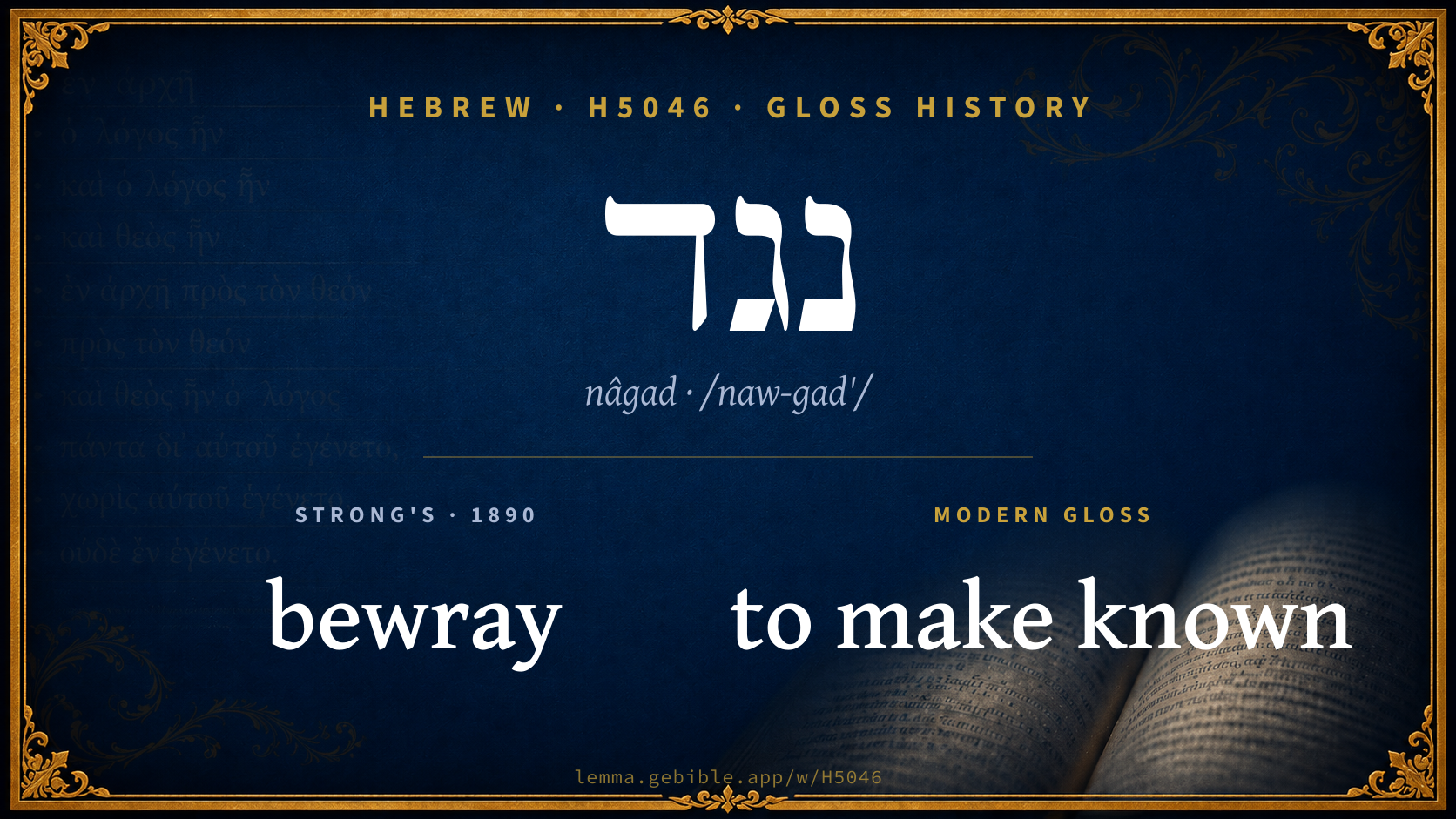
Gloss history
Strong's 1890 vs modern scholarship
About this word
Strong's H5046 catalogs a Hebrew word from the Hebrew Old Testament.
These counts are not copied from any lexicon or concordance. They are computed here, from the morphology-tagged Hebrew Old Testament. What Lemma adds →
- 344
- distinct verses
- The word appears in 344 distinct verses.
- 31 / 39
- OT books
- The word appears in 31 of 39 Old Testament books.
- #136
- by frequency
- Top 250 most frequent Hebrew words (rank 136 of 8,640 Hebrew words by occurrence).
View all 344 occurrences in the concordance →
By section of the Old Testament
By traditional corpus
Conventional, traditional groupings — biblical authorship is debated, so this is a traditional corpus grouping, not an authorship claim. Each share is this word’s portion of its verses in that division of the Hebrew canon. Each figure is a share of the word’s 344 distinct verses.
- Prophets (Nevi'im) 213 verses · 62%
- Writings (Ketuvim) 78 verses · 23%
- Torah (Pentateuch) 53 verses · 15%
How translations render this word
Counts come from each version’s own published word-to-Strong’s tagging or interlinear alignment — an approximate guide to how each version renders this word, not a word-level alignment the data otherwise carries. Because each total is that version’s own tagged count, the per-version totals vary from one another and need not match the appearance or distinct-verse counts above. These counts may also differ from a printed concordance because Lemma counts each distinctly tagged rendering and does not collapse phrase taggings into a single head-word total. This is a fixed set of word-tagged versions (KJV, ASV, BSB, ULT) and does not change with the reading translation you choose elsewhere. Each version’s license is shown beside its name below (and on Sources).
- King James Version: Told 64×, Tell 32×, Was told 25×
- American Standard Version: Told 58×, Tell 28×, Declare 23×
- Berean Standard Bible: Tell 49×, Told 36×, Was told 18×
- unfoldingWord Literal Text: Declare 57×, Declared 35×, Tell 23×
King James Version Public Domain
Renders H5046 across 370 tagged occurrences — most commonly:
Plus other, less common renderings. Plus 118 renderings that appear only once — usually multi-word phrases or single function words the recovered tagging swept in, not distinct renderings.
American Standard Version Public Domain
Renders H5046 across 369 tagged occurrences — most commonly:
Plus other, less common renderings. Plus 120 renderings that appear only once — usually multi-word phrases or single function words the recovered tagging swept in, not distinct renderings.
Berean Standard Bible Public Domain
Renders H5046 across 359 tagged occurrences — most commonly:
Plus other, less common renderings. Plus 120 renderings that appear only once — usually multi-word phrases or single function words the recovered tagging swept in, not distinct renderings. Not rendered by a distinct English word in 11 further occurrences.
unfoldingWord Literal Text CC BY-SA 4.0
Renders H5046 across 431 tagged occurrences — most commonly:
Plus other, less common renderings. Plus 84 renderings that appear only once — usually multi-word phrases or single function words the recovered tagging swept in, not distinct renderings.
7 senses and sub-senses in the full BDB
Hebrew verbs can shift meaning by stem (binyan): Qal is the basic action, Niphal is often passive or reflexive, Piel often intensifies or makes it factitive, and Hiphil is typically causative. The senses below are grouped under the stem BDB assigns to each. This entry also uses Hophal (the passive of Hiphil).
What do BDB’s symbols mean?
BDB uses these scholarly abbreviations:
| Symbol | Meaning |
|---|---|
| 𝔊 | the Septuagint (the ancient Greek translation, LXX) |
| 𝔙 | the Vulgate (the Latin translation) |
| 𝔖 | the Syriac version (the Peshitta) |
| 𝔗 | the Targum (the Aramaic translation) |
| ψ | the Psalms |
| √ | root (the underlying root or stem) |
| ‖ | parallel passage (a synonymous or contrasted parallel) |
| † | the dagger: every passage where the word occurs is cited |
The 7 senses and sub-senses the full Brown-Driver-Briggs lexicon distinguishes for this word, in lexicon order (not ranked by frequency), with BDB’s own verbatim wording and sub-sense lettering. Shown in Hebrew script with BDB’s own scholarly abbreviations. The condensed entry is in the Lexicon Entry tab. See also the Forms in the corpus table below.
Hiphil
- Pf. הִגִּיד Gn 3:11 +, 3 fs. הִגִּ֫ידָה 1 S 25:19 +, הִגַּדְתָּ Gn 12:8 +, etc.; Impf. יַגִּיד 1 S 9:6 +; וַיַּגֵּד Gn 9:22 +; sf. יַגִּידֶ֫הָ Is 44:7; יַגִּדָהּ Je 9:11; יַגֵּֽדְךָ Dt 32:7 (juss.), etc.; Imv. הַגֵּד 2 S 18:21 +; הַגִּ֫ידָה Gn 29:15 +, etc.; Inf. abs. הַגֵּד Ju 14:12 + 2 times; הַגִּיד Je 36:16; cstr. לְהַגִּיד Gn 32:6 +; לגיד 2 K 9:15 Kt. (Qr לְהַגּ׳); Pt. מַגִּיד Gn 41:24; +; f. מַגֶּ֫דֶת Est 2:20; pl. cstr. מַגִּידֵי Ju 14:19;—declare, tell [usually sq. לְ of indir. obj. Gn 3:11 + often; ins. also 1 S 12:7 2 S 13:34 𝔊 Th We Klo Dr Kit Bu, so HPS 2 S 13:34 (1 S 12:7 he foll. ℌ as more diff.); sq. אֶל Ex 19:9 1 S 3:15; sq. לִפְנֵי 1 S 17:31 ψ 142:3; עַל־פָּנָיו Jb 21:31; בְּאָזְנֵי Je 36:20; sq. בְּ loc. (instead of indir. obj.) chiefly proph. Je 4:5; 5:20; 31:10 +; also 1 S 4:13 2 S 1:20 2 K 9:15 Mi 1:10; rarely sq. acc. pers. 2 S 15:31 (but read וּלְדָוִד הִגִּיד HPS (indef. subj.), or ולד׳ הֻגַּד We Dr Kit, 𝔊 𝔙 Th Klo Bu favour הֻגַּד), 2 K 7:9, 11 Ez 43:10 Jb 17:5; 26:4; 31:37; sq. dir. obj. in acc. Gn 45:13 + often; sq. cl. wi. כִּי Gn 3:11 + often; sq. cl. wi. אֲשֶׁר = כִּי (late) Est 3:4; 6:2; sq. cl. wi. מָה Gn 29:15 Ju 16:15 Est 8:1 +; sq. cl. wi. מִי 2 K 6:11; sq. cl. wi. אֵיכָה Ct 1:7, once sq. cl. wi. הֲ Gn 43:6, etc.; often no dir. obj., sq. לֵאמֹר Ex 13:8 1 S 25:14 +; sq. וַיֹּאמֶר Gn 47:1 +; אמר then foll. by orat. rect.; הִגּ׳ alone sq. orat. rect. Zc 9:12; sq. עַל concerning, 1 S 27:11 Est 6:2; often indir. obj. om. 1 S 24:19 +; dir. obj. om. Ju 13:10 +; both om. Lv 5:1 +]. In Hex. rarely P, †Lv 5:1; 14:35 Ex 16:22†; J, Gn 3:11; 12:18 Ex 13:8 + 18 times; E, Gn 21:6; 31:20; 41:25 + 15 times; D, Dt 17:9; 26:3; 30:18 + 5 times;— e.g. Genesis 3:11
- 1. tell, announce, report, usually human subj. Gn 9:22; 24:23; 32:6 Lv 14:35 Ju 13:6 1 S 3:18 1 K 1:23 Ne 2:12 Est 2:10(×2) Jb 12:7 ψ 142:3 Is 19:12 Je 5:20 Ez 24:19 + e.g. Genesis 9:22
- 2. declare, make known, expound, especially of something before not understood, concealed or mysterious, Gn 3:11; 12:18, etc.; 1 K 10:3 = 2 Ch 9:2; a riddle Ju 14:12, 15, 16(×3), 19; dream Dn 2:2; secret Jb 11:6, etc.; of י׳ as revealing, Gn 41:25 2 S 7:11 2 K 4:27 Mi 6:8 Je 42:3 ψ 147:19; of declaring by י׳’s agents Dt 5:5 Mi 3:8 1 S 15:16 2 S 24:13 Je 50:28 Is 58:1; by divin. Ho 4:12. e.g. Genesis 3:11
- 3. inform of (play the informer concerning) Jos 2:14, 20 Je 20:10 Jb 17:5 Lv 5:1 Pr 29:24. e.g. Joshua 2:14
- 4. publish, declare, proclaim, especially of proclaiming wisdom, power, loving-kindness, etc., of י׳ (especially ψψ): ψ 9:12; 22:32; 51:17; 92:3, 16; 145:4 +, subj. heavens ψ 19:2; 50:6; 97:6; Is 42:12; 57:12. e.g. Psalms 9:12
- 5. avow, acknowledge, confess: Is 3:9 ψ 38:19, cf. Is 48:6.—Pt. = messenger 2 S 15:13 Je 51:31(×2) cf. הַנַּ֫עַר הַמַּגִּיד 2 S 1:5, 6, 13; הָאִישׁ הַמּ׳ 2 S 18:11. e.g. Isaiah 3:9
Hophal
- Pf. הֻגַּד Jos 9:24 +; Impf. וַיֻּגַּד Gn 22:20 +; Inf. abs. הֻגֵּד Jos 9:24 Ru 2:11;—be told, announced, reported, always sq. לְ (sometimes impers., logical subj. in acc., cf. Gn 27:42 2 S 21:11, c. fem. Is 21:2; not in P): Gn 27:42 (J), 31:22 (E), Dt 17:4 Jos 9:24(×2) (D), Ru 2:11(×2) Ju 9:25 2 S 10:17; 19:2; 21:11 1 K 10:7; 18:13 1 Ch 19:17 2 Ch 9:6 Is 21:2; 40:21; sq. לֵאמר Gn 22:20; 38:13, 24 (all J), Jos 10:17 (JE), 1 S 15:12; 19:19 2 S 6:12 1 K 1:51 2 K 6:13; 8:7 Is 7:2; sq. cl. with כִּי Ex 14:5 (J), Ju 9:47 1 S 23:7, 13; 27:4 1 K 2:29, 41. e.g. Joshua 9:24
Senses from the full Brown-Driver-Briggs lexicon (Brown, Driver, Briggs; Oxford 1906 — public domain), digitized via Sefaria, supplemented by the OpenScriptures HebrewLexicon (CC BY 4.0). Full attribution on Sources.
Word origin
vb. be conspicuous (NH in deriv.; Ph. n.pr.m. נגד; Arabic نَجَدَ conquer, overcome, also be apparent, conspicuous; نَجْدٌ high land or country; نَجُدَ be courageous, vigorous, effective, نَجِدٌ courageous, efficient; Aramaic ܢܓܰܕ, נְגַד drag, draw, lead; ܢܳܓܽܘܕܳܐ, נָגוֹדָא leader; Ethiopic ነገደ: is travel);—
— Brown-Driver-Briggs (Oxford 1906, public domain), digitized via Sefaria, supplemented by the OpenScriptures HebrewLexicon (CC BY 4.0). See Sources.
Origin: a primitive root
Jastrow Dictionary
A second Hebrew/Aramaic lexicon for comparison, covering Aramaic and post-biblical (Talmudic, Targumic, Midrashic) usage that the biblical-Hebrew BDB does not. Matched by lemma rather than by Strong’s number, so a lemma may carry more than one Jastrow headword (shown separately below), and the entries cover usage well beyond the Bible.
אִינְגַּד
- prolong! go further! Git. 58ᵃ א׳ פוסתא וכ׳ go one page and a half further, (and you will find it). [Rashi: a little = אִי־נְגַד, v. אי III.]
נָגַד
- (b. h.) to draw a line; denom. נֶגֶד.
- (denom. of נֶגֶד) to show; to announce, tell; to testify. Tanḥ. Tsav 13 ומשם … והִגִּידָה לאהרן from there Miriam learned it and told Aaron. Ib. מַגִּיד שהכל מודים וכ׳ this shows (intimates) that all agreed as to her beauty. Snh. IV, 5 להַגִּיד גדולתו וכ׳ to show the greatness &c. Ib. 44ᵇ, a. e. (ref. to Lev. V, 1) כיון שה׳ שוב אינו חוזר ומַגִּיד after he has once testified, he cannot again testify, i.e. is not permitted to retract; a. v. fr.—[Pes. 87ᵃ, v. אָגַד.]—V. מַגִּיד. e.g. Leviticus 5:1
- to be told, proclaimed. Yalk. Koh. 989 שה׳ לה בסיני the word which has been proclaimed at Sinai; a. e.
- to oppose. Yeb. 63ᵃ; Yalk. Gen. 23 (ref. to כנגדו, Gen. II, 18) זכה כנגדו לא זכה מְנַגַּדְתּוֹ if he is favored, she will be corresponding to (in harmony with) him, if not, she will oppose him (Rashi: ‘she will be a lash to him’, v. נִגְדָּא II); Pirké’ d’R. El. ch. XII א"ת כנגדו אלא לנגדו אם זכה תהיה לו עזר ואם לאו לנַגְּדוֹ להלחם read not k’negdo, but l’nagg’do; if he is favored, she will be a help to him, if not, ‘to oppose him’, to fight. e.g. Genesis 2:18
נְגַד
- 1. (corresp. to h. מָשַׁךְ, נָטָה a. אָרַךְ) to stretch; to draw, pull, spread. Targ. Jud. XVI, 30. Targ. Deut. XXI, 3. Targ. Jer. XLIII, 10.—Targ. Ps. LV, 4 יִיגְּדוּן ed. Lag. (ed. Wil. יגרון; h. text ימיטו). Targ. Y. Deut. XVII, 20. Targ. Y. Ex. XII, 21 נגודו ידיכון וכ׳ withdraw your hands from (v. מָשַׁךְ); a. fr.—Succ. 4ᵇ גּוּד אסיק וכ׳ stretch and raise the partitions, i.e. adopt the legal fiction that the partitions around the stand are prolonged so as to reach the ceiling (v. דּוֹפָן). Sabb. 101ᵃ גוּד אחית וכ׳ stretch and bring the partitions down, i.e. adopt the fiction that the walls are prolonged so as to reach the bottom. Erub. 4ᵇ לְגוּד, v. לָבוּד. Gitt. 68ᵇ נְגִידוּ מיניה מיכליה (Rashi: נְגוּדוּ) withdraw his food from him, reduce his rations. B. Mets. 74ᵃ למידש ולמִנְגַּד to tread the grapes and to conduct the wine into the pit. Ib. 84ᵇ נַגְדוּ מתותיה וכ׳ they drew from under him sixty &c., v. מְשִׂיכְלָא. B. Bath. 111ᵇ גוד לית וכ׳ draw (take me away from here), this man does not want to learn. Pesik. B’shall., p. 90ᵃ; Koh. R. to X, 8 גוד חמי לי lead the way, show it to me. Bekh. 44ᵇ נגדו ליה גלימא they spread for him (held up between him and the people) a cloak. Erub. 94ᵃ שקולו … נְגִידוּ בה take a cloak and spread it (as a partition); a. v. fr.—Ab. I, 13 נְגַד שמא וכ׳ he who stretches his fame (is ambitious), will lose his name.
- 2. to lash, v. Pa.
- 3. to guide, rule. Targ. Ruth I, 1 (h. text שפט).
- 4. to grow long; to be drawn, follow after; to flow. Targ. Job XXI, 33 (h. text ימשוך). Targ. Jer. VI, 4 (h. tex ינטו). Targ. Cant. I, 4 נְגִדְנָא וכ׳ we are drawn after &c. Targ. Deut. XXXIII, 13; 22; a. fr. (v. נְגַר).—B. Bath. 91ᵇ והוה נָגֵיד חוטא וכ׳ a line of honey flowed over both his arms; Y. Peah VII, 20ᵃ bot. ונ׳ מלא וכ׳ and honey flowed as much as my hands could hold; a. e.—Part. pass. נְגִיד stretched, fainting (v. Ithpe.). Targ. Ps. LXXXVIII, 16.—Sabb. 152ᵃ, v. Ithpe.
- (denom. of נִגְדָּא II) to lash, punish. Targ. Cant. VII, 5 למִינְגַּד … לנַגָּדָא.—Keth. 33ᵇ נַגְּדוּהָ, v. אִלְמָלֵא. Kidd. 12ᵇ נַגְּדֵיה כרב punish him in accordance with Rab’s practice. Pes. 52ᵃ ולִינַגְּדֵיה מר נַגּוּדֵי Ms. (ed. נגידי, corr. acc.) why do you not order him to be lashed?; a. e.
- to declare liable to lashes. Kidd. l. c.; Yeb. 52ᵃ, a. e. רב מַנְגִּיד (על) וכ׳ Rab decreed punishment for him who &c. Kidd. l. c. לא מינגיד רב (read: מנגיד, as) Yeb. l. c.
- , אִינְּגִיד, Ithpa. אִתְנַגַּד
- 1. to be drawn, to extend; to run. Targ. Is. XXXIV, 11. Targ. Y. Num. XXV, 8. Targ. Y. Gen. XLV, 19. Targ. Is. XLIV, 3; a. e.
- 2. to spread, invade. Targ. I Sam. XXVII, 10 (h. text פשט); a. e.
- 3. to be withdrawn. Targ. Josh. IV, 18; a. e.
- 4. [to stretch one’s self,] to faint, fall away, die (h. גָּוַע). Targ. Gen. XXV, 8; a. fr.—Pes. 50ᵃ חלש וא׳ כי וכ׳ was sick and fainted (seemed to be dead), and when he came to &c.; B. Bath. 10ᵇ. Snh. 39ᵃ א׳ ואתנח he became faint and sighed; Sabb. 152ᵃ נגיד ואתנח.
- 5. to be lashed. Macc. 11ᵃ; Pes. 113ᵇ מִינְּגִיד, v. זִיגּוֹד.—[Kidd. 12ᵇ מינגיד, v. supra.]
נֶגֶד
- line, direction; prep. נֶ׳, mostly כְּנֶ׳ towards, opposite, corresponding to. Sifra Tsav, Milluim, Par. 1 והלא כבר זיוג … זה נ׳ זה has not the Scripture, before this, paired the two rams, one to correspond with the other? Tam. II, 5 (29ᵃ) כנ׳ מערבית דרומית משוך וכ׳ (Mish. ed. מִכְּנֶ׳) in a line with the south-west corner of the altar continued northward to a distance of &c.; Zeb. 58ᵃ. Ib. אם שחטן כְּנֶגְדָּן בקרקע if he slaughtered them in the corresponding direction, but in the ground. Mekh. Yithro, Baḥod, s. 11 (ref. to Ex. XX, 24) כְּנֶגְדּוֹ ‘alav means in a certain direction opposite the altar (not on top of it). Ber. 10ᵃ הנהו … כנ׳ מי אמרן with reference to whom did David compose these five psalms beginning with bar’khi nafshi? Ib. 26ᵇ כנ׳ תמידין corresponding to the daily offerings. Num. R. s. 18 המחלוקת הזו אינה כְּנֶגְדֵּנוּ אלא כנ׳ וכ׳ this rebellion is not directed against us but against &c.; a. v. fr.—Yeb. 63ᵃ (ref. to Gen. II, 18) זכה … לא זכה כנגדו if he is favored, she will be his help, if not, she will be against him; ib. כתיב כנַגְּדוֹ וקרינן כְּנֶיגְדּוֹ (missing in Yalk. Gen. 23) following the writing we may read k’nagg’do (opposing him, v. נָגַד), but the Massoretic reading is k’negdo (corresponding to him); Gen. R. s. 17 זכה עזר ואם לאו כנגדו; Pirké d’R. El. ch. XII, v. נָגַד.—מִנֶּ׳ at a distance. Num. R. s. 2 (ref. to Num. II, 2) מהו מנ׳ what distance is meant by minneged?. Ib. ילפינן מנ׳ מנ׳ וכ׳ we draw an analogy between minneged (Num. l. c.) and minneged (Gen. XXI, 16) &c.; Gen. R. s. 53 הא למדנו נגד מנגד. e.g. Exodus 20:24
A Dictionary of the Targumim, the Talmud Babli and Yerushalmi, and the Midrashic Literature (Marcus Jastrow; London, Luzac, 1903) — Public Domain. Digitized via Sefaria. Digitized via Sefaria. Full attribution on Sources.
Forms in the corpus
The 180 distinct written forms H5046 takes in the Hebrew Bible, most frequent first — each parse links to that stem’s occurrences in the concordance. Hebrew forms include their vowel points and cantillation, so a single lemma takes many written forms.
The 60 most common forms are shown; 120 rarer forms follow in the full concordance.
Same root — word family
Other BDB entries built from the same root as H5046, grouped by Strong’s listed origin. These share a root / origin per the lexicon — not necessarily a shared meaning. Each links to that word’s own entry.
Derived from this word
Compare all same-root words → They share a root, not necessarily a meaning.
Septuagint verse parallels
This word appears in 327 verses that also exist in the Greek Old Testament (Septuagint), out of the 344 Hebrew verses it occurs in. You can read those verses in Greek by switching the Old Testament edition to the Septuagint.
Read these verses in the Septuagint
- Genesis 3:11
- Exodus 4:28
- Leviticus 5:1
- Numbers 11:27
- Deuteronomy 4:13
- Joshua 2:14
- Judges 4:12
- Ruth 2:11
- 1 Samuel 3:13
- 2 Samuel 1:4
- 1 Kings 1:20
- 2 Kings 4:2
This is a verse-level parallel only — the same verses exist in both the Hebrew and Greek Old Testaments. No word-level Hebrew↔Greek correspondence is claimed: the data carries no such alignment, so no Greek word is shown as this Hebrew word’s translation. Coverage is not total — the Septuagint omits the deuterocanon and renumbers the Psalms, so some Hebrew verses have no direct Greek parallel.