Ezekiel 44:23

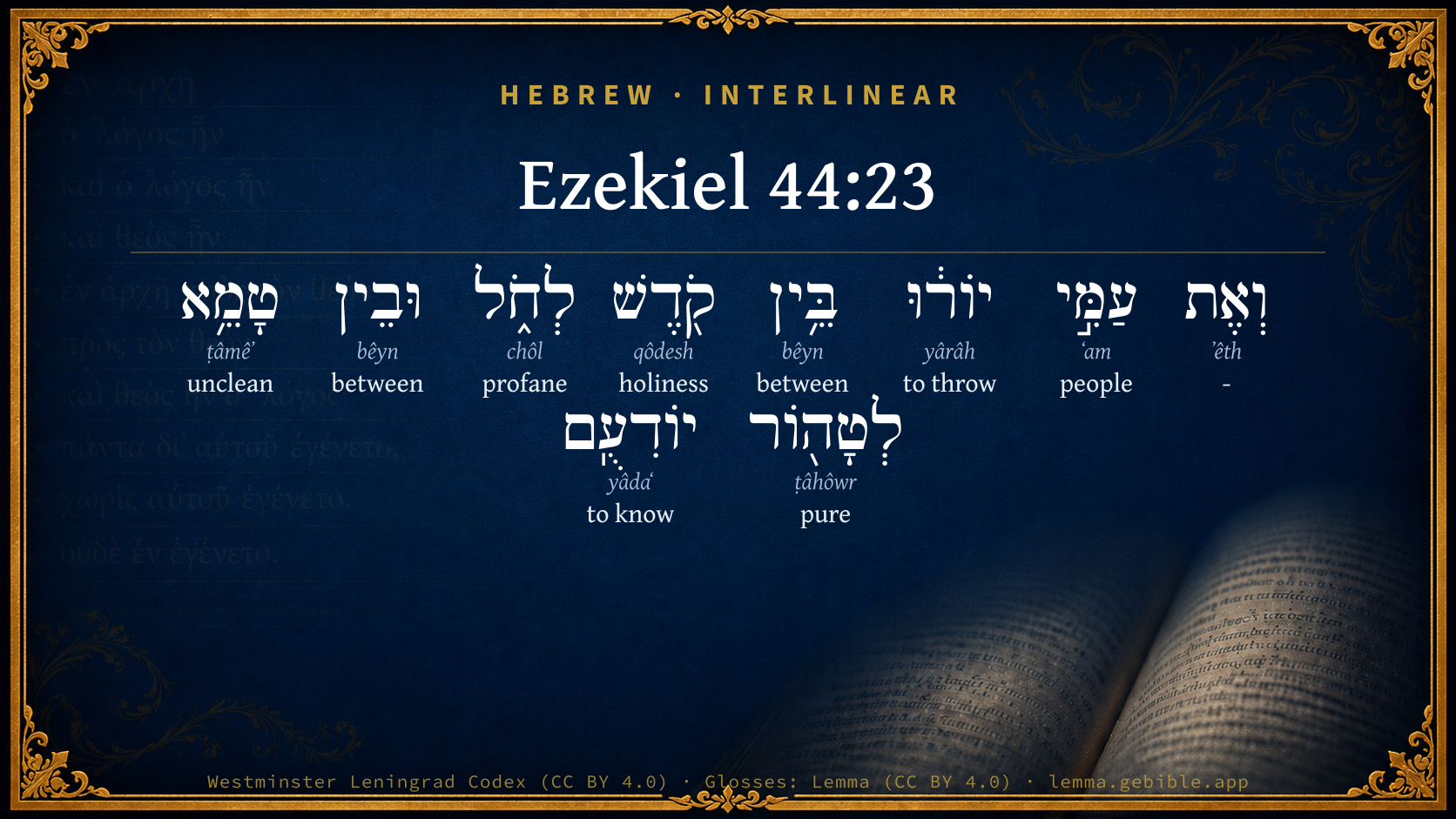
Hebrew (Westminster Leningrad Codex) Ezekiel 44:23 appears in the Hebrew Old Testament. The text above is from the Westminster Leningrad Codex. Each word links to its Strong’s number, a concise gloss, and parsing drawn from the Open Scriptures Hebrew Bible morphology. Click any word for its full Brown-Driver-Briggs (BDB) entry.
Download image
Cite this verse

Ezekiel 44:23 (World English Bible). Public Domain. Lemma interlinear Bible study tool, https://lemma.gebible.app/v/ezekiel/44/23.

Show BibTeX & RIS
BibTeX
RIS
English Translation
They shall teach my people the difference between the holy and the common, and cause them to discern between the unclean and the clean.
World English Bible · Public Domain
Download a study sheet

One document with this verse’s original text, its word-by-word gloss line, the meaning frame, cross-references with their text, attributed commentary, and full source and license credits — printable, and it pastes into notes with its structure intact.

This verse Autodidact and up

Study sheet (.html) Plain text (.txt)

A passage Seminary Student

Up to 50 verses in one chapter. A passage sheet keeps up to 6 commentary sources and 12 cross-references per verse, in the order this page ranks them, and says so on the sheet whenever that leaves anything out. Ask for a single verse and you get the Autodidact verse sheet above.

Everything on this page stays free to read, with no account — the sheet is a download of what is already on screen, not access to it.

Want to remove ads? Support Godless Engineer
Compare translations 3

The same verse in 3 English versions, stacked beneath the original-language interlinear above. Click any original word for its lexicon entry.

Each is an independent rendering of the whole verse — the interlinear is not word-aligned to these translations.

Highlighted words mark where these versions differ — a whole-verse word diff, not a word-by-word alignment.

  • World English Bible Public Domain
    They shall teach my people the difference between the holy and the common, and cause them to discern between the unclean and the clean.
  • King James Version Public Domain
    And they shall teach my people the difference between the holy and profane, and cause them to discern between the unclean and the clean.
  • unfoldingWord Literal Text CC BY-SA 4.0
    For they will teach my people the difference between the holy and the profane; they will make them know the unclean from the clean.

unfoldingWord Literal Text — © unfoldingWord, licensed CC BY-SA 4.0. Word-aligned USFM3 via Door43 (git.door43.org/unfoldingWord/en_ult).

Versions to compare (up to 4)

3 of 4 selected

Show all 18 translations

Every available English version of this verse, each an independent rendering of the whole verse.

  • World English Bible Public Domain
    They shall teach my people the difference between the holy and the common, and cause them to discern between the unclean and the clean.
  • Berean Standard Bible Public Domain
    They are to teach My people the difference between the holy and the common, and show them how to discern between the clean and the unclean.
  • Majority Standard Bible Public Domain
    They are to teach My people the difference between the holy and the common and show them how to discern between the clean and the unclean.
  • King James Version Public Domain
    And they shall teach my people the difference between the holy and profane, and cause them to discern between the unclean and the clean.
  • American Standard Version (1901) Public Domain
    And they shall teach my people the difference between the holy and the common, and cause them to discern between the unclean and the clean.
  • Revised Version (1885) Public Domain
    And they shall teach my people the difference between the holy and the common, and cause them to discern between the unclean and the clean.
  • Geneva Bible (1599) Public Domain
    And they shall teach my people the difference betweene the holy and prophane, and cause them to discerne betweene the vncleane and the cleane.
  • Douay-Rheims (1899) Public Domain
    And they shall teach my people the difference between holy and profane, and shew them how to discern between clean and unclean.
  • Young's Literal Translation Public Domain
    `And My people they direct between holy and common, and between unclean and clean they cause them to discern.
  • Literal Standard Version CC BY-SA 4.0
    And they direct My people between holy and common, and they cause them to discern between unclean and clean.
  • Unlocked Literal Bible CC BY-SA 4.0
    For they will teach my people the difference between the holy and the profane; they will make them know the unclean from the clean.
  • unfoldingWord Literal Text CC BY-SA 4.0
    For they will teach my people the difference between the holy and the profane; they will make them know the unclean from the clean.
  • Darby Bible Public Domain
    And they shall teach my people [the difference] between holy and profane, and cause them to discern between unclean and clean.
  • World Messianic Bible Public Domain
    They shall teach my people the difference between the holy and the common, and cause them to discern between the unclean and the clean.
  • Webster's Bible Public Domain
    And they shall teach my people the difference between the holy and profane, and cause them to discern between the unclean and the clean.
  • Free Bible Version CC BY-SA 4.0
    They are to teach my people the difference between what is holy and what is common, and explain to them how to distinguish between what is clean and what is unclean.
  • Bible in Basic English Public Domain
    And they are to make clear to my people the division between what is holy and what is common, and to give them the knowledge of what is clean and what is unclean.
  • JPS Tanakh (1917) Public Domain
    And they shall teach My people the difference between the holy and the common, and cause them to discern between the unclean and the clean.

Literal Standard Version (2020), Covenant Press — licensed CC BY-SA 4.0. Text via the HelloAO Bible API (eBible.org). Unlocked Literal Bible (unfoldingWord) — licensed CC BY-SA 4.0. Text via the HelloAO Bible API (eBible.org). unfoldingWord Literal Text — © unfoldingWord, licensed CC BY-SA 4.0. Word-aligned USFM3 via Door43 (git.door43.org/unfoldingWord/en_ult). Free Bible Version, Dr. Jonathan Gallagher — licensed CC BY-SA 4.0. Text via the HelloAO Bible API (eBible.org).

Word by word

More ways to search: Search by grammar → Find every occurrence → Compare this word →

Practice this passage: Drill this verse → Learn its vocabulary →

לְחֹ֑ל
chôl
H2455
“to/for · profane”
Preposition + Noun, Common, Masculine, Singular, Absolute
Part of Speech
Preposition + Noun
Type
Common
Gender
Masculine
Number
Singular
State
Absolute
Full BDB Definition

Origin: from H2490

TWOT: 623a , 661a

profaneness, commonness, unholy, profane, common, sand
  1. וְאֶת ʼêth H853 “and · -” Conjunction + Particle, Direct Object
  2. עַמִּ֣י ʻam H5971 “people · my” Noun, Common, Masculine, Singular, Construct + Suffix, Personal, 1st Person, Common, Singular
  3. יוֹר֔וּ yârâh H3384 “to throw” Verb, Hiphil, Imperfect, 3rd Person, Masculine, Plural
  4. בֵּ֥ין bêyn H996 “between” Preposition
  5. קֹ֖דֶשׁ qôdesh H6944 “holiness” Noun, Common, Masculine, Singular, Absolute
  6. וּבֵין bêyn H996 “and · between” Conjunction + Preposition
  7. טָמֵ֥א ṭâmêʼ H2931 “unclean” Adjective, Adjective, Masculine, Singular, Absolute
  8. לְטָה֖וֹר ṭâhôwr H2889 “to/for · pure” Preposition + Adjective, Adjective, Masculine, Singular, Absolute
  9. יוֹדִעֻֽם yâdaʻ H3045 “to know · them” Verb, Hiphil, Imperfect, 3rd Person, Masculine, Plural + Suffix, Personal, 3rd Person, Masculine, Plural

About this verse

These counts appear in no published source. They are computed here, from the morphology-tagged text and Lemma’s own curated glosses. What Lemma adds →

10
words
9
distinct lemmas
Prophets
section

Notable vocabulary

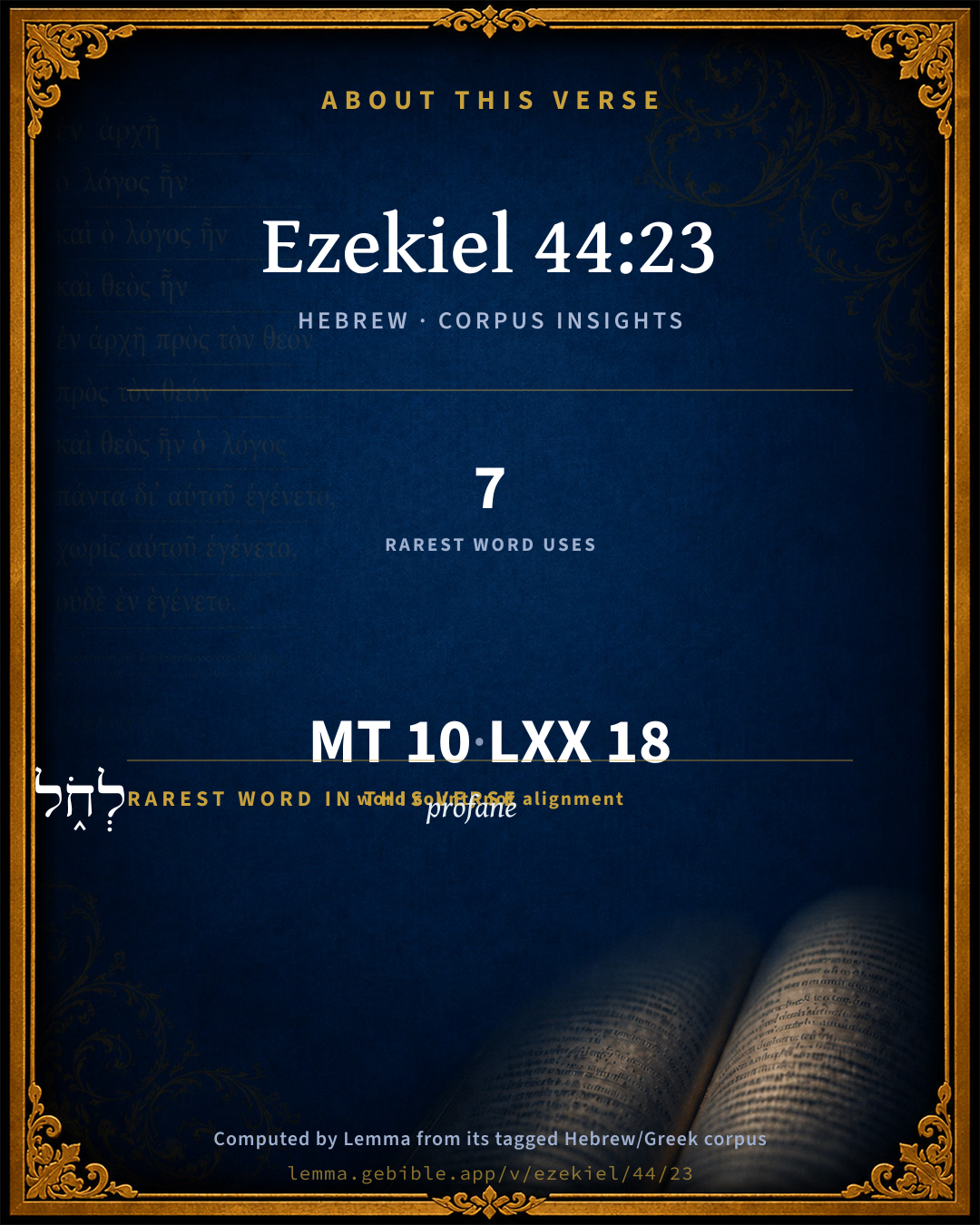
The rarest word here is לְחֹ֑ל profane H2455 — appearing just 7 times in the whole Hebrew Bible.

Shared distinctive vocabulary

לְחֹ֑ל profane H2455 occurs in 7 verses of the Hebrew Bible. Also found in:

Grammatical profile

  • 2 verbs
  • 3 nouns
  • 2 adjectives
  • 2 prepositions
  • 1 particle

Verb forms

  • יוֹר֔וּ Hiphil · Imperfect
  • יוֹדִעֻֽם Hiphil · Imperfect

Repetition

A word recurs within this verse — often emphatic in Hebrew:

  • בֵּ֥ין between H996 ×2

Hebrew & Septuagint length

In English translation the verse runs 24 words from the Hebrew and 25 from the Septuagint (LXX English) — closely comparable.

A rough comparison of the two English renderings, which tokenize alike — not a word-level alignment.

Word counts can differ between the Hebrew and the Greek without any difference in meaning — e.g. the Hebrew direct-object marker אֵת has no separate Greek word, and Greek often adds the article ὁ.

In the original languages it is 10 Hebrew tokens and 18 Greek tokens — but the two are counted differently (Hebrew bundles its prefixes and suffixes into one token; the Greek is in lemma form), so that isn’t a like-for-like length.

Cross-references

10

Topical passages linked to Ezekiel 44:23 in the Treasury of Scripture Knowledge — connected by theme and wording, ordered by reader-vote popularity; previews shown in the World English Bible.

  • Ezekiel 22:26 Her priests have done violence to my law, and have profaned my holy things: they have made no distinction between the holy and the common, neither have they caused men to discern between the unclean and the clean, and have hid their eyes from my Sabbaths, and I am profaned among them.
  • Leviticus 10:10–11 and that you are to make a distinction between the holy and the common, and between the unclean and the clean;
  • 2 Timothy 2:24–25 The Lord's servant must not quarrel, but be gentle towards all, able to teach, patient,
  • Hosea 4:6 My people are destroyed for lack of knowledge. Because you have rejected knowledge, I will also reject you, That you may be no priest to me. Because you have your God's law, I will also forget your children.
  • Zephaniah 3:4 Her prophets are arrogant and treacherous people. Her priests have profaned the sanctuary. They have done violence to the law.
  • Malachi 2:6–9 The law of truth was in his mouth, and unrighteousness was not found in his lips. He walked with me in peace and uprightness, and turned many away from iniquity.
  • Deuteronomy 33:10 They shall teach Jacob your ordinances, Israel your law: They shall put incense before you, Whole burnt offering on your altar.
  • Haggai 2:11–13 "Thus says Yahweh of Hosts: Ask now the priests concerning the law, saying,
  • Titus 1:9–11 holding to the faithful word which is according to the teaching, that he may be able to exhort in the sound doctrine, and to convict those who contradict him.
  • Micah 3:9–11 Please listen to this, you heads of the house of Jacob, And rulers of the house of Israel, Who abhor justice, And pervert all equity.

Cross-references courtesy of OpenBible.info (CC BY 4.0).

Hebrew and Greek witnesses Masoretic Hebrew ↔ Greek Septuagint

The same verse in the two great witnesses to the Old Testament, shown verse-for-verse.

These are two independent witnesses, not word-aligned to each other, and the Septuagint is shown in lemma (dictionary) form.

Hebrew Ezekiel 44:23 Masoretic · Westminster Leningrad Codex

וְאֶת עַמִּ֣י יוֹר֔וּ בֵּ֥ין קֹ֖דֶשׁ לְחֹ֑ל וּבֵין טָמֵ֥א לְטָה֖וֹר יוֹדִעֻֽם

They shall teach my people the difference between the holy and the common, and cause them to discern between the unclean and the clean.

World English Bible · Public Domain

Greek LXX Ezekiel 44:23 Septuagint · lemma form

καί ὁ λαός ἐγώ διδάσκω ἀνά μέσος ἅγιος καί βέβηλος καί ἀνά μέσος ἀκάθαρτος καί καθαρός γνωρίζω αὐτός

And they shall teach my people to distinguish between holy and profane, and they shall make known to them the difference between unclean and clean.

LXX2012 (modern English Septuagint) · Public Domain

Hebrew: Westminster Leningrad Codex (CC BY 4.0). Greek: Septuagint (public domain); English from LXX2012 (modern English Septuagint) (Public Domain). How the Septuagint differs from the Hebrew →

Targum (Aramaic paraphrase)

1

The Targum is the ancient Jewish Aramaic paraphrase of the Hebrew Scriptures — an interpretive translation, not the Hebrew text itself. Onkelos (literal) and Pseudo-Jonathan (expansive) render the Torah, and Jonathan the Prophets. Coverage is partial: where no permissively-licensed English translation exists for a verse, only the Aramaic is shown. This is verse-level text, not a word-by-word alignment to the Hebrew.

  1. Targum Jonathan Prophets (Joshua–Malachi)
    וְיַת עַמִי יֵלְפוּן בֵּין קוּדְשָׁא לְחוֹלָא וּבֵין מְסָאֲבָא לְדַכְיָא יְהוֹדְעוּנוּן:

    (no public-domain English translation for this verse)

    Targum Jonathan — Aramaic: “Mikraot Gedolot” (public domain). English: “Sefaria Community Translation” (CC0 1.0 (public-domain dedication)); “London "Chaldee Paraphrase," 1871” (public domain). Text via Sefaria.

Commentary

Notes on Ezekiel 44:23 from classic Christian and Jewish commentators (each source and its license shown beneath its notes). The classic Christian expositions comment on the surrounding passage and are grouped to its opening verse, so a note may address several verses; the Jewish commentaries on the Tanakh (Rashi and others) are per-verse, so they appear only where the commentator wrote on this verse.

Lemma curates 59 commentaries, every one of them public domain or Creative Commons licensed, each selected and text-cleaned for this edition rather than reprinted as found. About our sources →

Trapp's Complete Commentary

John Trapp

Eze 44:23 And they shall teach my people [the difference] between the holy and profane, and cause them to discern between the unclean and the clean.

Ver. 23. And they shall teach.] Ministers must be able and "apt to teach." {1Ti 3:2 Tit 1:9 Act 20:28}

John Trapp, A Commentary or Exposition upon All the Books of the Old and New Testament (1647–1656) — public domain. Text from a community e-Sword module.

The Biblical Illustrator

Joseph S. Exell

Eze_44:23

They shall teach My people the difference between the holy and profane.

Steering between the rocks

I. You can judge of the moral character of any amusement by its healthful result, or by its baleful reaction. In proportion as a ship is swift, it wants a strong helmsman; in proportion as a horse is gay, it wants a stout driver; and people of exuberant nature will do well to look at the reaction of all their amusements. If an amusement sends you home at night nervous, so that you cannot sleep, and you rise up in the morning, not because you are slept out, but because your duty drags you from your slumbers, you have been where you ought not to have been. If any amusement sends you home longing for a life of romance and thrilling adventure, love that takes poison and shoots itself, moonlight adventures and hairbreadth escapes, you may depend upon it that you are the sacrificed victim of unsanctified pleasure. Our recreations are intended to build us up; and if they pull us down as to our moral or as to our physical strength, you may come to the conclusion that they are in the class spoken of by my text as obnoxious.

II. Those amusements are wrong which lead you into expenditure beyond your means. The table has been robbed to pay the club. The champagne has cheated the childrens wardrobe. Excursions that in a day make a tour around a whole months wages; ladies whose lifetime business it is to go shopping; bets on horses and a box at the theatre have their counterparts in uneducated children, bankruptcies that shock the money market and appall the Church, and that send drunkenness staggering across the richly figured carpet of the mansion, and dashing into the mirror, and drowning out the carol of music with the whooping of bloated sons come home to break their old mothers heart. When men go into amusements that they cannot afford, they first borrow what they cannot earn, and then they steal what they cannot borrow. First, they go into embarrassment, and then into lying, and then into theft; and when a man gets as far on as that, he does not stop short of the penitentiary. There is not a prison in the land where there are not victims of unsanctified amusements.

III. Those are unchristian amusements which become the chief business of a mans life. Your sports are merely means to an end. They are alleviations and helps. The arm of toil is the only arm strong enough to bring up the bucket out of the deep well of pleasure. Amusement is only the bower where business and philanthropy rest while on their way to stirring achievements. Amusements are merely the vines that grow about the anvil of toil, and the blossoming of the hammers. Alas for the man who spends his life in laboriously doing nothing, his days in hunting up lounging places and loungers, his nights in seeking out some gas-lighted foolery! The amusements of life are merely the orchestra playing while the great tragedy of life plunges through its five acts--infancy, childhood, manhood, old age, and death. Then exit the last chance for mercy. Enter the overwhelming realities of an eternal world!

IV. Those amusements are wrong which lead into bad company. If you belong to an organisation where you have to associate with the intemperate, with the unclean, with the abandoned, however well they may be dressed, in the name of God quit it. They will despoil your nature. They will undermine your moral character. They will drop you when you are destroyed. They will give not one cent to support your children when you are dead. They will weep not one tear at your burial. They will chuckle over your damnation.

V. Any amusement that gives you a distaste for domestic life is bad. How many bright domestic circles have been broken up by sinful pleasuring! The father went off, the mother went off, the child went off. There are today the fragments before me of a great many blasted households. Oh, if you have wandered away, I would like to charm you back by the sound of that one word home. Do you not know that you have but little more time to give to domestic welfare? Do you not see, father, that your children are soon to get out into the world, and all the influence for good you are to have over them you are to have now? Death will break in on your conjugal relations, and alas, if you have to stand over the grave of one who perished from your neglect! (T. De Witt Talmage.)

The Biblical Illustrator, edited by Joseph S. Exell (c. 1880s–1900s) — public domain. Text from a community e-Sword module.

The Cambridge Bible for Schools and Colleges

gen. ed. J. J. S. Perowne

23, 24. General duties of the priests towards the people. They shall teach the people to distinguish between the holy and the common, between the clean and the unclean, cf. Eze_22:26; Lev_10:10; Hag_2:11; Mal_2:7.

The Cambridge Bible for Schools and Colleges (gen. ed. J. J. S. Perowne; Cambridge University Press, 1878–1918) — public domain. Text from a community e-Sword module.

John Gill's Exposition

And they shall teach my people the difference between the holy and the profane,.... Persons and things; not in a ceremonial, nor merely in a moral, but in an evangelical sense, between truth and error; between the doctrine which is according to godliness, and that which is corrupt and unsound, and eats as cloth a canker; between holy worship, and superstition; between holy duties, and profane and Heathen rites and ceremonies; and between persons sanctified by the Spirit and grace of God, and unconverted ones:

and cause them to discern between the unclean and the clean; impure persons, doctrines, and manners, and those which are agreeable to the word of God; the sense is, that they shall take pains to instruct persons in the knowledge of divine things, and shall do it truly, faithfully, and sincerely.

John Gill's Exposition of the Whole Bible (1746–1763) — public domain (CC PDM 1.0). Text via the HelloAO Bible API.

Matthew Poole's English Annotations

They shall teach; by their place they were bound to instruct the people, Lev 10:10,11; this was part of their work, to read the law, expound it, and resolve questions arising about it. They were to be, as ministers ought now to be, apt to teach, 1Ti 3:2.

Between the holy and profane; whether legally and ceremonially so, or morally and really so, that they might keep the people from pollutions.

Between the unclean and the clean; the same thing in other words, only this seems to require priests’ patient instructing, till the people have learned to difference unclean and clean.

Matthew Poole's English Annotations on the Holy Bible (1683–1685) — public domain. Text from a community e-Sword/MySword module.

Whedon's Commentary on the Bible

Daniel D. Whedon

23, 24. The priests shall teach the people the difference between “the holy and the common,” that they may know the inner meaning of their symbolic ritual (Eze_22:26; Hag_2:11-14), administer justice (compare Eze_45:17; Deu_17:8-12; Deu_21:5), keep to Jehovah’s laws, “and hallow my sabbaths.” (Compare Eze_20:12-21; Eze_22:8.)

Daniel D. Whedon (gen. ed.), Commentary on the Old and New Testaments (1874–1909) — public domain. Text from a community e-Sword module.

The Pulpit Commentary

Vers. 23, 24 Among the priests" official duties four things are prescribed.

(1) The education of the people in the fundamental principles of their religion, viz. that a distinction existed between the "holy" and "profane," or common," and in the practical application of that principle, the art of discerning between the "unclean" and the "clean." This duty had been laid upon the priests of Mosaism (Lev_10:10; Deu_24:8 Deu_33:10) but in the last years of the monarchy had been neglected. (Eze_26:2-6; comp. Mal_2:7-9)

(2) The administration of justice in all disputes arising out of and connected with the practices of their religion. This office had pertained to the priests under the Law (Num_5:14-31; Deu_17:8-13 Deu_19:17 Deu_21:5) and was exercised in pre-exilic times (Hos_4:6; Mic_3:11; Isa_28:7; Jer_18:18) though not always in accord-ante with Jehovah s judgments. That the juridical authority of the priests was purely of a moral kind (Wellhausen, Smend), can be maintained only by rejecting 2Ch_17:7-9 and 2Ch_19:5-11 as unhistorical

(3) The regulation of all festal assemblies in accordance with the Divine statutes. For errors in the celebration of these festivals, the priests should be answerable, as they had always been; only under the new regime there should be no errors.

(4) The hallowing of Jehovah"s sabbaths. This they should do both by resting on the seventh day and by offering the sabbath sacrifices, the showbread, and the burnt offering; both of which things the priests under the Law had been commanded to do. (see Exo_20:8-11 Exo_31:13-17; Lev_23:3 Lev_24:8; Num_28:9) but had not done. (Eze_20:12, Eze_20:13, Eze_20:20, 21 22:8 23:28)

The difference between the holy and profane.

I THERE IS A REAL DIFFERENCE. Men have been much concerned with wholly fictitious distinctions, and a most artificial line has been drawn between what has been accounted sacred and what has been regarded as profane. But this is only the abuse and the degeneracy of what should be discovered in its high and true condition as a genuine difference. The formal distinctions of the Jewish Law were all intended to symbolize moral and spiritual differences. Some of them were obviously concerned with matters of common cleanliness and decency; some had a more immediate bearing on sanitary laws; others, perhaps, were too suggestive of Jewish exclusiveness or conventional propriety; but even these latter regulations could not but impress upon the minds of thoughtful men the separateness of true holiness. The one real distinction is moral. It is the line of demarcation that separates sin from righteousness. This, and not the supposed distinction between the secular and the sacred, is the real difference between clean and unclean. St. Peter was taught to call none of the creatures of God common or unclean. (Act_10:15) It is not they that are so, but the uncleanness is in us, in our use of them. "Unto the pure all things are pure: but unto them that are defiled and unbelieving is nothing pure; but even their mind and conscience is defiled". (Tit_1:15) Similarly, men make an artificial distinction between sacred and profane history. Coming from the pen of a Josephus, the history of Israel is profane; written by an Arnold, the history of Rome is sacred. He who sees God in history beholds a sacredness in it. To him who is worldly and untrue in heart all that he touches is profane.

II THIS DIFFERENCE IS TO BE LEARNT BY SPIRITUAL EDUCATION. The priests were to teach the people the difference between the clean and the unclean. No doubt the elaborate external regulations of the Jewish Law required careful study, and men needed to be thoroughly instructed in regard to them, in order that they might avoid even unconscious offences. This was a necessary adjunct of a ceremonial religion. A religion of law needed lawyers for its priests. Now that system is wholly swept away. We live in the glorious liberty of the sons of God, and there is no need for us to be instructed in elaborate rules of ceremonial purification. Still, moral education is now needed, though in another direction. Conscience must be educated, so that it may be sensitive and keen to discern what is right, and separate this from what is evil. This education is not to be a drilling in casuistry, which would be a return to the old bondage of the Law; but it is to be an enlightening in regard to the great principles of Christian righteousness, and still more a quickening of the soul to feel the force of those principles, and to apply them without delay to every case as it arises. It is important that the religious teaching of children should be directed more to this end. One great function of the pulpit is to awaken men"s sense of the great distinction between sin and purity. We live too much by compromise. We need to learn more of the absolute claims of righteousness.

The difference between the holy and profane.

It was one great office of the Jewish priesthood to instruct the people to discern between the unclean and the clean. No doubt this office was often discharged in a perfunctory manner; yet a valuable purpose was answered by the importance which the Israelites were thus encouraged to attach to obedience to the behests of the great King.

I THERE IS AN ARBITRARY AND FACTITIOUS DISTINCTION BETWEEN THE HOLY AND THE PROFANE. Such is the distinction drawn in heathen communities, simply in the interests of the priests themselves, with no moral bearing or intention.

II THERE IS A CEREMONIAL AND SYMBOLICAL DISTINCTION BETWEEN THE HOLY AND THE PROFANE. Such was the difference which was established by the Law given by Moses to the Israelites, and maintained by Divine command by the instrumentality of the priests of Jehovah.

III THERE IS A SPIRITUAL AND REAL DISTINCTION BETWEEN THE HOLY AND THE PROFANE. It cannot be doubted that the ceremonial differences were intended to be the emblems of deeper and more real distinctions of a moral nature. In the Christian dispensation men were early taught upon the highest authority to call nothing common or unclean. But whilst Christ abolished distinctions, which were a means to an end, which served a temporary purpose of preparation, he emphasized those distinctions which, in the sight of a holy God, are real and important. Especially was this the case with the eternal difference between moral good and evil, between what is in accordance with, and what is repugnant to, the nature, the character, and the will of God, This distinction is one which the Church of Christ is bound to maintain, both by teaching and by conduct, before a sinful and disobedient world. T.

The Pulpit Commentary (1880–1919), ed. H.D.M. Spence-Jones & Joseph S. Exell — public domain. Text from a community e-Sword module.

unfoldingWord translationNotes

Door43 World Missions Community

General Information:

Yahweh continues giving Ezekiel his message to the house of Israel about the descendants of Zadok who serve as priests.

In a dispute they will stand to judge with my decrees

"When people are arguing, they will be the ones who decide who is right by applying my laws"

translationWords

people of God

profane

know

clean

clean

judge

decree

law

statute

feast

Sabbath

unfoldingWord translationNotes — © Distant Shores Media and the Door43 World Missions Community, licensed CC BY-SA 4.0. Source: git.door43.org/Door43/en_tn.

Lesson kit

Teaching starters — assembled from the data on this page, not authored interpretation. Every prompt links to the verse data it draws on. Edit before teaching.

Ezekiel, in the Prophets, opens this verse with 10 words (9 distinct Hebrew lemmas). Its most distinctive word is chôl (“profane”). A historical commentator’s framing appears above. Read the whole chapter for the surrounding context.

Discussion questions

  1. What does “profane” (chôl) contribute to the verse as a whole?
  2. Leviticus 10:10 shares the word «profane» with this verse. How do the two illuminate each other?
  3. “between” occurs 2× in this one verse. What is the effect of the repetition?
  4. These translations render this verse differently; the difference is in the English rendering, not the original. What questions does that raise?
  5. The verb «יוֹר֔וּ» is Hiphil Imperfect. How does its form color the action?
  6. Reading how Trapp's Complete Commentary and The Biblical Illustrator read this verse, where do the two commentators agree and where do they part?

Things to notice

Reading settings

Reading text

Shown beneath each verse's original-language words.

Old Testament
Old Testament edition

Read the OT as the Masoretic Hebrew (MT) or the Greek Septuagint (LXX).

English shown for the Greek Septuagint (in the Hebrew ↔ Greek comparison).

Comparing translations? Open the Compare panel on any verse page to stack up to four side by side.