
Psalms 25:12

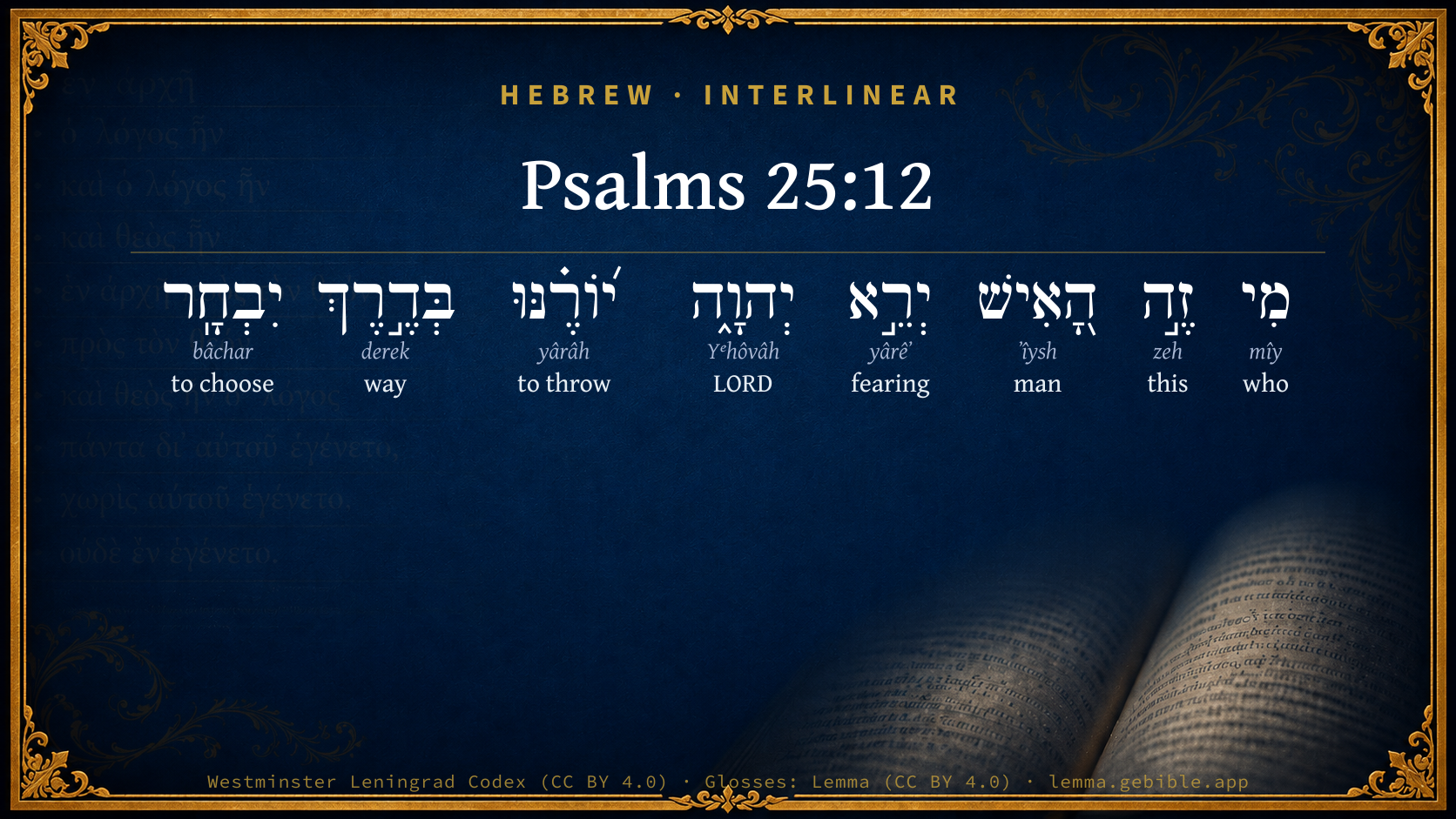
Hebrew (Westminster Leningrad Codex) Psalms 25:12 appears in the Hebrew Old Testament. The text above is from the Westminster Leningrad Codex. Each word links to its Strong’s number, a concise gloss, and parsing drawn from the Open Scriptures Hebrew Bible morphology. Click any word for its full Brown-Driver-Briggs (BDB) entry.
Download image
Cite this verse

Psalms 25:12 (World English Bible). Public Domain. Lemma interlinear Bible study tool, https://lemma.gebible.app/v/psalms/25/12.

Show BibTeX & RIS
BibTeX
RIS
English Translation
What man is he who fears Yahweh? He shall instruct him in the way that he shall choose.
World English Bible · Public Domain
Download a study sheet

One document with this verse’s original text, its word-by-word gloss line, the meaning frame, cross-references with their text, attributed commentary, and full source and license credits — printable, and it pastes into notes with its structure intact.

This verse Autodidact and up

Study sheet (.html) Plain text (.txt)

A passage Seminary Student

Up to 50 verses in one chapter. A passage sheet keeps up to 6 commentary sources and 12 cross-references per verse, in the order this page ranks them, and says so on the sheet whenever that leaves anything out. Ask for a single verse and you get the Autodidact verse sheet above.

Everything on this page stays free to read, with no account — the sheet is a download of what is already on screen, not access to it.

Want to remove ads? Support Godless Engineer
Compare translations 3

The same verse in 3 English versions, stacked beneath the original-language interlinear above. Click any original word for its lexicon entry.

Each is an independent rendering of the whole verse — the interlinear is not word-aligned to these translations.

Highlighted words mark where these versions differ — a whole-verse word diff, not a word-by-word alignment.

  • World English Bible Public Domain
    What man is he who fears Yahweh? He shall instruct him in the way that he shall choose.
  • King James Version Public Domain
    What man is he that feareth the LORD? him shall he teach in the way that he shall choose.
  • unfoldingWord Literal Text CC BY-SA 4.0
    Who is the man fearing Yahweh? He will teach him in the way he is to choose.

unfoldingWord Literal Text — © unfoldingWord, licensed CC BY-SA 4.0. Word-aligned USFM3 via Door43 (git.door43.org/unfoldingWord/en_ult).

Versions to compare (up to 4)

3 of 4 selected

Show all 18 translations

Every available English version of this verse, each an independent rendering of the whole verse.

  • World English Bible Public Domain
    What man is he who fears Yahweh? He shall instruct him in the way that he shall choose.
  • Berean Standard Bible Public Domain
    Who is the man who fears the LORD? He will instruct him in the path chosen for him.
  • Majority Standard Bible Public Domain
    Who is the man who fears the LORD? He will instruct him in the path chosen for him.
  • King James Version Public Domain
    What man is he that feareth the LORD? him shall he teach in the way that he shall choose.
  • American Standard Version (1901) Public Domain
    What man is he that feareth Jehovah? Him shall he instruct in the way that he shall choose.
  • Revised Version (1885) Public Domain
    What man is he that feareth the LORD? him shall he instruct in the way that he shall choose.
  • Geneva Bible (1599) Public Domain
    What man is he that feareth the Lord? him wil he teache the way that hee shall chuse.
  • Douay-Rheims (1899) Public Domain
    Who is the man that feareth the Lord? He hath appointed him a law in the way he hath chosen.
  • Young's Literal Translation Public Domain
    Who `is' this -- the man fearing Jehovah? He directeth him in the way He doth choose.
  • Literal Standard Version CC BY-SA 4.0
    Who [is] this—the man fearing YHWH? He directs him in the way He chooses.
  • Unlocked Literal Bible CC BY-SA 4.0
    Who is the man who fears Yahweh? The Lord will instruct him in the way that he should choose.
  • unfoldingWord Literal Text CC BY-SA 4.0
    Who is the man fearing Yahweh? He will teach him in the way he is to choose.
  • Darby Bible Public Domain
    What man is he that feareth Jehovah? him will he instruct in the way [that] he should choose.
  • World Messianic Bible Public Domain
    What man is he who fears the LORD? He shall instruct him in the way that he shall choose.
  • Webster's Bible Public Domain
    What man is he that feareth the LORD? him shall he teach in the way that he shall choose.
  • Free Bible Version CC BY-SA 4.0
    Who are those who respect the Lord? He will show them the path to choose.
  • Bible in Basic English Public Domain
    If a man has the fear of the Lord, the Lord will be his teacher in the way of his pleasure.
  • JPS Tanakh (1917) Public Domain
    What man is he that feareth the LORD? him will He instruct in the way that He should choose.

Literal Standard Version (2020), Covenant Press — licensed CC BY-SA 4.0. Text via the HelloAO Bible API (eBible.org). Unlocked Literal Bible (unfoldingWord) — licensed CC BY-SA 4.0. Text via the HelloAO Bible API (eBible.org). unfoldingWord Literal Text — © unfoldingWord, licensed CC BY-SA 4.0. Word-aligned USFM3 via Door43 (git.door43.org/unfoldingWord/en_ult). Free Bible Version, Dr. Jonathan Gallagher — licensed CC BY-SA 4.0. Text via the HelloAO Bible API (eBible.org).

Word by word

More ways to search: Search by grammar → Find every occurrence → Compare this word →

Practice this passage: Drill this verse → Learn its vocabulary →

About this verse

These counts appear in no published source. They are computed here, from the morphology-tagged text and Lemma’s own curated glosses. What Lemma adds →

8
words
8
distinct lemmas
Wisdom
section

Shared distinctive vocabulary

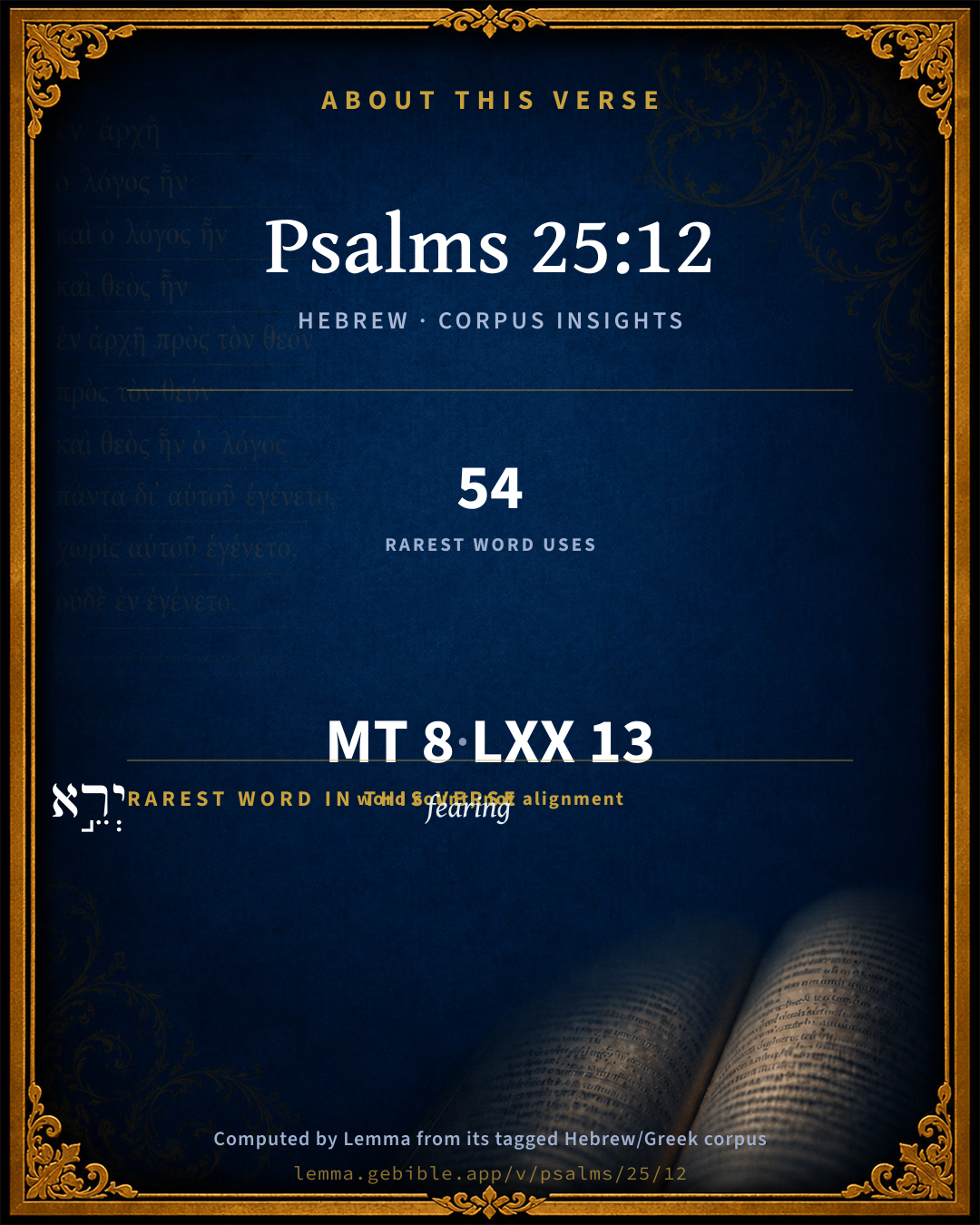
יְרֵ֣א fearing H3373 occurs in 54 verses of the Hebrew Bible. Also found in:

Grammatical profile

  • 2 verbs
  • 3 nouns
  • 1 adjective
  • 1 pronoun
  • 1 particle

Verb forms

  • י֝וֹרֶ֗נּוּ Hiphil · Imperfect
  • יִבְחָֽר Qal · Imperfect

Hebrew & Septuagint length

In English translation the verse runs 18 words from the Hebrew and 19 from the Septuagint (LXX English) — closely comparable.

A rough comparison of the two English renderings, which tokenize alike — not a word-level alignment.

Word counts can differ between the Hebrew and the Greek without any difference in meaning — e.g. the Hebrew direct-object marker אֵת has no separate Greek word, and Greek often adds the article ὁ.

In the original languages it is 8 Hebrew tokens and 13 Greek tokens — but the two are counted differently (Hebrew bundles its prefixes and suffixes into one token; the Greek is in lemma form), so that isn’t a like-for-like length.

Cross-references

19

Topical passages linked to Psalms 25:12 in the Treasury of Scripture Knowledge — connected by theme and wording, ordered by reader-vote popularity; previews shown in the World English Bible.

  • Psalms 37:23 A man's goings are established by Yahweh. He delights in his way.
  • Psalms 32:8 I will instruct you and teach you in the way which you shall go. I will counsel you with my eye on you.
  • John 7:17 If anyone desires to do his will, he will know about the teaching, whether it is from God, or if I am speaking from myself.
  • Psalms 111:10 The fear of Yahweh is the beginning of wisdom. All those who do his work have a good understanding. His praise endures forever!
  • Ecclesiastes 12:13 This is the end of the matter. All has been heard. Fear God, and keep his commandments; for this is the whole duty of man.
  • Proverbs 1:7 The fear of Yahweh is the beginning of knowledge; But the foolish despise wisdom and instruction.
  • Isaiah 50:10 Who is among you who fears Yahweh, who obeys the voice of his servant? He who walks in darkness, and has no light, let him trust in the name of Yahweh, and rely on his God.
  • John 8:31–32 Jesus therefore said to those Jews who had believed him, "If you remain in my word, then you are truly my disciples.
  • Proverbs 15:33 The fear of Yahweh teaches wisdom. Before honor is humility.
  • Proverbs 16:6 By mercy and truth iniquity is atoned for. By the fear of Yahweh men depart from evil.
  • John 3:20–21 For everyone who does evil hates the light, and doesn't come to the light, lest his works would be exposed.
  • Isaiah 35:8 A highway shall be there, and a way, and it shall be called The way of holiness. The unclean shall not pass over it, but is shall be for for him who walks in the Way. Wicked fools will not go there.
  • Acts 10:22 They said, "Cornelius, a centurion, a righteous man and one who fears God, and well spoken of by all the nation of the Jews, was directed by a holy angel to invite you to his house, and to listen to what you say."
  • Proverbs 2:5 Then you will understand the fear of Yahweh, And find the knowledge of God.
  • 2 Thessalonians 2:10–12 and with all deception of wickedness for those who are being lost, because they didn't receive the love of the truth, that they might be saved.
  • Acts 10:2 a devout man, and one who feared God with all his house, who gave gifts for the needy generously to the people, and always prayed to God.
  • Acts 11:14 who will speak to you words by which you will be saved, you and all your house.'
  • Acts 13:26 Brothers, children of the stock of Abraham, and those among you who fear God, the word of this salvation is sent out to you.
  • 1 John 2:27 As for you, the anointing which you received from him remains in you, and you don't need for anyone to teach you. But as his anointing teaches you concerning all things, and is true, and is no lie, and even as it taught you, you will remain in him.

Cross-references courtesy of OpenBible.info (CC BY 4.0).

Hebrew and Greek witnesses Masoretic Hebrew ↔ Greek Septuagint

The same verse in the two great witnesses to the Old Testament, shown verse-for-verse.

You’re reading Greek Psalm 24 (Hebrew Psalm 25). The Septuagint counts the superscription, so verse numbers can differ from the Hebrew — chapter-level alignment, not verse-by-verse. Numbering follows Rahlfs.

These are two independent witnesses, not word-aligned to each other, and the Septuagint is shown in lemma (dictionary) form.

Hebrew Psalms 25:12 Masoretic · Westminster Leningrad Codex

מִי זֶ֣ה הָ֭אִישׁ יְרֵ֣א יְהוָ֑ה י֝וֹרֶ֗נּוּ בְּדֶ֣רֶךְ יִבְחָֽר

What man is he who fears Yahweh? He shall instruct him in the way that he shall choose.

World English Bible · Public Domain

Greek LXX Greek Psalm 24:12 Septuagint · lemma form

τίς εἰμί ἄνθρωπος ὁ φοβέω ὁ κύριος νομοθετέω αὐτός ἐν ὁδός ὅς αἱρετίζω

Who is the man that fears the Lord? he shall instruct him in the way which he has chosen.

LXX2012 (modern English Septuagint) · Public Domain

On this verse, Ellicott's Commentary for English Readers discusses the Septuagint’s reading. Read the note in Commentary ↓

Hebrew: Westminster Leningrad Codex (CC BY 4.0). Greek: Septuagint (public domain); English from LXX2012 (modern English Septuagint) (Public Domain). How the Septuagint differs from the Hebrew →

Commentary

Notes on Psalms 25:12 from classic Christian and Jewish commentators (each source and its license shown beneath its notes). The classic Christian expositions comment on the surrounding passage and are grouped to its opening verse, so a note may address several verses; the Jewish commentaries on the Tanakh (Rashi and others) are per-verse, so they appear only where the commentator wrote on this verse.

Lemma curates 59 commentaries, every one of them public domain or Creative Commons licensed, each selected and text-cleaned for this edition rather than reprinted as found. About our sources →

John Gill's Exposition

What man is he that feareth the Lord? That is, how happy a man is he! and one that fears the Lord is one that has the fear of God put into his heart, as a blessing of the covenant of grace before spoken of; who fears the Lord, not on account of the punishment of sin, but under the influence of the pardon of it, and for his goodness's sake; who loves the Lord, trusts in him, is careful not to offend him, hates sin, and avoids it, and has a strict regard to the worship of God in all its parts and branches, and performs it in fear; or who serves the Lord with reverence and godly fear. The description of this man's happiness follows in this verse and Psa 25:12,

him shall he teach in the way that he shall choose; either which the man that fears God shall choose, which is the way of truth and duty, Psa 119:30; or the way which God prescribes to him, and is well pleasing in his sight, who teaches to profit, and leads in the way his people should go; and a great happiness it is for a man to have his steps ordered by the Lord and his goings directed by him.

John Gill's Exposition of the Whole Bible (1746–1763) — public domain (CC PDM 1.0). Text via the HelloAO Bible API.

Trapp's Complete Commentary

John Trapp

Psa 25:12 What man [is] he that feareth the LORD? him shall he teach in the way [that] he shall choose.

Ver. 12. What man is he that feareth the Lord?] This question implieth, first, a paucity of such, as Hos 14:9; secondly, the felicity of such as, out of a reverential fear of God, sue to him for pardon of sin, and seek to be made his servants. O quanta est felicitas istius viri! Oh the heaped up happiness of such a rare man! (Vatab.) David admireth it here (utitur exclamations Mol.); and well he may, for he hath close communion with God, and sweet communication of Christ’s secrets, as followeth.

Him shall he teach in the way that he shall choose] i.e. That the good man shall pitch upon. God will direct him in all dealings to make a good choice; and will give good success. This is not in a man’s own power to do, Jer 10:23. But the "steps of a good man are ordered by the Lord, and he delighteth in his way," Psa 37:23. He was a pillar of fire and cloud to the Israelites, Exo 14:19, and carefully chose out their way for them; not the nearest alway, but yet the safest.

John Trapp, A Commentary or Exposition upon All the Books of the Old and New Testament (1647–1656) — public domain. Text from a community e-Sword module.

The Biblical Illustrator

Joseph S. Exell

Psa_25:12

What man is he that feareth the Lord?

The fear of God a restraining influence

This secret fear, if it be once planted in the heart, will direct thee in all good actions acceptable to God, and correct thy evil doings. The love of God hath a constraining power whereby it compelleth and forceth us to serve Him: the fear of God hath a restraining power, by which it restraineth and stayeth us, and keepeth us back from offending Him: this is like a bit, that like a spur. Abraham feared that the fear of God was not in the place whereto he went. Joseph being enticed by his mistress to commit wickedness with her, answered, How can I do this great wickedness, and so sin against God? The Lord plant this fear in our hearts. This is a filial fear which he craveth, coming from love, and not a servile fear, which cometh from fear of punishment. The preserver of this fear in thee is a continual nourishment in thy mind of the presence of God, to whom thou presentest all thy actions. Will He teach the way that he shall choose. He promiseth four benefits to the man that feareth God,--He heapeth upon him grace upon grace: before He pardoned him, and now He directeth the man whom He forgave: for no sooner receiveth He any man in His favour, but He immediately takes the protection and direction of him. But out of these words we see three things. First, that there are divers, yea contrary ways, as there are contrary ends, the broad and the narrow, the Kings way and by-roads, the way of life and of death. This is against such as dream to themselves that whatsoever religion they profess, or howsoever they live, they shall go to heaven; but they are deceived, for if thou be not in the way to the kingdom thou shalt never attain to the kingdom; many, yea the most part, are not going but riding, not running but posting, to hell; of whom, if it be demanded whither they go? they will answer, to heaven; yea, and they will brag that they are nearer God than the preacher himself, even as if one should dream of life at the point of death. Next, we see that a man cannot of himself choose the right way to heaven; for the natural man cannot apprehend those things which appertain to Gods kingdom, neither yet can he see them, for they are spiritually discerned. Whereupon followeth the third, that is, how man shall choose the good and refuse the evil way. It is not in him that runneth, nor in him that willeth, but in God that sheweth mercy. Moses chose rather to suffer with the Church than to be called the son of Pharaohs daughter. (A. Symson.)

The fruits of godly fear

The fear of God is a familiar expression in the Scriptures. Let us lay hold of one element in the spacious word. When we profoundly fear a thing we are haunted by it. It affects everything. To fear God is to be God-haunted, God-possessed. But this figure is defective. In all fruitful fear of God there is no cringing, no slavishness, no paralysing terror. Perfect love casteth out this type of fear. Change the figure. We speak of being haunted by an air of music. In such a way the man who fears God is haunted by Gods presence; God is an abiding consciousness. Everything is seen in relationship to God. What would be the fruits of such a fear? The succeeding verses give some outline of the spacious ministry. Him shall He teach in the way that he shall choose. He shall be guided in his choices. He shall have the gift of enlightenment. His discernment shall be refined so as to perceive the right way when the ways are many. His moral judgment shall be instructed. The moral choice shall be firm and sure. The practical judgment shall be nurtured and refined in the Lords school. His soul shall dwell at ease. Restlessness and worry shall be abolished. The sense of the companionship of God will make every place the realm of promise, and in every place he will find the riches of grace. His seed shall inherit the earth. Children become heirs when parents become pious. The God-possessed transmits a legacy of blessing. It would be a profitable thing to calculate what one may inherit because another man was good. The secret of the Lord is with them that fear Him. They are taken into intimate fellowship. To be made the depository of a rare secret is to be sealed as a friend. How can we become God-haunted? Let us begin by deliberately consulting God in the individual movements of our busy life. Refer everything to His decision Begin by distinct acts of volition This may become at length an easy-fitting habit, and may even ripen into the spontaneity of an instinct. (J. H. Jowett, M. A.)

The Biblical Illustrator, edited by Joseph S. Exell (c. 1880s–1900s) — public domain. Text from a community e-Sword module.

Joseph Benson's Commentary

Psa 25:12-13. What man is he that feareth the Lord — Whosoever he be, whether Jew or Gentile, whether comparatively innocent or a great sinner, which is my case: him shall he teach in the way he shall choose — The way which God chooseth, or appointeth and approveth, or which the good man should, or ought to choose. His soul shall dwell at ease — Hebrew, בשׂוב תלין, betob talin, shall lodge, that is, continue in good, in the possession and enjoyment of the true good. His seed shall inherit the earth — Or, the land, namely, Canaan; which was promised and given as an earnest of the whole covenant of grace and all its promises.

Joseph Benson's Commentary on the Old and New Testaments (1811–1818) — public domain. Text from a community e-Sword module.

Tyndale Open Study Notes

Tyndale Open Resources

25:12-15 Those who fear the Lord will receive further instruction and experience God’s presence (25:14) and blessing (25:13).

Tyndale Open Study Notes — © Tyndale Open Resources, licensed CC BY-SA 4.0. Text via the HelloAO Bible API.

Geneva Bible (1599)

Geneva Bible translators

Meaning, the number is very small.

He will direct such with his spirit to follow the right way.

Geneva Bible (1599) marginal notes — public domain. Text via Bolls.life.

Jamieson, Fausset & Brown

Robert Jamieson, A. R. Fausset & David Brown

What he asks for himself is the common lot of all the pious.

Jamieson, Fausset & Brown — Commentary Critical and Explanatory on the Whole Bible (1871) — public domain (CC PDM 1.0). Text via the HelloAO Bible API.

Adam Clarke's Commentary

Verse 12. That feareth the Lord] Who has a proper apprehension of his holiness, justice, and truth; and who, at the same time, sees himself a fallen spirit, and a transgressor of God's holy law, and consequently under the curse. That is the person that truly and reverently fears God.

Him shall he teach] Such a person has a teachable spirit.

The way that he shall choose.] The way that in the course of Providence he has chosen, as the way in which he is to gain things honest in the sight of all men; God will bless him in it, and give him as much earthly prosperity as may be useful to his soul in his secular vocation.

Adam Clarke's Commentary on the Bible (1810–1826) — public domain. Text from a community e-Sword/MySword module.

John Calvin's Commentaries

12. Who is the man. By again recalling to his mind the character in which God manifests himself towards his servants, he derives new strength and courage. For we have said, that nothing more readily occurs than a relaxation in earnest and attentive prayer, unless it be sustained by the recollection of God’s promises. There can, however, be no doubt, that David both accuses himself, and by entertaining a better hope, takes encouragement to continue in the fear of God. In the first place, by intimating that men are destitute of right understanding and sound judgment, because they yield not themselves to be governed by God with reverence and fear, he imputes it to his own indolence, that by reason of the darkness of his mind, he had wandered so far astray after his own lusts; and yet, on the other hand, he promises himself the guidance and direction of the Holy Spirit, if he only yield himself wholly to God, and show that he is willing to learn. Moreover, the interrogatory style of speaking, which he here employs, seems designed to show how few there are who fear God: for, although all men in general pray, and manifest some appearance of piety, yet where is there one among so many who is really in earnest? Instead of this, almost all men indulge themselves in their own drowsiness. The fear of God, therefore, is very rare; and on this account it is that the world, for the most part, continues destitute of the Spirit of counsel and wisdom.

Some interpreters render the word choose in the present tense, instead of the future, shall choose; as if it had been said, that God shows the way which he approves, and in which he wishes men to walk. With this interpretation I cannot agree; for, in my judgment, the word choose rather refers to every individual; as if it had been said, Provided we are disposed to fear God, he will not be wanting on his part, but will always direct us by the Spirit of wisdom to choose the right way. When we are called upon to adopt some particular course in life, we find ourselves as it were placed between two ways, and know not which of them to follow; “Les gachans lequel prendre.” — Fr.

John Calvin's Commentaries (1540-1563) — public domain. Text from the Calvin Translation Society English edition (1840s-50s) via the Christian Classics Ethereal Library (ccel.org). Calvin's coverage is partial (roughly two-thirds of the Bible); uncommented books and verses are honest gaps, never fabricated. The 19th-century editor's footnotes and remarks are omitted so the notes are faithfully Calvin's own voice.

Ellicott's Commentary for English Readers

(12) What man is he . . .?—For the emphatic question compare Psa_34:12.

The way that he shall choose.—Rather, the way that he should choose—i.e., the way of right choice. The LXX. and Vulg., however, refer it to God—“the way in which He took delight.”

A Bible Commentary for English Readers, edited by Charles John Ellicott (1878–1897) — public domain. Text from a community e-Sword module.

The Cambridge Bible for Schools and Colleges

gen. ed. J. J. S. Perowne

12. What man &c.] A rhetorical question, equivalent to whosoever. Cp. Psa_34:12.

him shall he teach] R.V., him shall he Instruct, as in Psa_25:8.

in the way that he shall choose] In the course of life which His Providence chooses for him: or, in the way that he should choose; what course to take in circumstances of doubt or difficulty; or, in the way that he chooseth; he chooses ‘the fear of the Lord’ which is ‘the way of truth,’ and Jehovah instructs him in it. This is most in accordance with Psa_119:30; Psa_119:173; Pro_1:29; Pro_3:31.

The Cambridge Bible for Schools and Colleges (gen. ed. J. J. S. Perowne; Cambridge University Press, 1878–1918) — public domain. Text from a community e-Sword module.

Albert Barnes' Notes on the Bible

What man is he - Who is he. The statement in this verse is intended to include every man; or to be universal. Wherever one is found who has the character here referred to, or whoever he may be, of him what is here affirmed will be true, that God will lead him in the way that he shall choose.

That feareth the Lord - That is, a true worshipper of Yahweh, or that is truly a pious man: Psa 5:7. “Him shall he teach.” He will guide, or instruct him. See Psa 25:9.

In the way that he shall choose - The way that the person ought to choose; or, in other words, in the right way. It is not the way that God shall choose, but the way that the pious person ought to choose: God will so instruct him that he shall find the true path.

Albert Barnes' Notes on the Bible (1834–1885) — public domain. Text from a community e-Sword/MySword module.

Matthew Poole's English Annotations

What man is he, i.e. whosoever he be, whether Jew or Gentile, whether more innocent, or a greater sinner, which is my case.

That he shall choose, i.e. which God appointeth or approveth. Or, which he, i.e. such person, should choose; for the future tense is oft put potentially, and so as to express a man’s duty, as Gen 20:9; Mal 1:6; 2:7.

Matthew Poole's English Annotations on the Holy Bible (1683–1685) — public domain. Text from a community e-Sword/MySword module.

The Treasury of David

Charles H. Spurgeon

Ver. 12. What man is he that feareth the Lord? Let the question provoke self examination. Gospel privileges are not for every pretender. Art thou of the seed royal or no? Him shall he teach in the way that he shall choose. Those whose hearts are right shall not err for want of heavenly direction. Where God sanctifies the heart he enlightens the head. We all wish to choose our way; but what a mercy is it when the Lord directs that choice, and makes free will to be goodwill! If we make our will God's will, God will let is have our will. God does not violate our will, but leaves much to our choice; nevertheless, he instructs our wills, and so we choose that which is well pleasing in his sight. The will should be subject to law; there is a way which we should choose, but so ignorant are we that we need to be taught, and so wilful that none but God himself can teach us effectually.

Ver. 12. What man is he that feareth the Lord? Blessed shall he be1. In the sacred knowledge of Christ's will; Him shall he teach in the way that he shall choose. 2. Blessed shall he be in the quiet peace of a good conscience; "His soul shall dwell at ease." 3. Blessed he shall be in the present comfort of a hopeful progeny; "His seed shall inherit the earth." Robert Mossom.

Ver. 12. What man is he that feareth the Lord? There is nothing so effectual to obtain grace, to retain grace, as always to be found before God not over wise, but to fear: happy art thou, if thy heart be replenished with three fears; a fear for received grace, a greater fear for lost grace, a greatest fear to recover grace. Bernard.

Ver. 12. He that feareth the Lord. Present fear begetteth eternal security: fear God, which is above all, and no need to fear man at all. Augustine.

Ver. 12. Him shall he teach in the way that he shall choose, i.e., that the good man shall pitch upon. God will direct him in all dealings to make a good choice, and will give good success. This is not in a man's own power to do. Jer 10:23. John Trapp.

Ver. 12. Holiness the best security for a well ordered life. Free will at school, questioned and instructed.

Psalms 25:13*

Charles H. Spurgeon's The Treasury of David (1869–1885) — public domain. Psalms only. Text from a community e-Sword/MySword module.

Whedon's Commentary on the Bible

Daniel D. Whedon

12. From the greatness of his sin he turns to the blessedness of those who fear God.

What man—Whosoever, whatsoever man. God makes no personal distinctions.

The way he shall choose—That is, the way God shall choose, as Psa_25:8

Daniel D. Whedon (gen. ed.), Commentary on the Old and New Testaments (1874–1909) — public domain. Text from a community e-Sword module.

The Pulpit Commentary

What man is he that feareth the Lord? Once more we have a series of reflections (vers. 12-15) first, with respect to the God-fearing man. Every such man shall have favour shown him by Godhim shall he (i.e. God) teach in the way that he shall choose. This is, of course, the right way the way of God"s commandments. (Psa_119:30, Psa_119:173) God shall make his way plain to the God-fearing man.

The Pulpit Commentary (1880–1919), ed. H.D.M. Spence-Jones & Joseph S. Exell — public domain. Text from a community e-Sword module.

John Wesley's Explanatory Notes

Chuse - Which God appointeth.

John Wesley, Explanatory Notes Upon the Whole Bible (1754–1765) — public domain. Text via the GEBible commentary corpus.

Keil & Delitzsch

C. F. Keil & F. Delitzsch

The question: quisnam est vir, which resembles Psa 34:13; Psa 107:43; Isa 50:10, is only propounded in order to draw attention to the person who bears the character described, and then to state what such an one has to expect. In prose we should have a relative antecedent clause instead, viz., qui (quisquis) talis est qui Dominum vereatur.

(Note: The verb ver-eri, which signifies "to guard one's self, defend one's self from anything" according to its radical notion, has nothing to do with ירא (ורא).)

The attributive יבהר, (viam) quam eligat (cf. Isa 48:17), might also be referred to God: in which He takes delight (lxx); but parallels like Psa 119:30, Psa 119:173, favour the rendering: which he should choose. Among all the blessings which fall to the lot of him who fears God, the first place is given to this, that God raises him above the vacillation and hesitancy of human opinion.

Keil & Delitzsch — Biblical Commentary on the Old Testament (1861–1891) — public domain (CC PDM 1.0). Text via the HelloAO Bible API. (Old Testament only.)

J. A. Alexander on Psalms

Joseph Addison Alexander

12. Who (is) the man fearing Jehovah? Be will guide him in the way he shall choose. In the first clause the form of the original is highly idiomatic; who (is) this, the man, a fearer of Jehovah? See above, on Psa 24:8. —The ellipsis of the relative in the last clause is common to both idioms.—He guides him, and will guide him. There is not only an affirmation, but a promise. The way, as in the foregoing context, is the providential way in which God directs the course of a man's life. His choosing it implies not only sovereign authority, but a gracious regard to the interests of his servant.

Joseph Addison Alexander, The Psalms Translated and Explained (1850) — public domain. Text from a community e-Sword module.

Scofield Reference Notes

C. I. Scofield

feareth

(See Scofield "Psa 19:9").

The Scofield Reference Bible (1917 edition), notes by C. I. Scofield — public domain. Text from a community e-Sword module.

unfoldingWord translationNotes

Door43 World Missions Community

Who is the man who fears Yahweh?

This question introduces "the man who fears Yahweh" as a new topic. AT: "I will tell you about the man who fears Yahweh." (See: Rhetorical Question)

is the man who fears ... instruct him ... he should ... His life ... his descendants

This does not refer to a specific person. AT: "are those who fear ... instruct them ... they should ... Their lives ... their descendants" (See: Generic Noun Phrases)

The Lord will instruct him in the way that he should choose

Yahweh teaching people how they should behave is spoken of as if Yahweh were teaching the people what way or path they should travel. (See: Metaphor)

His life will go along in goodness

"God will cause him to prosper" or "God will cause them to prosper"

translationWords

fear

lord

life

descend

inherit

unfoldingWord translationNotes — © Distant Shores Media and the Door43 World Missions Community, licensed CC BY-SA 4.0. Source: git.door43.org/Door43/en_tn.

Rashi

Rabbi Shlomo Yitzchaki (Rashi)

Who is this man who fears the Lord? The Holy One, blessed be He, will guide him on the road that he chooses; that is the good road.

Rashi on the Tanakh — English translations: “The Judaica Press complete Tanach with Rashi, translated by A. J. Rosenberg” (CC BY 4.0); “Pentateuch with Rashi's commentary by M. Rosenbaum and A.M. Silbermann, 1929-1934” (public domain); “The Metsudah Tanach series, Lakewood, N.J” (CC BY 4.0); and “The Book of Joshua, Metsudah Publications, 1997” (CC BY 4.0). Text via Sefaria.

Lesson kit

Teaching starters — assembled from the data on this page, not authored interpretation. Every prompt links to the verse data it draws on. Edit before teaching.

Psalms, in the Wisdom, opens this verse with 8 words (8 distinct Hebrew lemmas). Its most distinctive word is yârêʼ (“fearing”). A historical commentator’s framing appears above. Read the whole chapter for the surrounding context.

Discussion questions

  1. How does “fearing” (yârêʼ) shape what this verse is saying?
  2. Genesis 22:12 shares the word «fearing» with this verse. How do the two illuminate each other?
  3. These translations render this verse differently; the difference is in the English rendering, not the original. What questions does that raise?
  4. The verb «י֝וֹרֶ֗נּוּ» is Hiphil Imperfect. How does its form color the action?
  5. Reading how John Gill's Exposition and Trapp's Complete Commentary read this verse, where do the two commentators agree and where do they part?

Things to notice

Reading settings

Reading text

Shown beneath each verse's original-language words.

Old Testament
Old Testament edition

Read the OT as the Masoretic Hebrew (MT) or the Greek Septuagint (LXX).

English shown for the Greek Septuagint (in the Hebrew ↔ Greek comparison).

Comparing translations? Open the Compare panel on any verse page to stack up to four side by side.