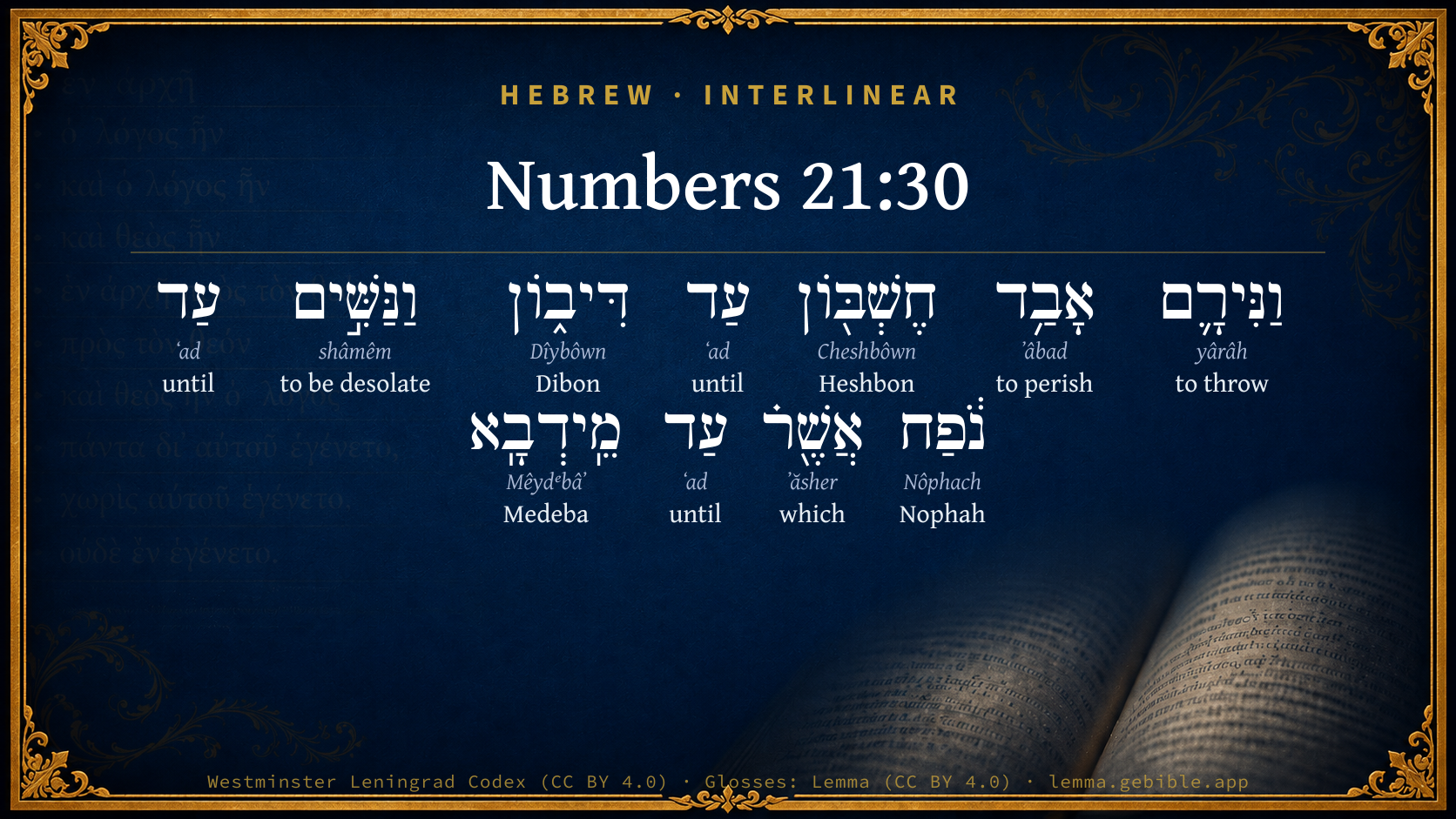
Numbers 21:30

Hebrew (Westminster Leningrad Codex) Numbers 21:30 appears in the Hebrew Old Testament. The text above is from the Westminster Leningrad Codex. Each word links to its Strong’s number, a concise gloss, and parsing drawn from the Open Scriptures Hebrew Bible morphology. Click any word for its full Brown-Driver-Briggs (BDB) entry.
Download image
Cite this verse

Numbers 21:30 (World English Bible). Public Domain. Lemma interlinear Bible study tool, https://lemma.gebible.app/v/numbers/21/30.

Show BibTeX & RIS
BibTeX
RIS
English Translation
We have shot at them; Heshbon is perished even to Dibon, We have laid waste even to Nophah, Which [reaches] to Medeba.
World English Bible · Public Domain
Highlights
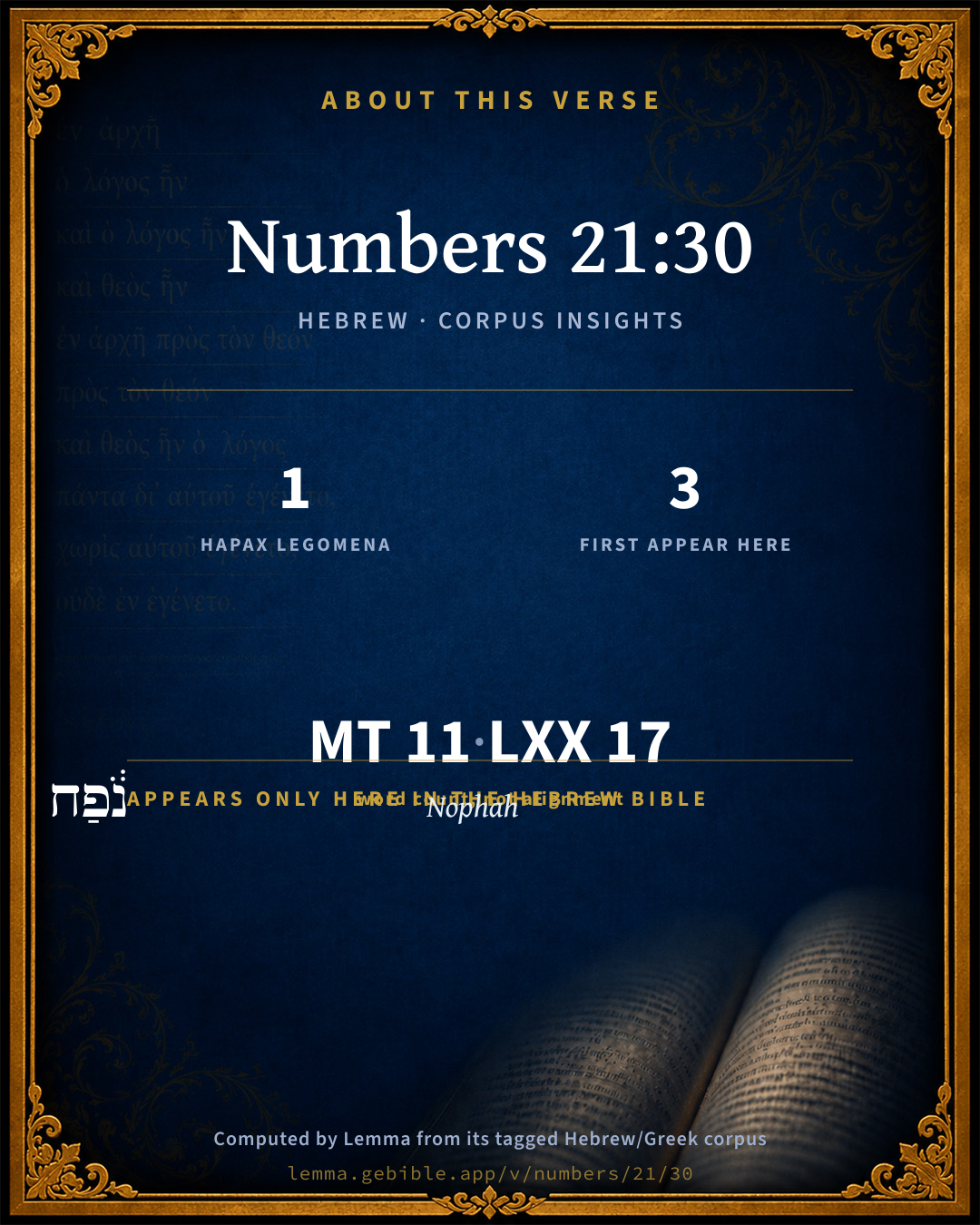
  • 1 hapax legomenon — only here in the Hebrew Bible
  • 3 first appearances in the Hebrew Bible
Full analysis ↓
Download a study sheet

One document with this verse’s original text, its word-by-word gloss line, the meaning frame, cross-references with their text, attributed commentary, and full source and license credits — printable, and it pastes into notes with its structure intact.

This verse Autodidact and up

Study sheet (.html) Plain text (.txt)

A passage Seminary Student

Up to 50 verses in one chapter. A passage sheet keeps up to 6 commentary sources and 12 cross-references per verse, in the order this page ranks them, and says so on the sheet whenever that leaves anything out. Ask for a single verse and you get the Autodidact verse sheet above.

Everything on this page stays free to read, with no account — the sheet is a download of what is already on screen, not access to it.

Want to remove ads? Support Godless Engineer
Compare translations 3

The same verse in 3 English versions, stacked beneath the original-language interlinear above. Click any original word for its lexicon entry.

Each is an independent rendering of the whole verse — the interlinear is not word-aligned to these translations.

Highlighted words mark where these versions differ — a whole-verse word diff, not a word-by-word alignment.

  • World English Bible Public Domain
    We have shot at them; Heshbon is perished even to Dibon, We have laid waste even to Nophah, Which [reaches] to Medeba.
  • King James Version Public Domain
    We have shot at them; Heshbon is perished even unto Dibon, and we have laid them waste even unto Nophah, which reacheth unto Medeba.
  • unfoldingWord Literal Text CC BY-SA 4.0
    And we shot at them. Heshbon has perished as far as Dibon. And we made desolation as far as Nophah, which as far as Medeba.”

unfoldingWord Literal Text — © unfoldingWord, licensed CC BY-SA 4.0. Word-aligned USFM3 via Door43 (git.door43.org/unfoldingWord/en_ult).

Versions to compare (up to 4)

3 of 4 selected

Show all 18 translations

Every available English version of this verse, each an independent rendering of the whole verse.

  • World English Bible Public Domain
    We have shot at them; Heshbon is perished even to Dibon, We have laid waste even to Nophah, Which [reaches] to Medeba.
  • Berean Standard Bible Public Domain
    But we have overthrown them; Heshbon is destroyed as far as Dibon. We demolished them as far as Nophah, which reaches to Medeba.”
  • Majority Standard Bible Public Domain
    But we have overthrown them; Heshbon is destroyed as far as Dibon. We demolished them as far as Nophah, which reaches to Medeba.”
  • King James Version Public Domain
    We have shot at them; Heshbon is perished even unto Dibon, and we have laid them waste even unto Nophah, which reacheth unto Medeba.
  • American Standard Version (1901) Public Domain
    We have shot at them; Heshbon is perished even unto Dibon, And we have laid waste even unto Nophah, Which `reacheth' unto Medeba.
  • Revised Version (1885) Public Domain
    We have shot at them; Heshbon is perished even unto Dibon, And we have laid waste even unto Nophah, Which reacheth unto Medeba.
  • Geneva Bible (1599) Public Domain
    Their empire also is lost from Heshbon vnto Dibon, and wee haue destroyed them vnto Nophah, which reacheth vnto Medeba.
  • Douay-Rheims (1899) Public Domain
    Their yoke is perished from Hesebon unto Dibon, they came weary to Nophe, and unto Medaba.
  • Young's Literal Translation Public Domain
    And we shoot them, Perished hath Heshbon unto Dibon, And we make desolate unto Nophah, Which `is' unto Medeba.'
  • Literal Standard Version CC BY-SA 4.0
    And we shoot them; Heshbon has perished as far as Dibon, || And we make desolate as far as Nophah, || Which [is] as far as Medeba.”
  • Unlocked Literal Bible CC BY-SA 4.0
    But we have conquered Sihon. Heshbon is devastated all the way to Dibon. We have defeated them all the way to Nophah, which reaches to Medeba.”
  • unfoldingWord Literal Text CC BY-SA 4.0
    And we shot at them. Heshbon has perished as far as Dibon. And we made desolation as far as Nophah, which as far as Medeba.”
  • Darby Bible Public Domain
    And we have shot at them; Heshbon is perished even unto Dibon; and we have laid [them] waste even unto Nophah, which reacheth unto Medeba.
  • World Messianic Bible Public Domain
    We have shot at them. Heshbon has perished even to Dibon. We have laid waste even to Nophah, Which reaches to Medeba.”
  • Webster's Bible Public Domain
    We have shot at them; Heshbon has perished even to Dibon, and we have laid them waste even to Nophah, which reacheth to Medeba.
  • Free Bible Version CC BY-SA 4.0
    But now we have defeated the Amorites! Heshbon's rule has been destroyed all the way to Dibon. We wiped them out all the way to Nophah and on to Medeba.”
  • Bible in Basic English Public Domain
    They are wounded with our arrows; destruction has come on Heshbon, even to Dibon; and we have made the land waste as far as Nophah, stretching out to Medeba.
  • JPS Tanakh (1917) Public Domain
    We have shot at them — Heshbon is perished — even unto Dibon, and we have laid waste even unto Nophah, which reacheth unto Medeba.

Literal Standard Version (2020), Covenant Press — licensed CC BY-SA 4.0. Text via the HelloAO Bible API (eBible.org). Unlocked Literal Bible (unfoldingWord) — licensed CC BY-SA 4.0. Text via the HelloAO Bible API (eBible.org). unfoldingWord Literal Text — © unfoldingWord, licensed CC BY-SA 4.0. Word-aligned USFM3 via Door43 (git.door43.org/unfoldingWord/en_ult). Free Bible Version, Dr. Jonathan Gallagher — licensed CC BY-SA 4.0. Text via the HelloAO Bible API (eBible.org).

Word by word

More ways to search: Search by grammar → Find every occurrence → Compare this word →

Practice this passage: Drill this verse → Learn its vocabulary →

About this verse

These counts appear in no published source. They are computed here, from the morphology-tagged text and Lemma’s own curated glosses. What Lemma adds →

11
words
9
distinct lemmas
Pentateuch
section

Notable vocabulary

1 hapax legomenon — a word that appears only here in the entire Hebrew Bible:

  • נֹ֔פַח Nophah H5302

First appearance in Scripture

These words make their first canonical appearance in the Hebrew Bible here:

  • דִּיב֑וֹן Dibon H1769
  • נֹ֔פַח Nophah H5302
  • מֵֽידְבָֽא Medeba H4311

Shared distinctive vocabulary

מֵֽידְבָֽא Medeba H4311 occurs in 5 verses of the Hebrew Bible. Also found in:

Grammatical profile

  • 3 verbs
  • 4 nouns
  • 3 prepositions
  • 1 particle

Verb forms

  • וַנִּירָ֛ם Qal · Sequential Imperfect
  • אָבַ֥ד Qal · Perfect
  • וַנַּשִּׁ֣ים Hiphil · Sequential Imperfect

Repetition

A word recurs within this verse — often emphatic in Hebrew:

Hebrew & Septuagint length

In English translation the verse runs 22 words from the Hebrew and 20 from the Septuagint (LXX English) — closely comparable.

A rough comparison of the two English renderings, which tokenize alike — not a word-level alignment.

Word counts can differ between the Hebrew and the Greek without any difference in meaning — e.g. the Hebrew direct-object marker אֵת has no separate Greek word, and Greek often adds the article ὁ.

In the original languages it is 11 Hebrew tokens and 17 Greek tokens — but the two are counted differently (Hebrew bundles its prefixes and suffixes into one token; the Greek is in lemma form), so that isn’t a like-for-like length.

Cross-references

10

Topical passages linked to Numbers 21:30 in the Treasury of Scripture Knowledge — connected by theme and wording, ordered by reader-vote popularity; previews shown in the World English Bible.

  • Isaiah 15:2 They are gone up to Bayith, and to Dibon, to the high places, to weep: Moab wails over Nebo, and over Medeba; on all their heads is baldness, every beard is cut off.
  • Jeremiah 48:18 You daughter who dwells in Dibon, come down from your glory, and sit in thirst; for the destroyer of Moab is come up against you, he has destroyed your strongholds.
  • Jeremiah 48:22 and on Dibon, and on Nebo, and on Beth Diblathaim,
  • Numbers 32:3 Ataroth, and Dibon, and Jazer, and Nimrah, and Heshbon, and Elealeh, and Sebam, and Nebo, and Beon,
  • Numbers 32:34 The children of Gad built Dibon, and Ataroth, and Aroer,
  • Joshua 13:17 Heshbon, and all its cities that are in the plain; Dibon, and Bamoth Baal, and Beth Baal Meon,
  • Genesis 49:23 The archers have sorely grieved him, Shot at him, and persecute him:
  • 2 Samuel 11:24 The shooters shot at your servants from off the wall; and some of the king's servants are dead, and your servant Uriah the Hittite is dead also.
  • Psalms 18:14 He sent out his arrows, and scattered them; Yes, great lightning bolts, and routed them.
  • Isaiah 15:9 For the waters of Dimon are full of blood; for I will bring yet more on Dimon, a lion on them of Moab that escape, and on the remnant of the land.

Cross-references courtesy of OpenBible.info (CC BY 4.0).

Hebrew and Greek witnesses Masoretic Hebrew ↔ Greek Septuagint

The same verse in the two great witnesses to the Old Testament, shown verse-for-verse.

These are two independent witnesses, not word-aligned to each other, and the Septuagint is shown in lemma (dictionary) form.

Hebrew Numbers 21:30 Masoretic · Westminster Leningrad Codex

וַנִּירָ֛ם אָבַ֥ד חֶשְׁבּ֖וֹן עַד דִּיב֑וֹן וַנַּשִּׁ֣ים עַד נֹ֔פַח אֲשֶׁ֖רׄ עַד מֵֽידְבָֽא

We have shot at them; Heshbon is perished even to Dibon, We have laid waste even to Nophah, Which [reaches] to Medeba.

World English Bible · Public Domain

Greek LXX Numbers 21:30 Septuagint · lemma form

καί ὁ σπέρμα αὐτός ἀποὀλλύω εσεβων ἕως δαιβων καί ὁ γυνή ἔτι προσ ἐκκαίω πῦρ ἐπί μωαβ

And their seed shall perish from Esebon to Daebon; and their women have yet farther kindled a fire against Moab.

LXX2012 (modern English Septuagint) · Public Domain

On this verse, The Cambridge Bible for Schools and Colleges discusses the Septuagint’s reading. Read the note in Commentary ↓

Hebrew: Westminster Leningrad Codex (CC BY 4.0). Greek: Septuagint (public domain); English from LXX2012 (modern English Septuagint) (Public Domain). How the Septuagint differs from the Hebrew →

Targum (Aramaic paraphrase)

2

The Targum is the ancient Jewish Aramaic paraphrase of the Hebrew Scriptures — an interpretive translation, not the Hebrew text itself. Onkelos (literal) and Pseudo-Jonathan (expansive) render the Torah, and Jonathan the Prophets. Coverage is partial: where no permissively-licensed English translation exists for a verse, only the Aramaic is shown. This is verse-level text, not a word-by-word alignment to the Hebrew.

  1. Targum Onkelos Torah (Genesis–Deuteronomy)
    וּמַלְכוּ פְסָקַת מֵחֶשְׁבּוֹן עֲדָא שׁוּלְטַן מִדִיבוֹן וְצֲדִיאוּ עַד נֹפַח דִסְמִיךְ עַד מֵידְבָא

    (no public-domain English translation for this verse)

    Targum Onkelos — Aramaic: “Onkelos Genesis” (public domain); “Onkelos Exodus” (public domain); “Onkelos Leviticus” (public domain); “Onkelos Numbers” (public domain); “Onkelos Deuteronomy” (public domain). English: “Sefaria Community Translation” (CC0 1.0 (public-domain dedication)); “J.W. Etheridge. The Targums of Onkelos and Jonathan Ben Uzziel on the Pentateuch. London: Longmans, Green, 1862” (public domain). Text via Sefaria.

  2. Targum Pseudo-Jonathan Torah (Genesis–Deuteronomy)
    אֲמִירִין רַשִׁיעַיָא לֵית רְמָא וּמְנַטְלָא חָמֵי כָּל דָא עָבַד חוּשְׁבַּנְכוֹן עַד דִיסוּף כִּדְבוֹנָא נַפְשֵׁיכוֹן וּמָרֵי עַלְמָא יִצְדֵי יַתְהוֹן עַד דִיפַח נַפְשֵׁיהוֹן וְיִצְדוּן כְּמָא דְאַצְדֵי קִרְוֵי אֱמוֹרָאֵי וּפַלְטִירֵי רַבָּנֵיהוֹן מִן תַּרְעָא רַבָּא דְבֵית מַלְכוּתָא עַד שׁוּקָא דִנְפָחַיָא דִסְמִיךְ עַד מֵידְבָא

    The wicked have said, In all this there is nothing lofty to the sight; but your numbers shall perish until the falsehood of your souls be ended, and the Lord of the world destroy them till their lives have expired, and they have come to nothing, as the cities of the Amorites have perished, and the palaces of their princes from the great gate of the house of the kingdom to the street of the smiths which is nigh to Medeba.

    Targum Pseudo-Jonathan — Aramaic: “Targum Jonathan on Genesis” (public domain); “Targum Jonathan on Exodus” (public domain); “Targum Jonathan on Leviticus” (public domain); “Targum Jonathan on Numbers” (public domain); “Targum Jonathan on Deuteronomy” (public domain). English: “The Targum of Jonathan ben Uzziel, trans. J. W. Etheridge, London, 1862” (public domain). Text via Sefaria.

Commentary

Notes on Numbers 21:30 from classic Christian and Jewish commentators (each source and its license shown beneath its notes). The classic Christian expositions comment on the surrounding passage and are grouped to its opening verse, so a note may address several verses; the Jewish commentaries on the Tanakh (Rashi and others) are per-verse, so they appear only where the commentator wrote on this verse.

Lemma curates 59 commentaries, every one of them public domain or Creative Commons licensed, each selected and text-cleaned for this edition rather than reprinted as found. About our sources →

Trapp's Complete Commentary

John Trapp

Num 21:30 We have shot at them; Heshbon is perished even unto Dibon, and we have laid them waste even unto Nophah, which [reacheth] unto Medeba.

Ver. 30. We have shot at them.] Great swelling words of vanity, uttered by the conquering Amorites. How much better our Henry V, who, after his victory at Agincourt, gave strait order, that no ballad or song should be made or sung, more than of thanksgiving to God for his happy victory; and that nothing that might tend to ostentation or boasting of the valiant, or cowardly act of any, should be set forth. {a}

{a} Dan., Hist., p. 101.

John Trapp, A Commentary or Exposition upon All the Books of the Old and New Testament (1647–1656) — public domain. Text from a community e-Sword module.

Joseph Benson's Commentary

Num 21:30. Though you, feeble Moabites, and your god too, could not resist Sihon, we Israelites, by the help of our God, have shot — With success and victory; at them — At Sihon and his Amorites. Heshbon — The royal city of Sihon, and by him lately repaired; is perished — Is taken away from Sihon, and so is all his country, even as far as Dibon.

Joseph Benson's Commentary on the Old and New Testaments (1811–1818) — public domain. Text from a community e-Sword module.

Tyndale Open Study Notes

Tyndale Open Resources

21:30 The area described here is the one that Israel had just conquered (21:24), making the ballad celebrating Sihon a fitting tribute to Israel’s victory.

Tyndale Open Study Notes — © Tyndale Open Resources, licensed CC BY-SA 4.0. Text via the HelloAO Bible API.

Geneva Bible (1599)

Geneva Bible translators

Hebrew, light.

Geneva Bible (1599) marginal notes — public domain. Text via Bolls.life.

The Cambridge Bible for Schools and Colleges

gen. ed. J. J. S. Perowne

30. And we shot at them] So the Heb. text. An extremely doubtful clause, which represents a single word in the Heb. (וַנִּירָם). If it is correct, the taunt has now ceased, and the words are those of the Israelites who triumph over the Amorites. But the sudden introduction of the first person is strange, the form of the Heb. verb is unusual, and the rhythmical division of the line is disturbed.

Heshbon is perished even unto Dibon] A very awkward expression, if it means that the people of all the towns from Heshbon to Dibon perished. Both these clauses require emendation. LXX. has καὶ τὸ σπέρμα αὐτῶν ἀπολεῖται, Ἑσεβὼν ἕως Δαιβών, which may preserve the true reading, ‘and their posterity (וְנִינָם) perished (from) Heshbon to Dibon.’

And we have laid waste … Medeba] This latter half of the verse is even more corrupt, and no very satisfactory solution has been proposed. A variety of emendations is possible, as may be seen in Dillmann’s note on the passage1 [Note: Pesh. reads the last three words as אֲשֶׁר עַל מִדְבָּר ‘which is on the desert.’ This is adopted by G. A. Smith (H. G. 560). The LXX. translators found the passage hopeless.] . Nothing more can be said with certainty than that the verse describes the destruction of Moabite towns.

Dibon] The modern Dhibân, which lies in the south of what was the Amorite district, half-an-hour’s walk N.W. of Aroer, and 1½ hours from the Arnon (Baedeker’s Palestine).

Nophah] is unknown, and the name is probably only the result of the corruption of the text. G. A. Smith and others suggest Nobaḥ, which is mentioned with Jogbehah in Jdg_8:11; this lay to the east of Moab near the desert.

Medeba] spelt Mehedeba in Mesha’s inscription. It is the modern Mâdebâ, two hours to the south of Heshbon.

Another explanation of the song, adopted by several writers, is that it celebrates a conquest of Moab by Israel. The verbs in Num_21:28 f. can, in this case, be rendered as perfects, as in R.V. But nothing has been said of any conquest of the Moabites by Israel; indeed in the tradition preserved in Deu_2:9 the Israelites were forbidden to attack Moab. Hence the supporters of this interpretation understand the song to refer to a later victory over Moab, e.g. that in the 9th century which reduced Moab to pay tribute to Israel (see 2Ki_3:4 f., and Mesha’s inscription), and suppose that the compiler inserted it at this point with no regard to the context. But even if that were possible it would leave ‘wherefore’ (Num_21:27) unexplained. If the words ‘unto an Amorite king Sihon’ (Num_21:29) are genuine, they definitely exclude this interpretation; but see note above. Cf. also G. A. Smith, H. G. [Note: . G. Historical Geography of the Holy Land.] 560 f. and Appendix III.

The Cambridge Bible for Schools and Colleges (gen. ed. J. J. S. Perowne; Cambridge University Press, 1878–1918) — public domain. Text from a community e-Sword module.

John Gill's Exposition

And the Lord said unto Moses, fear him not,.... Og being of a gigantic stature, and his forces numerous, might cause some fear in Moses, and in the people, and therefore the Lord encouraged them not to be afraid of him and his army:

for I have delivered him into thy hand, and all his people, and his land; that is, he had determined to do it, and now promised it, and it might be depended on and looked upon as if actually done:

and thou shalt do to him as thou didst unto Sihon king of the Amorites, which dwelt at Heshbon; slay him and his people, and take possession of his country.

John Gill's Exposition of the Whole Bible (1746–1763) — public domain (CC PDM 1.0). Text via the HelloAO Bible API.

Haydock's Catholic Bible Commentary

Hesebon in the north, to Dibon in the southern extremity of the conquered country, near the Arnon, where Moses places the station of Dibon-gad. The yoke, or dominion of the Moabites, was ruined in all those parts. (Calmet) --- Hebrew, "We have shot at them; or their lamp, (children or power,) from Hesebon as far as Dibon, is extinguished; and their wives (or we have destroyed them) even unto Nophe and Medaba." Septuagint, "Their women have still kindled a fire against Moab." Nophe is probably the Nabo of Isaias, (xv. 2,) in the environs of Medaba, where the fainting Moabites had time to breathe. The fire, which the Septuagint say the women enkindled against Moab, might seem to indicate that the war was commenced on their account, like that which brought on the destruction of Troy. They entailed a still heavier destruction upon their country, when, by alluring the Hebrews to sin, they enkindled God’s indignation, chap xxv. With this verse the quotation, from the Amorrhite proverbial writers, concludes, ver. 27. (Haydock)

George Leo Haydock (1774–1849), Haydock's Catholic Family Bible and Commentary, 1859 edition — public domain. Excludes Psalms (Douay-Rheims chapter numbering differs from Protestant) and Deuterocanonical books (Catholic canon only).

Matthew Poole's English Annotations

Though you feeble Moabites, and your god too, could not resist Sihon, we Israelites, by the help of our God,

have shot, to wit, with success and victory, as the following words show, at them, to wit, at Sihon and his Amorites; which is easily and plainly understood, both from the foregoing and following words.

Heshbon, the royal city of Sihon, and by him lately repaired,

is perished, is taken away from Sihon, and so is all his territory or country, even as far as

Dibon, which, as some think is called Dibon-gad, Num 33:45.

Which reached unto Medeba, i.e. whose territory extendeth to Medeba. Or, yea, even to Medeba; for the Hebrew word asher is sometimes used for yea, or moreover, as 1Sa 15:20; Psa 10:6; 95:11. The sense is, the whole country of Sihon, taken by him from the Moabites, is wasted and perished.

Matthew Poole's English Annotations on the Holy Bible (1683–1685) — public domain. Text from a community e-Sword/MySword module.

Whedon's Commentary on the Bible

Daniel D. Whedon

30. Dibon — See Jos_13:17, note.

Which reacheth — Here there is supposed to be an error in the Hebrew אשׁר, which, being written for אשׁ עד, with fire unto. Thus the Masoretic mark. The Seventy render it πυρ επι, fire upon.

Medeba — “Here,” says Dr. Ridgaway, “are some of the most remarkable ruins of the country.” See Jos_13:16, note.

Daniel D. Whedon (gen. ed.), Commentary on the Old and New Testaments (1874–1909) — public domain. Text from a community e-Sword module.

The Pulpit Commentary

We have shot at them. A poetical word of somewhat doubtful meaning. It is generally supposed to be a verbal form (first person plural imperf. Kal), from hry, with an unusual suffix. (cf. for in Exo_29:30) hry has the primary meaning "to shoot at," the secondary, "to overthrow," as in Exo_15:4. Others, however, derive the word from hra, a root supposed to mean "burn." Even unto Dibon. See on Num_32:34. The site of Nophah, perhaps the Nobah of Jud_1:8:11, is unknown. Which reacheth unto Medeba. The reading is uncertain here as well as the meaning. The received text has abdymAd rvae, which gives no meaning, but the circle over the resh marks it as suspicious. The Septuagint (pur ep Mwab ) and the Samaritan evidently read vae, and this has been generally followed: "we have wasted even unto Nophah, with fire unto Medeba." Medeba, of which the ruins are still known by the same name, lay five or six miles south-south-east of Heshbon. It was a fortress in the time of David (1Ch_19:7) and of Omri, as appears from the Moabite stone.

The Pulpit Commentary (1880–1919), ed. H.D.M. Spence-Jones & Joseph S. Exell — public domain. Text from a community e-Sword module.

John Wesley's Explanatory Notes

Though you feeble Moabites, and your God too, could not resist Sihon, we Israelites, by the help of our God, have shot, with success and victory, at them, at Sihon and his Amorites. Heshbon - The royal city of Sihon, and by him lately repaired, Is perished - Is taken away from Sihon, and so is all his country, even as far as Dibon.

John Wesley, Explanatory Notes Upon the Whole Bible (1754–1765) — public domain. Text via the GEBible commentary corpus.

Rashi

Rabbi Shlomo Yitzchaki (Rashi)

ונירם means their sovreignty.

אבד חשבון עד דיבן means: the sovreignty and the subjugation which Moab had over Heshbon is destroyed from thence. Similar also is the meaning of עד דיבן because the Targum of סר “it hath departed” is עד, so that this phrase means to say, sovreignty hath departed from Dibon. The word ניר denotes the sovreignty and yoke which result from a person’s rulership, as, (1 Kings 11:36) “that David Thy servant may always have dominion (ניר) before Me”.

ונשים WE HAVE LAID WASTE — The ש has a Dagesh, for the word denotes waste (שמם). Thus say they who speak in parables: ונשים אותם עד נפח which signifies we have laid them waste as far as Nophah.

Rashi on the Tanakh — English translations: “The Judaica Press complete Tanach with Rashi, translated by A. J. Rosenberg” (CC BY 4.0); “Pentateuch with Rashi's commentary by M. Rosenbaum and A.M. Silbermann, 1929-1934” (public domain); “The Metsudah Tanach series, Lakewood, N.J” (CC BY 4.0); and “The Book of Joshua, Metsudah Publications, 1997” (CC BY 4.0). Text via Sefaria.

Lesson kit

Teaching starters — assembled from the data on this page, not authored interpretation. Every prompt links to the verse data it draws on. Edit before teaching.

Numbers, in the Pentateuch, opens this verse with 11 words (9 distinct Hebrew lemmas). Its most distinctive word is Nôphach (“Nophah”). A historical commentator’s framing appears above. Read the whole chapter for the surrounding context.

Discussion questions

  1. How does “Nophah” (Nôphach) shape what this verse is saying?
  2. This verse holds 1 word here found nowhere else in the Hebrew Bible. What might the rare word draw attention to?
  3. 3 words here appear for the first time in Scripture. What is being introduced at this debut?
  4. Joshua 13:9 shares the word «Medeba» with this verse. How do the two illuminate each other?
  5. “until” occurs 3× in this one verse. What is the effect of the repetition?
  6. These translations render this verse differently; the difference is in the English rendering, not the original. What questions does that raise?
  7. The verb «וַנִּירָ֛ם» is Qal Sequential Imperfect. How does its form color the action?
  8. Reading how Trapp's Complete Commentary and Joseph Benson's Commentary read this verse, where do the two commentators agree and where do they part?

Things to notice

  • 1 word in this verse appears nowhere else in the Hebrew Bible.
  • 3 words make their first canonical appearance in Scripture here.
  • This verse counts 11 Hebrew ↔ 17 Greek words.
  • These translations choose different wording for 10 words in this verse.
  • “until” occurs 3× in this single verse.

Reading settings

Reading text

Shown beneath each verse's original-language words.

Old Testament
Old Testament edition

Read the OT as the Masoretic Hebrew (MT) or the Greek Septuagint (LXX).

English shown for the Greek Septuagint (in the Hebrew ↔ Greek comparison).

Comparing translations? Open the Compare panel on any verse page to stack up to four side by side.