

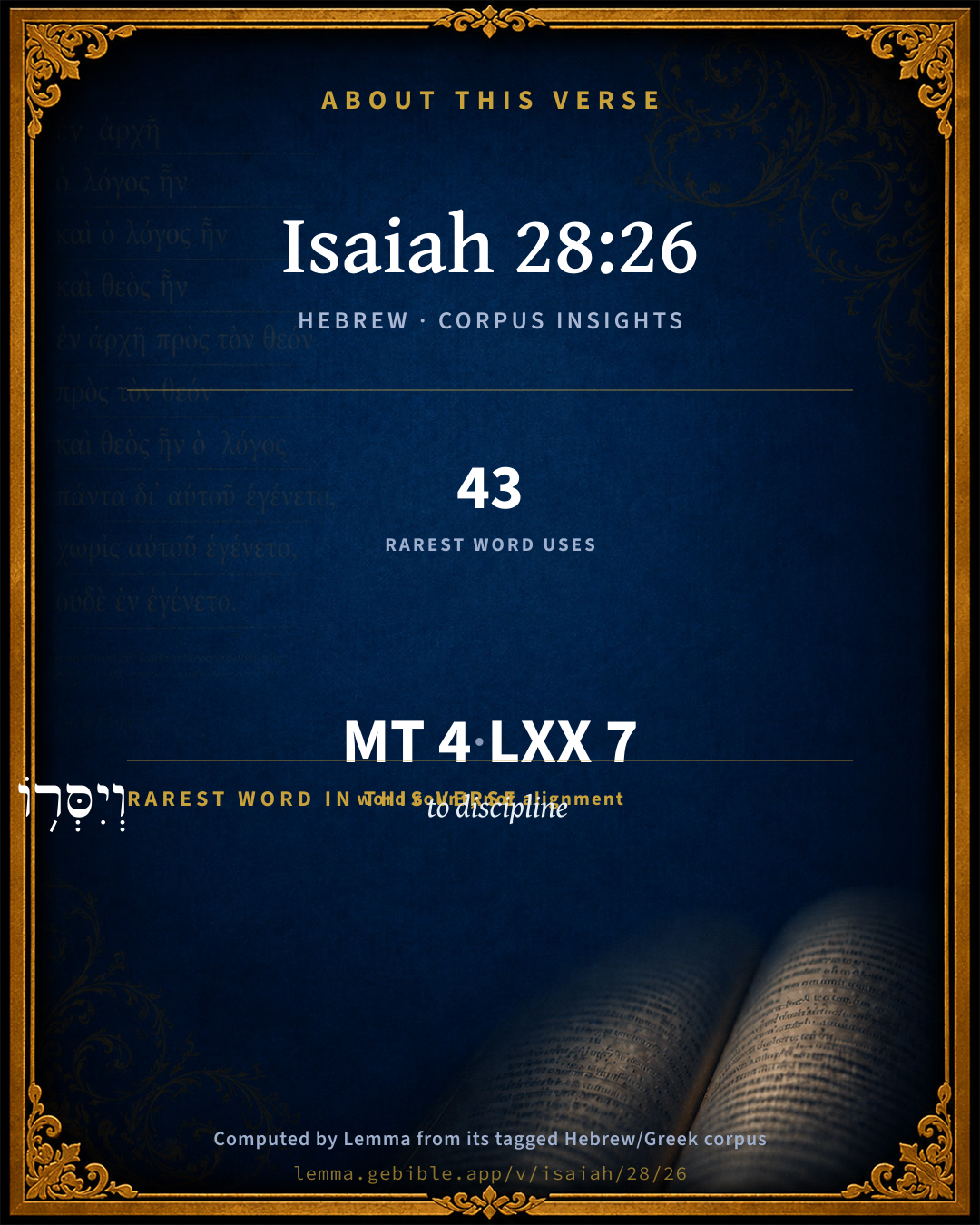
Isaiah 28:26

Hebrew (Westminster Leningrad Codex) Isaiah 28:26 appears in the Hebrew Old Testament. The text above is from the Westminster Leningrad Codex. Each word links to its Strong’s number, a concise gloss, and parsing drawn from the Open Scriptures Hebrew Bible morphology. Click any word for its full Brown-Driver-Briggs (BDB) entry.
Download image
Cite this verse

Isaiah 28:26 (World English Bible). Public Domain. Lemma interlinear Bible study tool, https://lemma.gebible.app/v/isaiah/28/26.

Show BibTeX & RIS
BibTeX
RIS
English Translation
For his God does instruct him aright, [and] does teach him.
World English Bible · Public Domain
Download a study sheet

One document with this verse’s original text, its word-by-word gloss line, the meaning frame, cross-references with their text, attributed commentary, and full source and license credits — printable, and it pastes into notes with its structure intact.

This verse Autodidact and up

Study sheet (.html) Plain text (.txt)

A passage Seminary Student

Up to 50 verses in one chapter. A passage sheet keeps up to 6 commentary sources and 12 cross-references per verse, in the order this page ranks them, and says so on the sheet whenever that leaves anything out. Ask for a single verse and you get the Autodidact verse sheet above.

Everything on this page stays free to read, with no account — the sheet is a download of what is already on screen, not access to it.

Want to remove ads? Support Godless Engineer
Compare translations 3

The same verse in 3 English versions, stacked beneath the original-language interlinear above. Click any original word for its lexicon entry.

Each is an independent rendering of the whole verse — the interlinear is not word-aligned to these translations.

Highlighted words mark where these versions differ — a whole-verse word diff, not a word-by-word alignment.

  • World English Bible Public Domain
    For his God does instruct him aright, [and] does teach him.
  • King James Version Public Domain
    For his God doth instruct him to discretion, and doth teach him.
  • unfoldingWord Literal Text CC BY-SA 4.0
    For his God instructs him in judgment; he teaches him.

unfoldingWord Literal Text — © unfoldingWord, licensed CC BY-SA 4.0. Word-aligned USFM3 via Door43 (git.door43.org/unfoldingWord/en_ult).

Versions to compare (up to 4)

3 of 4 selected

Show all 18 translations

Every available English version of this verse, each an independent rendering of the whole verse.

  • World English Bible Public Domain
    For his God does instruct him aright, [and] does teach him.
  • Berean Standard Bible Public Domain
    For his God instructs and teaches him properly.
  • Majority Standard Bible Public Domain
    For his God instructs and teaches him properly.
  • King James Version Public Domain
    For his God doth instruct him to discretion, and doth teach him.
  • American Standard Version (1901) Public Domain
    For his God doth instruct him aright, `and' doth teach him.
  • Revised Version (1885) Public Domain
    For his God doth instruct him aright, and doth teach him.
  • Geneva Bible (1599) Public Domain
    For his God doeth instruct him to haue discretion, and doeth teach him.
  • Douay-Rheims (1899) Public Domain
    For he will instruct him in judgment: his God will teach him.
  • Young's Literal Translation Public Domain
    And instruct him for judgment doth his God, He doth direct him.
  • Literal Standard Version CC BY-SA 4.0
    And his God instructs him for judgment, || He directs him.
  • Unlocked Literal Bible CC BY-SA 4.0
    His God instructs him; he teaches him wisely.
  • unfoldingWord Literal Text CC BY-SA 4.0
    For his God instructs him in judgment; he teaches him.
  • Darby Bible Public Domain
    His God doth instruct him in [his] judgment, he doth teach him.
  • World Messianic Bible Public Domain
    For his God instructs him in right judgment and teaches him.
  • Webster's Bible Public Domain
    For his God doth instruct him to discretion, and doth teach him.
  • Free Bible Version CC BY-SA 4.0
    His God gives him instructions and teaches him the right thing to do.
  • Bible in Basic English Public Domain
    For his God is his teacher, giving him the knowledge of these things.
  • JPS Tanakh (1917) Public Domain
    For He doth instruct him aright; his God doth teach him.

Literal Standard Version (2020), Covenant Press — licensed CC BY-SA 4.0. Text via the HelloAO Bible API (eBible.org). Unlocked Literal Bible (unfoldingWord) — licensed CC BY-SA 4.0. Text via the HelloAO Bible API (eBible.org). unfoldingWord Literal Text — © unfoldingWord, licensed CC BY-SA 4.0. Word-aligned USFM3 via Door43 (git.door43.org/unfoldingWord/en_ult). Free Bible Version, Dr. Jonathan Gallagher — licensed CC BY-SA 4.0. Text via the HelloAO Bible API (eBible.org).

Word by word

More ways to search: Search by grammar → Find every occurrence → Compare this word →

Practice this passage: Drill this verse → Learn its vocabulary →

וְיִסְּר֥וֹ
yâçar
H3256
“and · to discipline · him”
Conjunction + Verb, Piel, Sequential Perfect, 3rd Person, Masculine, Singular + Suffix, Personal, 3rd Person, Masculine, Singular
Part of Speech
Conjunction + Verb
Stem
Piel
Form
Sequential Perfect
Person
3rd Person
Gender
Masculine
Number
Singular
Full BDB Definition

Origin: a primitive root

TWOT: 877

to chasten, discipline, instruct, admonish - (Qal) - to chasten, admonish - to instruct - to discipline - (Niphal) to let oneself be chastened or corrected or admonished - (Piel) - to discipline, correct - to chasten, chastise - (Hiphil) to chasten - (Nithpael) to teach
  1. לַמִּשְׁפָּ֖ט mishpâṭ H4941 “to/for the · judgment” Preposition, Determined + Noun, Common, Masculine, Singular, Absolute
  2. אֱלֹהָ֥יו ʼĕlôhîym H430 “God(s) · his” Noun, Common, Masculine, Plural, Construct + Suffix, Personal, 3rd Person, Masculine, Singular
  3. יוֹרֶֽנּוּ yârâh H3384 “to throw · him” Verb, Hiphil, Imperfect, 3rd Person, Masculine, Singular + Suffix, Personal, 3rd Person, Masculine, Singular

About this verse

These counts appear in no published source. They are computed here, from the morphology-tagged text and Lemma’s own curated glosses. What Lemma adds →

4
words
4
distinct lemmas
Prophets
section

Shared distinctive vocabulary

וְיִסְּר֥וֹ to discipline H3256 occurs in 38 verses of the Hebrew Bible. Also found in:

Grammatical profile

  • 2 verbs
  • 2 nouns

Verb forms

  • וְיִסְּר֥וֹ Piel · Sequential Perfect
  • יוֹרֶֽנּוּ Hiphil · Imperfect

Hebrew & Septuagint length

In English translation the verse runs 11 words from the Hebrew and 14 from the Septuagint (LXX English) — closely comparable.

A rough comparison of the two English renderings, which tokenize alike — not a word-level alignment.

Word counts can differ between the Hebrew and the Greek without any difference in meaning — e.g. the Hebrew direct-object marker אֵת has no separate Greek word, and Greek often adds the article ὁ.

In the original languages it is 4 Hebrew tokens and 7 Greek tokens — but the two are counted differently (Hebrew bundles its prefixes and suffixes into one token; the Greek is in lemma form), so that isn’t a like-for-like length.

Cross-references

8

Topical passages linked to Isaiah 28:26 in the Treasury of Scripture Knowledge — connected by theme and wording, ordered by reader-vote popularity; previews shown in the World English Bible.

  • Exodus 31:3–6 and I have filled him with the Spirit of God, in wisdom, and in understanding, and in knowledge, and in all manner of workmanship,
  • Exodus 36:2 Moses called Bezalel and Oholiab, and every wise-hearted man, in whose heart Yahweh had put wisdom, even everyone whose heart stirred him up to come to the work to do it:
  • Exodus 28:3 You shall speak to all who are wise-hearted, whom I have filled with the spirit of wisdom, that they make Aaron's garments to sanctify him, that he may minister to me in the priest's office.
  • Job 35:11 Who teaches us more than the animals of the earth, And makes us wiser than the birds of the sky?'
  • Job 39:17 Because God has deprived her of wisdom, Neither has he imparted to her understanding.
  • Psalms 144:1 Blessed be Yahweh, my rock, Who teaches my hands to war, And my fingers to battle:
  • Daniel 1:17 Now as for these four youths, God gave them knowledge and skill in all learning and wisdom: and Daniel had understanding in all visions and dreams.
  • James 1:17 Every good gift and every perfect gift is from above, coming down from the Father of lights, with whom can be no variation, nor turning shadow.

Cross-references courtesy of OpenBible.info (CC BY 4.0).

Hebrew and Greek witnesses Masoretic Hebrew ↔ Greek Septuagint

The same verse in the two great witnesses to the Old Testament, shown verse-for-verse.

These are two independent witnesses, not word-aligned to each other, and the Septuagint is shown in lemma (dictionary) form.

Hebrew Isaiah 28:26 Masoretic · Westminster Leningrad Codex

וְיִסְּר֥וֹ לַמִּשְׁפָּ֖ט אֱלֹהָ֥יו יוֹרֶֽנּוּ

For his God does instruct him aright, [and] does teach him.

World English Bible · Public Domain

Greek LXX Isaiah 28:26 Septuagint · lemma form

καί παιδεύω κρίμα θεός σύ καί εὐφραίνω

So you shall be chastened by the judgment of your God, and shall rejoice.

LXX2012 (modern English Septuagint) · Public Domain

Hebrew: Westminster Leningrad Codex (CC BY 4.0). Greek: Septuagint (public domain); English from LXX2012 (modern English Septuagint) (Public Domain). How the Septuagint differs from the Hebrew →

Targum (Aramaic paraphrase)

1

The Targum is the ancient Jewish Aramaic paraphrase of the Hebrew Scriptures — an interpretive translation, not the Hebrew text itself. Onkelos (literal) and Pseudo-Jonathan (expansive) render the Torah, and Jonathan the Prophets. Coverage is partial: where no permissively-licensed English translation exists for a verse, only the Aramaic is shown. This is verse-level text, not a word-by-word alignment to the Hebrew.

  1. Targum Jonathan Prophets (Joshua–Malachi)
    הָא כָּל אִלֵין אוּלְפַן דְדִין דְיֵדְעוּן דִי אֱלָהָא מְחַוֵי לְהוֹן אוֹרְחָא דְתַקְנָא דִיהֲכוּן בָּהּ:

    All these things are instruction of judgment, that they may know, that our God shows them the right path, in which they ought to walk.

    Targum Jonathan — Aramaic: “Mikraot Gedolot” (public domain). English: “Sefaria Community Translation” (CC0 1.0 (public-domain dedication)); “London "Chaldee Paraphrase," 1871” (public domain). Text via Sefaria.

Commentary

Notes on Isaiah 28:26 from classic Christian and Jewish commentators (each source and its license shown beneath its notes). The classic Christian expositions comment on the surrounding passage and are grouped to its opening verse, so a note may address several verses; the Jewish commentaries on the Tanakh (Rashi and others) are per-verse, so they appear only where the commentator wrote on this verse.

Lemma curates 59 commentaries, every one of them public domain or Creative Commons licensed, each selected and text-cleaned for this edition rather than reprinted as found. About our sources →

Trapp's Complete Commentary

John Trapp

Isa 28:26 For his God doth instruct him to discretion, [and] doth teach him.

Ver. 26. For his God doth instruct him to discretion.] Being a better tutor to him than any Varro de agricultura, Cato de re rustica, Hesiod, in his Works and Days; Virgil’s Georgics; or, Geonomica Constantino inscripta. Some read the verse thus: "And he beateth it out according to that course that his God teacheth him"; that is, according to the judgment of right reason. God is to be praised for the art of agriculture. How thankful were the poor heathens to their Saturn, Triptolemus, Ceres, &c.

John Trapp, A Commentary or Exposition upon All the Books of the Old and New Testament (1647–1656) — public domain. Text from a community e-Sword module.

The Biblical Illustrator

Joseph S. Exell

Isa_28:26-29

For his God doth instruct him

Chastising with judgment

More literally and with better significance, And he chastiseth it with judgment; his God doth instruct him.

This judgment is shown in two ways.

(1) In the choice and adaptation of the mode of threshing. There were four modes in use among the Jews; first there was the wain, a very ponderous and formidable instrument brought out only for the heavier and harder kinds of fruits; then there was the cart, the wheels of which also were for the same purpose; then there was the horse or the ox, whose feet were employed to tread out the corn; and then there was the staff, an instrument corresponding with our flail. Well, says the prophet, fitches, the lighter kinds of seeds, are not threshed with a wain, nor is a cart wheel turned upon the cummin; upon these the farmer, using sound judgment, employs only a staff or flail. Bread corn requires a heavier threshing, and bread corn is therefore bruised. But

(2) he does not go on threshing it forever, nor does he continue so long turning the wheel of his cart upon it, or crushing it with his horses, that it is broken into pieces and spoiled; in the measure of his threshing no less than in its mode does he exercise discretion; in the amount which he inflicts no less than in the form which he selects. This also cometh forth from the Lord of hosts, which is wonderful in counsel, and excellent in working. (R. H.Roberts, B. A.)

Tribulation

Though not a parable in form, the passage is intended to be parabolically interpreted by us. The unsown land indicates human nature in its native condition; the fruit of that land after it has been sown indicates human nature taken possession of by the Word and Spirit of God.

I. Just as the corn, after it has grown up from the seed sown, needs the c causing process of threshing, so THE SOUL, AFTER IT HAS APPROPRIATED THE GRACE OF GOD IN SALVATION THROUGH FAITH, NEEDS TO BE DISCIPLINED AND CHASTENED AND PERFECTED BY SUFFERING. It used to be a great puzzle with some of the Old Testament saints why a man of God should be subjected to trial Perhaps their bewilderment arose out of the exceeding dimness which surrounded a future life; but the life and immortality brought to light in the Gospel has made this all clear to us, and the suggestion contained in the figure of the text, whilst it cannot be pressed too strictly, may be taken to remind us that in our first salvation we have not reached our final development. The corn is not grown for itself, it is meant for something beyond; and that beyond can only be attained through bruising. It must be beaten into its future life. Even so our salvation is only a step in the onward, heavenward progress; and into that higher kingdom we must enter through the narrow pass of tribulation. This is Christs teaching. Every branch in Me that beareth fruit, He purgeth it. This is brought out, too, in the words of John the Baptist regarding Christ. I, he says, baptize you with water, but He will baptize you in the Holy Ghost and in fire. When first we are separated from the rock of nature and raked out of the pit of corruption, we are like iron ore, having in us a vast deal of dross which must become slag and refuse, and we need the blast furnace not only that this dross may be removed, but that we may be in a condition to run into the mould, and so take the shape which the Master desires, and be prepared for the utilities unto which He destines us. It often happens, too, that the more noble the elements which exist in a man, the more severe is the process required unto the perfecting of their possibilities. Corn wants heavier threshing than cummin, not because it is less valuable but because its superior value gives it a greater power of resistance and makes it worth while to accept the heavier toil.

II. THE DISCIPLINE EXPERIENCED BY THE PEOPLE OF GOD WILL BE CERTAINLY SUCH AS IS BEST ADAPTED TO SECURE THE HIGHEST POSSIBLE ENDS. It is being administered and superintended by One who, whilst He sets much value upon them, is distinguished by the profoundest wisdom. And we may be sure that His wisdom will be applied to the adaptation of the discipline to the character with which He has to deal; the husbandman does not thresh fitches with a wain, nor is a cart wheel turned about upon the cummin; but the fitches are beaten out with a staff, and the cummin with a rod. You look at your children and you discriminate; you say that boy has a sensitive, gentle, yielding nature, and I must be careful that I do not handle him too roughly, lest I brush the bloom off and spoil the possible beauty which, by careful training, may be made to blossom in the kingdom of God. And that lad is made of a coarser grain, which is not readily injured, and with a dash of self-will and obstinacy in it, upon which I must lay a firm and strong hand. And so, it may be, you put your arm around the one, and you have a rod for the other; and yet all the while you mean the same by both. He who is wonderful in counsel is also wonderful in working. (R. H. Robert, B. A.)

The, ploughman taught of God

Let us contemplate the method of the Divine teaching. The ploughman teaches us--

I. A LESSON OF PREPARATION. God prepared much for man before He introduced him into Eden. God would not bring His favourite creature man into a dreary, cheerless world, but into one glowing with beauty, impressive in magnificence, overflowing with goodness.

II. A LESSON OF ACTIVITY. The ploughman has passed the time of deliberation; he has decided, and decision has led to action. There is much truth in Bacons complaint, That some men object too much, consult too long, adventure too little, repent too soon, and seldom drive business home. This aphorism applies, alas, to too many alike in the world and the Church. Ulysses could not discover a happier method of making his foes believe in his insanity than by ploughing up the sand by the seashore. How much quick-witted invention degenerates to the same folly! Often within the Church, where heavenly wisdom ought to shine, matters are not much improved. How many are at ease in Zion! How many shirk the ploughing altogether! How many let noxious weeds grow apace! How many miss the time of open-handed sowing, and yet expect to wake up when the song of harvest home fills the air, and to gather their own golden sheaves! There is still a sense in which the children of the world are wiser than the children of light. Many of these count years not wasted to acquire proficiency in mere vanities and trivialities over which angels well may weep.

III. A LESSON OF PRUDENCE. God giveth him discretion All toil that is honest, is honourable, but that is the most honourable which employs the greatest variety of our powers. How much of the service offered to pomp, pride vanity, and fashion lacks discretion! This faculty of discretion men are called upon to exercise daily. Prudence or discretion is a good commander-in-chief: it has won battles over the stubbornness of the soil, the inclemency of the climate, the stormy elements. If we thoughtfully and prayerfully take care of our own actions, God will take care of results. We have no right to tempt providence in any part of its wide domains. He who walks in dangerous ways will perish in them, even as Josiah--favourite of God though he was--was wounded unto death, because he pressed further against his enemies than the words of God permitted.

IV. A LESSON OF ORDER. The discreet husbandman ploughs in the proper season in order that the Lords plough, the frost may pulverise the soft a thousand times finer than any human implement. And is not order one of the greatest of Heavens appointed laws? The Church itself is to be an army with banners, to consist of governors and governed, some to tend, some to serve, some to hear. Evolve your heaven in due order, out of holy desires, pure affection, spiritual principle, full consecration. (F. Standfast.)

The need and measure of afflictive dispensations

I. THE NEED OF TRIAL TO THE CHILDREN OF GOD. To the wicked afflictions may come as present manifestations of Divine displeasure, and most unwelcome earnests of future judgment. And God may cause the very pleasant vices in which they indulged to become whips and scourge them. As for the children of God, however,--the corn, the fitches, and the cummin, it is not so with them. Every providential dealing of their Heavenly Father is linked with the intentions of His grace, and subserves them. The grain is beaten, the corn is bruised, that they may become useful to man, in providing him with food. Even so, afflictions may be for the good of others, as well as for the glory of God.

II. THE WISE AND GRACIOUS MANNER IN WHICH GOD LAYS AFFLICTION ON HIS CHILDREN. The text beautifully exhibits the skilful and tender adaptation of means to their end. (B. P. Buddicom, M. A.)

Threshing

I. WE ALL NEED THRESHING. What is the object of threshing the grain? Is it not to separate it from the straw and the chaff?

1. About the best of men there is still a measure of chaff. There is something superfluous, something which must be removed. Either in spirit, or motive, or lack of zeal, or want of discretion, we are faulty, if before an action we are right, we err in the doing of it, or, if not, we become proud after it is over. If sin be shut out at the front door, it tries the back gate, or climbs in at the window, or comes down the chimney. Those who cannot perceive it in themselves are frequently blinded by its smoke. They are so thoroughly in the water that they do not know that it rains.

2. Threshing is useful in loosening the connection between the good corn and the husk. If it would slip out easily from its husk, the corn would only need to be shaken. But theres the rub: our soul not only lieth in the dust, but cleaveth to it. As the work of threshing is never done till the corn is separated altogether from the husk, so chastening and discipline have never accomplished their design till Gods people give up every form of evil, and abhor all iniquity. Threshing becomes needful for the sake of our usefulness; for the wheat must come out of the husk to be of service. Eminent usefulness usually necessitates eminent affliction.

3. The threshing instrument is a prophecy of our future perfection.

II. GODS THRESHING IS DONE WITH GREAT DISCRETION.

1. Reflect that your threshing and mine are in Gods hands. Our chastening is not left to servants, much less to enemies; we are chastened of the Lord! How roughly some ministers, some good men and women will go to work with timid, tender souls; yet we need not fear that they will destroy the true-hearted, for, however much they may vex them, the Lord will not leave His chosen in their hands, but will overrule their mistaken severity, and preserve His own from being destroyed thereby. As the Lord has not left us in the power of man, so also He has not left us in the power of the devil. Satan may sift us as wheat, but he shall not thresh us as fitches. He may blow away the chaff from us even with his foul breath, but he shall not have the management of the Lords corn. The Lord preserveth the righteous.

2. The instruments used for our threshing are chosen also by the great Husbandman. The Eastern farmer has several instruments, and so has our God. No form of threshing is pleasant to the seed which bears it; indeed, each one seems to the sufferer to be peculiarly objectionable.

3. God not only selects the instruments, but He chooses the place. Farmers in the East have large threshing floors upon which they throw the sheaves of corn or barley, and upon these they turn horses and drags; but near the house door I have often noticed in Italy a much smaller circle of hardened clay or cement, and here I have seen the peasants beating out their garden seeds in a more careful manner than would naturally be used towards the greater heaps upon the larger area. Some saints are not afflicted in the common affairs of life, but they have peculiar sorrow in their innermost spirits: they are beaten on the smaller and more private threshing floor; but the process is none the less effectual

4. It is interesting to notice in the text the limit of this threshing. The husbandman is zealous to beat out the seed, but he is careful not to break it in pieces by too severe a process. In the same way the Lord has a measure in all His chastening. The wisdom of the husbandman in limiting his threshing is far exceeded in the wisdom of God by which He sets a limit to our griefs. We see that our God uses discretion in the chastisement of His people; let us use a loving prudence when we have to deal with others in that way. Be gentle as well as firm with your children; and if you have to rebuke your brother do it very tenderly. Do not drive your horses over the tender seed.

III. THE THRESHING WILL NOT LAST FOREVER. The threshing will not last all our days even here. Bread corn is bruised, but He will not always he threshing it. Oh, no! He will not always chide, neither will He keep His anger forever. Weeping may endure for a night, but joy cometh in the morning. Threshing is not an operation which the corn requires all the year round; for the most part the flail is idle. Then, we shall soon be gone to another and better world. (C. H. Spurgeon.)

How the Lord threshes us

I. IT IS NO COMPLIMENT TO US IF WE ESCAPE GREAT TRIAL.

II. GOD PROPORTIONS OUR TRIALS TO WHAT WE CAN BEAR.

III. GOD KEEPS TRIAL ON US UNTIL WE LET GO. The farmer shouts whoa! to his horses as soon as the grain has dropped from the stalk. The farmer comes with his fork and tosses up the straw, and he sees that the straw has let go the grain, and the grain is thoroughly threshed. So God. Smiting rod and turning wheel, but cease as soon as we let go. We hold on to this world with its pleasures, and riches, and emoluments, and our knuckles are so firmly set that it seems as if we could hold on forever. God comes along with some threshing troubles, and beats us loose.

IV. CHRISTIAN SORROW IS GORING TO HAVE A SURE TERMINUS. (T. DeWitt Talmage, D. D.)

The wisdom of God in discipline

Some men require very little hard usage. A tap will do, a gentle stroke, a touch that hardly amounts to a blow, a ministry that may be wrought out with the tips of the fingers. Other men require flail, and iron instrument, and harrow, and cart wheel and rough treatment: they are differently organised, they are differently constituted. What would be thought of a man who blew up birds nests with gunpowder? Who would not say, There is great want of proportion in that mans method of looking at things; he is expending far too much energy upon the object? So with regard to the Divine discipline. Some men could be almost brought to fulness or fruition by a smile. Of some men God says, Thou art not far from the kingdom of heaven; one little step would bring thee right home. God whispers some men into heaven. But what thunder He needs for others! God treats character according to the variety of character. (J. Parker, D. D.)

Chastisement not pleasant

There is no pleasing us in the matter of chastisement. When I was at school, with my uncle for master, it often happened that he would send me out to find a cane for him. It was not a very pleasant task, and I noticed that I never once succeeded in selecting a stick which was liked by the boy who had to feel it. Either it was too thin, or too stout; and in consequence I was threatened by the sufferers with condign punishment if I did not do better next time. I learned from that experience never to expect Gods children to like the particular rod with which they are chastened. (C. H. Spurgeon.)

Moral threshing

We all go through, some kind of threshing process. The fact that you may be devoting your life to honourable and noble purposes will not win you any escape. Wilberforce, the Christian emancipator, was in his day derisively called Doctor Cantwell. Thomas Babington Macaulay, the advocate of all that was good long before he became the most conspicuous historian of his day, was caricatured in one of the Quarterly Reviews as Babble-tongue Macaulay. (T. DeWitt Talmage, D. D.)

The higher nature requires the more force

Bread corn is bruised. There are more blows given by the sculptor to carve a saint or angel man by the mason to square a paving stone. (F. Standfast.)

Tribulation

Tribulation comes from the word Tribulum, and tribulum means a threshing instrument. Whatever the man used who was treating the growth in its latest phases was called a tribulum, and he tribulated the harvest into bread. The seed did not go from the field into the oven; it had to undergo the action of the tribulum. Watch it there: what is that seed now undergoing! Tribulation. This is the bread that came out of much tribulating, tribulation, tearing asunder, shaking, beating. (J. Parker, D. D.)

The Biblical Illustrator, edited by Joseph S. Exell (c. 1880s–1900s) — public domain. Text from a community e-Sword module.

Joseph Benson's Commentary

Isa 28:26. For his God doth instruct him — The art of husbandry is so necessary for the support of human life, that all men have ascribed its original to God as the inventor and ordainer of it. The Most High hath ordained husbandry, saith the son of Sirach, Sir 7:15. In like manner, Virgil, Georg., lib. 1. line 121:

“ — — — — — — — — — Pater ipse colendi Haud facilem esse viam voluit, primusq; per artem Movit agros — — .”

“Himself invented first the shining share, And whetted human industry by care;

Himself did handicrafts and arts ordain;

Nor suffer’d sloth to rust his active reign.”

By other heathen, the invention of agriculture is ascribed to the goddess Ceres.

Joseph Benson's Commentary on the Old and New Testaments (1811–1818) — public domain. Text from a community e-Sword module.

Jamieson, Fausset & Brown

Robert Jamieson, A. R. Fausset & David Brown

to discretion--in the due rules of husbandry; God first taught it to man (Gen 3:23).

Jamieson, Fausset & Brown — Commentary Critical and Explanatory on the Whole Bible (1871) — public domain (CC PDM 1.0). Text via the HelloAO Bible API.

Adam Clarke's Commentary

Verse 26. For his God doth instruct him] All nations have agreed in attributing agriculture, the most useful and the most necessary of all sciences, to the invention and to the suggestions of their deities. "The Most High hath ordained husbandry," saith the son of Sirach, Ecclus. 7:15.

Namque Ceres fertur fruges, Liberque liquoris

Vitigeni laticem mortalibus instituisse.

LUCRETIUS, v. 14.

"Ceres has taught mortals how to produce fruits; and Bacchus has taught them how to cultivate the vine."

Ὁ δ' ηπιος ανθρωποισι

Δεξια σημαινει, λαους δ' επι εργον εγειρει

Μιμνησκων βιοτοιο· λεγει δ' ὁτε βωλος αριστη

Βουσι τε και μακελῃσι· λεγει δ' ὁτε δεξιαι ὡραι

Και φυτα γυρωσαι, και σπερματα παντα βαλεσθαι.

ARATUS, Phaenom. v.

"He, Jupiter, to the human race

Indulgent, prompts to necessary toil

Man provident of life; with kindly signs

The seasons marks, when best to turn the glebe

With spade and plough, to nurse the tender plant,

And cast o'er fostering earth the seeds abroad."

Adam Clarke's Commentary on the Bible (1810–1826) — public domain. Text from a community e-Sword/MySword module.

Ellicott's Commentary for English Readers

(26) For his God doth instruct him to discretion . . .—Better, as in the margin, with a slight variation, He treateth each as is fitting, his God instructing him. The prophet looks on the skill of the tiller of the soil, which seemed the outcome of a long experience, as nothing less than a gift of God. The legends of the Gentiles embraced that thought in the myths of Osiris and Oannes, of Dionysius and Triptolemos; Isaiah states the fact without the mythos.

A Bible Commentary for English Readers, edited by Charles John Ellicott (1878–1897) — public domain. Text from a community e-Sword module.

The Cambridge Bible for Schools and Colleges

gen. ed. J. J. S. Perowne

26. All this is done in obedience to an inherited, almost instinctive, wisdom, which rests ultimately on Divine inspiration. See Isa_28:29; and Sir_7:15 (“husbandry which the Most High hath ordained”). Verg. Georg. I. 147.

to discretion] to right, i.e. “right, or orderly, method.” The word is that usually rendered “judgment,” used here in a non-ethical application.

The Cambridge Bible for Schools and Colleges (gen. ed. J. J. S. Perowne; Cambridge University Press, 1878–1918) — public domain. Text from a community e-Sword module.

John Gill's Exposition

For the fitches are not threshed with a threshing instrument,.... A wooden sledge, dray, or cart, drawn on wheels; the bottom of which was stuck with iron teeth, and the top filled with stones, to press it down with the weight thereof, and was drawn by horses, or oxen, to and fro, over the sheaves of corn, laid in proper order, whereby the grain was separated from the husk: See Gill on Co1 9:9 but fitches, the grain of them being more easily separated, such an instrument was not used in threshing them:

neither is a cart wheel turned about upon the cummin; the cart wheel of the above instrument was not turned upon the cummin, that being also more easily threshed, or beaten out, and therefore another method was used with these, as follows:

but the fitches are beaten out with a staff, and the cummin with a rod: in like manner as corn is with us threshed out with a flail; so the Lord proportions the chastisement, and corrections of his people to the grace and strength that he gives them; he afflicts them either more gently, or more severely, as they are able to bear it; with some he uses his staff and rod, and with others his threshing instrument and cart wheel; some being easier and others harder to be wrought upon by the afflictive dispensations of Providence; see Co1 10:13 or this may point out the difference between the punishment of wicked men and the chastisement of the saints.

John Gill's Exposition of the Whole Bible (1746–1763) — public domain (CC PDM 1.0). Text via the HelloAO Bible API.

Albert Barnes' Notes on the Bible

For his God doth instruct him ... - Margin, ‘He bindeth it in such sort as his God doth teach him.’ The more correct idea is conveyed in the text. The word יסרו yiserô, properly means, he instructs, admonishes, or teaches him. The idea that skill in agriculture is communicated by God is not one that is discordant to reason, or to the general teachings of the Bible. Thus the achitectural and mechanical skill of Bezaleel and Aholiab, by which they were enabled to make the tabernacle, is said expressly to have been imparted to them by God Exo 31:2-6. Thus also Noah was taught how to build the ark Gen 6:14-16. We are not, indeed, to suppose that the farmer is inspired; or that God communicates to him by special revelation where, and when, and how he shall sow his grain, but the sense is, that God is the author of all his skill. He has endowed him with understanding, and taught him by his providence. It is by the study of what God teaches in the seasons, in the soil, in the results of experience and observation, that he has this art. He teaches him also by the example, the counsel, and even by the failures of others; and all the knowledge of agriculture that he has is to be traced up to God.

Albert Barnes' Notes on the Bible (1834–1885) — public domain. Text from a community e-Sword/MySword module.

Haydock's Catholic Bible Commentary

God. From him proceeds every useful invention. The pagans attributed the discovery of corn, &c., to their idols.

George Leo Haydock (1774–1849), Haydock's Catholic Family Bible and Commentary, 1859 edition — public domain. Excludes Psalms (Douay-Rheims chapter numbering differs from Protestant) and Deuterocanonical books (Catholic canon only).

Matthew Poole's English Annotations

The sense of the words thus rendered is this, All this he performeth by that discretion which God hath put into him; and therefore be assured that God will order all his affairs with judgment, and will in due season execute the punishments which now he threatens, and will perfect his own works. But the words by some are rendered otherwise.

And he beateth it out (as this word may be rendered, 1Ki 12:11; Pro 19:18; 29:17) in such sort as his God doth teach him; in a discreet manner, which being generally mentioned here, is particularly described in the following verse.

Matthew Poole's English Annotations on the Holy Bible (1683–1685) — public domain. Text from a community e-Sword/MySword module.

The Pulpit Commentary

For his God doth instruct him. Through the reason which God has given to men, they deal thus prudently and carefully with the pieces of land which they cultivate.

The Pulpit Commentary (1880–1919), ed. H.D.M. Spence-Jones & Joseph S. Exell — public domain. Text from a community e-Sword module.

J. A. Alexander on Isaiah

Joseph Addison Alexander

“So teaches him aright his God instructs him.” This is the form of the Hebrew sentence, in which his God is the grammatical subject of both the verbs between which it stands. The English idiom requires the noun to be prefixed, as in the common version. The verse refers even agricultural skill to divine instruction.

Joseph Addison Alexander, The Prophecies of Isaiah (1846–1847; New York: Scribner, 1870–1878) — public domain. Text from a community e-Sword module.

Rashi

Rabbi Shlomo Yitzchaki (Rashi)

And He shall chasten him justly Likewise, he whose God directs him, He shall not send prophets forever to admonish him. Since he does not heed admonition, He shall chasten him with judgments of chastening in order that the toil of His admonition will help, like the one who smoothes the surface of the earth to sow, in order that the toil of his plowing that he plowed shall succeed.

Rashi on the Tanakh — English translations: “The Judaica Press complete Tanach with Rashi, translated by A. J. Rosenberg” (CC BY 4.0); “Pentateuch with Rashi's commentary by M. Rosenbaum and A.M. Silbermann, 1929-1934” (public domain); “The Metsudah Tanach series, Lakewood, N.J” (CC BY 4.0); and “The Book of Joshua, Metsudah Publications, 1997” (CC BY 4.0). Text via Sefaria.

Ibn Ezra

Rabbi Abraham ibn Ezra

ויסרו For the Lord instructed him. The Lord has already instructed him, who sows and scatters the seed, and taught him how to do it.

למשפט According to the custom, to do as it is usually done; comp. כמשפט after the manner (Num. 29:32). His God doth teach him. The same.

Ibn Ezra on the Tanakh — English translations: “Sefaria Community Translation” (CC0 1.0 (public-domain dedication)); “Yalkut, Sifsei Chachomim Chumash, Metsudah Publications, 2009” (CC BY 4.0); and “Commentary of Ibn Ezra on Isaiah - trans. by M. Friedlander, 1873” (public domain). Text via Sefaria.

Lesson kit

Teaching starters — assembled from the data on this page, not authored interpretation. Every prompt links to the verse data it draws on. Edit before teaching.

Isaiah, in the Prophets, opens this verse with 4 words (4 distinct Hebrew lemmas). Its most distinctive word is yâçar (“to discipline”). A historical commentator’s framing appears above. Read the whole chapter for the surrounding context.

Discussion questions

  1. The word yâçar carries the sense “to discipline.” How does it shape the verse?
  2. How does Leviticus 26:18, which shares the word «to discipline», read alongside this verse?
  3. These translations render this verse differently. What is at stake in choosing one wording over another?
  4. «וְיִסְּר֥וֹ» is a Piel Sequential Perfect verb. How does that grammatical form shape the action described?
  5. Compare how Trapp's Complete Commentary and The Biblical Illustrator read this verse. Where do they agree or differ?

Things to notice

Reading settings

Reading text

Shown beneath each verse's original-language words.

Old Testament
Old Testament edition

Read the OT as the Masoretic Hebrew (MT) or the Greek Septuagint (LXX).

English shown for the Greek Septuagint (in the Hebrew ↔ Greek comparison).

Comparing translations? Open the Compare panel on any verse page to stack up to four side by side.