
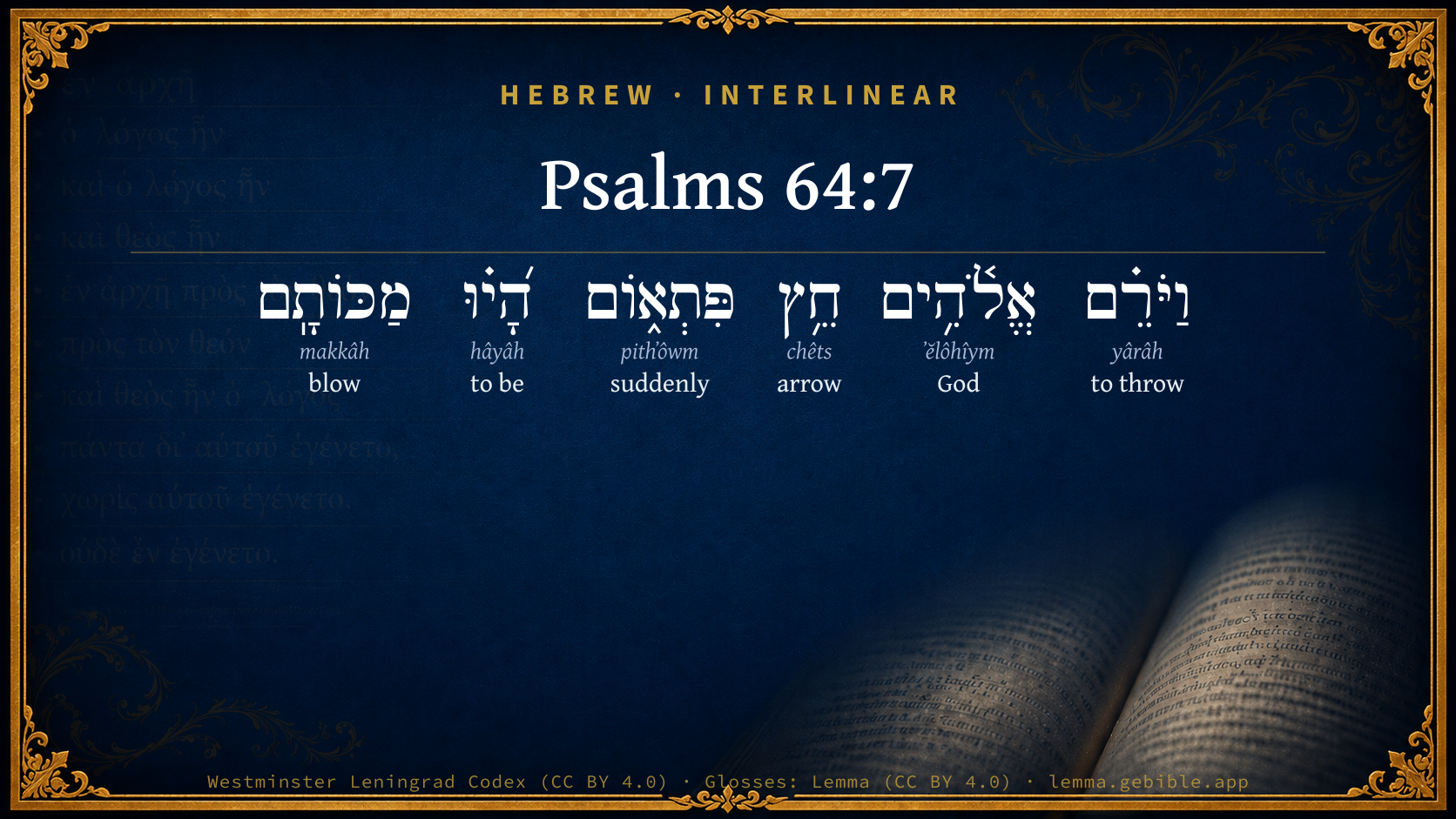
Psalms 64:7

Hebrew (Westminster Leningrad Codex) Psalms 64:7 appears in the Hebrew Old Testament. The text above is from the Westminster Leningrad Codex. Each word links to its Strong’s number, a concise gloss, and parsing drawn from the Open Scriptures Hebrew Bible morphology. Click any word for its full Brown-Driver-Briggs (BDB) entry.
Download image
Cite this verse

Psalms 64:7 (World English Bible). Public Domain. Lemma interlinear Bible study tool, https://lemma.gebible.app/v/psalms/64/7.

Show BibTeX & RIS
BibTeX
RIS
English Translation
But God will shoot at them. They will be suddenly struck down with an arrow.
World English Bible · Public Domain
Download a study sheet

One document with this verse’s original text, its word-by-word gloss line, the meaning frame, cross-references with their text, attributed commentary, and full source and license credits — printable, and it pastes into notes with its structure intact.

This verse Autodidact and up

Study sheet (.html) Plain text (.txt)

A passage Seminary Student

Up to 50 verses in one chapter. A passage sheet keeps up to 6 commentary sources and 12 cross-references per verse, in the order this page ranks them, and says so on the sheet whenever that leaves anything out. Ask for a single verse and you get the Autodidact verse sheet above.

Everything on this page stays free to read, with no account — the sheet is a download of what is already on screen, not access to it.

Want to remove ads? Support Godless Engineer
Compare translations 3

The same verse in 3 English versions, stacked beneath the original-language interlinear above. Click any original word for its lexicon entry.

Each is an independent rendering of the whole verse — the interlinear is not word-aligned to these translations.

Highlighted words mark where these versions differ — a whole-verse word diff, not a word-by-word alignment.

  • World English Bible Public Domain
    But God will shoot at them. They will be suddenly struck down with an arrow.
  • King James Version Public Domain
    But God shall shoot at them with an arrow; suddenly shall they be wounded.
  • unfoldingWord Literal Text CC BY-SA 4.0
    But God will shoot an arrow; suddenly their wounds will happen.

unfoldingWord Literal Text — © unfoldingWord, licensed CC BY-SA 4.0. Word-aligned USFM3 via Door43 (git.door43.org/unfoldingWord/en_ult).

Versions to compare (up to 4)

3 of 4 selected

Show all 18 translations

Every available English version of this verse, each an independent rendering of the whole verse.

  • World English Bible Public Domain
    But God will shoot at them. They will be suddenly struck down with an arrow.
  • Berean Standard Bible Public Domain
    But God will shoot them with arrows; suddenly they will be wounded.
  • Majority Standard Bible Public Domain
    But God will shoot them with arrows; suddenly they will be wounded.
  • King James Version Public Domain
    But God shall shoot at them with an arrow; suddenly shall they be wounded.
  • American Standard Version (1901) Public Domain
    But God will shoot at them; With an arrow suddenly shall they be wounded.
  • Revised Version (1885) Public Domain
    But God shall shoot at them; with an arrow suddenly shall they be wounded.
  • Geneva Bible (1599) Public Domain
    But God will shoote an arrowe at them suddenly: their strokes shalbe at once.
  • Douay-Rheims (1899) Public Domain
    They have searched after iniquities: they have failed in their search. Man shall come to a deep heart:
  • Young's Literal Translation Public Domain
    And God doth shoot them `with' an arrow, Sudden have been their wounds,
  • Literal Standard Version CC BY-SA 4.0
    And God shoots them [with] an arrow, || Their wounds have been sudden,
  • Unlocked Literal Bible CC BY-SA 4.0
    But God will shoot them; suddenly they will be wounded with his arrows.
  • unfoldingWord Literal Text CC BY-SA 4.0
    But God will shoot an arrow; suddenly their wounds will happen.
  • Darby Bible Public Domain
    But God will shoot an arrow at them: suddenly are they wounded;
  • World Messianic Bible Public Domain
    But God will shoot at them. They will be suddenly struck down with an arrow.
  • Webster's Bible Public Domain
    \\64:6\\They search out iniquities; they accomplish a diligent search: both the inward thought of every one of them, and the heart, is deep.
  • Free Bible Version CC BY-SA 4.0
    But God will shoot them with arrows; all of a sudden they will be wounded.
  • Bible in Basic English Public Domain
    But God sends out an arrow against them; suddenly they are wounded.
  • JPS Tanakh (1917) Public Domain
    (64-8) But God doth shoot at them with an arrow suddenly; thence are their wounds.

Literal Standard Version (2020), Covenant Press — licensed CC BY-SA 4.0. Text via the HelloAO Bible API (eBible.org). Unlocked Literal Bible (unfoldingWord) — licensed CC BY-SA 4.0. Text via the HelloAO Bible API (eBible.org). unfoldingWord Literal Text — © unfoldingWord, licensed CC BY-SA 4.0. Word-aligned USFM3 via Door43 (git.door43.org/unfoldingWord/en_ult). Free Bible Version, Dr. Jonathan Gallagher — licensed CC BY-SA 4.0. Text via the HelloAO Bible API (eBible.org).

Word by word

More ways to search: Search by grammar → Find every occurrence → Compare this word →

Practice this passage: Drill this verse → Learn its vocabulary →

About this verse

These counts appear in no published source. They are computed here, from the morphology-tagged text and Lemma’s own curated glosses. What Lemma adds →

6
words
6
distinct lemmas
Wisdom
section

Notable vocabulary

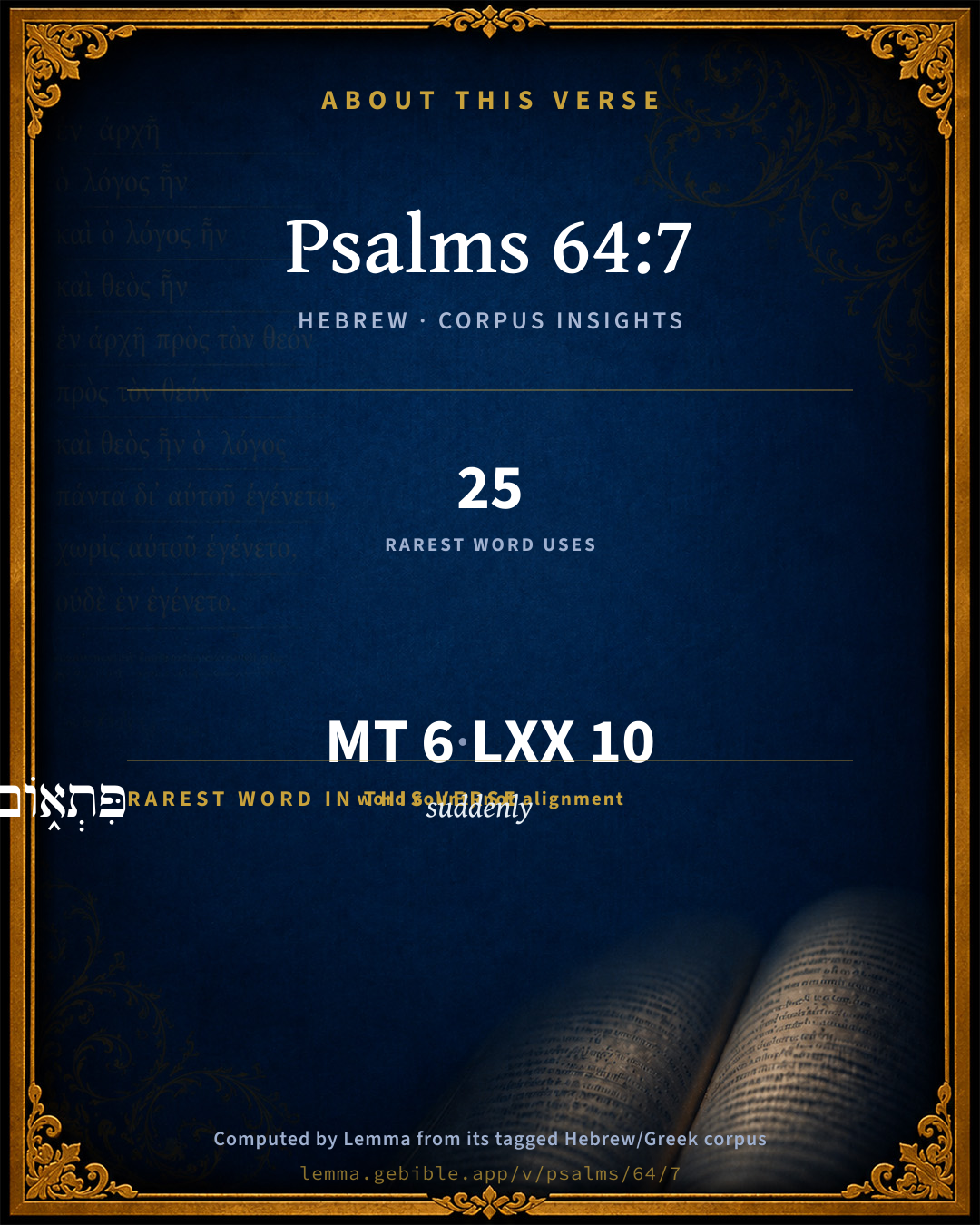
The rarest word here is פִּתְא֑וֹם suddenly H6597 — appearing just 25 times in the whole Hebrew Bible.

Shared distinctive vocabulary

פִּתְא֑וֹם suddenly H6597 occurs in 25 verses of the Hebrew Bible. Also found in:

Grammatical profile

  • 2 verbs
  • 3 nouns
  • 1 adverb

Verb forms

  • וַיֹּרֵ֗ם Hiphil · Sequential Imperfect
  • הָ֝י֗וּ Qal · Perfect

Hebrew & Septuagint length

In English translation the verse runs 15 words from the Hebrew and 16 from the Septuagint (LXX English) — closely comparable.

A rough comparison of the two English renderings, which tokenize alike — not a word-level alignment.

Word counts can differ between the Hebrew and the Greek without any difference in meaning — e.g. the Hebrew direct-object marker אֵת has no separate Greek word, and Greek often adds the article ὁ.

In the original languages it is 6 Hebrew tokens and 10 Greek tokens — but the two are counted differently (Hebrew bundles its prefixes and suffixes into one token; the Greek is in lemma form), so that isn’t a like-for-like length.

Cross-references

16

Topical passages linked to Psalms 64:7 in the Treasury of Scripture Knowledge — connected by theme and wording, ordered by reader-vote popularity; previews shown in the World English Bible.

  • Psalms 7:12–13 If a man doesn't relent, he will sharpen his sword; He has bent and strung his bow.
  • Proverbs 6:15 Therefore his calamity will come suddenly. He will be broken suddenly, and that without remedy.
  • Psalms 18:14 He sent out his arrows, and scattered them; Yes, great lightning bolts, and routed them.
  • 1 Thessalonians 5:2–3 For you yourselves know well that the day of the Lord comes like a thief in the night.
  • Deuteronomy 32:23 I will heap evils on them; I will spend my arrows on them:
  • Deuteronomy 32:42 I will make my arrows drunk with blood, My sword shall devour flesh; With the blood of the slain and the captives, From the head of the leaders of the enemy.
  • 1 Chronicles 10:3–7 The battle went sore against Saul, and the archers overtook him; and he was distressed by reason of the archers.
  • Job 6:4 For the arrows of the Almighty are within me, My spirit drinks up their poison. The terrors of God set themselves in array against me.
  • Psalms 73:19 How they are suddenly destroyed! They are completely swept away with terrors.
  • Proverbs 29:1 He who is often rebuked and stiffens his neck Will be destroyed suddenly, with no remedy.
  • Isaiah 30:13 therefore this iniquity shall be to you as a breach ready to fall, swelling out in a high wall, whose breaking comes suddenly in an instant.
  • 1 Kings 22:34 A certain man drew his bow at a venture, and struck the king of Israel between the joints of the armor: therefore he said to the driver of his chariot, Turn your hand, and carry me out of the host; for I am severely wounded.
  • Lamentations 3:12–13 He has bent his bow, and set me as a mark for the arrow.
  • Matthew 24:40 Then two men will be in the field: one will be taken and one will be left;
  • Matthew 24:50–51 the lord of that servant will come in a day when he doesn't expect it, and in an hour when he doesn't know it,
  • Psalms 64:4 To shoot innocent men from ambushes. They shoot at him suddenly and fearlessly.

Cross-references courtesy of OpenBible.info (CC BY 4.0).

Hebrew and Greek witnesses Masoretic Hebrew ↔ Greek Septuagint

The same verse in the two great witnesses to the Old Testament, shown verse-for-verse.

You’re reading Greek Psalm 63 (Hebrew Psalm 64). The Septuagint counts the superscription, so verse numbers can differ from the Hebrew — chapter-level alignment, not verse-by-verse. Numbering follows Rahlfs.

These are two independent witnesses, not word-aligned to each other, and the Septuagint is shown in lemma (dictionary) form.

Hebrew Psalms 64:7 Masoretic · Westminster Leningrad Codex

וַיֹּרֵ֗ם אֱלֹ֫הִ֥ים חֵ֥ץ פִּתְא֑וֹם הָ֝י֗וּ מַכּוֹתָֽם

But God will shoot at them. They will be suddenly struck down with an arrow.

World English Bible · Public Domain

Greek LXX Greek Psalm 63:7 Septuagint · lemma form

ἐκἐρευνάω ἀνομία ἐκλείπω ἐκἐρευνάω ἐξερεύνησις προςἔρχομαι ἄνθρωπος καί καρδία βαθύς

and God shall be exalted, their wounds were caused by the weapon of the foolish children,

LXX2012 (modern English Septuagint) · Public Domain

Hebrew: Westminster Leningrad Codex (CC BY 4.0). Greek: Septuagint (public domain); English from LXX2012 (modern English Septuagint) (Public Domain). How the Septuagint differs from the Hebrew →

Commentary

Notes on Psalms 64:7 from classic Christian and Jewish commentators (each source and its license shown beneath its notes). The classic Christian expositions comment on the surrounding passage and are grouped to its opening verse, so a note may address several verses; the Jewish commentaries on the Tanakh (Rashi and others) are per-verse, so they appear only where the commentator wrote on this verse.

Lemma curates 59 commentaries, every one of them public domain or Creative Commons licensed, each selected and text-cleaned for this edition rather than reprinted as found. About our sources →

Trapp's Complete Commentary

John Trapp

Psa 64:7 But God shall shoot at them [with] an arrow; suddenly shall they be wounded.

Ver. 7. But God shall shoot at them, &c.] He shall overshoot them in their own bow, pay them home in their own coin; he will deal with them lege talionis, for he loveth to retaliate, see Psa 64:4, they shall find that he can handle his arms a fair deal better against them than they did against David.

With an arrow suddenly] As was Ahab, and the rich fool, Luk 12:16-21, while he sat pruning himself like a bird on a bough, death fetched him off suddenly by his shaft shot at him, and down be came tumbling. See 1Th 5:3.

John Trapp, A Commentary or Exposition upon All the Books of the Old and New Testament (1647–1656) — public domain. Text from a community e-Sword module.

Joseph Benson's Commentary

Psa 64:7. But God shall shoot at them — Though I can neither search out nor prevent their subtle devices, yet God can, and will certainly do it, for he ordains his arrows against persecutors, Psa 7:13, and his arrows will hit more surely, and fly more swiftly, and pierce more deeply than theirs do or can. They have many arrows, but they are only words, though bitter, and the curse causeless shall not come: but God has one arrow that will be their destruction; his curse, which is never causeless, and therefore shall come. Suddenly shall they be wounded — That is, their wound by it will be a surprise upon them, because they were secure, and not apprehensive of any danger.

Joseph Benson's Commentary on the Old and New Testaments (1811–1818) — public domain. Text from a community e-Sword module.

J. A. Alexander on Psalms

Joseph Addison Alexander

8. (Psa 64:7). But God has shot them—with an arrow—suddenly—the wounds are theirs. By an abrupt but beautiful transition he describes the tables as completely turned upon the enemy. The antithesis is rendered very striking by the repetition of the verb, noun, and adverb used in Psa 64:3-4. Just as they are about to shoot an arrow suddenly at the righteous, God shoots an arrow suddenly at them. The wounds which they intended to inflict on others have become their own. When they thought to strike others, they were struck themselves. The general idea is the same as in Psa 7:11-16; Psa 53:5; Psa 57:6. The adversative particle at the beginning is substituted for the simple copulative of the Hebrew, to make the transition or antithesis more obvious in English. See above, on Psa 52:8; Psa 55:13.

Joseph Addison Alexander, The Psalms Translated and Explained (1850) — public domain. Text from a community e-Sword module.

Tyndale Open Study Notes

Tyndale Open Resources

64:7-10 What God does is righteous. God undoes what is wicked and pays the wicked back with what they planned for others.

Tyndale Open Study Notes — © Tyndale Open Resources, licensed CC BY-SA 4.0. Text via the HelloAO Bible API.

Matthew Henry's Commentary

We may observe here,

I. The judgments of God which should certainly come upon these malicious persecutors of David. Though they encouraged themselves in their wickedness, here is that which, if they would believe and consider it, was enough to discourage them. And it is observable how the punishment answers the sin. 1. They shot at David secretly and suddenly, to wound him; but God shall shoot at them, for the ordains his arrows against the persecutors (Psa 7:13), against the face of them, Psa 21:12. And God's arrows will hit surer, and fly swifter, and pierce deeper, than theirs do or can. They have many arrows, but they are only bitter words, and words are but wind: the curse causeless shall not come. But God has one arrow that will be their death, his curse which is never causeless, and therefore shall come; with it they shall be suddenly wounded, that is, their wound by it will be a surprise upon them, because they were secure and not apprehensive of any danger. 2. Their tongues fell upon him, but God shall make their tongues to fall upon themselves. They do it by the desert of their sin; God does it by the justice of his wrath, Psa 64:8. When God deals with men according to the desert of their tongue-sins, and brings those mischiefs upon them which they have passionately and maliciously imprecated upon others, then he makes their own tongues to fall upon them; and it is weight enough to sink a man to the lowest hell, like a talent of lead. Many have cut their own throats, and many more have damned their own souls, with their tongues, and it will be an aggravation of their condemnation. O Israel! thou hast destroyed thyself, art snared in the words of thy mouth. If thou scornest, thou alone shalt bear it. Those that love cursing, it shall come unto them. Sometimes men's secret wickedness is brought to light by their own confession, and then their own tongue falls upon them.

II. The influence which these judgments should have upon others; for it is done in the open sight of all, Job 34:26.

1. Their neighbours shall shun them and shift for their own safety. They shall flee away, as the men of Israel did from the tents of Korah, Dathan, and Abiram, Num 16:27. Some think this was fulfilled in the death of Saul, when not only his army was dispersed, but the inhabitants of the neighbouring country were so terrified with the fall, not only of their king but of his three sons, that they quitted their cities and fled, Sa1 31:7.

2. Spectators shall reverence the providence of God therein, Psa 64:9. (1.) They shall understand and observe God's hand in all (and, unless we do so, we are not likely to profit by the dispensations of Providence, Hos 14:9): They shall wisely consider his doing. There is need of consideration and serious thought rightly to apprehend the matter of fact, and need of wisdom to put a true interpretation upon it. God's doing is well worth our considering (Ecc 7:13), but it must be considered wisely, that we put not a corrupt gloss upon a pure text. (2.) They shall be affected with a holy awe of God upon the consideration of it. All men (all that have any thing of the reason of a man in them) shall fear and tremble because of God's judgments, Psa 119:120. They shall fear to do the like, fear being found persecutors of God's people. Smite the scorner and the simple shall beware. (3.) They shall declare the work of God. They shall speak to one another and to all about them of the justice of God in punishing persecutors. What we wisely consider ourselves we should wisely declare to others, for their edification and the glory of God. This is the finger of God.

3. Good people shall in a special manner take notice of it, and it shall affect them with a holy pleasure, Psa 64:10. (1.) It shall increase their joy: The righteous shall be glad in the Lord, not glad of the misery and ruin of their fellow-creatures, but glad that God is glorified, and his word fulfilled, and the cause of injured innocency pleaded effectually. (2.) It shall encourage their faith. They shall commit themselves to him in the way of duty and be willing to venture for him with an entire confidence in him. (3.) Their joy and faith shall both express themselves in a holy boasting: All the upright in heart, that keep a good conscience and approve themselves to God, shall glory, not in themselves, but in the favour of God, in his righteousness and goodness, their relation to him and interest in him. Let him that glories glory in the Lord.

Matthew Henry's Commentary on the Whole Bible (1708–1710) — public domain (CC PDM 1.0). Text via the HelloAO Bible API.

Jamieson, Fausset & Brown

Robert Jamieson, A. R. Fausset & David Brown

The contrast is heightened by representing God as using weapons like theirs.

Jamieson, Fausset & Brown — Commentary Critical and Explanatory on the Whole Bible (1871) — public domain (CC PDM 1.0). Text via the HelloAO Bible API.

Adam Clarke's Commentary

Verse 7. But God shall shoot at them with an arrow] They endeavour to trace me out, that they may shoot me; but God will shoot at them. This, if the Psalm refer to the times of David, seems to be prophetic of Saul's death. The archers pressed upon him, and sorely wounded him with their arrows. 1Sa 31:3.

Adam Clarke's Commentary on the Bible (1810–1826) — public domain. Text from a community e-Sword/MySword module.

John Calvin's Commentaries

7 And God shall shoot an arrow at them The Psalmist now congratulates himself in the confident persuasion that his prayers have not been without effect, but already answered. Though there was no appearance of God’s approaching judgment, he declares that it would suddenly be executed; and in this he affords a remarkable proof of his faith. He saw the wicked hardening themselves in their prosperity, and presuming upon impunity from the divine connivance and forbearance; but instead of yielding to discouragement, he was borne up by the belief that God, according to his usual mode of procedure with the wicked, would visit them at an unexpected moment, when they were flattering themselves with having escaped, and indulging in extravagant confidence. It is a consideration which should comfort us, when subjected to long-continued trial, that God, in delaying to punish the ungodly, does so with the express design of afterwards inflicting judgments of a more condign description upon them, and when they shall say, “Peace and safety,” overwhelming them with sudden destruction, (Jeremiah 8:11 )

John Calvin's Commentaries (1540-1563) — public domain. Text from the Calvin Translation Society English edition (1840s-50s) via the Christian Classics Ethereal Library (ccel.org). Calvin's coverage is partial (roughly two-thirds of the Bible); uncommented books and verses are honest gaps, never fabricated. The 19th-century editor's footnotes and remarks are omitted so the notes are faithfully Calvin's own voice.

Ellicott's Commentary for English Readers

(7, 8) The meaning of these verses is clear. In the moment of their imagined success, their deeply-laid schemes just on the point of ripening, a sudden Divine retribution overtakes the wicked, and all their calumnies, invented with such cunning, fall back on their own heads. But the construction is most perplexing. The text presents a tangled maze of abrupt clauses, which, arranged according to the accents, run: And God shoots an arrow, sudden are their wounds, and they make it (or him) fall on themselves their tongue. The last clause seems to pronounce the law which obtains in Divine judgment. While God orders the retribution it is yet the recoil of their own evil on the guilty. In these cases,

“We still have judgment here, that we but teach

Bloody instructions, which, being taught, return

To plague the inventor; this evenhanded justice

Commends the ingredients of our poisoned chalice

To our own lips.”

SHAKSPEARE: Macbeth.

Flee away.—The verb (nâdad) properly means to flutter the wings like a bird (Isa_10:14).

A Bible Commentary for English Readers, edited by Charles John Ellicott (1878–1897) — public domain. Text from a community e-Sword module.

The Cambridge Bible for Schools and Colleges

gen. ed. J. J. S. Perowne

7. Therefore God shoots at them with an arrow;

Suddenly are they smitten.

The peculiar idiom of the Heb. in this and the following verses conveys the idea that this judgement is the immediate consequence of their conduct, and though still future, is as certain as though it were already historical fact. Lit. So God hath shot … they have been wounded … and they have been made to stumble … and all men have feared, and they have declared … and understood &c.: Note the parallelism of this verse to Psa_64:4, They aim their arrows at the righteous, unseen, as they fancy, by man, and unregarded by God; but swift retribution overtakes them unawares. Cp. Psa_7:12 ff. R.V. follows the Massoretic accents in attaching with an arrow to the second line; but the balance of the clauses is in favour of dividing the verses as A.V. does, and the parallel with Psa_64:4 is more striking if ‘suddenly’ occupies the same emphatic position at the beginning of the second line as there. Note how their punishment is described in terms of their crime (Psa_64:4-5).

7–10. They may scheme, but in the midst of their schemes the arrow of divine judgement pierces them: by this exhibition of God’s justice all men are warned, and the righteous are encouraged.

The Cambridge Bible for Schools and Colleges (gen. ed. J. J. S. Perowne; Cambridge University Press, 1878–1918) — public domain. Text from a community e-Sword module.

John Gill's Exposition

But God shall shoot at them with an arrow,.... With one or other of his four judgments; famine, pestilence, sword, and wild beasts, Eze 14:21; which he brings upon wicked men; and may be compared to arrows, as they are, Eze 5:16; because they move swiftly. The judgment of wicked men lingereth not, though it may seem to do so; and because they often come suddenly and at an unawares, when men are crying Peace, peace; and because they are sharp and piercing, penetrate deep and stick fast, and wound and kill; they are not arrows of deliverance, unless to the Lord's people, who, by his judgments on the wicked, are delivered from them; but destroying ones, Kg2 13:17; when God draws the bow and shoots, execution is done. This is said in opposition to what wicked men do, Psa 64:3; and in just retaliation; they shoot at the perfect, and God shoots at them;

suddenly shall they be wounded; with the wound of an enemy, with the chastisement of a cruel one, with a deadly wound that shall never be healed; not with the arrow of God's word, but with the stroke of his hand; which comes suddenly, falls heavy, and makes the wound incurable.

John Gill's Exposition of the Whole Bible (1746–1763) — public domain (CC PDM 1.0). Text via the HelloAO Bible API.

Albert Barnes' Notes on the Bible

But God shall shoot at them with an arrow - That is, Instead of their being able to carry out their purposes of shooting the arrows which they had prepared against others, God will shoot his arrows against them. The tables will be turned. They themselves will experience what they had intended to inflict on others. God will deal with them as they intended to deal with others. The sentiment here is substantially the same as in Psa 7:15; see the notes at that passage. It is also in accordance with what we often find in the writings of David, when in the close of a psalm he expresses a confident expectation that the prayer which he had offered in the beginning would be heard, or rejoices in the assurance that he had been heard. The idea, also, is involved in this part of the psalm that God will deal with men as they purpose to deal with others; that is, according to their true character. Compare the notes at Psa 18:25-26.

Suddenly shall they be wounded - Margin, their wound shall be. The Hebrew is, “Suddenly shall be their wounds.” The idea is, that the wounds in the case would be theirs; and would be inflicted suddenly. The blows which they thought to give to others would come on themselves, and this would occur at an unexpected moment.

Albert Barnes' Notes on the Bible (1834–1885) — public domain. Text from a community e-Sword/MySword module.

Matthew Poole's English Annotations

God shall shoot at them; though I can neither search out or prevent their subtle devices, yet God can and will certainly do it.

Suddenly; shortly and unexpectedly.

Matthew Poole's English Annotations on the Holy Bible (1683–1685) — public domain. Text from a community e-Sword/MySword module.

The Treasury of David

Charles H. Spurgeon

Ver. 7. But God shall shoot at them with an arrow. They shot, and shall be shot. A greater archer than they are shall take sure aim at their hearts. One of his arrows shall be enough, for he never misses his aim. The Lord turns the tables on his adversaries, and defeats them at their own weapons.

Suddenly shall they be wounded. They were looking to surprise the saint, but, lo! they are taken at unawares themselves; they desired to inflict deadly wounds, and are smitten themselves with wounds which none can heal. While they were bending their bows, the great Lord had prepared his bow already, and he let slip the shaft when least they looked for such an unsparing messenger of justice. "Vengeance is mine; I will repay, saith the Lord." The righteous need not learn the arts of self defence or of attack, their avenging is in better hands than their own.

Ver. 7. With an arrow suddenly. As was Ahab, and the rich fool (Luke 16): while he sat pruning himself like a bird on a bough, death fetched him off suddenly by his shaft, shot at him, and down he came tumbling. See 1Th 5:3. John Trapp.

None.

Psalms 64:8*

Charles H. Spurgeon's The Treasury of David (1869–1885) — public domain. Psalms only. Text from a community e-Sword/MySword module.

Whedon's Commentary on the Bible

Daniel D. Whedon

7. But God shall shoot at them with an arrow—Both the verbs in the two lines of this verse are in the past tense, and though the Hebrew gives an ambiguous idea as to interpunction, yet we should read:—

But God hath shot at them an arrow,

Suddenly have come their wounds.

Thus, when they had completed their deep schemes—when they had bent their bow to shoot in secret at the upright,—(Psa_64:3-4,) in a moment, by the unseen arrow of God, they received their own death wound. See Psa_7:12; Psa_38:2

Daniel D. Whedon (gen. ed.), Commentary on the Old and New Testaments (1874–1909) — public domain. Text from a community e-Sword module.

The Pulpit Commentary

But God shall shoot at them with an arrow. But God will interpose. As they have shot with their arrows at the righteous (ver. 3), so with his arrow shall God shoot at them. Suddenly shall they be wounded. The first word, "suddenly," may belong equally well either to the preceding or to the following clause. The result is all that is important. Not the righteous, but they themselves, shall receive the wound; literally, their wound shall be.

The Pulpit Commentary (1880–1919), ed. H.D.M. Spence-Jones & Joseph S. Exell — public domain. Text from a community e-Sword module.

Keil & Delitzsch

C. F. Keil & F. Delitzsch

Deep is man's heart and inward part, but not too deep for God, who knoweth the heart (Jer 17:9.). And He will just as suddenly surprise the enemies of His anointed with their death-blow, as they had plotted it for him. The futt. consec. that follow represent that which is future, with all the certainty of an historical fact as a retribution springing from the malicious craftiness of the enemies. According to the accentuation, Psa 64:8 is to be rendered: "then will Elohim shoot them, a sudden arrow become their wounds." Thus at length Hupfeld renders it; but how extremely puzzling is the meaning hidden behind this sentence! The Targum and the Jewish expositors have construed it differently: "Then will Elohim shoot them with arrows suddenly;" in this case, however, because Psa 64:8 then becomes too blunt and bald, פּתאם has to be repeated in thought with this member of the verse, and this is in itself an objection to it. We interpunctuate with Ewald and Hitzig thus: then does Elohim shoot them with an arrow, suddenly arise (become a reality) their wounds (cf. Mic 7:4), namely, of those who had on their part aimed the murderous weapon against the upright for a sudden and sure shot. Psa 64:9 is still more difficult. Kimchi's interpretation, which accords with the accents: et corruere facient eam super se, linguam suam, is intolerable; the proleptic suffix, having reference to לשׁונם (Exo 3:6; Job 33:20), ought to have been feminine (vid., on Psa 22:16), and "to make their own tongue fall upon themselves" is an odd fancy. The objective suffix will therefore refer per enallagen to the enemy. But not thus (as Hitzig, who now seeks to get out of the difficulty by an alteration of the text, formerly rendered it): "and they cause those to fall whom they have slandered [lit. upon whom their tongue came]." This form of retribution does not accord with the context; and moreover the gravely earnest עלימו, like the הוּ-, refers more probably to the enemies than to the objects of their hostility. The interpretation of Ewald and Hengstenberg is better: "and one overthrows him, inasmuch as their tongue, i.e., the sin of their tongue with which they sought to destroy others, comes upon themselves." The subject to ויּכשׁילהוּ, as in Psa 63:11; Job 4:19; Job 7:3; Luk 12:20, is the powers which are at the service of God, and which are not mentioned at all; and the thought עלימו לשׁונם (a circumstantial clause) is like Psa 140:10, where in a similar connection the very same singularly rugged lapidary, or terse, style is found. In Psa 64:9 we must proceed on the assumption that ראה ב in such a connection signifies the gratification of looking upon those who are justly punished and rendered harmless. But he who tarries to look upon such a scene is certainly not the person to flee from it; התנודד does not here mean "to betake one's self to flight" (Ewald, Hitzig), but to shake one's self, as in Jer 48:27, viz., to shake the head (Psa 44:15; Jer 18:16) - the recognised (vid., Psa 22:8) gesture of malignant, mocking astonishment. The approbation is awarded, according to Psa 64:10, to God, the just One. And with the joy at His righteous interposition, - viz. of Him who has been called upon to interpose, - is combined a fear of the like punishment. The divine act of judicial retribution now set forth becomes a blessing to mankind. From mouth to mouth it is passed on, and becomes an admonitory nota bene. To the righteous in particular it becomes a consolatory and joyous strengthening of his faith. The judgment of Jahve is the redemption of the righteous. Thus, then, does he rejoice in his God, who by thus judging and redeeming makes history into the history of redemption, and hide himself the more confidingly in Him; and all the upright boast themselves, viz., in God, who looks into the heart and practically acknowledges them whose heart is directed unswervingly towards Him, and conformed entirely to Him. In place of the futt. consec., which have a prophetic reference, simple futt. come in here, and between these a perf. consec. as expressive of that which will then happen when that which is prophetically certain has taken place.

Keil & Delitzsch — Biblical Commentary on the Old Testament (1861–1891) — public domain (CC PDM 1.0). Text via the HelloAO Bible API. (Old Testament only.)

unfoldingWord translationNotes

Door43 World Missions Community

General Information:

The writer continues to speak of the "evildoers" of Psalms 64:01.

But God will shoot them ... with his arrows

The writer speaks of God's punishment of the evildoers as if God were shooting arrows at them. (See: Metaphor)

They will be made to stumble

The writer speaks of God's causing the evildoers' plans to fail as if God were making them stumble in their paths. This can be stated in active form. AT: "God will make them stumble" or "God will cause their plans to fail" (See: Metaphor and Active or Passive)

since their own tongues are against them

Here "tongues" represents the words that they say. AT: "since the words that they say are against them" (See: Metonymy)

what he has done

"what God has done"

translationWords

bow and arrow

stumble

fear

declare

works

wise

unfoldingWord translationNotes — © Distant Shores Media and the Door43 World Missions Community, licensed CC BY-SA 4.0. Source: git.door43.org/Door43/en_tn.

Rashi

Rabbi Shlomo Yitzchaki (Rashi)

They seek pretexts Heb. עולות. They seek pretexts (עלילות), as it is stated (Dan. 6:5): “sought to find a pretext against Daniel.”

they hid Heb. טמנו. They hid their thoughts in their heart and did not reveal the search for a pretext, which was searched out through them, and the midst of their thoughts and the depth of their heart.

hidden within man Each man of them. Each one concealed his thought.

Rashi on the Tanakh — English translations: “The Judaica Press complete Tanach with Rashi, translated by A. J. Rosenberg” (CC BY 4.0); “Pentateuch with Rashi's commentary by M. Rosenbaum and A.M. Silbermann, 1929-1934” (public domain); “The Metsudah Tanach series, Lakewood, N.J” (CC BY 4.0); and “The Book of Joshua, Metsudah Publications, 1997” (CC BY 4.0). Text via Sefaria.

Lesson kit

Teaching starters — assembled from the data on this page, not authored interpretation. Every prompt links to the verse data it draws on. Edit before teaching.

Psalms, in the Wisdom, opens this verse with 6 words (6 distinct Hebrew lemmas). Its most distinctive word is pithʼôwm (“suddenly”). A historical commentator’s framing appears above. Read the whole chapter for the surrounding context.

Discussion questions

  1. The word pithʼôwm carries the sense “suddenly.” How does it shape the verse?
  2. How does Numbers 6:9, which shares the word «suddenly», read alongside this verse?
  3. The translations on this page render this verse differently — a whole-verse word diff, not a word-by-word alignment. What might account for the different wordings?
  4. «וַיֹּרֵ֗ם» is a Hiphil Sequential Imperfect verb. How does that grammatical form shape the action described?
  5. Compare how Trapp's Complete Commentary and Joseph Benson's Commentary read this verse. Where do they agree or differ?

Things to notice

Reading settings

Reading text

Shown beneath each verse's original-language words.

Old Testament
Old Testament edition

Read the OT as the Masoretic Hebrew (MT) or the Greek Septuagint (LXX).

English shown for the Greek Septuagint (in the Hebrew ↔ Greek comparison).

Comparing translations? Open the Compare panel on any verse page to stack up to four side by side.