
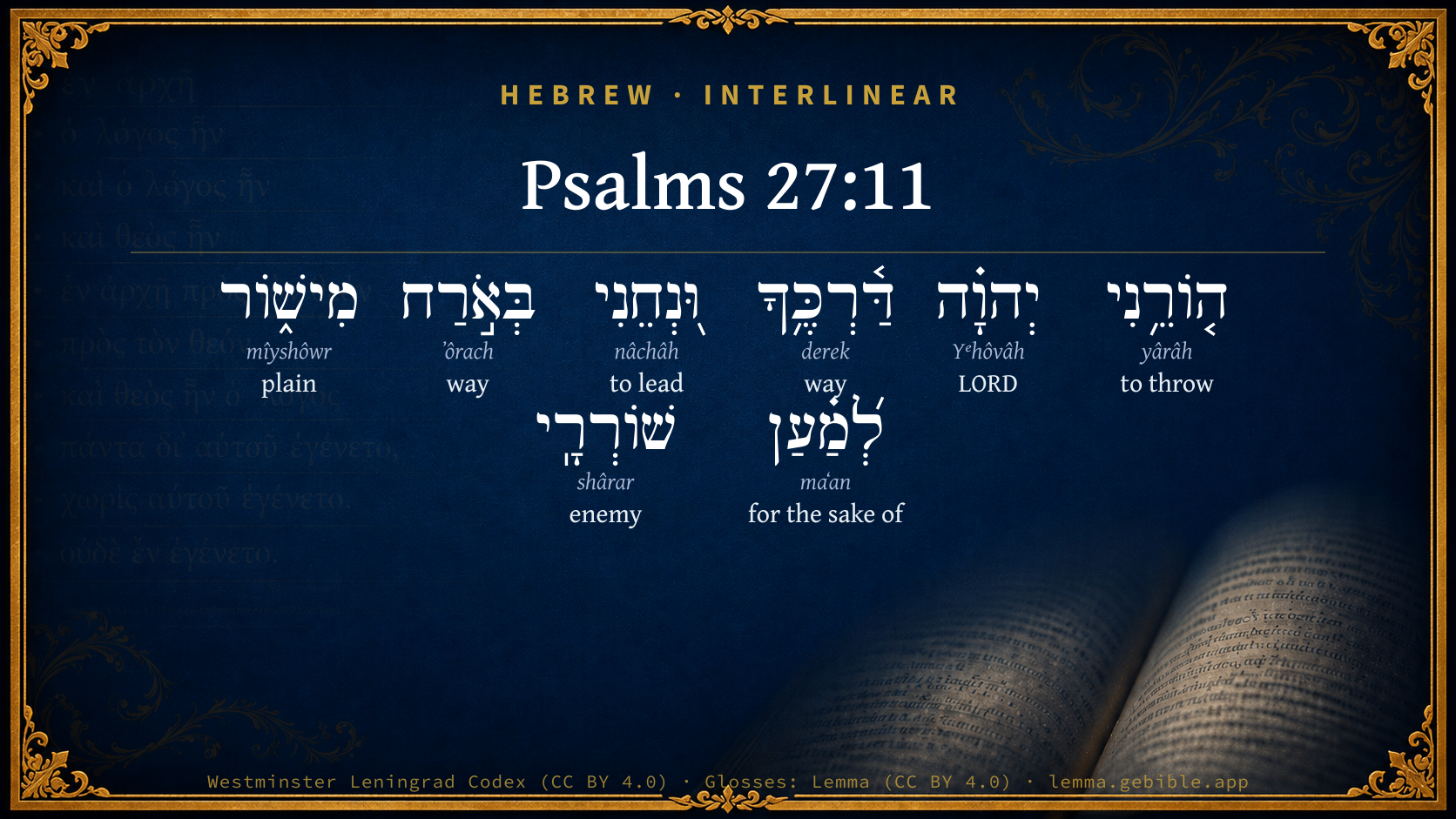
Psalms 27:11

Hebrew (Westminster Leningrad Codex) Psalms 27:11 appears in the Hebrew Old Testament. The text above is from the Westminster Leningrad Codex. Each word links to its Strong’s number, a concise gloss, and parsing drawn from the Open Scriptures Hebrew Bible morphology. Click any word for its full Brown-Driver-Briggs (BDB) entry.
Download image
Cite this verse

Psalms 27:11 (World English Bible). Public Domain. Lemma interlinear Bible study tool, https://lemma.gebible.app/v/psalms/27/11.

Show BibTeX & RIS
BibTeX
RIS
English Translation
Teach me your way, Yahweh. Lead me in a straight path, because of my enemies.
World English Bible · Public Domain
Download a study sheet

One document with this verse’s original text, its word-by-word gloss line, the meaning frame, cross-references with their text, attributed commentary, and full source and license credits — printable, and it pastes into notes with its structure intact.

This verse Autodidact and up

Study sheet (.html) Plain text (.txt)

A passage Seminary Student

Up to 50 verses in one chapter. A passage sheet keeps up to 6 commentary sources and 12 cross-references per verse, in the order this page ranks them, and says so on the sheet whenever that leaves anything out. Ask for a single verse and you get the Autodidact verse sheet above.

Everything on this page stays free to read, with no account — the sheet is a download of what is already on screen, not access to it.

Want to remove ads? Support Godless Engineer
Compare translations 3

The same verse in 3 English versions, stacked beneath the original-language interlinear above. Click any original word for its lexicon entry.

Each is an independent rendering of the whole verse — the interlinear is not word-aligned to these translations.

Highlighted words mark where these versions differ — a whole-verse word diff, not a word-by-word alignment.

  • World English Bible Public Domain
    Teach me your way, Yahweh. Lead me in a straight path, because of my enemies.
  • King James Version Public Domain
    Teach me thy way, O LORD, and lead me in a plain path, because of mine enemies.
  • unfoldingWord Literal Text CC BY-SA 4.0
    Teach me your way, Yahweh, and lead me on a level path because of my enemies.

unfoldingWord Literal Text — © unfoldingWord, licensed CC BY-SA 4.0. Word-aligned USFM3 via Door43 (git.door43.org/unfoldingWord/en_ult).

Versions to compare (up to 4)

3 of 4 selected

Show all 18 translations

Every available English version of this verse, each an independent rendering of the whole verse.

  • World English Bible Public Domain
    Teach me your way, Yahweh. Lead me in a straight path, because of my enemies.
  • Berean Standard Bible Public Domain
    Teach me Your way, O LORD, and lead me on a level path, because of my oppressors.
  • Majority Standard Bible Public Domain
    Teach me Your way, O LORD, and lead me on a level path, because of my oppressors.
  • King James Version Public Domain
    Teach me thy way, O LORD, and lead me in a plain path, because of mine enemies.
  • American Standard Version (1901) Public Domain
    Teach me thy way, O Jehovah; And lead me in a plain path, Because of mine enemies.
  • Revised Version (1885) Public Domain
    Teach me thy way, O LORD; and lead me in a plain path, because of mine enemies.
  • Geneva Bible (1599) Public Domain
    Teache mee thy way, O Lord, and leade me in a right path, because of mine enemies.
  • Douay-Rheims (1899) Public Domain
    Set me, O Lord, a law in thy way, and guide me in the right path, because of my enemies.
  • Young's Literal Translation Public Domain
    Shew me, O Jehovah, Thy way, And lead me in a path of uprightness, For the sake of my beholders.
  • Literal Standard Version CC BY-SA 4.0
    Show me, O YHWH, Your way, || And lead me in a path of uprightness, || For the sake of my beholders.
  • Unlocked Literal Bible CC BY-SA 4.0
    Teach me your way, Yahweh! Lead me on a level path because of my enemies.
  • unfoldingWord Literal Text CC BY-SA 4.0
    Teach me your way, Yahweh, and lead me on a level path because of my enemies.
  • Darby Bible Public Domain
    Teach me thy way, Jehovah, and lead me in an even path, because of mine enemies.
  • World Messianic Bible Public Domain
    Teach me your way, LORD. Lead me in a straight path, because of my enemies.
  • Webster's Bible Public Domain
    Teach me thy way, O LORD, and lead me in a plain path, because of my enemies.
  • Free Bible Version CC BY-SA 4.0
    Lord, teach me your way and lead me along the right path, because my enemies are against me —
  • Bible in Basic English Public Domain
    Make your way clear to me, O Lord, guiding me by the right way, because of my haters.
  • JPS Tanakh (1917) Public Domain
    Teach me Thy way, O LORD; and lead me in an even path, because of them that lie in wait for me.

Literal Standard Version (2020), Covenant Press — licensed CC BY-SA 4.0. Text via the HelloAO Bible API (eBible.org). Unlocked Literal Bible (unfoldingWord) — licensed CC BY-SA 4.0. Text via the HelloAO Bible API (eBible.org). unfoldingWord Literal Text — © unfoldingWord, licensed CC BY-SA 4.0. Word-aligned USFM3 via Door43 (git.door43.org/unfoldingWord/en_ult). Free Bible Version, Dr. Jonathan Gallagher — licensed CC BY-SA 4.0. Text via the HelloAO Bible API (eBible.org).

Word by word

More ways to search: Search by grammar → Find every occurrence → Compare this word →

Practice this passage: Drill this verse → Learn its vocabulary →

About this verse

These counts appear in no published source. They are computed here, from the morphology-tagged text and Lemma’s own curated glosses. What Lemma adds →

8
words
8
distinct lemmas
Wisdom
section

Notable vocabulary

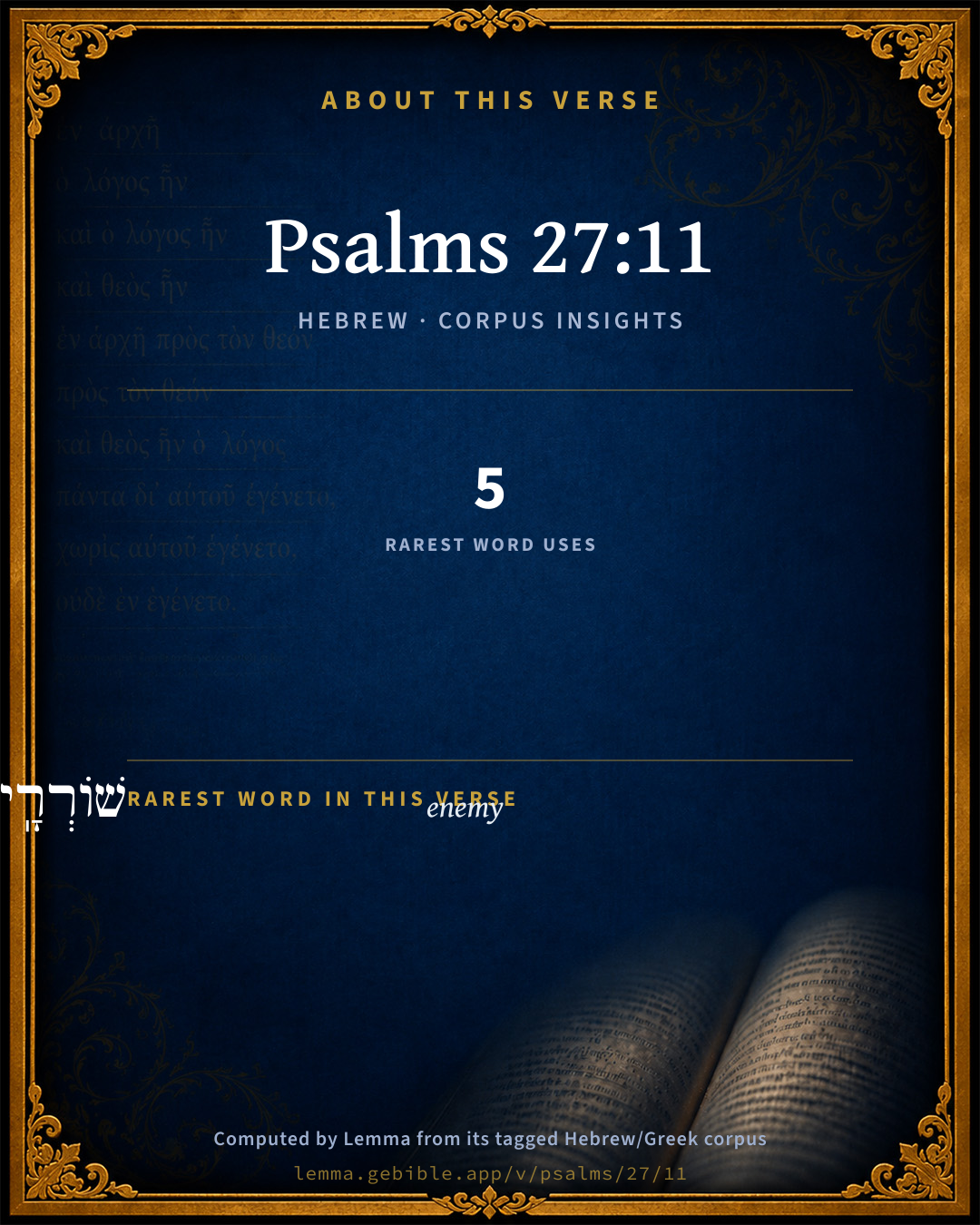
The rarest word here is שׁוֹרְרָֽי enemy H8324 — appearing just 5 times in the whole Hebrew Bible.

Shared distinctive vocabulary

שׁוֹרְרָֽי enemy H8324 occurs in 5 verses of the Hebrew Bible. Also found in:

Grammatical profile

  • 2 verbs
  • 5 nouns
  • 1 preposition

Verb forms

  • ה֤וֹרֵ֥נִי Hiphil · Imperative
  • וּ֭נְחֵנִי Qal · Imperative

Hebrew & Septuagint length

In English translation the verse runs 15 words from the Hebrew and 18 from the Septuagint (LXX English) — closely comparable.

A rough comparison of the two English renderings, which tokenize alike — not a word-level alignment.

Word counts can differ between the Hebrew and the Greek without any difference in meaning — e.g. the Hebrew direct-object marker אֵת has no separate Greek word, and Greek often adds the article ὁ.

Cross-references

20

Topical passages linked to Psalms 27:11 in the Treasury of Scripture Knowledge — connected by theme and wording, ordered by reader-vote popularity; previews shown in the World English Bible.

  • Psalms 25:4–5 Show me your ways, Yahweh. Teach me your paths.
  • Psalms 5:8 Lead me, Yahweh, in your righteousness because of my enemies. Make your way straight before my face.
  • Psalms 86:11 Teach me your way, Yahweh. I will walk in your truth. Make my heart undivided to fear your name.
  • Psalms 26:12 My foot stands in an even place. In the congregations I will bless Yahweh.
  • Psalms 143:8–10 Cause me to hear your loving kindness in the morning, For I trust in you. Cause me to know the way in which I should walk, For I lift up my soul to you.
  • Psalms 119:10 With my whole heart, I have sought you. Don't let me wander from your commandments.
  • Proverbs 2:6–9 For Yahweh gives wisdom. Out of his mouth comes knowledge and understanding.
  • Psalms 64:6 They plot injustice, saying, "We have made a perfect plan!" Surely man's mind and heart are cunning.
  • Isaiah 30:20–21 Though the Lord give you the bread of adversity and the water of affliction, yet shall not your teachers be hidden anymore, but your eyes shall see your teachers;
  • Isaiah 35:8 A highway shall be there, and a way, and it shall be called The way of holiness. The unclean shall not pass over it, but is shall be for for him who walks in the Way. Wicked fools will not go there.
  • Luke 3:4–6 As it is written in the book of the words of Isaiah the prophet, "The voice of one crying in the wilderness, 'Make ready the way of the Lord. Make his paths straight.
  • Psalms 25:9 He will guide the humble in justice. He will teach the humble his way.
  • Psalms 25:12 What man is he who fears Yahweh? He shall instruct him in the way that he shall choose.
  • Psalms 56:5–6 All day long they twist my words. All their thoughts are against me for evil.
  • Proverbs 8:9 They are all plain to him who understands, Right to those who find knowledge.
  • Jeremiah 20:10 For I have heard the defaming of many, terror on every side. Denounce, and we will denounce him, [say] all my familiar friends, those who watch for my fall; peradventure he will be persuaded, and we shall prevail against him, and we shall take our revenge on him.
  • Daniel 6:4–5 Then the presidents and the satraps sought to find occasion against Daniel as touching the kingdom; but they could find no occasion nor fault, because he was faithful, neither was there any error or fault found in him.
  • Luke 20:20 They watched him, and sent out spies, who pretended to be righteous, that they might trap him in something he said, so as to deliver him up to the power and authority of the governor.
  • Psalms 54:5 He will repay the evil to my enemies. Destroy them in your truth.
  • Proverbs 15:19 The way of the sluggard is like a thorn patch, But the path of the upright is a highway.

Cross-references courtesy of OpenBible.info (CC BY 4.0).

Hebrew and Greek witnesses Masoretic Hebrew ↔ Greek Septuagint

The same verse in the two great witnesses to the Old Testament, shown verse-for-verse.

You’re reading Greek Psalm 26 (Hebrew Psalm 27). The Septuagint counts the superscription, so verse numbers can differ from the Hebrew — chapter-level alignment, not verse-by-verse. Numbering follows Rahlfs.

These are two independent witnesses, not word-aligned to each other, and the Septuagint is shown in lemma (dictionary) form.

Hebrew Psalms 27:11 Masoretic · Westminster Leningrad Codex

ה֤וֹרֵ֥נִי יְהוָ֗ה דַּ֫רְכֶּ֥ךָ וּ֭נְחֵנִי בְּאֹ֣רַח מִישׁ֑וֹר לְ֝מַ֗עַן שׁוֹרְרָֽי

Teach me your way, Yahweh. Lead me in a straight path, because of my enemies.

World English Bible · Public Domain

Greek LXX Greek Psalm 26:11 Septuagint · lemma form

νομοθετέω ἐγώ κύριος ὁ ὁδός σύ καί ὁδηγέω ἐγώ ἐν τρίβος εὐθύς ἕνεκα ὁ ἐχθρός ἐγώ

Teach me, O Lord, in your way, and guide me in a right path, because of my enemies.

LXX2012 (modern English Septuagint) · Public Domain

Hebrew: Westminster Leningrad Codex (CC BY 4.0). Greek: Septuagint (public domain); English from LXX2012 (modern English Septuagint) (Public Domain). How the Septuagint differs from the Hebrew →

Commentary

Notes on Psalms 27:11 from classic Christian and Jewish commentators (each source and its license shown beneath its notes). The classic Christian expositions comment on the surrounding passage and are grouped to its opening verse, so a note may address several verses; the Jewish commentaries on the Tanakh (Rashi and others) are per-verse, so they appear only where the commentator wrote on this verse.

Lemma curates 59 commentaries, every one of them public domain or Creative Commons licensed, each selected and text-cleaned for this edition rather than reprinted as found. About our sources →

Trapp's Complete Commentary

John Trapp

Psa 27:11 Teach me thy way, O LORD, and lead me in a plain path, because of mine enemies.

Ver. 11. Teach me thy way, O Lord, and lead me, &c.] Deus non deserit suos, dum eos docet ac ducit, God shows that he forsaketh not his (whatever other friends do) so long as he teacheth and leadeth them. See Psa 25:4-5. {See Trapp on "Psa 25:4"} {See Trapp on "Psa 25:5"}

In a plain path] Heb. In a way of plainness, wherein I may escape mine enemies’ ambushes.

Because of mine enemies] Or, Because of mine observers; so it may be read ( propter insidiatores meos); such as Saul and Doeg were, who looked upon David with an evil eye, and watched for his halting. It was the wisdom of the Lacedaemonians always to send two ambassadors together which disagreed among themselves; that so they might mutually eye one another’s actions (Aristot. Polit. lib. ii. cap. 7). The wicked will be eyeing and prying into the practices of good people, who must therefore watch and pray.

John Trapp, A Commentary or Exposition upon All the Books of the Old and New Testament (1647–1656) — public domain. Text from a community e-Sword module.

The Biblical Illustrator

Joseph S. Exell

Psa_27:11

Lead me in a plain path, because of mine enemies.

Our observers

Instead of enemies, the margin reads observers. And we have many such.

I. the world--with keen and malignant eye. If we act inconsistently with our profession, they will be sure to notice it and despise us, and our religion accordingly.

II. saints. They observe us from a sense of love and duty; they are commanded to admonish, exhort, and consider one another.

III. ministers are our observers. They are to take heed to the flock over which, etc.

IV. angel observers. We are a spectacle to angels as well as to men.

V. above all, God observes us. He bids us walk before Him and be perfect. We are men in secret, but observed at all times. Surely we need wisdom and strength far above our own. (W. Jay.)

Divine direction

I. the text is applicable to relievers in all ages, since all need the same direction and instruction. How many have attempted to reach the summit of Parnassus, from which they might view the flowers of rhetoric and the fruits of philosophy flourishing beneath their feet; but how few have ascended far above the base of the mount before they have been discouraged by its amazing height, when they have returned in despair of ever attaining to such an elevation. Although David prayed to be led in a plain path, yet he neither thought nor expected that this path was to be attended with no difficulties ,--free from all pain, and full of unfading pleasure. All that any one can reasonably desire, who prefers the prayer contained in the text, is that God would graciously vouchsafe such guidance, that we may not swerve from that true and living way, marked out in the councils of His love, and made manifest by Him who declares Himself to be the way, the truth, and the life. One reason why so many mistake the plain path, arises partly from the pride of the human mind, which would rather employ its faculties upon those subjects which relate to things temporal, as bearing upon mans present enjoyment, than direct its energies to the pursuit of those objects which lie beyond the precincts of time, and are connected with unseen and spiritual realities. How often are the most elevated minds and soaring spirits engaged rather in those speculations which tend more to increase scepticism, than to diminish error! How unwilling is the loftiness of intellect to bow to the humiliating doctrine of the Cross! And how reluctant is the philosophic sage to stoop from the heights of scientific discovery, and condescend to the humble condition of a learner at the feet of the despised Nazarene!

II. the ordinary way in which God leads his people to their heavenly rest, Surely the rewards and punishments of another life, which the Almighty has established as the enforcements of His law, are of sufficient weight to determine the choice, against whatever pleasure or pain this life can show, when the eternal state is considered in reference merely to its bare possibility, of which possibility no one can have any doubt. If the good man be in the right, be is eternally happy; if he mistakes, he is not miserable, for he feels nothing. On the other hand, if the wicked be in the right, he is not happy; if he mistakes, he is infinitely miserable. But in that manifestation of mercy; vouchsafed by that better and brighter dispensation made known by Christ, we are not left to mere hypothesis in order to elucidate the vast extremes of infinite felicity and eternal misery. Since life and immortality are brought to light by the Gospel, we can behold in the mirror of Revelation that light and joy, which we could not see inscribed in the fairest productions of Nature, nor ever attain, in the ample reign of philosophical research or metaphysical discussion, but in the path marked out by Him who hath left us an example that we should walk in His steps. (N. Meeres, B. D.)

Safe leading amid many dangers

As a great ocean steamer nears a coast., the captain and helmsman need a minuteness of knowledge which they do not possess. Unknown dangers, hidden rocks and shoals, are all around them. So a pilot comes off from shore, climbs on board, and takes his place at the wheel. Instantly the control of the ship is transferred from ignorance to knowledge and incompetency to ability. Just, such a transfer takes place in a life that is surrendered to the Infinite Pilot. He knows every sea, to the least shifting bar and the slightest wind that blows. He will bring us to the desired haven. (Christian Commonwealth.)

The Biblical Illustrator, edited by Joseph S. Exell (c. 1880s–1900s) — public domain. Text from a community e-Sword module.

Joseph Benson's Commentary

Psa 27:11-12. Teach me thy way — What course I shall take to please thee, and to discharge my duty, and to save myself from ruin; and lead me in a plain path — Of which see the note on Psa 26:12; where the Hebrew words are the same; because of mine enemies — That I may neither give them cause to open their mouths against me or religion, by my misconduct, nor fall into their hands by my folly, nor afford them any occasion of triumphing over me. Deliver me not over unto the will — Hebrew, בנפשׁ, benephesh, to the soul, that is, the lust, or desire, as the word here means; of mine enemies — Who watch for my halting, and seek my ruin; such as breathe out cruelty — Against me. He presses his request from the consideration of the quality of his enemies, who were both false and cruel, and in both respects hateful to God and men.

Joseph Benson's Commentary on the Old and New Testaments (1811–1818) — public domain. Text from a community e-Sword module.

J. A. Alexander on Psalms

Joseph Addison Alexander

11. (Psa 27:11) Guide me, Jehovah, (in) thy way, and lead me in a straight (or level) path, because of my adversaries. The way in which he here desires to be led, is not the way of duty but of providence, which he calls a straight or smooth path, as distinguished from the rough or crooked ways of adversity. See above, on Psa 25:4; Psa 26:12.—Because of my enemies, that they may have no occasion to exult or triumph. Of the many Hebrew words applied to enemies, the one here used is supposed by some to signify malignant watchers for the errors or calamities of others. The one used in the next verse means oppressors or causers of distress.—With this clause compare Psa 26:12.

Joseph Addison Alexander, The Psalms Translated and Explained (1850) — public domain. Text from a community e-Sword module.

Jamieson, Fausset & Brown

Robert Jamieson, A. R. Fausset & David Brown

thy way--of providence.

a plain path-- (Psa 26:12).

enemies--literally, "watchers for my fall" (Psa 5:8).

Jamieson, Fausset & Brown — Commentary Critical and Explanatory on the Whole Bible (1871) — public domain (CC PDM 1.0). Text via the HelloAO Bible API.

Adam Clarke's Commentary

Verse 11. Teach me thy way] Let me know the gracious designs of thy providence towards me, that my heart may submit to thy will.

And lead me in a plain path] In the path of righteousness, because of mine enemies, who watch for my halting.

Adam Clarke's Commentary on the Bible (1810–1826) — public domain. Text from a community e-Sword/MySword module.

John Calvin's Commentaries

11. Teach me thy way, O Jehovah! Many think that David here requests that God would guide him by his Spirit, lest he should surpass his enemies in acting violently and wickedly. This doctrine is, no doubt, very useful, but it does not seem to agree with the scope of the passage. It is a simpler interpretation, in my opinion, to consider that David desires, in order to escape the snares and violence of his enemies, that God would extend to him his hand, and safely conduct him, so as to give a happy issue to his affairs. He sets the right path in opposition to the difficulties and impediments which are in places which are rough, and of difficult access, to overcome which he was unequal, unless God undertook the office of a guide to lead him. But he who thus desires to commit himself to the safeguard and protection of God, “En la sauvegarde et protection de Dieu.” — Fr.

John Calvin's Commentaries (1540-1563) — public domain. Text from the Calvin Translation Society English edition (1840s-50s) via the Christian Classics Ethereal Library (ccel.org). Calvin's coverage is partial (roughly two-thirds of the Bible); uncommented books and verses are honest gaps, never fabricated. The 19th-century editor's footnotes and remarks are omitted so the notes are faithfully Calvin's own voice.

Ellicott's Commentary for English Readers

(11) Enemies.—Comp. Psa_56:2; Psa_54:7; Psa_59:10-11. Ewald, “malignant liers in wait”; so Aquila.

A Bible Commentary for English Readers, edited by Charles John Ellicott (1878–1897) — public domain. Text from a community e-Sword module.

The Cambridge Bible for Schools and Colleges

gen. ed. J. J. S. Perowne

11. Cp. Psa_5:8; Psa_25:12. In the course of life designed for him by God he will be safe. He prays that it may be like a path along a level open plain, free from pitfalls and places where enemies may lurk in ambush. Plain is the same word as even in Psa_26:12; and mine enemies means literally, those that lie in wail for me, as in Psa_5:8. Cp. Mar_12:13 for illustration.

The Cambridge Bible for Schools and Colleges (gen. ed. J. J. S. Perowne; Cambridge University Press, 1878–1918) — public domain. Text from a community e-Sword module.

John Gill's Exposition

Teach me thy way, O Lord,.... Of providence, grace, and duty; See Gill on Psa 25:4;

and lead me in a plain path: as the path of truth is to those that understand and find knowledge; and as the way of holiness is, even to such who in other things are fools, but shall not err therein, Pro 8:9, Isa 35:8; or the path of righteousness, in which Christ, the wisdom of God, and shepherd of his people, leads them, Psa 23:3;

because of mine enemies, or "those that observe me"; who eyed him as Saul did, Sa1 18:9; and waited for his halting, as Jeremiah's familiars did for him; and lay in wait to deceive him, and lead him out of the way, as false teachers do; and come upon him at an unawares, and take every advantage against him, as Satan does.

John Gill's Exposition of the Whole Bible (1746–1763) — public domain (CC PDM 1.0). Text via the HelloAO Bible API.

Albert Barnes' Notes on the Bible

Teach me thy way, O Lord - See the notes at Psa 25:4-5.

And lead me in a plain path - Margin, “a way of plainness.” That is, a straight or smooth path. In other words, he prayed that he might be enabled to act wisely and right; he desired that God would teach him what he should do.

Because of mine enemies - Margin, “those which observe me.” The translation in the text expresses the true sense. The word which is used is derived from a verb that signifies “to twist; to twist together;” and then, to oppress; to treat as an enemy. Here it refers to those who would treat him harshly or cruelly; and he prays that God would show him how to act in view of the fact that he was surrounded by such foes. They were harsh and cruel; they sought to overcome him; they laid snares for him. He knew not how to act so as to escape from them, and he, therefore, pleads that God would instruct and guide him.

Albert Barnes' Notes on the Bible (1834–1885) — public domain. Text from a community e-Sword/MySword module.

Matthew Poole's English Annotations

Thy way, i.e. what course I shall take to please thee, and to discharge my duty, and to save myself from ruin.

A plain path; of which See Poole "Psa 26:12", where the Hebrew words are the same.

Because of mine enemies; that I may neither open their mouths against me or religion by my miscarriages, nor fall into their hands by my folly, nor give them any occasion of triumphing over me.

Matthew Poole's English Annotations on the Holy Bible (1683–1685) — public domain. Text from a community e-Sword/MySword module.

The Treasury of David

Charles H. Spurgeon

Ver. 11. Teach me thy way, O Lord. He does not pray to be indulged with his own way, but to be informed as to the path in which the righteous Jehovah would have him walk. This prayer evinces an humble sense of personal ignorance, great teachableness of spirit, and cheerful obedience of heart. Lead me in a plain path. Help is here sought as well as direction; we not only need a map of the way, but a guide to assist us in the journey. A path is here desired which shall be open, honest, straightforward, in opposition to the way of cunning, which is intricate, tortuous, dangerous. Good men seldom succeed in fine speculations and doubtful courses; plain simplicity is the best spirit for an heir of heaven: let us leave shifty tricks and political expediencies to the citizens of the worldthe New Jerusalem owns plain men for its citizens. Esau was a cunning hunter, Jacob was a plain man, dwelling in tents. Because of mine enemies. These will catch us if they can, but the way of manifest, simple honesty is safe from their rage. It is wonderful to observe how honest simplicity baffles and outwits the craftiness of wickedness. Truth is wisdom. "Honesty is the best policy."

Ver. 11. Teach me thy way, O Lord. Having compared himself to an exposed, deserted infant, adopted by God, he anon fairly asks to be shown how to walk. He asks the grace of being able to observe all his holy commandments, which he never loses sight of through the whole one hundred and fifty Psalms. What else could he do? when it was the only path to that heavenly house of God, which he had just declared to be the only wish and desire of his heart. Robert Bellarmine (Cardinal), 1542-1621.

Ver. 11. Lead me in a plain path, because of mine enemies. If a man travelling in the King's highway, be robbed between sun and sun, satisfaction is recoverable upon the county where the robbery was made; but if he takes his journey in the night, being an unseasonable time, then it is at his own peril, he must take what falls. So, if a man keep in God's ways, he shall be sure of God's protection; but if he stray out of them, he exposes himself to danger. Robert Skinner (Bishop), 1636.

Ver. 11. Because of mine enemies. If once a man commence a professor, the eyes of all are upon him; and well they may, for his profession in the world is a separation from the world. Believers condemn those by their lives who condemn them by their lips. Righteous David saw many who were waiting to triumph in his mistakes. Hence the more they watched, the more he prayed: "Teach me thy way, O Lord, and lead me in a plain path, because of mine enemies." It may be rendered, because of mine observers. Christian, if you dwell in the open tent of licentiousness, the wicked will not walk backward, like modest Shem and Japheth, to cover your shame: but they will walk forward, like cursed Ham, to publish it. Thus they make use of your weakness as a plea for their wickedness. Men are merciless in their censures of Christians; they have no sympathy for their infirmity: while God weighs them in more equal scales, and says, "The spirit is willing, but the flesh is weak." While a saint is a dove in the eyes of God, he is only a raven in the estimation of sinners. William Secker.

Ver. 11. The plain man's pathway desired, described, divinely approved, "thy way", "a plain way", and divinely taught, "teach me, O Lord, ""lead me."

Psalms 27:12*

Charles H. Spurgeon's The Treasury of David (1869–1885) — public domain. Psalms only. Text from a community e-Sword/MySword module.

Whedon's Commentary on the Bible

Daniel D. Whedon

11. A plain path—This even or straight path is the Lord’s “way,” as in the preceding member of the verse. See Psa_26:12. In it there are no dangers. Isa_35:8.

Because of mine enemies—Who watch all my steps for evil.

Daniel D. Whedon (gen. ed.), Commentary on the Old and New Testaments (1874–1909) — public domain. Text from a community e-Sword module.

The Pulpit Commentary

Teach me thy way, O Lord. (comp. Psa_25:3, and the comment ad loc.) And lead me in a plain path; literally, a level path a path traversing a fiat and smooth country, not one where the ground is rugged and beset with rocks and precipices. Because of mine enemies. David"s enemies are ever at hand, to swallow him up. (Psa_56:2) If his way be not plain and smooth, it will be to their advantage and to his detriment.

A double safeguard.

"Lead me in a plain path." This is a wise, humble, comprehensive prayer. Like the entire psalm, it is the language of a heart deeply taught by experience. It asks for a double safeguard Divine guidance and a plain path. If sure of the one, why ask for the other? Answer:

(1) Because a great part of God"s leading just consists in making the path plain;

(2) because danger and temptation beset even the plainest path of mine enemies." At every step we need God"s upholding and protecting hand.

I A PATH EASY TO SEE; free from intricacy and obscurity. In the margin, "a way of plainness." The Hebrew word (like our English "plain") signifies "level". (see Isa_42:16, "straight In a mountainous region the path is winding, often hidden a few yards ahead. On the open plain you see it for miles. As a rule, the straight path in life is the plain path. The same Hebrew word also means "uprightness," "righteousness". (Psa_45:6) Duty is commonly much more easy to discern than expediency; "What is right?" than "What is polite, worldly wise?" One of the great trials of life is when duty is not plain; duties seem to clash. Then comes in the comfort and strength of thin prayer, "Teach me thy way!". (Psa_25:5, Psa_25:8, Psa_25:9) God"s way must be the right way; "and he will make it plain.

II A SAFE AND EASY PATH; at all events, in comparison with the wrong path. Not climbing the sharp ascent of the Hill Difficulty, nor winding along the slippery edge of temptation, nor descending into the Valley of the Shadow of Death. God cannot always grant this prayer in this sense. Yet Christ teaches us to offer it. (Luk_22:40 Mat_6:13) If, nevertheless, the path by which God sees fit to lead us either for spiritual discipline and growth, or for greater usefulness be rough, dark, dangerous; the spirit of this prayer may nevertheless be answered by a larger measure of guidance and strength. "In the mount, the Lord is seen." In the furnace is "the Son of God." In Gethsemane, the angel. When "all hope was taken away," God"s angel told Paul that all were to be saved for his sake. (Act_27:20, Act_27:22-24) Be the path what it may, those shall be safe who trust God"s leading. (Isa_35:8 Rom_8:28 Jud_1:24 Pro_15:19) This prayer is a prayer against three dangers.

1. Choosing our own way. (Pro_14:12)

2. Trusting, even in the plainest way, to our own strength and wisdom. (Pro_3:5, 6 Jer_10:23)

3. Being left to our own weakness; or distrusting, in the darkest path, God"s leading. (Isa_43:1, Isa_43:2)

The Pulpit Commentary (1880–1919), ed. H.D.M. Spence-Jones & Joseph S. Exell — public domain. Text from a community e-Sword module.

John Wesley's Explanatory Notes

Because of - That I may neither fall into their hands by my folly, nor give them any occasion of triumphing over me.

John Wesley, Explanatory Notes Upon the Whole Bible (1754–1765) — public domain. Text via the GEBible commentary corpus.

Keil & Delitzsch

C. F. Keil & F. Delitzsch

He is now wandering about like a hunted deer; but God is able to guide him so that he may escape all dangers. And this is what he prays for. As in Psa 143:10, מישׁור is used in an ethical sense; and differs in this respect from its use in Psa 26:12. On שׁררים, see the primary passage Psa 5:9, of which this is an echo. Wily spies dodge his every step and would gladly see what they have invented against him and wished for him, realised. Should he enter the way of sin leading to destruction, it would tend to the dishonour of God, just as on the contrary it is a matter of honour with God not to let His servant fall. Hence he prays to be led in the way of God, for a oneness of his own will with the divine renders a man inaccessible to evil. נפשׁ, Psa 27:12, is used, as in Psa 17:9, and in the similar passage, which is genuinely Davidic, Psa 41:3, in the signification passion or strong desire; because the soul, in its natural state, is selfishness and inordinate desire. יפח is a collateral form of יפיח; they are both adjectives formed from the future of the verb פּוּח (like ירב, יריב): accustomed to breathe out (exhale), i.e., either to express, or to snort, breathe forth (cf. πνεῖν, or ἐμπνεῖν φόνον and θόνοῦ, θυμον, and the like, Act 9:1). In both Hitzig sees participles of יפח (Jer 4:31); but Psa 10:5 and Hab 2:3 lead back to פּוּח (פּיח); and Hupfeld rightly recognises such nouns formed from futures to be, according to their original source, circumlocutions of the participle after the manner of an elliptical relative clause (the ṣifat of the Arabic syntax), and explains יפיח כּזבים, together with יפח חמס, from the verbal construction which still continues in force.

Keil & Delitzsch — Biblical Commentary on the Old Testament (1861–1891) — public domain (CC PDM 1.0). Text via the HelloAO Bible API. (Old Testament only.)

unfoldingWord translationNotes

Door43 World Missions Community

Teach me your way

How a person should behave is spoken of as if it were a way or path that person should travel. AT: "Teach me how you want me to live" or "Teach me to do what you want me to do" (See: Metaphor)

Lead me on a level path

Yahweh keeping the writer safe from his enemies is spoken of as if Yahweh leads the writer on a level path where he will not stumble and fall. AT: "Keep me safe" (See: Metaphor)

Do not give me up to the desires of my enemies

The abstract noun "desires" can be stated as a verb. AT: "Do not let my enemies do to me what they desire" (See: Abstract Nouns)

have risen up against me

"Risen up" here is an idiom meaning that a witness stood in court to present testimony. AT: "have stood up in order to speak against me" (See: Idiom)

they breathe out violence

Here violence is spoken for as if it was something a person could breathe out. AT: "they say that they will do violent things to me" (See: Metaphor)

translationWords

adversary

corrupt witness

raise

unfoldingWord translationNotes — © Distant Shores Media and the Door43 World Missions Community, licensed CC BY-SA 4.0. Source: git.door43.org/Door43/en_tn.

Lesson kit

Teaching starters — assembled from the data on this page, not authored interpretation. Every prompt links to the verse data it draws on. Edit before teaching.

Psalms, in the Wisdom, opens this verse with 8 words (8 distinct Hebrew lemmas). Its most distinctive word is shârar (“enemy”). A historical commentator’s framing appears above. Read the whole chapter for the surrounding context.

Discussion questions

  1. How does “enemy” (shârar) shape what this verse is saying?
  2. How does Psalms 5:8, which shares the word «enemy», read alongside this verse?
  3. The translations on this page render this verse differently — a whole-verse word diff, not a word-by-word alignment. What might account for the different wordings?
  4. «ה֤וֹרֵ֥נִי» is a Hiphil Imperative verb. How does that grammatical form shape the action described?
  5. Compare how Trapp's Complete Commentary and The Biblical Illustrator read this verse. Where do they agree or differ?

Things to notice

Reading settings

Reading text

Shown beneath each verse's original-language words.

Old Testament
Old Testament edition

Read the OT as the Masoretic Hebrew (MT) or the Greek Septuagint (LXX).

English shown for the Greek Septuagint (in the Hebrew ↔ Greek comparison).

Comparing translations? Open the Compare panel on any verse page to stack up to four side by side.