
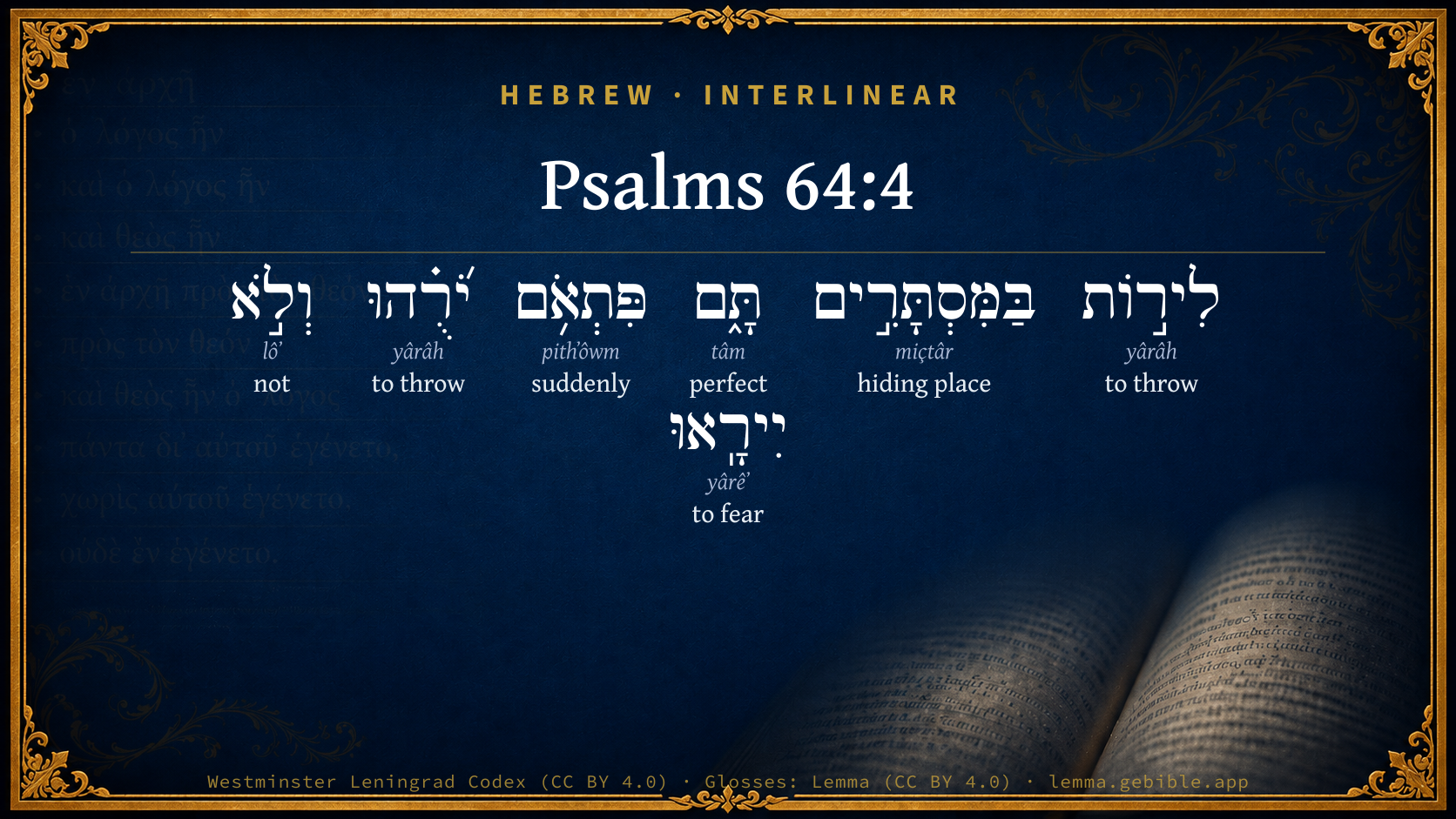
Psalms 64:4

Hebrew (Westminster Leningrad Codex) Psalms 64:4 appears in the Hebrew Old Testament. The text above is from the Westminster Leningrad Codex. Each word links to its Strong’s number, a concise gloss, and parsing drawn from the Open Scriptures Hebrew Bible morphology. Click any word for its full Brown-Driver-Briggs (BDB) entry.
Download image
Cite this verse

Psalms 64:4 (World English Bible). Public Domain. Lemma interlinear Bible study tool, https://lemma.gebible.app/v/psalms/64/4.

Show BibTeX & RIS
BibTeX
RIS
English Translation
To shoot innocent men from ambushes. They shoot at him suddenly and fearlessly.
World English Bible · Public Domain
Download a study sheet

One document with this verse’s original text, its word-by-word gloss line, the meaning frame, cross-references with their text, attributed commentary, and full source and license credits — printable, and it pastes into notes with its structure intact.

This verse Autodidact and up

Study sheet (.html) Plain text (.txt)

A passage Seminary Student

Up to 50 verses in one chapter. A passage sheet keeps up to 6 commentary sources and 12 cross-references per verse, in the order this page ranks them, and says so on the sheet whenever that leaves anything out. Ask for a single verse and you get the Autodidact verse sheet above.

Everything on this page stays free to read, with no account — the sheet is a download of what is already on screen, not access to it.

Want to remove ads? Support Godless Engineer
Compare translations 3

The same verse in 3 English versions, stacked beneath the original-language interlinear above. Click any original word for its lexicon entry.

Each is an independent rendering of the whole verse — the interlinear is not word-aligned to these translations.

Highlighted words mark where these versions differ — a whole-verse word diff, not a word-by-word alignment.

  • World English Bible Public Domain
    To shoot innocent men from ambushes. They shoot at him suddenly and fearlessly.
  • King James Version Public Domain
    That they may shoot in secret at the perfect: suddenly do they shoot at him, and fear not.
  • unfoldingWord Literal Text CC BY-SA 4.0
    to shoot the innocent from secret places; suddenly they shoot, and they do not fear.

unfoldingWord Literal Text — © unfoldingWord, licensed CC BY-SA 4.0. Word-aligned USFM3 via Door43 (git.door43.org/unfoldingWord/en_ult).

Versions to compare (up to 4)

3 of 4 selected

Show all 18 translations

Every available English version of this verse, each an independent rendering of the whole verse.

  • World English Bible Public Domain
    To shoot innocent men from ambushes. They shoot at him suddenly and fearlessly.
  • Berean Standard Bible Public Domain
    ambushing the innocent in seclusion, shooting suddenly, without fear.
  • Majority Standard Bible Public Domain
    ambushing the innocent in seclusion, shooting suddenly, without fear.
  • King James Version Public Domain
    That they may shoot in secret at the perfect: suddenly do they shoot at him, and fear not.
  • American Standard Version (1901) Public Domain
    That they may shoot in secret places at the perfect: Suddenly do they shoot at him, and fear not.
  • Revised Version (1885) Public Domain
    That they may shoot in secret places at the perfect: suddenly do they shoot at him, and fear not.
  • Geneva Bible (1599) Public Domain
    To shoote at the vpright in secrete: they shoote at him suddenly, and feare not.
  • Douay-Rheims (1899) Public Domain
    For they have whetted their tongues like a sword; they have bent their bow a bitter thing,
  • Young's Literal Translation Public Domain
    To shoot in secret places the perfect, Suddenly they shoot him, and fear not.
  • Literal Standard Version CC BY-SA 4.0
    To shoot the perfect in secret places, || Suddenly they shoot him, and do not fear.
  • Unlocked Literal Bible CC BY-SA 4.0
    so that they may shoot from secret places at someone who is innocent; suddenly they shoot at him and fear nothing.
  • unfoldingWord Literal Text CC BY-SA 4.0
    to shoot the innocent from secret places; suddenly they shoot, and they do not fear.
  • Darby Bible Public Domain
    That they may shoot in secret at the perfect: suddenly do they shoot at him, and fear not.
  • World Messianic Bible Public Domain
    to shoot innocent men from ambushes. They shoot at him suddenly and fearlessly.
  • Webster's Bible Public Domain
    \\64:3\\Who whet their tongue like a sword, and bend their bows to shoot their arrows, even bitter words:
  • Free Bible Version CC BY-SA 4.0
    They shoot from their hiding places at innocent people—doing this without warning, not afraid of being caught.
  • Bible in Basic English Public Domain
    So that in secret they may let loose their arrows at the upright, suddenly and unseen.
  • JPS Tanakh (1917) Public Domain
    (64-5) That they may shoot in secret places at the blameless; suddenly do they shoot at him, and fear not.

Literal Standard Version (2020), Covenant Press — licensed CC BY-SA 4.0. Text via the HelloAO Bible API (eBible.org). Unlocked Literal Bible (unfoldingWord) — licensed CC BY-SA 4.0. Text via the HelloAO Bible API (eBible.org). unfoldingWord Literal Text — © unfoldingWord, licensed CC BY-SA 4.0. Word-aligned USFM3 via Door43 (git.door43.org/unfoldingWord/en_ult). Free Bible Version, Dr. Jonathan Gallagher — licensed CC BY-SA 4.0. Text via the HelloAO Bible API (eBible.org).

Word by word

More ways to search: Search by grammar → Find every occurrence → Compare this word →

Practice this passage: Drill this verse → Learn its vocabulary →

About this verse

These counts appear in no published source. They are computed here, from the morphology-tagged text and Lemma’s own curated glosses. What Lemma adds →

7
words
6
distinct lemmas
Wisdom
section

Notable vocabulary

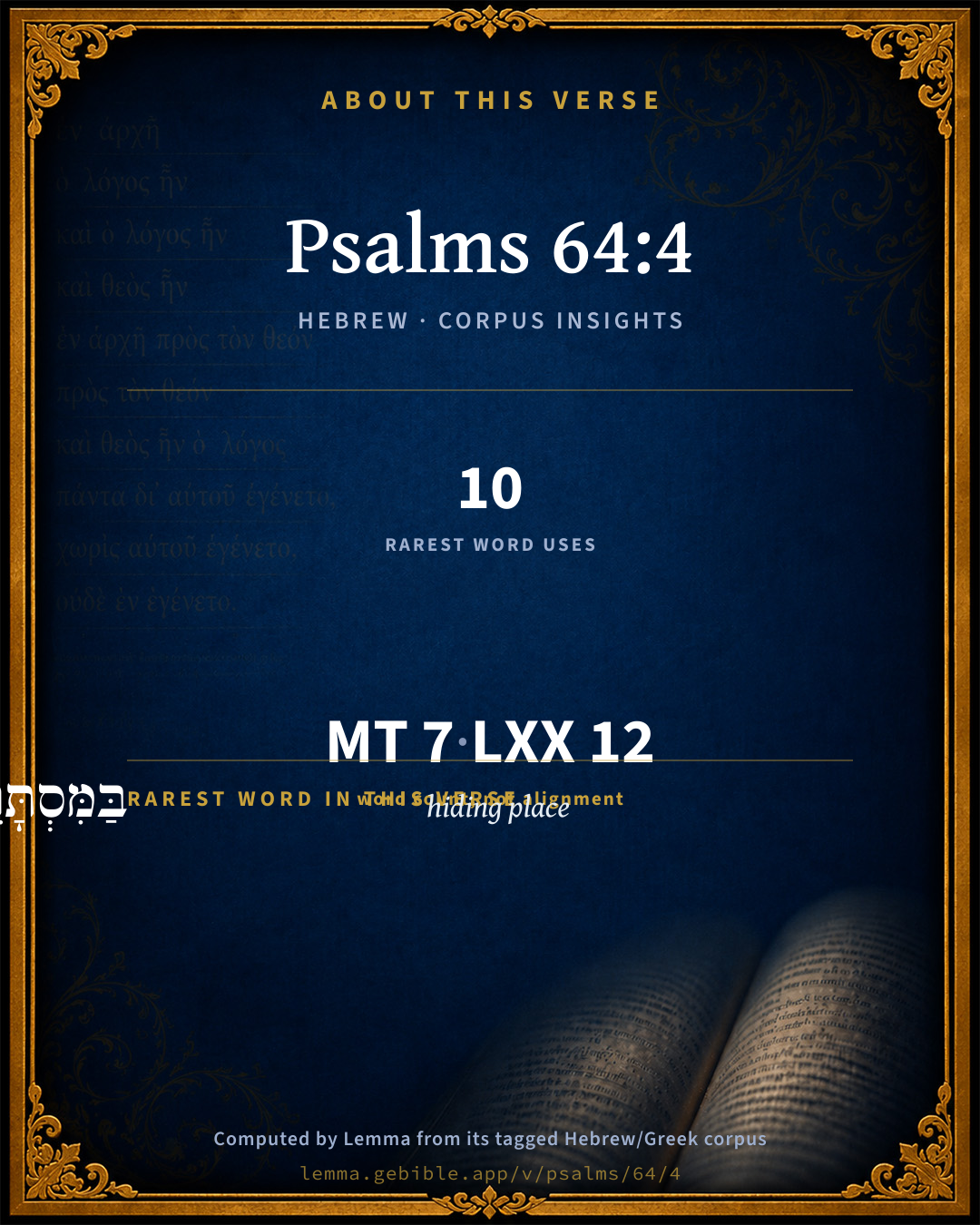
The rarest word here is בַּמִּסְתָּרִ֣ים hiding place H4565 — appearing just 10 times in the whole Hebrew Bible.

Shared distinctive vocabulary

בַּמִּסְתָּרִ֣ים hiding place H4565 occurs in 10 verses of the Hebrew Bible. Also found in:

Grammatical profile

  • 3 verbs
  • 1 noun
  • 1 adjective
  • 1 adverb
  • 1 particle

Verb forms

  • לִיר֣וֹת Qal · Infinitive Construct
  • יֹ֝רֻ֗הוּ Hiphil · Imperfect
  • יִירָֽאוּ Qal · Imperfect

Repetition

A word recurs within this verse — often emphatic in Hebrew:

  • לִיר֣וֹת to throw H3384 ×2

Hebrew & Septuagint length

In English translation the verse runs 13 words from the Hebrew and 16 from the Septuagint (LXX English) — closely comparable.

A rough comparison of the two English renderings, which tokenize alike — not a word-level alignment.

Word counts can differ between the Hebrew and the Greek without any difference in meaning — e.g. the Hebrew direct-object marker אֵת has no separate Greek word, and Greek often adds the article ὁ.

In the original languages it is 7 Hebrew tokens and 12 Greek tokens — but the two are counted differently (Hebrew bundles its prefixes and suffixes into one token; the Greek is in lemma form), so that isn’t a like-for-like length.

Cross-references

12

Topical passages linked to Psalms 64:4 in the Treasury of Scripture Knowledge — connected by theme and wording, ordered by reader-vote popularity; previews shown in the World English Bible.

  • Psalms 55:19 God, who is enthroned forever, Will hear, and answer them. Selah. They never change, Who don't fear God.
  • 1 Peter 2:22–23 who did not sin, "neither was deceit found in his mouth."
  • Psalms 10:8–9 He lies in wait near the villages. From ambushes, he murders the innocent. His eyes are secretly set against the helpless.
  • Psalms 11:2 For, behold, the wicked bend their bows. They set their arrows on the strings, That they may shoot in darkness at the upright in heart.
  • 1 Samuel 18:11 and Saul cast the spear; for he said, I will strike David even to the wall. David avoided out of his presence twice.
  • 1 Samuel 19:10 Saul sought to strike David even to the wall with the spear; but he slipped away out of Saul's presence, and he struck the spear into the wall: and David fled, and escaped that night.
  • 2 Samuel 15:14 David said to all his servants who were with him at Jerusalem, Arise, and let us flee; for else none of us shall escape from Absalom: make speed to depart, lest he overtake us quickly, and bring down evil on us, and strike the city with the edge of the sword.
  • Nehemiah 4:11 Our adversaries said, They shall not know, neither see, until we come into the midst of them, and kill them, and cause the work to cease.
  • Psalms 59:3–4 For, behold, they lie in wait for my soul. The mighty gather themselves together against me, Not for my disobedience, nor for my sin, Yahweh.
  • Psalms 64:7 But God will shoot at them. They will be suddenly struck down with an arrow.
  • Habakkuk 3:14 You pierced the heads of his warriors with their own spears. They came as a whirlwind to scatter me, Gloating as if to devour the wretched in secret.
  • John 19:6 When therefore the chief priests and the officers saw him, they shouted, saying, "Crucify! Crucify!" Pilate said to them, "Take him yourselves, and crucify him, for I find no basis for a charge against him."

Cross-references courtesy of OpenBible.info (CC BY 4.0).

Hebrew and Greek witnesses Masoretic Hebrew ↔ Greek Septuagint

The same verse in the two great witnesses to the Old Testament, shown verse-for-verse.

You’re reading Greek Psalm 63 (Hebrew Psalm 64). The Septuagint counts the superscription, so verse numbers can differ from the Hebrew — chapter-level alignment, not verse-by-verse. Numbering follows Rahlfs.

These are two independent witnesses, not word-aligned to each other, and the Septuagint is shown in lemma (dictionary) form.

Hebrew Psalms 64:4 Masoretic · Westminster Leningrad Codex

לִיר֣וֹת בַּמִּסְתָּרִ֣ים תָּ֑ם פִּתְאֹ֥ם יֹ֝רֻ֗הוּ וְלֹ֣א יִירָֽאוּ

To shoot innocent men from ambushes. They shoot at him suddenly and fearlessly.

World English Bible · Public Domain

Greek LXX Greek Psalm 63:4 Septuagint · lemma form

ὅστις ἀκονάω ὡς ῥομφαία ὁ γλῶσσα αὐτός ἐντείνω τόξον αὐτός πρᾶγμα πικρός

to shoot in secret at the blameless; they will shoot him suddenly, and will not fear.

LXX2012 (modern English Septuagint) · Public Domain

Hebrew: Westminster Leningrad Codex (CC BY 4.0). Greek: Septuagint (public domain); English from LXX2012 (modern English Septuagint) (Public Domain). How the Septuagint differs from the Hebrew →

Commentary

Notes on Psalms 64:4 from classic Christian and Jewish commentators (each source and its license shown beneath its notes). The classic Christian expositions comment on the surrounding passage and are grouped to its opening verse, so a note may address several verses; the Jewish commentaries on the Tanakh (Rashi and others) are per-verse, so they appear only where the commentator wrote on this verse.

Lemma curates 59 commentaries, every one of them public domain or Creative Commons licensed, each selected and text-cleaned for this edition rather than reprinted as found. About our sources →

Trapp's Complete Commentary

John Trapp

Psa 64:4 That they may shoot in secret at the perfect: suddenly do they shoot at him, and fear not.

Ver. 4. That they may shoot in secret at the perfect] Innocence and integrity is no target against calumny; but every Zopyrus shall be sure of his Zoilus, who, right or wrong, will shoot him down if he can, Aliquid saltem adhaerebit (Machiavel).

Suddenly do they shoot at him] As the hunter when he lieth hidden in a bush; or as when hedges are lined, as they call it, with musketeers, which gall and kill.

And fear not] They are not at all touched either with reverence toward God or respect to man, but are utterly debauched, they ride on without reins, &c. There is an elegance in the original that cannot be translated into English.

John Trapp, A Commentary or Exposition upon All the Books of the Old and New Testament (1647–1656) — public domain. Text from a community e-Sword module.

J. A. Alexander on Psalms

Joseph Addison Alexander

5. (Psa 64:4). To shoot in secret places (at) the perfect; suddenly they will shoot him, and will not fear. With the first clause compare Psa 10:8; Psa 11:2. The perfect, the sincere and upright servant of God, who is free from all fatal and essential defect of character. See above, on Psa 15:2; Psa 18:23; Psa 25:21; Psa 26:1; Psa 26:11; Psa 37:37, in the last of which places the Hebrew adjective has the same form as in the case before us. And will not fear, i.e. without being deterred by the fear of God or man. See above, on Psa 55:19.

Joseph Addison Alexander, The Psalms Translated and Explained (1850) — public domain. Text from a community e-Sword module.

Geneva Bible (1599)

Geneva Bible translators

To be without fear of God, and reverence of man, is a sign of reprobation.

Geneva Bible (1599) marginal notes — public domain. Text via Bolls.life.

Jamieson, Fausset & Brown

Robert Jamieson, A. R. Fausset & David Brown

the perfect--one innocent of the charges made (Psa 18:23).

fear not-- (Psa 55:19), not regarding God.

Jamieson, Fausset & Brown — Commentary Critical and Explanatory on the Whole Bible (1871) — public domain (CC PDM 1.0). Text via the HelloAO Bible API.

Adam Clarke's Commentary

Verse 4. That they may shoot in secret] They lurk, that they may take their aim the more surely, and not miss their mark.

Suddenly] When there is no fear apprehended, because none is seen.

Adam Clarke's Commentary on the Bible (1810–1826) — public domain. Text from a community e-Sword/MySword module.

Ellicott's Commentary for English Readers

(4) And fear not.—These are utterly unscrupulous, fearing neither God nor man.

A Bible Commentary for English Readers, edited by Charles John Ellicott (1878–1897) — public domain. Text from a community e-Sword module.

The Cambridge Bible for Schools and Colleges

gen. ed. J. J. S. Perowne

4. That they may shoot] Cp. Psa_11:2.

in secret] R.V., in secret places, as Psa_10:8; Psa_17:12.

the perfect] The upright, blameless man, an epithet often applied to Job (Job_1:1, &c.). Cp. Psa_37:37; Pro_29:10, and see note on the cognate word in Psa_15:2.

fear not] They neither fear God nor regard man. Cp. Psa_55:19.

The Cambridge Bible for Schools and Colleges (gen. ed. J. J. S. Perowne; Cambridge University Press, 1878–1918) — public domain. Text from a community e-Sword module.

John Gill's Exposition

That they may shoot in secret at the perfect,.... Meaning himself, who though not without sin, and far from perfection in himself, in the sight of God and with respect to his righteous law, which was exceeding broad; and therefore he saw an end of all perfection, and desired that God would not enter into judgment with him; but yet, in the case of Saul, he was quite clear and innocent, and without fault. Likewise the Messiah, of whom David was a type, may be meant; who has all the perfections of the divine and human nature in him, and is without sin, holy, harmless, pure, and undefiled: and it may be applied to the church and people of God, who, though they are not perfect in themselves, far from it, sin being in them, and their graces weak; unless it be in a comparative sense; yet they are perfect in Christ Jesus, their souls being clothed with his righteousness, and so are the spirits of just men made perfect. And this character may also respect the truth and sincerity of grace in them, and the uprightness of their hearts and conversation; and such as these wicked men level their arrows at, and direct their spite and venom against, and that in the most private and secret manner;

suddenly do they shoot at him; as unseen by him, so unawares to him;

and fear not; neither God nor judgment to come. Though some understand this of the perfect who, though shot at in this manner are intrepid and courageous, and have no fear of their enemies; but the former sense seems best, which describes persons that neither fear God, nor regard man.

John Gill's Exposition of the Whole Bible (1746–1763) — public domain (CC PDM 1.0). Text via the HelloAO Bible API.

Albert Barnes' Notes on the Bible

That they may shoot in secret - From an unobserved quarter; from a place where they are so concealed that it cannot be known where the arrows come from. There was a purpose to ruin him, and at the same time to conceal themselves, or not to let him know from what source the ruin came. It was not an open and manly fight, where he could see his enemy, but it was a warfare with a concealed foe.

At the perfect - At the upright; at one who is perfect so far as his treatment of them is concerned. Compare Psa 18:20, note; Psa 18:23, note.

Suddenly do they shoot at him - At an unexpected time, and from an unlooked-for quarter. They accomplish what they intended; they carry out their design.

And fear not - They feel confident that they are not known, and that they will not be detected. They have no fear of God or man. Compare Psa 55:19.

Albert Barnes' Notes on the Bible (1834–1885) — public domain. Text from a community e-Sword/MySword module.

Matthew Poole's English Annotations

In secret; lying in ambush, or hiding themselves in secret places, as fowlers commonly do.

The perfect; or, upright man; i.e. at me, who in spite of all their calumnies dare avow that my heart is perfect with God, and that I am blameless as to them, having given them no just provocation.

Suddenly; at the very first opportunity.

Fear not; neither men, because they conceal it from them, as appears from the foregoing and following words; nor God, whose judgments they despise.

Matthew Poole's English Annotations on the Holy Bible (1683–1685) — public domain. Text from a community e-Sword/MySword module.

The Treasury of David

Charles H. Spurgeon

Ver. 4. That they may shoot in secret at the perfect. They lie in ambush, with bows ready bent to aim a coward's shaft at the upright man. Sincere and upright conduct will not secure us from the assaults of slander. The devil shot at our Lord himself, and we may rest assured he has a fiery dart in reserve for us; He was absolutely perfect, we are only so in a relative sense, hence in us there is fuel for fiery darts to kindle on. Observe the meanness of malicious men; they will not accept fair combat, they shun the open field, and skulk in the bushes, lying in ambush against those who are not so acquainted with deceit as to suspect their treachery, and are to manly to imitate their despicable modes of warfare.

Suddenly do they shoot at him, and fear not. To secrecy they add suddenness. They give their unsuspecting victim no chance of defending himself; they pounce on him like a wild beast leaping on its prey. They lay their plans so warily that they fear no detection. We have seen in daily life the arrow of calumny wounding its victim sorely; and yet we have not been able to discover the quarter from which the weapon was shot, nor to detect the hand which forged the arrowhead, or tinged it with the poison. Is it possible for justice to invent a punishment sufficiently severe to meet the case of the dastard who defiles my good name, and remains himself in concealment? An open liar is an angel compared with this demon. Vipers and cobras are harmless and amiable creatures compared with such a reptile. The devil himself might blush at being the father of so base an offspring.

Ver. 4. That they may shoot in secret. The wicked are said to shoot their arrows in secret at the perfect; and then "they say, Who shall see them?" Ps 64:5. Thus Satan lets fly a temptation so secretly, that he is hardly suspected in the thing. Sometimes he useth a wife's tongue to do his errand; another while he gets behind the back of a husband, friend, servant, etc., and is not seen all the while he is doing his work. Who would have thought to have found a devil in Peter, tempting his Master, or suspected that Abraham should be the instrument to betray his beloved wife into the hands of a sin? yet it was so. Nay, sometimes he is so secret, that he borrows God's bow to shoot his arrows from, and the poor Christian is abused, thinking it is God chides and is angry, when it is the devil tempts him to think so, and only counterfeits God's voice. William Gurnall.

None.

Psalms 64:5*

Charles H. Spurgeon's The Treasury of David (1869–1885) — public domain. Psalms only. Text from a community e-Sword/MySword module.

Whedon's Commentary on the Bible

Daniel D. Whedon

4. Shoot in secret—A mark at once of treachery, cowardice, and cruelty. See Psa_10:8-10 and Psa_11:2.

They… fear not— “They cast their arrows at men because they are not seen by them, and they are not afraid of God, who does see them.”—Phillips, Psa_55:19

Daniel D. Whedon (gen. ed.), Commentary on the Old and New Testaments (1874–1909) — public domain. Text from a community e-Sword module.

The Pulpit Commentary

That they may shoot in secret at the perfect; or, in their hiding places. David does not scruple to call himself "perfect," using the word in the sense in which it is used of Job, (Job_1:1 Job_2:3) meaning a sincere and upright man. Suddenly do they shoot at him, and fear not. They are not afraid, though it is "the anointed of the Lord," whom to attack is not only rebellion, but sacrilege. (see 2Sa_1:14)

The Pulpit Commentary (1880–1919), ed. H.D.M. Spence-Jones & Joseph S. Exell — public domain. Text from a community e-Sword module.

Rashi

Rabbi Shlomo Yitzchaki (Rashi)

who aimed...their arrow That is their slander.

Rashi on the Tanakh — English translations: “The Judaica Press complete Tanach with Rashi, translated by A. J. Rosenberg” (CC BY 4.0); “Pentateuch with Rashi's commentary by M. Rosenbaum and A.M. Silbermann, 1929-1934” (public domain); “The Metsudah Tanach series, Lakewood, N.J” (CC BY 4.0); and “The Book of Joshua, Metsudah Publications, 1997” (CC BY 4.0). Text via Sefaria.

Lesson kit

Teaching starters — assembled from the data on this page, not authored interpretation. Every prompt links to the verse data it draws on. Edit before teaching.

Psalms, in the Wisdom, opens this verse with 7 words (6 distinct Hebrew lemmas). Its most distinctive word is miçtâr (“hiding place”). A historical commentator’s framing appears above. Read the whole chapter for the surrounding context.

Discussion questions

  1. How does “hiding place” (miçtâr) shape what this verse is saying?
  2. Psalms 10:8 shares the word «hiding place» with this verse. How do the two illuminate each other?
  3. “to throw” occurs 2× in this one verse. What is the effect of the repetition?
  4. These translations render this verse differently; the difference is in the English rendering, not the original. What questions does that raise?
  5. The verb «לִיר֣וֹת» is Qal Infinitive Construct. How does its form color the action?
  6. Reading how Trapp's Complete Commentary and J. A. Alexander on Psalms read this verse, where do the two commentators agree and where do they part?

Things to notice

Reading settings

Reading text

Shown beneath each verse's original-language words.

Old Testament
Old Testament edition

Read the OT as the Masoretic Hebrew (MT) or the Greek Septuagint (LXX).

English shown for the Greek Septuagint (in the Hebrew ↔ Greek comparison).

Comparing translations? Open the Compare panel on any verse page to stack up to four side by side.