
Proverbs 6:13

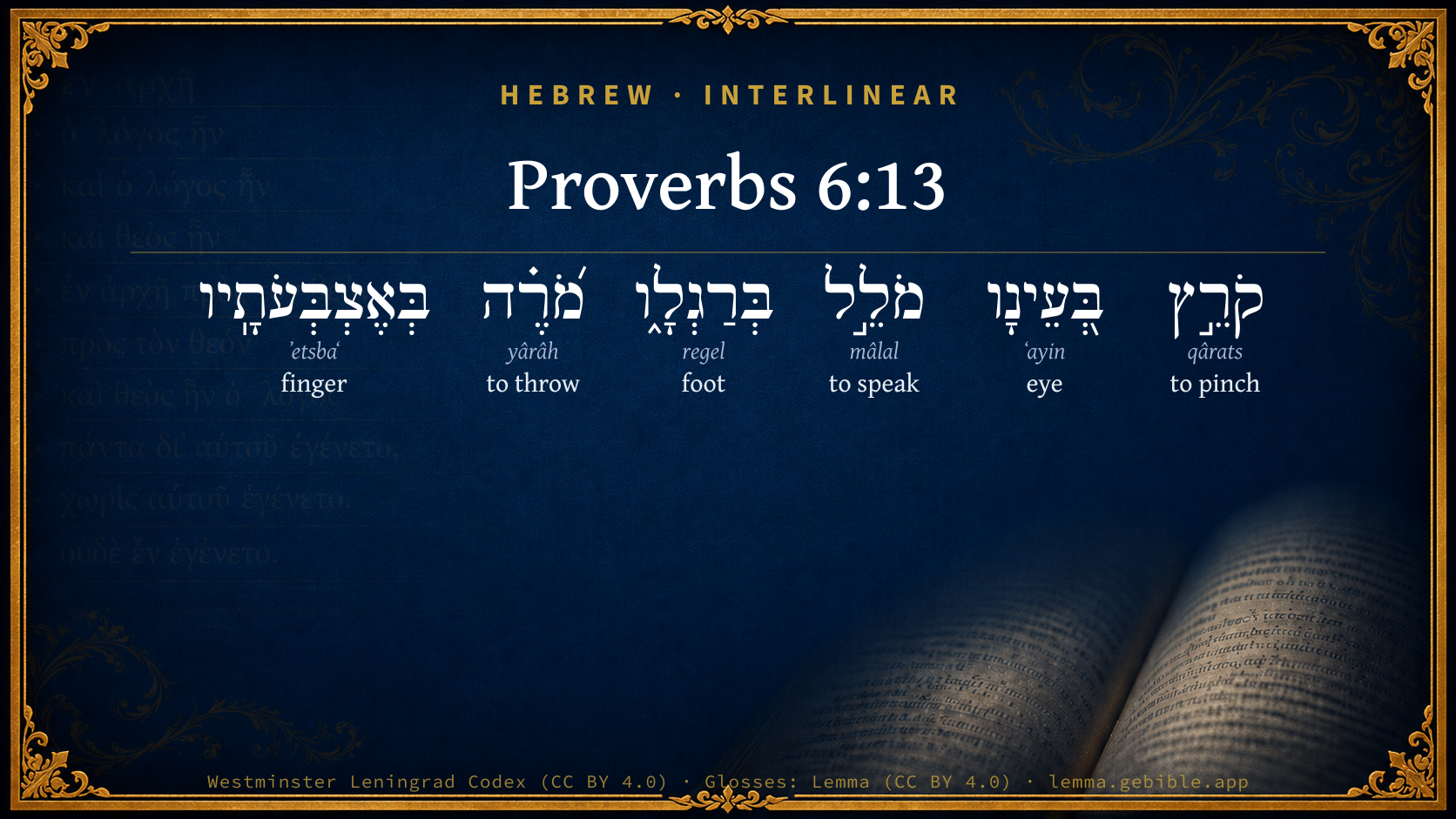
Hebrew (Westminster Leningrad Codex) Proverbs 6:13 appears in the Hebrew Old Testament. The text above is from the Westminster Leningrad Codex. Each word links to its Strong’s number, a concise gloss, and parsing drawn from the Open Scriptures Hebrew Bible morphology. Click any word for its full Brown-Driver-Briggs (BDB) entry.
Download image
Cite this verse

Proverbs 6:13 (World English Bible). Public Domain. Lemma interlinear Bible study tool, https://lemma.gebible.app/v/proverbs/6/13.

Show BibTeX & RIS
BibTeX
RIS
English Translation
Who winks with his eyes, who signals with his feet, Who motions with his fingers;
World English Bible · Public Domain
Download a study sheet

One document with this verse’s original text, its word-by-word gloss line, the meaning frame, cross-references with their text, attributed commentary, and full source and license credits — printable, and it pastes into notes with its structure intact.

This verse Autodidact and up

Study sheet (.html) Plain text (.txt)

A passage Seminary Student

Up to 50 verses in one chapter. A passage sheet keeps up to 6 commentary sources and 12 cross-references per verse, in the order this page ranks them, and says so on the sheet whenever that leaves anything out. Ask for a single verse and you get the Autodidact verse sheet above.

Everything on this page stays free to read, with no account — the sheet is a download of what is already on screen, not access to it.

Want to remove ads? Support Godless Engineer
Compare translations 3

The same verse in 3 English versions, stacked beneath the original-language interlinear above. Click any original word for its lexicon entry.

Each is an independent rendering of the whole verse — the interlinear is not word-aligned to these translations.

Highlighted words mark where these versions differ — a whole-verse word diff, not a word-by-word alignment.

  • World English Bible Public Domain
    Who winks with his eyes, who signals with his feet, Who motions with his fingers;
  • King James Version Public Domain
    He winketh with his eyes, he speaketh with his feet, he teacheth with his fingers;
  • unfoldingWord Literal Text CC BY-SA 4.0
    one who winks with his eye, one who rubs with his foot, one who points with his fingers.

unfoldingWord Literal Text — © unfoldingWord, licensed CC BY-SA 4.0. Word-aligned USFM3 via Door43 (git.door43.org/unfoldingWord/en_ult).

Versions to compare (up to 4)

3 of 4 selected

Show all 18 translations

Every available English version of this verse, each an independent rendering of the whole verse.

  • World English Bible Public Domain
    Who winks with his eyes, who signals with his feet, Who motions with his fingers;
  • Berean Standard Bible Public Domain
    winking his eyes, speaking with his feet, and pointing with his fingers.
  • Majority Standard Bible Public Domain
    winking his eyes, speaking with his feet, and pointing with his fingers.
  • King James Version Public Domain
    He winketh with his eyes, he speaketh with his feet, he teacheth with his fingers;
  • American Standard Version (1901) Public Domain
    That winketh with his eyes, that speaketh with his feet, That maketh signs with his fingers;
  • Revised Version (1885) Public Domain
    He winketh with his eyes, he speaketh with his feet, he maketh signs with his fingers;
  • Geneva Bible (1599) Public Domain
    He maketh a signe with his eyes: he signifieth with his feete: he instructeth with his fingers.
  • Douay-Rheims (1899) Public Domain
    He winketh with the eyes, presseth with the foot, speaketh with the finger.
  • Young's Literal Translation Public Domain
    Winking with his eyes, speaking with his feet, Directing with his fingers,
  • Literal Standard Version CC BY-SA 4.0
    Winking with his eyes, speaking with his feet, || Directing with his fingers,
  • Unlocked Literal Bible CC BY-SA 4.0
    winking his eyes, making signals with his feet and pointing with his fingers.
  • unfoldingWord Literal Text CC BY-SA 4.0
    one who winks with his eye, one who rubs with his foot, one who points with his fingers.
  • Darby Bible Public Domain
    he winketh with his eyes, he speaketh with his feet, he teacheth with his fingers;
  • World Messianic Bible Public Domain
    who winks with his eyes, who signals with his feet, who motions with his fingers,
  • Webster's Bible Public Domain
    He winketh with his eyes, he speaketh with his feet, he teacheth with his fingers;
  • Free Bible Version CC BY-SA 4.0
    winking slyly, giving sneaky foot gestures, rudely pointing with their fingers.
  • Bible in Basic English Public Domain
    Making signs with his eyes, rubbing with his feet, and giving news with his fingers;
  • JPS Tanakh (1917) Public Domain
    That winketh with his eyes, that scrapeth with his feet, that pointeth with his fingers;

Literal Standard Version (2020), Covenant Press — licensed CC BY-SA 4.0. Text via the HelloAO Bible API (eBible.org). Unlocked Literal Bible (unfoldingWord) — licensed CC BY-SA 4.0. Text via the HelloAO Bible API (eBible.org). unfoldingWord Literal Text — © unfoldingWord, licensed CC BY-SA 4.0. Word-aligned USFM3 via Door43 (git.door43.org/unfoldingWord/en_ult). Free Bible Version, Dr. Jonathan Gallagher — licensed CC BY-SA 4.0. Text via the HelloAO Bible API (eBible.org).

Word by word

More ways to search: Search by grammar → Find every occurrence → Compare this word →

Practice this passage: Drill this verse → Learn its vocabulary →

About this verse

These counts appear in no published source. They are computed here, from the morphology-tagged text and Lemma’s own curated glosses. What Lemma adds →

6
words
6
distinct lemmas
Wisdom
section

Notable vocabulary

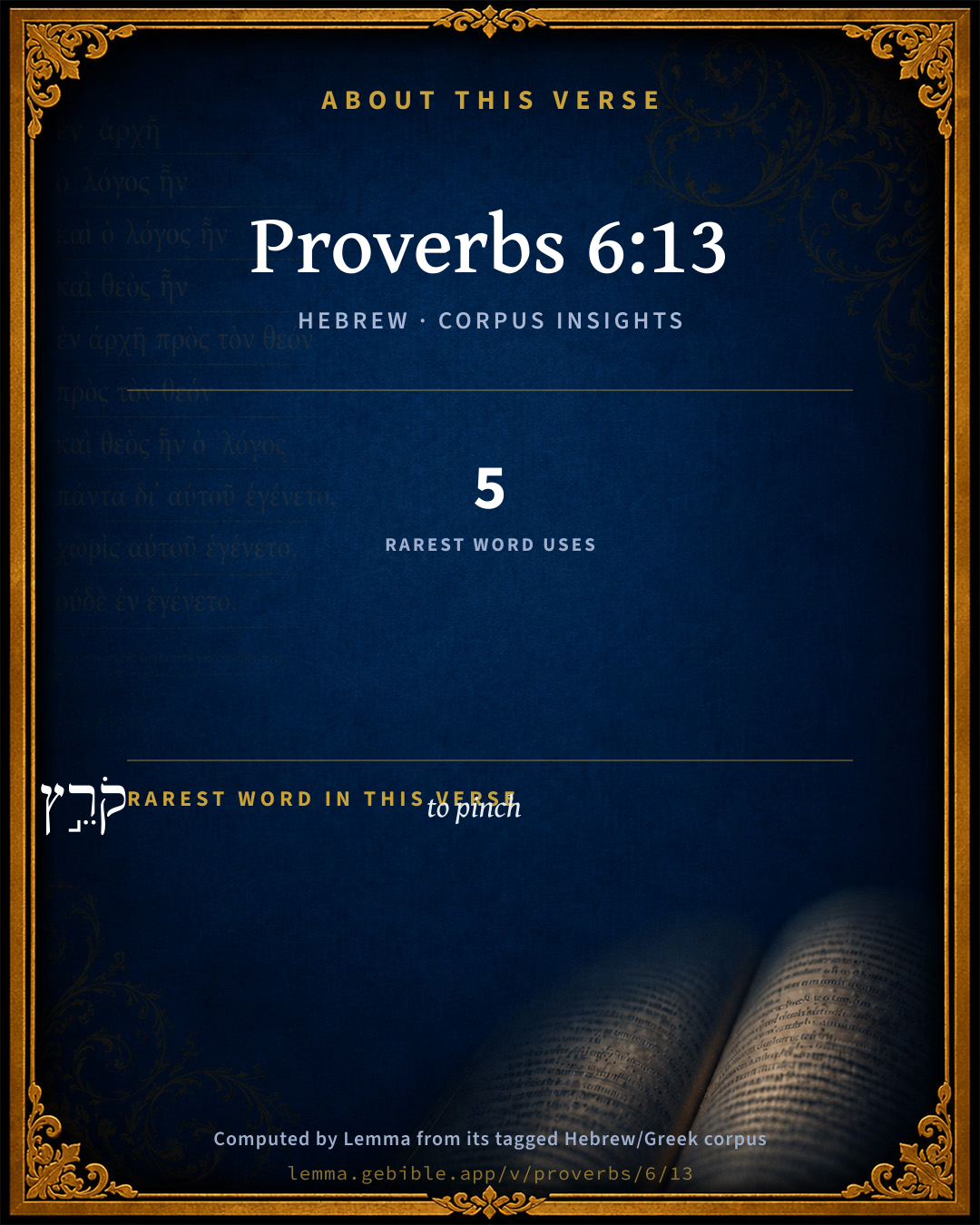
The rarest word here is קֹרֵ֣ץ to pinch H7169 — appearing just 5 times in the whole Hebrew Bible.

Shared distinctive vocabulary

קֹרֵ֣ץ to pinch H7169 occurs in 5 verses of the Hebrew Bible. Also found in:

Grammatical profile

  • 3 verbs
  • 3 nouns

Verb forms

  • קֹרֵ֣ץ Qal · Participle Active
  • מֹלֵ֣ל Qal · Participle Active
  • מֹ֝רֶ֗ה Hiphil · Participle Active

Hebrew & Septuagint length

In English translation the verse runs 15 words from the Hebrew and 22 from the Septuagint (LXX English) — the Septuagint runs noticeably longer here. See the side-by-side →

A rough comparison of the two English renderings, which tokenize alike — not a word-level alignment.

Word counts can differ between the Hebrew and the Greek without any difference in meaning — e.g. the Hebrew direct-object marker אֵת has no separate Greek word, and Greek often adds the article ὁ.

Cross-references

4

Topical passages linked to Proverbs 6:13 in the Treasury of Scripture Knowledge — connected by theme and wording, ordered by reader-vote popularity; previews shown in the World English Bible.

  • Psalms 35:19 Don't let those who are my enemies wrongfully rejoice over me; Neither let them wink with the eye who hate me without a cause.
  • Job 15:12 Why does your heart carry you away? Why do your eyes flash,
  • Proverbs 10:10 One winking with the eye causes sorrow, But a chattering fool will fall.
  • Proverbs 5:6 She gives no thought to the way of life. Her ways are crooked, and she doesn't know it.

Cross-references courtesy of OpenBible.info (CC BY 4.0).

Hebrew and Greek witnesses Masoretic Hebrew ↔ Greek Septuagint

The same verse in the two great witnesses to the Old Testament, shown verse-for-verse.

Here the Septuagint runs noticeably longer than the Hebrew — LXX2012 (modern English Septuagint) 22 words vs World English Bible 15. A rough length comparison of the two English translations, not a word-level alignment — read both below.

These are two independent witnesses, not word-aligned to each other, and the Septuagint is shown in lemma (dictionary) form.

Hebrew Proverbs 6:13 Masoretic · Westminster Leningrad Codex

קֹרֵ֣ץ בְּ֭עֵינָו מֹלֵ֣ל בְּרַגְלָ֑ו מֹ֝רֶ֗ה בְּאֶצְבְּעֹתָֽיו

Who winks with his eyes, who signals with his feet, Who motions with his fingers;

World English Bible · Public Domain

Greek LXX Proverbs 6:13 Septuagint · lemma form

ὁ δέ αὐτός ἐννεύω ὀφθαλμός σημαίνω δέ πούς διδάσκω δέ ἔννευμα δάκτυλος

And the same winks with the eye, and makes a sign with his foot, and teaches with the beckonings of his fingers.

LXX2012 (modern English Septuagint) · Public Domain

On this verse, The Cambridge Bible for Schools and Colleges discusses the Septuagint’s reading. Read the note in Commentary ↓

Hebrew: Westminster Leningrad Codex (CC BY 4.0). Greek: Septuagint (public domain); English from LXX2012 (modern English Septuagint) (Public Domain). How the Septuagint differs from the Hebrew →

Commentary

Notes on Proverbs 6:13 from classic Christian and Jewish commentators (each source and its license shown beneath its notes). The classic Christian expositions comment on the surrounding passage and are grouped to its opening verse, so a note may address several verses; the Jewish commentaries on the Tanakh (Rashi and others) are per-verse, so they appear only where the commentator wrote on this verse.

Lemma curates 59 commentaries, every one of them public domain or Creative Commons licensed, each selected and text-cleaned for this edition rather than reprinted as found. About our sources →

Trapp's Complete Commentary

John Trapp

Pro 6:13 He winketh with his eyes, he speaketh with his feet, he teacheth with his fingers;

Ver. 13. He winketh with his eyes.] He is restless in evil, and with his odd tricks and gesticulations seeks to spread mischief, even there, where he dares not otherwise discover himself. Or the sense may be this: Though he speak froward things, though he slander and detract, to the hurt of the hearers, yet as if he spake nothing but truth, and out of deep affection to the party, he seeks to assure it by the constance of his countenance, by the gravity of his gait, and by the motion of his fingers, to make believe that it is so indeed, when as in truth it is neither so nor so.

John Trapp, A Commentary or Exposition upon All the Books of the Old and New Testament (1647–1656) — public domain. Text from a community e-Sword module.

The Biblical Illustrator

Joseph S. Exell

Pro_6:13

He winketh with his eyes, he speaketh with his feet, he teacheth with his fingers.

Secret ways of speaking

The wicked man not only his abuseth big mouth, but also his eyes, feet, and fingers. When he is ashamed, or wants power to utter his mind as he would in words, he makes it known by signs; showing forth his spleen, lust, or contempt by his eyes, feet, or fingers. He is much addicted to perverse speeches who, when his tongue fails, speaks with his other members. He cannot hold; he must make his mind known to his brethren in evil some way or other. He makes known occasions of evil to his companions by signs. He acts his part to draw others to folly. What he cannot or dare not persuade to by words, that he doth by gestures. His tongue is not sufficient to express his wickedness. He useth gestures instead of words. He omits no way to stir up others to wickedness. He useth three quick members, that are easily moved, to show his quick, wicked wit by them. He abuses all the members of his body, but especially eyes, feet, and hands, to be signs of lewdness, he is wholly composed of fraud, and while he counterfeits goodness in words, practices mischief by signs. The froward person cannot always speak well, and therefore must sometimes hold his peace, and show his mind by tokens, lest his wicked disposition be discovered.

I. A wicked man makes his mind known by his eyes. So Eliphaz conceived of Job (Job_15:12. See also Psa_35:19).

1. In general. There is a faculty in all the members, some way or other to express the thoughts of the heart, though not so clear as in the tongue. Men use these faculties when they are ashamed to speak what they would have, or would be understood only by their partners in evil, to whom they give particular known tokens.

2. In particular. Men by the eyes give signs of wantonness. Men wink for flattery, as conniving at, or tacitly commending what others say or do. Or for derision, as intimating secretly to a friend that another mans words or actions are ridiculous. Or for secret solicitation to another, to do some evil, as to strike or wound a man.

II. A wicked mans feet can speak. They speak--

1. Rage and anger, as when men stamp with their feet.

2. Murder, when they go apace to take occasion to kill.

3. Wantonness. So the treading on the toe is commonly interpreted by wantons.

III. A wicked mans fingers teach folly.

1. Anger. Men hold out the finger by way of threatening.

2. Derision. We can mock with our fingers.

3. Mischief. By lifting up the finger giving a sign to hurt others. (Francis Taylor, B. D.)

How character is expressed

Naughty people think that no one knows anything about their naughtiness, when the truth is, that everybody knows it. The inward character of the man is expressed through mouth, eyes, hands, and feet.

I. eyes. He winketh with his eyes. How much of the character the eye expresses! There is the open, clear, intelligent look that speaks volumes. There is the low, cunning look, the guilty, stealthy look of the criminal--well known and easily detected by experts. The eye speaks all the motions of the mind. It can command, entreat, repel, invite, subdue. Emerson says, The eye obeys exactly the action of the mind.

II. Feet express the character. Compare the firm step of the business man and the shuffling wriggle of the loafer. How much of bad character is expressed in the word tramp! The Bible often designates the whole character of a man by the word walk.

III. Hands have a language. The wave of the hand, the use of the hands in public address, the sign or signal between two persons. The dumb talk together with their hands. Learn--

1. If you would be received as a worthy person, you must be worthy at heart.

2. If you would be known as upright, you must be such at heart.

3. If you aspire to rank in the community as a lady or gentleman, you must be such in every fibre of your being. Character always carries its own certificate with it. (George H. Smyth.)

The Biblical Illustrator, edited by Joseph S. Exell (c. 1880s–1900s) — public domain. Text from a community e-Sword module.

Tyndale Open Study Notes

Tyndale Open Resources

6:13 wink . . . nudge . . . wiggle: These behaviors were signals used while trying to deceive the innocent.

Tyndale Open Study Notes — © Tyndale Open Resources, licensed CC BY-SA 4.0. Text via the HelloAO Bible API.

Geneva Bible (1599)

Geneva Bible translators

Hebrew, speaketh.

Thus all his gesture tendeth to wickedness.

Geneva Bible (1599) marginal notes — public domain. Text via Bolls.life.

Jamieson, Fausset & Brown

Robert Jamieson, A. R. Fausset & David Brown

If, for fear of detection, he does not speak, he uses signs to carry on his intrigues. These signs are still so used in the East.

Jamieson, Fausset & Brown — Commentary Critical and Explanatory on the Whole Bible (1871) — public domain (CC PDM 1.0). Text via the HelloAO Bible API.

Adam Clarke's Commentary

Verse 13. He winketh with his eyes, he speaketh with his feet, he teacheth with his fingers] These things seem to be spoken of debauchees; and the following quotation from Ovid, Amor. lib. i., El. iv., ver. 15, shows the whole process of the villany spoken of by Solomon:

Cum premit ille torum, vultu comes ipsa modesto

Ibis, ut accumbas: clam mihi tange pedem.

Me specta, nutusque meos, vultum que loquacem

Excipe furtivas, et refer ipsa, notas.

Verba superciliis sine voce loquentia dicam

Verba leges digitis, verba notata mero.

Cum tibi succurrit Veneris lascivia nostrae,

Purpureas tenero pollice tange genas, &c., &c.

The whole elegy is in the same strain: it is translated in Garth's Ovid, but cannot be introduced here.

Adam Clarke's Commentary on the Bible (1810–1826) — public domain. Text from a community e-Sword/MySword module.

Ellicott's Commentary for English Readers

(13) He winketh with his eyes . . .—A picture, taken from the life, of a malicious tattler and scandalmonger, who fills out his lying tale with winks and signs, whereby even more is suggested than he says, to the blasting of his neighbour’s character.

A Bible Commentary for English Readers, edited by Charles John Ellicott (1878–1897) — public domain. Text from a community e-Sword module.

The Cambridge Bible for Schools and Colleges

gen. ed. J. J. S. Perowne

13. winketh] Comp. Pro_10:10; Psa_35:19.

speaketh] Not only the tongue (Pro_6:12), but the eye, the foot and the hand are used to make false suggestions, and to further his deceitful designs. Comp. Pro_16:30. Shuffleth, R.V. marg., is a rendering adopted by many good scholars, σημαίνει, LXX.

teacheth] This is retained in R.V. marg. (διδάσκει, LXX.), but giveth signs, R.V. text, is preferable.

Attention has been called to the striking parallel of the description in the Tarentilla of the Latin poet Nævius: “alium tenet, alii adnictat, alibi manus est, alii percellit pedem.”

The Cambridge Bible for Schools and Colleges (gen. ed. J. J. S. Perowne; Cambridge University Press, 1878–1918) — public domain. Text from a community e-Sword module.

John Gill's Exposition

Frowardness is in his heart,.... Or perverse things; evil habits and principles of sin; all manner of wickedness, errors and heresies; things contrary to right reason, repugnant to the will and law of God, and the reverse of sound doctrine; all evil thoughts and evil things; see Mat 15:19;

he deviseth mischief continually; against his neighbours, and especially against good men; he is continually planning schemes, contriving methods, ways, and means, how to disturb, distress, and ruin men; being a true child of Belial, or of the devil, his heart is the forge where he is continually framing wickedness in one shape or another; and the ground which he is always ploughing up and labouring at to bring forth sin and wickedness, and with which it is fruitful;

he soweth discord; or "strifes" (z): the Syriac version adds, "between two"; which Jarchi interprets between a man and his Maker; rather between a man and his neighbour; between one friend and another; between husband and wife, parents and children, brethren and brethren, magistrates and subjects; between kings and princes of the earth in which sort of work the man of sin, antichrist, has been very busy. The Targum is, "he casteth out strifes", as firebrands among men. The words in the Hebrew text are, "he sendeth out discord", or "strife" (a); these are the messengers sent out by him to make mischief.

(z) "contentiones", Pagninus, Montanus, Junius & Tremellius, Piscator, Mercerus, Gejerus; "jurgia", V. L. "lites", Baynus, Cocceius; "litigia", Schultens. (a) "mittet", Pagninus, Montanus; "immittit", Junius & Tremellius, Piscator, Mercerus, Gejerus, Schultens, Michaelis.

John Gill's Exposition of the Whole Bible (1746–1763) — public domain (CC PDM 1.0). Text via the HelloAO Bible API.

Haydock's Catholic Bible Commentary

Finger. These signs imply haughtiness, &c., Psalm xxxiv. 19., and Isaias lviii. 9. The posture indicates the interior sentiments, (St. Ambrose, off. i. 18.) insomuch, that St. Ambrose would not receive among the clergy one whose gestures were too light. The Persians still speak by signs. (Calmet)

George Leo Haydock (1774–1849), Haydock's Catholic Family Bible and Commentary, 1859 edition — public domain. Excludes Psalms (Douay-Rheims chapter numbering differs from Protestant) and Deuterocanonical books (Catholic canon only).

Matthew Poole's English Annotations

He vents his wickedness, as by his speech, so also by his gestures, whereby he secretly signifies what he is afraid or ashamed to express openly to his accomplices, his intentions or desires of some evil towards another person; which having in the general declared by the motion of his eyes or feet, he points out the particular person by his fingers.

Matthew Poole's English Annotations on the Holy Bible (1683–1685) — public domain. Text from a community e-Sword/MySword module.

Whedon's Commentary on the Bible

Daniel D. Whedon

13. His arts are further described.

He winketh with his eyes, etc. — He deceives not with speech only, but uses covert means to effect his object.

So associates in wickedness at the present day are said to “give” each other “the wink.” The flash language of modern rogues is, probably, an advance on the speech of villainy in Solomon’s day. The Orientals are wonderfully proficient in making communications to each other by means of signs and gestures with the eyes, the hands, and the feet. The number of signs of this sort which have a wide and most extensively understood signification, and which are, in fact, in current use among the people, is very large. — Kitto. They wear neither shoes nor sandals in their houses, so that their feet and toes are exposed. When guests wish to speak with each other, so as not to be observed by the host, they convey their meaning by their feet and toes. When merchants wish to bargain in the presence of others, without having them knew their terms, they sit on the ground, have a piece of cloth thrown over their lap, and then put each a hand under, and thus speak with their fingers. When the Brahmins convey religious mysteries to their disciples, they teach with their fingers, having their hands concealed in the folds of their robes. (Roberts.)

Daniel D. Whedon (gen. ed.), Commentary on the Old and New Testaments (1874–1909) — public domain. Text from a community e-Sword module.

The Pulpit Commentary

He winketh with his eyes, he speaketh with his feet, he teacheth with his fingers. He employs his other members for the same nefarious purpose. In the language of St. Paul, he yields his members to uncleanness, and to iniquity unto iniquity. (Rom_6:19) "To wink with the eye (karats ayin)," as in Pro_10:10 and Psa_35:19, or "with the eyes (karats b"eynayim)," is properly to compress or nip them together, and so to wink, and give the signal to others not to interfere (Gesenius and Delitzsch); cf. the LXX, enneuei ofyalmw ; and the Vulgate, annuit oculis. Aquila and Theodoret, however, read, knizei , "he vexes or annoys. " The observation of the teacher in Pro_10:10 is, "He that winketh with his eyes causeth sorrow." The same verb karuts is also used of the compression or closing of the lips in Pro_16:30. He speaketh with his feet; i.e. he conveys signs by them to his companion; cf. the LXX, shmainei de podi , and the Vulgate, terit pede, which conveys much the same meaning. He teacheth with his fingers; or, as more fully expressed in the LXX, didaskei de enneumasi daktulwn , "he teacheth by the signs of his fingers." Symmachus has daktulodeiktwn , which, however, in its strictly classical use (see Demosthenes, 790, 20) is pointing at with the finger. "Teaching" is only the secondary meaning of the Hebrew participle moreh, which is here used. The verb yarah, to which it belongs, means properly to extend or stretch out the hand for the purpose of pointing out the way (compare the Hebrew shalakh yod, and the Latin monstrare), and hence came to mean "to teach." The crafty and deceitful character which is here presented to as is strikingly reproduced in Ecclesiasticus: "He that winketh with the eyes worketh evil: and he that knoweth him will depart from him. When thou art present, he will speak sweetly, and will admire thy words: but at the last he will writhe his mouth, and slander thy sayings. I have hated many things, but nothing like him; for the Lord will hate him" (Ecc 27:22-24). The heathen poet Naevius says of the impudent woman"Allium tenet, alii adnutat, alibi manus Est occupata: est alii percellit pedem.

Compare also Ovid"s words ("Amor.," 1:4, 16)"Clam mihi tange pedem: Me specta, mutusque meos, vultumque loquacem... Verba superciliis sine voce loquentia dicam; Verba leges digitis.

So Tibullus, 1:12"Illa viro coram nutus conferre loquaces Blandaque compositis abdere verba notis.

The lesson which we may learn from this verse is not to abuse the members of our bodies, by employing them for the purposes of deceit and hypocrisy, and so to promote evil, but to put them to their natural and legitimate use.

The Pulpit Commentary (1880–1919), ed. H.D.M. Spence-Jones & Joseph S. Exell — public domain. Text from a community e-Sword module.

Rashi

Rabbi Shlomo Yitzchaki (Rashi)

he winks with his eyes winks of deceit.

shuffles with his feet He rubs one on the other.

points with his fingers They are all expressions of hinting: one applies to the eye, one applies to the foot, and one applies to the finger, but the main idea is that it is speaking of the wicked.

Rashi on the Tanakh — English translations: “The Judaica Press complete Tanach with Rashi, translated by A. J. Rosenberg” (CC BY 4.0); “Pentateuch with Rashi's commentary by M. Rosenbaum and A.M. Silbermann, 1929-1934” (public domain); “The Metsudah Tanach series, Lakewood, N.J” (CC BY 4.0); and “The Book of Joshua, Metsudah Publications, 1997” (CC BY 4.0). Text via Sefaria.

Lesson kit

Teaching starters — assembled from the data on this page, not authored interpretation. Every prompt links to the verse data it draws on. Edit before teaching.

Proverbs, in the Wisdom, opens this verse with 6 words (6 distinct Hebrew lemmas). Its most distinctive word is qârats (“to pinch”). The Greek Septuagint runs longer here. A historical commentator’s framing appears above. Read the whole chapter for the surrounding context.

Discussion questions

  1. How does “to pinch” (qârats) shape what this verse is saying?
  2. How does Job 33:6, which shares the word «to pinch», read alongside this verse?
  3. The Septuagint runs longer here than the Hebrew. What might account for the difference?
  4. These translations render this verse differently. What is at stake in choosing one wording over another?
  5. «קֹרֵ֣ץ» is a Qal Participle Active verb. How does that grammatical form shape the action described?
  6. Compare how Trapp's Complete Commentary and The Biblical Illustrator read this verse. Where do they agree or differ?

Things to notice

Reading settings

Reading text

Shown beneath each verse's original-language words.

Old Testament
Old Testament edition

Read the OT as the Masoretic Hebrew (MT) or the Greek Septuagint (LXX).

English shown for the Greek Septuagint (in the Hebrew ↔ Greek comparison).

Comparing translations? Open the Compare panel on any verse page to stack up to four side by side.