1 Chronicles 10:3

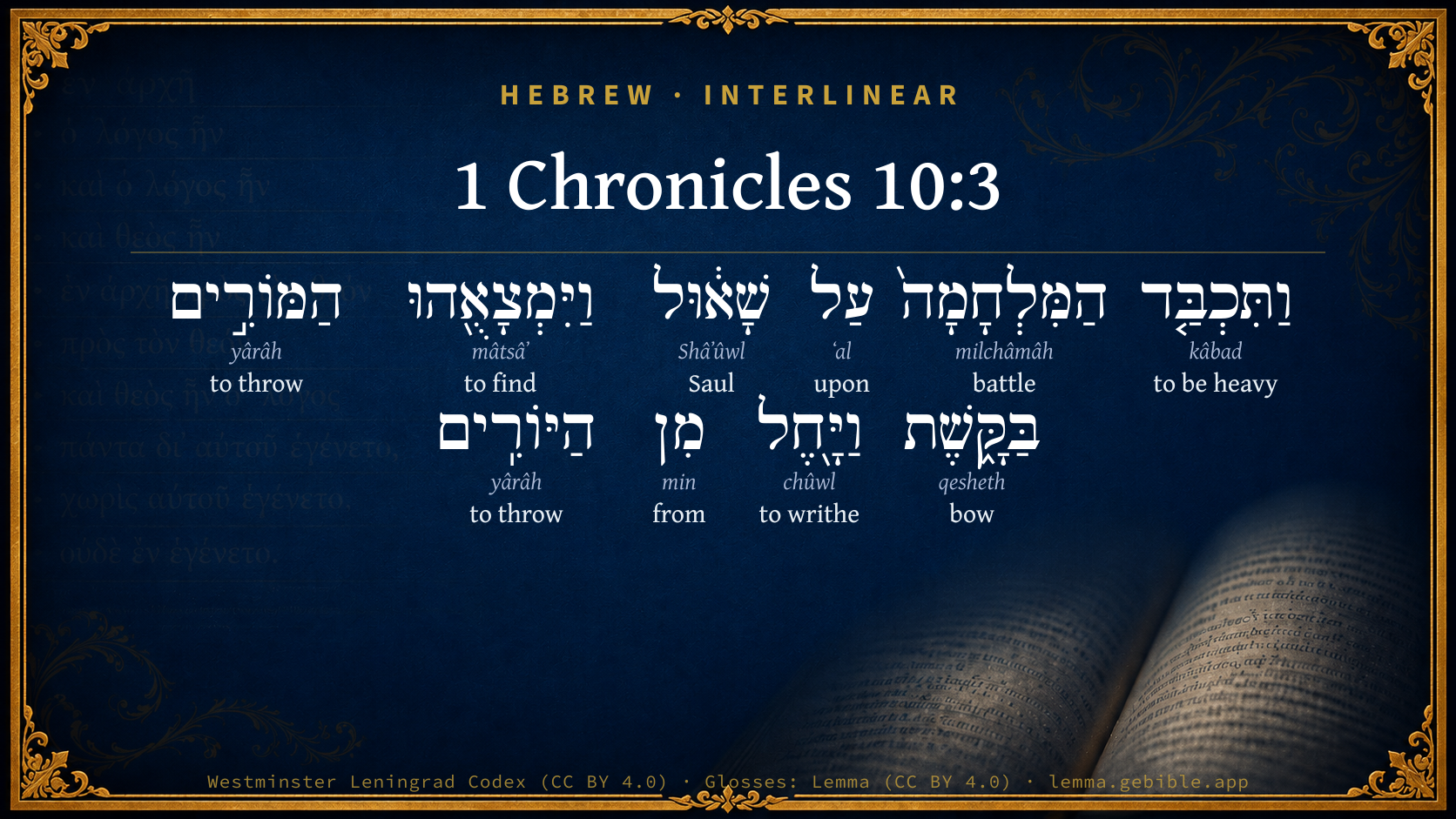
Hebrew (Westminster Leningrad Codex) 1 Chronicles 10:3 appears in the Hebrew Old Testament. The text above is from the Westminster Leningrad Codex. Each word links to its Strong’s number, a concise gloss, and parsing drawn from the Open Scriptures Hebrew Bible morphology. Click any word for its full Brown-Driver-Briggs (BDB) entry.
Download image
Cite this verse

1 Chronicles 10:3 (World English Bible). Public Domain. Lemma interlinear Bible study tool, https://lemma.gebible.app/v/1-chronicles/10/3.

Show BibTeX & RIS
BibTeX
RIS
English Translation
The battle went sore against Saul, and the archers overtook him; and he was distressed by reason of the archers.
World English Bible · Public Domain
Download a study sheet

One document with this verse’s original text, its word-by-word gloss line, the meaning frame, cross-references with their text, attributed commentary, and full source and license credits — printable, and it pastes into notes with its structure intact.

This verse Autodidact and up

Study sheet (.html) Plain text (.txt)

A passage Seminary Student

Up to 50 verses in one chapter. A passage sheet keeps up to 6 commentary sources and 12 cross-references per verse, in the order this page ranks them, and says so on the sheet whenever that leaves anything out. Ask for a single verse and you get the Autodidact verse sheet above.

Everything on this page stays free to read, with no account — the sheet is a download of what is already on screen, not access to it.

Want to remove ads? Support Godless Engineer
Compare translations 3

The same verse in 3 English versions, stacked beneath the original-language interlinear above. Click any original word for its lexicon entry.

Each is an independent rendering of the whole verse — the interlinear is not word-aligned to these translations.

Highlighted words mark where these versions differ — a whole-verse word diff, not a word-by-word alignment.

  • World English Bible Public Domain
    The battle went sore against Saul, and the archers overtook him; and he was distressed by reason of the archers.
  • King James Version Public Domain
    And the battle went sore against Saul, and the archers hit him, and he was wounded of the archers.
  • unfoldingWord Literal Text CC BY-SA 4.0
    And the battle was heavy against Saul. And the shooters with the bow found him. And he writhed from the shooters.

unfoldingWord Literal Text — © unfoldingWord, licensed CC BY-SA 4.0. Word-aligned USFM3 via Door43 (git.door43.org/unfoldingWord/en_ult).

Versions to compare (up to 4)

3 of 4 selected

Show all 18 translations

Every available English version of this verse, each an independent rendering of the whole verse.

  • World English Bible Public Domain
    The battle went sore against Saul, and the archers overtook him; and he was distressed by reason of the archers.
  • Berean Standard Bible Public Domain
    When the battle intensified against Saul, the archers overtook him and wounded him.
  • Majority Standard Bible Public Domain
    When the battle intensified against Saul, the archers overtook him and wounded him.
  • King James Version Public Domain
    And the battle went sore against Saul, and the archers hit him, and he was wounded of the archers.
  • American Standard Version (1901) Public Domain
    And the battle went sore against Saul, and the archers overtook him; and he was distressed by reason of the archers.
  • Revised Version (1885) Public Domain
    And the battle went sore against Saul, and the archers overtook him; and he was distressed by reason of the archers.
  • Geneva Bible (1599) Public Domain
    And the battel was sore against Saul; and the archers hit him, and he was wounded of the archers.
  • Douay-Rheims (1899) Public Domain
    And the battle grew hard against Saul, and the archers reached him, and wounded him with arrows.
  • Young's Literal Translation Public Domain
    And the battle `is' heavy on Saul, and those shooting with the bow find him, and he is wounded by those shooting,
  • Literal Standard Version CC BY-SA 4.0
    And the battle [is] heavy on Saul, and those shooting with the bow find him, and he is wounded by those shooting,
  • Unlocked Literal Bible CC BY-SA 4.0
    The battle went heavily against Saul, and the archers overtook him, and they wounded him.
  • unfoldingWord Literal Text CC BY-SA 4.0
    And the battle was heavy against Saul. And the shooters with the bow found him. And he writhed from the shooters.
  • Darby Bible Public Domain
    And the battle went sore against Saul, and the archers came up with him, and he was terrified by the archers.
  • World Messianic Bible Public Domain
    The battle went hard against Saul, and the archers overtook him; and he was distressed by reason of the archers.
  • Webster's Bible Public Domain
    And the battle prevailed against Saul, and the archers hit him, and he was wounded by the archers.
  • Free Bible Version CC BY-SA 4.0
    The battle raged intensely around Saul. The enemy archers saw where he was, and they wounded him.
  • Bible in Basic English Public Domain
    And the fight was going against Saul, and the archers came across him, and he was wounded by the archers.
  • JPS Tanakh (1917) Public Domain
    And the battle went sore against Saul, and the archers overtook him; and he was in anguish by reason of the archers.

Literal Standard Version (2020), Covenant Press — licensed CC BY-SA 4.0. Text via the HelloAO Bible API (eBible.org). Unlocked Literal Bible (unfoldingWord) — licensed CC BY-SA 4.0. Text via the HelloAO Bible API (eBible.org). unfoldingWord Literal Text — © unfoldingWord, licensed CC BY-SA 4.0. Word-aligned USFM3 via Door43 (git.door43.org/unfoldingWord/en_ult). Free Bible Version, Dr. Jonathan Gallagher — licensed CC BY-SA 4.0. Text via the HelloAO Bible API (eBible.org).

Word by word

More ways to search: Search by grammar → Find every occurrence → Compare this word →

Practice this passage: Drill this verse → Learn its vocabulary →

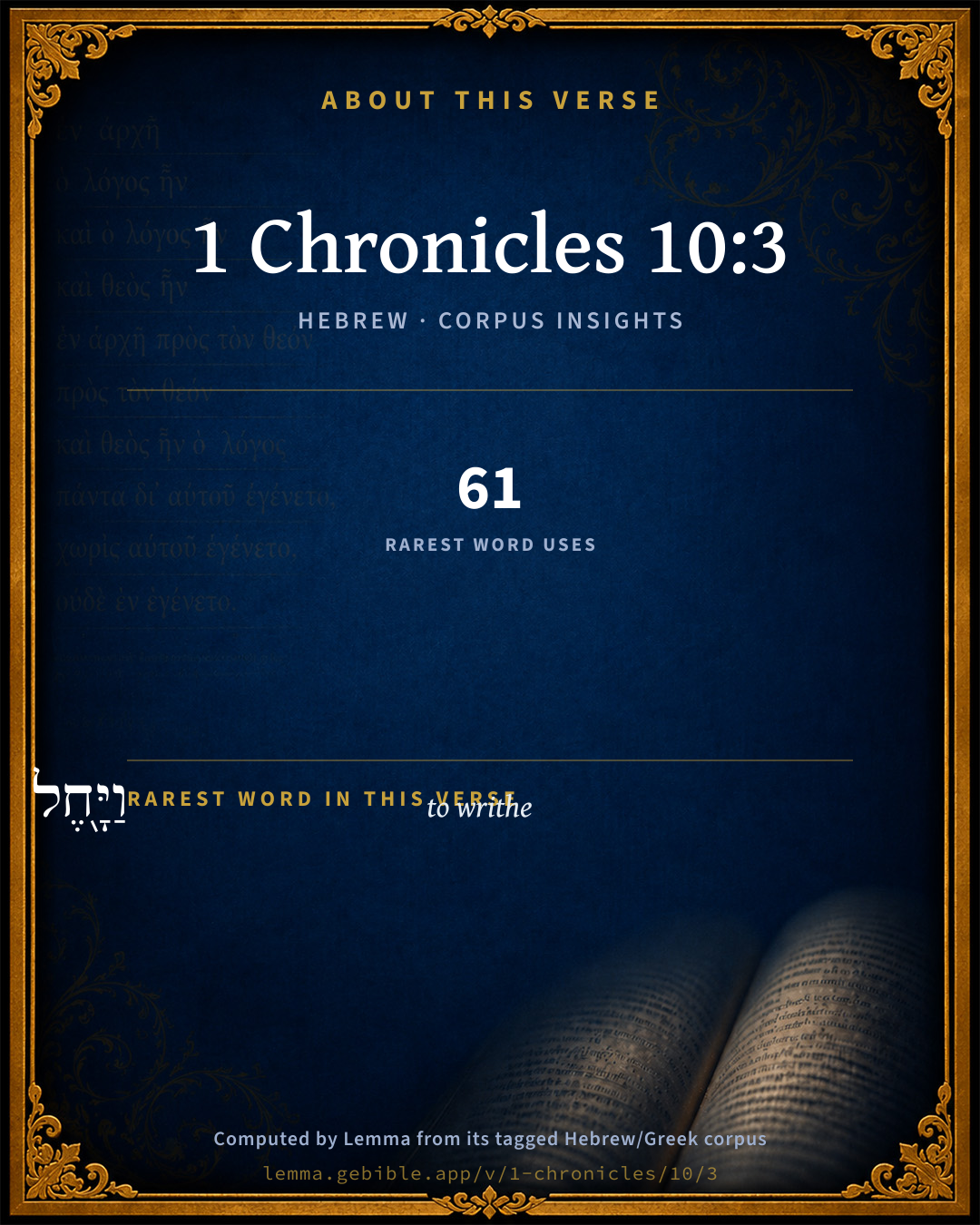
וַיָּ֖חֶל
chûwl
H2342
“and · to writhe”
Conjunction + Verb, Qal, Sequential Imperfect, 3rd Person, Masculine, Singular
Part of Speech
Conjunction + Verb
Stem
Qal
Form
Sequential Imperfect
Person
3rd Person
Gender
Masculine
Number
Singular
Full BDB Definition

Origin: a primitive root

TWOT: 623

to twist, whirl, dance, writhe, fear, tremble, travail, be in anguish, be pained - (Qal) - to dance - to twist, writhe - to whirl, whirl about - (Polel) - to dance - to writhe (in travail with), bear, bring forth - to wait anxiously - (Pulal) - to be made to writhe, be made to bear - to be brought forth - (Hophal) to be born - (Hithpolel) - whirling (participle) - writhing, suffering torture (participle) - to wait longingly - (Hithpalpel) to be distressed
  1. וַתִּכְבַּ֤ד kâbad H3513 “and · to be heavy” Conjunction + Verb, Qal, Sequential Imperfect, 3rd Person, Feminine, Singular
  2. הַמִּלְחָמָה֙ milchâmâh H4421 “the · battle” Particle, Definite Article + Noun, Common, Feminine, Singular, Absolute
  3. עַל ʻal H5921 “upon” Preposition
  4. שָׁא֔וּל Shâʼûwl H7586 “Saul” Noun, Proper
  5. וַיִּמְצָאֻ֖הוּ mâtsâʼ H4672 “and · to find · him” Conjunction + Verb, Qal, Sequential Imperfect, 3rd Person, Masculine, Plural + Suffix, Personal, 3rd Person, Masculine, Singular
  6. הַמּוֹרִ֣ים yârâh H3384 “the · throwing” Particle, Definite Article + Verb, Hiphil, Participle Active, Masculine, Plural, Absolute
  7. בַּקָּ֑שֶׁת qesheth H7198 “in/at the · bow” Preposition, Determined + Noun, Common, Feminine, Singular, Absolute
  8. מִן min H4480 “from” Preposition
  9. הַיּוֹרִֽים yârâh H3384 “the · throwing” Particle, Definite Article + Verb, Qal, Participle Active, Masculine, Plural, Absolute

About this verse

These counts appear in no published source. They are computed here, from the morphology-tagged text and Lemma’s own curated glosses. What Lemma adds →

10
words
9
distinct lemmas
Historical
section

Grammatical profile

  • 5 verbs
  • 3 nouns
  • 2 prepositions

Verb forms

  • וַתִּכְבַּ֤ד Qal · Sequential Imperfect
  • וַיִּמְצָאֻ֖הוּ Qal · Sequential Imperfect
  • הַמּוֹרִ֣ים Hiphil · Participle Active
  • וַיָּ֖חֶל Qal · Sequential Imperfect
  • הַיּוֹרִֽים Qal · Participle Active

Repetition

A word recurs within this verse — often emphatic in Hebrew:

  • הַמּוֹרִ֣ים to throw H3384 ×2

Hebrew & Septuagint length

In English translation the verse runs 20 words from the Hebrew and 22 from the Septuagint (LXX English) — closely comparable.

A rough comparison of the two English renderings, which tokenize alike — not a word-level alignment.

Word counts can differ between the Hebrew and the Greek without any difference in meaning — e.g. the Hebrew direct-object marker אֵת has no separate Greek word, and Greek often adds the article ὁ.

Cross-references

4

Topical passages linked to 1 Chronicles 10:3 in the Treasury of Scripture Knowledge — connected by theme and wording, ordered by reader-vote popularity; previews shown in the World English Bible.

  • 1 Samuel 31:3–6 The battle went sore against Saul, and the archers overtook him; and he was greatly distressed by reason of the archers.
  • 2 Samuel 1:4–10 David said to him, How went the matter? Please tell me. He answered, The people are fled from the battle, and many of the people also are fallen and dead; and Saul and Jonathan his son are dead also.
  • Genesis 49:23–24 The archers have sorely grieved him, Shot at him, and persecute him:
  • Amos 2:14 Flight will perish from the swift; And the strong won't strengthen his force; Neither shall the mighty deliver himself;

Cross-references courtesy of OpenBible.info (CC BY 4.0).

Hebrew and Greek witnesses Masoretic Hebrew ↔ Greek Septuagint

The same verse in the two great witnesses to the Old Testament, shown verse-for-verse.

These are two independent witnesses, not word-aligned to each other, and the Septuagint is shown in lemma (dictionary) form.

Hebrew 1 Chronicles 10:3 Masoretic · Westminster Leningrad Codex

וַתִּכְבַּ֤ד הַמִּלְחָמָה֙ עַל שָׁא֔וּל וַיִּמְצָאֻ֖הוּ הַמּוֹרִ֣ים בַּקָּ֑שֶׁת וַיָּ֖חֶל מִן הַיּוֹרִֽים

The battle went sore against Saul, and the archers overtook him; and he was distressed by reason of the archers.

World English Bible · Public Domain

Greek LXX 1 Chronicles 10:3 Septuagint · lemma form

καί βαρύνω ὁ πόλεμος ἐπί σαούλ καί εὑρίσκω αὐτός ὁ τοξότης ἐν ὁ τόξον καί πόνος καί πονέω ἀπό ὁ τόξον

And the battle prevailed against Saul, and the archers hit him with bows and arrows, and they were wounded of the bows.

LXX2012 (modern English Septuagint) · Public Domain

On this verse, Haydock's Catholic Bible Commentary discusses the Septuagint’s reading. Read the note in Commentary ↓

Hebrew: Westminster Leningrad Codex (CC BY 4.0). Greek: Septuagint (public domain); English from LXX2012 (modern English Septuagint) (Public Domain). How the Septuagint differs from the Hebrew →

Commentary

Notes on 1 Chronicles 10:3 from classic Christian and Jewish commentators (each source and its license shown beneath its notes). The classic Christian expositions comment on the surrounding passage and are grouped to its opening verse, so a note may address several verses; the Jewish commentaries on the Tanakh (Rashi and others) are per-verse, so they appear only where the commentator wrote on this verse.

Lemma curates 59 commentaries, every one of them public domain or Creative Commons licensed, each selected and text-cleaned for this edition rather than reprinted as found. About our sources →

Trapp's Complete Commentary

John Trapp

1Ch 10:3 And the battle went sore against Saul, and the archers hit him, and he was wounded of the archers.

Ver. 3. And the battle went sore against Saul.] The weight of the war was turned against him. See the like policy used, 1Ki 22:31. This is the right bird, said that officer of the cuirassiers, {a} who shot the king of Sweden through the body at the battle of Lutzen.

And he was wounded of the archers.] Heb., He was grieved, or frighted: he, who by his tyranny had been terrible and grievous to others, &c., his sin hath found him out, being worse than any archer’s.

{a} A horse soldier wearing a cuirass.

John Trapp, A Commentary or Exposition upon All the Books of the Old and New Testament (1647–1656) — public domain. Text from a community e-Sword module.

The Biblical Illustrator

Joseph S. Exell

1Ch_10:3

And the battle went sore against Saul.

The death of Saul

Learn

I. That a splendid beginning may have an awful ending.

II. That Divine judgments overtake mens sins.

III. That in national calamities the godly suffer with the ungodly. (J. Wolfendale.)

The departure of God, the departure of strength

Why was the battle sore against the king of Israel? Saul believes himself to be forsaken of God, and therefore to have become the sport of man. Here we are reminded of the analogy of the vine and the branches. As the branch cannot bear fruit of itself, except it abide in the vine, no more can the Church make vital and faithful progress, except by continual fellowship with God. Saul was muscular as ever, as ambitious as ever, and as energetic as ever; but he had lost the consciousness of the nearness of the Almighty. What are all church buildings, formularies, ceremonies, pecuniary resources, literary achievements, when the Spirit of God has been grieved or quenched? (J. Parker, D. D.)

An unblest leader does not necessarily represent an unblest cause

Although the battle went sore against Saul, we must not suppose that Saul represented an unblest cause. The reason may be in Saul himself, rather than in the cause for which he fought. Sometimes leaders, captains, and commanders have to be overborne or displaced, in order that the great cause which they fail to grasp, and adequately to represent, may vindicate its own claim to a position of confidence and honour. It does not follow that because a man has been once a leader, that he must be always at the head of the army. Sometimes by the infirmity of old age the very princes of the Church are displaced and put behind. There are some trusts which we only keep as long as we keep our character. (J. Wolfendale.)

The Biblical Illustrator, edited by Joseph S. Exell (c. 1880s–1900s) — public domain. Text from a community e-Sword module.

Geneva Bible (1599)

Geneva Bible translators

Hebrew, found.

Geneva Bible (1599) marginal notes — public domain. Text via Bolls.life.

Jamieson, Fausset & Brown

Robert Jamieson, A. R. Fausset & David Brown

the battle went sore against Saul; and the archers hit him, and he was wounded--The Hebrew words may be thus rendered: "The archers found (attacked) him, and he feared the archers." He was not wounded, at least not dangerously, when he resolved on committing suicide. The deed was the effect of sudden terror and overwhelming depression of spirits [CALMET].

Jamieson, Fausset & Brown — Commentary Critical and Explanatory on the Whole Bible (1871) — public domain (CC PDM 1.0). Text via the HelloAO Bible API.

Ellicott's Commentary for English Readers

(3) The battle went sore against Saul.—Literally, was heavy upon (Samuel, “unto”) him, like a burden weighing him to the earth.

And the archers hit him.—Literally, And they that shoot with the bow came upon him; and he shuddered (Sam., “greatly”) before the shooters. “He shuddered or trembled” (Deu_2:25). The verb is properly to writhe, travail (Isa_23:4). Saul’s deadly terror was natural. He believed himself forsaken of God, and stood now, after a lost battle, beset by murderous foes, whom he could not reach. There was no chance of a fair hand to hand encounter. The Heb. word for “archers” is the same in both places in Sam. (môrîm); here a rarer form (yôrîm, 2Ch_35:23) fills the second place. The Philistines were from Egypt, and the bow was a favourite Egyptian arm. The hieroglyph for “soldier” (menfat) is a man with bow and quiver.

A Bible Commentary for English Readers, edited by Charles John Ellicott (1878–1897) — public domain. Text from a community e-Sword module.

The Cambridge Bible for Schools and Colleges

gen. ed. J. J. S. Perowne

3. the archers hit him, and he was wounded of the archers] R.V. the archers overtook him; and he was distressed by reason of the archers.

The Cambridge Bible for Schools and Colleges (gen. ed. J. J. S. Perowne; Cambridge University Press, 1878–1918) — public domain. Text from a community e-Sword module.

Haydock's Catholic Bible Commentary

Reached: literally, "found." (Haydock) --- Hebrew, or "attacked him, and he feared the archers. He was not, at least, mortally wounded, when he took the desperate resolution to destroy himself, through fear and consternation. (Calmet) Yet the original will admit the sense of the Vulgate and Saul might have received some wounds. Septuagint, "Archers found him with bows, and in labours, and he laboured on account of (or to avoid) the bows." (Haydock)

George Leo Haydock (1774–1849), Haydock's Catholic Family Bible and Commentary, 1859 edition — public domain. Excludes Psalms (Douay-Rheims chapter numbering differs from Protestant) and Deuterocanonical books (Catholic canon only).

The Pulpit Commentary

The archers hit him. The literal translation would be, the shooters, men with the bow, found him. The context makes it plain that the meaning is that the arrows of the pursuers rather than the pursuers themselves "found" him, and these made him argue all the rest. To this our Authorized Version has jumped by the one word "hit" him. It is evident from ver. 8 that the Philistines did not find the body of Saul to recognize it till next day. And he was wounded of the archers. The radical meaning of the verb (lWj) is rather "to twist" (torquere) or "be twisted," "writhe" (torqueri). And the meaning here is in harmony with it, that Saul trembled from fear or writhed with the pain already inflicted of the arrows. Hence the parallel passage couples with this same verb, the adverb

Vers. 3-6, 13.

The end of self-will.

In dwelling on the sad circumstances of King Saul"s death, we are led to review the life which ended so miserably, and to endeavour to find the root of evil, in disposition or in conduct, which bore at last such fruitage. The actual incidents of Saul"s career should be recalled.

I THE HOPEFULNESS OF HIS INTRODUCTION TO US. In his expedition to seek the lost asses, in his anointing at Ramah, in his election by lot at Mizpeh, in the confirmation of his kingship at Gilgal, and in the first actions of his government, there are the signs of a hopeful reign. Especially may be noted and illustrated his modesty in shrinking from the responsibility of kingship; his loyalty to duty where the will of God and the people was made plain to him; his openness to religious influences as seen in his catching the prophetic impulse; and his generosity shown in refusing to take vengeance on those who disputed his authority. Many a man has begun well. No man knows himself until he has berne the stress of middle life, and its responsibilities, testings, and temptations.

II THE PERIL OF THE OVER-DEVELOPED BODY. For this he was chosen and admired; in accordance with the admiration of physical size and strength which is common to all people who retain tribal notions. But there is also the peril of the bodily growth being stronger than the mental, and the overgrowth of body often involves moral weakness. And these may find expression in a stubbornness of self-will, which, by indulgence, may become mania. The self-will of moral weakness should be carefully distinguished from the self-reliance, power of rule, and masterfulness, which are as clearly the signs of mental and moral strength.

III THE TEST OF THE NEW TRUST OF KINGSHIP. The office was quite a new one; the only previous instance was the forced kingship of Abimelech. Saul had really no modes on which to order his conduct. Exactly what kingship could be in a country where Jehovah himself was the sole sovereign Lord, he had to find out. So that, beyond the ordinary testings of any new and untried situations, Saul was tried by the uniqueness of the position in which he was placed. Exactly the point at which he might fail was this he might practically claim independence for an office which was nevertheless strictly a conditioned and a dependent office. He could be Jehovah"s prince and viceroy; he would be tempted to claim personal and independent kingly rights. So the trust of the office tested his will, proved whether he was fully and sincerely loyal to God. This piece of Saul"s life brought him into the conflict of the seen and the unseen , which every man must enter. Would he, even with all the fascinations and interest of the "seen," be true to God, the unseen? Would he be strictly and wholly obedient to the Divine commands and the Divine leadings? Not character only, but the very root-principle of Saul"s being, was tested. Compare the searching tests of Abraham"s faith and Job"s patient submission. Saul failed under the testing; so we have to consider

IV THE CONDITIONS OF THE GROWTH OF SELF-WILL. Apparent success in the earlier efforts of wilfulness encourages the self-confidence. But, in view of Saul"s case, we may especially dwell on the influence of rejecting early Divine warnings, and refusing to be humbled under reproofs of earlier sins and failures. This involves the hardening of the heart, as may be illustrated in the case of Pharaoh.

V SELF-WILL, IN THE END, BRINGS BOTH SELF AND OTHERS TO RUIN. It can never have more than a certain length of tether. No man can long "resist God and prosper." Saul"s later days fully illustrate the inward miseries and-outward ruin of self-will; the "death" which this sin, "when it is finished, surely brings forth." Distinguish between the self-strength which God may use, and the self-will which severs a man wholly from God. Whatever may be our station or our office, there is one condition of success, and only one we must "fear God, and keep his commandments. R.T.

The Pulpit Commentary (1880–1919), ed. H.D.M. Spence-Jones & Joseph S. Exell — public domain. Text from a community e-Sword module.

Rashi

Rabbi Shlomo Yitzchaki (Rashi)

and the archers discovered him Come and see that (Prov. 21:30): “... there is neither wisdom nor understanding, etc. against the Lord,” because man’s ways are before the Lord. Benjamin’s enemies would fall before them [when they used] the bow because they were well trained with the bow, as it is written: “[Ehud the son of Gera, the Benjamite,] a man with a shriveled right hand,” (Judges 3:15). And so it is written, concerning Jonathan (I Samuel 20:20): “And I shall shoot three arrows to the side, as though I shot at a mark.” And it is written below (I Chron. 12:2) concerning Benjamin: “Armed with bows, shooting with the right and left hands, etc.” and concerning Asa in this Book (II 14:7): “... and out of Benjamin, who bore shields and drew bows, etc.” But when the Lord turned away from Saul [who was from the tribe of Benjamin], he fell into the hands of the archers, into something that was his own craft. and he was terrified of the archers וַיָחֶל like (Esther 4:4): “...and the queen was extremely terrified (וַתִּתְחַלְחַל).”

Rashi on the Tanakh — English translations: “The Judaica Press complete Tanach with Rashi, translated by A. J. Rosenberg” (CC BY 4.0); “Pentateuch with Rashi's commentary by M. Rosenbaum and A.M. Silbermann, 1929-1934” (public domain); “The Metsudah Tanach series, Lakewood, N.J” (CC BY 4.0); and “The Book of Joshua, Metsudah Publications, 1997” (CC BY 4.0). Text via Sefaria.

Lesson kit

Teaching starters — assembled from the data on this page, not authored interpretation. Every prompt links to the verse data it draws on. Edit before teaching.

1 Chronicles, in the Historical, opens this verse with 10 words (9 distinct Hebrew lemmas). Its most distinctive word is chûwl (“to writhe”). A historical commentator’s framing appears above. Read the whole chapter for the surrounding context.

Discussion questions

  1. The word chûwl carries the sense “to writhe.” How does it shape the verse?
  2. How does 1 Samuel 31:3–6, which shares this passage’s theme, read alongside this verse?
  3. What does the repetition of “to throw” (2× in this one verse) do in this verse?
  4. These translations render this verse differently; the difference is in the English rendering, not the original. What questions does that raise?
  5. «וַתִּכְבַּ֤ד» is a Qal Sequential Imperfect verb. How does that grammatical form shape the action described?
  6. Compare how Trapp's Complete Commentary and The Biblical Illustrator read this verse. Where do they agree or differ?

Things to notice

  • These translations choose different wording for 13 words in this verse.
  • “to throw” occurs 2× in this single verse.
  • 9 distinct Hebrew lemmas span 10 words in this verse.

Reading settings

Reading text

Shown beneath each verse's original-language words.

Old Testament
Old Testament edition

Read the OT as the Masoretic Hebrew (MT) or the Greek Septuagint (LXX).

English shown for the Greek Septuagint (in the Hebrew ↔ Greek comparison).

Comparing translations? Open the Compare panel on any verse page to stack up to four side by side.