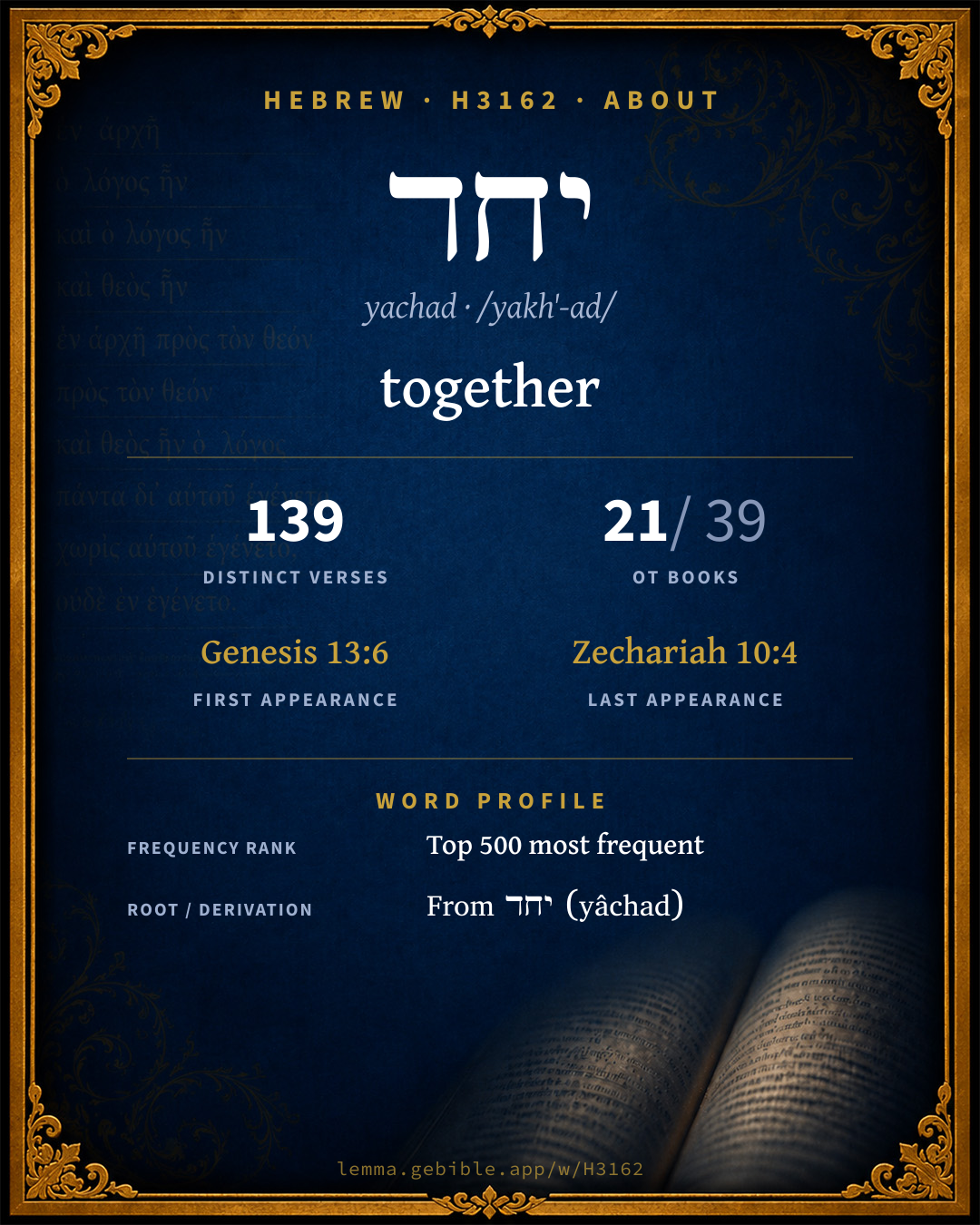
יַ֫חַד
together
‘together’ is one of 2 main senses fuller range ↓
Full lexicon entry — Brown-Driver-Briggs (BDB)
From Brown-Driver-Briggs (BDB)
Where this word appears
Grammar key — what these labels mean
Part of speech
- Adverb
- A word that modifies a verb, adjective, or other adverb.
- Noun
- A naming word — a person, place, thing, or idea.
Noun type
- Common
- A common noun — a general class of person, place, or thing (“king,” “city,” “water”), not a specific name.
State
- Absolute
- The independent form of a noun, not bound to a following word.
Gender
- Masculine
- Grammatically masculine.
Number
- Singular
- One.
Every verse where H3162 appears in the Book of Isaiah — 33 distinct verses. Click any verse to open its interlinear word-by-word view. Verse text shown in the World English Bible for context — . Each verse’s Hebrew form is shown with its reference; the English is not keyword-highlighted, since the data carries no word-level English alignment. Use “Compare translations” on any verse to read it across multiple English versions. This concordance covers the Hebrew Bible; Septuagint (Greek Old Testament) occurrences are not indexed here.
Isaiah
- Isaiah 1:28 יַחְדָּ֑ו adv But the destruction of transgressors and sinners shall be together, And those who forsake Yahweh shall be consumed.
- Isaiah 1:31 יַחְדָּ֖ו adv The strong will be like tinder, And his work like a spark. They will both burn together, And no one will quench them."
- Isaiah 9:21 יַחְדָּ֥ו adv Manasseh, Ephraim; and Ephraim, Manasseh; and they together shall be against Judah. For all this his anger is not turned away, but his hand is stretched out still.
- Isaiah 10:8 יַחְדָּ֖ו adv For he says, Aren't my princes all of them kings?
- Isaiah 11:6 יַחְדָּ֔ו adv The wolf shall dwell with the lamb, and the leopard shall lie down with the kid; and the calf and the young lion and the fattened calf together; and a little child shall lead them.
- Isaiah 11:7 יַחְדָּ֖ו adv The cow and the bear shall feed; their young ones shall lie down together; and the lion shall eat straw like the ox.
- Isaiah 11:14 יַחְדָּ֖ו adv They shall fly down on the shoulder of the Philistines on the west; together shall they despoil the children of the east: they shall put forth their hand on Edom and Moab; and the children of Ammon shall obey them.
- Isaiah 18:6 יַחְדָּו֙ adv They shall be left together to the ravenous birds of the mountains, and to the animals of the earth; and the ravenous birds shall summer on them, and all the animals of the earth shall winter on them.
- Isaiah 22:3 יַ֖חַד יַחְדָּ֔ו adv adv All your rulers fled away together, they were bound by the archers; all who were found of you were bound together; they fled afar off.
- Isaiah 27:4 יָּֽחַד adv Wrath is not in me: would that the briers and thorns were against me in battle! I would march on them, I would burn them together.
- Isaiah 31:3 וְ/יַחְדָּ֖ו conj + adv Now the Egyptians are men, and not God; and their horses flesh, and not spirit: and when Yahweh shall stretch out his hand, both he who helps shall stumble, and he who is helped shall fall, and they all shall be consumed together.
- Isaiah 40:5 יַחְדָּ֔ו adv and the glory of Yahweh shall be revealed, and all flesh shall see it together; for the mouth of Yahweh has spoken it.
- Isaiah 41:1 יַחְדָּ֖ו adv Keep silence before me, islands; and let the peoples renew their strength: let them come near; then let them speak; let us come near together to judgment.
- Isaiah 41:19 יַחְדָּֽו adv I will put in the wilderness the cedar, the acacia, and the myrtle, and the oil tree; I will set in the desert the fir tree, the pine, and the box tree together:
- Isaiah 41:20 יַחְדָּ֔ו adv that they may see, and know, and consider, and understand together, that the hand of Yahweh has done this, and the Holy One of Israel has created it.
- Isaiah 41:23 יַחְדָּֽו adv Declare the things that are to come hereafter, that we may know that you are gods: yes, do good, or do evil, that we may be dismayed, and see it together.
- Isaiah 42:14 יָֽחַד n c ms I have long time held my peace; I have been still, and refrained myself: [now] will I cry out like a travailing woman; I will gasp and pant together.
- Isaiah 43:9 יַחְדָּ֗ו adv Let all the nations be gathered together, and let the peoples be assembled: who among them can declare this, and show us former things? let them bring their witnesses, that they may be justified; or let them hear, and say, It is truth.
- Isaiah 43:17 יַחְדָּ֤ו adv who brings forth the chariot and horse, the army and the mighty man (they lie down together, they shall not rise; they are extinct, they are quenched as a wick):
- Isaiah 43:26 יָ֑חַד n c ms Put me in remembrance; let us plead together: set you forth [your cause], that you may be justified.
- Isaiah 44:11 יָֽחַד n c ms Behold, all his fellows shall be disappointed; and the workmen, they are of men: let them all be gathered together, let them stand up; they shall fear, they shall be put to shame together.
- Isaiah 45:8 יַ֔חַד adv Distil, you heavens, from above, and let the skies pour down righteousness: let the earth open, that it may bring forth salvation, and let it cause righteousness to spring up together; I, Yahweh, have created it.
- Isaiah 45:16 יַחְדָּו֙ adv They shall be disappointed, yes, confounded, all of them; they shall go into confusion together who are makers of idols.
- Isaiah 45:20 יַחְדָּ֖ו adv Assemble yourselves and come; draw near together, you who have escaped from the nations: they have no knowledge who carry the wood of their engraved image, and pray to a god that can't save.
- Isaiah 45:21 יַחְדָּ֑ו adv Declare you, and bring [it] forth; yes, let them take counsel together: who has shown this from ancient time? who has declared it of old? Haven't I, Yahweh? and there is no God else besides me, a just God and a Savior; there is no one besides me.
- Isaiah 46:2 יַחְדָּ֔ו adv They stoop, they bow down together; they could not deliver the burden, but themselves are gone into captivity.
- Isaiah 48:13 יַחְדָּֽו adv Yes, my hand has laid the foundation of the earth, and my right hand has spread out the heavens: when I call to them, they stand up together.
- Isaiah 50:8 יָּ֑חַד adv He is near who justifies me; who will bring charges against me? Let us stand up together: who is my adversary? Let him come near to me.
- Isaiah 52:8 יַחְדָּ֣ו adv The voice of your watchmen! they lift up the voice, together do they sing; for they shall see eye to eye, when Yahweh returns to Zion.
- Isaiah 52:9 יַחְדָּ֔ו adv Break forth into joy, sing together, you waste places of Jerusalem; for Yahweh has comforted his people, he has redeemed Jerusalem.
- Isaiah 60:13 יַחְדָּ֑ו adv The glory of Lebanon shall come to you, the fir tree, the pine, and the box tree together, to beautify the place of my sanctuary; and I will make the place of my feet glorious.
- Isaiah 65:7 יַחְדָּו֙ adv your own iniquities, and the iniquities of your fathers together, says Yahweh, who have burned incense on the mountains, and blasphemed me on the hills; therefore will I first measure their work into their bosom.
- Isaiah 66:17 יַחְדָּ֥ו adv Those who sanctify themselves and purify themselves [to go] to the gardens, behind one in the midst, eating pig's flesh, and the abomination, and the mouse, they shall come to an end together, says Yahweh.
About this entry
At a glance — auto-summarized from this page’s data, not written by a person. Every figure links to its source below. This summary describes the numbers; it doesn’t interpret them.
“together” is the headline sense of the Hebrew word יחד (yachad). First canonically at Genesis 13:6, it enters the text early. It appears 139 verses across 21 books of the Hebrew Bible, among its common vocabulary. Its meaning spans more than one sense — see its full sense range. Related forms include יחד, יחיד and יחת. The sections below give every sense, occurrence, and version rendering.
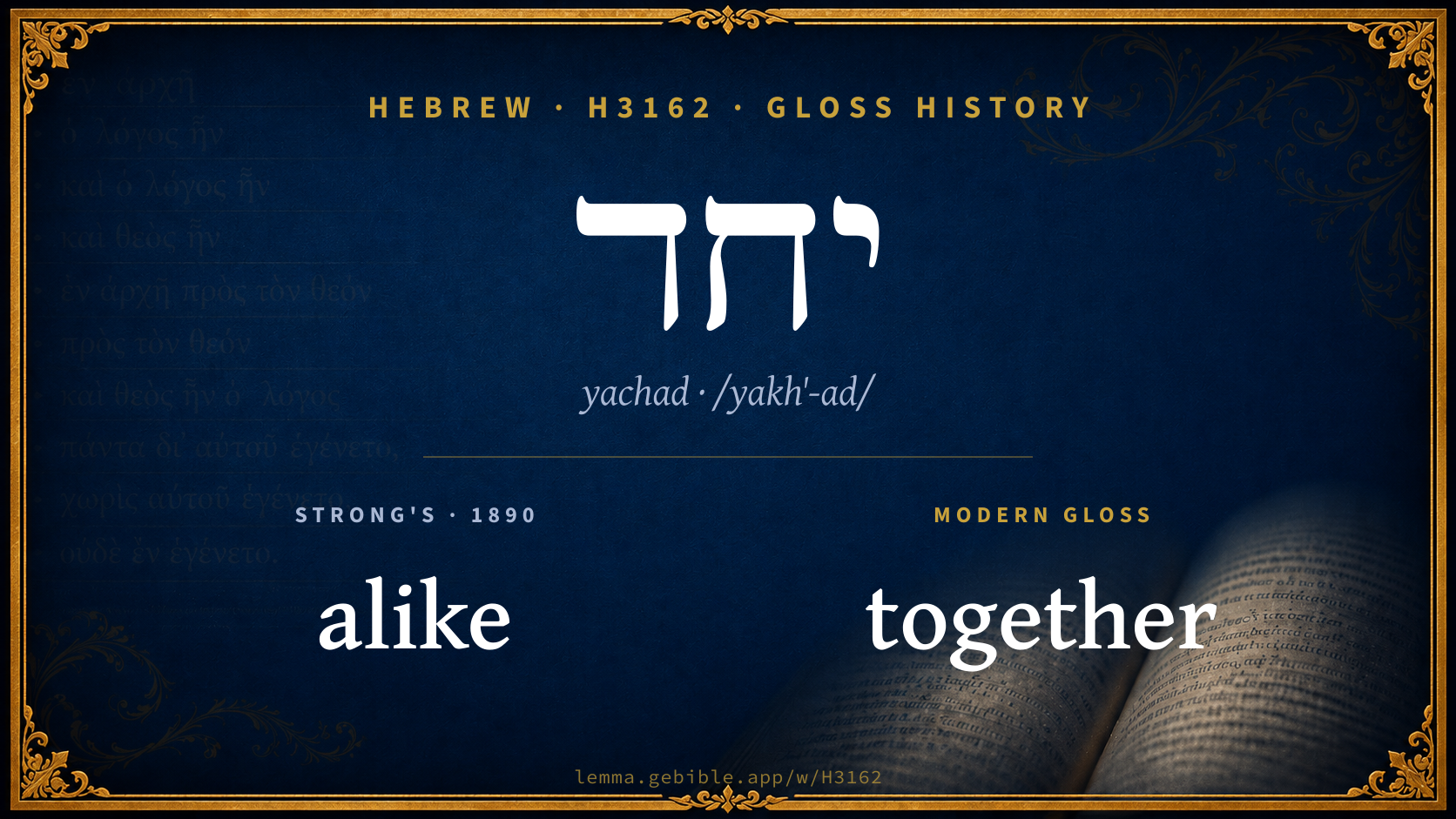
Gloss history
Strong's 1890 vs modern scholarship
About this word
Strong's H3162 catalogs a Hebrew word from the Hebrew Old Testament.
These counts are not copied from any lexicon or concordance. They are computed here, from the morphology-tagged Hebrew Old Testament. What Lemma adds →
- 139
- distinct verses
- The word appears in 139 distinct verses.
- 21 / 39
- OT books
- The word appears in 21 of 39 Old Testament books.
- #316
- by frequency
- Top 500 most frequent Hebrew words (rank 316 of 8,640 Hebrew words by occurrence).
View all 139 occurrences in the concordance →
By section of the Old Testament
By traditional corpus
Conventional, traditional groupings — biblical authorship is debated, so this is a traditional corpus grouping, not an authorship claim. Each share is this word’s portion of its verses in that division of the Hebrew canon. Each figure is a share of the word’s 139 distinct verses.
- Prophets (Nevi'im) 72 verses · 52%
- Writings (Ketuvim) 51 verses · 37%
- Torah (Pentateuch) 16 verses · 12%
How translations render this word
Counts come from each version’s own published word-to-Strong’s tagging or interlinear alignment — an approximate guide to how each version renders this word, not a word-level alignment the data otherwise carries. Because each total is that version’s own tagged count, the per-version totals vary from one another and need not match the appearance or distinct-verse counts above. These counts may also differ from a printed concordance because Lemma counts each distinctly tagged rendering and does not collapse phrase taggings into a single head-word total. This is a fixed set of word-tagged versions (KJV, ASV, BSB, ULT) and does not change with the reading translation you choose elsewhere. Each version’s license is shown beside its name below (and on Sources).
BDB lists this Strong’s number as 2 distinct words (homographs). Each count above pools all of them and is not split by sense — see the Senses section below. A low-frequency rendering may belong to a different one of those words, not the primary meaning.
- King James Version†: Together 108×, Alike 4×, Themselves together 4×
- American Standard Version†: Together 89×, All 4×, Alike 3×
- Berean Standard Bible†: Together 70×, Both 6×, Alike 4×
- unfoldingWord Literal Text†: Together 111×, Alike 4×, Altogether 4×
King James Version Public Domain
Renders H3162 across 142† tagged occurrences — most commonly:
Plus 20 renderings that appear only once — usually multi-word phrases or single function words the recovered tagging swept in, not distinct renderings.
American Standard Version Public Domain
Renders H3162 across 140† tagged occurrences — most commonly:
Plus 35 renderings that appear only once — usually multi-word phrases or single function words the recovered tagging swept in, not distinct renderings.
Berean Standard Bible Public Domain
Renders H3162 across 120† tagged occurrences — most commonly:
Plus 28 renderings that appear only once — usually multi-word phrases or single function words the recovered tagging swept in, not distinct renderings. Not rendered by a distinct English word in 21 further occurrences.
unfoldingWord Literal Text CC BY-SA 4.0
Renders H3162 across 135† tagged occurrences — most commonly:
Plus 8 renderings that appear only once — usually multi-word phrases or single function words the recovered tagging swept in, not distinct renderings.
8 senses and sub-senses in the full BDB
What do BDB’s symbols mean?
BDB uses these scholarly abbreviations:
| Symbol | Meaning |
|---|---|
| 𝔊 | the Septuagint (the ancient Greek translation, LXX) |
| 𝔙 | the Vulgate (the Latin translation) |
| 𝔖 | the Syriac version (the Peshitta) |
| 𝔗 | the Targum (the Aramaic translation) |
| ψ | the Psalms |
| √ | root (the underlying root or stem) |
| ‖ | parallel passage (a synonymous or contrasted parallel) |
| † | the dagger: every passage where the word occurs is cited |
The 8 senses and sub-senses the full Brown-Driver-Briggs lexicon distinguishes for this word, in lexicon order (not ranked by frequency), with BDB’s own verbatim wording and sub-sense lettering. Shown in Hebrew script with BDB’s own scholarly abbreviations. The condensed entry is in the Lexicon Entry tab. See also the Forms in the corpus table below.
יחד I [m.] unitedness.
- 1. as subst. only 1 Ch 12:17 (peculiar) יִהְיֶה־לִּי עֲלֵיכֶם לֵבָב לֳי֑חַד I will have a heart toward you for unitedness, i.e. my heart shall be ready to become one with yours (cf. v 38 לב אחד). e.g. 1 Chronicles 12:17
- 2. elsewhere always in acc. as adv. in union, together (cf. Arabic وَحْدٌ in acc. with sf. in his solitariness = alone)—
- a. together, of community in action, place, or time (often combined, but one usually more prominent than the others); (1) in action, Jb 38:7 בְּרָן־יַחַד כּוֹכְבֵי בֹקֶר when the stars of God shouted together; Ezr 4:3 we together will build (opp. to you), with נִלְחַם 1 S 17:10, נִשְׁפַּט Is 43:26; (2) in place 1 S 11:11 ולא נשׁארו בם שׁנים יָ֑חַד; 2 S 10:15 וַיֵּאָֽסְפוּ יָ֑חַד ψ 2:2; 31:14; 88:18, 133:1 שֶׁבֶת יַחַד, Is 50:8, as pred. Mi 2:12 יַחַד אֲשִׂימֶנּוּ; (3) in place and time at once, 2 S 21:9 וַיִּפְּלוּ יָ֑חַד and they perished together, 14:16 to destroy אתי ואת בני יחד; (4) of time alone (poet.) Is 42:14 אֶשֹּׁם וְאֶשְׁאַף יחד I will gasp and pant together, 45:8 Jb 6:2; 10:8; 17:16 read נֵחָ֑ת for נָ֑חַת (v. pp. 94b, 629a); יַחַד here will then belong to (1); ψ 141:10 יחד אנכי עד אעבור while I at the same time pass on. e.g. Job 38:7
- b. all together, altogether (poet. syn. of כֻּלָּם, but more forcible, suggesting often, especially with כל, all at once, as well as altogether), Is 44:11 יפחדו יבשׁו יחד (cf. ψ 40:15), ψ 62:10 הֵמָּה מֵהֶבֶל יַחַד they are all together (made) of vanity, Is 22:3 כל קציניך נדדו יחד (with כל also ψ 41:8 Jb 34:15): often in poet. beginning a clause with emph., Dt 33:5 Jb 3:18 יחד אסירים שׁאננו, 16:10; 19:12 יחד יבאו גדודיו, 24:4; 31:38 ψ 41:8; 98:8 Ho 11:7 (with a neg.), v 8; in connexion with a sf., or obj. of a vb., Is 27:4 אציתנה יָ֑חַד I will burn it altogether, ψ 33:15 הַיֹּצֵר יַחַד לִבָּם who formeth the hearts of them all together, 74:6, 8 Jb 10:8 יַחַד סָבִיב altogether round about (but read perhaps with 𝔊 𝔖 Del Di אַחַר תִּסּוֹב), 40:13. e.g. Isaiah 44:11
- c. together, in the sense of alike, the one as well as the other, ψ 49:3, 11 יחד כסיל ובער יאבדו, Jb 21:26; 34:29. More frequent is e.g. Psalms 49:3
יחד II
- a. of community in action, ψ 34:4 ונרוממה שׁמו יחדו let us exalt his name together, Is 52:9, with נוֹעַץ take counsel, 45:21 ψ 71:10; 83:6 Ne 6:7; נִצָּה to struggle Dt 25:11; in place, as with ישׁב Gn 13:6 Dt 25:5, הלך Gn 22:6, 8 Am 3:3, בוא Je 3:18 Jb 9:32, קרב Is 41:1, נפל 2 S 2:16, אכל Ju 19:6 Je 41:1, התקבץ Jos 9:2, נאסף Ju 6:33, etc.; Dt 22:10 בשׁור ובחמור יחדו; coupling pairs, and so strengthening וְ (mostly poet.), v 11 Am 1:15 הוא ושׂריו יחדו (cf. Je 48:7 Qr [Kt יחד], 49:3) Je 6:11, 12 שׂדות ונשׁים י׳, v 21 (accents), 13:14; 31:8, 13; 50:4, 33 Is 41:19, cf. 65:7; in time (rare: but v. infr.), ψ 4:9 in peace יחדו אשׁכבה ואישׁן will I at once lie down and sleep (i.e. lie down and fall asleep immediately). e.g. Psalms 34:4
- b. emph. (especially poet.) = all together 1 S 31:6, Is 10:8 הלא שׂרי יחדו מלכים are not my princes all together, all alike, kings? 18:6; 40:5; 41:20, 23; 45:16 (‖ כֻּלָּם), 46:2 קרסו כרעו יחדו, 48:13; 66:17 ψ 14:3 (‖ הַכֹּל), 19:10 צדקו יחדו (of J.’s ordinances), 35:26; 37:38; sometimes (like יַחַד b) suggesting all at once, as well as all together, Ex 19:8 ויענו כל העם יחדו (so, with כל, Is 22:3; 31:3 Zc 10:4), Is 1:28, 31 ובערו שׁניהם יחדו. Prefixed to a clause (like יחד), Dt 33:17 (cf. יחד v 5), Is 9:20; 11:7, 14; 31:3; 43:17; 45:16; 52:8 Je 46:12; 51:38 La 2:8 Jb 24:17 (strengthening לָמוֹ). e.g. 1 Samuel 31:6
- c. alike, the one as well as the other, Dt 12:22 (= 15:22) the unclean and the clean alike may eat it, 1 S 30:24 יַחְדָּו יַחֲלֹֽקוּ׃ they shall share together, i.e. alike. e.g. Deuteronomy 12:22
Senses from the full Brown-Driver-Briggs lexicon (Brown, Driver, Briggs; Oxford 1906 — public domain), digitized via Sefaria, supplemented by the OpenScriptures HebrewLexicon (CC BY 4.0). Full attribution on Sources.
Word origin
(Je 46:12, 21; 49:3 יַחְדָּיו), adv. together (proposes (in) his or its unitednesses (cf. Arabic وَحْدَهُ alone; and for the form אַשְׁרָיו), but, the orig. of the term. being forgotten, applied gen. as an adv., without regard to number, gender, or person: so Ges Ol§ 135 c Sta§ 370 a)—together:
— Brown-Driver-Briggs (Oxford 1906, public domain), digitized via Sefaria, supplemented by the OpenScriptures HebrewLexicon (CC BY 4.0). See Sources.
Derived from יחד (yâchad) (H3161) — to join.
Jastrow Dictionary
A second Hebrew/Aramaic lexicon for comparison, covering Aramaic and post-biblical (Talmudic, Targumic, Midrashic) usage that the biblical-Hebrew BDB does not. Matched by lemma rather than by Strong’s number, so a lemma may carry more than one Jastrow headword (shown separately below), and the entries cover usage well beyond the Bible.
יָחַד
- , Pi. יִחֵד, יִיחֵד (b. h.; v. אֶחָד)
- 1. to unite, concentrate. Y. Ber. IV, 7ᵈ bot. ותְיַיחֵד לבבינו וכ׳ and concentrate our hearts (inclinations) to fear thy Name.
- 2. (with על) to confer a distinction, name &c. Gen. R. s. 68 אברהם י׳ … שמו עליו on Abraham did the Lord confer His Name (Gen. XXVI, 24, a. e.). Ib. ידע שהקב"ה מְיַחֵד שמו עליו he inferred that the Lord would confer His Name upon him (to be called ‘the God of Jacob’). Mekh. Mishp. s. 20 על ישראל י׳ שמו ביותר (although the Lord of the universe) He conferred His Name particularly on Israel (v. יוֹתֵר); a. fr. e.g. Genesis 26:24
- 3. to declare the unity of God, to recite Sh’ma (Deut. VI, 4). Gen. R. s. 20 אנו … ומְיַחֲדִים שמו וכ׳ we trust in Him and profess His unity &c. Cant. R. to II, 16 ואני מְיַחֶדֶת שמו וכ׳ and I (Israel) profess the unity of His name twice every day, (saying) Hear, O Israel &c.; a. fr. e.g. Deuteronomy 6:4
- 4. to single out, select, designate. Snh. 57ᵃ שיי׳ שפחה לעבדו who designated a handmaid (as a wife) for his slave. Lev. R. s. 12 ויי׳ אליו הדבור וכ׳ addressed the command to him exclusively (Lev. X, 8); a. e.—Yoma 11ᵇ (ref. to Lev. XIV, 35) מי שמְיַיחֵד ביתו לו וכ׳ he who devotes his household exclusively to himself, and is unwilling to lend his vessels &c.; Arakh. 16ᵃ שמיוחד (v. infra); Yalk. Lev. 564.—5) to leave persons alone in a special room, to arrange a private meeting for. Keth. 12ᵃ; Tosef. ib. I, 4; Y. ib. I, 25ᵃ bot. היו מְיַיחֲדִין וכ׳ they used to leave bride and groom in a private room alone for a while.—Part. pass. מְיוּחָד, f. מְיוּחֶדֶת; pl. מְיוּחָדִים, מְיוּחָדִין, מְיוּחָדוֹת a) especial, particular, designated; chosen, distinguished (v. יָחִיד). Snh. 60ᵃ, a. e. שם המי׳ the proper Name of the Lord (Jehovah).—Yoma 11ᵃ ביתך ביתך המי׳ לך ‘thy house’ (Deut. VI, 9; XI, 20), thy house which is designated for thy personal use. Ib.ᵇ מה בית מ׳ לדירה bayith means a room designated for a dwelling, יצאו אלו שאינן מי׳ לדירה to the exclusion of those rooms (gate lodge &c.) which are not designated for dwellings. Arakh. l. c. מי׳ לו devoted to his own exclusive use, v. supra; a. fr.—Gen. R. s. 99, end (ref. to כאחד, Gen. XLIX, 16) כמי׳ שבשבטים like the most distinguished among the tribes. Yeb. 62ᵃ אני שמ׳ לדבור בכל וכ׳ I (Moses) who am singled out (must be prepared) for divine communication every hour; Ab. d’R. N., II Vers., ch. II (ed. Schechter, p. 10) שאני כלי מי׳ who am a special vessel (of revelation). Meïl. 15ᵃ קדשים המי׳ לה׳ sanctified things which are exclusively dedicated to the Lord; Sifra Vayikra, Ḥobah, Par. 11, ch. XX.—Ib. Sh’mini, ch. II, Par. 2 כבשים ועזים המי׳ lambs and goats which are specified (Deut. XIV, 4); a. fr.—b) locked up with. Num. R. s. 9 בזמן שהאשה מי׳ עם וכ׳ when a wife is locked up with her husband. e.g. Leviticus 10:8
- , Nithpa. נִתְיַיחֵד
- 1. to be conferred (with על); to be especially addressed (with אל). Ex. R. s. 7 היה ראוי … להִתְיַיחֵד עליו וכ׳ the divine communication was to bear his name alone. Lev. R. s. 12 נתי׳ אליו הדבור the divine communication was addressed to him especially; a. e.
- 2. to be alone with, to be closeted with. Kidd. IV, 12 לא יִתְיַיחֵד אדם וכ׳ a man must not be alone (even) with two women, but one woman מִתְיַיחֶדֶת וכ׳ may be alone with two men. Ab. Zar. II, 1. Tosef. Gitt. VII (V), 4; a. fr.—V. יִחוּד.
יְחַד
- , Pa. יַחֵד ch. same,
- 1. to concentrate. Targ. Ps. LXXXVI, 11.—Part. pass. מְיַחַד united, harmonious. Targ. Y. Ex. XIX, 2 (cmp. הוֹמוֹנְיָא).
- 2. to specify, single out, designate. Macc. 18ᵃ ליַחוּדֵי לאוי וכ׳ Ms. M. (ed. לי׳ להו) to forbid each of these acts singly (as if each were prohibited by a special prohibitory law, v. לַאו).—Part. pass. מְיָחַד = h. מְיוּחָד (v. preced.). Targ. O. Gen. XXVI, 10 דמְיָ׳ בעמא ed. Berl. (oth. ed. מְיָחֵיד; Y. מלכא דמֵיחַד) a distinguished person of the people. Targ. Y. Lev. XV, 20; 22 מְיַיחֵד designated; a. e.
- , contr. אִיַּיחֵד to be joined; to be locked up. Targ. Y. I Gen. XLIX, 6. Targ. Job. III, 6.—Targ. Y. II, Num. XXXI, 50.—Snh. 37ᵃ שרי לִיַּיחוּדֵי וכ׳ is permitted to be closeted up with her husband.
A Dictionary of the Targumim, the Talmud Babli and Yerushalmi, and the Midrashic Literature (Marcus Jastrow; London, Luzac, 1903) — Public Domain. Digitized via Sefaria. Digitized via Sefaria. Full attribution on Sources.
Forms in the corpus
The 36 distinct written forms H3162 takes in the Hebrew Bible, most frequent first — each parse links to that state’s occurrences in the concordance. Hebrew forms include their vowel points and cantillation, so a single lemma takes many written forms.
| Form | Parsing | Example | Uses |
|---|---|---|---|
| יַחְדָּ֑ו | Adverb | Amos 3:3 | 20 |
| יַחְדָּֽו | Adverb | Deuteronomy 22:10 | 16 |
| יַחְדָּ֖ו | Adverb | Amos 1:15 | 14 |
| יַחְדָּ֔ו | Adverb | Deuteronomy 15:22 | 11 |
| יָֽחַד | Noun, Common, Masculine, Singular, Absolute | 1 Samuel 11:11 | 10 |
| יַחְדָּו֙ | Adverb | Deuteronomy 25:11 | 8 |
| יָ֑חַד | Noun, Common, Masculine, Singular, Absolute | 2 Samuel 21:9 | 6 |
| יַ֖חַד | Adverb | Deuteronomy 33:5 | 5 |
| יַחְדָּ֥ו | Adverb | 1 Chronicles 10:6 | 5 |
| יַ֥חַד | Adverb | Job 10:8 | 4 |
| יַ֝֗חַד | Adverb | Job 16:10 | 3 |
| יַ֭חַד | Adverb | Job 3:18 | 3 |
| יַחְדָּ֗ו | Adverb | Deuteronomy 25:5 | 3 |
| וְ/יַחְדָּ֗ו | Adverb | Exodus 26:24 | 2 |
| יַ֔חַד | Adverb | 2 Samuel 14:16 | 2 |
| יַ֝חְדָּ֗ו | Adverb | Job 9:32 | 2 |
| יַ֣חַד | Adverb | Psalms 31:13 | 2 |
| יַ֤חַד | Adverb | Job 19:12 | 2 |
| יַחְדָּ֖יו | Adverb | Jeremiah 46:12 | 2 |
| יַחְדָּ֛ו | Adverb | Jeremiah 6:21 | 2 |
| יַחְדָּ֪ו | Adverb | Psalms 14:3 | 2 |
| יַחְדָּֽיו | Adverb | Jeremiah 48:7 | 2 |
| יַחְדָּו֮ | Adverb | Psalms 4:8 | 2 |
| יָּ֑חַד | Adverb | Isaiah 50:8 | 2 |
| וְ/יַחְדָּ֖ו | Adverb | Isaiah 31:3 | 1 |
| וְ֝/יַ֗חַד | Adverb | Job 31:38 | 1 |
| יַ֗חַד | Adverb | Psalms 41:7 | 1 |
| יַ֜חַד | Adverb | Ezra 4:3 | 1 |
| יַ֭חְדָּו | Adverb | Psalms 55:14 | 1 |
| יַחְדָּ֣ו | Adverb | Isaiah 52:8 | 1 |
| יַחְדָּ֤ו | Adverb | Isaiah 43:17 | 1 |
| יַחְדָּ֨ו | Adverb | Job 24:17 | 1 |
| יַחַד֮ | Adverb | Psalms 40:14 | 1 |
| יָּֽחַד | Adverb | Isaiah 27:4 | 1 |
| יחד | Adverb | Jeremiah 48:7 | 1 |
| לְ/יָ֑חַד | Noun, Common, Masculine, Singular, Absolute | 1 Chronicles 12:17 | 1 |
Same root — word family
Other BDB entries built from the same root as H3162, grouped by Strong’s listed origin. These share a root / origin per the lexicon — not necessarily a shared meaning. Each links to that word’s own entry.
Derives from
Shares the same root
Proper names from this root
People and places named from this root — a name, not an additional meaning of the word.
- יחת Yachath H3189 Jahath
- יחדו Yachdôw H3163 Jahdo
- יחדיאל Yachdîyʼêl H3164 Jahdiel
- יחדיהו Yechdîyâhûw H3165 Jehdeiah
Compare all same-root words → Showing 4 of 7 — not the complete family. 4 of the same-root words are proper names (people or places). They share a root, not necessarily a meaning.
Septuagint verse parallels
This word appears in 126 verses that also exist in the Greek Old Testament (Septuagint), out of the 139 Hebrew verses it occurs in. You can read those verses in Greek by switching the Old Testament edition to the Septuagint.
Read these verses in the Septuagint
- Genesis 13:6
- Exodus 19:8
- Deuteronomy 12:22
- Joshua 9:2
- Judges 6:33
- 1 Samuel 11:11
- 2 Samuel 2:13
- 1 Kings 3:18
- 1 Chronicles 10:6
- Ezra 4:3
- Job 2:11
- Psalms 2:2
This is a verse-level parallel only — the same verses exist in both the Hebrew and Greek Old Testaments. No word-level Hebrew↔Greek correspondence is claimed: the data carries no such alignment, so no Greek word is shown as this Hebrew word’s translation. Coverage is not total — the Septuagint omits the deuterocanon and renumbers the Psalms, so some Hebrew verses have no direct Greek parallel.