
Psalms 49:3

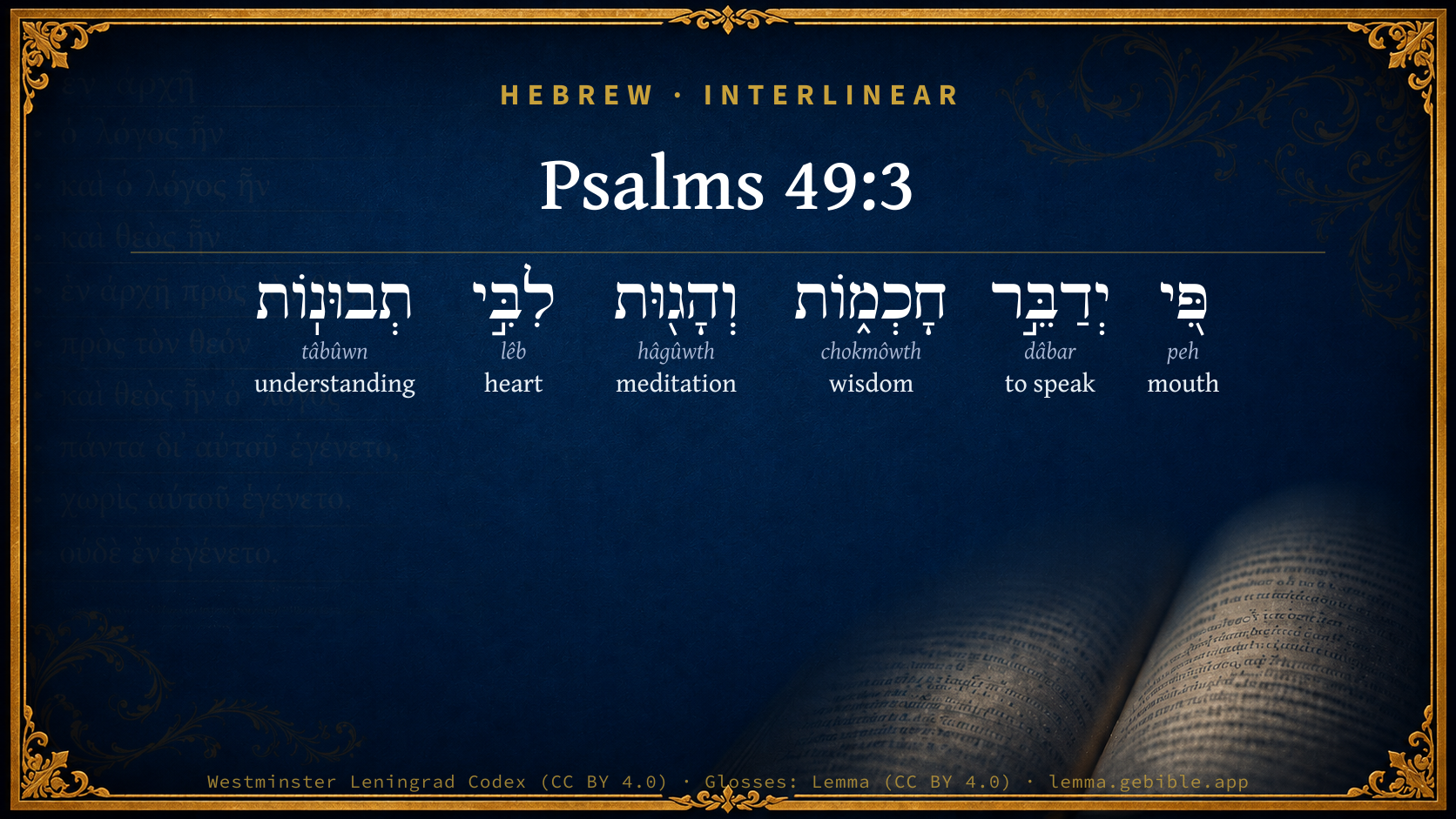
Hebrew (Westminster Leningrad Codex) Psalms 49:3 appears in the Hebrew Old Testament. The text above is from the Westminster Leningrad Codex. Each word links to its Strong’s number, a concise gloss, and parsing drawn from the Open Scriptures Hebrew Bible morphology. Click any word for its full Brown-Driver-Briggs (BDB) entry.
Download image
Cite this verse

Psalms 49:3 (World English Bible). Public Domain. Lemma interlinear Bible study tool, https://lemma.gebible.app/v/psalms/49/3.

Show BibTeX & RIS
BibTeX
RIS
English Translation
My mouth will speak words of wisdom. My heart shall utter understanding.
World English Bible · Public Domain
Highlights
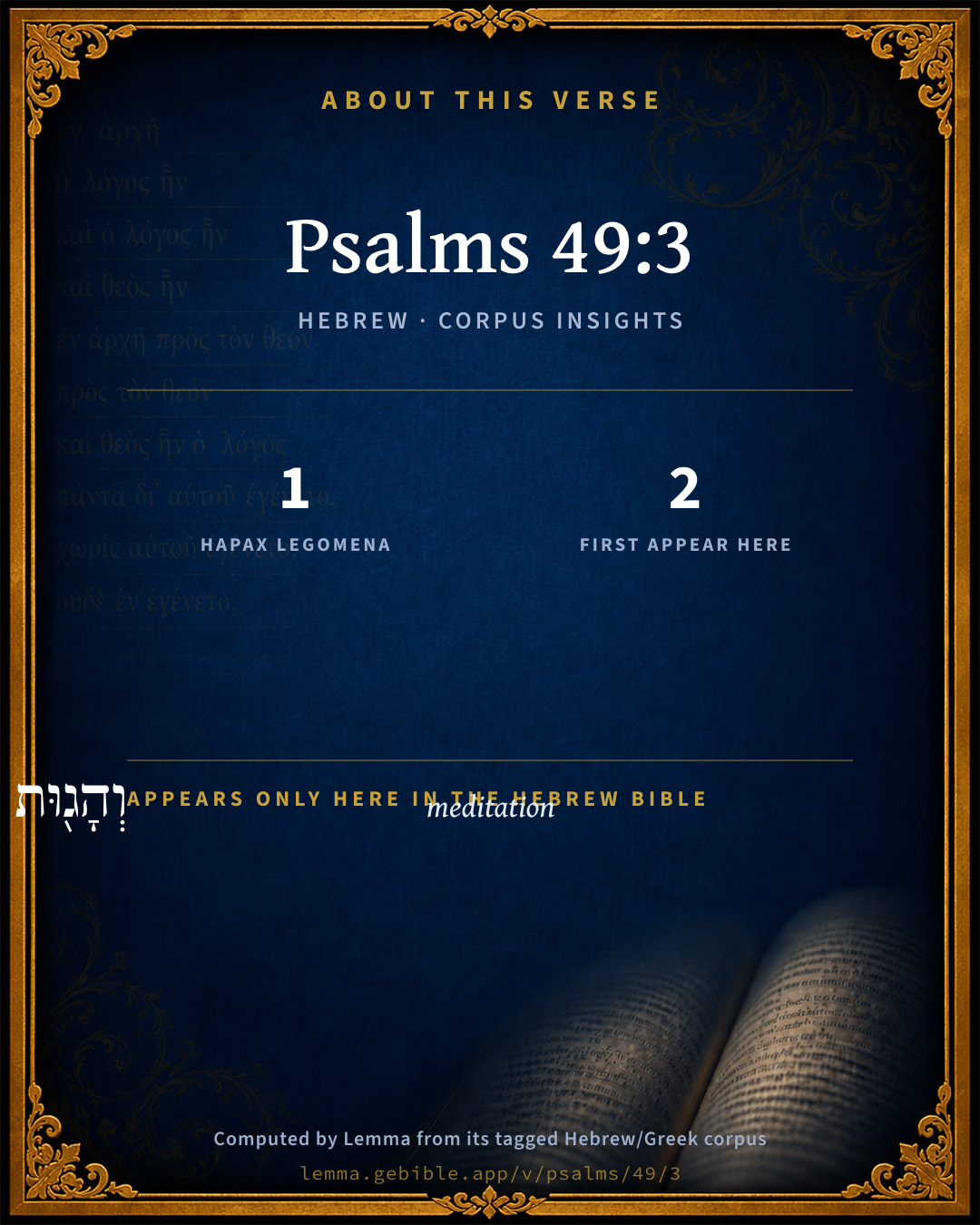
  • 1 hapax legomenon — only here in the Hebrew Bible
  • 2 first appearances in the Hebrew Bible
Full analysis ↓
Download a study sheet

One document with this verse’s original text, its word-by-word gloss line, the meaning frame, cross-references with their text, attributed commentary, and full source and license credits — printable, and it pastes into notes with its structure intact.

This verse Autodidact and up

Study sheet (.html) Plain text (.txt)

A passage Seminary Student

Up to 50 verses in one chapter. A passage sheet keeps up to 6 commentary sources and 12 cross-references per verse, in the order this page ranks them, and says so on the sheet whenever that leaves anything out. Ask for a single verse and you get the Autodidact verse sheet above.

Everything on this page stays free to read, with no account — the sheet is a download of what is already on screen, not access to it.

Want to remove ads? Support Godless Engineer
Compare translations 3

The same verse in 3 English versions, stacked beneath the original-language interlinear above. Click any original word for its lexicon entry.

Each is an independent rendering of the whole verse — the interlinear is not word-aligned to these translations.

Highlighted words mark where these versions differ — a whole-verse word diff, not a word-by-word alignment.

  • World English Bible Public Domain
    My mouth will speak words of wisdom. My heart shall utter understanding.
  • King James Version Public Domain
    My mouth shall speak of wisdom; and the meditation of my heart shall be of understanding.
  • unfoldingWord Literal Text CC BY-SA 4.0
    My mouth will speak wisdom, and the meditation of my heart, understanding.

unfoldingWord Literal Text — © unfoldingWord, licensed CC BY-SA 4.0. Word-aligned USFM3 via Door43 (git.door43.org/unfoldingWord/en_ult).

Versions to compare (up to 4)

3 of 4 selected

Show all 18 translations

Every available English version of this verse, each an independent rendering of the whole verse.

  • World English Bible Public Domain
    My mouth will speak words of wisdom. My heart shall utter understanding.
  • Berean Standard Bible Public Domain
    My mouth will impart wisdom, and the meditation of my heart will bring understanding.
  • Majority Standard Bible Public Domain
    My mouth will impart wisdom, and the meditation of my heart will bring understanding.
  • King James Version Public Domain
    My mouth shall speak of wisdom; and the meditation of my heart shall be of understanding.
  • American Standard Version (1901) Public Domain
    My mouth shall speak wisdom; And the meditation of my heart shall be of understanding.
  • Revised Version (1885) Public Domain
    My mouth shall speak wisdom; and the meditation of my heart shall be of understanding.
  • Geneva Bible (1599) Public Domain
    My mouth shall speake of wisdome, and the meditation of mine heart is of knowledge.
  • Douay-Rheims (1899) Public Domain
    All you that are earthborn, and you sons of men: both rich and poor together.
  • Young's Literal Translation Public Domain
    My mouth speaketh wise things, And the meditations of my heart `are' things of understanding.
  • Literal Standard Version CC BY-SA 4.0
    My mouth speaks wise things, || And the meditations of my heart [are] things of understanding.
  • Unlocked Literal Bible CC BY-SA 4.0
    My mouth will speak wisdom and the meditation of my heart will be of understanding.
  • unfoldingWord Literal Text CC BY-SA 4.0
    My mouth will speak wisdom, and the meditation of my heart, understanding.
  • Darby Bible Public Domain
    My mouth shall speak wisdom, and the meditation of my heart shall be of understanding:
  • World Messianic Bible Public Domain
    My mouth will speak words of wisdom. My heart will utter understanding.
  • Webster's Bible Public Domain
    \\49:2\\Both low and high, rich and poor together.
  • Free Bible Version CC BY-SA 4.0
    For what I say is wise, and my thinking is perceptive.
  • Bible in Basic English Public Domain
    From my mouth will come words of wisdom; and in the thoughts of my heart will be knowledge.
  • JPS Tanakh (1917) Public Domain
    (49-4) My mouth shall speak wisdom, and the meditation of my heart shall be understanding.

Literal Standard Version (2020), Covenant Press — licensed CC BY-SA 4.0. Text via the HelloAO Bible API (eBible.org). Unlocked Literal Bible (unfoldingWord) — licensed CC BY-SA 4.0. Text via the HelloAO Bible API (eBible.org). unfoldingWord Literal Text — © unfoldingWord, licensed CC BY-SA 4.0. Word-aligned USFM3 via Door43 (git.door43.org/unfoldingWord/en_ult). Free Bible Version, Dr. Jonathan Gallagher — licensed CC BY-SA 4.0. Text via the HelloAO Bible API (eBible.org).

Word by word

More ways to search: Search by grammar → Find every occurrence → Compare this word →

Practice this passage: Drill this verse → Learn its vocabulary →

About this verse

These counts appear in no published source. They are computed here, from the morphology-tagged text and Lemma’s own curated glosses. What Lemma adds →

6
words
6
distinct lemmas
Wisdom
section

Notable vocabulary

1 hapax legomenon — a word that appears only here in the entire Hebrew Bible:

  • וְהָג֖וּת meditation H1900

First appearance in Scripture

These words make their first canonical appearance in the Hebrew Bible here:

  • חָכְמ֑וֹת wisdom H2454
  • וְהָג֖וּת meditation H1900

Shared distinctive vocabulary

חָכְמ֑וֹת wisdom H2454 occurs in 5 verses of the Hebrew Bible. Also found in:

Grammatical profile

  • 1 verb
  • 5 nouns

Verb forms

  • יְדַבֵּ֣ר Piel · Imperfect

Hebrew & Septuagint length

In English translation the verse runs 12 words from the Hebrew and 16 from the Septuagint (LXX English) — closely comparable.

A rough comparison of the two English renderings, which tokenize alike — not a word-level alignment.

Word counts can differ between the Hebrew and the Greek without any difference in meaning — e.g. the Hebrew direct-object marker אֵת has no separate Greek word, and Greek often adds the article ὁ.

Cross-references

14

Topical passages linked to Psalms 49:3 in the Treasury of Scripture Knowledge — connected by theme and wording, ordered by reader-vote popularity; previews shown in the World English Bible.

  • Psalms 19:14 Let the words of my mouth and the meditation of my heart Be acceptable in your sight, Yahweh, my rock, and my redeemer.
  • Matthew 12:35 The good man out of his good treasure brings out good things, and the evil man out of his evil treasure brings out evil things.
  • Proverbs 22:20–21 Haven't I written to you thirty excellent things Of counsel and knowledge,
  • Proverbs 22:17 Turn your ear, and listen to the words of the wise. Apply your heart to my teaching.
  • Deuteronomy 32:2 My doctrine shall drop as the rain; My speech shall condense as the dew, As the small rain on the tender grass, As the showers on the herb.
  • Job 33:3 My words shall utter the uprightness of my heart; That which my lips know they shall speak sincerely.
  • Job 33:33 If not, listen to me: Hold your peace, and I will teach you wisdom."
  • Psalms 119:130 The entrance of your words gives light. It gives understanding to the simple.
  • 2 Timothy 3:15–17 From infancy, you have known the sacred writings which are able to make you wise for salvation through faith, which is in Christ Jesus.
  • Psalms 37:30 The mouth of the righteous talks of wisdom. His tongue speaks justice.
  • Psalms 45:1 My heart overflows with a noble theme. I recite my verses for the king. My tongue is like the pen of a skillful writer.
  • Proverbs 4:1–2 Listen, sons, to a father's instruction. Pay attention and know understanding;
  • Psalms 104:34 Let your meditation be sweet to him. I will rejoice in Yahweh.
  • Proverbs 8:6–11 Hear, for I will speak excellent things. The opening of my lips is for right things.

Cross-references courtesy of OpenBible.info (CC BY 4.0).

Hebrew and Greek witnesses Masoretic Hebrew ↔ Greek Septuagint

The same verse in the two great witnesses to the Old Testament, shown verse-for-verse.

You’re reading Greek Psalm 48 (Hebrew Psalm 49). The Septuagint counts the superscription, so verse numbers can differ from the Hebrew — chapter-level alignment, not verse-by-verse. Numbering follows Rahlfs.

These are two independent witnesses, not word-aligned to each other, and the Septuagint is shown in lemma (dictionary) form.

Hebrew Psalms 49:3 Masoretic · Westminster Leningrad Codex

פִּ֭י יְדַבֵּ֣ר חָכְמ֑וֹת וְהָג֖וּת לִבִּ֣י תְבוּנֽוֹת

My mouth will speak words of wisdom. My heart shall utter understanding.

World English Bible · Public Domain

Greek LXX Greek Psalm 48:3 Septuagint · lemma form

ὅς τε γηγενής καί ὁ υἱός ὁ ἄνθρωπος ἐπί ὁ αὐτός πλούσιος καί πένης

My mouth shall speak of wisdom; and the meditation of my heart shall bring forth understanding.

LXX2012 (modern English Septuagint) · Public Domain

Hebrew: Westminster Leningrad Codex (CC BY 4.0). Greek: Septuagint (public domain); English from LXX2012 (modern English Septuagint) (Public Domain). How the Septuagint differs from the Hebrew →

Commentary

Notes on Psalms 49:3 from classic Christian and Jewish commentators (each source and its license shown beneath its notes). The classic Christian expositions comment on the surrounding passage and are grouped to its opening verse, so a note may address several verses; the Jewish commentaries on the Tanakh (Rashi and others) are per-verse, so they appear only where the commentator wrote on this verse.

Lemma curates 59 commentaries, every one of them public domain or Creative Commons licensed, each selected and text-cleaned for this edition rather than reprinted as found. About our sources →

Trapp's Complete Commentary

John Trapp

Psa 49:3 My mouth shall speak of wisdom; and the meditation of my heart [shall be] of understanding.

Ver. 3. My mouth shall speak of wisdom] Heb. Wisdomns and understandings; and yet the matter of this psalm was nothing extraordinary for the main of it; so that a profane person would have come out with his

Quid dignum tanto tulit hic promissor hiatu?

But good points are not therefore to be slighted, because commonly handled; but therefore the better to be heeded, and proof to be made by practice, what that good and holy and acceptable will of God is that is so much pressed upon, as Rom 12:2.

John Trapp, A Commentary or Exposition upon All the Books of the Old and New Testament (1647–1656) — public domain. Text from a community e-Sword module.

Joseph Benson's Commentary

Psa 49:3-4. My mouth shall speak of wisdom — I shall not treat of trivial things, nor of those I have but slightly considered; but about the most weighty matters, which my mind hath greatly pondered. I will enrich your souls with wisdom, which is better than the wealth of the world, which you covet; and I will teach you how to direct all your actions aright unto that scope at which you aim, the being happy. I will incline mine ear — I will hearken to what God by his Spirit speaks to me, and that I will now speak to you. To a parable — Which properly is an allegorical speech, but is often taken for an important, and withal dark doctrine or sentence. I will open — I will not smother it in my own breast, but publish it to the world. My dark saying — So he calls the following discourse, because the thing in question ever hath been thought hard to be understood. “Much of the eastern wisdom consisted in the understanding of parables; and in the interpretation of dark sayings or riddles: the mysterious cover to this kind of wisdom made it the most high-prized accomplishment. And here, when the psalmist was to raise and engage the attention of his audience, he promises that he would speak of those things, in which the highest wisdom was supposed to consist: and, indeed, it must be confessed that, in the composition of this Psalm, he has made use of every art to render it worthy the subject.” — Dodd, and Warburton’s Divine Legation.

Joseph Benson's Commentary on the Old and New Testaments (1811–1818) — public domain. Text from a community e-Sword module.

J. A. Alexander on Psalms

Joseph Addison Alexander

4. (Psa 49:3). My mouth shall speak wisdom, and the meditation of my heart (is) understanding. This is no self-praise, as he is only to communicate what he has received. Shall speak, is speaking or about to speak. Wisdom and understanding are both plural in the Hebrew, that form denoting fulness or variety. See above, on Psa 18:50 (49). The plural of the first word is also applied to the personification of the highest wisdom, in Pro 9:1. The speech mentioned in the first clause is the outward expression of the thought or meditation in the second. See the same combination above, Psa 54:2 (1).

Joseph Addison Alexander, The Psalms Translated and Explained (1850) — public domain. Text from a community e-Sword module.

John Calvin's Commentaries

3. My mouth shall speak of wisdom The prophet was warranted in applying these commendatory terms to the doctrine which he was about to communicate. It is, no doubt, by plain appeals to observation that we find him reproving human folly; but the general principle upon which his instruction proceeds is one by no means obvious to the common sense of mankind, not to say that his design in using such terms is less to assert the dignity of his subject than simply to awaken attention. This he does all the more effectually by speaking as one who would apply his own mind to instruction rather than assume the office of exhortation. He puts himself forward as an humble scholar, one who, in acting the part of teacher, has an eye at the same time to his own improvement. It were desirable that all the ministers of God should be actuated by a similar spirit, disposing them to regard God as at once their own teacher and that of the common people, and to embrace in the first place themselves that divine word which they preach to others. The Psalmist had another object in view. He would secure the greater weight and deference to his doctrine by announcing that he had no intention to vend fancies of his own, but to advance what he had learned in the school of God. This is the true method of instruction to be followed in the Church. The man who holds the office of teacher must apply himself to the reception of truth before he attempt to communicate it, and in this manner become the means of conveying to the hands of others that which God has committed to his own. Wisdom is not the growth of human genius. It must be sought from above, and it is impossible that any should speak with the propriety and knowledge necessary for the edification of the Church, who has not, in the first place, been taught at the feet of the Lord. To condescend upon the words, some read in the third verse, And the meditation of my heart shall speak of understanding But as it were a harsh and improper expression to say that the meditation of the heart speaks, I have adopted the simpler reading.

John Calvin's Commentaries (1540-1563) — public domain. Text from the Calvin Translation Society English edition (1840s-50s) via the Christian Classics Ethereal Library (ccel.org). Calvin's coverage is partial (roughly two-thirds of the Bible); uncommented books and verses are honest gaps, never fabricated. The 19th-century editor's footnotes and remarks are omitted so the notes are faithfully Calvin's own voice.

The Cambridge Bible for Schools and Colleges

gen. ed. J. J. S. Perowne

3. My mouth shall speak wisdom,

And the meditation of my heart shall be (full of) understanding.

The words for wisdom and understanding are both plural in the Heb., denoting manifold wisdom and profound insight.

The Cambridge Bible for Schools and Colleges (gen. ed. J. J. S. Perowne; Cambridge University Press, 1878–1918) — public domain. Text from a community e-Sword module.

John Gill's Exposition

My mouth shall speak of wisdom,.... Or "wisdoms" (m); of Christ, who is so called, Pro 1:20. He being as a divine Person the wisdom of God, and the only wise God; and having all the treasures of wisdom in him, as man and Mediator: of him the prophet spake, and of him the apostles and all Gospel ministers speak; of the glories of his Person, of the fulness of his grace, and of his wonderful works; especially of that of redemption and salvation by him, in which there is an abounding of wisdom and prudence. Or the Gospel may be meant, and all the truths of it, in which there is a glorious display of divine wisdom; it is the wisdom of God in a mystery; hidden and ancient wisdom; and which, when truly understood, makes a man wise unto salvation; see Co1 2:6;

and the meditation of my heart shall be of understanding; or "understandings" (n); and this is in order to the former; what the heart meditates the mouth speaks. If the heart meditates on understanding, the mouth will speak of wisdom; and a man should think before he speaks, especially the ministers of the Gospel: they ought to meditate on the word of God, the Gospel, and the truths of it, that their profiling may appear to all; that they may understand divine things themselves, and deliver them out to the understanding of others: their concern should be, that through meditation they may have a good treasure of wisdom and knowledge in their hearts, that out of it they may bring forth things pleasant and profitable unto others.

(m) "sapientias", Pagninus, Montanus, Vatablus, Cocceius, Gejerus, Michaelis. (n) "intelligentias", Pagninus, Montanus.

John Gill's Exposition of the Whole Bible (1746–1763) — public domain (CC PDM 1.0). Text via the HelloAO Bible API.

Albert Barnes' Notes on the Bible

My mouth shall speak of wisdom - That is, I will utter sentiments that are wise, or that are of importance to all; sentiments that will enable all to take a just view of the subject on which I speak. This indicates “confidence” in what he was about to utter, as being eminently deserving of attention.

And the meditation of my heart shall be of understanding - What I reflect on, and what I give utterance to, in the matter under consideration. The idea is, that he had meditated on the subject, as to what was real wisdom in the matter, and that he would now give utterance to the result of his meditations. It was not wisdom in general, or intelligence or understanding as such on which he designed to express the results of his thoughts, but it was only in respect to the proper value to be attached to wealth, and as to the fact of its causing fear Psa 49:5 in those who were not possessed of it, and who might be subjected to the oppressive acts of those who were rich.

Albert Barnes' Notes on the Bible (1834–1885) — public domain. Text from a community e-Sword/MySword module.

Matthew Poole's English Annotations

It concerns you diligently to attend to me, for I am about to speak not of vulgar and trivial things, or such as come suddenly into my mind, and rush as hastily out of my mouth, but of such things as are the result of my most serious and considerate thoughts, and such as, if you observe them and lay them to heart, will make you truly wise, and keep you from those errors, and follies, and mischiefs, which the generality of mankind, for want of a right understanding, do run into.

Matthew Poole's English Annotations on the Holy Bible (1683–1685) — public domain. Text from a community e-Sword/MySword module.

The Treasury of David

Charles H. Spurgeon

Ver. 3. My mouth shall speak of wisdom. Inspired and therefore lifted beyond himself, the prophet is not praising his own attainments, but extolling the divine Spirit which spoke in him. He knew that the Spirit of truth and wisdom spoke through him. He who is not sure that his matter is good has no right to ask a hearing. And the meditation of my heart shall be of understanding. The same Spirit who made the ancient seers eloquent, also made them thoughtful. The help of the Holy Ghost was never meant to supersede the use of our own mental powers. The Holy Spirit does not make us speak as Balaam's ass, which merely uttered sounds, but never meditated; but he first leads us to consider and reflect, and then he gives us the tongue of fire to speak with power.

None.

Ver. 3. The deep things of God are intended,

1. To exercise our minds to understand them.

2. To try our faith by believing them"incline" implies a submissive mind.

3. To excite our joy as we grasp them"upon the harp."

4. To employ our faculties in explaining them to others.

Psalms 49:4*

Charles H. Spurgeon's The Treasury of David (1869–1885) — public domain. Psalms only. Text from a community e-Sword/MySword module.

The Pulpit Commentary

My mouth shall speak of wisdom. (comp. Job_33:3, Job_33:4) It is not his own "wisdom" that the psalmist is about to utter, but a wisdom communicated to him from without, to which he has "to incline his ear" (ver. 4). And the meditation of my heart shall be of understanding; or, of discernment (Kay).

The Pulpit Commentary (1880–1919), ed. H.D.M. Spence-Jones & Joseph S. Exell — public domain. Text from a community e-Sword module.

unfoldingWord translationNotes

Door43 World Missions Community

My mouth will speak wisdom

Here the word "mouth" refers to the whole person who speaks. AT: "I will speak wise words" (See: Synecdoche)

the meditation of my heart will be of understanding

Here the word "heart" represents the mind and thoughts. The abstract nouns "meditation" and "understanding" can be translated as verbs. AT: "the thoughts upon which I meditate will help you to understand" (See: Metonymy and Abstract Nouns)

incline my ear

The writer speaks of listening carefully to something as if it were bending one's ear towards the person who is speaking. AT: "listen carefully" (See: Metaphor)

with the harp

"as I play the harp"

Why should I fear ... heels?

The writer asks this question to emphasize that he has no reason to fear when bad things happen. AT: "I have no reason to fear ... heels." (See: Rhetorical Question)

the days of evil

"when evil things happen." Here the word "days" refers to general periods of time.

when iniquity surrounds me at my heels

Possible meanings are 1) the writer speaks of the evil desires of his enemies as if it were a predator ready to overtake him. AT: "when the iniquity of sinful men is ready to overcome me" or 2) the writer's enemies surround him as they commit their iniquity. AT: "when my enemies surround me" (See: Metaphor)

translationWords

wise

meditate

heart

understand

parable

harp

fear

evil

iniquity

unfoldingWord translationNotes — © Distant Shores Media and the Door43 World Missions Community, licensed CC BY-SA 4.0. Source: git.door43.org/Door43/en_tn.

Rashi

Rabbi Shlomo Yitzchaki (Rashi)

Both the sons of “adam” The sons of Abraham, who was called (Josh. 14:15): “the greatest man (האדם) among the giants”; the sons of Ishmael and the sons of Keturah.

and the sons of “ish” The sons of Noah, who was called (Gen. 6:9): “a righteous man (איש צדיק).”

Rashi on the Tanakh — English translations: “The Judaica Press complete Tanach with Rashi, translated by A. J. Rosenberg” (CC BY 4.0); “Pentateuch with Rashi's commentary by M. Rosenbaum and A.M. Silbermann, 1929-1934” (public domain); “The Metsudah Tanach series, Lakewood, N.J” (CC BY 4.0); and “The Book of Joshua, Metsudah Publications, 1997” (CC BY 4.0). Text via Sefaria.

Ibn Ezra

Rabbi Abraham ibn Ezra

"Also" - calling the sons of Adam who aren't wealthy, or who are and are well known. That is the reason for also having "sons of man", to include the rich and the poor.

Ibn Ezra on the Tanakh — English translations: “Sefaria Community Translation” (CC0 1.0 (public-domain dedication)); “Yalkut, Sifsei Chachomim Chumash, Metsudah Publications, 2009” (CC BY 4.0); and “Commentary of Ibn Ezra on Isaiah - trans. by M. Friedlander, 1873” (public domain). Text via Sefaria.

Lesson kit

Teaching starters — assembled from the data on this page, not authored interpretation. Every prompt links to the verse data it draws on. Edit before teaching.

Psalms, in the Wisdom, opens this verse with 6 words (6 distinct Hebrew lemmas). Its most distinctive word is hâgûwth (“meditation”). A historical commentator’s framing appears above. Read the whole chapter for the surrounding context.

Discussion questions

  1. What does “meditation” (hâgûwth) contribute to the verse as a whole?
  2. This verse holds 1 word here found nowhere else in the Hebrew Bible. What might the rare word draw attention to?
  3. 2 words here appear for the first time in Scripture. What is being introduced at this debut?
  4. Proverbs 1:20 shares the word «wisdom» with this verse. How do the two illuminate each other?
  5. These translations render this verse differently; the difference is in the English rendering, not the original. What questions does that raise?
  6. The verb «יְדַבֵּ֣ר» is Piel Imperfect. How does its form color the action?
  7. Reading how Trapp's Complete Commentary and Joseph Benson's Commentary read this verse, where do the two commentators agree and where do they part?

Things to notice

  • 1 word in this verse appears nowhere else in the Hebrew Bible.
  • 2 words make their first canonical appearance in Scripture here.
  • These translations choose different wording for 5 words in this verse.
  • 6 distinct Hebrew lemmas span 6 words in this verse.

Reading settings

Reading text

Shown beneath each verse's original-language words.

Old Testament
Old Testament edition

Read the OT as the Masoretic Hebrew (MT) or the Greek Septuagint (LXX).

English shown for the Greek Septuagint (in the Hebrew ↔ Greek comparison).

Comparing translations? Open the Compare panel on any verse page to stack up to four side by side.