Isaiah 45:16

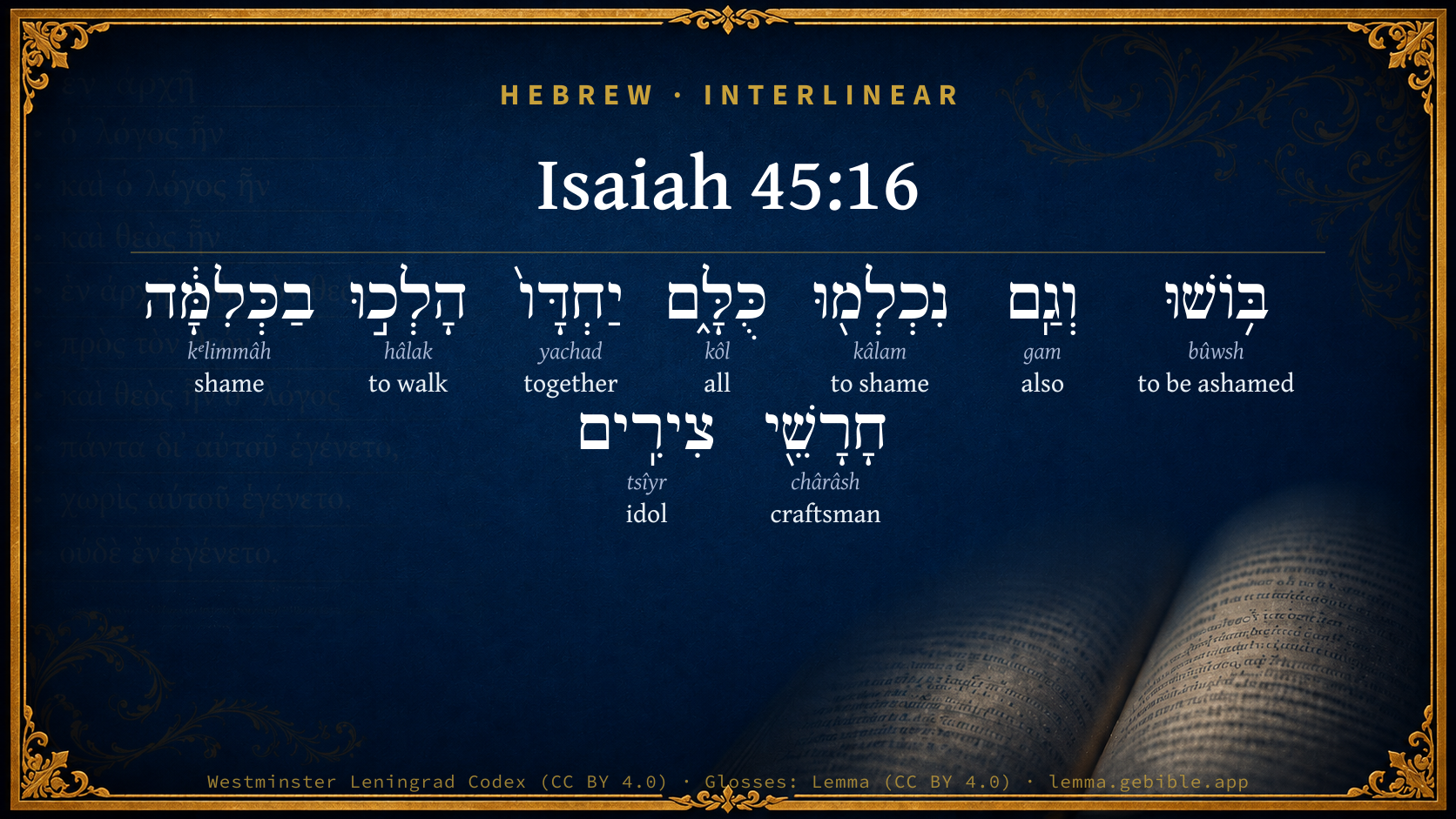
Hebrew (Westminster Leningrad Codex) Isaiah 45:16 appears in the Hebrew Old Testament. The text above is from the Westminster Leningrad Codex. Each word links to its Strong’s number, a concise gloss, and parsing drawn from the Open Scriptures Hebrew Bible morphology. Click any word for its full Brown-Driver-Briggs (BDB) entry.
Download image
Cite this verse

Isaiah 45:16 (World English Bible). Public Domain. Lemma interlinear Bible study tool, https://lemma.gebible.app/v/isaiah/45/16.

Show BibTeX & RIS
BibTeX
RIS
English Translation
They shall be disappointed, yes, confounded, all of them; they shall go into confusion together who are makers of idols.
World English Bible · Public Domain
Download a study sheet

One document with this verse’s original text, its word-by-word gloss line, the meaning frame, cross-references with their text, attributed commentary, and full source and license credits — printable, and it pastes into notes with its structure intact.

This verse Autodidact and up

Study sheet (.html) Plain text (.txt)

A passage Seminary Student

Up to 50 verses in one chapter. A passage sheet keeps up to 6 commentary sources and 12 cross-references per verse, in the order this page ranks them, and says so on the sheet whenever that leaves anything out. Ask for a single verse and you get the Autodidact verse sheet above.

Everything on this page stays free to read, with no account — the sheet is a download of what is already on screen, not access to it.

Want to remove ads? Support Godless Engineer
Compare translations 3

The same verse in 3 English versions, stacked beneath the original-language interlinear above. Click any original word for its lexicon entry.

Each is an independent rendering of the whole verse — the interlinear is not word-aligned to these translations.

Highlighted words mark where these versions differ — a whole-verse word diff, not a word-by-word alignment.

  • World English Bible Public Domain
    They shall be disappointed, yes, confounded, all of them; they shall go into confusion together who are makers of idols.
  • King James Version Public Domain
    They shall be ashamed, and also confounded, all of them: they shall go to confusion together that are makers of idols.
  • unfoldingWord Literal Text CC BY-SA 4.0
    They will have shame and also be disgraced, all of them; together they will walk in disgrace, the crafters of idols.

unfoldingWord Literal Text — © unfoldingWord, licensed CC BY-SA 4.0. Word-aligned USFM3 via Door43 (git.door43.org/unfoldingWord/en_ult).

Versions to compare (up to 4)

3 of 4 selected

Show all 18 translations

Every available English version of this verse, each an independent rendering of the whole verse.

  • World English Bible Public Domain
    They shall be disappointed, yes, confounded, all of them; they shall go into confusion together who are makers of idols.
  • Berean Standard Bible Public Domain
    They will all be put to shame and humiliated; the makers of idols will depart together in disgrace.
  • Majority Standard Bible Public Domain
    They will all be put to shame and humiliated; the makers of idols will depart together in disgrace.
  • King James Version Public Domain
    They shall be ashamed, and also confounded, all of them: they shall go to confusion together that are makers of idols.
  • American Standard Version (1901) Public Domain
    They shall be put to shame, yea, confounded, all of them; they shall go into confusion together that are makers of idols.
  • Revised Version (1885) Public Domain
    They shall be ashamed, yea, confounded, all of them: they shall go into confusion together that are makers of idols.
  • Geneva Bible (1599) Public Domain
    All they shalbe ashamed and also confounded: they shall goe to confusion together, that are the makers of images.
  • Douay-Rheims (1899) Public Domain
    They are all confounded and ashamed: the forgers of errors are gone together into confusion.
  • Young's Literal Translation Public Domain
    They have been ashamed, And they have even blushed -- all of them, Together gone in confusion have those carving images.
  • Literal Standard Version CC BY-SA 4.0
    They have been ashamed, || And they have even blushed—all of them, || Those carving images have gone together in confusion.
  • Unlocked Literal Bible CC BY-SA 4.0
    They will all be ashamed and disgraced together; those who carve idols will walk in humiliation.
  • unfoldingWord Literal Text CC BY-SA 4.0
    They will have shame and also be disgraced, all of them; together they will walk in disgrace, the crafters of idols.
  • Darby Bible Public Domain
    They shall be ashamed, and also confounded, all of them; they shall go away in confusion together, the makers of idols.
  • World Messianic Bible Public Domain
    They will be disappointed, yes, confounded, all of them. Those who are makers of idols will go into confusion together.
  • Webster's Bible Public Domain
    They shall be ashamed, and also confounded, all of them: they shall go to confusion together that are makers of idols.
  • Free Bible Version CC BY-SA 4.0
    Everyone who makes idols are ashamed and humiliated, all of them are disgraced.
  • Bible in Basic English Public Domain
    All those who have gone against him will be put to shame; the makers of images will be made low.
  • JPS Tanakh (1917) Public Domain
    They shall be ashamed, yea, confounded, all of them; they shall go in confusion together that are makers of idols.

Literal Standard Version (2020), Covenant Press — licensed CC BY-SA 4.0. Text via the HelloAO Bible API (eBible.org). Unlocked Literal Bible (unfoldingWord) — licensed CC BY-SA 4.0. Text via the HelloAO Bible API (eBible.org). unfoldingWord Literal Text — © unfoldingWord, licensed CC BY-SA 4.0. Word-aligned USFM3 via Door43 (git.door43.org/unfoldingWord/en_ult). Free Bible Version, Dr. Jonathan Gallagher — licensed CC BY-SA 4.0. Text via the HelloAO Bible API (eBible.org).

Word by word

More ways to search: Search by grammar → Find every occurrence → Compare this word →

Practice this passage: Drill this verse → Learn its vocabulary →

About this verse

These counts appear in no published source. They are computed here, from the morphology-tagged text and Lemma’s own curated glosses. What Lemma adds →

9
words
9
distinct lemmas
Prophets
section

Notable vocabulary

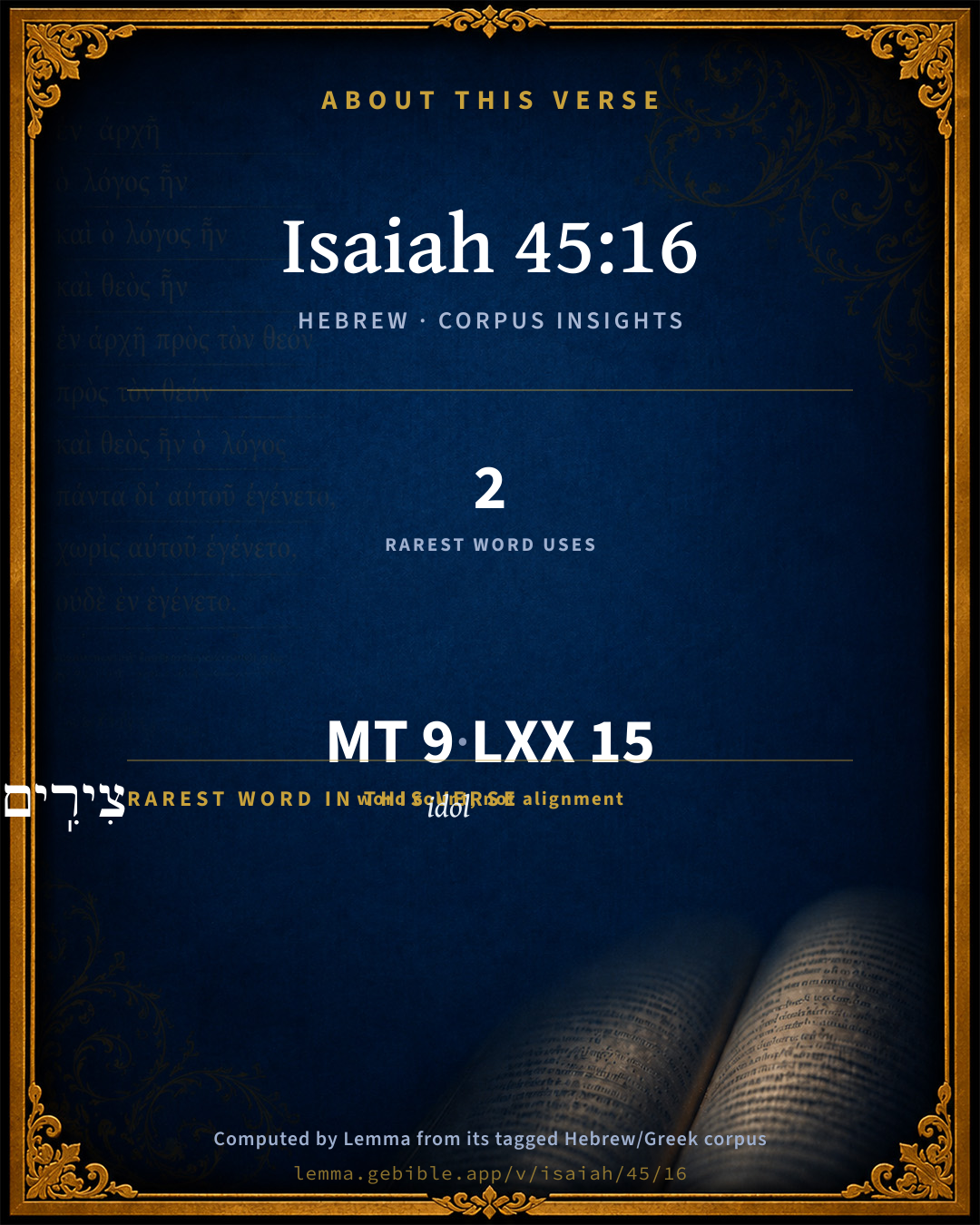
The rarest word here is צִירִֽים idol H6736 — appearing just 2 times in the whole Hebrew Bible.

Shared distinctive vocabulary

צִירִֽים idol H6736 occurs in 2 verses of the Hebrew Bible. Also found in:

Grammatical profile

  • 3 verbs
  • 4 nouns
  • 1 adverb
  • 1 particle

Verb forms

  • בּ֥וֹשׁוּ Qal · Perfect
  • נִכְלְמ֖וּ Niphal · Perfect
  • הָלְכ֣וּ Qal · Perfect

Hebrew & Septuagint length

In English translation the verse runs 20 words from the Hebrew and 23 from the Septuagint (LXX English) — closely comparable.

A rough comparison of the two English renderings, which tokenize alike — not a word-level alignment.

Word counts can differ between the Hebrew and the Greek without any difference in meaning — e.g. the Hebrew direct-object marker אֵת has no separate Greek word, and Greek often adds the article ὁ.

In the original languages it is 9 Hebrew tokens and 15 Greek tokens — but the two are counted differently (Hebrew bundles its prefixes and suffixes into one token; the Greek is in lemma form), so that isn’t a like-for-like length.

Cross-references

8

Topical passages linked to Isaiah 45:16 in the Treasury of Scripture Knowledge — connected by theme and wording, ordered by reader-vote popularity; previews shown in the World English Bible.

  • Isaiah 42:17 They shall be turned back, they shall be utterly disappointed, who trust in engraved images, who tell molten images, You are our gods.
  • Isaiah 44:9 Those who fashion an engraved image are all of them vanity; and the things that they delight in shall not profit; and their own witnesses don't see, nor know: that they may be disappointed.
  • Isaiah 44:11 Behold, all his fellows shall be disappointed; and the workmen, they are of men: let them all be gathered together, let them stand up; they shall fear, they shall be put to shame together.
  • Psalms 97:7 Let all them be shamed who serve engraved images, Who boast in their idols. Worship him, all you gods!
  • Isaiah 41:19 I will put in the wilderness the cedar, the acacia, and the myrtle, and the oil tree; I will set in the desert the fir tree, the pine, and the box tree together:
  • Isaiah 45:20 Assemble yourselves and come; draw near together, you who have escaped from the nations: they have no knowledge who carry the wood of their engraved image, and pray to a god that can't save.
  • Jeremiah 2:26–27 As the thief is ashamed when he is found, so is the house of Israel ashamed; they, their kings, their princes, and their priests, and their prophets;
  • Jeremiah 10:14–15 Every man is become brutish [and is] without knowledge; every goldsmith is disappointed by his engraved image; for his molten image is falsehood, and there is no breath in them.

Cross-references courtesy of OpenBible.info (CC BY 4.0).

Hebrew and Greek witnesses Masoretic Hebrew ↔ Greek Septuagint

The same verse in the two great witnesses to the Old Testament, shown verse-for-verse.

These are two independent witnesses, not word-aligned to each other, and the Septuagint is shown in lemma (dictionary) form.

Hebrew Isaiah 45:16 Masoretic · Westminster Leningrad Codex

בּ֥וֹשׁוּ וְגַֽם נִכְלְמ֖וּ כֻּלָּ֑ם יַחְדָּו֙ הָלְכ֣וּ בַכְּלִמָּ֔ה חָרָשֵׁ֖י צִירִֽים

They shall be disappointed, yes, confounded, all of them; they shall go into confusion together who are makers of idols.

World English Bible · Public Domain

Greek LXX Isaiah 45:16 Septuagint · lemma form

αἰσχύνω καί ἐντρέπω πᾶς ὁ ἀντικεῖμαι αὐτός καί πορεύομαι ἐν αἰσχύνη ἐνκαινίζω πρός ἐγώ νήσος

All that are opposed to him shall be ashamed and confounded, and shall walk in shame: you⌃ isles, keep a feast to me.

LXX2012 (modern English Septuagint) · Public Domain

On this verse, Adam Clarke's Commentary discusses the Septuagint’s reading. Read the note in Commentary ↓

Hebrew: Westminster Leningrad Codex (CC BY 4.0). Greek: Septuagint (public domain); English from LXX2012 (modern English Septuagint) (Public Domain). How the Septuagint differs from the Hebrew →

Targum (Aramaic paraphrase)

1

The Targum is the ancient Jewish Aramaic paraphrase of the Hebrew Scriptures — an interpretive translation, not the Hebrew text itself. Onkelos (literal) and Pseudo-Jonathan (expansive) render the Torah, and Jonathan the Prophets. Coverage is partial: where no permissively-licensed English translation exists for a verse, only the Aramaic is shown. This is verse-level text, not a word-by-word alignment to the Hebrew.

  1. Targum Jonathan Prophets (Joshua–Malachi)
    בְּהִיתוּ וְאַף אִתְכַּנִעוּ כּוּלְהוֹן כַּחֲדָא הֲלִיכוּ בְּאִתְכַּנְעוּ פָּלְחֵי צַלְמַיָא:

    They shall be ashamed and confounded, all of them: the worshippers of images shall walk in confusion.

    Targum Jonathan — Aramaic: “Mikraot Gedolot” (public domain). English: “Sefaria Community Translation” (CC0 1.0 (public-domain dedication)); “London "Chaldee Paraphrase," 1871” (public domain). Text via Sefaria.

Commentary

Notes on Isaiah 45:16 from classic Christian and Jewish commentators (each source and its license shown beneath its notes). The classic Christian expositions comment on the surrounding passage and are grouped to its opening verse, so a note may address several verses; the Jewish commentaries on the Tanakh (Rashi and others) are per-verse, so they appear only where the commentator wrote on this verse.

Lemma curates 59 commentaries, every one of them public domain or Creative Commons licensed, each selected and text-cleaned for this edition rather than reprinted as found. About our sources →

The Cambridge Bible for Schools and Colleges

gen. ed. J. J. S. Perowne

16, 17. The prophet now speaks, presenting in sharp contrast the confusion of the idolaters (Isa_45:16) and the everlasting salvation enjoyed by Israel. The verbs should be rendered as presents.

They shall be ashamed &c.] Better: they are ashamed, yea confounded all of them; they are gone away in confusion (i. e. disgrace) etc. The perfect in Heb. depicts that which will have happened in that day.

The word for “idol” is used in the sense of “form” in Psa_49:14 (R.V. marg.), only here of an idolatrous image.

The Cambridge Bible for Schools and Colleges (gen. ed. J. J. S. Perowne; Cambridge University Press, 1878–1918) — public domain. Text from a community e-Sword module.

Trapp's Complete Commentary

John Trapp

Isa 45:16 They shall be ashamed, and also confounded, all of them: they shall go to confusion together [that are] makers of idols.

Ver. 16. That are makers of idols.] The word rendered idols, signifieth properly Tormina, cruciatus, pains, and throes, and straits. Idolaters heap up sorrows to themselves, and terrors of conscience. See Psa 16:4. {See Trapp on "Psa 16:4"}

John Trapp, A Commentary or Exposition upon All the Books of the Old and New Testament (1647–1656) — public domain. Text from a community e-Sword module.

Joseph Benson's Commentary

Isa 45:16-17. They — The idolatrous Gentiles, as it is explained in the end of the verse, opposed to Israel in the beginning of the next verse, shall be ashamed, &c. — Hebrew, בושׁו וגם גכלמר כלם, They are ashamed, they are even confounded, all of them; that is, after the completion of this prophecy. They shall go — Hebrew, הלכו, they go, to confusion together, the makers of idols — Both the artificers, and the masters that set them on work, and consequently all their worshippers. “The reader cannot but observe the sudden transition from the solemn adoration of the secret and mysterious nature of God’s counsels in regard to his people, to the spirited denunciation of the confusion of idolaters, and the final destruction of idolatry; contrasted (Isa 45:17) with the salvation of Israel, not from temporal captivity, but the eternal salvation by the Messiah, strongly marked by the repetition and augmentation of the phrase, עד עולמי עד, usque ad secula eternitatis, to the ages of eternity.” — Bishop Lowth.

Joseph Benson's Commentary on the Old and New Testaments (1811–1818) — public domain. Text from a community e-Sword module.

Keil & Delitzsch

C. F. Keil & F. Delitzsch

The way in which this God who hides Himself is ultimately revealed as the God of salvation, is then pointed out in Isa 45:16, Isa 45:17 : "They are put to shame, and also confounded, all of them; they go away into confusion together, the forgers of idols. Israel is redeemed by Jehovah with everlasting redemption: ye are not put to shame nor confounded to everlasting eternities." The perfects are expressive of the ideal past. Jehovah shows Himself as a Savour by the fact, that whereas the makers of idols perish, Israel is redeemed an everlasting redemption (acc. obj. as in Isa 14:6; Isa 22:17; Ges. 138, 1, Anm. 1), i.e., so that its redemption is one that lasts for aeons (αἰωνία λύτρωσις, Heb 9:12) - observe that teshū‛âh does not literally signify redemption or rescue, but transfer into a state of wide expanse, i.e., of freedom and happiness. The plural ‛ōlâmı̄m (eternities = αἰῶνες aeua) belongs, according to Knobel, to the later period of the language; but it is met with as early as in old Asaphite psalms (Psa 77:6). When the further promise is added, Ye shall not be put to shame, etc., this clearly shows, what is also certain on other grounds - namely, that the redemption is not thought of merely as an outward and bodily one, but also as inward and spiritual, and indeed (in accordance with the prophetic blending of the end of the captivity with the end of all things) as a final one. Israel will never bring upon itself again such a penal judgment as that of the captivity by falling away from God; that is to say, its state of sin will end with its state of punishment, even עב עד־עולמי, i.e., since עד has no plural, εἰς αἰῶνας τῶν αἰώνων.

Keil & Delitzsch — Biblical Commentary on the Old Testament (1861–1891) — public domain (CC PDM 1.0). Text via the HelloAO Bible API. (Old Testament only.)

Jamieson, Fausset & Brown

Robert Jamieson, A. R. Fausset & David Brown

ashamed--"disappointed" in their expectation of help from their idols (see on Isa 42:17; Psa 97:7).

Jamieson, Fausset & Brown — Commentary Critical and Explanatory on the Whole Bible (1871) — public domain (CC PDM 1.0). Text via the HelloAO Bible API.

Adam Clarke's Commentary

Verse 16. They shall be ashamed - "They are ashamed"] The reader cannot but observe the sudden transition from the solemn adoration of the secret and mysterious nature of God's counsels in regard to his people, to the spirited denunciation of the confusion of idolaters, and the final destruction of idolatry; contrasted with the salvation of Israel, not from temporal captivity, but the eternal salvation by the Messiah, strongly marked by the repetition and augmentation of the phrase, to the ages of eternity. But there is not only a sudden change in the sentiment, the change is equally observable in the construction of the sentences; which from the usual short measure, runs out at once into two distichs of the longer sort of verse. See Prelim. Dissert. p. 66, &c. There is another instance of the same kind and very like to this, of a sudden transition in regard both to the sentiment and construction in Isa 42:17.

"His adversaries"] This line, to the great diminution of the beauty of the distich, is imperfect in the present text: the subject of the proposition is not particularly expressed, as it is in the line following. The version of the Septuagint happily supplies the word that is lost: οἱ αντικειμενοι αυτῳ, "his adversaries," the original word was צריו tsaraiv. - L.

Adam Clarke's Commentary on the Bible (1810–1826) — public domain. Text from a community e-Sword/MySword module.

John Gill's Exposition

They shall be ashamed, and also confounded, all of them,.... This refers not to any persons spoken of before; not to Israel or the church, or converts among the Gentiles that came to her; but to those that follow, of whom the same is said in other words:

they shall go to confusion together, that are makers of idols; the Targum is,

"worshippers of images;''

both may be designed: this refers to the first times of the Gospel, and its coming into the Gentile world, and its success there; when the oracles of the Heathens were struck dumb; idols and idol temples were forsaken; and Paganism was abolished in the Roman empire; and when the gods they served could not help them, but they fled to the rocks to hide them from the wrath of God and the Lamb, Rev 6:15.

John Gill's Exposition of the Whole Bible (1746–1763) — public domain (CC PDM 1.0). Text via the HelloAO Bible API.

Albert Barnes' Notes on the Bible

They shall be ashamed and confounded - That is, they shall find all their hopes fail, and shall be suffused with shame that they were ever so senseless as to trust in blocks of wood and stone (see the notes at Isa 1:29; Isa 20:5; Isa 30:5; Isa 43:17).

They shall go to confusion - They shall all retire in shame and disgrace. That is, when they have gone to supplicate their idols, they shall find them unable to render them any aid, and they shall retire with shame.

Albert Barnes' Notes on the Bible (1834–1885) — public domain. Text from a community e-Sword/MySword module.

Haydock's Catholic Bible Commentary

Confusion. Idolaters shall be confounded, when they shall behold the glory of the elect.

George Leo Haydock (1774–1849), Haydock's Catholic Family Bible and Commentary, 1859 edition — public domain. Excludes Psalms (Douay-Rheims chapter numbering differs from Protestant) and Deuterocanonical books (Catholic canon only).

Matthew Poole's English Annotations

They; the idolatrous Gentiles, as it is explained in the end of the verse, opposed to Israel in the beginning of the next verse.

Makers; either the artificers, or the chief masters that set them on work, and consequently all their worshippers; although the makers being most guilty, and the cause of the sins of others, might justly expect a higher degree of confusion.

Matthew Poole's English Annotations on the Holy Bible (1683–1685) — public domain. Text from a community e-Sword/MySword module.

Whedon's Commentary on the Bible

Daniel D. Whedon

16, 17. They shall be ashamed… Israel shall be saved — A marked antithesis. The sixteenth verse states the disappointment and disgust with idol religion on the part of its old devotees, (Isa_42:17,) both among Gentiles and idolatrous Jews. On the other hand, both faithful and reformed Israel, and converts thereto, with confident mien shall rejoice in conscious salvation now and evermore.

Daniel D. Whedon (gen. ed.), Commentary on the Old and New Testaments (1874–1909) — public domain. Text from a community e-Sword module.

The Pulpit Commentary

They shall be ashamed... shall go to confusion; rather, ore ashamed... are gone to confusion the "perfect of prophetic certainty." While the heathen that join themselves to Israel partake of their glory and salvation, such as abide by their idols are covered with shame and confusion.

Vers. 16-19. What shall the end be?

Things are rightly tested by their issues. We do well to ask To what is this course tending? in what will it terminate? Taken in a deep and full sense, though not in a short and shallow one, "all is well that ends well." The prophet says that idolatry will be condemned in the ultimate and utter overthrow and confusion of its victims (ver. 16), while true piety will be finally and fully established (ver. 17). Of this there was the most ample security (vers. 18, 19). We infer, generally

I THAT EVIL ENDS IN OVERTHROW AND DISHONOUR. It is not idolatry only which, when the last stage is reached, is covered with confusion. It is the doom of all departure from the righteous will of God. Self-indulgence has its pleasant hours; but it conducts by a sure road to disease and early death. Crime has its successes; but it spends its last days within prison-walls. Greed has its own wretched gratification; but it earns general and unspeakable contempt. Worldliness wins its honour and "has its reward;" but it ends in heart-ache and bitter disappointment, Rapacity and injustice do often wring treasures from the wronged and suffering; but they end in exposure, in condemnation, in ruin.

II THAT OBEDIENCE ENDS IN BLESSEDNESS AND HONOUR. It is not confounded nor ashamed; it is saved it "seeks not God"s face in vain." It "inherits the land." Though much may be endured, yet a great deal more is gained, by a complete surrender of self to the service of Christ. (see Mar_10:29, 30) It ensures that without which all earthly possessions and all human honours are worthless, with which they can be cheerfully foregone. It brings peace of mind, joy of soul, growth in goodness, victory over the world, Divine favour and guidance, eternal glory.

III THAT OF THIS RESULT WE HAVE THE MOST AMPLE SECURITY. It rests on the foundations of:

1. Divine power. On the "thus saith the Lord," on the word of him who "created the heavens and formed the earth.

2. Divine wisdom. On the word of him whose presence is attested by his handiwork: "He created it not in vain.

3. Divine righteousness. "I the Lord speak righteousness, I declare things that are right." The power, the wisdom, and the righteousness of God are to us the all-sufficient pledge that we shall not seek his face in vain, but shall find that the earnest seeker after God will find all that will fill his heart, ennoble his life, and secure a glorious and immortal destiny. C.

The Pulpit Commentary (1880–1919), ed. H.D.M. Spence-Jones & Joseph S. Exell — public domain. Text from a community e-Sword module.

J. A. Alexander on Isaiah

Joseph Addison Alexander

“They are ashamed and also confounded all of them together, they are gone into confusion (or away in confusion), the carvers of images.” Unless we assume, without necessity or warrant, an abrupt and perfectly capricious change of subject, this verse must contain the conclusion of the process described in the foregoing context. We might therefore expect to find Egypt, Ethiopia, and Seba, introduced again by name; but instead of these, the sentence closes with a general expression, which has already been referred to as a proof that the war in question is a spiritual war, and that the enemies to be subdued are not certain nations, in themselves considered, but the heathen world, the vast mixed multitude who worship idols. These are described as the carvers or artificers of images, which strengthens the conclusion before drawn, that the smith and carpenter and cook and baker and cultivator of Isa 44:12-16, are one and the same person, viz. the idolatrous devotee himself.

Joseph Addison Alexander, The Prophecies of Isaiah (1846–1847; New York: Scribner, 1870–1878) — public domain. Text from a community e-Sword module.

unfoldingWord translationNotes

Door43 World Missions Community

They will all be ashamed and disgraced together; those who carve idols will walk in humiliation

These two lines share similar meanings, with the second clarifying the subject of the first. (See: Parallelism)

They will all be ashamed and disgraced together

The words "ashamed" and "disgraced" mean basically the same thing and emphasize the intensity of shame. This can be stated in active form. AT: "Their idols will leave them all completely ashamed" (See: Doublet and Active or Passive)

will walk in humiliation

Living in continual humiliation is spoken of as if it were walking in humiliation. AT: "will be continually humiliated" (See: Metaphor)

Israel will be saved by Yahweh

This can be stated in active form. AT: "Yahweh will save the people of Israel" (See: Active or Passive)

you will never again be ashamed or humiliated

Here "you" refers to the people of Israel. The words "ashamed" and "humiliated" mean basically the same thing. This can be stated in active form. AT: "No one will ever humiliate you again" (See: Active or Passive and Doublet)

translationWords

shame

false god

walk

humiliate

Israel

save

Yahweh

eternity

save

unfoldingWord translationNotes — © Distant Shores Media and the Door43 World Missions Community, licensed CC BY-SA 4.0. Source: git.door43.org/Door43/en_tn.

Rashi

Rabbi Shlomo Yitzchaki (Rashi)

master painters Heb. חָרָשֵׁי צִירִים, the master painters of the idols, from among the pagans.

Rashi on the Tanakh — English translations: “The Judaica Press complete Tanach with Rashi, translated by A. J. Rosenberg” (CC BY 4.0); “Pentateuch with Rashi's commentary by M. Rosenbaum and A.M. Silbermann, 1929-1934” (public domain); “The Metsudah Tanach series, Lakewood, N.J” (CC BY 4.0); and “The Book of Joshua, Metsudah Publications, 1997” (CC BY 4.0). Text via Sefaria.

Ibn Ezra

Rabbi Abraham ibn Ezra

They shall go with confusion, etc. They that make the idols, and come with honour to those that send for them, shall go, etc. צירים Messengers. Comp. ציר an ambassador (Jer. 49:14). הלכו They shall go. They shall return to their land.

Ibn Ezra on the Tanakh — English translations: “Sefaria Community Translation” (CC0 1.0 (public-domain dedication)); “Yalkut, Sifsei Chachomim Chumash, Metsudah Publications, 2009” (CC BY 4.0); and “Commentary of Ibn Ezra on Isaiah - trans. by M. Friedlander, 1873” (public domain). Text via Sefaria.

Lesson kit

Teaching starters — assembled from the data on this page, not authored interpretation. Every prompt links to the verse data it draws on. Edit before teaching.

Isaiah, in the Prophets, opens this verse with 9 words (9 distinct Hebrew lemmas). Its most distinctive word is tsîyr (“idol”). A historical commentator’s framing appears above. Read the whole chapter for the surrounding context.

Discussion questions

  1. What does “idol” (tsîyr) contribute to the verse as a whole?
  2. How does Psalms 49:14, which shares the word «idol», read alongside this verse?
  3. These translations render this verse differently. What is at stake in choosing one wording over another?
  4. «בּ֥וֹשׁוּ» is a Qal Perfect verb. How does that grammatical form shape the action described?
  5. Compare how The Cambridge Bible for Schools and Colleges and Trapp's Complete Commentary read this verse. Where do they agree or differ?

Things to notice

Reading settings

Reading text

Shown beneath each verse's original-language words.

Old Testament
Old Testament edition

Read the OT as the Masoretic Hebrew (MT) or the Greek Septuagint (LXX).

English shown for the Greek Septuagint (in the Hebrew ↔ Greek comparison).

Comparing translations? Open the Compare panel on any verse page to stack up to four side by side.