
Isaiah 60:13

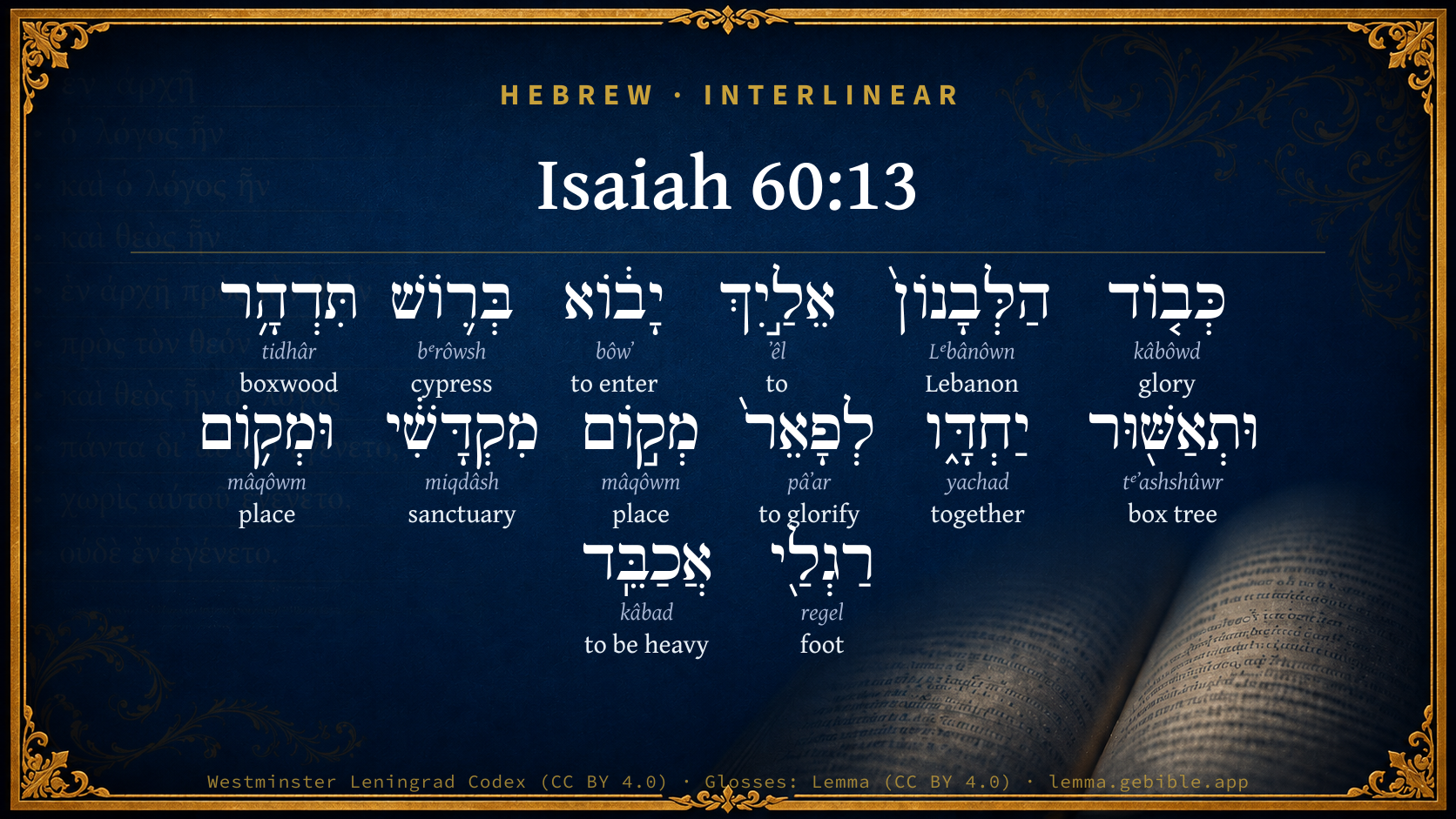
Hebrew (Westminster Leningrad Codex) Isaiah 60:13 appears in the Hebrew Old Testament. The text above is from the Westminster Leningrad Codex. Each word links to its Strong’s number, a concise gloss, and parsing drawn from the Open Scriptures Hebrew Bible morphology. Click any word for its full Brown-Driver-Briggs (BDB) entry.
Download image
Cite this verse

Isaiah 60:13 (World English Bible). Public Domain. Lemma interlinear Bible study tool, https://lemma.gebible.app/v/isaiah/60/13.

Show BibTeX & RIS
BibTeX
RIS
English Translation
The glory of Lebanon shall come to you, the fir tree, the pine, and the box tree together, to beautify the place of my sanctuary; and I will make the place of my feet glorious.
World English Bible · Public Domain
Download a study sheet

One document with this verse’s original text, its word-by-word gloss line, the meaning frame, cross-references with their text, attributed commentary, and full source and license credits — printable, and it pastes into notes with its structure intact.

This verse Autodidact and up

Study sheet (.html) Plain text (.txt)

A passage Seminary Student

Up to 50 verses in one chapter. A passage sheet keeps up to 6 commentary sources and 12 cross-references per verse, in the order this page ranks them, and says so on the sheet whenever that leaves anything out. Ask for a single verse and you get the Autodidact verse sheet above.

Everything on this page stays free to read, with no account — the sheet is a download of what is already on screen, not access to it.

Want to remove ads? Support Godless Engineer
Compare translations 3

The same verse in 3 English versions, stacked beneath the original-language interlinear above. Click any original word for its lexicon entry.

Each is an independent rendering of the whole verse — the interlinear is not word-aligned to these translations.

Highlighted words mark where these versions differ — a whole-verse word diff, not a word-by-word alignment.

  • World English Bible Public Domain
    The glory of Lebanon shall come to you, the fir tree, the pine, and the box tree together, to beautify the place of my sanctuary; and I will make the place of my feet glorious.
  • King James Version Public Domain
    The glory of Lebanon shall come unto thee, the fir tree, the pine tree, and the box together, to beautify the place of my sanctuary; and I will make the place of my feet glorious.
  • unfoldingWord Literal Text CC BY-SA 4.0
    The glory of Lebanon will come to you, the cypress, the plane, and the box tree together, to beautify the place of my sanctuary, and I will glorify the place of my feet.

unfoldingWord Literal Text — © unfoldingWord, licensed CC BY-SA 4.0. Word-aligned USFM3 via Door43 (git.door43.org/unfoldingWord/en_ult).

Versions to compare (up to 4)

3 of 4 selected

Show all 18 translations

Every available English version of this verse, each an independent rendering of the whole verse.

  • World English Bible Public Domain
    The glory of Lebanon shall come to you, the fir tree, the pine, and the box tree together, to beautify the place of my sanctuary; and I will make the place of my feet glorious.
  • Berean Standard Bible Public Domain
    The glory of Lebanon will come to you—its cypress, elm, and boxwood together—to adorn the place of My sanctuary, and I will glorify the place of My feet.
  • Majority Standard Bible Public Domain
    The glory of Lebanon will come to you—its cypress, elm, and boxwood together—to adorn the place of My sanctuary, and I will glorify the place of My feet.
  • King James Version Public Domain
    The glory of Lebanon shall come unto thee, the fir tree, the pine tree, and the box together, to beautify the place of my sanctuary; and I will make the place of my feet glorious.
  • American Standard Version (1901) Public Domain
    The glory of Lebanon shall come unto thee, the fir-tree, the pine, and the box-tree together, to beautify the place of my sanctuary; and I will make the place of my feet glorious.
  • Revised Version (1885) Public Domain
    The glory of Lebanon shall come unto thee, the fir tree, the pine, and the box tree together; to beautify the place of my sanctuary; and I will make the place of my feet glorious.
  • Geneva Bible (1599) Public Domain
    The glory of Lebanon shall come vnto thee, the firre tree, the elme and the boxe tree together, to beautifie the place of my Sanctuarie: for I will glorifie the place of my feete.
  • Douay-Rheims (1899) Public Domain
    The glory of Libanus shall come to thee, the Ar tree, and the box tree, and the pine tree together, to beautify the place of my sanctuary: and I will glorify the place of my feet.
  • Young's Literal Translation Public Domain
    The honour of Lebanon unto thee doth come, Fir, pine, and box together, To beautify the place of My sanctuary, And the place of My feet I make honourable.
  • Literal Standard Version CC BY-SA 4.0
    The glory of Lebanon comes to you, || Fir, pine, and box together, || To beautify the place of My sanctuary, || And I make the place of My feet honorable.
  • Unlocked Literal Bible CC BY-SA 4.0
    The glory of Lebanon will come to you, the cypress tree, the fir, and the cypress box tree together, to beautify my sanctuary; and I will glorify the place of my feet.
  • unfoldingWord Literal Text CC BY-SA 4.0
    The glory of Lebanon will come to you, the cypress, the plane, and the box tree together, to beautify the place of my sanctuary, and I will glorify the place of my feet.
  • Darby Bible Public Domain
    The glory of Lebanon shall come unto thee, the cypress, pine, and box-tree together, to beautify the place of my sanctuary; and I will make the place of my feet glorious.
  • World Messianic Bible Public Domain
    “The glory of Lebanon shall come to you, the cypress tree, the pine, and the box tree together, to beautify the place of my sanctuary; and I will make the place of my feet glorious.
  • Webster's Bible Public Domain
    The glory of Lebanon shall come to thee, the fir-tree, the pine-tree, and the box together, to beautify the place of my sanctuary; and I will make the place of my feet glorious.
  • Free Bible Version CC BY-SA 4.0
    The glory of Lebanon will come to you: cedars, acacias, and myrtle trees, to make my Temple beautiful and to honor the place I choose to live.
  • Bible in Basic English Public Domain
    The glory of Lebanon will come to you, the cypress, the plane, and the sherbin-tree together, to make my holy place beautiful; and the resting-place of my feet will be full of glory.
  • JPS Tanakh (1917) Public Domain
    The glory of Lebanon shall come unto thee, the cypress, the plane-tree and the larch together; to beautify the place of My sanctuary, and I will make the place of My feet glorious.

Literal Standard Version (2020), Covenant Press — licensed CC BY-SA 4.0. Text via the HelloAO Bible API (eBible.org). Unlocked Literal Bible (unfoldingWord) — licensed CC BY-SA 4.0. Text via the HelloAO Bible API (eBible.org). unfoldingWord Literal Text — © unfoldingWord, licensed CC BY-SA 4.0. Word-aligned USFM3 via Door43 (git.door43.org/unfoldingWord/en_ult). Free Bible Version, Dr. Jonathan Gallagher — licensed CC BY-SA 4.0. Text via the HelloAO Bible API (eBible.org).

Word by word

More ways to search: Search by grammar → Find every occurrence → Compare this word →

Practice this passage: Drill this verse → Learn its vocabulary →

תִּדְהָ֥ר
tidhâr
H8410
“boxwood”
Noun, Common, Masculine, Singular, Absolute
Part of Speech
Noun
Type
Common
Gender
Masculine
Number
Singular
State
Absolute
Full BDB Definition

Origin: apparently from H1725

TWOT: 408b

a species of hardwood tree - perhaps boxwood, elm
  1. כְּב֤וֹד kâbôwd H3519 “glory of” Noun, Common, Both, Singular, Construct
  2. הַלְּבָנוֹן֙ Lᵉbânôwn H3844 “the · Lebanon” Particle, Definite Article + Noun, Proper
  3. אֵלַ֣יִךְ ʼêl H413 “to · you” Preposition + Suffix, Personal, 2nd Person, Feminine, Singular
  4. יָב֔וֹא bôwʼ H935 “to enter” Verb, Qal, Imperfect, 3rd Person, Masculine, Singular
  5. בְּר֛וֹשׁ bᵉrôwsh H1265 “cypress of” Noun, Common, Masculine, Singular, Construct
  6. וּתְאַשּׁ֖וּר tᵉʼashshûwr H8391 “and · box tree” Conjunction + Noun, Common, Feminine, Singular, Absolute
  7. יַחְדָּ֑ו yachad H3162 “together” Adverb
  8. לְפָאֵר֙ pâʼar H6286 “to glorify” Preposition + Verb, Piel, Infinitive Construct
  9. מְק֣וֹם mâqôwm H4725 “place of” Noun, Common, Masculine, Singular, Construct
  10. מִקְדָּשִׁ֔י miqdâsh H4720 “sanctuary · my” Noun, Common, Masculine, Singular, Construct + Suffix, Personal, 1st Person, Common, Singular
  11. וּמְק֥וֹם mâqôwm H4725 “and · place of” Conjunction + Noun, Common, Masculine, Singular, Construct
  12. רַגְלַ֖י regel H7272 “feet · my” Noun, Common, Feminine, Dual, Construct + Suffix, Personal, 1st Person, Common, Singular
  13. אֲכַבֵּֽד kâbad H3513 “to be heavy” Verb, Piel, Imperfect, 1st Person, Common, Singular

About this verse

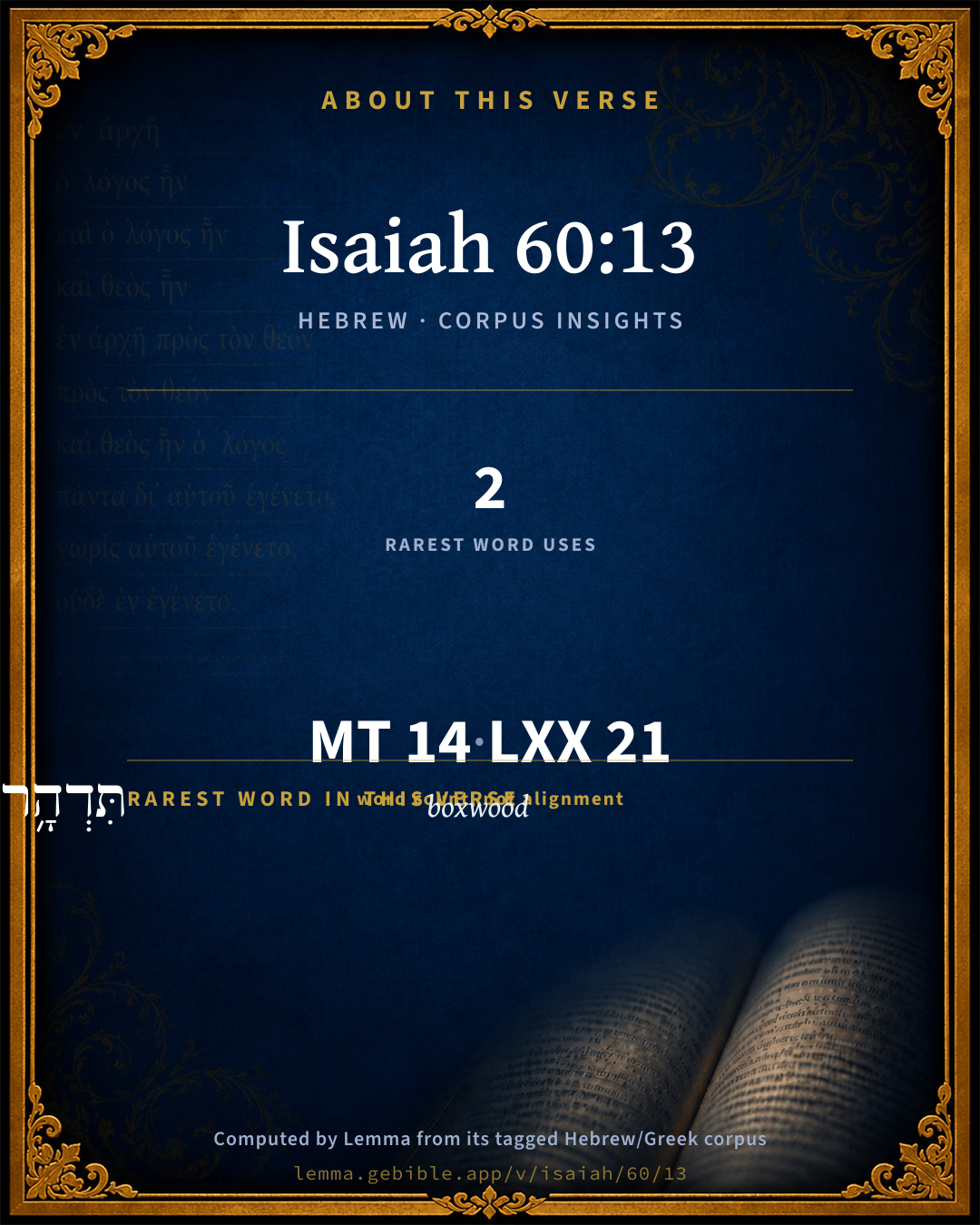
These counts appear in no published source. They are computed here, from the morphology-tagged text and Lemma’s own curated glosses. What Lemma adds →

14
words
13
distinct lemmas
Prophets
section

Notable vocabulary

The rarest word here is תִּדְהָ֥ר boxwood H8410 — appearing just 2 times in the whole Hebrew Bible.

Shared distinctive vocabulary

תִּדְהָ֥ר boxwood H8410 occurs in 2 verses of the Hebrew Bible. Also found in:

Grammatical profile

  • 3 verbs
  • 9 nouns
  • 1 preposition
  • 1 adverb

Verb forms

  • יָב֔וֹא Qal · Imperfect
  • לְפָאֵר֙ Piel · Infinitive Construct
  • אֲכַבֵּֽד Piel · Imperfect

Repetition

A word recurs within this verse — often emphatic in Hebrew:

  • מְק֣וֹם place H4725 ×2

Hebrew & Septuagint length

In English translation the verse runs 35 words from the Hebrew and 22 from the Septuagint (LXX English) — the Septuagint runs noticeably shorter here. See the side-by-side →

A rough comparison of the two English renderings, which tokenize alike — not a word-level alignment.

Word counts can differ between the Hebrew and the Greek without any difference in meaning — e.g. the Hebrew direct-object marker אֵת has no separate Greek word, and Greek often adds the article ὁ.

In the original languages it is 14 Hebrew tokens and 21 Greek tokens — but the two are counted differently (Hebrew bundles its prefixes and suffixes into one token; the Greek is in lemma form), so that isn’t a like-for-like length.

Cross-references

9

Topical passages linked to Isaiah 60:13 in the Treasury of Scripture Knowledge — connected by theme and wording, ordered by reader-vote popularity; previews shown in the World English Bible.

  • Isaiah 35:2 It shall blossom abundantly, and rejoice even with joy and singing; the glory of Lebanon shall be given to it, the excellency of Carmel and Sharon: they shall see the glory of Yahweh, the excellency of our God.
  • 1 Chronicles 28:2 Then David the king stood up on his feet, and said, Hear me, my brothers, and my people: as for me, it was in my heart to build a house of rest for the ark of the covenant of Yahweh, and for the footstool of our God; and I had made ready for the building.
  • Psalms 96:6 Honor and majesty are before him. Strength and beauty are in his sanctuary.
  • Psalms 132:7 "We will go into his dwelling place. We will worship at his footstool.
  • Ezra 7:27 Blessed be Yahweh, the God of our fathers, who has put such a thing as this in the king's heart, to beautify the house of Yahweh which is in Jerusalem;
  • Isaiah 41:19–20 I will put in the wilderness the cedar, the acacia, and the myrtle, and the oil tree; I will set in the desert the fir tree, the pine, and the box tree together:
  • Isaiah 55:13 Instead of the thorn shall come up the fir tree; and instead of the brier shall come up the myrtle tree: and it shall be to Yahweh for a name, for an everlasting sign that shall not be cut off.
  • Isaiah 66:1 Thus says Yahweh, heaven is my throne, and the earth is my footstool: what manner of house will you build to me? and what place shall be my rest?
  • Hosea 14:6–7 His branches will spread, And his beauty will be like the olive tree, And his fragrance like Lebanon.

Cross-references courtesy of OpenBible.info (CC BY 4.0).

Hebrew and Greek witnesses Masoretic Hebrew ↔ Greek Septuagint

The same verse in the two great witnesses to the Old Testament, shown verse-for-verse.

Here the Septuagint runs noticeably shorter than the Hebrew — LXX2012 (modern English Septuagint) 22 words vs World English Bible 35. A rough length comparison of the two English translations, not a word-level alignment — read both below.

These are two independent witnesses, not word-aligned to each other, and the Septuagint is shown in lemma (dictionary) form.

Hebrew Isaiah 60:13 Masoretic · Westminster Leningrad Codex

כְּב֤וֹד הַלְּבָנוֹן֙ אֵלַ֣יִךְ יָב֔וֹא בְּר֛וֹשׁ תִּדְהָ֥ר וּתְאַשּׁ֖וּר יַחְדָּ֑ו לְפָאֵר֙ מְק֣וֹם מִקְדָּשִׁ֔י וּמְק֥וֹם רַגְלַ֖י אֲכַבֵּֽד

The glory of Lebanon shall come to you, the fir tree, the pine, and the box tree together, to beautify the place of my sanctuary; and I will make the place of my feet glorious.

World English Bible · Public Domain

Greek LXX Isaiah 60:13 Septuagint · lemma form

καί ὁ δόξα ὁ λίβανος πρός σύ ἥκω ἐν κυπάρισσος καί πεύκη καί κέδρος ἅμα δοξάζω ὁ τόπος ὁ ἅγιος ἐγώ

And the glory of Libanus shall come to you, with the cypress, and pine, and cedar together, to glorify my holy place.

LXX2012 (modern English Septuagint) · Public Domain

Hebrew: Westminster Leningrad Codex (CC BY 4.0). Greek: Septuagint (public domain); English from LXX2012 (modern English Septuagint) (Public Domain). How the Septuagint differs from the Hebrew →

Targum (Aramaic paraphrase)

1

The Targum is the ancient Jewish Aramaic paraphrase of the Hebrew Scriptures — an interpretive translation, not the Hebrew text itself. Onkelos (literal) and Pseudo-Jonathan (expansive) render the Torah, and Jonathan the Prophets. Coverage is partial: where no permissively-licensed English translation exists for a verse, only the Aramaic is shown. This is verse-level text, not a word-by-word alignment to the Hebrew.

  1. Targum Jonathan Prophets (Joshua–Malachi)
    יְקַר לִבְנָן לְגַוִיךְ יִתְעַל בִּירְוַן מוֹרְנְיָן וְאֶשְׁכַּרְעִין כַּחֲדָא לְשַׁבְּחָא אֲתַר בֵּית מַקְדְשִׁי וַאֲתַר בֵּית אַשְׁרָיוּת שְׁכִנְתִּי אֲיַקֵר:

    The glory of Lebanon shall be brought unto thee, the fir-tree, the elm, and the box together, to beautify the place of the house of my sanctuary; and I will make the place of the dwelling of my Shekinah glorious.

    Targum Jonathan — Aramaic: “Mikraot Gedolot” (public domain). English: “Sefaria Community Translation” (CC0 1.0 (public-domain dedication)); “London "Chaldee Paraphrase," 1871” (public domain). Text via Sefaria.

Commentary

Notes on Isaiah 60:13 from classic Christian and Jewish commentators (each source and its license shown beneath its notes). The classic Christian expositions comment on the surrounding passage and are grouped to its opening verse, so a note may address several verses; the Jewish commentaries on the Tanakh (Rashi and others) are per-verse, so they appear only where the commentator wrote on this verse.

Lemma curates 59 commentaries, every one of them public domain or Creative Commons licensed, each selected and text-cleaned for this edition rather than reprinted as found. About our sources →

Trapp's Complete Commentary

John Trapp

Isa 60:13 The glory of Lebanon shall come unto thee, the fir tree, the pine tree, and the box together, to beautify the place of my sanctuary; and I will make the place of my feet glorious.

Ver. 13. The glory of Lebanon.] The best cedars there, in allusion to the building of the material temple by Solomon, and afterwards by Ezra; q.d., Whatsoever is good in the world, either in understanding, virtue, or doctrine, shall be sanctified and employed for the building up of the Church.

The fir tree, the pine tree, and the box tree.] Which from those that would, but cannot, bring better, shall be well accepted.

And I will make the place of my feet glorious,] ie., My Church, when at lowest, and the members thereof, even the meanest of them. Hence also Christ’s name, "King of kings and Lord of lords," is written "on his thigh," i.e., on his lower parts. {Rev 19:16}

John Trapp, A Commentary or Exposition upon All the Books of the Old and New Testament (1647–1656) — public domain. Text from a community e-Sword module.

The Biblical Illustrator

Joseph S. Exell

Isa_60:13

The glory of Lebanon shall come unto thee

Trees employed in the service of the Church

It is difficult to say whether the reference he to building materials for the sacred edifice, or to ornamental trees planted in the temple-courts.

(Prof. J. Skinner, D. D.)

Variety in unity

Variety of instrumentality and operation subordinate to unity of purpose is a striking feature in all the works of God. This law provides for beauty as well as use. The text teaches us that the method by which God works in nature is also the method by which He works in grace--that the law of variety in unity is the law according to which Heconsolidates and extends His kingdom among mankind. The allusion and the doctrine are equally clear. The allusion is to the various trees of Lebanon employed by Solomon for utility and beauty in the erection of the temple in Jerusalem. Varying in size, and quality, and appearance of wood, they were all deemed necessary for the purpose of beautifying the place, that was to be made more beautiful and glorious still by the majesty and grace of the indwelling God. The doctrine is that, in like manner, various agencies--men of different periods and nations, men of different positions, talents, and attainments, men of opposite creeds and mental tastes--are used by God in the erection and adornment of that spiritual temple which He makes His special abode, the magnificence and glory of which, outliving the desolations of time, shall shine to His praise through the ages of eternity. (W. Waiters.)

Diverse agencies in the Church

I. THE ILLUSTRATIONS OF THIS DOCTRINE ARE MANIFOLD.

1. The first I notice is that which is supplied us in the structure of the Bible. To a superficial observer the Bible seems a collection of small books bound together without any connecting-link. But if we come to study this collection of books carefully, we shall see, underlying all diversities, a unity which indicates that all have been originated and guided by one supreme mind.

2. Certain periods require certain orders of men and certain gifts, not necessary at other times.

3. Further, the peculiar qualities of various races and tribes serve to extend the truth of God, and promote the growth and perfection of His Church. Christianity does not recognize nationalities as such Jew and Gentile,

Greek and Barbarian, European and African, American and Asiatic,--all are one in Christ Jesus. Still, God sanctifies all national characteristics to His gracious purpose of making Christianity universally triumphant. Jewish reverence, Grecian intelligence and taste, Roman courage and honour, Scandinavian enterprise, the practical energy of the Anglo-Saxon, the speculative inquiry and patient toil of the German, the Frenchmans brilliant vivacity and grace, the Italians glowing imagination, the ardent negro, and the Oriental full of subtlety and disputation--all are wrought by the Master-Builder into the strength and beauty of the structure He is rearing to His honour.

4. Nor can denominational distinctions be regarded as altogether an evil; for God makes them all subserve the complete manifestation of His many-sided Gospel, and the wider extension of His kingdom.

5. Original differences of mental constitution and temperament have also their place and function. There arc diversities of gifts, yet there is the same Spirit; there are differences of administrations, yet there is the same Lord; there arc diversities of operations, yet it is the same God which worketh all in all.

II. PRACTICAL REMARKS.

1. We may be sure that where God has designed and qualified men for work in His Church He will prepare the way for their usefulness.

2. Every man should try to find his true position, and prove faithful in it.

3. The subject affords encouragement to the feeblest of the Lords servants. All have their place and use.

4. Are we not reminded of the duty of charity towards all engaged the work of the Lord? Too often the diversities of Christian men are occasions for jealous; let and strife. If we are Christians, we are all plants of Gods right hand planting; let us be content to bloom after our kind, and rejoice in that we all contribute something to the glory of the Masters garden. (W. Waiters.)

I will make the place of My feet glorious

The place of My feet

I. THE SCENE OF THIS SPECIAL DIVINE GLORY. The place of My feet. The sacred writers speak of Gods feet as indicating His personal presence. The place of Gods feet, or His footstool, was, in ancient times, the temple at Jerusalem. The allusion of the language is to a royal throne. Jehovah is conceived of as the King of Israel, the King of kings, whose throne is in heaven, but His footstool in the earthly temple; and thither the Israelites as His true subjects were required to repair, to render homage to their great King, and bend lowly before His footstool. All this was, in turn, a figure of the better things reserved for us. The Jewish particularity has been broadened out into the compass of the great household of faith, whose sons and daughters are drawn from all the earths kindreds, and peoples, and tongues. The true Church, composed of all believers of whatever name or nation, is Gods temple--the place of His feet I In a real and important sense the wide earth, and the whole material creation, is His footstool, marked everywhere by the broad footprints of the Creator revealing His eternal power and Godhead. The signs of Providence reveal the movements of a present and ever-working God, exercising wise, and righteous, and benignant control over His creatures.

II. THE GLORY OF THE SCENE. It was the glory of Eden that there God talked with man face to face. So it is the glory of heaven that there He replenishes His saints with the joys of His eternal fellowship. It was the glory of Sinai that there He displayed His grandeur and proclaimed His law; and of Tabor and Calvary that there He unfolded His hidden majesty, and the fulness of His mercy. And it is the glory of the Church that it is distinguished by the clearest manifestations of the Divine presence and grace. What are these manifestations? God makes the place of His feet glorious--

1. By the worship that is there rendered and accepted.

2. By the spiritual glory that is there created. The glory of Lebanon, etc. The glory of the Church lies in the possession and exercise of the grandest and noblest moral principles--those that are most assimilated to the Divine nature. The true purpose of the Church, the final end of its warfare, is to be a living witness to mankind of these moral principles, to be an embodied protest against all the money-worship and pleasure-worship, and therefore worship of the world; to be a revelation to man of higher interests and blessings, and a Diviner greatness. It is when she is most distinctly Godlike and Christlike that men fall down and confess that God is in her of a truth. The glory of the Lord is then risen upon her.

3. By attracting immense and various multitudes from all quarters of the globe to His Church. Though numbers be not the chief, they are a real element of glory.

4. By the blessedness there conferred. All the elements of the Churchs glory hitherto enumerated are elements of blessedness; but there are other special sources of that blessedness.

(1) There is the blessedness of inviolable security. The greatest earthly monarchy has no power to protect itself against assault, against even successful assault. It is the glory of Gods house that it is safe. It is founded on a rock, and the gates of hell cannot prevail against it.

(2) The absolute and unspeakable splendour of the Church--the splendour of her purity--the splendour of her joy. (J. Riddell.)

The Biblical Illustrator, edited by Joseph S. Exell (c. 1880s–1900s) — public domain. Text from a community e-Sword module.

Joseph Benson's Commentary

Isa 60:13. The glory of Lebanon shall come unto thee — As Lebanon furnished cedars, and other choice timber, for building and beautifying Solomon’s temple, so shall different nations contribute what is most excellent and suitable among them for supporting, establishing, enlarging, and adorning the church of Christ, here called the place of God’s sanctuary, with allusion to the temple, an eminent type of it. See note on Psa 46:4-5. And I will make the place of my feet glorious — The Christian Church, so called in allusion to the ark in the most holy place of the tabernacle and temple, where the divine glory, termed by the Jews the Shechinah, was wont to appear between the wings of the cherubim, over the mercy-seat, which was, as it were, the footstool of that glorious symbol of God’s presence.

Joseph Benson's Commentary on the Old and New Testaments (1811–1818) — public domain. Text from a community e-Sword module.

The Preacher's Complete Homiletical Commentary

Joseph S. Exell (gen. ed.)

THE PLACE OF GOD’S FEET GLORIOUS

Isa_60:13. I will make the place of My feet glorious.

These promises, while serving the purpose of sustaining the heart of God’s faithful people throughout their dismal captivity, took a far grander range than their restoration and revival, &c.

I. THE SCENE OF THIS SPECIAL DIVINE GLORY. “The place of My feet.” This is the language of figure, but plain and intelligible. God has no bodily parts, yet the sacred writers speak of His eye, &c., as indicating His personal presence. Such language deceives no one, and it gives a lively representation of the actual spiritual fact. “The place of God’s feet,” or His “footstool,” was in ancient times the temple (1Ch_28:2). This was His rest, where He had chosen to put His name, where in a special sense Jehovah dwelt between the Cherubim over the mercy-seat. The allusion is to a royal throne. God’s throne is in heaven, but His footstool in the earthly temple whither His subjects repair. It was for Israel the place of reception, of communion, and of worship. And all this was in turn a figure of the better things reserved for us. No place of worship on earth may claim to be, in preference to others, the footstool of Jehovah. The true Church, composed of all believers of whatever name or nation, is God’s temple, “the place of His feet.” It is no particular altar or edifice; it is the living stones. In a real sense the wide earth is His footstool, marked by the footprints of His glory; but it is in the new creation that he has given the most perfect manifestation of His glory.

II. THE GLORY OF THE SCENE. It was the glory of Eden that God talked there with man, and it is the glory of the Church that it has the clearest manifestations of His presence and grace.

1. The worship there rendered and accepted.

2. The glory that is there created (Isa_60:13). Many can see no glory in the Church. They admire the beauty of the palace, the splendour of a mighty monarchy, but conclude that the Church has no glory. This is not to be wondered at: they see only what they have the power of seeing—they have no spiritual discernment. The true purpose of the Church is to be a living witness, an embodied protest against money-worship, &c. Her grandest glory consists in the image of Christ: she is the true home of holiness.

3. The multitudes attracted to her. The Gospel is for the world, and the Church is the light-bearer. In proportion as she is healthy will she bestir herself in this great service of humanity, and commend the Gospel by her own high-toned character (Isa_60:1-2). The nations come to her in procession (Isa_60:8-9). This is a spiritual movement, the approach of souls, the submission of hearts to Christ, and much of it is already fact.

4. The blessedness there conferred—the blessedness of inviolable security (Isa_60:12; Isa_60:18). A nation not in alliance with God has a canker eating at the heart of its power. What vitality the Church has shown! How vainly the powers of earth have conspired to trample her down! What is the ground of this security? Not her own strength but God’s salvation. Hers is the glory of purity. Let the world see that the Church is what she claims to be—a society unselfish and benevolent. As she is holy she will be joyful. She has forsaken the pleasures of sin, and unless she has the joy of salvation, she has no comfort of any kind. Let us partake of the true joy, and we will walk in the light of God’s face; and that joy will prove a grand attraction to the nations of the world, and reveal to them a blessedness which the world cannot bestow.—John Riddell Moffat: Discourses, pp. 222–241.

Isa_60:14. I. The sorrows of Zion. Afflicted. Despised. II. Their relief. By the subjection of her foes. By the acknowledgment of her claims. By the presence and favour of God.

Isa_60:15-22. The happy condition of Zion. I. Temporal blessings. Once forsaken and despised, now held in universal honour. All the advantages of commerce, civilisation, and wealth. Just government—peace and protection. II. Spiritual blessings. Knowledge of God and Christ. Salvation. Divine light and comfort. Universal righteousness. Permanent increase.

Isa_60:15-16. I. The desolations of Zion. II. Her restoration. III. Prosperity. IV. Acknowledgment of God.

Isa_60:16-17. Iron. I. All things must be laid under contribution for the accomplishment of the Divine purpose in His Church. All the achievements of the human mind. All the conveniences of wealth and civilisation. All the influence of human power. II. In the subjection and sanctification of human resources God develops His own character in relation to His Church. As Saviour, Redeemer, the Might One of Jacob.

Isa_60:17-18. The exaltation of the Church secures the best interests of a nation. I. Social peace and order. II. Honesty and integrity in the transactions of business and commerce. III. Protection from violence within and foes without. IV. Happiness in the blessings of salvation, and the spirit of praise.—J. Lyth, D.D.

The Preacher's Complete Homiletical Commentary (gen. ed. Joseph S. Exell; Funk & Wagnalls, c. 1892) — public domain (pre-1929). A full-Bible homiletical/sermon-outline anthology covering 65 of 66 books (2 John is absent from the source module). Text from a community e-Sword module.

Tyndale Open Study Notes

Tyndale Open Resources

60:13 The Temple was God’s sanctuary, the symbol of his presence on earth. Believers now are the temple of God by the indwelling Spirit (1 Cor 3:16). We still await the fullness of God’s presence (Rev 21:22).

Tyndale Open Study Notes — © Tyndale Open Resources, licensed CC BY-SA 4.0. Text via the HelloAO Bible API.

Geneva Bible (1599)

Geneva Bible translators

There is nothing so excellent which shall not serve the necessity of the Church.

Signifying, that God’s Majesty is not included in the Temple, which is but the place for his feet, that we may learn to rise us to the heavens.

Geneva Bible (1599) marginal notes — public domain. Text via Bolls.life.

Jamieson, Fausset & Brown

Robert Jamieson, A. R. Fausset & David Brown

glory--that is, the trees which adorned Lebanon; emblem of men eminent in natural gifts, devoting all that is in them to the God of Israel (Hos 14:5-6).

fir . . . pine . . . box--rather, "the cypress . . . ilex . . . cedar."

place of my sanctuary--Jerusalem (Jer 3:17).

place of my feet--no longer the ark (Jer 3:16), "the footstool" of Jehovah (Psa 99:5; Psa 132:7; Ch1 28:2); but "the place of His throne, the place of the soles of His feet, where He will dwell in the midst of the children of Israel for ever," in the new temple (Eze 43:7).

Jamieson, Fausset & Brown — Commentary Critical and Explanatory on the Whole Bible (1871) — public domain (CC PDM 1.0). Text via the HelloAO Bible API.

Adam Clarke's Commentary

Verse 13. And I will make the place of my feet glorious - "And that I may glorify the place whereon I rest my feet"] The temple of Jerusalem was called the house of God, and the place of his rest or residence. The visible symbolical appearance of God, called by the Jews the schechinah, was in the most holy place, between the wings of the cherubim, above the ark. This is considered as the throne of God, presiding as King over the Jewish state; and as a footstool is a necessary appendage to a throne, (See Clarke on Isa 52:2,) the ark is considered as the footstool of God, and is so called, Ps 99:6; 1Ch 28:2.

The glory of Lebanon] That is, the cedar.

Adam Clarke's Commentary on the Bible (1810–1826) — public domain. Text from a community e-Sword/MySword module.

Ellicott's Commentary for English Readers

(13) The glory of Lebanon . . .—The prophet sees in the new Jerusalem a revival of the glories of the days of Solomon. The cedars of Lebanon, and other trees of the forest, are to furnish timber for its buildings, or even to be planted in the courts of the Temple, or in its open places and streets (Psa_52:8; Psa_92:12-13; Isa_35:2).

The box is probably, as in Isa_41:19, a species of cedar.

The place of my feet is clearly parallel with the “sanctuary” of the previous clause. So the word “footstool” is used of the Temple in Psa_99:5; Psa_132:7.

A Bible Commentary for English Readers, edited by Charles John Ellicott (1878–1897) — public domain. Text from a community e-Sword module.

The Cambridge Bible for Schools and Colleges

gen. ed. J. J. S. Perowne

13. Forest trees from Lebanon shall be brought for the adornment of the Temple. It is difficult to say whether the reference be to building materials for the sacred edifice, or to ornamental trees planted in the Temple-courts. The former view, though less poetic, is more probable; and it is certainly unfair to cite the proverbial expressions of Isa_60:17 as an argument against it.

the fir tree, the pine tree, and the box together] See ch. Isa_41:19.

the place of my sanctuary] is the Temple (Jer_17:12), not the city of Jerusalem, as the place where the Temple is situated.

the place of my feet] Cf. Eze_43:7 (“the place of the soles of my feet”).

The Cambridge Bible for Schools and Colleges (gen. ed. J. J. S. Perowne; Cambridge University Press, 1878–1918) — public domain. Text from a community e-Sword module.

John Gill's Exposition

The glory of Lebanon shall come unto thee,.... Which are the trees that grew upon it, especially the cedars, for which it was famous, as well as the other trees after mentioned. Now, as these were brought into Solomon's temple, and used in the building of that, Kg1 6:9, so such shall come of themselves, willingly and cheerfully, being drawn with the cords of love, into the church of Christ, comparable to the tall and strong cedars of Lebanon, and other trees, being eminent for their gifts and graces, and strong in the exercise of them; the more feeble among them being as the house of David, and that as the Angel of the Lord; and being durable, constant, and immovable in the work of the Lord; pillars in his house that shall never go out; ever green and flourishing; never wither in their profession, and always fruitful in every good word and work; of a good smell in the exercise of grace; of savoury conversations, and of a good report in the world; see Psa 107:12,

the fir tree, the pine tree, and the box together; which may denote persons of different ranks and sizes, both as to worldly and spiritual affairs; and yet will all agree to come together to the church, and will unite in the service and worship of God in it, and be a real glory to it; see Isa 41:19,

to beautify the place of my sanctuary; the church, so called in allusion to the tabernacle and temple; and thus the Targum here,

"the place of the house of my sanctuary;''

where the holy God dwells; and which is sanctified by him, and where he is sanctified, and worshipped in a holy and spiritual manner; and which will be beautified in the latter day, when the saints that will come into the church will put on by faith more manifestly the beautiful garments of Christ's righteousness; and be more visibly adorned with the graces of his Spirit, which will shine like so many brilliant diamonds and sparkling gems; and will appear in the beauties of a holy conversation; walk in brotherly love with each other, and unite in sentiments of doctrine, and in acts of Gospel worship; and when the Gospel shall be purely and powerfully preached; the ordinances administered as they were in the times of Christ and his apostles; and Gospel discipline in all its branches restored:

and I will make the place of my feet glorious; alluding to the ark under the mercy seat, over which were the cherubim, and between which Jehovah dwelt, hence called his footstool, Ch1 28:2, denoting that the church is the place where the Lord grants his presence through Christ, the antitype of the mercy seat and ark; and which is the seat of his rest and residence; where he takes his walks, and where his footsteps of rich grace are seen; where his lower parts, his feet, his works, and acts of grace, are beheld; where he favours with communion with himself; where his power and glory are observed, and his beauty is upon his people; where they see the King in his beauty, and all which will be more manifestly enjoyed in the latter day, and make his church very glorious indeed.

John Gill's Exposition of the Whole Bible (1746–1763) — public domain (CC PDM 1.0). Text via the HelloAO Bible API.

Albert Barnes' Notes on the Bible

The glory of Lebanon - The ‘glory of Lebanon,’ here means the trees that grew on Lebanon (see the notes at Isa 35:2).

Shall come unto thee - That is, thy beauty and glory will be as great as if those valuable trees were brought and planted around the temple.

The fir-tree - (See the notes at Isa 41:19; Isa 55:13).

The box - (See also the notes at Isa 41:19).

To beautify the place of my sanctuary - The site of the temple, as if they were planted around it, and as if the magnificence of Lebanon was transferred there at once. The idea is, that the most valuable and glorious objects in distant nations would be consecrated to the service of the true God.

And I will make the place of my feet glorious - Lowth renders this, ‘I will glorify the place whereon I rest my feet;’ and he supposes thai the ark is meant as the place on which God rested his feet as a footstool. In support of this, he appeals to Psa 99:5, ‘Worship at his footstool;’ and 1Ch 28:2. So Rosenmuller understands it, and appeals further to Psa 132:7. Doubtless the main idea is, that the temple was regarded as the sacred dwelling-place of God - and that he means to say, that every place in his temple, even where, to keep up the figure, he rested his feet when he sat on the throne, would be filled with magnificence and glory.

Albert Barnes' Notes on the Bible (1834–1885) — public domain. Text from a community e-Sword/MySword module.

Haydock's Catholic Bible Commentary

Glory; cedar, which was chiefly used in building the temple, 1 Esdras iii. 7. (Calmet) --- This must be explained of the saints, who founded the Church, &c. (St. Jerome) --- Emperors became Christians, with the most potent nations. (Worthington)

George Leo Haydock (1774–1849), Haydock's Catholic Family Bible and Commentary, 1859 edition — public domain. Excludes Psalms (Douay-Rheims chapter numbering differs from Protestant) and Deuterocanonical books (Catholic canon only).

Matthew Poole's English Annotations

The glory of Lebanon; the box, the fir, the pine, and the cedar, on account whereof Lebanon grew so famous; a metonymy of the efficient: kings and great ones, the glory of the world, and also persons of a lower rank, the

pines, firs, and box trees, as also the choicest persons, endued with the special gifts of the Holy Ghost, shall be the materials and members of Christ’s church, as those also of a lower size and measure. We find the godly called trees, Isa 61:3. They shall have sweet communion together; the box shall not envy the pine, nor the pine despise the box, they shall worship the Lord together.

To beautify: this is the reason and end why the glory of Lebanon is to be brought hither: by these trees understand the beauty and nobility of the church; trees being both for building and for beautifying.

The place of my sanctuary; the temple, wherein was the sanctuary; this being a type of the church, both actively, as that which his presence sanctifieth; and passively, as that wherein he is worshipped and sanctified.

The place of my feet, viz. the ark, 1Ch 28:2, described here by a periphrasis; so called, because, supposing God after the manner of man to sit as on a seat between the wings of the cherubims, his feet would rest upon the ark, and therefore called the mercy-seat, Exo 25:17-20. The temple and Zion is called his rest, Psa 132:13,14, and all this is made good in the gospel church, 2Co 6:16.

Matthew Poole's English Annotations on the Holy Bible (1683–1685) — public domain. Text from a community e-Sword/MySword module.

Whedon's Commentary on the Bible

Daniel D. Whedon

13. The glory of Lebanon — The whole of it, here specified in its trees, shall be employed to beautify thee: as it did so, literally, in Zion’s temple under Solomon, so shall it in the exalted figurative and spiritual senses.

The place of my feet — See Eze_43:7; 1Ch_27:2. The ark of the covenant is God’s footstool. In Isa_66:1, the whole earth is so named.

Daniel D. Whedon (gen. ed.), Commentary on the Old and New Testaments (1874–1909) — public domain. Text from a community e-Sword module.

The Pulpit Commentary

The glory of Lebanon shall come. (comp. Isa_35:2 Isa_41:19) Considered as imagery, the representation is that the barren hills which stand about Jerusalem shall, in the new state of things, be decked with tall and beautiful forest trees, all the sylvan scenery of Lebanon being transported to Southern Palestine, so as to encompass the city of God with a garden as delightful as that of Eden. The spiritual meaning is that graces of all kinds shall abound in and around the holy city, and shall make it beautiful and glorious. The fir tree, the pine tree, and the box together Isa_41:19, where the same words occur in the same order; and, for the trees intended, see the comment on that passage). To beautify the place of my sanctuary. Not with "avenues of cedars and plane trees leading up to it" (Delitzsch), which was a style of ornamentation quite unknown to the lie-brews; but with groves, and thickets, and sylvan glades, and wooded slopes all around it, as round the Syrian temples in the Lebanon. The place of my feet. The Jewish temple, as the special place of God"s presence upon earth, was frequently termed "God"s footstool". (1Ch_28:2 Psa_99:5 Psa_132:7 Lam_2:1) He that towers above the heavens had there set his foot. The metaphor is transferred to the renovated Zion.

Glorifying the second temple.

There are no records of such overwhelming manifestations of the Divine glory at the dedication of the second temple as were granted when Solomon consecrated the first. And yet its glory was to be higher than any reached in the experiences of Solomon"s temple. There was to be a spiritual presence of God, which was to be realized by the help of the human presence of Christ.

I EVIDENCES OF THE FULFILMENT OF This PROMISE. Or signs of the spiritual presence and spiritual power of God in his Church.

1. Quickening of religious life; or conversions.

2. Renewals of religious life; or sanctification.

3. Enlargement of religious feelings. This, however, may be spurious, or itmay be sound.

4. Reconsecration to religious work.

II THE CONDITIONS ON WHICH THE FULFILMENTS OF THIS PROMISE DEPEND. Our moral attitudes. We must be set for the blessing. The Church that would have the spiritual presence of God must be

(1) maintaining the Christian spirit;

(2) living the Christian life;

(3) upholding the Christian worship;

(4) working the Christian work.

Then there is much preparing and fitting work for us to do, if God is to "make the place of his feet glorious" where we unite in his worship. R.T.

The Pulpit Commentary (1880–1919), ed. H.D.M. Spence-Jones & Joseph S. Exell — public domain. Text from a community e-Sword module.

John Wesley's Explanatory Notes

The glory - The box, the fir, the pine, and the cedar, on account whereof Lebanon was so famous; kings and great ones, the glory of the world, and also persons of a lower rank, shall be the materials, and members of Christ's church. To beautify - This is the reason and end why the glory of Lebanon is to be brought hither; by these trees understand the beauty, and nobility of the church. Sanctuary - The temple wherein was the sanctuary. The place of my feet - The ark, so called, because, supposing God after the manner of men, to sit between the wings of the cherubim, his feet would rest upon the ark. All this is made good in the gospel-church.

John Wesley, Explanatory Notes Upon the Whole Bible (1754–1765) — public domain. Text via the GEBible commentary corpus.

Keil & Delitzsch

C. F. Keil & F. Delitzsch

From the thought that everything great in the world of man is to be made to serve the Holy One and His church, the prophet passes to what is great in the world of nature. "The glory of Lebanon will come to thee, cypresses, plane-trees and Sherbin-trees all together, to beautify the place of my sanctuary, and to make the place of my feet glorious." The splendid cedars, which are the glory of Lebanon, and in fact the finest trees of all kinds, will be brought to Zion, not as trunks felled to be used as building materials, but dug up with their roots, to ornament the holy place of the temple (Jer 17:12), and also to this end, that Jehovah may glorify the "holy place of His feet," i.e., the place where He, who towers above the heaven of all heavens, has as it were to place His feet. The temple is frequently called His footstool (hadōm raglâiv), with especial reference to the ark of the covenant (Psa 99:5; Psa 132:7; Lam 2:1; Ch1 28:2) as being the central point of the earthly presence of God (cf., Isa 66:1). The trees, that is to say, which tower in regal glory above all the rest of the vegetable world, are to adorn the environs of the temple, so that avenues of cedars and plane-trees lead into it; a proof that there is no more fear of any further falling away to idolatry. On the names of the trees, see Isa 41:19. Three kinds are mentioned here; we found seven there. The words יחדו ותשׁור תדהר ברושׁ are repeated verbatim from Isa 41:19.

Keil & Delitzsch — Biblical Commentary on the Old Testament (1861–1891) — public domain (CC PDM 1.0). Text via the HelloAO Bible API. (Old Testament only.)

J. A. Alexander on Isaiah

Joseph Addison Alexander

“The glory of Lebanon to thee shall come, cypress, plane, and box together, to adorn the place of my sanctuary, and the place of my feet I will honor.” The glory of Lebanon is its cedars. For the other trees here mentioned, see above, on Isa 41:19, where, as here, they are merely representatives of ornamental forest trees in general. ‘The place of my sanctuary’ has been generally understood to mean the sanctuary itself; but several of the latest writers understand by it Jerusalem, as being the place where the temple was erected. The same sense is put by some writers on ‘the place of my feet’, that is, the place where I habitually stand or walk (Eze 43:7). The older writers generally understand by it the ark of the covenant, considered as the footstool of Jehovah (1Ch 28:2; Psa 99:5; Psa 132:7) when enthroned upon or between the cherubim (Isa 37:16; Psa 80:1). In favor of the wider sense is the analogy of Isa 66:1, where the same description is applied to the whole earth, but in reference to heaven as the throne of God. Another topic upon which interpreters have been divided, is the question whether the adorning mentioned here is that of cultivated grounds by living trees, or that of buildings by the use of the choicest kinds of timber. The latter opinion has most commonly prevailed, but the other is far more pleasing in itself and more in keeping with the poetical tone of the whole context. In either case the meaning of the figure is that the earthly residence of God shall be invested with the most attractive forms of beauty.

Joseph Addison Alexander, The Prophecies of Isaiah (1846–1847; New York: Scribner, 1870–1878) — public domain. Text from a community e-Sword module.

Kretzmann's Popular Commentary

Paul E. Kretzmann

The Happiness Attending the Glorification of the Messiah

v. 13. The glory of Lebanon, the wonderful forest growth which adorned its mountains, shall come unto thee, men of excellence everywhere devoting themselves to the service of the Lord and His Church, the fir-tree, the pine-tree, and the box together, the cypress, ilex, and cedar, the finest trees of Lebanon’s forest, to beautify the place of My Sanctuary, and I will make the place of My feet glorious, so that Zion, the city of God, the Church of Jehovah, will immediately be recognized as a dwelling of the Lord.

v. 14. The sons also of them that afflicted thee, of the former oppressors and enemies of the Church, shall come bending unto thee, in humble submission to Jehovah; and all they that despised thee shall bow themselves down at the soles of thy feet, in a gesture of complete surrender; and they shall call thee The City of the Lord, of Jehovah, the covenant God, The Zion of the Holy One of Israel, who is a jealous God and zealous of His own honor and of that of His Church. Thus the confession of the mouth agrees with the outward behavior and conduct.

v. 15. Whereas thou hast been forsaken and hated, Isa 54:1, so that no man went through thee, an expression increasing the picture of complete desolation, I will make thee an eternal excellency, the highest expression of unparalleled magnificence, a joy of many generations, so that many people would delight in her.

v. 16. Thou shalt also suck the milk of the Gentiles, enjoy the gifts brought by them, and shalt suck the breast of kings, have the use of the most precious treasures of earth, and thou shalt know that I, the Lord, am thy Savior and thy Redeemer, the Mighty One of Jacob, He to whose unvarying faithfulness and almighty power Zion owes all that she is and has. In this way the glorification of the Church by the Lord will cause her former enemies and oppressors to give her reverence and love.

v. 17. For brass I will bring gold, and for iron I will bring silver, and for wood, brass, and for stones, iron, replacing the former inexpensive building materials with the most precious metals, with the most durable materials, so that the city would be both well protected and beautifully ornamented; I will also make thy officers peace and thine exactors righteousness, so that the government of Zion would be peace and the salvation of righteousness, security within and safety without, so that there is no further need of rulers.

v. 18. Violence shall no more be heard in thy land, on account of the fact that the members of the Church will be united by the bands of the most cordial love, wasting nor destruction within thy borders, the enemies no longer being permitted to work their evil will without hindrance; but thou shalt call thy walls Salvation and thy gates Praise, the place of walls and gates being taken by the deliverance and redemption of Jehovah and by the reputation which Zion would have throughout the world. That this has been fulfilled in the Church of the New Testament is evident frotn the fact that the enmity of the world has not only not succeeded in overcoming the Church, hut has even resulted in a condition which gives the Church a certain standing in the midst of the so-called Christian nations.

v. 19. The sun shall be no more thy light by day, neither for brightness shall the moon give light unto thee, Zion no longer being in need of these external, physical light bodies; but the Lord shall be unto thee an everlasting Light, and thy God thy Glory, namely, in and through the Word of His grace, from which the Church derives all her light.

v. 20. Thy Sun, the Lord Himself, shall no more go down, neither shall thy Moon withdraw itself, disappearing by setting, for the Lord shall be thine everlasting Light, in an uninterrupted continuity, Jas 1:17, and the days of thy mourning shall be ended. Ceaseless happiness, endless joy and delight, is the lot of the Church under the gracious rule of the Lord. Cf Rev 7:17.

v. 21. Thy people also shall be all righteous, as the nature of the covenant of mercy demands, by virtue of the righteousness imputed to them; they shall inherit the land forever, Mat 5:5, the branch of My planting, the work of My hands, a true garden of Jehovah, owing everything to His grace, that I may be glorified, for this is the final aim and object of His expressions of mercy.

v. 22. A little one, the smallest and most insignificant member of Zion, shall become a thousand and a small one a strong nation, equaling a great many enemies in might; I, the Lord, will hasten it in His time. When the period fixed by His eternal counsel has come, His plans go into effect with a suddenness which overwhelms all those who are not on His side, who are not upheld by His power. Therefore all believers should be careful to discern the signs of the times and know what pertains to their peace.

Paul E. Kretzmann, Popular Commentary of the Bible (1921–1924) — public domain. Text from a community e-Sword module.

Rashi

Rabbi Shlomo Yitzchaki (Rashi)

box trees, firs, and cypresses Species of trees of the forest of Lebanon.

Rashi on the Tanakh — English translations: “The Judaica Press complete Tanach with Rashi, translated by A. J. Rosenberg” (CC BY 4.0); “Pentateuch with Rashi's commentary by M. Rosenbaum and A.M. Silbermann, 1929-1934” (public domain); “The Metsudah Tanach series, Lakewood, N.J” (CC BY 4.0); and “The Book of Joshua, Metsudah Publications, 1997” (CC BY 4.0). Text via Sefaria.

Ibn Ezra

Rabbi Abraham ibn Ezra

The glory of Lebanon. The best trees of Lebanon; the fir tree, etc.

To beautify the place of my sanctuary. To build the house of the Lord.

Ibn Ezra on the Tanakh — English translations: “Sefaria Community Translation” (CC0 1.0 (public-domain dedication)); “Yalkut, Sifsei Chachomim Chumash, Metsudah Publications, 2009” (CC BY 4.0); and “Commentary of Ibn Ezra on Isaiah - trans. by M. Friedlander, 1873” (public domain). Text via Sefaria.

Lesson kit

Teaching starters — assembled from the data on this page, not authored interpretation. Every prompt links to the verse data it draws on. Edit before teaching.

Isaiah, in the Prophets, opens this verse with 14 words (13 distinct Hebrew lemmas). Its most distinctive word is tidhâr (“boxwood”). The Greek Septuagint runs shorter here. A historical commentator’s framing appears above. Read the whole chapter for the surrounding context.

Discussion questions

  1. How does “boxwood” (tidhâr) shape what this verse is saying?
  2. How does Isaiah 41:19, which shares the word «boxwood», read alongside this verse?
  3. What does the repetition of “place” (2× in this one verse) do in this verse?
  4. The Septuagint runs shorter here than the Hebrew. What might account for the difference?
  5. The translations on this page render this verse differently — a whole-verse word diff, not a word-by-word alignment. What might account for the different wordings?
  6. «יָב֔וֹא» is a Qal Imperfect verb. How does that grammatical form shape the action described?
  7. Compare how Trapp's Complete Commentary and The Biblical Illustrator read this verse. Where do they agree or differ?

Things to notice

Reading settings

Reading text

Shown beneath each verse's original-language words.

Old Testament
Old Testament edition

Read the OT as the Masoretic Hebrew (MT) or the Greek Septuagint (LXX).

English shown for the Greek Septuagint (in the Hebrew ↔ Greek comparison).

Comparing translations? Open the Compare panel on any verse page to stack up to four side by side.