
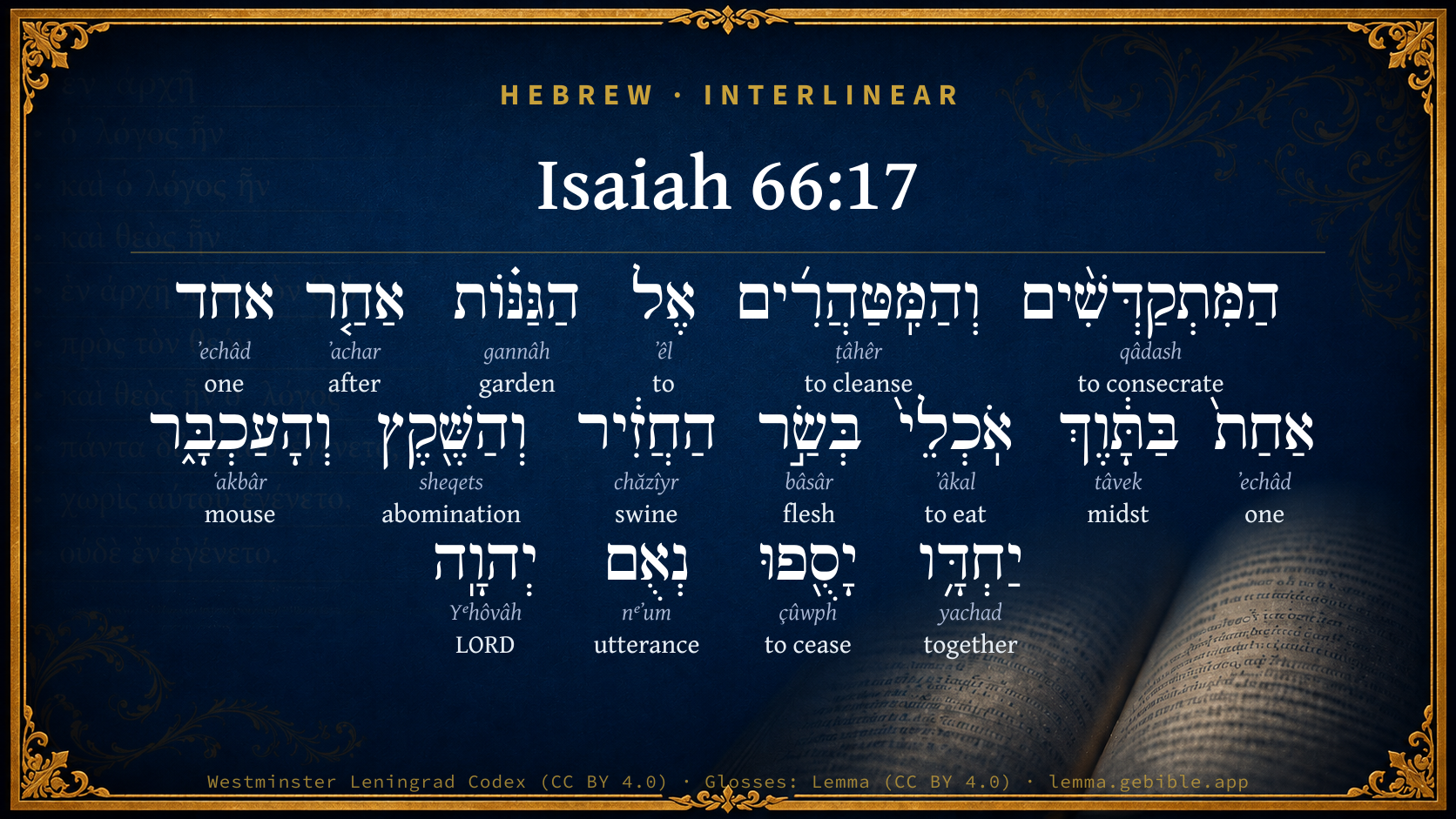
Isaiah 66:17

Hebrew (Westminster Leningrad Codex) Isaiah 66:17 appears in the Hebrew Old Testament. The text above is from the Westminster Leningrad Codex. Each word links to its Strong’s number, a concise gloss, and parsing drawn from the Open Scriptures Hebrew Bible morphology. Click any word for its full Brown-Driver-Briggs (BDB) entry.
Download image
Cite this verse

Isaiah 66:17 (World English Bible). Public Domain. Lemma interlinear Bible study tool, https://lemma.gebible.app/v/isaiah/66/17.

Show BibTeX & RIS
BibTeX
RIS
English Translation
Those who sanctify themselves and purify themselves [to go] to the gardens, behind one in the midst, eating pig's flesh, and the abomination, and the mouse, they shall come to an end together, says Yahweh.
World English Bible · Public Domain
Download a study sheet

One document with this verse’s original text, its word-by-word gloss line, the meaning frame, cross-references with their text, attributed commentary, and full source and license credits — printable, and it pastes into notes with its structure intact.

This verse Autodidact and up

Study sheet (.html) Plain text (.txt)

A passage Seminary Student

Up to 50 verses in one chapter. A passage sheet keeps up to 6 commentary sources and 12 cross-references per verse, in the order this page ranks them, and says so on the sheet whenever that leaves anything out. Ask for a single verse and you get the Autodidact verse sheet above.

Everything on this page stays free to read, with no account — the sheet is a download of what is already on screen, not access to it.

Want to remove ads? Support Godless Engineer
Compare translations 3

The same verse in 3 English versions, stacked beneath the original-language interlinear above. Click any original word for its lexicon entry.

Each is an independent rendering of the whole verse — the interlinear is not word-aligned to these translations.

Highlighted words mark where these versions differ — a whole-verse word diff, not a word-by-word alignment.

  • World English Bible Public Domain
    Those who sanctify themselves and purify themselves [to go] to the gardens, behind one in the midst, eating pig's flesh, and the abomination, and the mouse, they shall come to an end together, says Yahweh.
  • King James Version Public Domain
    They that sanctify themselves, and purify themselves in the gardens behind one tree in the midst, eating swine's flesh, and the abomination, and the mouse, shall be consumed together, saith the LORD.
  • unfoldingWord Literal Text CC BY-SA 4.0
    “The ones consecrating themselves and the ones purifying themselves to the gardens after the one in the midst, eaters of the flesh of the pig and the abomination and the mouse, they will end together”—the declaration of Yahweh.

unfoldingWord Literal Text — © unfoldingWord, licensed CC BY-SA 4.0. Word-aligned USFM3 via Door43 (git.door43.org/unfoldingWord/en_ult).

Versions to compare (up to 4)

3 of 4 selected

Show all 18 translations

Every available English version of this verse, each an independent rendering of the whole verse.

  • World English Bible Public Domain
    Those who sanctify themselves and purify themselves [to go] to the gardens, behind one in the midst, eating pig's flesh, and the abomination, and the mouse, they shall come to an end together, says Yahweh.
  • Berean Standard Bible Public Domain
    “Those who consecrate and purify themselves to enter the groves—to follow one in the center of those who eat the flesh of swine and vermin and rats—will perish together,” declares the LORD.
  • Majority Standard Bible Public Domain
    “Those who consecrate and purify themselves to enter the groves—to follow one in the center of those who eat the flesh of swine and vermin and rats—will perish together,” declares the LORD.
  • King James Version Public Domain
    They that sanctify themselves, and purify themselves in the gardens behind one tree in the midst, eating swine's flesh, and the abomination, and the mouse, shall be consumed together, saith the LORD.
  • American Standard Version (1901) Public Domain
    They that sanctify themselves and purify themselves `to go' unto the gardens, behind one in the midst, eating swine's flesh, and the abomination, and the mouse, they shall come to an end together, saith Jehovah.
  • Revised Version (1885) Public Domain
    They that sanctify themselves and purify themselves to go unto the gardens, behind one in the midst, eating swine’s flesh, and the abomination, and the mouse; they shall come to an end together, saith the LORD.
  • Geneva Bible (1599) Public Domain
    They that sanctifie themselues, and purifie themselues in the gardens behinde one tree in the middes eating swines flesh, and such abomination, euen the mouse, shall be consumed together, sayeth the Lord.
  • Douay-Rheims (1899) Public Domain
    They that were sanctified, and thought themselves clean in the gardens behind the gate within, they that did eat swine's flesh, and the abomination, and the mouse: they shall be consumed together, saith the Lord.
  • Young's Literal Translation Public Domain
    Those sanctifying and cleansing themselves at the gardens, After Ahad in the midst, Eating flesh of the sow, And of the abomination, and of the mouse, Together are consumed, An affirmation of Jehovah.
  • Literal Standard Version CC BY-SA 4.0
    “Those sanctifying and cleansing themselves [to go] to the gardens, || One after another in the midst, || Eating flesh of the sow, || And of the abomination, and of the muroid, || Are consumed together,” || A declaration of YHWH.
  • Unlocked Literal Bible CC BY-SA 4.0
    They consecrate themselves and make themselves pure, so they may enter the gardens, following the one in the middle of those who eat the flesh of pig and abominable things like mice. “They will come to an end—this is Yahweh's declaration.
  • unfoldingWord Literal Text CC BY-SA 4.0
    “The ones consecrating themselves and the ones purifying themselves to the gardens after the one in the midst, eaters of the flesh of the pig and the abomination and the mouse, they will end together”—the declaration of Yahweh.
  • Darby Bible Public Domain
    They that sanctify themselves, and purify themselves in the gardens behind one in the midst; that eat swine's flesh, and the abomination, and the mouse, shall perish together, saith Jehovah.
  • World Messianic Bible Public Domain
    “Those who sanctify themselves and purify themselves to go to the gardens, following one in the middle, eating pig’s meat, abominable things, and the mouse, they shall come to an end together,” says the LORD.
  • Webster's Bible Public Domain
    They that sanctify themselves, and purify themselves in the gardens behind one tree in the midst, eating swine's flesh, and the abomination, and the mouse, shall be consumed together, saith the LORD.
  • Free Bible Version CC BY-SA 4.0
    Those who dedicate themselves and make themselves pure in order to enter the sacred gardens, to worship the idol placed in the center, and to eat pork and vermin and rats and other disgusting things—they will all die together, says the Lord.
  • Bible in Basic English Public Domain
    As for those who keep themselves separate, and make themselves clean in the gardens, going after one in the middle, taking pig's flesh for food, and other disgusting things, such as the mouse: their works and their thoughts will come to an end together, says the Lord.
  • JPS Tanakh (1917) Public Domain
    They that sanctify themselves and purify themselves to go unto the gardens, behind one in the midst, eating swine's flesh, and the detestable thing, and the mouse, shall be consumed together, saith the LORD.

Literal Standard Version (2020), Covenant Press — licensed CC BY-SA 4.0. Text via the HelloAO Bible API (eBible.org). Unlocked Literal Bible (unfoldingWord) — licensed CC BY-SA 4.0. Text via the HelloAO Bible API (eBible.org). unfoldingWord Literal Text — © unfoldingWord, licensed CC BY-SA 4.0. Word-aligned USFM3 via Door43 (git.door43.org/unfoldingWord/en_ult). Free Bible Version, Dr. Jonathan Gallagher — licensed CC BY-SA 4.0. Text via the HelloAO Bible API (eBible.org).

Word by word

More ways to search: Search by grammar → Find every occurrence → Compare this word →

Practice this passage: Drill this verse → Learn its vocabulary →

וְהָעַכְבָּ֑ר
ʻakbâr
H5909
“and · the · mouse”
Conjunction + Particle, Definite Article + Noun, Common, Masculine, Singular, Absolute
Part of Speech
Conjunction + Particle + Noun
Type
Common
Gender
Masculine
Number
Singular
State
Absolute
Full BDB Definition

Origin: probably from the same as H5908 in the secondary sense of attacking

TWOT: 1618

mouse
  1. הַמִּתְקַדְּשִׁ֨ים qâdash H6942 “the · consecrating” Particle, Definite Article + Verb, Hithpael, Participle Active, Masculine, Plural, Absolute
  2. וְהַמִּֽטַּהֲרִ֜ים ṭâhêr H2891 “and · the · cleansing” Conjunction + Particle, Definite Article + Verb, Hithpael, Participle Active, Masculine, Plural, Absolute
  3. אֶל ʼêl H413 “to” Preposition
  4. הַגַּנּ֗וֹת gannâh H1593 “the · gardens” Particle, Definite Article + Noun, Common, Feminine, Plural, Absolute
  5. אַחַ֤ר ʼachar H310 “after” Preposition
  6. אחד ʼechâd H259 “one” Adjective, Cardinal number, Masculine, Singular, Absolute
  7. אַחַת֙ ʼechâd H259 “one” Adjective, Cardinal number, Feminine, Singular, Absolute
  8. בַּתָּ֔וֶךְ tâvek H8432 “in/at the · midst” Preposition, Determined + Noun, Common, Masculine, Singular, Absolute
  9. אֹֽכְלֵי֙ ʼâkal H398 “eating” Verb, Qal, Participle Active, Masculine, Plural, Construct
  10. בְּשַׂ֣ר bâsâr H1320 “flesh of” Noun, Common, Masculine, Singular, Construct
  11. הַחֲזִ֔יר chăzîyr H2386 “the · swine” Particle, Definite Article + Noun, Common, Masculine, Singular, Absolute
  12. וְהַשֶּׁ֖קֶץ sheqets H8263 “and · the · abomination” Conjunction + Particle, Definite Article + Noun, Common, Masculine, Singular, Absolute
  13. יַחְדָּ֥ו yachad H3162 “together” Adverb
  14. יָסֻ֖פוּ çûwph H5486 “to cease” Verb, Qal, Imperfect, 3rd Person, Masculine, Plural
  15. נְאֻם nᵉʼum H5002 “utterance of” Noun, Common, Masculine, Singular, Construct
  16. יְהוָֽה Yᵉhôvâh H3068 “LORD” Noun, Proper

About this verse

These counts appear in no published source. They are computed here, from the morphology-tagged text and Lemma’s own curated glosses. What Lemma adds →

17
words
16
distinct lemmas
Prophets
section

Notable vocabulary

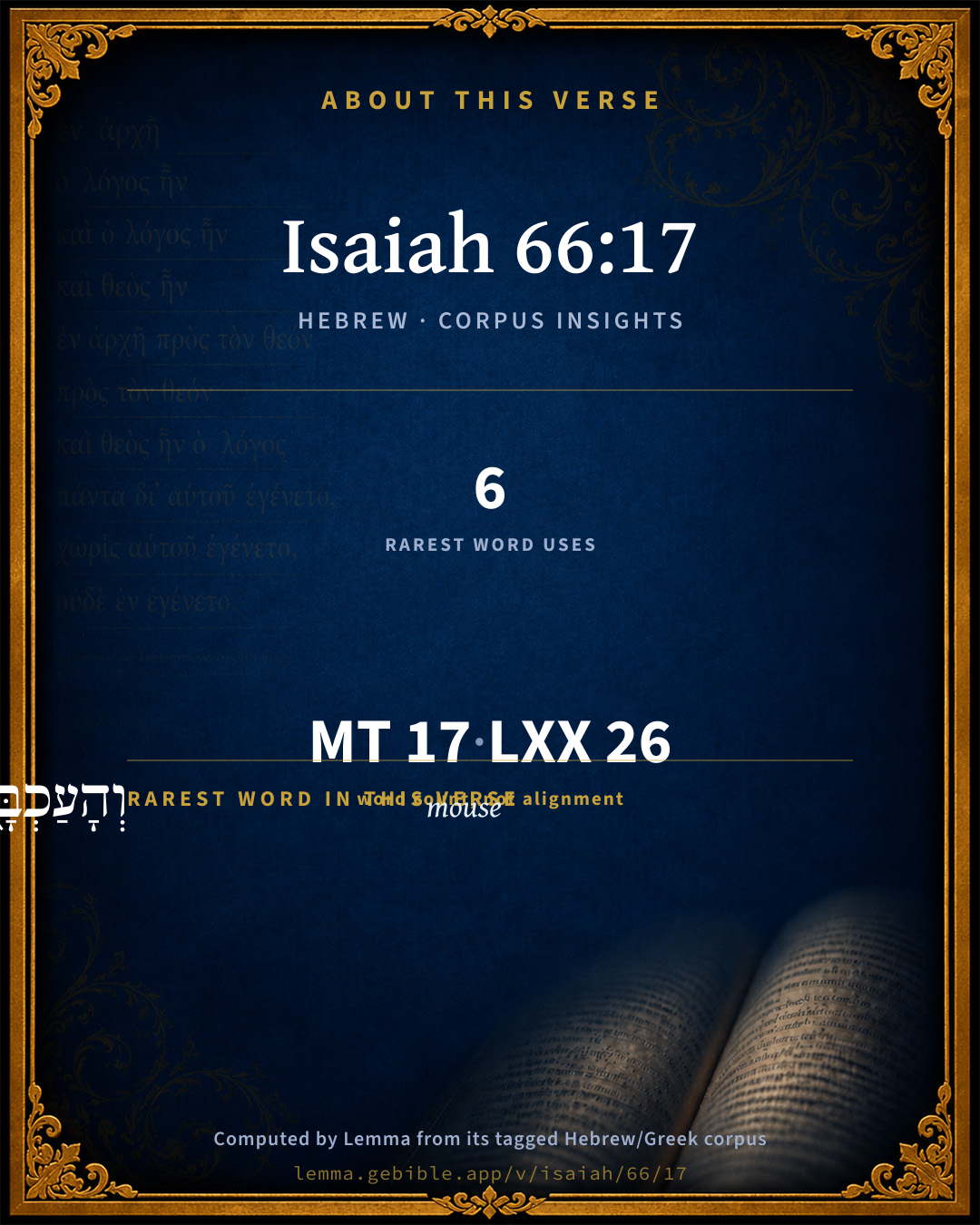
The rarest word here is וְהָעַכְבָּ֑ר mouse H5909 — appearing just 6 times in the whole Hebrew Bible.

Shared distinctive vocabulary

וְהָעַכְבָּ֑ר mouse H5909 occurs in 6 verses of the Hebrew Bible. Also found in:

Grammatical profile

  • 4 verbs
  • 8 nouns
  • 2 adjectives
  • 2 prepositions
  • 1 adverb

Verb forms

  • הַמִּתְקַדְּשִׁ֨ים Hithpael · Participle Active
  • וְהַמִּֽטַּהֲרִ֜ים Hithpael · Participle Active
  • אֹֽכְלֵי֙ Qal · Participle Active
  • יָסֻ֖פוּ Qal · Imperfect

Repetition

A word recurs within this verse — often emphatic in Hebrew:

  • אחד one H259 ×2

Hebrew & Septuagint length

In English translation the verse runs 35 words from the Hebrew and 30 from the Septuagint (LXX English) — closely comparable.

A rough comparison of the two English renderings, which tokenize alike — not a word-level alignment.

Word counts can differ between the Hebrew and the Greek without any difference in meaning — e.g. the Hebrew direct-object marker אֵת has no separate Greek word, and Greek often adds the article ὁ.

In the original languages it is 17 Hebrew tokens and 26 Greek tokens — but the two are counted differently (Hebrew bundles its prefixes and suffixes into one token; the Greek is in lemma form), so that isn’t a like-for-like length.

Cross-references

4

Topical passages linked to Isaiah 66:17 in the Treasury of Scripture Knowledge — connected by theme and wording, ordered by reader-vote popularity; previews shown in the World English Bible.

  • Isaiah 65:3–4 a people who provoke me to my face continually, sacrificing in gardens, and burning incense on bricks;
  • Deuteronomy 14:3–8 You shall not eat any abominable thing.
  • Leviticus 11:2–8 "Speak to the children of Israel, saying, 'These are the living things which you may eat among all the animals that are on the earth.
  • Isaiah 1:28–29 But the destruction of transgressors and sinners shall be together, And those who forsake Yahweh shall be consumed.

Cross-references courtesy of OpenBible.info (CC BY 4.0).

Hebrew and Greek witnesses Masoretic Hebrew ↔ Greek Septuagint

The same verse in the two great witnesses to the Old Testament, shown verse-for-verse.

These are two independent witnesses, not word-aligned to each other, and the Septuagint is shown in lemma (dictionary) form.

Hebrew Isaiah 66:17 Masoretic · Westminster Leningrad Codex

הַמִּתְקַדְּשִׁ֨ים וְהַמִּֽטַּהֲרִ֜ים אֶל הַגַּנּ֗וֹת אַחַ֤ר אחד אַחַת֙ בַּתָּ֔וֶךְ אֹֽכְלֵי֙ בְּשַׂ֣ר הַחֲזִ֔יר וְהַשֶּׁ֖קֶץ וְהָעַכְבָּ֑ר יַחְדָּ֥ו יָסֻ֖פוּ נְאֻם יְהוָֽה

Those who sanctify themselves and purify themselves [to go] to the gardens, behind one in the midst, eating pig's flesh, and the abomination, and the mouse, they shall come to an end together, says Yahweh.

World English Bible · Public Domain

Greek LXX Isaiah 66:17 Septuagint · lemma form

ὁ ἁγνίζω καί καθαρίζω εἰς ὁ κῆπος καί ἐν ὁ πρόθυρον ἐσθίω κρέας ὕειος καί ὁ βδέλυγμα καί ὁ νῦν ἐπί ὁ αὐτός ἀναἁλίσκω εἶπον κύριος

They that sanctify themselves and purify themselves in the gardens, and eat swine's flesh in the porches, and the abominations, and the mouse, shall be consumed together, says the Lord.

LXX2012 (modern English Septuagint) · Public Domain

On this verse, Jamieson, Fausset & Brown discusses the Septuagint’s reading. Read the note in Commentary ↓

Hebrew: Westminster Leningrad Codex (CC BY 4.0). Greek: Septuagint (public domain); English from LXX2012 (modern English Septuagint) (Public Domain). How the Septuagint differs from the Hebrew →

Targum (Aramaic paraphrase)

1

The Targum is the ancient Jewish Aramaic paraphrase of the Hebrew Scriptures — an interpretive translation, not the Hebrew text itself. Onkelos (literal) and Pseudo-Jonathan (expansive) render the Torah, and Jonathan the Prophets. Coverage is partial: where no permissively-licensed English translation exists for a verse, only the Aramaic is shown. This is verse-level text, not a word-by-word alignment to the Hebrew.

  1. Targum Jonathan Prophets (Joshua–Malachi)
    דְמִזְדַמְנִין וְדִמְדַכָּן לְגִנָן דְטַעֲוָתָא סִיעָא בָּתַר סִיעָא אָכְלֵי בְּשַׂר חֲזִירָא וְשִׁקְצָא וְעַכְבְּרָא כַּחֲדָא יְסוּפוּן אֲמַר יְיָ:

    They who prepare and purify themselves in the gardens of idols, multitude after multitude, eating swines' flesh, and the abomination, and the mouse, shall be consumed together, saith the Lord.

    Targum Jonathan — Aramaic: “Mikraot Gedolot” (public domain). English: “Sefaria Community Translation” (CC0 1.0 (public-domain dedication)); “London "Chaldee Paraphrase," 1871” (public domain). Text via Sefaria.

Commentary

Notes on Isaiah 66:17 from classic Christian and Jewish commentators (each source and its license shown beneath its notes). The classic Christian expositions comment on the surrounding passage and are grouped to its opening verse, so a note may address several verses; the Jewish commentaries on the Tanakh (Rashi and others) are per-verse, so they appear only where the commentator wrote on this verse.

Lemma curates 59 commentaries, every one of them public domain or Creative Commons licensed, each selected and text-cleaned for this edition rather than reprinted as found. About our sources →

The Cambridge Bible for Schools and Colleges

gen. ed. J. J. S. Perowne

17. A renewed description of the apostates, in terms similar to Isa_66:3, Isa_65:3-5; Isa_65:11. Although the judgement is “with all flesh” it has a special significance for these reprobates. The connexion of Isa_66:17 with Isa_66:16 is not, however, beyond suspicion.

in the gardens] for the gardens, i.e. in order to go into the sacred gardens (ch. Isa_65:3) where the illegal rites were to be consummated (“ad sacra in lucis obeunda”).

behind one tree in the midst] A difficult and much disputed phrase. The insertion of the word “tree” is purely gratuitous, and indefensible. If the consonantal text be sound the best rendering by far is after one in the midst; i.e. following the actions of a hierophant or mystagogue, who stands in the midst of the brotherhood and regulates the important ceremony of purification. Comp. Eze_8:11, “… seventy men of the elders of the house of Israel, and in the midst of them stood Jaazaniah the son of Shaphan, with every man his censer in his hand.” There does not appear to be any valid objection to this interpretation, although it is not supported by any ancient authority. The Massoretes substitute the fem. of “one” for the masc., thinking apparently of the image of some goddess as the central object. (The Babylonian Codex and the Soncino Bible have the fem. in the text.) Many commentators, guided by a faulty reference in Macrobius (Saturn. 1. 23), have supposed that the word for “one” (אֶחָד) contains the name of a deity; but this view, although revived by Lagarde, finds little favour among modern scholars. Several ancient versions (Pesh., Sym., Theod.) render “one after another” (Targ. “company after company”), which would be possible if we might insert an additional אחד (אחד אחר אחד), but it leaves “in the midst” unexplained. Cheyne (Introd. p. 370) reads with Klostermann אחד אחד בתנך—“one (consecrating) the other on the tip of the ear”; an ingenious emendation, but hardly yielding an easier sense than the received (consonantal) text as understood above.

swine’s flesh] ch. Isa_65:4.

the abomination] Hebr. shéqec̨, the general name for unclean animals; Lev_7:21; Lev_9:10 ff. (passim); cf. Eze_8:10. (Duhm reads shéreç, “vermin,” creeping or swarming creatures).

the mouse] an unclean animal according to Lev_11:29. Of the 23 species of small rodents included under the name in Palestine, several are esteemed edible by the Arabs (Tristram, Nat. Hist., pp. 122 ff.). The allusion here without doubt is to sacrificial meals, the mouse being a sacred animal in the same sense as the swine and the dog. see W. R. Smith, Rel. of Sem.2 p. 293; who mentions a statement of Maimonides that the Harranians sacrificed field-mice.

shall be consumed] shall come to an end; see on next verse.

The Cambridge Bible for Schools and Colleges (gen. ed. J. J. S. Perowne; Cambridge University Press, 1878–1918) — public domain. Text from a community e-Sword module.

Trapp's Complete Commentary

John Trapp

Isa 66:17 They that sanctify themselves, and purify themselves in the gardens behind one [tree] in the midst, eating swine’s flesh, and the abomination, and the mouse, shall be consumed together, saith the LORD.

Ver. 17. In the gardens.] Where these idolaters had set up altars, offered sacrifices, and had their ponds, wherein, when they were about to sacrifice, heathen like, they washed and purified themselves one after another, and not together, which they held to be the best way of purifying. This they did also, not apart and in private, but in the midst, ut hoc mode oculos in nudis lavantium, praesertim muliercularum, corporibus pascerent, that they might feed their eyes with the sight of those parts which nature would have hid; for your pagan superstitions were ofttimes contrary to natural honesty. {a}

Behind one tree in the midst.] Or, as others render it, After; or, Behind Ahad, which was the name of a Syrian idol, representing the sun, as Macrobius telleth us, calling him Adad. {b}

{a} Donec me flumine vivo Abluero. - Virg. Qui noctem in flumine purgas. - Pers.; i.e., nocturnam Venerem.

{b} Saturnal., lib. i. cap. 23.

John Trapp, A Commentary or Exposition upon All the Books of the Old and New Testament (1647–1656) — public domain. Text from a community e-Sword module.

Joseph Benson's Commentary

Isa 66:17. They that sanctify themselves, &c. — “Behold,” says Vitringa, “the reason of the great severity above mentioned, namely, a base and abominable departure from God, represented under a certain kind of idolatry and detestable superstition, of all others the most odious and contrary to the institutions of the ancient religion.” It is evident the passage is to be understood figuratively, like those in Isa 66:3, and in Isa 65:3-4; Isa 65:11, on which see the notes. And purify themselves in the gardens — There were several sorts of lustrations, or purifications, used among the heathen, from whence the Jews learned their idolatrous customs, some of which were performed by washings, for which purpose they had fountains in their sacred groves and gardens. Behind one tree — The word tree is not in the Hebrew. The words are אחר אחד, achar achad, which may signify, after the manner of achad. Or, as Bishop Lowth renders it, after the rites of achad; observing, “the Syrians worshipped a god called Adad, whom they held to be the highest and greatest of the gods, and to be the same with Jupiter and the sun: and the name Adad, says Macrobius, signifies one, as likewise does the word achad, in Isaiah. Many learned men, therefore, have supposed, and with some probability, that the prophet means the same pretended deity. But whatever the particular mode of idolatry might be, the general sense of the verse is perfectly clear.” It is plainly a reproof of the wicked Jews for the many idolatries and superstitions of which they were guilty, and which are here set forth in figurative language, borrowed from the abominable practices to which many of the Jews were addicted in Isaiah’s time; who privately, in enclosed gardens which were not exposed to view, performed the heathen lustrations, sacrificed in the heathen manner, and to their gods, and eat meats which were prohibited by the law as unclean, although in public they pretended to be true Jews, or strict observers of the law. Eating swine’s flesh — Forbidden, Lev 11:7; Deu 14:8. And the abomination — Other abominable meats forbidden to the Jews; and the mouse — The word which we translate mouse being nowhere found but Lev 11:29; 1Sa 6:4-5; 1Sa 6:11; 1Sa 6:18, and here, some think it is not that creature which we call a mouse, but rather signifies some serpent. Be this as it may, the sense evidently is, that God would not only destroy the open and gross idolaters and superstitious persons, but all those who made no conscience of yielding obedience to the law of God in such things as seemed to them of a trivial nature, and in which they easily might have yielded obedience. The Lord here assures them that they should all perish together. Observe, reader, in the day of final judgment, the idolatrous pagan or Papist, and the ungodly Protestant, shall fare alike. For no man can reasonably imagine that either baptism, or a profession of Christianity, can save a man from God’s wrath without holiness, any more than circumcision, and the being reputed a member in the Jewish Church.

Joseph Benson's Commentary on the Old and New Testaments (1811–1818) — public domain. Text from a community e-Sword module.

Tyndale Open Study Notes

Tyndale Open Resources

66:17 Apostates who ‘consecrate’ and ‘purify’ themselves through idolatrous practices are an abomination to God (cp. 1:28-31; 65:4).

Tyndale Open Study Notes — © Tyndale Open Resources, licensed CC BY-SA 4.0. Text via the HelloAO Bible API.

Geneva Bible (1599)

Geneva Bible translators

Meaning, the hypocrites.

Whereby are meant them that did maliciously transgress the Law, by eating beasts forbidden, even to the mouse, which nature abhoreth.

Geneva Bible (1599) marginal notes — public domain. Text via Bolls.life.

Jamieson, Fausset & Brown

Robert Jamieson, A. R. Fausset & David Brown

in . . . gardens--Hebrew and the Septuagint rather require, "for (entering into) gardens," namely, to sacrifice there [MAURER].

behind one tree--rather, "following one," that is, some idol or other, which, from contempt, he does not name [MAURER]. VITRINGA, &c., think the Hebrew for "one," Ahhadh, to be the name of the god; called Adad (meaning One) in Syria (compare Act 17:23). The idol's power was represented by inclined rays, as of the sun shining on the earth. GESENIUS translates, "following one," namely, Hierophant ("priest"), who led the rest in performing the sacred rites.

in . . . midst--namely, of the garden (see on Isa 65:3-4).

mouse--legally unclean (Lev 11:29) because it was an idol to the heathen (see on Isa 37:36; Sa1 6:4). Translate, "the field mouse," or "dormouse" [BOCHART]. The Pharisees with their self-righteous purifications, and all mere formalists, are included in the same condemnation, described in language taken from the idolatries prevalent in Isaiah's times.

Jamieson, Fausset & Brown — Commentary Critical and Explanatory on the Whole Bible (1871) — public domain (CC PDM 1.0). Text via the HelloAO Bible API.

Adam Clarke's Commentary

Verse 17. Behind one tree - "After the rites of Achad"] The Syrians worshipped a god called Adad, Plin. Nat. Hist. xxxvii. 11; Macrob. Sat. i. 23. They held him to be the highest and greatest of the gods, and to be the same with Jupiter and the sun; and the name Adad, says Macrobius, signifies one; as likewise does the word Achad in Isaiah. Many learned men therefore have supposed, and with some probability, that the prophet means the same pretended deity. אחד achad, in the Syrian and Chaldean dialects, is חד chad; and perhaps by reduplication of the last letter to express perfect unity, it may have become חדד chadad, not improperly expressed by Macrobius Adad, without the aspirate. It was also pronounced by the Syrians themselves, with a weaker aspirate, הדד hadad, as in Benhadad, Hadadezer, names of their kings, which were certainly taken from their chief object of worship. This seems to me to be a probable account of this name.

But the Masoretes correct the text in this place. Their marginal reading is אחת achath which is the same word, only in the feminine form; and so read thirty MSS. (six ancient) and the two oldest editions. This Le Clerc approves, and supposes it to mean Hecate, or the moon; and he supports his hypothesis by arguments not at all improbable. See his note on the place.

Whatever the particular mode of idolatry which the prophet refers to might be, the general sense of the place is perfectly clear. But the Chaldee and Syriac, and after them Symmachus and Theodotion, cut off at once all these difficulties, by taking the word אחד achad in its common meaning, not as a proper name; the two latter rendering the sentence thus: Οπισω αλληλων εν μεσῳ εσθιοντων το κρεας το χοιρειον; "One after another, in the midst of those that eat swine's flesh." I suppose they all read in their copies אחד אחד achad achad, one by one, or perhaps אחד אחר אחד achad achar achad, one after another. See a large dissertation on this subject in Davidis Millii Dissertationes Selectae, Dissert. vi. - L.

I know not what to make of this place; it is certain that our translation makes no sense, and that of the learned prelate seems to me too refined. Kimchi interprets this of the Turks, who are remarkable for ablutions. "Behind one in the midst" he understands of a large fish-pond placed in the middle of their gardens. Others make אחד achad a deity, as above; and a deity of various names it is supposed to be, for it is Achad, and Chad, and Hadad, and Achath, and Hecat, an Assyrian idol. Behynd the fyrst tree or the gate withine forth. - Old MS. Bible.

Adam Clarke's Commentary on the Bible (1810–1826) — public domain. Text from a community e-Sword/MySword module.

Ellicott's Commentary for English Readers

(17) They that sanctify themselves . . .—Better, they that consecrate themselves . . . As in Isa_65:3-4, the prophet has in his thoughts the apostates, who gloried in mingling heathen rites with the worship of Jehovah. Such a blending of incompatible elements was, as we have seen, eminently characteristic of the reign of Manasseh. We have no trace of anything corresponding to it among the. Babylonian exiles, either before or after their return. The “consecration” and “purification” are the initiatory rites of heathen mysteries, connected probably with the worship of Baal or Ashtoreth, or, as the context, with its reference to gardens and swine’s flesh, renders probable, with that of Thammuz. (See Note on Isa_64:4.)

Behind one tree in the midst.—The noun “tree” is a conjectural explanation. The Hebrew text gives the “one” in the masculine, and is explained as referring either (1) to the Hierophant, who led the worshippers; or (2), as with a contemptuous reluctance to utter the name of the false deity, to Thammuz. The Hebrew margin gives “one” in the feminine, and this may have been meant for the Asherah, the “grove,” or Phallic symbol of idolatrous worship. If we adopt the masculine, and refer it to Thammuz, the word may connect itself with the lamentations of the Syrian maidens over Thammuz (Adonis) as over an only son. (Comp. Milton, Paradise Lost, i.)

The abomination.—The word stands in Lev_7:21; Lev_11:11, for various kinds of unclean beasts, among which the mouse, or jerboa, still eaten by the Arabs, was conspicuous (Lev_11:29). It is probable that all these, as well as the swine’s flesh, were used in the idolfeasts. In any case the apostate worshippers would seem to have exulted in throwing off the restraints of the Mosaic law.

A Bible Commentary for English Readers, edited by Charles John Ellicott (1878–1897) — public domain. Text from a community e-Sword module.

John Gill's Exposition

They that sanctify themselves,.... This is a description of the enemies of the Lord, and of his people, who shall be slain at this time; not who are sanctified by the Spirit and grace of God, but who sanctify themselves, pretend to make themselves holy, and give out that they are holier than others; professing great outward sanctity, as the Papists do, but destitute of real inward holiness: or, "that prepare themselves", as the Targum; to go and worship such an idol, on such a day, as Jarchi and Aben Ezra interpret it, and as the above followers of the man of sin do, Rev 9:20.

that purify themselves in the gardens; in pools or ponds of water in gardens. This Kimchi understands of the Persians, by whom he means the Mahometans, who bathe and purify themselves daily, but yet are unclean in their lives and actions; and it is true also of the Papists, who pretend to purify themselves with their holy water in their churches. "Behind one tree in the midst": so Aben Ezra supplies it. Some take Achad, rendered "one", to be the name of an idol. Macrobius (d) says, the Assyrians worshipped the sun under the name of Adad, which signifies "one"; him they adore as a most powerful deity; the same perhaps, with the Adodus of Sanchoniatho (e), whom he calls the king of the gods; and the Adadus of Pliny (f), the god of the Syrians, from whom the gem "adadunephros" has its name. The Targum paraphrases it, "company after company"; to which agrees the Syriac version, "that purify themselves--one after another"; as the Papists go to Mass company after company, when they make use of their holy water purification. The phrase, "after one in the midst" (g), as it may be rendered, may signify, after some middle person or mediator; and the note of Cocceius is not amiss, after the false vicar and head, that is, the pope, the pretended vicar of Christ, and head of the church the above things the Papists do after his orders and injunctions. So R. Bechai (h) interprets all of this of the Mahometans and Papists; his words are, as Buxtorf (i) has cited them,

"that sanctify themselves; these are the sons of Edom (that is, the Christians), whose custom it is to move their fingers here and there (that is, to sanctify themselves with the sign of the cross): that purify, themselves; these are the sons of Ishmael (that is, the Turks), whose custom is to wash their hands and their feet; which custom of washing they had from Esau and the Jews: "after one in the midst"; this signifies the cross of the Edomites (that is, the Christians), by which they sanctify, themselves;''

the Papists he means. Ben Melech understands it of one pool in the midst of the garden; and observes, that others interpret it of one of the groves in the midst of it.

Eating swine's flesh, and the abomination, and the mouse; the eating of swine's flesh, and the mouse, were forbidden by the law of Moses, Lev 11:7 and some think by the "abomination" is meant the "weasel", since that is mentioned in the above law with the "mouse"; though it may be rather things offered to idols, or blood, are designed. Mice have been eaten, at least some sort of them, as the dormouse, by some people, particularly the Romans, and counted delicious food, as Sanctius upon the place, from various authors, has showed; and Bochart (k) also observes, that there is a kind of field mice, called by the Arabians "jarbuo", which are eaten by them, and had in great esteem, and is the very word the Arabic interpreter renders this by in the text. Now, though the ceremonial law is abolished, and all distinction of meats ceased, and will continue so in the times referred to; yet the description of these unclean people, pretending to so much sanctity and purity, is taken from such persons who were reckoned impure in the times the prophet wrote; and may particularly point at such who abstain from meats at certain times, to be eaten lawfully; and yet are as unclean as those under the law were, who ate things forbidden; they being such who are abominable, and make an abomination, and a lie, Rev 21:8, "these shall be consumed together, saith the Lord"; in the above mentioned battles, or in the lake which burns with fire and brimstone.

(d) Saturnal. I. 1. c. 23. (e) Apud Euseb. Praepar. Evangel. I. 1. c. 10. p. 38. (f) Nat. Hist. 1. 37. c. 11. (g) "post unam in medio", Montanus Munster, Vatablus; "post unum in medio", Cocceius, Vitringa. (h) Comment. in Deut. xxx. fol. 220. col, 4. (i) De Abbreviat. Heb. p. 199, 200. (k) Hierozoic. par. 1. l. 3. c. 33. col. 1014.

John Gill's Exposition of the Whole Bible (1746–1763) — public domain (CC PDM 1.0). Text via the HelloAO Bible API.

Albert Barnes' Notes on the Bible

They that sanctify themselves - That is, who attempt to purify themselves by idolatrous rites, by ablutions, and lustrations. The design here is, to describe those who will be exposed to the wrath of God when he shall come to execute vengeance.

And purify themselves in the gardens - (See the notes at Isa 65:3).

Behind one tree in the midst - This passage has not a little exercised the ingenuity of commentators. It is quite evident that our translators were not able to satisfy themselves with regard to its meaning. In the margin they have rendered it, ‘one after another,’ supposing that it may mean that the idolaters engaged in their sacrifices in a solemn procession, walking one after another around their groves, their shrines, or their altars. In the translation in the text, they seem to have supposed that the religious rites referred to were celebrated behind one particular selected tree in the garden. Lowth renders it, ‘After the rites of Achad.’ Jerome renders it, In hortis post januam intrinsecus - ‘In the gardens they sanctify themselves behind the gate within.’ The Septuagint, ‘Who consecrate and purify themselves (εἰς τοὺς κήπους, καὶ ἐν τοῖς προθύροις ἕσθοντες, κ.τ.λ. eis tous kēpous, kai en tois prothurois hesthontes, etc.) for the gardens, and they who, in the outer courts, eat swine’s flesh,’ etc. The Chaldee renders the phrase סיעא בחר סיעא siy‛ā' bāchar siy‛ā' - ‘Multitude after multitude.’ The vexed Hebrew phrase used here, אחד אחר 'achar 'achad, it is very difficult to explain. The word אחר 'achar means properly after; the after part; the extremity; behind - in the sense of following after, or going after anyone. The word אחד 'achad, means properly one; someone; anyone. Gesenius (Commentary at the place) says that the phrase may be used in one of the three following senses:

1. In the sense of one after another. So Sym. and Theo. render it - ὀπίσω ἀλλήλων opisō allēlōn. Luther renders it, Einer hier, der andere da - ‘one here, another there.’

2. The word אחד 'achad, may be understood as the name of a god who was worshipped in Syria, by the name of Adad. This god is that described by Macrobius, Sat., i. 23: ‘Understand what the Assyrians think about the power of the sun. For to the God whom they worship as Supreme they give the name Adad, and the signification of this name is One.’ That the passage before us refers to this divinity is the opinion of Lowth, Grotius, Bochart, Vitringa, Dathe, and others. ‘The image of Adad,’ Macrobius adds, ‘was designated by inclined rays, by which it was shown that the power of heaven was in the rays of the sun which were sent down to the earth.’ The same god is referred to by Pliny (Hist. Nat. xxxvii. 71), where he mentions three gems which received their names from three parts of the body, and were called ‘The veins of Adad, the eye of Adad, the finger of Adad;’ and he adds, ‘This god was worshipped by the Syrians.’ There can be no doubt that such a god was worshipped; but it is by no means certain that this idol is here referred to. It is not improbable, Vitringa remarks, that the name Adad should be written for Achadh, for the ease of pronunciation - as a slight change in letters was common for the purpose of euphony. But it is still not quite clear that this refers to any particular idol.

3. The third opinion is that of Gesenius and accords substantially with that which our translators have expressed it the text. According to that, it should be rendered ‘Those who sanctify and purify themselves in the (idol) groves after one in the midst;’ that is, following and imitating the one priest who directed the sacred ceremonies. It may mean that a solemn procession was formed in the midst of the grove, which was led on by the priest, whom all followed; or it may mean that they imitated him in the sacred rites. It seems tome probable that this refers to some sacred procession in honor of an idol, where the idol or the altar was encompassed by the worshippers, and where they were led on by the officiating priest. Such processions we know were common in pagan worship.

In the midst - In the midst of the sacred grove; that is, in the darkest and obscurest recess. Groves were selected for such worship on account of the sacred awe which it was supposed their dark shades would produce and cherish. For the same reason, therefore, the darkest retreat - the very middle of the grove - would be selected as the place where their religious ceremonies would be performed. I see no evidence that there is any allusion to any tree here, as our translators seem to have supposed; still less, that there was, as Burder supposes, any allusion to the tree of life in the midst of the garden of Eden, and their attempts to cultivate and preserve the memory of it; but there is reason to believe that their religious rites would be performed in the center, or most shady part of the grove.

Eating swine’s flesh - That is, in connection with their public worship (see the notes at Isa 65:4).

And the abomination - The thing which is held as abominable or detestable in the law of God. Thus the creeping thing and the reptile were regarded as abominations Lev 11:41-42. They were not to be eaten; still less were they to be offered in sacrifice (compare Exo 8:26; Deu 20:16; Deu 29:17; see the notes at Isa 65:3).

And the mouse - The Hebrew word used here means the dormouse - a small field-mouse. Jerome understands it as meaning the glis, a small mouse that was regarded as a great delicacy by the Romans. They were carefully kept and fattened for food (see Varro, De Rust., iii. 15). Bochart (Hieroz., i. 3, 34) supposes that the name used here is of Chaldaic origin, and that it denotes a field-mouse. Mice abounded in the East, and were often exceedingly destructive in Syria (see Bochart; compare 1Sa 5:4). Strabo mentions that so vast a multitude of mice sometimes invaded Spain as to produce a pestilence; and in some parts of Italy, the number of field-mice was so great that the inhabitants were forced to abandon the country. It was partly on account of its destructive character that it was held in abomination by the Hebrews. Yet it would seem that it was eaten by idolaters; and was, perhaps, used either in their sacrifices or in their incantations (see the notes at Isa 65:4). Vitringa supposes that the description in this verse is applicable to the time of Herod, and that it refers to the number of pagan customs and institutions which were introduced under his auspices. But this is by no means certain. It may be possible that it is a general description of idolatry, and of idolaters as the enemies of God, and that the idea is, that God would come with vengeance to cut off all his foes.

Albert Barnes' Notes on the Bible (1834–1885) — public domain. Text from a community e-Sword/MySword module.

Haydock's Catholic Bible Commentary

Within the court, or gardens, where they purified themselves, foolishly supposing that this would remove their crimes, as the pagans did. (St. Jerome) (Tertullian, Bapt. v.) --- Instead of gate, St. Jerome wrote unam, "one," moon or Hecate, which is obviously derived from Hebrew Achat, chap. lvii. 8., and lxv. 11. Chaldean, Syriac, &c., "gardens, one after another with those who eat," &c. --- Mouse, or "field-rat," (Bochart) all declared unclean; (Leviticus xi. 7, 29.; Calmet) or, "the dor-mouse," (St. Jerome) which was looked upon as a delicacy by the Romans. (Varro iii. 15.; Pliny, [Natural History?] xxxvi. 1.)

George Leo Haydock (1774–1849), Haydock's Catholic Family Bible and Commentary, 1859 edition — public domain. Excludes Psalms (Douay-Rheims chapter numbering differs from Protestant) and Deuterocanonical books (Catholic canon only).

Matthew Poole's English Annotations

That the Jews might not think that the judgments threatened concerned only the heathen, he tells them they concerned them, the idol worshippers amongst them; and not idolaters only, but such as broke his laws about meats, which he had prohibited them to eat. Those that sanctified and purified themselves in gardens, gardens in which they worshipped idols, Isa 1:29; 65:3,4; 1Ki 14:23; 15:13; the word translated gardens signifieth such as were thick planted with trees, and had groves in them, where they set their idols, 1Ki 15:13; hence the idol is called the grove, 2Ki 23:6; they had also in these gardens pools, where they washed themselves in a way of preparation for their idol worship, as the priest by God’s ordinance was to bathe himself, Num 19:7.

Behind one tree in the midst; behind one of the trees, or one by one behind the trees. Some think that Achar is here a proper name of an idol, behind which or behind whose temple these idolaters were wont to purify themselves. These gardens were places too as well for brutish lusts as idol worship, as may be learned from 1Ki 14:24; 2Ki 23:7, and they by these washings thought to make themselves clean.

Eating swine’ s flesh, forbidden Lev 11:7; Deu 14:8.

And the abomination; either any abominable things, or all those beasts forbidden the Jews for meat, Lev 11:9,10, &c. Some think a particular abominable thing is here meant, and think it is the weasel, which, Lev 11:29, is joined with the mouse, which is here next mentioned. The word which we translate mouse being no where found but there, and here, and 1Sa 6:4,5,11,18, some think it is not that creature we call a mouse, (because a mouse is properly no creeping thing; but the word, Lev 11:29, signifieth a creeping thing,) they therefore think it rather signifieth some serpent. It is a matter of no great consequence. The sense is, that God would not only destroy the open and gross idolaters and superstitious persons, but all those also who had made no conscience of yielding obedience to the law of God in such things as seemed to them of a minute nature, and such as they easily might have yielded obedience to; he saith that they shall all perish together. In the day of judgment, the idolatrous pagan and papist, and the lewd anti disobedient protestant, shall fare alike. It will be a hard thing for a thinking soul to see how baptism, and a membership in the Christian church, should save men from God’s wrath, without holiness, more than circumcision and membership in the Jewish church.

Matthew Poole's English Annotations on the Holy Bible (1683–1685) — public domain. Text from a community e-Sword/MySword module.

Whedon's Commentary on the Bible

Daniel D. Whedon

17. The judgments of Isa_66:15-16, likewise fall on nations or heathen as well as on Jews who still voluntarily drop themselves from the election of grace, and become measurably like the heathen.

They that sanctify themselves, and purify themselves in the gardens — The same as described in Isa_65:3-4. These are the ancient idolaters among the Jews, of whom so much has been said in these prophecies. Their sins, past, present, and future, are considered as in one group, for which judgment of “fire” and “sword” is executed.

Gardens — Enclosures containing trees and shrubs and aromatic plants, belonging to the wealthy, especially kings and nobles. When idolatry became common in Palestine these were used for polluting, idol worship.

Behind one tree in the midst — The word “tree” is not in the Hebrew text, but the reading is: Behind one, one, or one after one. It is generally believed one file leader is the proper idea; he standing in the “midst,” giving instruction and direction in idolatrous procession along the groves of the garden, where swine’s flesh is sacrificed and eaten, with the abomination, and the mouse. What these were is very difficult to ascertain; but the sentiment indicates that nothing was too disgusting to be an object of idolatrous reverence in the days of the wicked kings of Israel and Judah. The retributive judgments of these verses are seemingly generic, and do their chastising work along the whole course of history pertaining to the abuses of Jehovah’s true religion. This entire subject is quite inscrutable still to the ablest critics.

Daniel D. Whedon (gen. ed.), Commentary on the Old and New Testaments (1874–1909) — public domain. Text from a community e-Sword module.

The Pulpit Commentary

They that sanctify... themselves in the gardens. (comp. Isa_1:29 Isa_65:3; and see the comment on the latter passage) Behind one tree in the midst; literally, behind one in the midst. It seems quite impossible that "one" can mean "one tree," when no tree has been mentioned, and gardens do not necessarily contain trees. The marginal rendering, "one after another," is also impossible. The "one in the midst" must have been either a hierophant who directed the ceremonies (Gesenius, Hitzig, Knobel, Delitzsch), or an image of a deity (Scaliger, Voss, Grotius, Lagarde, Cheyne). In the latter case, we must suppose that the worshippers had a scruple about mentioning the deity"s name, and were accustomed to call him "one," or "a certain one" (comp. Herod., 2:171). Isaiah adopts their usage. Eating swine"s flesh. (comp. Isa_65:4) And the abomination. The word is used generically of all the "abominable things" forbidden to be eaten in Lev_11:4-30, as the camel, the coney, the hare, the eagle, the vulture, the ferret, the chameleon, the lizard, etc. The mouse. Probably the jerboa. (see Lev_11:20)

Vain attempts to sanctify self.

"They that sanctify themselves. shall be consumed together." The prophetic allusion is to those who attempted secure themselves by "fearing the Lord, and serving other gods." They wanted to secure all possible Israelite privileges, yet wanted to sanctify themselves by means of the heathen rites which were the fashion of their times. "Such a blending of incompatible elements was eminently characteristic of the reign of Manasseh." The things specially noticed are wilful throwings off of all the restraints of the Mosaic Law. These mistaken ones dared to indulge in swine"s flesh, and eat even other unclean foods. Van Lennep has a curious note on eating the mouse. "The mouse is extremely common in Western Asia, and the Mosaic prohibition of its flesh continues to be generally observed. We have reason to believe that those who have tasted the flesh of the mouse acquire as great a relish for it as the Frenchman does for his frog diet, or the German for sauerkraut. We once had a servant from one of the Greek islands who was addicted to this habit, and could be induced to relinquish it neither by expostulation nor by ridicule." Swine are always spoken of in both the Old and New Testaments with horror and disgust, especially for their close association with pagan rites.

I ATTEMPTS TO SANCTIFY SELF. Explain the forms such work has taken in old times, and is taking now. There is a proper sanctifying of self, which goes with due dependence on God"s sanctifying, and is our "working out our own salvation with fear and trembling;" but what is reproved here is trying to sanctify one"s self in one"s own strength, in one"s own way, and for one"s own ends.

II THE VANITY OF ATTEMPTS TO SANCTIFY SELF. We cannot. It is running after a "Will-o"-the-wisp." It is hurrying to drink of the "mirage." Solomon tried to satisfy, if we may not say to sanctify, himself, and ended with a wail, "Vanity of vanities; all is vanity!

III THE DEGRADATION OF ATTEMPTS TO SANCTIFY SELF. We are sure to come down from trying high things to trying low ones. We come at last to making much of some tree, or eating swine"s flesh, or abominable mice, or counting beads, or grovelling among stones, or drinking of so-called "holy wells." And there is no hope in God for any of us until we are wholly willing to give up all these attempts, and just take God"s way of sanctifying us, which is at once the only way, and the best way. R.T.

The Pulpit Commentary (1880–1919), ed. H.D.M. Spence-Jones & Joseph S. Exell — public domain. Text from a community e-Sword module.

John Wesley's Explanatory Notes

Gardens - In which they worshipped idols. In the midst - Behind one of the trees, or one by one behind the trees. The abominations - All those beasts forbidden the Jews for meat. God will not only destroy gross idolaters, but all those who make no conscience of yielding obedience to the law of God in such things as seemed to them of a minute nature, and such as they easily might have obeyed.

John Wesley, Explanatory Notes Upon the Whole Bible (1754–1765) — public domain. Text via the GEBible commentary corpus.

Keil & Delitzsch

C. F. Keil & F. Delitzsch

The judgment predicted here is a judgment upon nations, and falls not only upon the heathen, but upon the great mass of Israel, who have fallen away from their election of grace and become like the heathen. "They that consecrate themselves and purify themselves for the gardens behind one in the midst, who eat swine's flesh and abomination and the field-mouse-they will come to an end together, saith Jehovah." The persons are first of all described; and then follows the judgment pronounced, as the predicate of the sentence. They subject themselves to the heathen rites of lustration, and that with truly bigoted thoroughness, as is clearly implied by the combination of the two synonyms hammithqaddeshı̄m and hammittahărı̄m (hithpael with an assimilated tav), which, like the Arabic qadusa and tahura, are both traceable to the radical idea ἀφορίζειν. The אל of תונּגּה־לא is to be understood as relating to the object or behoof: their intention being directed to the gardens as places of worship (Isa 1:29; Isa 65:3), ad sacra in lucis obeunda, as Shelling correctly explains. In the chethib בּתּוך אחד אחר, the אחד (for which we may also read אחד, the form of connection, although the two pathachs of the text belong to the keri) is in all probability the hierophant, who leads the people in the performances of the rites of religious worship and as he is represented as standing in the midst (בּתּוך) of the worshipping crowd that surrounds him, 'achar (behind, after) cannot be understood locally, as if they formed his train or tail, but temporally or in the way of imitation. He who stands in their midst performs the ceremonies before them, and they follow him, i.e., perform them after him. This explanation leaves nothing to be desired. The keri, 'achath, is based upon the assumption that 'achad must refer to the idol, and substitutes therefore the feminine, no doubt with an allusion to 'ăshērâh, so that battâvekh (in the midst) is to be taken as referring not to the midst of the worshipping congregation, but to the midst of the gardens. This would be quite as suitable; for even if it were not expressly stated, we should have to assume that the sacred tree of Astarte, or her statue, occupied the post of honour in the midst of the garden, and 'achar would correspond to the phrase in the Pentateuch, אחרים אלהים אחרי זנה. But the foregoing expression, sanctificantes et mundantes se (consecrating and purifying), does not favour this sense of the word 'achar (why not ל = לכבוד?), nor do we see why the name of the goddess should be suppressed, or why she should be simply hinted at in the word אחת (one). אחד (אחד) has its sufficient explanation in the antithesis between the one choir-leader and the many followers; but if we take 'achath as referring to the goddess, we can find no intelligible reason or object.

Some again have taken both 'achad and 'achath to be the proper name of the idol. Ever since the time of Scaliger and Groitus, 'achad has been associated with the Phoenician ̓́Αδωδος βασιλεὺς θεῶν mentioned by Sanchuniathon in Euseb. praep. ev. 1, 10, 21, or with the Assyrian sun-god Adad, of whom Macrobius says (Saturn. 1, 23), Ejus nominis interpretatio significat unus; but we should expect the name of a Babylonian god here, and not of a Phoenician or Assyrian (Syrian) deity. Moreover, Macrobius' combination of the Syrian Hadad with 'achad was a mere fancy, arising from an imperfect knowledge of the language. Clericus' combination of 'achath with Hecate, who certainly appears to have been worshipped by the Harranians as a monster, though not under this name, and not in gardens (which would not have suited her character), is also untenable. Now as 'achath cannot be explained as a proper name, and the form of the statement does not favour the idea that 'achar 'achath or 'achar 'achad refers to an idol, we adopt the reading 'achad, and understand it to refer to the hierophant or mystagogue. Jerome follows the keri, and renders it post unam intrinsecus. The reading post januam is an ancient correction, which is not worth tracing to the Aramaean interpretation of 'achar 'achad, "behind a closed door," and merely rests upon some rectification of the unintelligible post unam. The Targum renders it, "one division after another," and omits battâvekh. The lxx, on the other hand, omits 'achar 'achad, reads ūbhattâvekh, and renders it καὶ ἐν τοῖς προθύροις (in the inner court). Symmachus and Theodoret follow the Targum and Syriac, and render it ὀπίσω ἀλλήλων, and then pointing the next word בּתוך (which Schelling and Bttcher approve), render the rest ἐν μέσω ἐσθιόντων τὸ κρέας τὸ χοιρεῖον (in the midst of those who eat, etc.). But אכלי commences the further description of those who were indicated first of all by their zealous adoption of heathen customs. Whilst, on the one hand, they readily adopt the heathen ritual; they set themselves on the other hand, in the most daring way, altogether above the law of Jehovah, by eating swine's flesh (Isa 65:4) and reptiles (sheqets, abomination, used for disgusting animals, such as lizards, snails, etc., Lev 7:21; Lev 11:11),

(Note: See Levysohn, Zoologie des Talmuds, pp. 218-9.)

and more especially the mouse (Lev 11:29), or according to Jerome and Zwingli the dormouse (glis esculentus), which the Talmud also mentions under the name דברא עכברא (wild mouse) as a dainty bit with epicures, and which was fattened, as is well known, by the Romans in their gliraria.

(Note: See Levysohn, id. pp. 108-9. A special delicacy was glires isicio porcino, dormice with pork stuffing; see Brillat-Savarin's Physiologie des Geschmacks, by C. Vogt, p. 253.)

However inward and spiritual may be the interpretation given to the law in these prophecies, yet, as we see here, the whole of it, even the laws of food, were regarded as inviolable. So long as God Himself had not taken away the hedges set about His church, every wilful attempt to break through them was a sin, which brought down His wrath and indignation.

Keil & Delitzsch — Biblical Commentary on the Old Testament (1861–1891) — public domain (CC PDM 1.0). Text via the HelloAO Bible API. (Old Testament only.)

J. A. Alexander on Isaiah

Joseph Addison Alexander

“The (men) hallowing themselves and the (men) cleansing themselves to (or towards) the gardens after one in the midst, eaters of swine’s flesh and vermin and mouse, together shall cease (or come to an end), saith Jehovah.” This verse is closely connected with the one before it, and explains who are meant by the slain of Jehovah. It is almost universally agreed that these are here described as gross idolaters. But even among those who so understand it there is no small difference of opinion in relation to particular expressions. The class of persons meant is obviously the same as that described in Isa 65:3; Isa 65:5, the gardens and the swine’s flesh being common to both. The reflexive participles in the first clause are technical terms for ceremonial purification under the law of Moses, here transferred to heathen rites. The words ‘after one’ are those which constitute the principal difficulty of the sentence. This some have undertaken to remove by emendations of the text, so as to mean ‘far back, one by one, or one after the other’. Some, without a change of text, explain the numeral ‘one’, as agreeing either with grove, or with pool, or with tree, or with priest or priestess. This last may be given as the current explanation, in which an allusion is supposed to an idolatrous procession led by a hierophant. Others apply ‘one’ to the idol, so called in contempt, one being then equivalent to the Latin quidam, nescio quem. Others treat ’chad as the proper name of a Syrian idol, called by Sanchoniathon Adodos and by Pliny and Macrobius Adad, the last writer adding expressly that the name means ‘one’. Henderson calls attention to a striking coincidence between the use of this word here and the constant application of the cognate one in Arabic by the Muslims to God as being One, in express contradiction to the doctrine of the Trinity. Besides the difficulty which attends the absolute use of the numeral without a noun, there is another of the same kind arising from the like use of ‘midst’ without anything to limit or determine it, as meaning the interior or court of an oriental house, or the midst of the grove or garden, where the idol was commonly erected, or the midst of the crowd or procession of worshippers. As to the eating of swine’s flesh, see above, on Isa 65:4. Sheqets may either have its generic sense of abomination or abominable food, or the more specific sense of flesh offered to idols, or of the smaller unclean animals, whether quadrupeds, insects, or reptiles, to which it is specially applied in the Law. In favour of the more specific meaning is the collocation of the word between swine’s flesh and the mouse, or, as the modern writers understand the word, the jerboa or oriental field-mouse, which is said to be eaten by the Arabs. The actual use of any kind of mouse in the ancient heathen rites has never been established, the modern allegations of the fact being founded on the place before us. As to the application of the passage, it is not to be expected that the advocates of any exegetical hypothesis will here abandon it if able by any means to reconcile it with the Prophet’s language. I see no cause to change my previous conclusion that this prophecy relates to the excision of the Jews and the vocation of the Gentiles, or in other words the change of dispensations. The apparent difficulty which arises from the description of such gross idolatry as all admit to have had no existence among the Jews after their return from exile, is removed by the consideration that the Jews were cast off not for the sins of a single generation, but of the race throughout its ancient history, and that idolatry was not only one of these, but that which most abounded in the days of the Prophet; so that when he looks forward to the great catastrophe and paints its causes, he naturally dips his pencil in the colors which were nearest and most vivid to his own perceptions, without meaning to exclude from his description other sins as great or greater in themselves, which afterwards supplanted these revolting practices as the besetting national transgressions of apostate Israel. A writer in the early days of Wilberforce and Clarkson, in denouncing God’s wrath upon England, would most naturally place the oppression of the negro in the foreground of his picture, even if he had been gifted to foresee that this great evil in the course of time would be completely banished from the sight of men by new forms of iniquity successively usurping its conspicuous position, such as excessive luxury, dishonest speculation, and ambitious encroachment on the rightful possessions of inferior powers in the east. If it were really God’s purpose to destroy that mighty kingdom for its national offences, He would not lose sight of ancient half-forgotten crimes, because they have long since given place to others more or less atrocious. So in reference to Israel, although the generation upon whom the final blow fell were hypocrites, not idolaters, the misdeeds of their fathers entered into the account, and they were cast off not merely as the murderers of the Lord of Life, but as apostates who insulted Jehovah to His face by bowing down to stocks and stones in groves and gardens, and by eating swine’s flesh, the abomination, and the mouse. And as all this was included in the grounds of their righteous condemnation, it might well be rendered prominent in some of the predictions of that great catastrophe. Another possible interpretation of the passage, in direct application to the unbelieving Jews who were contemporary with our Saviour, is obtained by supposing an allusion to v. 3, where those who still clung to the abrogated ritual are put upon a level with the grossest idolaters, and may here be absolutely so described, just as the rulers and people of Jerusalem in Isa 1:9 are addressed directly as rulers of Sodom and people of Gomorrah, on account of the comparison immediately preceding. This view of the passage is undoubtedly favoured by the mention of swine’s flesh in both places, which would naturally make the one suggestive of the other. Neither of these exegetical hypotheses requires the assumption of imaginary facts, such as the practice of idolatry by the Jews in exile, or their return to it hereafter.

Joseph Addison Alexander, The Prophecies of Isaiah (1846–1847; New York: Scribner, 1870–1878) — public domain. Text from a community e-Sword module.

unfoldingWord translationNotes

Door43 World Missions Community

General Information:

Isaiah continues speaking.

They consecrate themselves

"They" are those who worship Yahweh but go against his laws.

enter the gardens

This is a place where people would go to worship idols. (See: Assumed Knowledge and Implicit Information)

the one in the middle

This describes the leader of those of go to worship idols.

this is Yahweh's declaration

Yahweh speaks of himself by name to express the certainty of what he is declaring. Translate as in Isaiah 30:1. AT: "this is what Yahweh has declared" or "this is what I, Yahweh, have declared" (See: First, Second, or Third Person)

translationWords

consecrate

pure

flesh

pig

abomination

Yahweh

declare

unfoldingWord translationNotes — © Distant Shores Media and the Door43 World Missions Community, licensed CC BY-SA 4.0. Source: git.door43.org/Door43/en_tn.

Rashi

Rabbi Shlomo Yitzchaki (Rashi)

Those who prepare themselves Heb. הַמִּתְקַדְּשִׁים. Those who prepare themselves, “Let you and me go on such-and-such a day to worship such-and-such an idol.”

to the gardens where they plant vegetables, and there they would erect idols.

[one] after one As Jonathan renders: a company after a company. They prepare themselves and purify themselves to worship, one company after its fellow has completed its worship.

in the middle In the middle of the garden. Such was their custom to erect it.

Rashi on the Tanakh — English translations: “The Judaica Press complete Tanach with Rashi, translated by A. J. Rosenberg” (CC BY 4.0); “Pentateuch with Rashi's commentary by M. Rosenbaum and A.M. Silbermann, 1929-1934” (public domain); “The Metsudah Tanach series, Lakewood, N.J” (CC BY 4.0); and “The Book of Joshua, Metsudah Publications, 1997” (CC BY 4.0). Text via Sefaria.

Ibn Ezra

Rabbi Abraham ibn Ezra

That sanctify themselves, for idolatry.

המתטהרים═המטהרים. That purify themselves. The ת of the Hithpael is compensated for by the Dagesh in ט.

In the gardens. In the grovea.

אחת One. The feminine form agrees with אשרה grove, while the masculine form אחד of the Ketib refers to עץ tree; for every grove consists of trees.

In the midst. They surround the tree from all sides; or it is in the midst of the garden.

Eating swine’s meat. They sanctify themselves, but their bodies are full of uncleanliness.

Ibn Ezra on the Tanakh — English translations: “Sefaria Community Translation” (CC0 1.0 (public-domain dedication)); “Yalkut, Sifsei Chachomim Chumash, Metsudah Publications, 2009” (CC BY 4.0); and “Commentary of Ibn Ezra on Isaiah - trans. by M. Friedlander, 1873” (public domain). Text via Sefaria.

Lesson kit

Teaching starters — assembled from the data on this page, not authored interpretation. Every prompt links to the verse data it draws on. Edit before teaching.

Isaiah, in the Prophets, opens this verse with 17 words (16 distinct Hebrew lemmas). Its most distinctive word is ʻakbâr (“mouse”). A historical commentator’s framing appears above. Read the whole chapter for the surrounding context.

Discussion questions

  1. What does “mouse” (ʻakbâr) contribute to the verse as a whole?
  2. How does Leviticus 11:29, which shares the word «mouse», read alongside this verse?
  3. What does the repetition of “one” (2× in this one verse) do in this verse?
  4. The translations on this page render this verse differently — a whole-verse word diff, not a word-by-word alignment. What might account for the different wordings?
  5. «הַמִּתְקַדְּשִׁ֨ים» is a Hithpael Participle Active verb. How does that grammatical form shape the action described?
  6. Compare how The Cambridge Bible for Schools and Colleges and Trapp's Complete Commentary read this verse. Where do they agree or differ?

Things to notice

Reading settings

Reading text

Shown beneath each verse's original-language words.

Old Testament
Old Testament edition

Read the OT as the Masoretic Hebrew (MT) or the Greek Septuagint (LXX).

English shown for the Greek Septuagint (in the Hebrew ↔ Greek comparison).

Comparing translations? Open the Compare panel on any verse page to stack up to four side by side.