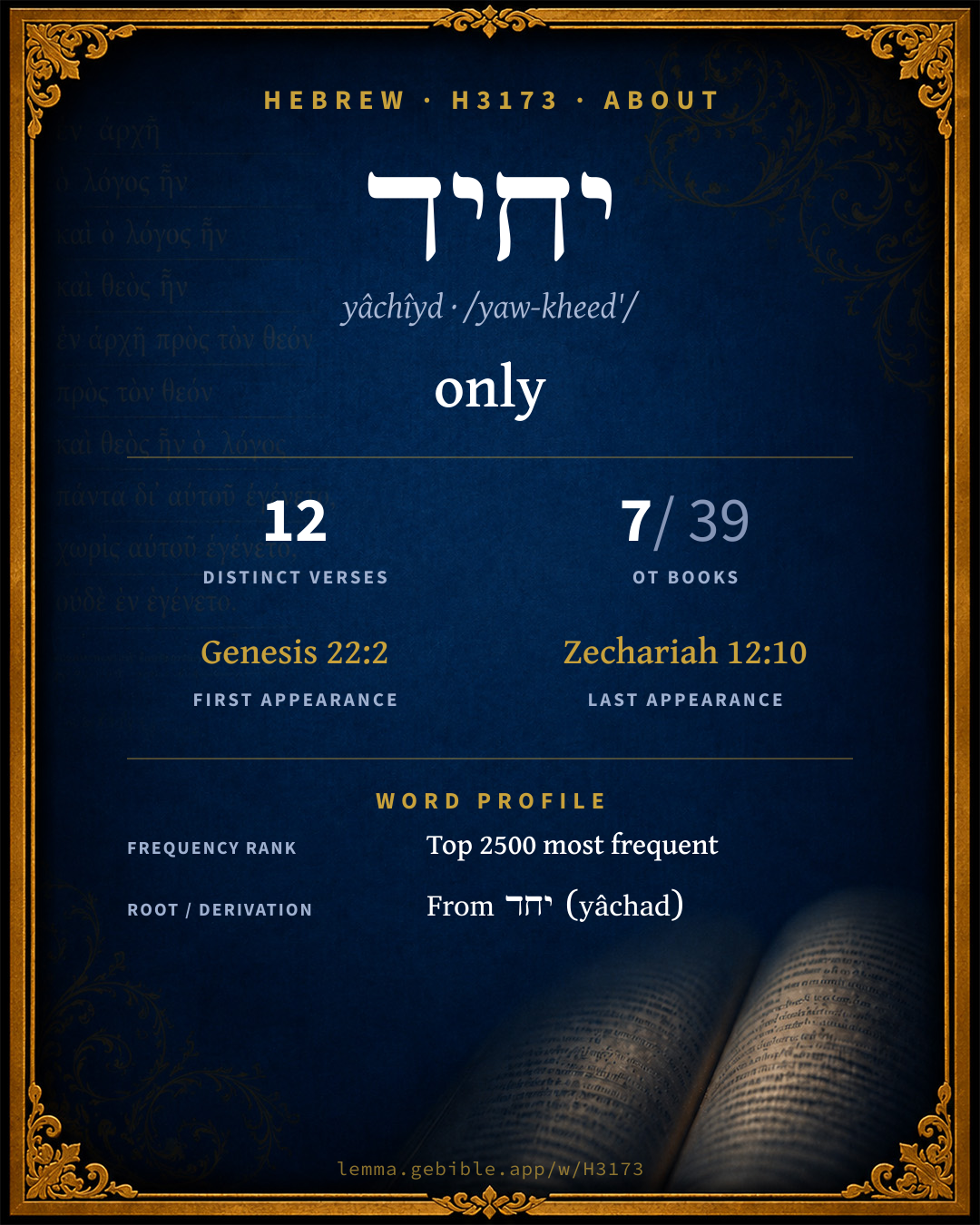
יָחִיד
only
also: only one, solitary, one fuller range ↓
Full lexicon entry — Brown-Driver-Briggs (BDB)
From Brown-Driver-Briggs (BDB)
Where this word appears
See every Absolute-state word in the Hebrew Bible →
Grammar key — what these labels mean
Part of speech
- Adjective
- A word that describes or qualifies a noun.
State
- Absolute
- The independent form of a noun, not bound to a following word.
- Construct
- A noun bound to a following noun in a possessive / “of” relationship (the construct chain).
Gender
- Masculine
- Grammatically masculine.
- Feminine
- Grammatically feminine.
Number
- Singular
- One.
- Plural
- More than one (in Hebrew, generally three or more).
Grammatical forms
- Adjective, Adjective, Masculine, Singular, Absolute 5 times (42%)
- Adjective, Adjective, Masculine, Singular, Construct 3 times (25%)
- Adjective, Adjective, Feminine, Singular, Construct 2 times (17%)
- Adjective, Adjective, Feminine, Singular, Absolute 1 time (8%)
- Adjective, Adjective, Masculine, Plural, Absolute 1 time (8%)
Parsed forms decoded from the imported morphology (morphhb / Westminster Leningrad Codex — WLC text public domain, morphhb tagging CC BY 4.0), counted across 12 parsed occurrences — not distinct verses.
Every verse where H3173 appears — 12 distinct verses across 7 books. Click any verse to open its interlinear word-by-word view. Verse text shown in the World English Bible for context — . Each verse’s Hebrew form is shown with its reference; the English is not keyword-highlighted, since the data carries no word-level English alignment. Use “Compare translations” on any verse to read it across multiple English versions. This concordance covers the Hebrew Bible; Septuagint (Greek Old Testament) occurrences are not indexed here.
Genesis 3 verses
- Genesis 22:2 יְחִֽידְ/ךָ֤ adj Adjective ms cs + sfx pers 2ms He said, "Now take your son, your only son, whom you love, even Isaac, and go into the land of Moriah. Offer him there for a burnt offering on one of the mountains which I will tell you of."
- Genesis 22:12 יְחִידְ/ךָ֖ adj Adjective ms cs + sfx pers 2ms He said, "Don't lay your hand on the boy, neither do anything to him. For now I know that you fear God, seeing you have not withheld your son, your only son, from me."
- Genesis 22:16 יְחִידֶֽ/ךָ adj Adjective ms cs + sfx pers 2ms and said, "I have sworn by myself, says Yahweh, because you have done this thing, and have not withheld your son, your only son,
Judges 1 verse
Psalms 4 verses
- Psalms 22:20 יְחִידָתִֽ/י adj Adjective fs cs + sfx pers 1cs Deliver my soul from the sword, My precious life from the power of the dog.
- Psalms 25:16 יָחִ֖יד adj Adjective ms Turn to me, and have mercy on me, For I am desolate and afflicted.
- Psalms 35:17 יְחִידָתִֽ/י adj Adjective fs cs + sfx pers 1cs Lord, how long will you look on? Rescue my soul from their destruction, My precious life from the lions.
- Psalms 68:6 יְחִידִ֨ים adj Adjective mp God sets the lonely in families. He brings out the prisoners with singing, But the rebellious dwell in a sun-scorched land.
Proverbs 1 verse
Jeremiah 1 verse
Amos 1 verse
Zechariah 1 verse
About this entry
At a glance — auto-summarized from this page’s data, not written by a person. Every figure links to its source below. This summary describes the numbers; it doesn’t interpret them.
יחיד — transliterated yâchîyd — is a Hebrew word carrying the sense “only.” Debuting at Genesis 22:2, it then recurs through the corpus. It appears 12 verses across 7 books of the Hebrew Bible, among its uncommon vocabulary. More than a third of its appearances fall in Psalms. It also covers “only one”, “solitary”, and “one”, alongside “only” — see its full sense range. See the sense tree, 12-verse concordance, and the renderings breakdown below.
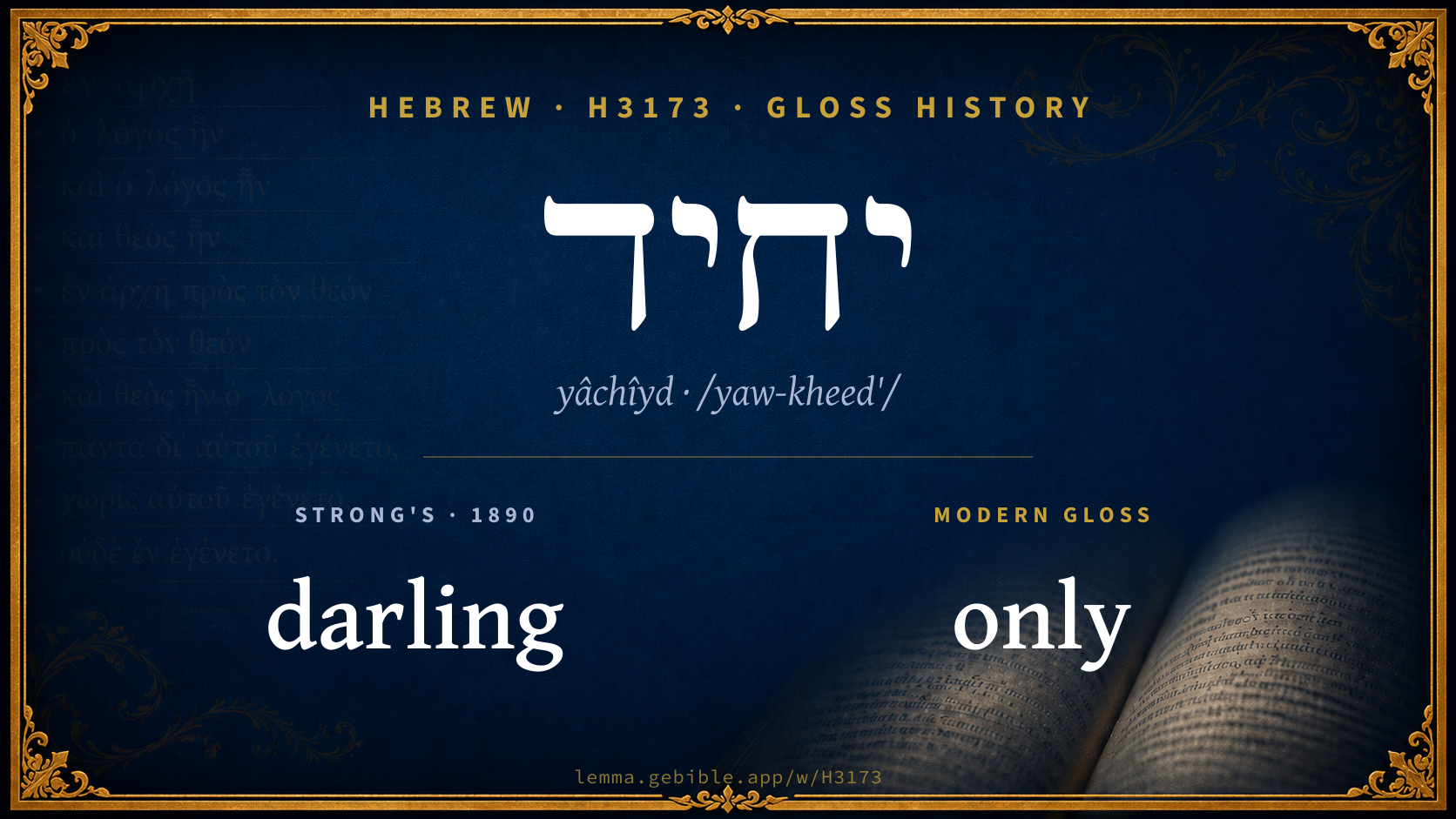
Gloss history
Strong's 1890 vs modern scholarship
About this word
Strong's H3173 catalogs a Hebrew word from the Hebrew Old Testament.
These counts are not copied from any lexicon or concordance. They are computed here, from the morphology-tagged Hebrew Old Testament. What Lemma adds →
- 12
- distinct verses
- The word appears in 12 distinct verses.
- 7 / 39
- OT books
- The word appears in 7 of 39 Old Testament books.
- #2,101
- by frequency
- Top 2500 most frequent Hebrew words (rank 2,101 of 8,640 Hebrew words by occurrence).
View all 12 occurrences in the concordance →
By section of the Old Testament
By traditional corpus
Conventional, traditional groupings — biblical authorship is debated, so this is a traditional corpus grouping, not an authorship claim. Each share is this word’s portion of its verses in that division of the Hebrew canon. Each figure is a share of the word’s 12 distinct verses.
- Writings (Ketuvim) 5 verses · 42%
- Prophets (Nevi'im) 4 verses · 33%
- Torah (Pentateuch) 3 verses · 25%
How translations render this word
Counts come from each version’s own published word-to-Strong’s tagging or interlinear alignment — an approximate guide to how each version renders this word, not a word-level alignment the data otherwise carries. Because each total is that version’s own tagged count, the per-version totals vary from one another and need not match the appearance or distinct-verse counts above. These counts may also differ from a printed concordance because Lemma counts each distinctly tagged rendering and does not collapse phrase taggings into a single head-word total. This is a fixed set of word-tagged versions (KJV, ASV, BSB, ULT) and does not change with the reading translation you choose elsewhere. Each version’s license is shown beside its name below (and on Sources).
- King James Version: Only 6×, Darling 2×
- American Standard Version: Only 4×, Darling 2×, Only son 2×
- Berean Standard Bible: Only 3×, Only child 2×, Only son 2×
- unfoldingWord Literal Text: Only 5×, Son 4×, Alone 2×
King James Version Public Domain
Renders H3173 across 12 tagged occurrences — most commonly:
Plus 4 renderings that appear only once — usually multi-word phrases or single function words the recovered tagging swept in, not distinct renderings.
American Standard Version Public Domain
Renders H3173 across 12 tagged occurrences — most commonly:
Plus 4 renderings that appear only once — usually multi-word phrases or single function words the recovered tagging swept in, not distinct renderings.
Berean Standard Bible Public Domain
Renders H3173 across 12 tagged occurrences — most commonly:
Plus 3 renderings that appear only once — usually multi-word phrases or single function words the recovered tagging swept in, not distinct renderings.
unfoldingWord Literal Text CC BY-SA 4.0
Renders H3173 across 17 tagged occurrences — most commonly:
Plus 2 renderings that appear only once — usually multi-word phrases or single function words the recovered tagging swept in, not distinct renderings.
Senses in the full BDB
What do BDB’s symbols mean?
BDB uses these scholarly abbreviations:
| Symbol | Meaning |
|---|---|
| 𝔊 | the Septuagint (the ancient Greek translation, LXX) |
| 𝔙 | the Vulgate (the Latin translation) |
| 𝔖 | the Syriac version (the Peshitta) |
| 𝔗 | the Targum (the Aramaic translation) |
| ψ | the Psalms |
| √ | root (the underlying root or stem) |
| ‖ | parallel passage (a synonymous or contrasted parallel) |
| † | the dagger: every passage where the word occurs is cited |
The 3 senses and sub-senses the full Brown-Driver-Briggs lexicon distinguishes for this word, in lexicon order (not ranked by frequency), with BDB’s own verbatim wording and sub-sense lettering. Shown in Hebrew script with BDB’s own scholarly abbreviations. The condensed entry is in the Lexicon Entry tab. See also the Forms in the corpus table below.
- 1. only one, especially of an only son, Gn 22:2, 12, 16 את בנך את יְחִידְךָ thy son, thine only one, אֵבֶל יָחִיד Am 8:10 Je 6:26 mourning for an only son, כמספד על היחיד Zc 12:10, Pr 4:3 רַךְ וְיָחִיד לפני אמי; so fem. יְחִידָה Ju 11:34. e.g. Genesis 22:2
- 2. fem. יְחִידָה as subst. ψ 22:21; 35:17 יְחִידָתִי my only one, poet. for my life, as the one unique and priceless possession which can never be replaced (in each ‖ נַפְשִׁי). e.g. Psalms 22:21
- 3. solitary, ψ 25:16 כי יחיד ועני אני; 68:7 מוֹשִׁיב יְחִידִים בַּיְתָה causing solitary, isolated ones (i.e. friendless wanderers or exiles; ‖ אֲסִירִים) to dwell at home (Lag Ch al. מֵשִׁיב bringing back home). e.g. Psalms 25:16
Senses from the full Brown-Driver-Briggs lexicon (Brown, Driver, Briggs; Oxford 1906 — public domain), digitized via Sefaria, supplemented by the OpenScriptures HebrewLexicon (CC BY 4.0). Full attribution on Sources.
Word origin
adj. and subst. only, only one, solitary (NH id.; Aramaic יָחִיד, יְחִידַי, ܝܺܚܺܝܕܳܐ, ܝܺܚܺܝܕܳܝܳܐ id.; Arabic وَحِيدٌ solitary)—
— Brown-Driver-Briggs (Oxford 1906, public domain), digitized via Sefaria, supplemented by the OpenScriptures HebrewLexicon (CC BY 4.0). See Sources.
Derived from יחד (yâchad) (H3161) — to join.
Jastrow Dictionary
A second Hebrew/Aramaic lexicon for comparison, covering Aramaic and post-biblical (Talmudic, Targumic, Midrashic) usage that the biblical-Hebrew BDB does not. Matched by lemma rather than by Strong’s number, so a lemma may carry more than one Jastrow headword (shown separately below), and the entries cover usage well beyond the Bible.
יָחִיד
- 1. only, single, individual. Gen. R. s. 99, end (ref. to כאחד, Gen. XLIX, 16) כִּיחִידוֹ של וכ׳ (not כיחודו) like the Only One of the world, as He needs no help &c.; ib. s. 21 (ref. to כאחד, ib. III, 22). Ib. s. 55 זה י׳ לאמו וכ׳ this one (Ishmael) is the only son of his mother, and the other (Isaac) is &c.—Taan. 9ᵃ בשביל י׳ for an individual’s sake, opp. רבים. Ber. 9ᵃ, a. fr. י׳ ורבים הלכה וכ׳ where a single opinion is opposed to the opinion of more than one, the law follows the latter. Bets. V, 5 בור של י׳ a well belonging to an individual. Erub. 46ᵃ י׳ במקום י׳ an individual opinion opposed to an individual opinion; a. v. fr.—Y. Keth. VII, 31ᵇ bot. בְּיָ׳ (= בְּיִחוּד) privately.—Pl. יְחִידִים, יְחִידִין. R. Hash. 17ᵇ כי׳ דמי are to be considered as individuals (in prayer); a. fr.—Fem. יְחִידָה. Num. R. s. 12 בת י׳ an only daughter; a. fr.—Deut. R. s. 2, end מה הקב"ה … כך הנפש י׳ בגוף as the Lord is matchless in his world, so is the soul in the body; Midr. Till. to Ps. CIII; Gen. R. s. 14, end שכל האברים … והיא י׳ בגוף all limbs are paired, but she (the soul) is unmatched in the body.—As a noun (b. h.) יְחִידָה soul. Ib. Deut. R. l. c.; a. e. e.g. Genesis 49:16
- 2. select, esp. one devoted to a particularly scrupulous life. Taan. 10ᵇ איזהו י׳ who is called a yaḥid? Ans. י׳ כל שראוי וכ׳ whoever is worthy to be appointed manager of a community. Ib. אל יאמר אדם … להיות י׳ one must not say, I am only a student, I am not fit to lead the life of a yaḥid (it would be an assumption, v. יוֹהֲרָא); Tosef. ib. I, 7 (v. Var. in ed. Zuck. a. Rabb. D. S. to Taan. l. c.); Y. Ber. II, end, 5ᵈ כל דבר של צער … י׳ עושה in all matters of self-abnegation, whoever desires to make himself a yaḥid, may do so.—Pl. as ab. Taan. I, 4; a. fr. V. יְחִידִי
יָחִיד ²
- Targ. Gen. XXII, 2. Targ. Prov. IV, 3; a. e.—Fem. יְחִידָאָה, יְחִידְתָּא. Targ. Jud. XI, 34 (ed. Lag. יְחִידָא, some ed. יְחִידָה).—Ned. 51ᵃ תספרתא י׳ a particular kind of hair-dressing.
A Dictionary of the Targumim, the Talmud Babli and Yerushalmi, and the Midrashic Literature (Marcus Jastrow; London, Luzac, 1903) — Public Domain. Digitized via Sefaria. Digitized via Sefaria. Full attribution on Sources.
Forms in the corpus
The 11 distinct written forms H3173 takes in the Hebrew Bible, most frequent first — each parse links to that state’s occurrences in the concordance. Hebrew forms include their vowel points and cantillation, so a single lemma takes many written forms.
| Form | Parsing | Example | Uses |
|---|---|---|---|
| יְחִידָתִֽ/י | Adjective, Adjective, Feminine, Singular, Construct | Psalms 22:20 | 2 |
| הַ/יָּחִ֔יד | Adjective, Adjective, Masculine, Singular, Absolute | Zechariah 12:10 | 1 |
| וְ֝/יָחִ֗יד | Adjective, Adjective, Masculine, Singular, Absolute | Proverbs 4:3 | 1 |
| יְחִֽידְ/ךָ֤ | Adjective, Adjective, Masculine, Singular, Construct | Genesis 22:2 | 1 |
| יְחִידְ/ךָ֖ | Adjective, Adjective, Masculine, Singular, Construct | Genesis 22:12 | 1 |
| יְחִידִ֨ים | Adjective, Adjective, Masculine, Plural, Absolute | Psalms 68:6 | 1 |
| יְחִידֶֽ/ךָ | Adjective, Adjective, Masculine, Singular, Construct | Genesis 22:16 | 1 |
| יְחִידָ֔ה | Adjective, Adjective, Feminine, Singular, Absolute | Judges 11:34 | 1 |
| יָחִ֔יד | Adjective, Adjective, Masculine, Singular, Absolute | Amos 8:10 | 1 |
| יָחִ֖יד | Adjective, Adjective, Masculine, Singular, Absolute | Psalms 25:16 | 1 |
| יָחִיד֙ | Adjective, Adjective, Masculine, Singular, Absolute | Jeremiah 6:26 | 1 |
Same root — word family
Other BDB entries built from the same root as H3173, grouped by Strong’s listed origin. These share a root / origin per the lexicon — not necessarily a shared meaning. Each links to that word’s own entry.
Derives from
Shares the same root
Proper names from this root
People and places named from this root — a name, not an additional meaning of the word.
Compare all same-root words → 1 of the same-root words is a proper name (a person or place). They share a root, not necessarily a meaning.
Septuagint verse parallels
This word appears in 9 verses that also exist in the Greek Old Testament (Septuagint), out of the 12 Hebrew verses it occurs in. You can read those verses in Greek by switching the Old Testament edition to the Septuagint.
Read these verses in the Septuagint
This is a verse-level parallel only — the same verses exist in both the Hebrew and Greek Old Testaments. No word-level Hebrew↔Greek correspondence is claimed: the data carries no such alignment, so no Greek word is shown as this Hebrew word’s translation. Coverage is not total — the Septuagint omits the deuterocanon and renumbers the Psalms, so some Hebrew verses have no direct Greek parallel.