
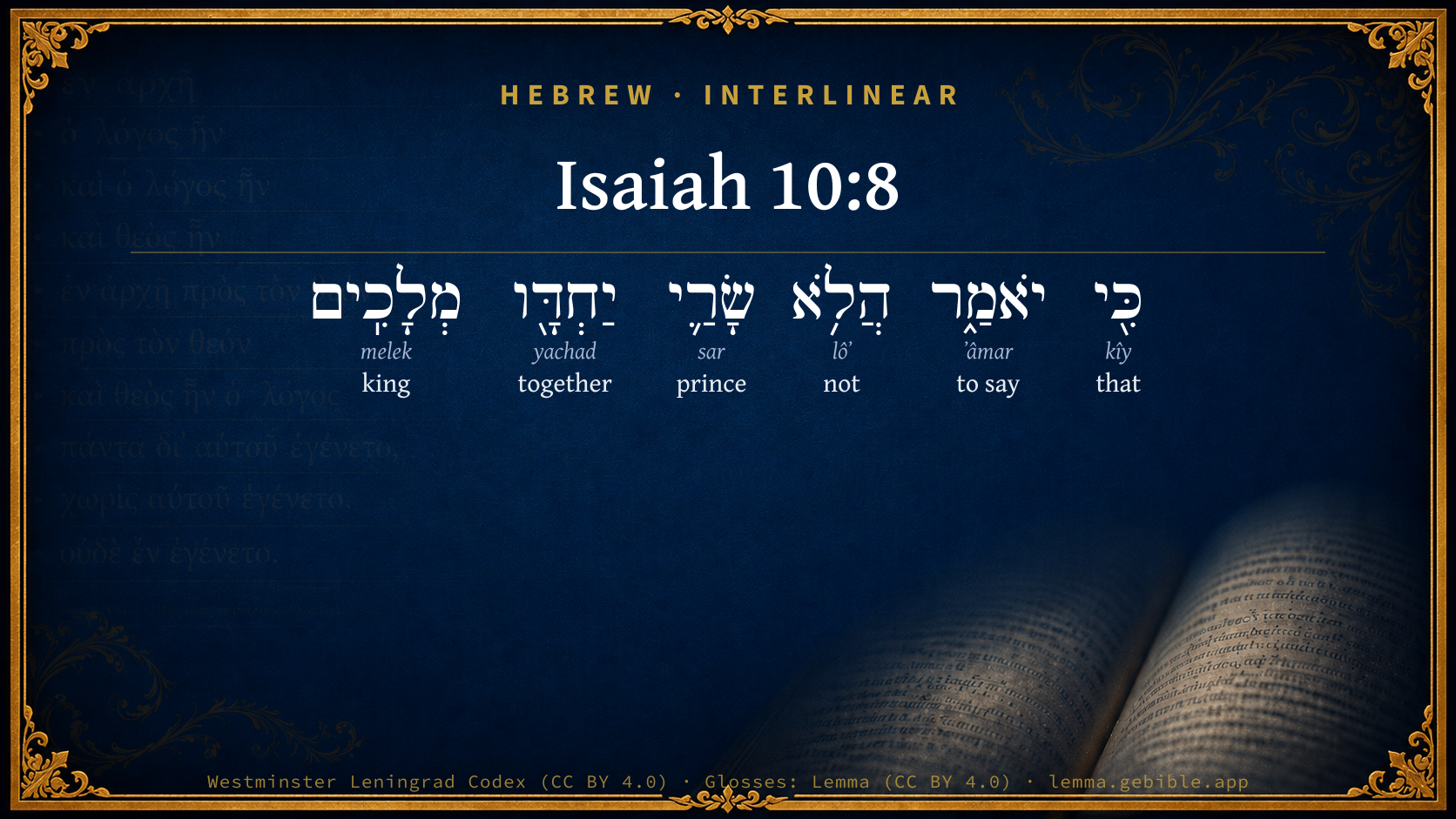
Isaiah 10:8

Hebrew (Westminster Leningrad Codex) Isaiah 10:8 appears in the Hebrew Old Testament. The text above is from the Westminster Leningrad Codex. Each word links to its Strong’s number, a concise gloss, and parsing drawn from the Open Scriptures Hebrew Bible morphology. Click any word for its full Brown-Driver-Briggs (BDB) entry.
Download image
Cite this verse

Isaiah 10:8 (World English Bible). Public Domain. Lemma interlinear Bible study tool, https://lemma.gebible.app/v/isaiah/10/8.

Show BibTeX & RIS
BibTeX
RIS
English Translation
For he says, Aren't my princes all of them kings?
World English Bible · Public Domain
Download a study sheet

One document with this verse’s original text, its word-by-word gloss line, the meaning frame, cross-references with their text, attributed commentary, and full source and license credits — printable, and it pastes into notes with its structure intact.

This verse Autodidact and up

Study sheet (.html) Plain text (.txt)

A passage Seminary Student

Up to 50 verses in one chapter. A passage sheet keeps up to 6 commentary sources and 12 cross-references per verse, in the order this page ranks them, and says so on the sheet whenever that leaves anything out. Ask for a single verse and you get the Autodidact verse sheet above.

Everything on this page stays free to read, with no account — the sheet is a download of what is already on screen, not access to it.

Want to remove ads? Support Godless Engineer
Compare translations 3

The same verse in 3 English versions, stacked beneath the original-language interlinear above. Click any original word for its lexicon entry.

Each is an independent rendering of the whole verse — the interlinear is not word-aligned to these translations.

Highlighted words mark where these versions differ — a whole-verse word diff, not a word-by-word alignment.

  • World English Bible Public Domain
    For he says, Aren't my princes all of them kings?
  • King James Version Public Domain
    For he saith, Are not my princes altogether kings?
  • unfoldingWord Literal Text CC BY-SA 4.0
    For he says, “ not my commanders all kings?

unfoldingWord Literal Text — © unfoldingWord, licensed CC BY-SA 4.0. Word-aligned USFM3 via Door43 (git.door43.org/unfoldingWord/en_ult).

Versions to compare (up to 4)

3 of 4 selected

Show all 18 translations

Every available English version of this verse, each an independent rendering of the whole verse.

  • World English Bible Public Domain
    For he says, Aren't my princes all of them kings?
  • Berean Standard Bible Public Domain
    “Are not all my commanders kings?” he says.
  • Majority Standard Bible Public Domain
    “Are not all my commanders kings?” he says.
  • King James Version Public Domain
    For he saith, Are not my princes altogether kings?
  • American Standard Version (1901) Public Domain
    For he saith, Are not my princes all of them kings?
  • Revised Version (1885) Public Domain
    For he saith, Are not my princes all of them kings?
  • Geneva Bible (1599) Public Domain
    For he sayeth, Are not my princes altogether Kings?
  • Douay-Rheims (1899) Public Domain
    For he shall say:
  • Young's Literal Translation Public Domain
    For he saith, `Are not my princes altogether kings?
  • Literal Standard Version CC BY-SA 4.0
    For he says, Are my princes not altogether kings?
  • Unlocked Literal Bible CC BY-SA 4.0
    For he says, “Are not all my princes kings?
  • unfoldingWord Literal Text CC BY-SA 4.0
    For he says, “ not my commanders all kings?
  • Darby Bible Public Domain
    For he saith, Are not my princes all kings?
  • World Messianic Bible Public Domain
    For he says, “Aren’t all of my princes kings?
  • Webster's Bible Public Domain
    For he saith, Are not my princes altogether kings?
  • Free Bible Version CC BY-SA 4.0
    He says: “All my commanders are kings!
  • Bible in Basic English Public Domain
    For he says, Are not all my captains kings?
  • JPS Tanakh (1917) Public Domain
    For he saith: 'Are not my princes all of them kings?

Literal Standard Version (2020), Covenant Press — licensed CC BY-SA 4.0. Text via the HelloAO Bible API (eBible.org). Unlocked Literal Bible (unfoldingWord) — licensed CC BY-SA 4.0. Text via the HelloAO Bible API (eBible.org). unfoldingWord Literal Text — © unfoldingWord, licensed CC BY-SA 4.0. Word-aligned USFM3 via Door43 (git.door43.org/unfoldingWord/en_ult). Free Bible Version, Dr. Jonathan Gallagher — licensed CC BY-SA 4.0. Text via the HelloAO Bible API (eBible.org).

Word by word

More ways to search: Search by grammar → Find every occurrence → Compare this word →

Practice this passage: Drill this verse → Learn its vocabulary →

About this verse

These counts appear in no published source. They are computed here, from the morphology-tagged text and Lemma’s own curated glosses. What Lemma adds →

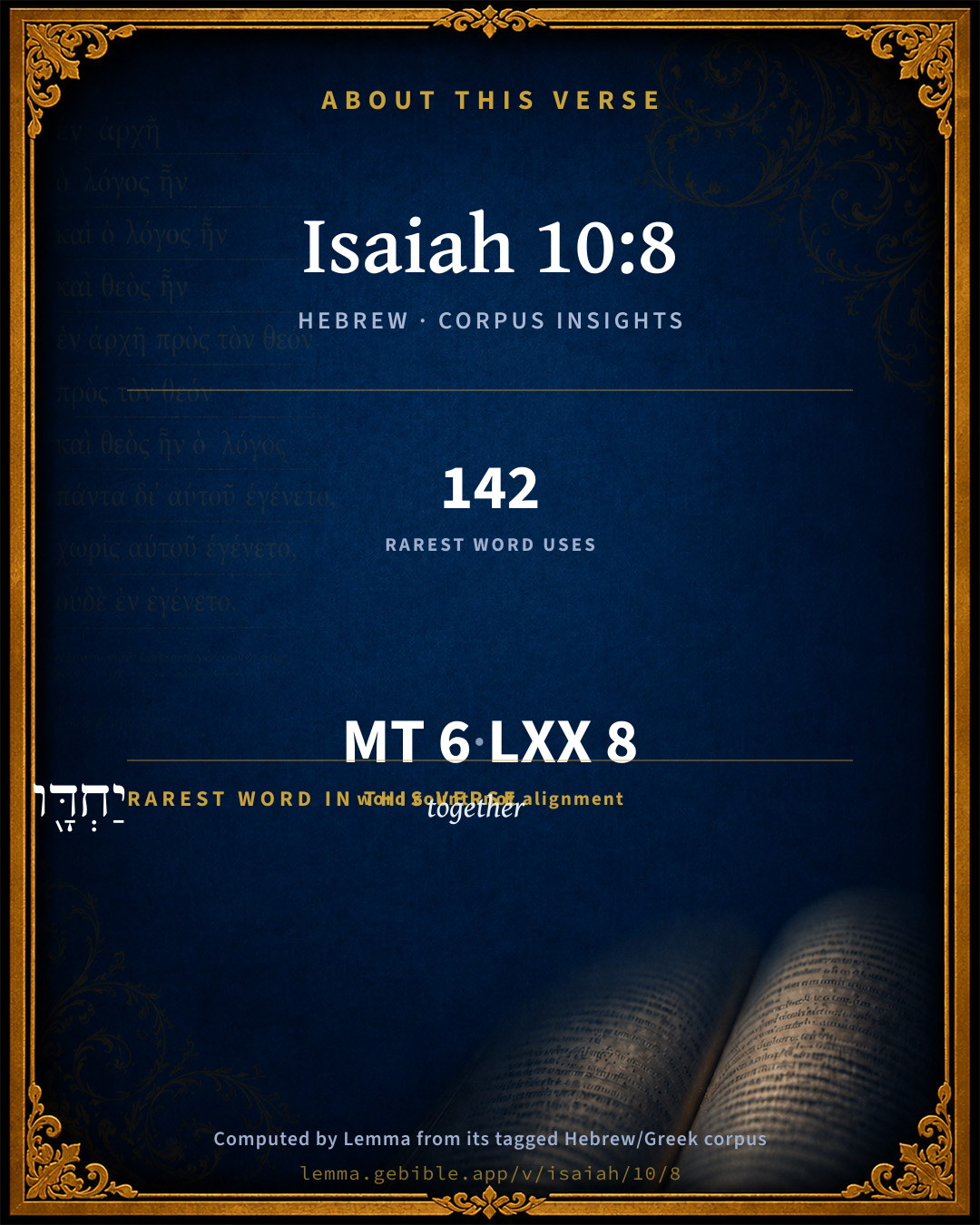
6
words
6
distinct lemmas
Prophets
section

Grammatical profile

  • 1 verb
  • 2 nouns
  • 1 conjunction
  • 1 adverb
  • 1 particle

Verb forms

  • יֹאמַ֑ר Qal · Imperfect

Hebrew & Septuagint length

In English translation the verse runs 10 words from the Hebrew and 11 from the Septuagint (LXX English) — closely comparable.

A rough comparison of the two English renderings, which tokenize alike — not a word-level alignment.

Word counts can differ between the Hebrew and the Greek without any difference in meaning — e.g. the Hebrew direct-object marker אֵת has no separate Greek word, and Greek often adds the article ὁ.

In the original languages it is 6 Hebrew tokens and 8 Greek tokens — but the two are counted differently (Hebrew bundles its prefixes and suffixes into one token; the Greek is in lemma form), so that isn’t a like-for-like length.

Cross-references

5

Topical passages linked to Isaiah 10:8 in the Treasury of Scripture Knowledge — connected by theme and wording, ordered by reader-vote popularity; previews shown in the World English Bible.

  • 2 Kings 18:24 How then can you turn away the face of one captain of the least of my master's servants, and put your trust on Egypt for chariots and for horsemen?
  • 2 Kings 19:10 Thus shall you speak to Hezekiah king of Judah, saying, Don't let your God in whom you trust deceive you, saying, Jerusalem shall not be given into the hand of the king of Assyria.
  • Isaiah 36:8 Now therefore, please give pledges to my master the king of Assyria, and I will give you two thousand horses, if you are able on your part to set riders on them.
  • Ezekiel 26:7 For thus says the Lord Yahweh: Behold, I will bring on Tyre Nebuchadrezzar king of Babylon, king of kings, from the north, with horses, and with chariots, and with horsemen, and a company, and much people.
  • Daniel 2:37 You, O king, are king of kings, to whom the God of heaven has given the kingdom, the power, and the strength, and the glory;

Cross-references courtesy of OpenBible.info (CC BY 4.0).

Hebrew and Greek witnesses Masoretic Hebrew ↔ Greek Septuagint

The same verse in the two great witnesses to the Old Testament, shown verse-for-verse.

These are two independent witnesses, not word-aligned to each other, and the Septuagint is shown in lemma (dictionary) form.

Hebrew Isaiah 10:8 Masoretic · Westminster Leningrad Codex

כִּ֖י יֹאמַ֑ר הֲלֹ֥א שָׂרַ֛י יַחְדָּ֖ו מְלָכִֽים

For he says, Aren't my princes all of them kings?

World English Bible · Public Domain

Greek LXX Isaiah 10:8 Septuagint · lemma form

καί ἐάν εἶπον αὐτός σύ μόνος εἰμί ἄρχων

And if they should say to him, You alone are ruler;

LXX2012 (modern English Septuagint) · Public Domain

On this verse, John Gill's Exposition discusses the Septuagint’s reading. Read the note in Commentary ↓

Hebrew: Westminster Leningrad Codex (CC BY 4.0). Greek: Septuagint (public domain); English from LXX2012 (modern English Septuagint) (Public Domain). How the Septuagint differs from the Hebrew →

Targum (Aramaic paraphrase)

1

The Targum is the ancient Jewish Aramaic paraphrase of the Hebrew Scriptures — an interpretive translation, not the Hebrew text itself. Onkelos (literal) and Pseudo-Jonathan (expansive) render the Torah, and Jonathan the Prophets. Coverage is partial: where no permissively-licensed English translation exists for a verse, only the Aramaic is shown. This is verse-level text, not a word-by-word alignment to the Hebrew.

  1. Targum Jonathan Prophets (Joshua–Malachi)
    אֲרֵי יֵימַר הֲלָא כָל שִׁלְטוֹנָי כַּחֲדָא כְּמַלְכִין חֲשִׁיבִין קֳדָמַי:

    For he saith, Are not all my rulers altogether as kings considered before me?

    Targum Jonathan — Aramaic: “Mikraot Gedolot” (public domain). English: “Sefaria Community Translation” (CC0 1.0 (public-domain dedication)); “London "Chaldee Paraphrase," 1871” (public domain). Text via Sefaria.

Commentary

Notes on Isaiah 10:8 from classic Christian and Jewish commentators (each source and its license shown beneath its notes). The classic Christian expositions comment on the surrounding passage and are grouped to its opening verse, so a note may address several verses; the Jewish commentaries on the Tanakh (Rashi and others) are per-verse, so they appear only where the commentator wrote on this verse.

Lemma curates 59 commentaries, every one of them public domain or Creative Commons licensed, each selected and text-cleaned for this edition rather than reprinted as found. About our sources →

Trapp's Complete Commentary

John Trapp

Isa 10:8 For he saith, [Are] not my princes altogether kings?

Ver. 8. For he saith.] Sennacherib saith. See Isa 36:9; Isa 36:15; Isa 36:18; Isa 36:20; Isa 37:10; Isa 37:13; Isa 37:24-25. A great part of this whole book of Isaiah concerneth Sennacherib.

Are not my princes altogether kings?] Behold a right Pyrgopolynices, {a} whenas he was set to work by God, exalting himself both against God and man. And saith not the Pope the same when he claims to be Dominus feudi? lord paramount in spirituals and temporals; and when, in creating his cardinals, he useth these words, Estote confratres nostri, et principes mundi, Be ye fellow brethren to us and princes of the world? The Assyrian styled himself king of kings, and accounted his commanders equals to Hezekiah. {Isa 36:9} So Cardinal Bellarmine held himself King James’s mate.

{a} Perhaps he had made some of his chief commanders kings. Our Henry VI crowned Henry Beauchamp, Earl of Warwick, King of the Isle of Wight.

John Trapp, A Commentary or Exposition upon All the Books of the Old and New Testament (1647–1656) — public domain. Text from a community e-Sword module.

Joseph Benson's Commentary

Isa 10:8-10. For he saith, Are not my princes, &c. — Are they not equal for power, and wealth, and glory, to the kings of other nations, though they be my subjects and servants? Is not Calno as Carchemish? — Have I not conquered one place as well as another, the stronger as well as the weaker? Have I not from time to time added new conquests to the old? None of those cities, against which he had turned his arms, had been able to resist him; but he had subjugated them all. Calno, Carchemish, Hamath, and Arpad, were cities of Syria and Israel, which this mighty monarch had subdued. Is not Samaria — Or, Shall not Samaria be, as Damascus? — Shall I not take that as I have done this city? For although Damascus, possibly, was not yet taken by the Assyrians, yet the prophet speaks of it as actually taken, because these words are prophetically delivered, and supposed to be uttered by the king of Assyria, at or about the time of the siege of Samaria, when Damascus was taken. As my hand hath found — Hath taken, as this word is often used, the kingdoms of the idols — Which worshipped their own idols, and vainly imagined that they could protect them from my power. He calls the gods of the nations, not excepting Jerusalem, idols, by way of contempt, because none of them could deliver their people out of his hands, and because he judged them to be but petty gods, far inferior to the sun, which was the god of the Assyrians. Whose graven images did excel them of Jerusalem — Namely, in reputation and power. Which blasphemy of his proceeded from his deep ignorance of the true God.

Joseph Benson's Commentary on the Old and New Testaments (1811–1818) — public domain. Text from a community e-Sword module.

Jamieson, Fausset & Brown

Robert Jamieson, A. R. Fausset & David Brown

Vauntings of the Assyrians. Illustrated by the self-laudatory inscriptions of Assyria deciphered by HINCKS.

princes . . . kings--Eastern satraps and governors of provinces often had the title and diadem of kings. Hence the title, "King of kings," implying the greatness of Him who was over them (Eze 26:7; Ezr 7:12).

Jamieson, Fausset & Brown — Commentary Critical and Explanatory on the Whole Bible (1871) — public domain (CC PDM 1.0). Text via the HelloAO Bible API.

Ellicott's Commentary for English Readers

(8) Are not my princes altogether kings?—So Tiglath-pileser names the twenty-three kings (Ahaz and Pekah among them) who came to do homage and pay tribute at Damascus (Records of the Past, v. 5-26).

A Bible Commentary for English Readers, edited by Charles John Ellicott (1878–1897) — public domain. Text from a community e-Sword module.

The Cambridge Bible for Schools and Colleges

gen. ed. J. J. S. Perowne

8. Are not my officers altogether kings?] Many of them really were subjugated kings (2Ki_25:28), and any one of them excelled in dignity the petty sovereigns of the independent states (see ch. Isa_36:9). The title “King of Kings” (Eze_26:7) was already assumed by Assyrian monarchs.

8–11. The first speech of the Assyrian.

The Cambridge Bible for Schools and Colleges (gen. ed. J. J. S. Perowne; Cambridge University Press, 1878–1918) — public domain. Text from a community e-Sword module.

John Gill's Exposition

For he saith, are not my princes altogether kings? Meaning either the kings which he had conquered, which were become his princes and subjects; or rather, such were the greatness and glory of his nobles, that they were equal in their riches and dominions to kings, and so were able to furnish him with men and money for such an expedition he had in his heart to undertake, even to conquer and subdue all the nations of the earth: and this he said either to his people, boasting of his grandeur; or in his heart, as Kimchi observes, to encourage himself; or rather more openly before others, in order to discourage and inject terror into the nations he meant to destroy, and particularly the inhabitants of Jerusalem.

For he saith, are not my princes altogether kings? Meaning either the kings which he had conquered, which were become his princes and subjects; or rather, such were the greatness and glory of his nobles, that they were equal in their riches and dominions to kings, and so were able to furnish him with men and money for such an expedition he had in his heart to undertake, even to conquer and subdue all the nations of the earth: and this he said either to his people, boasting of his grandeur; or in his heart, as Kimchi observes, to encourage himself; or rather more openly before others, in order to discourage and inject terror into the nations he meant to destroy, and particularly the inhabitants of Jerusalem.

Isaiah 10:9

isa 10:9

isa 10:9

isa 10:9Is not Calno as Carchemish?.... Jarchi's note is,

"as the children of Carchemish are princes and rulers, so are the children of Calno;''

as if this was giving an instance of the grandeur of his subjects; but much better is the Targum,

"as Carchemish is subdued before me, shall not Calno be so?''

as I or my ancestors have conquered the one, it is as easy for me to conquer the other; or as sure as the one is subject to me, so sure shall the other be; for Carchemish was a city belonging to the Assyrians, situated upon the river Euphrates, Ch2 35:20 called by Ammianus (k) Circusium; the Syriac version calls it Barchemosh; and Calno is the same with Calneh in the land of Shinar, a city built by Nimrod, Gen 10:10 in the Septuagint version it is called Chalane, and it is added,

"where the tower was built;''

from whence the country, called by Pliny (l) Chalonitis, had its name, the chief city of which was Ctesiphon, thought to be the same with Calneh.

Is not Hamath as Arphad? Hamath and Arphad were both cities conquered by the Assyrians; see Kg2 18:34 and are both mentioned along with Damascus, Jer 49:23.

Is not Samaria as Damascus? Damascus was the metropolis of Syria, and was taken by the Assyrians; and Samaria was the metropolis of Ephraim, or the ten tribes; see Isa 7:8 and was as easy to be taken as Damascus was. The Targum is,

"as Arphad is delivered into my hands, shall not Hamath be so? As I have done to Damascus, so will I do to Samaria.''

(k) L. 23. c. 5. p. 360. (l) Nat. Hist. l. 6. c. 26. and 27.

John Gill's Exposition of the Whole Bible (1746–1763) — public domain (CC PDM 1.0). Text via the HelloAO Bible API.

Albert Barnes' Notes on the Bible

For he saith - This verse, and the subsequent verses to Isa 10:11, contain the vaunting of the king of Assyria, and the descriptions of his own confidence of success.

Are not my princes altogether kings? - This is a confident boast of his “own” might and power. His own dominion was so great that even his princes were endowed with the ordinary power and “regalia” of kings. The word “princes,” may here refer either to those of his own family and court - to the satraps and officers of power in his army, or around his throne: or more probably, it may refer to the subordinate governors whom he had set over the provinces which he had conquered. ‘Are they not clothed with royal power and majesty? Are they not of equal splendor with the other monarchs at the earth?’ How great, then, must have been his “own” rank and glory to be placed “over” such illustrious sovereigns! It will be recollected, that a common title which oriental monarchs give themselves, is that of King of kings; see Eze 26:7; Dan 2:37; Ezr 7:12. The oriental princes are still distinguished for their sounding titles, and particularly for their claiming dominion over all other princes, and the supremacy over all other earthly powers.

Albert Barnes' Notes on the Bible (1834–1885) — public domain. Text from a community e-Sword/MySword module.

Matthew Poole's English Annotations

Equal for power, and wealth, and glory to the kings of other nations, though my subjects and servants.

Matthew Poole's English Annotations on the Holy Bible (1683–1685) — public domain. Text from a community e-Sword/MySword module.

Whedon's Commentary on the Bible

Daniel D. Whedon

8. For he saith — He fully exhibits what his spirit is — absolutely that of worldly ambition.

My princes — Satraps, vicegerents, generals. Are they not equal to the greatest of kings elsewhere? Assyria, Babylonia, and Persia were great empires, consisting of great numbers of provinces far and near, over which were placed governors called satraps.

Daniel D. Whedon (gen. ed.), Commentary on the Old and New Testaments (1874–1909) — public domain. Text from a community e-Sword module.

The Pulpit Commentary

Are not my princes altogether kings? One mark of the superiority of Assyria to other countries was to be seen in the fact that her king had not mere officers, but vassal kings under him. Hence the title "king of kings" assumed by so many Assyrian monarchs. While conquered territories were by degrees and to a certain extent absorbed into the empire and placed under prefects (see the "Eponym Canon"), an outer zone of more loosely organized dependencies was always maintained by the Assyrians; and these dependencies continued ordinarily to be administered by their native monarchs (see "Ancient Monarchies," vol. 2. pp. 524-526). These are the "princes" who were "altogether kings."

The Pulpit Commentary (1880–1919), ed. H.D.M. Spence-Jones & Joseph S. Exell — public domain. Text from a community e-Sword module.

John Wesley's Explanatory Notes

Kings - Equal for power and wealth, and glory, to the kings of other nations.

John Wesley, Explanatory Notes Upon the Whole Bible (1754–1765) — public domain. Text via the GEBible commentary corpus.

J. A. Alexander on Isaiah

Joseph Addison Alexander

This verse introduces the proof and illustration of his selfishness and pride. For he will say (or giving it a descriptive form, he says) are not my princes altogether kings, or at the same time kings, mere princes with respect to me, but kings as to all the world besides? By exalting his tributary princes or the nobles of his court, he magnifies himself the more. The oriental monarchs, both in ancient and modern times, have affected the title of Great King (Isa 36:4; Hos 8:10) and King of kings (Eze 26:7; Dan 2:37).

Joseph Addison Alexander, The Prophecies of Isaiah (1846–1847; New York: Scribner, 1870–1878) — public domain. Text from a community e-Sword module.

Rashi

Rabbi Shlomo Yitzchaki (Rashi)

For he says Therefore, his heart is haughty.

Rashi on the Tanakh — English translations: “The Judaica Press complete Tanach with Rashi, translated by A. J. Rosenberg” (CC BY 4.0); “Pentateuch with Rashi's commentary by M. Rosenbaum and A.M. Silbermann, 1929-1934” (public domain); “The Metsudah Tanach series, Lakewood, N.J” (CC BY 4.0); and “The Book of Joshua, Metsudah Publications, 1997” (CC BY 4.0). Text via Sefaria.

Ibn Ezra

Rabbi Abraham ibn Ezra

He will say in his heart. Behold my officers, etc. Those who formerly were officers, have now, through me, become rulers over nations.

Ibn Ezra on the Tanakh — English translations: “Sefaria Community Translation” (CC0 1.0 (public-domain dedication)); “Yalkut, Sifsei Chachomim Chumash, Metsudah Publications, 2009” (CC BY 4.0); and “Commentary of Ibn Ezra on Isaiah - trans. by M. Friedlander, 1873” (public domain). Text via Sefaria.

Lesson kit

Teaching starters — assembled from the data on this page, not authored interpretation. Every prompt links to the verse data it draws on. Edit before teaching.

Isaiah, in the Prophets, opens this verse with 6 words (6 distinct Hebrew lemmas). Its most distinctive word is yachad (“together”). A historical commentator’s framing appears above. Read the whole chapter for the surrounding context.

Discussion questions

  1. What does “together” (yachad) contribute to the verse as a whole?
  2. 2 Kings 18:24 shares this passage’s theme. How do the two illuminate each other?
  3. These translations render this verse differently. What is at stake in choosing one wording over another?
  4. The verb «יֹאמַ֑ר» is Qal Imperfect. How does its form color the action?
  5. Reading how Trapp's Complete Commentary and Joseph Benson's Commentary read this verse, where do the two commentators agree and where do they part?

Things to notice

Reading settings

Reading text

Shown beneath each verse's original-language words.

Old Testament
Old Testament edition

Read the OT as the Masoretic Hebrew (MT) or the Greek Septuagint (LXX).

English shown for the Greek Septuagint (in the Hebrew ↔ Greek comparison).

Comparing translations? Open the Compare panel on any verse page to stack up to four side by side.