Job 16:10

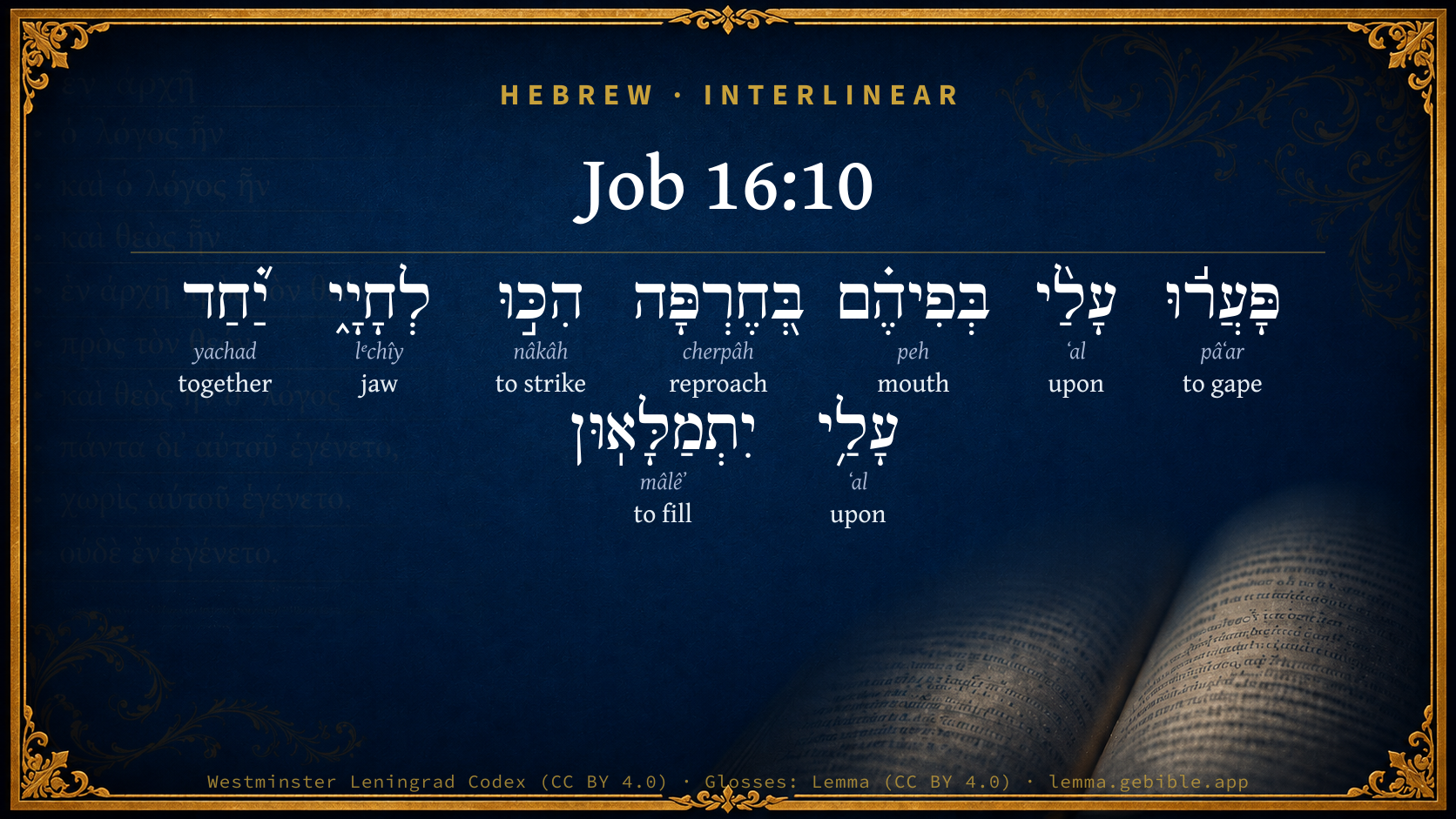
Hebrew (Westminster Leningrad Codex) Job 16:10 appears in the Hebrew Old Testament. The text above is from the Westminster Leningrad Codex. Each word links to its Strong’s number, a concise gloss, and parsing drawn from the Open Scriptures Hebrew Bible morphology. Click any word for its full Brown-Driver-Briggs (BDB) entry.
Download image
Cite this verse

Job 16:10 (World English Bible). Public Domain. Lemma interlinear Bible study tool, https://lemma.gebible.app/v/job/16/10.

Show BibTeX & RIS
BibTeX
RIS
English Translation
They have gaped on me with their mouth; They have struck me on the cheek reproachfully. They gather themselves together against me.
World English Bible · Public Domain
Highlights
  • 1 first appearance in the Hebrew Bible
Full analysis ↓
Download a study sheet

One document with this verse’s original text, its word-by-word gloss line, the meaning frame, cross-references with their text, attributed commentary, and full source and license credits — printable, and it pastes into notes with its structure intact.

This verse Autodidact and up

Study sheet (.html) Plain text (.txt)

A passage Seminary Student

Up to 50 verses in one chapter. A passage sheet keeps up to 6 commentary sources and 12 cross-references per verse, in the order this page ranks them, and says so on the sheet whenever that leaves anything out. Ask for a single verse and you get the Autodidact verse sheet above.

Everything on this page stays free to read, with no account — the sheet is a download of what is already on screen, not access to it.

Want to remove ads? Support Godless Engineer
Compare translations 3

The same verse in 3 English versions, stacked beneath the original-language interlinear above. Click any original word for its lexicon entry.

Each is an independent rendering of the whole verse — the interlinear is not word-aligned to these translations.

Highlighted words mark where these versions differ — a whole-verse word diff, not a word-by-word alignment.

  • World English Bible Public Domain
    They have gaped on me with their mouth; They have struck me on the cheek reproachfully. They gather themselves together against me.
  • King James Version Public Domain
    They have gaped upon me with their mouth; they have smitten me upon the cheek reproachfully; they have gathered themselves together against me.
  • unfoldingWord Literal Text CC BY-SA 4.0
    They have gaped at me with their mouth; in reproach they have struck my cheek; they have gathered themselves together against me.

unfoldingWord Literal Text — © unfoldingWord, licensed CC BY-SA 4.0. Word-aligned USFM3 via Door43 (git.door43.org/unfoldingWord/en_ult).

Versions to compare (up to 4)

3 of 4 selected

Show all 18 translations

Every available English version of this verse, each an independent rendering of the whole verse.

  • World English Bible Public Domain
    They have gaped on me with their mouth; They have struck me on the cheek reproachfully. They gather themselves together against me.
  • Berean Standard Bible Public Domain
    They open their mouths against me and strike my cheeks with contempt; they join together against me.
  • Majority Standard Bible Public Domain
    They open their mouths against me and strike my cheeks with contempt; they join together against me.
  • King James Version Public Domain
    They have gaped upon me with their mouth; they have smitten me upon the cheek reproachfully; they have gathered themselves together against me.
  • American Standard Version (1901) Public Domain
    They have gaped upon me with their mouth; They have smitten me upon the cheek reproachfully: They gather themselves together against me.
  • Revised Version (1885) Public Domain
    They have gaped upon me with their mouth; they have smitten me upon the cheek reproachfully: they gather themselves together against me.
  • Geneva Bible (1599) Public Domain
    They haue opened their mouthes vpon me, and smitten me on the cheeke in reproch; they gather themselues together against me.
  • Douay-Rheims (1899) Public Domain
    He hath gathered together his fury against me, and threatening me he hath gnashed with his teeth upon me: my enemy hath beheld me with terrible eyes.
  • Young's Literal Translation Public Domain
    They have gaped on me with their mouth, In reproach they have smitten my cheeks, Together against me they set themselves.
  • Literal Standard Version CC BY-SA 4.0
    They have gaped on me with their mouth, || In reproach they have struck my cheeks, || Together they set themselves against me.
  • Unlocked Literal Bible CC BY-SA 4.0
    People have gaped with open mouth at me; they have hit me reproachfully on the cheek; they have gathered together against me.
  • unfoldingWord Literal Text CC BY-SA 4.0
    They have gaped at me with their mouth; in reproach they have struck my cheek; they have gathered themselves together against me.
  • Darby Bible Public Domain
    They gape upon me with their mouth; they smite my cheeks reproachfully; they range themselves together against me.
  • World Messianic Bible Public Domain
    They have gaped on me with their mouth. They have struck me on the cheek reproachfully. They gather themselves together against me.
  • Webster's Bible Public Domain
    They have gaped upon me with their mouth; they have smitten me upon the cheek reproachfully; they have gathered themselves against me.
  • Free Bible Version CC BY-SA 4.0
    People stare at me with their mouths wide open, they slap me on my cheeks to mock me, they crowd around me to attack me.
  • Bible in Basic English Public Domain
    Their mouths are open wide against me; the blows of his bitter words are falling on my face; all of them come together in a mass against me.
  • JPS Tanakh (1917) Public Domain
    They have gaped upon me with their mouth; they have smitten me upon the cheek scornfully; they gather themselves together against me.

Literal Standard Version (2020), Covenant Press — licensed CC BY-SA 4.0. Text via the HelloAO Bible API (eBible.org). Unlocked Literal Bible (unfoldingWord) — licensed CC BY-SA 4.0. Text via the HelloAO Bible API (eBible.org). unfoldingWord Literal Text — © unfoldingWord, licensed CC BY-SA 4.0. Word-aligned USFM3 via Door43 (git.door43.org/unfoldingWord/en_ult). Free Bible Version, Dr. Jonathan Gallagher — licensed CC BY-SA 4.0. Text via the HelloAO Bible API (eBible.org).

Word by word

More ways to search: Search by grammar → Find every occurrence → Compare this word →

Practice this passage: Drill this verse → Learn its vocabulary →

About this verse

These counts appear in no published source. They are computed here, from the morphology-tagged text and Lemma’s own curated glosses. What Lemma adds →

9
words
8
distinct lemmas
Wisdom
section

Notable vocabulary

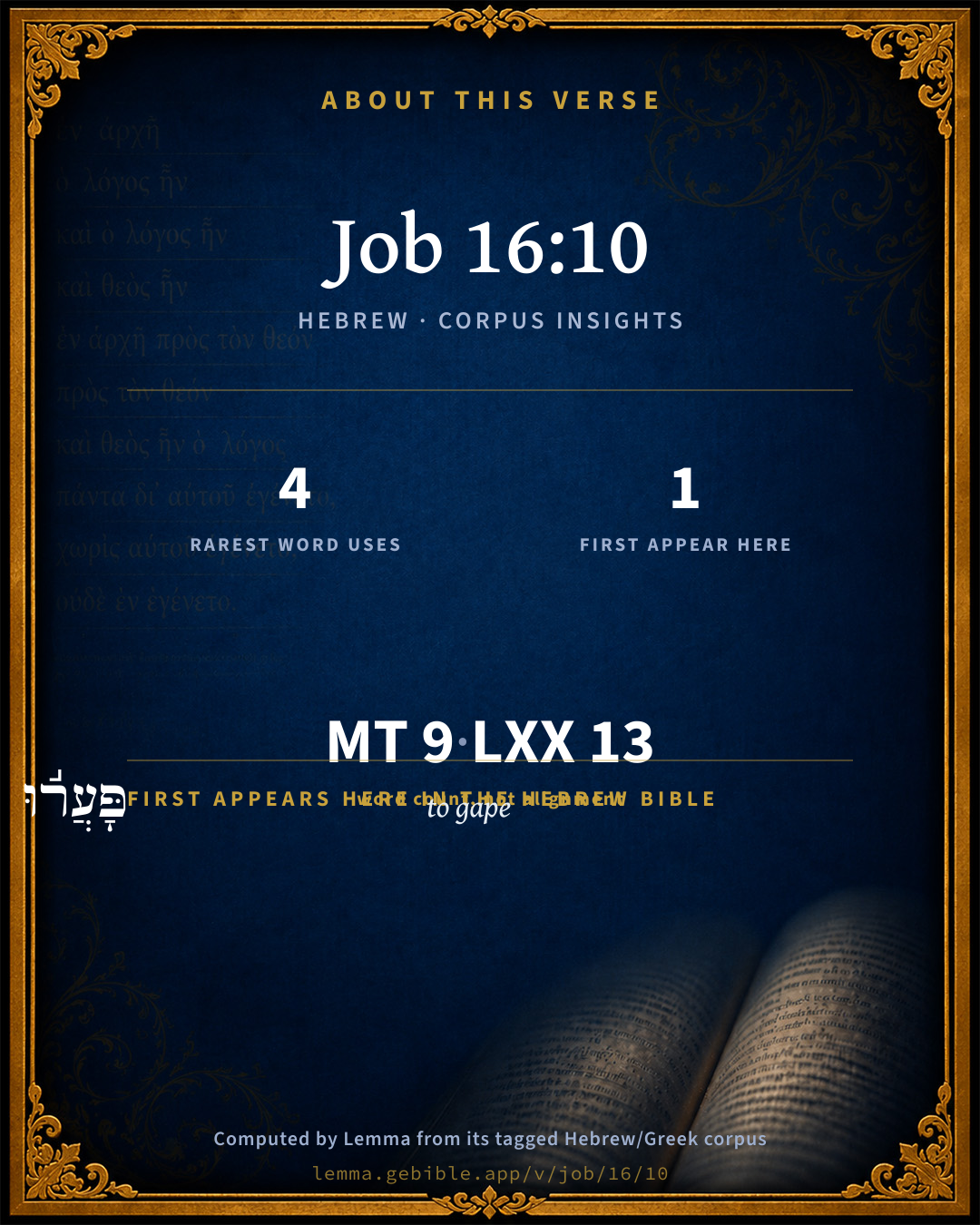
The rarest word here is פָּעֲר֬וּ to gape H6473 — appearing just 4 times in the whole Hebrew Bible.

First appearance in Scripture

This word makes its first canonical appearance in the Hebrew Bible here:

  • פָּעֲר֬וּ to gape H6473

Shared distinctive vocabulary

פָּעֲר֬וּ to gape H6473 occurs in 4 verses of the Hebrew Bible. Also found in:

Grammatical profile

  • 3 verbs
  • 3 nouns
  • 2 prepositions
  • 1 adverb

Verb forms

  • פָּעֲר֬וּ Qal · Perfect
  • הִכּ֣וּ Hiphil · Perfect
  • יִתְמַלָּאֽוּן Hithpael · Imperfect

Repetition

A word recurs within this verse — often emphatic in Hebrew:

  • עָלַ֨י upon H5921 ×2

Hebrew & Septuagint length

In English translation the verse runs 22 words from the Hebrew and 24 from the Septuagint (LXX English) — closely comparable.

A rough comparison of the two English renderings, which tokenize alike — not a word-level alignment.

Word counts can differ between the Hebrew and the Greek without any difference in meaning — e.g. the Hebrew direct-object marker אֵת has no separate Greek word, and Greek often adds the article ὁ.

In the original languages it is 9 Hebrew tokens and 13 Greek tokens — but the two are counted differently (Hebrew bundles its prefixes and suffixes into one token; the Greek is in lemma form), so that isn’t a like-for-like length.

Cross-references

16

Topical passages linked to Job 16:10 in the Treasury of Scripture Knowledge — connected by theme and wording, ordered by reader-vote popularity; previews shown in the World English Bible.

  • Psalms 35:15 But in my adversity, they rejoiced, and gathered themselves together. The attackers gathered themselves together against me, and I didn't know it. They tore at me, and didn't cease.
  • Psalms 22:13 They open their mouths wide against me, Lions tearing prey and roaring.
  • Isaiah 50:6 I gave my back to the strikers, and my cheeks to those who plucked off the hair; I didn't hide my face from shame and spitting.
  • Lamentations 3:30 Let him give his cheek to him who strikes him; let him be filled full with reproach.
  • Psalms 22:16–17 For dogs have surrounded me. A company of evil-doers have enclosed me. They pierced my hands and my feet.
  • Micah 5:1 Now you shall gather yourself in troops, Daughter of troops. He has laid siege against us; They will strike the judge of Israel with a rod on the cheek.
  • Acts 23:2 The high priest, Ananias, commanded those who stood by him to strike him on the mouth.
  • 1 Kings 22:24 Then Zedekiah the son of Chenaanah came near, and struck Micaiah on the cheek, and said, Which way went the Spirit of Yahweh from me to speak to you?
  • Psalms 94:21 They gather themselves together against the soul of the righteous, And condemn the innocent blood.
  • 2 Corinthians 11:20 For you bear with a man, if he brings you into bondage, if he devours you, if he takes you captive, if he exalts himself, if he strikes you on the face.
  • 2 Chronicles 18:23 Then Zedekiah the son of Chenaanah came near, and struck Micaiah on the cheek, and said, Which way went the Spirit of Yahweh from me to speak to you?
  • Psalms 35:21 Yes, they opened their mouth wide against me. They said, "Aha! Aha! Our eye has seen it!"
  • Matthew 26:67 Then they spit in his face and beat him with their fists, and some slapped him,
  • Luke 23:35–36 The people stood watching. The rulers with them also scoffed at him, saying, "He saved others. Let him save himself, if this is the Christ of God, his chosen one!"
  • John 18:22 When he had said this, one of the officers standing by slapped Jesus with his hand, saying, "Do you answer the high priest like that?"
  • Acts 4:27 For truly, in this city against your holy servant, Jesus, whom you anointed, both Herod and Pontius Pilate, with the Gentiles and the people of Israel, were gathered together

Cross-references courtesy of OpenBible.info (CC BY 4.0).

Hebrew and Greek witnesses Masoretic Hebrew ↔ Greek Septuagint

The same verse in the two great witnesses to the Old Testament, shown verse-for-verse.

These are two independent witnesses, not word-aligned to each other, and the Septuagint is shown in lemma (dictionary) form.

Hebrew Job 16:10 Masoretic · Westminster Leningrad Codex

פָּעֲר֬וּ עָלַ֨י בְּפִיהֶ֗ם בְּ֭חֶרְפָּה הִכּ֣וּ לְחָיָ֑י יַ֝֗חַד עָלַ֥י יִתְמַלָּאֽוּן

They have gaped on me with their mouth; They have struck me on the cheek reproachfully. They gather themselves together against me.

World English Bible · Public Domain

Greek LXX Job 16:10 Septuagint · lemma form

ἀκίς ὀφθαλμός ἐνἅλλομαι ὀξύς παίω ἐγώ εἰς σιαγών ὁμοθυμαδόν δέ κατατρέχω ἐπί ἐγώ

In his anger he has cast me down; he has gnashed his teeth upon me: the weapons of his robbers have fallen upon me.

LXX2012 (modern English Septuagint) · Public Domain

On this verse, Keil & Delitzsch discusses the Septuagint’s reading. Read the note in Commentary ↓

Hebrew: Westminster Leningrad Codex (CC BY 4.0). Greek: Septuagint (public domain); English from LXX2012 (modern English Septuagint) (Public Domain). How the Septuagint differs from the Hebrew →

Commentary

Notes on Job 16:10 from classic Christian and Jewish commentators (each source and its license shown beneath its notes). The classic Christian expositions comment on the surrounding passage and are grouped to its opening verse, so a note may address several verses; the Jewish commentaries on the Tanakh (Rashi and others) are per-verse, so they appear only where the commentator wrote on this verse.

Lemma curates 59 commentaries, every one of them public domain or Creative Commons licensed, each selected and text-cleaned for this edition rather than reprinted as found. About our sources →

Jamieson, Fausset & Brown

Robert Jamieson, A. R. Fausset & David Brown

gaped--not in order to devour, but to mock him. To fill his cup of misery, the mockery of his friends (Job 16:10) is added to the hostile treatment from God (Job 16:9).

smitten . . . cheek--figurative for contemptuous abuse (Lam 3:30; Mat 5:39).

gathered themselves--"conspired unanimously" [SCHUTTENS].

Jamieson, Fausset & Brown — Commentary Critical and Explanatory on the Whole Bible (1871) — public domain (CC PDM 1.0). Text via the HelloAO Bible API.

Trapp's Complete Commentary

John Trapp

Job 16:10 They have gaped upon me with their mouth; they have smitten me upon the cheek reproachfully; they have gathered themselves together against me.

Ver. 10. They have gaped upon me with their mouth] They? who? Non solum Deus, nec solum amici mei, sed tota rerum machina mihi adversatur, Not God only, nor these friends of mine, but all the creatures are up in arms against me, and threateneth to devour me at one morsel.

They have smitten me upon the cheek reproachfully] i.e. They have done me all the disgrace that may be. See Lam 3:30 2Co 11:20-21 Mic 5:1 Act 23:1-2; Joh 18:22. Our Saviour was so served according to the letter; they gaped upon him, mowed at him, buffeted him on the face, gathered themselves together against him, as here. Hence some of the ancients call Job a figure and type of Christ, who was thus dealt with both literally and also figuratively.

They have gathered themselves together against me] Or, They have filled themselves upon me, as Exo 15:7. They have taken their fill of pleasure at my miseries, as Tigurius rendereth it; or, They come upon me by full troops, so Broughton. Men are apt to agree for mischief Psa 35:15; Psa 83:5-7.

John Trapp, A Commentary or Exposition upon All the Books of the Old and New Testament (1647–1656) — public domain. Text from a community e-Sword module.

Joseph Benson's Commentary

Job 16:10. They — My friends, the instruments of God’s anger; have gaped upon me with their mouth — Have opened their mouths wide against me; either, 1st, To devour and destroy me, as a lion which falls upon its pray with open mouth: see Psa 22:13-14, where these very expressions are used in the prediction of Christ’s sufferings, of whom, in all this, Job was an eminent type. Or, 2d, To scoff and deride me, as it follows, and as this phrase is most commonly used: see Psa 22:8; Psa 35:21. They have smitten me upon the cheek reproachfully — Hebrew, בחרפה, becherpeh, by reproach; or in a way of scorn and contempt, of which smiting on the cheek was a sign: see Lam 3:30; Mic 5:1. The meaning is, they have despised and derided me, the sign being put for the thing signified. They have gathered themselves together against me — They are come from several places, and have met together here, not for me, or to comfort me, as they pretended; but really against me, and to grieve and torment me.

Joseph Benson's Commentary on the Old and New Testaments (1811–1818) — public domain. Text from a community e-Sword module.

Geneva Bible (1599)

Geneva Bible translators

That is, hath handled me most contemptuously: for so smiting on the cheek signified, 1 Kings 22:24; Mark 14:65.

Geneva Bible (1599) marginal notes — public domain. Text via Bolls.life.

The Cambridge Bible for Schools and Colleges

gen. ed. J. J. S. Perowne

10. Picture of the hostility of men—the pack of petty foes that howl at the heels of his greater enemy.

have gaped] Rather, they gape. Similarly, they smite. The figure of wild beasts is not strictly maintained, but passes in the second clause into the reality. The gestures described are those of contempt and destructive hatred, see Psa_22:13, Isa_57:4, Mic_5:1, Lam_3:30; cf. Joh_18:22; Joh_19:3, Act_23:2.

they have gathered themselves] they gather. The phrase means probably that they fling themselves in one body upon him, they combine in their attack against him.

The Cambridge Bible for Schools and Colleges (gen. ed. J. J. S. Perowne; Cambridge University Press, 1878–1918) — public domain. Text from a community e-Sword module.

John Gill's Exposition

God hath delivered me up to the ungodly,.... The evil or wicked one, for it is in the singular number; and designs either Satan, into whose hands God had not only delivered his substance, but his person, excepting his life; though it may be, and which is an objection to this sense, Job as yet knew it not; or else Eliphaz, or, the singular number being put for the plural, as the next clause explains it, all his friends, whom he in turn calls evil and wicked men, because of their treatment of him; or else the Sabeans and Chaldeans are intended, who were suffered to plunder him of his substance; the words are very applicable to Christ, who was delivered to the Gentiles, and into the hands of sinners and wicked men, and that by the determinate counsel and foreknowledge of God, who with wicked hands took him, and crucified him, Mat 20:19; or God "shut him up", or "delivered him bound" (d), as the word signifies; which was literally true of Christ, who was bound by the Jews, and delivered first to the high priest, and then to the Roman governor, in such circumstances, Joh 18:12;

and turned me over into the hands of the wicked; signifying the same as before, unless it should be rendered, "and caused me to decline", or "come down by the hands of the wicked" (e) that is, from his former state of prosperity and happiness, into the low circumstances in which he was, and which he was brought into by the means of wicked men, God suffering it so to be.

(d) "vinctum me tradidit", Grotius, Michaelis, Schultens. (e) "divertere fecit a vita", Pagninus; "declinare me facit", Beza, Drusius, Mercerus.

John Gill's Exposition of the Whole Bible (1746–1763) — public domain (CC PDM 1.0). Text via the HelloAO Bible API.

Albert Barnes' Notes on the Bible

They have gaped upon me - Changing the form from the singular to the plural, and including “all” his pretended friends. Such a change in the number is not uncommon. His mind seems to have passed from the particular instance which he was contemplating, to “all” his friends, and he suddenly felt that “all” had treated him alike. The meaning is, that, like wild beasts, they open their mouth to devour me.

They have gathered themselves together - They have entered into a conspiracy, and have “agreed” to oppose me. They are united in this thing, and all feel and act alike.

Albert Barnes' Notes on the Bible (1834–1885) — public domain. Text from a community e-Sword/MySword module.

Matthew Poole's English Annotations

They; the instruments of God’s anger, my friends, as they are falsely called.

Gaped upon me with their mouth; opened their mouths wide against me; either,

1. To devour and destroy me; as a lion which falls upon his prey with open mouth, as this phrase is used, Psa 22:13,14. And this they did aggravating and increasing his sorrows, whereby he was well-nigh overwhelmed. Or,

2. To scoff and deride me, as it follows, and as this phrase is most commonly used, as Psa 22:8; 35:21.

Reproachfully; or, by reproach; or in way of scorn and contempt; whereof such smiting was a sign, as 1Ki 22:24; Lam 3:30; Mic 5:1. The sign is here put for the thing signified; they despised and derided me.

They have gathered themselves together against me, i.e. they are come from several places, and met together here, not for me, or to comfort me, as they pretended, but really against me, or to torment and grieve me. Heb. they have filled themselves, &c. Either,

1. They have filled up their numbers, they are all come against me. Or,

2. They have filled their minds with evil opinions of me, and their hearts with courage and resolution to assault me, and their mouths with words and arguments against me. Compare Ecc 8:11; Act 5:3.

Matthew Poole's English Annotations on the Holy Bible (1683–1685) — public domain. Text from a community e-Sword/MySword module.

Whedon's Commentary on the Bible

Daniel D. Whedon

10. They have gaped upon me — As in many other instances, the subject of the sentence is left unexpressed. The thought is thus rendered more solemn and emphatic. See note on Psa_22:13; also Luk_6:38 — “Shall they give.” The text speaks of a company of fiends, whether human or diabolic, who crowd around the sufferer jeering and maltreating him.

The description bears a striking resemblance to that given of Christ, who in many respects was the antitype of Job. (Psalms 22.)

Smitten me upon the cheek — “To smite the cheek is the deepest insult that can be offered to an Asiatic.” — Lord Valentia.

Daniel D. Whedon (gen. ed.), Commentary on the Old and New Testaments (1874–1909) — public domain. Text from a community e-Sword module.

The Pulpit Commentary

They have gaped upon me with their mouth. The "man of sorrows" of the Old Testament is, in many respects, a type of the "Man of sorrows" of the New; and, in the Messianic psalms, David constantly applies to Christ expressions which Job had used in reference to himself. (Psa_22:13) They have smitten me upon the cheek reproachfully. (Mic_5:1 Mat_27:30 Luk_22:64 Joh_18:22) They have gathered themselves together against me. (see Psa_35:15, and compare, in illustration of the literal and historical sense, Job_30:1, Job_30:10-14)

The Pulpit Commentary (1880–1919), ed. H.D.M. Spence-Jones & Joseph S. Exell — public domain. Text from a community e-Sword module.

John Wesley's Explanatory Notes

They - My friends. Gaped - Opened their mouths wide against me. In all this Job was a type of Christ. These very expressions are used in the predictions of his sufferings, Psalm xxii, 13. They gaped upon me with their mouths, and Micah v, 1. They shall smite the judge of Israel upon the check.

John Wesley, Explanatory Notes Upon the Whole Bible (1754–1765) — public domain. Text via the GEBible commentary corpus.

Keil & Delitzsch

C. F. Keil & F. Delitzsch

10 They have gaped against me with their mouth,

In contempt they smite my cheeks;

They conspire together against me.

11 God left me to the mercy of the ungodly,

And cast me into the hands of the evil-doer.

He does not mean the friends by those who mock and vex him with their contemptuous words, but the men around him who envied his prosperity and now rejoice at his misfortune; those to whom his uprightness was a burden, and who now consider themselves disencumbered of their liege lord, the over-righteous, censorious, godly man. The perfects here also have not a present signification; he depicts his suffering according to the change it has wrought since it came upon him. The verb פּער is used with the instrumental Beth instead of with the acc., as Job 29:23 (comp. on במלים, Job 16:4): they make an opening with their mouth (similar to Psa 22:8, they make an opening with the lips, for diducunt labia). Smiting on the cheeks is in itself an insult (Lam 3:30); the additional בּחרפּה will therefore refer to insulting words which accompany the act. The Hithpa. התמלּא, which occurs only here, signifies not only to gather together a מלא in general, Isa 31:4, but (after the Arab. tamâla'a ‛ala, to conspire against any one)

(Note: Wetzstein thinks the signification conspirare for יתמלאון poor in this connection, and prefers to translate: All together they eat themselves full upon me, התמלּא as reflexive of מלּא, Job 38:39, synon. of נשׂבע, as in "the Lovers of Amsi," Ferhht, after the death of his beloved, cries out: We are not separated! To-morrow (i.e., soon) the All-kind One will unite us in paradise, and we shall satisfy ourselves one with another (Arab. w-ntmll' mn b-'dn 'l-b'd). One would, however, expect ממּנּי instead of עלי; but perhaps we may refer to the interchange of התענג על, Job 22:26; Job 27:10, with התענג מן, Isa 66:11.)

to complete one's self, to strengthen one's self (for a like hostile purpose): Reiske correctly: sibi invicem mutuam et auxiliatricem operam contra me simul omnes ferunt.

(Note: The signification to help, which belongs to the I. form Arab. mala'a, proceeds from malâ'un, to have abundance, to be well off; prop. to be able to furnish any one with the means (opes, copias) for anything, and thereby to place him in a position to accomplish it. Comp. the Lat. ops, opem ferre, opitulari, opes, opulentus (Arab. mal'un). - Fl.)

The meaning of עויל is manifest from Job 21:11; from עוּל, to suckle, alere (Arab. ‛âl med. Wau, whence the inf. ‛aul, ‛uwûl, and ‛ijâle), it signifies boys, knaves; and it is as unnecessary to suppose two forms, עויל and עויל, as two meanings, puer and pravus, since the language and particularly the book of Job has coined עוּל for the latter signification: it signifies in all three passages (here and Job 19:18; Job 21:11) boys, or the boyish, childish, knavish. The Arabic warratta leaves no doubt as to the derivation and meaning of ירטני; it signifies to cast down to destruction (warttah, a precipice, ruin, danger), and so here the fut. Kal ירטני for יירטני (Ges. 69, rem. 3), praecipitem me dabat (lxx ἔῤῥιψε, Symm. ἐνέβαλε), as the praet. Kal, Num 22:32 : praeceps = exitiosa est via. The preformative Jod has Metheg in correct texts, so that we need not suppose, with Ralbag, a רטה, similar in meaning to ירט.

Keil & Delitzsch — Biblical Commentary on the Old Testament (1861–1891) — public domain (CC PDM 1.0). Text via the HelloAO Bible API. (Old Testament only.)

Rashi

Rabbi Shlomo Yitzchaki (Rashi)

They open their mouth at me Heb. פערו, they open, like (Isa. 5:14), “and opened (ופערה) its mouth.”

they assemble Heb. יתמלאון, they gather, and there are many similar words in Scripture, e.g. (Jer. 12:6), “have called a gang (מלא) after you”; (Isa. 31:4), “although a band (מלא) of shepherds gather against him,” but it does not deviate from its original meaning because every filling (מלוי) is a gathering together.

Rashi on the Tanakh — English translations: “The Judaica Press complete Tanach with Rashi, translated by A. J. Rosenberg” (CC BY 4.0); “Pentateuch with Rashi's commentary by M. Rosenbaum and A.M. Silbermann, 1929-1934” (public domain); “The Metsudah Tanach series, Lakewood, N.J” (CC BY 4.0); and “The Book of Joshua, Metsudah Publications, 1997” (CC BY 4.0). Text via Sefaria.

Lesson kit

Teaching starters — assembled from the data on this page, not authored interpretation. Every prompt links to the verse data it draws on. Edit before teaching.

Job, in the Wisdom, opens this verse with 9 words (8 distinct Hebrew lemmas). Its most distinctive word is pâʻar (“to gape”). A historical commentator’s framing appears above. Read the whole chapter for the surrounding context.

Discussion questions

  1. What does “to gape” (pâʻar) contribute to the verse as a whole?
  2. This is the first place “to gape” appears in Scripture (first appears here). What does its debut here establish?
  3. How does Job 29:23, which shares the word «to gape», read alongside this verse?
  4. What does the repetition of “upon” (2× in this one verse) do in this verse?
  5. These translations render this verse differently; the difference is in the English rendering, not the original. What questions does that raise?
  6. «פָּעֲר֬וּ» is a Qal Perfect verb. How does that grammatical form shape the action described?
  7. Compare how Jamieson, Fausset & Brown and Trapp's Complete Commentary read this verse. Where do they agree or differ?

Things to notice

Reading settings

Reading text

Shown beneath each verse's original-language words.

Old Testament
Old Testament edition

Read the OT as the Masoretic Hebrew (MT) or the Greek Septuagint (LXX).

English shown for the Greek Septuagint (in the Hebrew ↔ Greek comparison).

Comparing translations? Open the Compare panel on any verse page to stack up to four side by side.