
Jeremiah 46:12

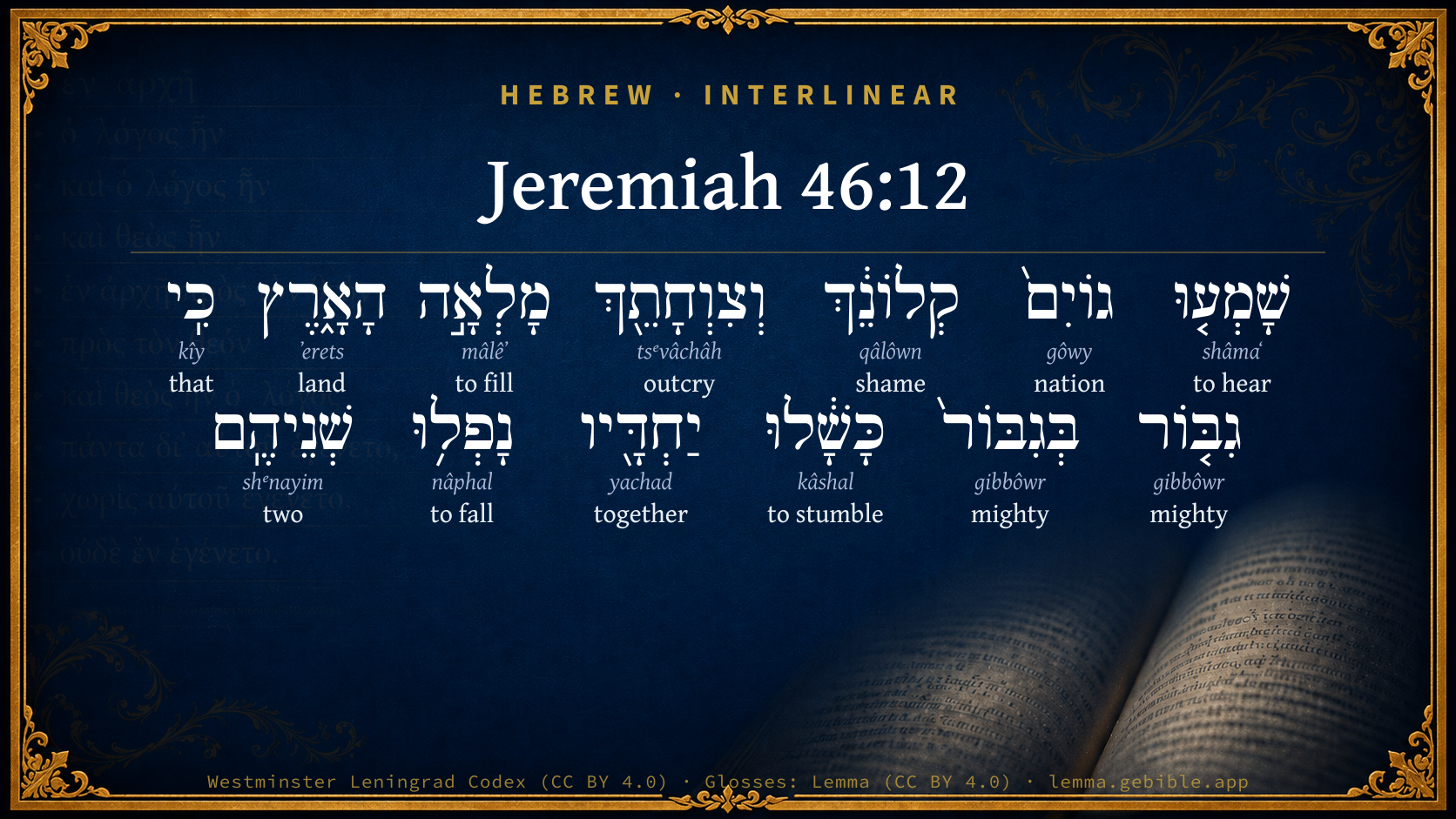
Hebrew (Westminster Leningrad Codex) Jeremiah 46:12 appears in the Hebrew Old Testament. The text above is from the Westminster Leningrad Codex. Each word links to its Strong’s number, a concise gloss, and parsing drawn from the Open Scriptures Hebrew Bible morphology. Click any word for its full Brown-Driver-Briggs (BDB) entry.
Download image
Cite this verse

Jeremiah 46:12 (World English Bible). Public Domain. Lemma interlinear Bible study tool, https://lemma.gebible.app/v/jeremiah/46/12.

Show BibTeX & RIS
BibTeX
RIS
English Translation
The nations have heard of your shame, and the earth is full of your cry; for the mighty man has stumbled against the mighty, they are fallen both of them together.
World English Bible · Public Domain
Download a study sheet

One document with this verse’s original text, its word-by-word gloss line, the meaning frame, cross-references with their text, attributed commentary, and full source and license credits — printable, and it pastes into notes with its structure intact.

This verse Autodidact and up

Study sheet (.html) Plain text (.txt)

A passage Seminary Student

Up to 50 verses in one chapter. A passage sheet keeps up to 6 commentary sources and 12 cross-references per verse, in the order this page ranks them, and says so on the sheet whenever that leaves anything out. Ask for a single verse and you get the Autodidact verse sheet above.

Everything on this page stays free to read, with no account — the sheet is a download of what is already on screen, not access to it.

Want to remove ads? Support Godless Engineer
Compare translations 3

The same verse in 3 English versions, stacked beneath the original-language interlinear above. Click any original word for its lexicon entry.

Each is an independent rendering of the whole verse — the interlinear is not word-aligned to these translations.

Highlighted words mark where these versions differ — a whole-verse word diff, not a word-by-word alignment.

  • World English Bible Public Domain
    The nations have heard of your shame, and the earth is full of your cry; for the mighty man has stumbled against the mighty, they are fallen both of them together.
  • King James Version Public Domain
    The nations have heard of thy shame, and thy cry hath filled the land: for the mighty man hath stumbled against the mighty, and they are fallen both together.
  • unfoldingWord Literal Text CC BY-SA 4.0
    The nations have heard of your disgrace. The earth is filled with your laments, for soldier stumbles against soldier; both of them fall together.”

unfoldingWord Literal Text — © unfoldingWord, licensed CC BY-SA 4.0. Word-aligned USFM3 via Door43 (git.door43.org/unfoldingWord/en_ult).

Versions to compare (up to 4)

3 of 4 selected

Show all 18 translations

Every available English version of this verse, each an independent rendering of the whole verse.

  • World English Bible Public Domain
    The nations have heard of your shame, and the earth is full of your cry; for the mighty man has stumbled against the mighty, they are fallen both of them together.
  • Berean Standard Bible Public Domain
    The nations have heard of your shame, and your outcry fills the earth, because warrior stumbles over warrior and both of them have fallen together.”
  • Majority Standard Bible Public Domain
    The nations have heard of your shame, and your outcry fills the earth, because warrior stumbles over warrior and both of them have fallen together.”
  • King James Version Public Domain
    The nations have heard of thy shame, and thy cry hath filled the land: for the mighty man hath stumbled against the mighty, and they are fallen both together.
  • American Standard Version (1901) Public Domain
    The nations have heard of thy shame, and the earth is full of thy cry; for the mighty man hath stumbled against the mighty, they are fallen both of them together.
  • Revised Version (1885) Public Domain
    The nations have heard of thy shame, and the earth is full of thy cry: for the mighty man hath stumbled against the mighty, they are fallen both of them together.
  • Geneva Bible (1599) Public Domain
    The nations haue heard of thy shame, and thy crie hath filled the lande: for the strong hath stumbled against the strong and they are fallen both together.
  • Douay-Rheims (1899) Public Domain
    The nations have heard of thy disgrace, and thy howling hath filled the land: for the strong hath stumbled against the strong, and both are fallen together.
  • Young's Literal Translation Public Domain
    Nations have heard of thy shame, And thy cry hath filled the land, For the mighty on the mighty did stumble, Together they have fallen -- both of them!'
  • Literal Standard Version CC BY-SA 4.0
    Nations have heard of your shame, || And your cry has filled the land, || For the mighty stumbled on the mighty, || Together they have fallen—both of them!”
  • Unlocked Literal Bible CC BY-SA 4.0
    The nations have heard of your disgrace. The earth is filled with your laments, for soldier stumbles against soldier; both of them fall together.”
  • unfoldingWord Literal Text CC BY-SA 4.0
    The nations have heard of your disgrace. The earth is filled with your laments, for soldier stumbles against soldier; both of them fall together.”
  • Darby Bible Public Domain
    The nations have heard of thy shame, and thy cry hath filled the earth; for the mighty man stumbleth against the mighty, they are both fallen together.
  • World Messianic Bible Public Domain
    The nations have heard of your shame, and the earth is full of your cry; for the mighty man has stumbled against the mighty, they both fall together.”
  • Webster's Bible Public Domain
    The nations have heard of thy shame, and thy cry hath filled the land: for the mighty man hath stumbled against the mighty, and they have fallen both together.
  • Free Bible Version CC BY-SA 4.0
    The other nations have heard how you were humiliated in defeat. Everyone can hear your cries of pain. Soldiers fall over each other, and die together.
  • Bible in Basic English Public Domain
    Your shame has come to the ears of the nations, and the earth is full of your cry: for the strong man is falling against the strong, they have come down together.
  • JPS Tanakh (1917) Public Domain
    The nations have heard of thy shame, and the earth is full of thy cry; for the mighty man hath stumbled against the mighty, they are fallen both of them together.

Literal Standard Version (2020), Covenant Press — licensed CC BY-SA 4.0. Text via the HelloAO Bible API (eBible.org). Unlocked Literal Bible (unfoldingWord) — licensed CC BY-SA 4.0. Text via the HelloAO Bible API (eBible.org). unfoldingWord Literal Text — © unfoldingWord, licensed CC BY-SA 4.0. Word-aligned USFM3 via Door43 (git.door43.org/unfoldingWord/en_ult). Free Bible Version, Dr. Jonathan Gallagher — licensed CC BY-SA 4.0. Text via the HelloAO Bible API (eBible.org).

Word by word

More ways to search: Search by grammar → Find every occurrence → Compare this word →

Practice this passage: Drill this verse → Learn its vocabulary →

וְצִוְחָתֵ֖ךְ
tsᵉvâchâh
H6682
“and · outcry · your”
Conjunction + Noun, Common, Feminine, Singular, Construct + Suffix, Personal, 2nd Person, Feminine, Singular
Part of Speech
Conjunction + Noun
Type
Common
Gender
Feminine
Number
Singular
State
Construct
Full BDB Definition

Origin: from H6681

TWOT: 1888a

outcry, shout
  1. שָׁמְע֤וּ shâmaʻ H8085 “to hear” Verb, Qal, Perfect, 3rd Person, Common, Plural
  2. גוֹיִם֙ gôwy H1471 “nations” Noun, Common, Masculine, Plural, Absolute
  3. קְלוֹנֵ֔ךְ qâlôwn H7036 “shame · your” Noun, Common, Masculine, Singular, Construct + Suffix, Personal, 2nd Person, Feminine, Singular
  4. מָלְאָ֣ה mâlêʼ H4390 “to fill” Verb, Qal, Perfect, 3rd Person, Feminine, Singular
  5. הָאָ֑רֶץ ʼerets H776 “the · land” Particle, Definite Article + Noun, Common, Both, Singular, Absolute
  6. כִּֽי kîy H3588 “that” Conjunction
  7. גִבּ֤וֹר gibbôwr H1368 “mighty” Adjective, Adjective, Masculine, Singular, Absolute
  8. בְּגִבּוֹר֙ gibbôwr H1368 “in/at · mighty” Preposition + Adjective, Adjective, Masculine, Singular, Absolute
  9. כָּשָׁ֔לוּ kâshal H3782 “to stumble” Verb, Qal, Perfect, 3rd Person, Common, Plural
  10. יַחְדָּ֖יו yachad H3162 “together” Adverb
  11. נָפְל֥וּ nâphal H5307 “to fall” Verb, Qal, Perfect, 3rd Person, Common, Plural
  12. שְׁנֵיהֶֽם shᵉnayim H8147 “two · their” Adjective, Cardinal number, Masculine, Dual, Construct + Suffix, Personal, 3rd Person, Masculine, Plural

About this verse

These counts appear in no published source. They are computed here, from the morphology-tagged text and Lemma’s own curated glosses. What Lemma adds →

13
words
12
distinct lemmas
Prophets
section

Notable vocabulary

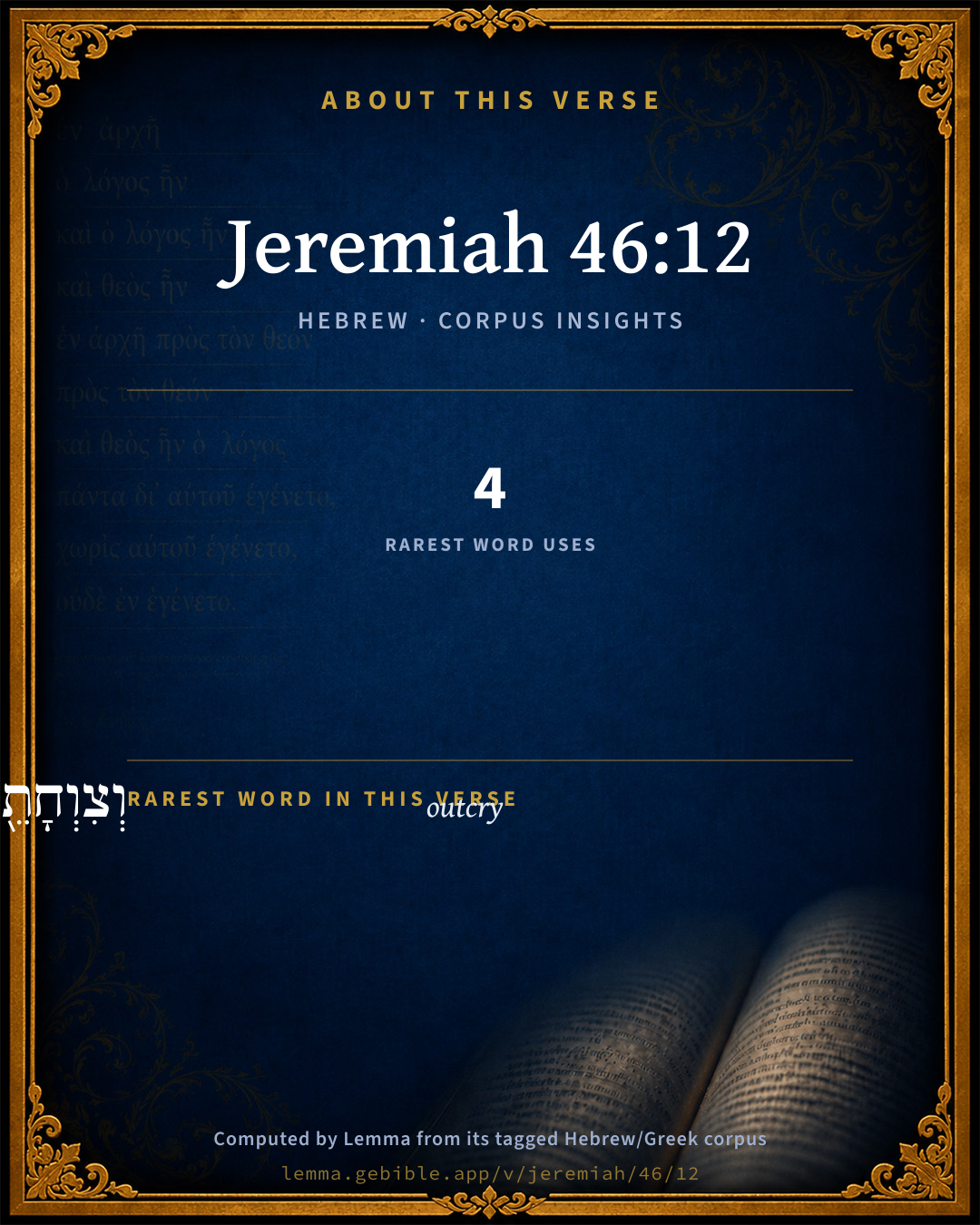
The rarest word here is וְצִוְחָתֵ֖ךְ outcry H6682 — appearing just 4 times in the whole Hebrew Bible.

Shared distinctive vocabulary

וְצִוְחָתֵ֖ךְ outcry H6682 occurs in 4 verses of the Hebrew Bible. Also found in:

Grammatical profile

  • 4 verbs
  • 4 nouns
  • 3 adjectives
  • 1 conjunction
  • 1 adverb

Verb forms

  • שָׁמְע֤וּ Qal · Perfect
  • מָלְאָ֣ה Qal · Perfect
  • כָּשָׁ֔לוּ Qal · Perfect
  • נָפְל֥וּ Qal · Perfect

Repetition

A word recurs within this verse — often emphatic in Hebrew:

  • גִבּ֤וֹר mighty H1368 ×2

Cross-references

12

Topical passages linked to Jeremiah 46:12 in the Treasury of Scripture Knowledge — connected by theme and wording, ordered by reader-vote popularity; previews shown in the World English Bible.

  • Nahum 3:8–10 Are you better than No-Amon, who was situated among the rivers, who had the waters around her; whose rampart was the sea, and her wall was of the sea?
  • Isaiah 19:2 I will stir up the Egyptians against the Egyptians: and they shall fight everyone against his brother, and everyone against his neighbor; city against city, [and] kingdom against kingdom.
  • Jeremiah 14:2 Judah mourns, and the gates of it languish, they sit in black on the ground; and the cry of Jerusalem is gone up.
  • Jeremiah 46:6 Don't let the swift flee away, nor the mighty man escape; in the north by the river Euphrates have they stumbled and fallen.
  • 1 Samuel 5:12 The men who didn't die were struck with the tumors; and the cry of the city went up to heaven.
  • Isaiah 10:4 They shall only bow down under the prisoners, and shall fall under the slain. For all this his anger is not turned away, but his hand is stretched out still.
  • Isaiah 15:5–8 My heart cries out for Moab; her nobles [flee] to Zoar, to Eglath Shelishiyah: for by the ascent of Luhith with weeping they go up; for in the way of Horonaim they raise up a cry of destruction.
  • Jeremiah 48:34 From the cry of Heshbon even to Elealeh, even to Jahaz have they uttered their voice, from Zoar even to Horonaim, to Eglath Shelishiyah: for the waters of Nimrim also shall become desolate.
  • Jeremiah 49:21 The earth trembles at the noise of their fall; there is a cry, the noise which is heard in the Red Sea.
  • Jeremiah 51:54 The sound of a cry from Babylon, and of great destruction from the land of the Chaldeans!
  • Ezekiel 32:9–12 I will also vex the hearts of many peoples, when I shall bring your destruction among the nations, into the countries which you have not known.
  • Zephaniah 1:10 In that day, says Yahweh, there will be the noise of a cry from the fish gate, a wailing from the second quarter, and a great crashing from the hills.

Cross-references courtesy of OpenBible.info (CC BY 4.0).

Hebrew and Greek witnesses Masoretic Hebrew ↔ Greek Septuagint

The same verse in the two great witnesses to the Old Testament, shown verse-for-verse.

These are two independent witnesses, not word-aligned to each other, and the Septuagint is shown in lemma (dictionary) form.

Hebrew Jeremiah 46:12 Masoretic · Westminster Leningrad Codex

שָׁמְע֤וּ גוֹיִם֙ קְלוֹנֵ֔ךְ וְצִוְחָתֵ֖ךְ מָלְאָ֣ה הָאָ֑רֶץ כִּֽי גִבּ֤וֹר בְּגִבּוֹר֙ כָּשָׁ֔לוּ יַחְדָּ֖יו נָפְל֥וּ שְׁנֵיהֶֽם

The nations have heard of your shame, and the earth is full of your cry; for the mighty man has stumbled against the mighty, they are fallen both of them together.

World English Bible · Public Domain

Greek LXX Structure differs

In the Septuagint, Jeremiah is about an eighth shorter than the Hebrew and arranges its material differently — the Oracles Against the Nations (Hebrew chapters 46–51) appear in the middle of the Greek book, after 25:13. Because the chapter and verse boundaries do not line up, a verse-for-verse comparison with the Hebrew is not shown.

A verse-for-verse comparison isn’t shown here because the chapters and verses don’t line up. Switch to the LXX edition with the MT / LXX toggle above to read the Greek directly.

On this verse, The Cambridge Bible for Schools and Colleges discusses the Septuagint’s reading. Read the note in Commentary ↓

Hebrew: Westminster Leningrad Codex (CC BY 4.0). Greek: Septuagint (public domain); English from a public-domain English Septuagint. How the Septuagint differs from the Hebrew →

Targum (Aramaic paraphrase)

1

The Targum is the ancient Jewish Aramaic paraphrase of the Hebrew Scriptures — an interpretive translation, not the Hebrew text itself. Onkelos (literal) and Pseudo-Jonathan (expansive) render the Torah, and Jonathan the Prophets. Coverage is partial: where no permissively-licensed English translation exists for a verse, only the Aramaic is shown. This is verse-level text, not a word-by-word alignment to the Hebrew.

  1. Targum Jonathan Prophets (Joshua–Malachi)
    שְׁמָעוּ עַמְמַיָא קְלָנַיִךְ וְצַוְחָתִיךְ אִתְמְלִיאַת אַרְעָא אֲרֵי גִבַּר בְּגִבַּר אִתְקָלוּ כַּחֲדָא אִתְקְטָלוּ תַרְוֵיהוֹן:

    (no public-domain English translation for this verse)

    Targum Jonathan — Aramaic: “Mikraot Gedolot” (public domain). English: “Sefaria Community Translation” (CC0 1.0 (public-domain dedication)); “London "Chaldee Paraphrase," 1871” (public domain). Text via Sefaria.

Commentary

Notes on Jeremiah 46:12 from classic Christian and Jewish commentators (each source and its license shown beneath its notes). The classic Christian expositions comment on the surrounding passage and are grouped to its opening verse, so a note may address several verses; the Jewish commentaries on the Tanakh (Rashi and others) are per-verse, so they appear only where the commentator wrote on this verse.

Lemma curates 59 commentaries, every one of them public domain or Creative Commons licensed, each selected and text-cleaned for this edition rather than reprinted as found. About our sources →

Trapp's Complete Commentary

John Trapp

Jer 46:12 The nations have heard of thy shame, and thy cry hath filled the land: for the mighty man hath stumbled against the mighty, [and] they are fallen both together.

Ver. 12. The nations have heard of thy shame.] Of the shameful defeat given thee; so that thou who wast once a terror to them art now a scorn.

For the mighty man hath stumbled against the mighty.] And this is the sum of the talk that goeth of thee.

John Trapp, A Commentary or Exposition upon All the Books of the Old and New Testament (1647–1656) — public domain. Text from a community e-Sword module.

Jamieson, Fausset & Brown

Robert Jamieson, A. R. Fausset & David Brown

mighty . . . stumbled against . . . mighty . . . fallen both together--Their very multitude shall prove an impediment in their confused flight, one treading on the other.

Jamieson, Fausset & Brown — Commentary Critical and Explanatory on the Whole Bible (1871) — public domain (CC PDM 1.0). Text via the HelloAO Bible API.

Adam Clarke's Commentary

Verse 12. The nations have heard of thy shame] Of thy disgrace, by this prodigious slaughter of thy troops.

Adam Clarke's Commentary on the Bible (1810–1826) — public domain. Text from a community e-Sword/MySword module.

John Calvin's Commentaries

He concludes this prophecy by saying that the report of this slaughter would be everywhere known among all nations. Had the Egyptians sustained only a small loss, the thing might have been unknown, as when a small engagement takes place the report does not spread far and wide; but when by one battle a nation is so conquered that a remarkable change follows, the event then is proclaimed everywhere. The Prophet then intimates by these words, that the stroke of Egypt would not be common, as also he said before, because the report would fly through all nations.

Heard then have all nations of thy reproach, even that the Egyptians had, to their great disgrace, been conquered by the Chaldeans, and that they had not only been put to flight, but that the greatest part of them had been slain, so that the kingdom of Egypt had been nearly lost; that at least they had been reduced to such straits, that they lost their chief eries and a very wide country, even throughout Asia to the river Euphrates.

He says that the land was filled with their cry: by voice or cry he means lamentations. Then he adds, Because the valiant hath stumbled against the valiant This may be thus explained, “The valiant hath contended with the valiant;” but. that the Chaldean proved stronger than the Egyptian: but I prefer to apply this to the Egyptians; and this may be inferred from the end of the verse, where he says, that both fell. So the Prophet means that the multitude, in which the Egyptians gloried, would be a hindrance to them, as usually is the case, when the army is too crowded, for the larger and the more numerous the army is, the greater is the disorder and confusion. When an army is small, they can by degrees recede, or stand still, until they take flight in safety: but in a great multitude there is also great trepidation, and hence a great disorder and confusion. This then is what the Prophet points out, when he says, The valiant stumbled against the valiant, and they both fell together; that is, that while they were fighting, they would clash with one another, and produce such disorder, as to occasion the fall of both.

John Calvin's Commentaries (1540-1563) — public domain. Text from the Calvin Translation Society English edition (1840s-50s) via the Christian Classics Ethereal Library (ccel.org). Calvin's coverage is partial (roughly two-thirds of the Bible); uncommented books and verses are honest gaps, never fabricated. The 19th-century editor's footnotes and remarks are omitted so the notes are faithfully Calvin's own voice.

The Cambridge Bible for Schools and Colleges

gen. ed. J. J. S. Perowne

12. thy shame] The LXX, “thy voice,” requires but a slight alteration of MT. and one which improves the parallelism.

the mighty man hath stumbled against the mighty] The heroes fighting on the Egyptian side tumble over one another in their blind flight. Cp. Lev_26:37.

The Cambridge Bible for Schools and Colleges (gen. ed. J. J. S. Perowne; Cambridge University Press, 1878–1918) — public domain. Text from a community e-Sword module.

John Gill's Exposition

The nations have heard of thy shame,.... Their shameful defeat and overthrow by the Chaldean army; so, after the manner of prophecy, the thing is related as done; the battle fought, and the victory obtained; and the rumour and fame of it spread among the nations, to the great mortification of this proud people:

and thy cry hath filled the land; the shrieks of the wounded; the cry of the pursued and taken; the lamentation of friends and relations for their dead; with one thing or another of this kind the whole land of Egypt was filled; yea, all the countries round about them, in confederacy with them, were filled with distress for the loss of their own; the calamity was large and spreading, and the rumour of it:

for the mighty man hath stumbled against the mighty, and they are fallen both together; either the mighty Egyptians against the mighty Chaldeans; and though the latter were the conquerors, yet lost abundance of men; so that there were mighty ones fell on both sides: or rather, as Jarchi, Kimchi, and Abarbinel, the mighty Egyptians in their flight fell, and other mighty ones of them following, stumbled at them, and fell upon them, and so both became a prey to the pursuers; or in their flight the mighty Egyptians stumbled against their mighty auxiliaries before mentioned, Jer 46:9; and so both came into the hands of their enemies. The Targum is, both were slain.

John Gill's Exposition of the Whole Bible (1746–1763) — public domain (CC PDM 1.0). Text via the HelloAO Bible API.

Albert Barnes' Notes on the Bible

The land - The earth; the world rings with the cry of grief.

Against the mighty - Against the mighty man, i. e., one mighty man against another. The champions hired to fight Egypt’s battle get in one another’s way, and so are slaughtered together.

Albert Barnes' Notes on the Bible (1834–1885) — public domain. Text from a community e-Sword/MySword module.

Matthew Poole's English Annotations

The prophet keepeth to his old prophetic style, speaking of things that were to come to pass some years after as if they were already past, because of the certainty of them; in this sense he saith other nations had seen, because they should see, the shame and confusion of the Egyptians upon their overthrow, and the cry of their slain and wounded men would fill other lands. For the Egyptians should certainly be overthrown, either by the Chaldeans stumbling upon the Babylonians, or the Babylonians on them, or they (fleeing) for haste stumbling one upon another, so as both those that went before, and those who followed after, should both fall together.

Matthew Poole's English Annotations on the Holy Bible (1683–1685) — public domain. Text from a community e-Sword/MySword module.

The Pulpit Commentary

Hath filled the land; rather, the earth, corresponding to "the nations."

The Pulpit Commentary (1880–1919), ed. H.D.M. Spence-Jones & Joseph S. Exell — public domain. Text from a community e-Sword module.

John Wesley's Explanatory Notes

Stumbled - Stumbling one upon another, so that both those that went before, and those who followed after, should fall together.

John Wesley, Explanatory Notes Upon the Whole Bible (1754–1765) — public domain. Text via the GEBible commentary corpus.

Rashi

Rabbi Shlomo Yitzchaki (Rashi)

a mighty man has stumbled upon a mighty man When they were fleeing they would stumble over each other.

Rashi on the Tanakh — English translations: “The Judaica Press complete Tanach with Rashi, translated by A. J. Rosenberg” (CC BY 4.0); “Pentateuch with Rashi's commentary by M. Rosenbaum and A.M. Silbermann, 1929-1934” (public domain); “The Metsudah Tanach series, Lakewood, N.J” (CC BY 4.0); and “The Book of Joshua, Metsudah Publications, 1997” (CC BY 4.0). Text via Sefaria.

Lesson kit

Teaching starters — assembled from the data on this page, not authored interpretation. Every prompt links to the verse data it draws on. Edit before teaching.

Jeremiah, in the Prophets, opens this verse with 13 words (12 distinct Hebrew lemmas). Its most distinctive word is tsᵉvâchâh (“outcry”). A historical commentator’s framing appears above. Read the whole chapter for the surrounding context.

Discussion questions

  1. The word tsᵉvâchâh carries the sense “outcry.” How does it shape the verse?
  2. Psalms 144:14 shares the word «outcry» with this verse. How do the two illuminate each other?
  3. “mighty” occurs 2× in this one verse. What is the effect of the repetition?
  4. The translations on this page render this verse differently — a whole-verse word diff, not a word-by-word alignment. What might account for the different wordings?
  5. The verb «שָׁמְע֤וּ» is Qal Perfect. How does its form color the action?
  6. Reading how Trapp's Complete Commentary and Jamieson, Fausset & Brown read this verse, where do the two commentators agree and where do they part?

Things to notice

Reading settings

Reading text

Shown beneath each verse's original-language words.

Old Testament
Old Testament edition

Read the OT as the Masoretic Hebrew (MT) or the Greek Septuagint (LXX).

English shown for the Greek Septuagint (in the Hebrew ↔ Greek comparison).

Comparing translations? Open the Compare panel on any verse page to stack up to four side by side.