
1 Chronicles 10:6

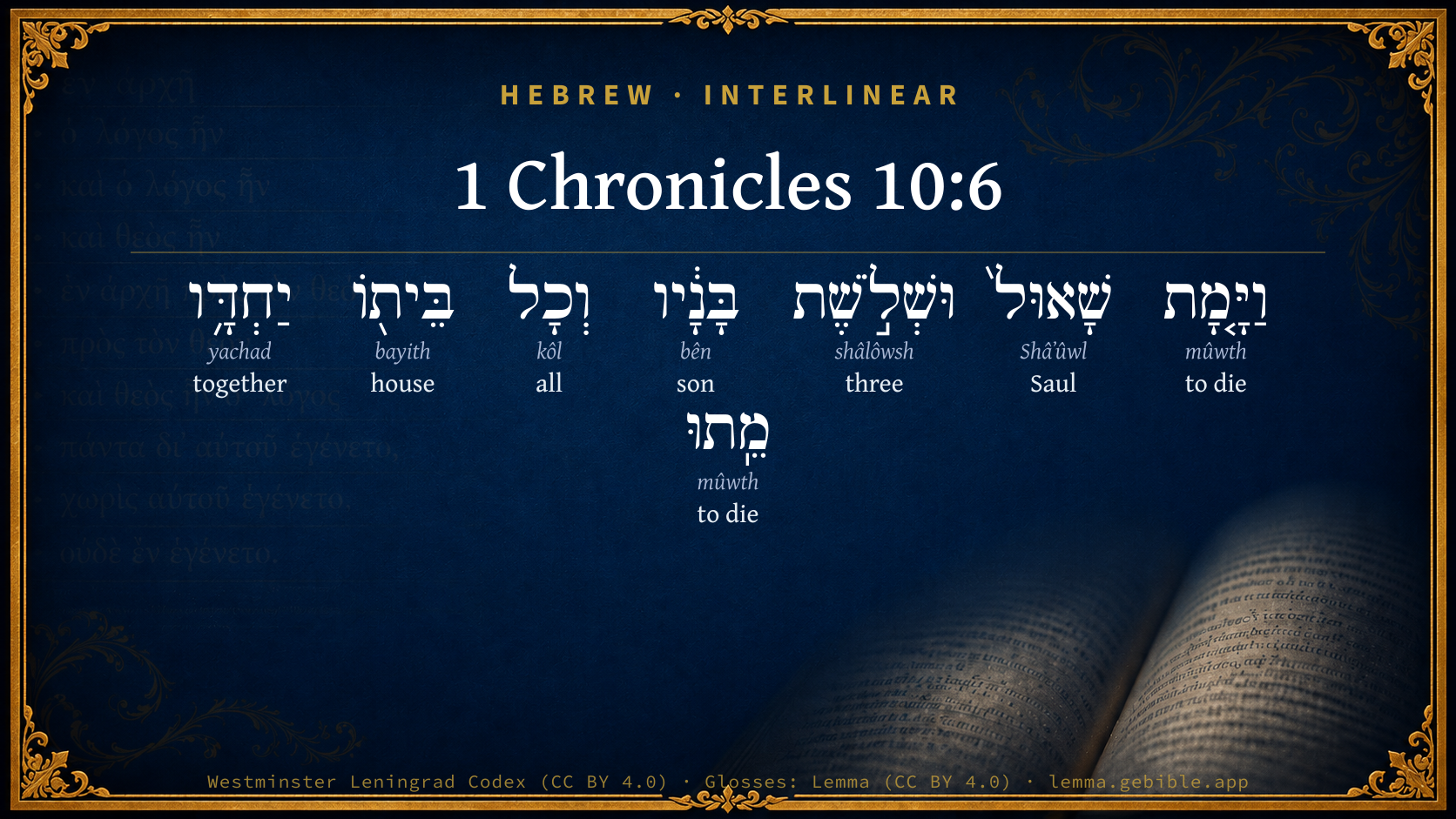
Hebrew (Westminster Leningrad Codex) 1 Chronicles 10:6 appears in the Hebrew Old Testament. The text above is from the Westminster Leningrad Codex. Each word links to its Strong’s number, a concise gloss, and parsing drawn from the Open Scriptures Hebrew Bible morphology. Click any word for its full Brown-Driver-Briggs (BDB) entry.
Download image
Cite this verse

1 Chronicles 10:6 (World English Bible). Public Domain. Lemma interlinear Bible study tool, https://lemma.gebible.app/v/1-chronicles/10/6.

Show BibTeX & RIS
BibTeX
RIS
English Translation
So Saul died, and his three sons; and all his house died together.
World English Bible · Public Domain
Download a study sheet

One document with this verse’s original text, its word-by-word gloss line, the meaning frame, cross-references with their text, attributed commentary, and full source and license credits — printable, and it pastes into notes with its structure intact.

This verse Autodidact and up

Study sheet (.html) Plain text (.txt)

A passage Seminary Student

Up to 50 verses in one chapter. A passage sheet keeps up to 6 commentary sources and 12 cross-references per verse, in the order this page ranks them, and says so on the sheet whenever that leaves anything out. Ask for a single verse and you get the Autodidact verse sheet above.

Everything on this page stays free to read, with no account — the sheet is a download of what is already on screen, not access to it.

Want to remove ads? Support Godless Engineer
Compare translations 3

The same verse in 3 English versions, stacked beneath the original-language interlinear above. Click any original word for its lexicon entry.

Each is an independent rendering of the whole verse — the interlinear is not word-aligned to these translations.

Highlighted words mark where these versions differ — a whole-verse word diff, not a word-by-word alignment.

  • World English Bible Public Domain
    So Saul died, and his three sons; and all his house died together.
  • King James Version Public Domain
    So Saul died, and his three sons, and all his house died together.
  • unfoldingWord Literal Text CC BY-SA 4.0
    So Saul died, and three of his sons, even all of his house, died together.

unfoldingWord Literal Text — © unfoldingWord, licensed CC BY-SA 4.0. Word-aligned USFM3 via Door43 (git.door43.org/unfoldingWord/en_ult).

Versions to compare (up to 4)

3 of 4 selected

Show all 18 translations

Every available English version of this verse, each an independent rendering of the whole verse.

  • World English Bible Public Domain
    So Saul died, and his three sons; and all his house died together.
  • Berean Standard Bible Public Domain
    So Saul died together with his three sons and all his house.
  • Majority Standard Bible Public Domain
    So Saul died together with his three sons and all his house.
  • King James Version Public Domain
    So Saul died, and his three sons, and all his house died together.
  • American Standard Version (1901) Public Domain
    So Saul died, and his three sons; and all his house died together.
  • Revised Version (1885) Public Domain
    So Saul died, and his three sons; and all his house died together.
  • Geneva Bible (1599) Public Domain
    So Saul dyed and his three sonnes, and all his house, they dyed together.
  • Douay-Rheims (1899) Public Domain
    So Saul died, and his three sons, and all his house fell together.
  • Young's Literal Translation Public Domain
    and Saul dieth, and his three sons, and all his house -- together they died.
  • Literal Standard Version CC BY-SA 4.0
    and Saul dies, and his three sons, and all his house—they died together.
  • Unlocked Literal Bible CC BY-SA 4.0
    So Saul died, and his three sons, so all his household members died together.
  • unfoldingWord Literal Text CC BY-SA 4.0
    So Saul died, and three of his sons, even all of his house, died together.
  • Darby Bible Public Domain
    So Saul died, and his three sons, and all his house died together.
  • World Messianic Bible Public Domain
    So Saul died with his three sons; and all his house died together.
  • Webster's Bible Public Domain
    So Saul died, and his three sons, and all his house died together.
  • Free Bible Version CC BY-SA 4.0
    So Saul and three of his sons died there, along with his royal line.
  • Bible in Basic English Public Domain
    So death overtook Saul and his three sons; all his family came to an end together.
  • JPS Tanakh (1917) Public Domain
    So Saul died, and his three sons; and all his house died together.

Literal Standard Version (2020), Covenant Press — licensed CC BY-SA 4.0. Text via the HelloAO Bible API (eBible.org). Unlocked Literal Bible (unfoldingWord) — licensed CC BY-SA 4.0. Text via the HelloAO Bible API (eBible.org). unfoldingWord Literal Text — © unfoldingWord, licensed CC BY-SA 4.0. Word-aligned USFM3 via Door43 (git.door43.org/unfoldingWord/en_ult). Free Bible Version, Dr. Jonathan Gallagher — licensed CC BY-SA 4.0. Text via the HelloAO Bible API (eBible.org).

Word by word

More ways to search: Search by grammar → Find every occurrence → Compare this word →

Practice this passage: Drill this verse → Learn its vocabulary →

About this verse

These counts appear in no published source. They are computed here, from the morphology-tagged text and Lemma’s own curated glosses. What Lemma adds →

8
words
7
distinct lemmas
Historical
section

Grammatical profile

  • 2 verbs
  • 4 nouns
  • 1 adjective
  • 1 adverb

Verb forms

  • וַיָּ֤מָת Qal · Sequential Imperfect
  • מֵֽתוּ Qal · Perfect

Repetition

A word recurs within this verse — often emphatic in Hebrew:

  • וַיָּ֤מָת to die H4191 ×2

Hebrew & Septuagint length

In English translation the verse runs 13 words from the Hebrew and 19 from the Septuagint (LXX English) — the Septuagint runs noticeably longer here. See the side-by-side →

A rough comparison of the two English renderings, which tokenize alike — not a word-level alignment.

Word counts can differ between the Hebrew and the Greek without any difference in meaning — e.g. the Hebrew direct-object marker אֵת has no separate Greek word, and Greek often adds the article ὁ.

Cross-references

5

Topical passages linked to 1 Chronicles 10:6 in the Treasury of Scripture Knowledge — connected by theme and wording, ordered by reader-vote popularity; previews shown in the World English Bible.

  • 1 Samuel 12:25 But if you shall still do wickedly, you shall be consumed, both you and your king."
  • Ecclesiastes 9:1–2 For all this I laid to my heart, even to explore all this: that the righteous, and the wise, and their works, are in the hand of God; whether it is love or hatred, man doesn't know it; all is before them.
  • Hosea 13:10–11 Where is your king now, that he may save you in all your cities? And your judges, of whom you said, 'Give me a king and princes?'
  • 1 Samuel 4:10–11 The Philistines fought, and Israel was struck, and they fled every man to his tent: and there was a very great slaughter; for there fell of Israel thirty thousand footmen.
  • 1 Samuel 4:18 It happened, when he made mention of the ark of God, that [Eli] fell from off his seat backward by the side of the gate; and his neck broke, and he died: for he was an old man, and heavy. He had judged Israel forty years.

Cross-references courtesy of OpenBible.info (CC BY 4.0).

Hebrew and Greek witnesses Masoretic Hebrew ↔ Greek Septuagint

The same verse in the two great witnesses to the Old Testament, shown verse-for-verse.

Here the Septuagint runs noticeably longer than the Hebrew — LXX2012 (modern English Septuagint) 19 words vs World English Bible 13. A rough length comparison of the two English translations, not a word-level alignment — read both below.

These are two independent witnesses, not word-aligned to each other, and the Septuagint is shown in lemma (dictionary) form.

Hebrew 1 Chronicles 10:6 Masoretic · Westminster Leningrad Codex

וַיָּ֤מָת שָׁאוּל֙ וּשְׁלֹ֣שֶׁת בָּנָ֔יו וְכָל בֵּית֖וֹ יַחְדָּ֥ו מֵֽתוּ

So Saul died, and his three sons; and all his house died together.

World English Bible · Public Domain

Greek LXX 1 Chronicles 10:6 Septuagint · lemma form

καί ἀποθνήσκω σαούλ καί τρεῖς υἱός αὐτός ἐν ὁ ἡμέρα ἐκεῖνος καί πᾶς ὁ οἶκος αὐτός ἐπί ὁ αὐτός ἀποθνήσκω

So Saul died, and his three sons on that day, and all his family died at the same time.

LXX2012 (modern English Septuagint) · Public Domain

On this verse, Ellicott's Commentary for English Readers discusses the Septuagint’s reading. Read the note in Commentary ↓

Hebrew: Westminster Leningrad Codex (CC BY 4.0). Greek: Septuagint (public domain); English from LXX2012 (modern English Septuagint) (Public Domain). How the Septuagint differs from the Hebrew →

Commentary

Notes on 1 Chronicles 10:6 from classic Christian and Jewish commentators (each source and its license shown beneath its notes). The classic Christian expositions comment on the surrounding passage and are grouped to its opening verse, so a note may address several verses; the Jewish commentaries on the Tanakh (Rashi and others) are per-verse, so they appear only where the commentator wrote on this verse.

Lemma curates 59 commentaries, every one of them public domain or Creative Commons licensed, each selected and text-cleaned for this edition rather than reprinted as found. About our sources →

Trapp's Complete Commentary

John Trapp

1Ch 10:6 So Saul died, and his three sons, and all his house died together.

Ver. 6. And all his house died together.] His courtiers and evil counsellors, who had sinned with him, perished with him.

John Trapp, A Commentary or Exposition upon All the Books of the Old and New Testament (1647–1656) — public domain. Text from a community e-Sword module.

Joseph Benson's Commentary

1Ch 10:6. Saul died, and all his house — All his children then present with him, namely, his three sons; for Ish-bosheth and Mephibosheth were not slain.

Joseph Benson's Commentary on the Old and New Testaments (1811–1818) — public domain. Text from a community e-Sword module.

Tyndale Open Study Notes

Tyndale Open Resources

10:6-12 Saul and his three sons died . . . bringing his dynasty to an end: The Chronicler does not mention Saul’s armor bearer or the rest of his troops (see 1 Sam 31:6), emphasizing God’s action in removing Saul and replacing him with David (1 Chr 10:14).

Tyndale Open Study Notes — © Tyndale Open Resources, licensed CC BY-SA 4.0. Text via the HelloAO Bible API.

Jamieson, Fausset & Brown

Robert Jamieson, A. R. Fausset & David Brown

Saul died, and his three sons, and all his house--his sons and courtiers who were there engaged in the battle. But it appears that Ish-bosheth and Mephibosheth were kept at Gibeah on account of their youth.

Jamieson, Fausset & Brown — Commentary Critical and Explanatory on the Whole Bible (1871) — public domain (CC PDM 1.0). Text via the HelloAO Bible API.

Adam Clarke's Commentary

Verse 6. So Saul died - and all his house] Every branch of his family that had followed him to the war was cut off; his three sons are mentioned as being the chief. No doubt all his officers were slain.

Adam Clarke's Commentary on the Bible (1810–1826) — public domain. Text from a community e-Sword/MySword module.

Ellicott's Commentary for English Readers

(6) And all his house died together.—Instead of this Samuel reads “and his armour-bearer; also all his men on that day together.” The LXX. adds “on that day” here, while in Samuel it omits “all his men,” thus minimising the differences of text. It is mere pedantry to press the phrases “all his men,” “all his house.” The strength of these expressions indicates the completeness of the overthrow.

The chronicler was fully aware that some of Saul’s house were not engaged in this battle (1Ch_9:35). And in any case, the chief warriors of his household, and immediate followers, died with the king.

A Bible Commentary for English Readers, edited by Charles John Ellicott (1878–1897) — public domain. Text from a community e-Sword module.

The Cambridge Bible for Schools and Colleges

gen. ed. J. J. S. Perowne

6. all his house] In Samuel “his armourbearer and all his men.” The reference is rather to Saul’s servants than to his family.

The Cambridge Bible for Schools and Colleges (gen. ed. J. J. S. Perowne; Cambridge University Press, 1878–1918) — public domain. Text from a community e-Sword module.

Albert Barnes' Notes on the Bible

All his house died together - Not the whole of his family, nor even “all his sons” (see 2Sa 2:8-15; 2Sa 3:6-15; 2Sa 4:1-12). The phrase is perhaps an abbreviation of the expression in the parallel passage of Samuel 1Sa 31:6.

Albert Barnes' Notes on the Bible (1834–1885) — public domain. Text from a community e-Sword/MySword module.

Haydock's Catholic Bible Commentary

Fell. Hebrew, "died." (Calmet) --- But, though the house of Saul was fallen from its former glory, on this fatal day, when so many of his courtiers perished; yet he left Isboseth to bewail his fate, (Haydock) and some others who were not of age to go to battle. (Calmet)

George Leo Haydock (1774–1849), Haydock's Catholic Family Bible and Commentary, 1859 edition — public domain. Excludes Psalms (Douay-Rheims chapter numbering differs from Protestant) and Deuterocanonical books (Catholic canon only).

Matthew Poole's English Annotations

All his house, i.e. all his children, to wit, then present with him, namely,

his three sons, as it is expressed, 1Sa 31:6. For it is evident that Ish-bosheth and Mephibosheth were not slain. But nothing is more common in Scripture and all authors, than to understand all of a great and most considerable part.

Matthew Poole's English Annotations on the Holy Bible (1683–1685) — public domain. Text from a community e-Sword/MySword module.

Whedon's Commentary on the Bible

Daniel D. Whedon

6. All his house died together — Not every member of his family, for Ishbosheth, (2Sa_2:8,) and Ziba, and Mephibosheth (2Sa_9:1-6) survived him; but all his men that accompanied him to the war.

Daniel D. Whedon (gen. ed.), Commentary on the Old and New Testaments (1874–1909) — public domain. Text from a community e-Sword module.

The Pulpit Commentary

All his house. In place of these words, the parallel (1Sa_31:6) has, "And his armour-bearer, and all his men, that same day together." This reading avoids the ambiguity referred to already (ver. 2). In either passage the moral is plain, that the end and ruin of Saul"s family as a whole had arrived, rather than literally that the whole, including every member, of that family had perished.

HOMILIES BY J.R. THOMSON Vers. 6, 13.

The mighty fallen!

The death of Saul and Jonathan, upon the heights of Gilboa, is one of the grandest and most awful episodes in Hebrew history. Behold the chosen of God, the hero and the idol of Israel, wounded by the archers, supplicating death from his armour-bearer, falling in despair upon his sword! Princes and warriors," swifter than eagles, stronger than lions; "Saul and Jonathan" are slain in the high places." The shields of the mighty are vilely cast away!" The king"s sons and his body-guards and the flower of his army perish with him on this awful day. "How are the mighty fallen!" But let us turn from the dramatic, the tragic side of this incident, to ponder its spiritual lessons.

I Saul"s appalling fate reminds us of GREAT POWERS MISUSED. The gigantic stature and amazing strength of the son of Kish naturally impressed all beholders, and conciliated almost commanded the respect and confidence of the people. But he was more than an athlete, he was a general who had delivered his country and gained many victories over his enemies. He appears to have possessed great qualities, not only of body, but of mind. All this gave Saul great advantages. If he had but used these aright, he would have retained the regard of his subjects and the allegiance of the brave, and he might have lived to old age, in possession of the dignity and power of kingship. But his moody, wilful spirit gave a wrong bias to his energies. His was a wonderful but a wasted life. The valour and skill which had defeated the Philistines in his early days might have defeated them now. But Saul was not the same man as of old. Even so many, whom God has richly endowed with gifts of body and of mind, have proved themselves unworthy of these gifts, have misused them in such manner that it had been better for them that they had never been born. To whom God has given much, of them he requires the more.

II We observe here A LOFTY VOCATION ILL UNDERSTOOD AND ILL FULFILLED. Saul was the first of Israel"s kings. Anointed by Samuel, chosen by lot, elected by the acclamation of the people, he entered upon the kingly office with every omen and every prospect of success. Called to be, not, like one of the judges, the chief of a tribe or a temporary deliverer, but the ruler of a nation and a king for life, Saul might have raised his people to independence and to power. But be was disobedient to the voice of the seer, he was unfaithful to the cause of the God who raised him to eminence and invested him with theocratic authority; and he reaped the bitter harvest of disobedience and unfaithfulness. To some position, with some vocation, the Author of our life has called each one of us. Not only kings and rulers, pastors and Church officers, but all Christians, in every station of life, have committed to them a peculiar and sacred trust. Let each ask How is this trust fulfilled?

III There is exemplified here the possibility of TRUE RELIGION BEING KNOWN AND YET FORSAKEN. In his early life, Saul had put within him another heart, and became another man. But there are signs that he came under heathen influences. Certainly one of the last acts of his life was indicative of superstition, when he sought unto the witch of Endor, instead of looking to Jehovah for counsel and encouragement. He "inquired not of the Lord." It was a grievous defection; he, whose religious life commenced so brightly under the guidance of Samuel, came to grovel before an ignorant necromancer! A lesson this of human instabilty, frailty, and fickleness. "Let him that thinketh he standeth take heed lest he fall!" Alas! how often has the bright promise of youth been clouded in maturer years, and the sun which rose in splendour sunk beneath the gloomy clouds! It is a solemn warning which none should disregard.

IV We are informed that THE FALL OF THIS FIRST KING OF ISRAEL WAS A DIVINE JUDGMENT. "Saul died for his transgression which he committed against the Lord." We are seldom at liberty authoritatively and confidently to pronounce calamity a judgment from the Lord. But in the case before us we are expressly warranted in doing so. Saul had violated the Divine Law. He had directed sacrifice to be offered without the permission of the prophet. He had spared Agag, and appropriated the spoil. He had displayed, again and again, a rebellions and ungodly disposition; had given way to impulses of anger, envy, jealousy, and fear. He had too often despised God"s Word, persecuted God"s servants, trusted in himself, and forgotten that Jehovah had called him to be the leader of his people in righteousness. Now at length the long-delayed retribution came upon the guilty monarch. "The Lord slew him." A warning to the impenitent, this terrible fate of Saul should summon the sinner to repentance, and (thank God!) to repentance unto life. T.

The Pulpit Commentary (1880–1919), ed. H.D.M. Spence-Jones & Joseph S. Exell — public domain. Text from a community e-Sword module.

John Wesley's Explanatory Notes

His house - All his children, then present with him, namely, his three sons, for Ishbosheth and Mephiboshieth were not slain.

John Wesley, Explanatory Notes Upon the Whole Bible (1754–1765) — public domain. Text via the GEBible commentary corpus.

Lesson kit

Teaching starters — assembled from the data on this page, not authored interpretation. Every prompt links to the verse data it draws on. Edit before teaching.

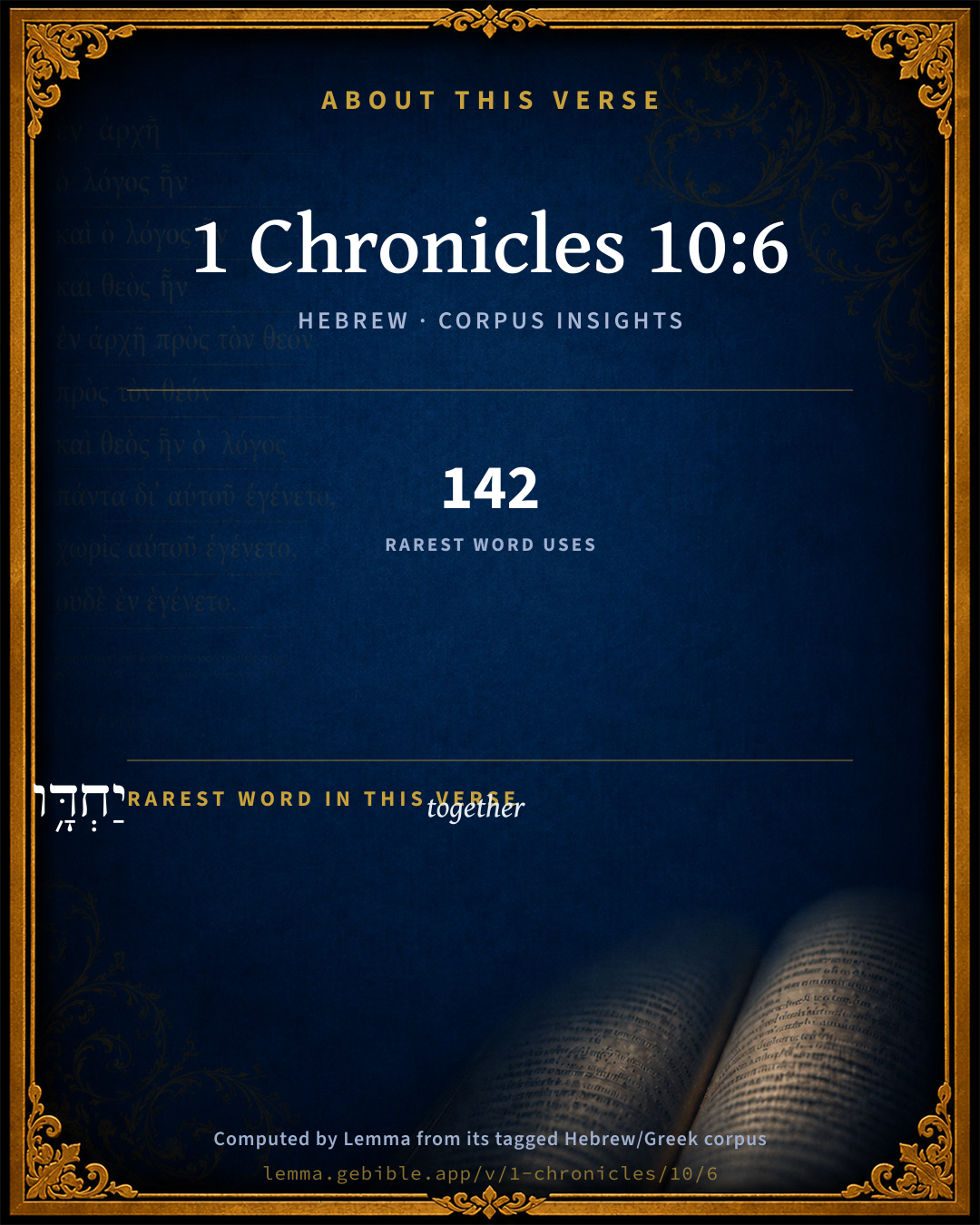
1 Chronicles, in the Historical, opens this verse with 8 words (7 distinct Hebrew lemmas). Its most distinctive word is yachad (“together”). The Greek Septuagint runs longer here. A historical commentator’s framing appears above. Read the whole chapter for the surrounding context.

Discussion questions

  1. How does “together” (yachad) shape what this verse is saying?
  2. 1 Samuel 12:25 shares this passage’s theme. How do the two illuminate each other?
  3. “to die” occurs 2× in this one verse. What is the effect of the repetition?
  4. Compared with the Hebrew, the Septuagint runs longer here. What questions does that raise?
  5. These translations render this verse differently. What is at stake in choosing one wording over another?
  6. The verb «וַיָּ֤מָת» is Qal Sequential Imperfect. How does its form color the action?
  7. Reading how Trapp's Complete Commentary and Joseph Benson's Commentary read this verse, where do the two commentators agree and where do they part?

Things to notice

  • These translations choose different wording for 1 word in this verse.
  • “to die” occurs 2× in this single verse.
  • 7 distinct Hebrew lemmas span 8 words in this verse.

Reading settings

Reading text

Shown beneath each verse's original-language words.

Old Testament
Old Testament edition

Read the OT as the Masoretic Hebrew (MT) or the Greek Septuagint (LXX).

English shown for the Greek Septuagint (in the Hebrew ↔ Greek comparison).

Comparing translations? Open the Compare panel on any verse page to stack up to four side by side.