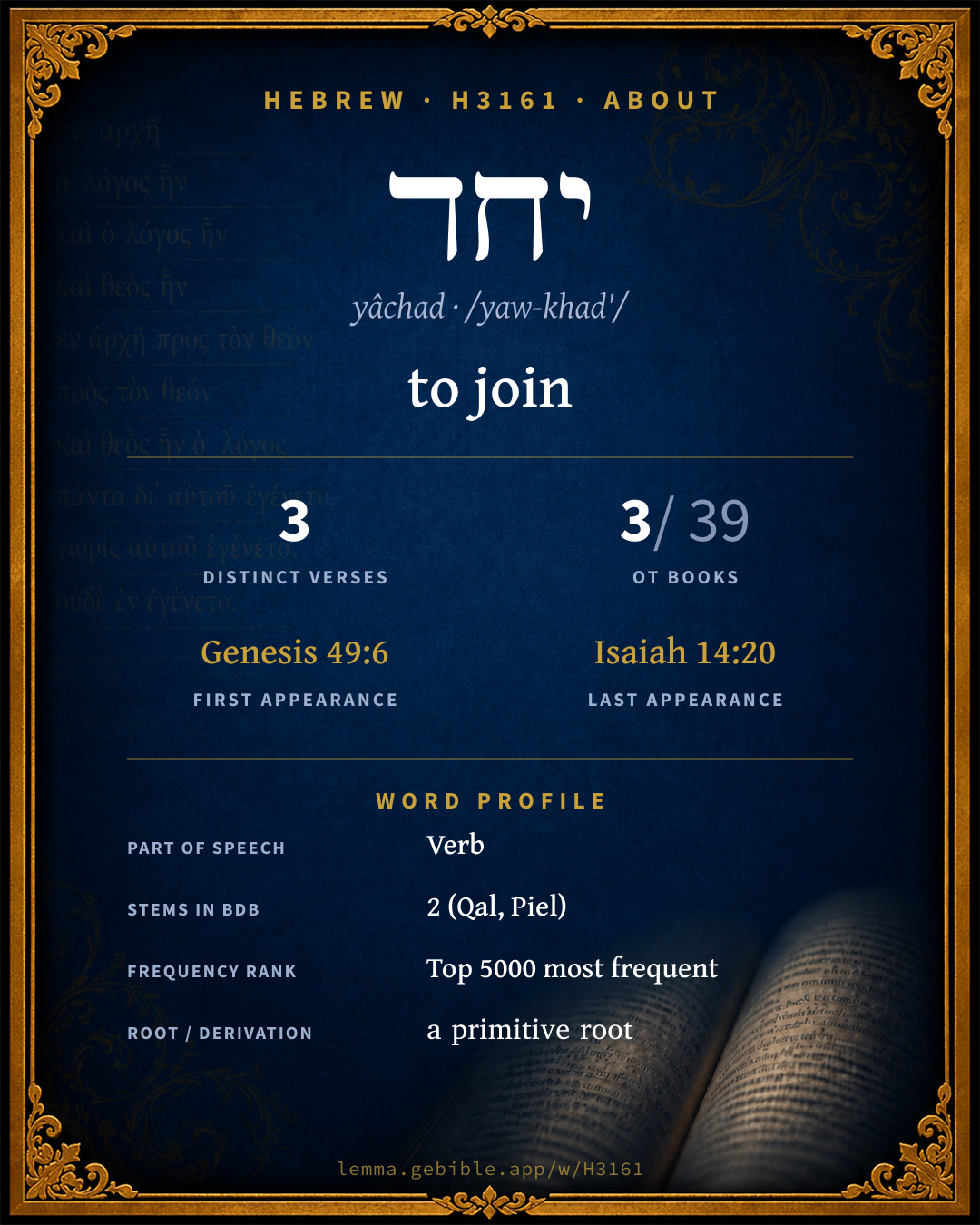
יָחַד
to join
also: unite, be joined, be united fuller range ↓
Full lexicon entry — Brown-Driver-Briggs (BDB)
From Brown-Driver-Briggs (BDB)
Where this word appears
See every Qal verb in the Hebrew Bible →
Grammar key — what these labels mean
Part of speech
- Verb
- An action or state-of-being word.
Stem
- Piel
- An intensive or resultative active stem.
- Qal
- The basic, simple active stem — the plain form of the verb (“he wrote”).
Form
- Imperative
- A direct command (“write!”).
- Imperfect
- An incomplete, ongoing, or future action (“he will / would write”).
- Jussive
- A third- or second-person volitional form expressing wish or command (“let him write”).
Person
- 2nd Person
- The one addressed (“you”).
- 3rd Person
- The one spoken about (“he / she / it / they”).
Gender
- Masculine
- Grammatically masculine.
- Feminine
- Grammatically feminine.
Number
- Singular
- One.
Grammatical forms
- Verb, Piel, Imperative, 2nd Person, Masculine, Singular 1 time (33%)
- Verb, Qal, Imperfect, 2nd Person, Masculine, Singular 1 time (33%)
- Verb, Qal, Jussive, 3rd Person, Feminine, Singular 1 time (33%)
Parsed forms decoded from the imported morphology (morphhb / Westminster Leningrad Codex — WLC text public domain, morphhb tagging CC BY 4.0), counted across 3 parsed occurrences — not distinct verses.
Every verse where H3161 appears — 3 distinct verses across 3 books. Click any verse to open its interlinear word-by-word view. Verse text shown in the World English Bible for context — . Each verse’s Hebrew form is shown with its reference; the English is not keyword-highlighted, since the data carries no word-level English alignment. Use “Compare translations” on any verse to read it across multiple English versions. This concordance covers the Hebrew Bible; Septuagint (Greek Old Testament) occurrences are not indexed here.
Genesis 1 verse
Psalms 1 verse
Isaiah 1 verse
About this entry
At a glance — auto-summarized from this page’s data, not written by a person. Every figure links to its source below. This summary describes the numbers; it doesn’t interpret them.
יחד (yâchad) is a Hebrew verb most often rendered “to join.” It is rare — just 3 verses in the entire Hebrew Bible. Genesis dominates its distribution — 1 of 3 verses. It first appears in Genesis 49:6. As a verb its force shifts by stem, across 2 stems (Qal, Piel, and more). The sections below give every sense, occurrence, and version rendering.
Gloss history
Strong's 1890 vs modern scholarship
About this word
Strong's H3161 catalogs a Hebrew word from the Hebrew Old Testament.
These counts are not copied from any lexicon or concordance. They are computed here, from the morphology-tagged Hebrew Old Testament. What Lemma adds →
- 3
- distinct verses
- The word appears in 3 distinct verses.
- 3 / 39
- OT books
- The word appears in 3 of 39 Old Testament books.
- #4,179
- by frequency
- Top 5000 most frequent Hebrew words (rank 4,179 of 8,640 Hebrew words by occurrence).
View all 3 occurrences in the concordance →
By section of the Old Testament
By traditional corpus
Conventional, traditional groupings — biblical authorship is debated, so this is a traditional corpus grouping, not an authorship claim. Each share is this word’s portion of its verses in that division of the Hebrew canon. Each figure is a share of the word’s 3 distinct verses.
- Torah (Pentateuch) 1 verse · 33%
- Prophets (Nevi'im) 1 verse · 33%
- Writings (Ketuvim) 1 verse · 33%
How translations render this word
Counts come from each version’s own published word-to-Strong’s tagging or interlinear alignment — an approximate guide to how each version renders this word, not a word-level alignment the data otherwise carries. Because each total is that version’s own tagged count, the per-version totals vary from one another and need not match the appearance or distinct-verse counts above. These counts may also differ from a printed concordance because Lemma counts each distinctly tagged rendering and does not collapse phrase taggings into a single head-word total. This is a fixed set of word-tagged versions (KJV, ASV, BSB, ULT) and does not change with the reading translation you choose elsewhere. Each version’s license is shown beside its name below (and on Sources).
- King James Version: Be not thou united 1×, Thou shalt not be joined 1×, Unite 1×
- American Standard Version: Be not thou united 1×, Thou shalt not be joined 1×, Unite 1×
- Berean Standard Bible: Give me an undivided 1×, Join 1×, Join them 1×
- unfoldingWord Literal Text: Join 2×
King James Version Public Domain
Renders H3161 across 3 tagged occurrences — most commonly:
American Standard Version Public Domain
Renders H3161 across 3 tagged occurrences — most commonly:
Berean Standard Bible Public Domain
Renders H3161 across 3 tagged occurrences — most commonly:
unfoldingWord Literal Text CC BY-SA 4.0
Renders H3161 across 6 tagged occurrences — most commonly:
Plus 4 renderings that appear only once — usually multi-word phrases or single function words the recovered tagging swept in, not distinct renderings.
Senses in the full BDB
Hebrew verbs can shift meaning by stem (binyan): Qal is the basic action, Niphal is often passive or reflexive, Piel often intensifies or makes it factitive, and Hiphil is typically causative. The senses below are grouped under the stem BDB assigns to each.
What do BDB’s symbols mean?
BDB uses these scholarly abbreviations:
| Symbol | Meaning |
|---|---|
| 𝔊 | the Septuagint (the ancient Greek translation, LXX) |
| 𝔙 | the Vulgate (the Latin translation) |
| 𝔖 | the Syriac version (the Peshitta) |
| 𝔗 | the Targum (the Aramaic translation) |
| ψ | the Psalms |
| √ | root (the underlying root or stem) |
| ‖ | parallel passage (a synonymous or contrasted parallel) |
| † | the dagger: every passage where the word occurs is cited |
The 2 senses and sub-senses the full Brown-Driver-Briggs lexicon distinguishes for this word, in lexicon order (not ranked by frequency), with BDB’s own verbatim wording and sub-sense lettering. Shown in Hebrew script with BDB’s own scholarly abbreviations. The condensed entry is in the Lexicon Entry tab. See also the Forms in the corpus table below.
Qal
- Impf. 3 fs. Gn 49:6 בִּקְהָלָם אַל־תֵּחַד כְּבוֹדִי in their assembly let my glory not be united (‖ בְּסֹדָם אַל־תָּבֹא נַפְשִׁי); 2 fs. Is 14:20 לֹא תֵחַד אִתָּם בִּקְבוּרָה. e.g. Genesis 49:6
Piel
- Imv. ψ 86:11 יַחֵד לְבָבִי לְיִרְאָה שְׁמֶ֑ךָ unite my heart (i.e. concentrate its affections, cf. Je 32:39) to fear thy name (but 𝔊 𝔖 𝔙 Gr Bi Ch יִחַדְּ (from חָדָה) let my heart rejoice, etc.) e.g. Psalms 86:11
Senses from the full Brown-Driver-Briggs lexicon (Brown, Driver, Briggs; Oxford 1906 — public domain), digitized via Sefaria, supplemented by the OpenScriptures HebrewLexicon (CC BY 4.0). Full attribution on Sources.
Word origin
vb. be united (Arabic وَحَدَ be alone, ii. make one; NH Pi. יִּחֵד make or declare one; Aramaic יַחֵד unite, ܫܰܘܚܶܕ set alone)—
— Brown-Driver-Briggs (Oxford 1906, public domain), digitized via Sefaria, supplemented by the OpenScriptures HebrewLexicon (CC BY 4.0). See Sources.
Origin: a primitive root
Jastrow Dictionary
A second Hebrew/Aramaic lexicon for comparison, covering Aramaic and post-biblical (Talmudic, Targumic, Midrashic) usage that the biblical-Hebrew BDB does not. Matched by lemma rather than by Strong’s number, so a lemma may carry more than one Jastrow headword (shown separately below), and the entries cover usage well beyond the Bible.
יָחַד
- , Pi. יִחֵד, יִיחֵד (b. h.; v. אֶחָד)
- 1. to unite, concentrate. Y. Ber. IV, 7ᵈ bot. ותְיַיחֵד לבבינו וכ׳ and concentrate our hearts (inclinations) to fear thy Name.
- 2. (with על) to confer a distinction, name &c. Gen. R. s. 68 אברהם י׳ … שמו עליו on Abraham did the Lord confer His Name (Gen. XXVI, 24, a. e.). Ib. ידע שהקב"ה מְיַחֵד שמו עליו he inferred that the Lord would confer His Name upon him (to be called ‘the God of Jacob’). Mekh. Mishp. s. 20 על ישראל י׳ שמו ביותר (although the Lord of the universe) He conferred His Name particularly on Israel (v. יוֹתֵר); a. fr. e.g. Genesis 26:24
- 3. to declare the unity of God, to recite Sh’ma (Deut. VI, 4). Gen. R. s. 20 אנו … ומְיַחֲדִים שמו וכ׳ we trust in Him and profess His unity &c. Cant. R. to II, 16 ואני מְיַחֶדֶת שמו וכ׳ and I (Israel) profess the unity of His name twice every day, (saying) Hear, O Israel &c.; a. fr. e.g. Deuteronomy 6:4
- 4. to single out, select, designate. Snh. 57ᵃ שיי׳ שפחה לעבדו who designated a handmaid (as a wife) for his slave. Lev. R. s. 12 ויי׳ אליו הדבור וכ׳ addressed the command to him exclusively (Lev. X, 8); a. e.—Yoma 11ᵇ (ref. to Lev. XIV, 35) מי שמְיַיחֵד ביתו לו וכ׳ he who devotes his household exclusively to himself, and is unwilling to lend his vessels &c.; Arakh. 16ᵃ שמיוחד (v. infra); Yalk. Lev. 564.—5) to leave persons alone in a special room, to arrange a private meeting for. Keth. 12ᵃ; Tosef. ib. I, 4; Y. ib. I, 25ᵃ bot. היו מְיַיחֲדִין וכ׳ they used to leave bride and groom in a private room alone for a while.—Part. pass. מְיוּחָד, f. מְיוּחֶדֶת; pl. מְיוּחָדִים, מְיוּחָדִין, מְיוּחָדוֹת a) especial, particular, designated; chosen, distinguished (v. יָחִיד). Snh. 60ᵃ, a. e. שם המי׳ the proper Name of the Lord (Jehovah).—Yoma 11ᵃ ביתך ביתך המי׳ לך ‘thy house’ (Deut. VI, 9; XI, 20), thy house which is designated for thy personal use. Ib.ᵇ מה בית מ׳ לדירה bayith means a room designated for a dwelling, יצאו אלו שאינן מי׳ לדירה to the exclusion of those rooms (gate lodge &c.) which are not designated for dwellings. Arakh. l. c. מי׳ לו devoted to his own exclusive use, v. supra; a. fr.—Gen. R. s. 99, end (ref. to כאחד, Gen. XLIX, 16) כמי׳ שבשבטים like the most distinguished among the tribes. Yeb. 62ᵃ אני שמ׳ לדבור בכל וכ׳ I (Moses) who am singled out (must be prepared) for divine communication every hour; Ab. d’R. N., II Vers., ch. II (ed. Schechter, p. 10) שאני כלי מי׳ who am a special vessel (of revelation). Meïl. 15ᵃ קדשים המי׳ לה׳ sanctified things which are exclusively dedicated to the Lord; Sifra Vayikra, Ḥobah, Par. 11, ch. XX.—Ib. Sh’mini, ch. II, Par. 2 כבשים ועזים המי׳ lambs and goats which are specified (Deut. XIV, 4); a. fr.—b) locked up with. Num. R. s. 9 בזמן שהאשה מי׳ עם וכ׳ when a wife is locked up with her husband. e.g. Leviticus 10:8
- , Nithpa. נִתְיַיחֵד
- 1. to be conferred (with על); to be especially addressed (with אל). Ex. R. s. 7 היה ראוי … להִתְיַיחֵד עליו וכ׳ the divine communication was to bear his name alone. Lev. R. s. 12 נתי׳ אליו הדבור the divine communication was addressed to him especially; a. e.
- 2. to be alone with, to be closeted with. Kidd. IV, 12 לא יִתְיַיחֵד אדם וכ׳ a man must not be alone (even) with two women, but one woman מִתְיַיחֶדֶת וכ׳ may be alone with two men. Ab. Zar. II, 1. Tosef. Gitt. VII (V), 4; a. fr.—V. יִחוּד.
יְחַד
- , Pa. יַחֵד ch. same,
- 1. to concentrate. Targ. Ps. LXXXVI, 11.—Part. pass. מְיַחַד united, harmonious. Targ. Y. Ex. XIX, 2 (cmp. הוֹמוֹנְיָא).
- 2. to specify, single out, designate. Macc. 18ᵃ ליַחוּדֵי לאוי וכ׳ Ms. M. (ed. לי׳ להו) to forbid each of these acts singly (as if each were prohibited by a special prohibitory law, v. לַאו).—Part. pass. מְיָחַד = h. מְיוּחָד (v. preced.). Targ. O. Gen. XXVI, 10 דמְיָ׳ בעמא ed. Berl. (oth. ed. מְיָחֵיד; Y. מלכא דמֵיחַד) a distinguished person of the people. Targ. Y. Lev. XV, 20; 22 מְיַיחֵד designated; a. e.
- , contr. אִיַּיחֵד to be joined; to be locked up. Targ. Y. I Gen. XLIX, 6. Targ. Job. III, 6.—Targ. Y. II, Num. XXXI, 50.—Snh. 37ᵃ שרי לִיַּיחוּדֵי וכ׳ is permitted to be closeted up with her husband.
A Dictionary of the Targumim, the Talmud Babli and Yerushalmi, and the Midrashic Literature (Marcus Jastrow; London, Luzac, 1903) — Public Domain. Digitized via Sefaria. Digitized via Sefaria. Full attribution on Sources.
Forms in the corpus
The 3 distinct written forms H3161 takes in the Hebrew Bible, most frequent first — each parse links to that stem’s occurrences in the concordance. Hebrew forms include their vowel points and cantillation, so a single lemma takes many written forms.
| Form | Parsing | Example | Uses |
|---|---|---|---|
| יַחֵ֥ד | Verb, Piel, Imperative, 2nd Person, Masculine, Singular | Psalms 86:11 | 1 |
| תֵחַ֤ד | Verb, Qal, Imperfect, 2nd Person, Masculine, Singular | Isaiah 14:20 | 1 |
| תֵּחַ֣ד | Verb, Qal, Jussive, 3rd Person, Feminine, Singular | Genesis 49:6 | 1 |
Same root — word family
Other BDB entries built from the same root as H3161, grouped by Strong’s listed origin. These share a root / origin per the lexicon — not necessarily a shared meaning. Each links to that word’s own entry.
Derived from this word
Proper names from this root
People and places named from this root — a name, not an additional meaning of the word.
Compare all same-root words → 1 of the same-root words is a proper name (a person or place). They share a root, not necessarily a meaning.
Septuagint verse parallels
This word appears in 2 verses that also exist in the Greek Old Testament (Septuagint), out of the 3 Hebrew verses it occurs in. You can read those verses in Greek by switching the Old Testament edition to the Septuagint.
Read these verses in the Septuagint
This is a verse-level parallel only — the same verses exist in both the Hebrew and Greek Old Testaments. No word-level Hebrew↔Greek correspondence is claimed: the data carries no such alignment, so no Greek word is shown as this Hebrew word’s translation. Coverage is not total — the Septuagint omits the deuterocanon and renumbers the Psalms, so some Hebrew verses have no direct Greek parallel.