
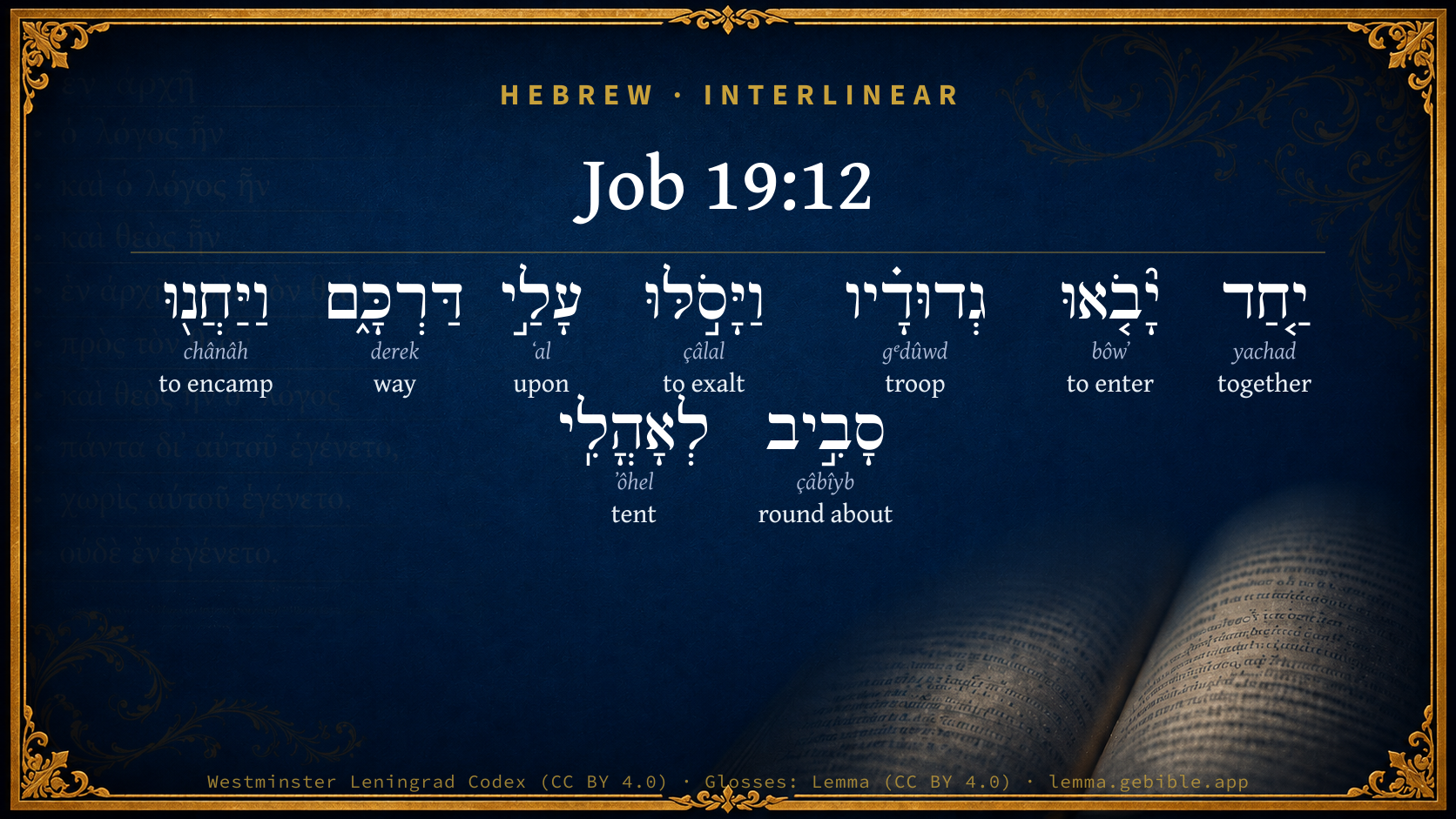
Job 19:12

Hebrew (Westminster Leningrad Codex) Job 19:12 appears in the Hebrew Old Testament. The text above is from the Westminster Leningrad Codex. Each word links to its Strong’s number, a concise gloss, and parsing drawn from the Open Scriptures Hebrew Bible morphology. Click any word for its full Brown-Driver-Briggs (BDB) entry.
Download image
Cite this verse

Job 19:12 (World English Bible). Public Domain. Lemma interlinear Bible study tool, https://lemma.gebible.app/v/job/19/12.

Show BibTeX & RIS
BibTeX
RIS
English Translation
His troops come on together, Build a siege ramp against me, And encamp around my tent.
World English Bible · Public Domain
Download a study sheet

One document with this verse’s original text, its word-by-word gloss line, the meaning frame, cross-references with their text, attributed commentary, and full source and license credits — printable, and it pastes into notes with its structure intact.

This verse Autodidact and up

Study sheet (.html) Plain text (.txt)

A passage Seminary Student

Up to 50 verses in one chapter. A passage sheet keeps up to 6 commentary sources and 12 cross-references per verse, in the order this page ranks them, and says so on the sheet whenever that leaves anything out. Ask for a single verse and you get the Autodidact verse sheet above.

Everything on this page stays free to read, with no account — the sheet is a download of what is already on screen, not access to it.

Want to remove ads? Support Godless Engineer
Compare translations 3

The same verse in 3 English versions, stacked beneath the original-language interlinear above. Click any original word for its lexicon entry.

Each is an independent rendering of the whole verse — the interlinear is not word-aligned to these translations.

Highlighted words mark where these versions differ — a whole-verse word diff, not a word-by-word alignment.

  • World English Bible Public Domain
    His troops come on together, Build a siege ramp against me, And encamp around my tent.
  • King James Version Public Domain
    His troops come together, and raise up their way against me, and encamp round about my tabernacle.
  • unfoldingWord Literal Text CC BY-SA 4.0
    His troops come together, and they build up their ramps against me, and they encamp around my tent.

unfoldingWord Literal Text — © unfoldingWord, licensed CC BY-SA 4.0. Word-aligned USFM3 via Door43 (git.door43.org/unfoldingWord/en_ult).

Versions to compare (up to 4)

3 of 4 selected

Show all 18 translations

Every available English version of this verse, each an independent rendering of the whole verse.

  • World English Bible Public Domain
    His troops come on together, Build a siege ramp against me, And encamp around my tent.
  • Berean Standard Bible Public Domain
    His troops advance together; they construct a ramp against me and encamp around my tent.
  • Majority Standard Bible Public Domain
    His troops advance together; they construct a ramp against me and encamp around my tent.
  • King James Version Public Domain
    His troops come together, and raise up their way against me, and encamp round about my tabernacle.
  • American Standard Version (1901) Public Domain
    His troops come on together, And cast up their way against me, And encamp round about my tent.
  • Revised Version (1885) Public Domain
    His troops come on together, and cast up their way against me, and encamp round about my tent.
  • Geneva Bible (1599) Public Domain
    His armies came together, and made their way vpon me, and camped about my tabernacle.
  • Douay-Rheims (1899) Public Domain
    His troops have come together, and have made themselves a way by me, and have besieged my tabernacle round about.
  • Young's Literal Translation Public Domain
    Come in do His troops together, And they raise up against me their way, And encamp round about my tent.
  • Literal Standard Version CC BY-SA 4.0
    His troops come in together, || And they raise up their way against me, || And encamp around my tent.
  • Unlocked Literal Bible CC BY-SA 4.0
    His troops come on together; they cast up siege mounds against me and encamp around my tent.
  • unfoldingWord Literal Text CC BY-SA 4.0
    His troops come together, and they build up their ramps against me, and they encamp around my tent.
  • Darby Bible Public Domain
    His troops have come together and cast up their way against me, and have encamped round about my tent.
  • World Messianic Bible Public Domain
    His troops come on together, build a siege ramp against me, and encamp around my tent.
  • Webster's Bible Public Domain
    His troops come together, and raise up their way against me, and encamp around my tabernacle.
  • Free Bible Version CC BY-SA 4.0
    God's troops assemble to attack me. They build ramparts against me. They encircle and besiege my home.
  • Bible in Basic English Public Domain
    His armies come on together, they make their road high against me, and put up their tents round mine.
  • JPS Tanakh (1917) Public Domain
    His troops come on together, and cast up their way against me, and encamp round about my tent.

Literal Standard Version (2020), Covenant Press — licensed CC BY-SA 4.0. Text via the HelloAO Bible API (eBible.org). Unlocked Literal Bible (unfoldingWord) — licensed CC BY-SA 4.0. Text via the HelloAO Bible API (eBible.org). unfoldingWord Literal Text — © unfoldingWord, licensed CC BY-SA 4.0. Word-aligned USFM3 via Door43 (git.door43.org/unfoldingWord/en_ult). Free Bible Version, Dr. Jonathan Gallagher — licensed CC BY-SA 4.0. Text via the HelloAO Bible API (eBible.org).

Word by word

More ways to search: Search by grammar → Find every occurrence → Compare this word →

Practice this passage: Drill this verse → Learn its vocabulary →

וַיָּסֹ֣לּוּ
çâlal
H5549
“and · to exalt”
Conjunction + Verb, Qal, Sequential Imperfect, 3rd Person, Masculine, Plural
Part of Speech
Conjunction + Verb
Stem
Qal
Form
Sequential Imperfect
Person
3rd Person
Gender
Masculine
Number
Plural
Full BDB Definition

Origin: a primitive root

TWOT: 1506

to lift up, cast up, exalt - (Qal) - to cast up a highway - to cast up a way - to lift up (of song) - (Pilpel) to exalt, esteem highly, prize - (Hithpoel) to exalt oneself
  1. יַ֤חַד yachad H3162 “together” Adverb
  2. יָ֘בֹ֤אוּ bôwʼ H935 “to enter” Verb, Qal, Imperfect, 3rd Person, Masculine, Plural
  3. גְדוּדָ֗יו gᵉdûwd H1416 “troops · his” Noun, Common, Masculine, Plural, Construct + Suffix, Personal, 3rd Person, Masculine, Singular
  4. עָלַ֣י ʻal H5921 “upon · me” Preposition + Suffix, Personal, 1st Person, Common, Singular
  5. דַּרְכָּ֑ם derek H1870 “way · their” Noun, Common, Both, Singular, Construct + Suffix, Personal, 3rd Person, Masculine, Plural
  6. וַיַּחֲנ֖וּ chânâh H2583 “and · to encamp” Conjunction + Verb, Qal, Sequential Imperfect, 3rd Person, Masculine, Plural
  7. סָבִ֣יב çâbîyb H5439 “round about” Noun, Common, Both, Singular, Absolute
  8. לְאָהֳלִֽי ʼôhel H168 “to/for · tent · my” Preposition + Noun, Common, Masculine, Singular, Construct + Suffix, Personal, 1st Person, Common, Singular

About this verse

These counts appear in no published source. They are computed here, from the morphology-tagged text and Lemma’s own curated glosses. What Lemma adds →

9
words
9
distinct lemmas
Wisdom
section

Notable vocabulary

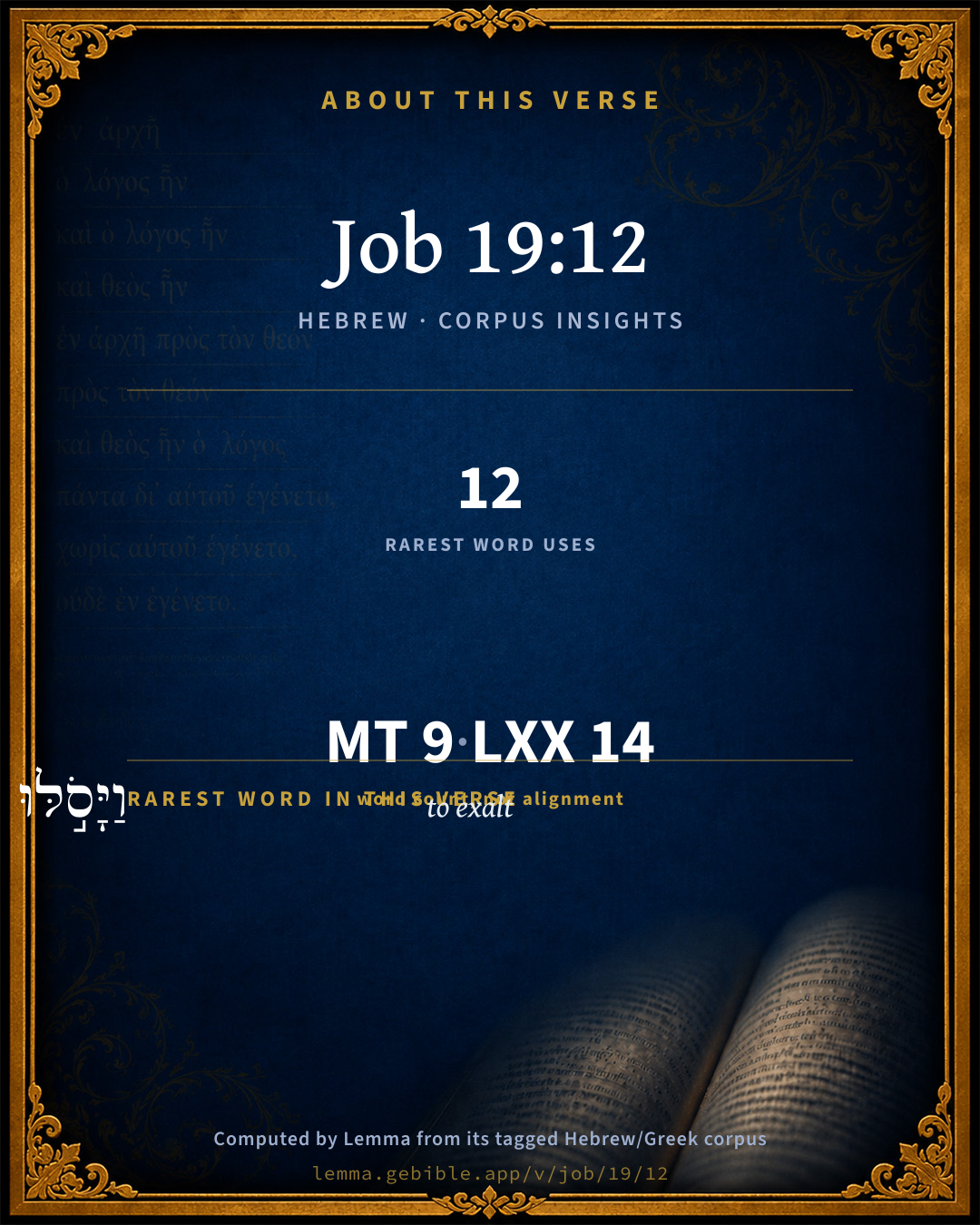
The rarest word here is וַיָּסֹ֣לּוּ to exalt H5549 — appearing just 12 times in the whole Hebrew Bible.

Shared distinctive vocabulary

וַיָּסֹ֣לּוּ to exalt H5549 occurs in 10 verses of the Hebrew Bible. Also found in:

Grammatical profile

  • 3 verbs
  • 4 nouns
  • 1 preposition
  • 1 adverb

Verb forms

  • יָ֘בֹ֤אוּ Qal · Imperfect
  • וַיָּסֹ֣לּוּ Qal · Sequential Imperfect
  • וַיַּחֲנ֖וּ Qal · Sequential Imperfect

Hebrew & Septuagint length

In English translation the verse runs 16 words from the Hebrew and 15 from the Septuagint (LXX English) — closely comparable.

A rough comparison of the two English renderings, which tokenize alike — not a word-level alignment.

Word counts can differ between the Hebrew and the Greek without any difference in meaning — e.g. the Hebrew direct-object marker אֵת has no separate Greek word, and Greek often adds the article ὁ.

In the original languages it is 9 Hebrew tokens and 14 Greek tokens — but the two are counted differently (Hebrew bundles its prefixes and suffixes into one token; the Greek is in lemma form), so that isn’t a like-for-like length.

Cross-references

5

Topical passages linked to Job 19:12 in the Treasury of Scripture Knowledge — connected by theme and wording, ordered by reader-vote popularity; previews shown in the World English Bible.

  • Job 30:12 On my right hand rise the rabble. They thrust aside my feet, They cast up against me their ways of destruction.
  • Job 16:13 His archers surround me. He splits my kidneys apart, and does not spare. He pours out my gall on the ground.
  • Job 16:11 God delivers me to the ungodly, And casts me into the hands of the wicked.
  • Isaiah 10:5–6 Ho Assyrian, the rod of my anger, the staff in whose hand is my indignation!
  • Isaiah 51:23 and I will put it into the hand of those who afflict you, who have said to your soul, Bow down, that we may go over; and you have laid your back as the ground, and as the street, to those who go over.

Cross-references courtesy of OpenBible.info (CC BY 4.0).

Hebrew and Greek witnesses Masoretic Hebrew ↔ Greek Septuagint

The same verse in the two great witnesses to the Old Testament, shown verse-for-verse.

These are two independent witnesses, not word-aligned to each other, and the Septuagint is shown in lemma (dictionary) form.

Hebrew Job 19:12 Masoretic · Westminster Leningrad Codex

יַ֤חַד יָ֘בֹ֤אוּ גְדוּדָ֗יו וַיָּסֹ֣לּוּ עָלַ֣י דַּרְכָּ֑ם וַיַּחֲנ֖וּ סָבִ֣יב לְאָהֳלִֽי

His troops come on together, Build a siege ramp against me, And encamp around my tent.

World English Bible · Public Domain

Greek LXX Job 19:12 Septuagint · lemma form

ὁμοθυμαδόν δέ ἔρχομαι ὁ πειρατήριον αὐτός ἐπί ἐγώ ὁ ὁδός ἐγώ κυκλόω ἐγώ ἐγκάθετος

His troops also came upon me with one accord, liars in wait compassed my ways.

LXX2012 (modern English Septuagint) · Public Domain

On this verse, Haydock's Catholic Bible Commentary discusses the Septuagint’s reading. Read the note in Commentary ↓

Hebrew: Westminster Leningrad Codex (CC BY 4.0). Greek: Septuagint (public domain); English from LXX2012 (modern English Septuagint) (Public Domain). How the Septuagint differs from the Hebrew →

Commentary

Notes on Job 19:12 from classic Christian and Jewish commentators (each source and its license shown beneath its notes). The classic Christian expositions comment on the surrounding passage and are grouped to its opening verse, so a note may address several verses; the Jewish commentaries on the Tanakh (Rashi and others) are per-verse, so they appear only where the commentator wrote on this verse.

Lemma curates 59 commentaries, every one of them public domain or Creative Commons licensed, each selected and text-cleaned for this edition rather than reprinted as found. About our sources →

Trapp's Complete Commentary

John Trapp

Job 19:12 His troops come together, and raise up their way against me, and encamp round about my tabernacle.

Ver. 12. His troops come together] i.e. Troops of tribulations and temptations, of pirates and robbers, σπειρατηρια (as the Seventy have it). Sickness and other sorrows are God’s soldiers, Mat 8:8-9, and they seldom come single, Jas 1:2, but trooping and treading on the heels of one another, Concateuata piorum crux; a company comes.

And raise up their way against me] As soldiers besieging a place cast up their trenches and fortifications. Vatablus rendereth it, And have beaten their way upon me; that is, saith he, tribulations have so often passed over me, that they have made a pathway upon me, more transeuntium, as passengers use to do.

And encamp round about my tabernacle] Afflictions hem me in on every side; the troops of troubles besiege me so straitly, that I can no way in all the world find relief or comfort; which, now as by a strong hand, yea, as by a strong host, are withheld from my soul; and so are like to be for a long season, as sieges are many times. Heman was afflicted and ready to die from his youth up, suffering those terrors, Psa 88:15. Job was a man of sorrows.

John Trapp, A Commentary or Exposition upon All the Books of the Old and New Testament (1647–1656) — public domain. Text from a community e-Sword module.

Joseph Benson's Commentary

Job 19:12. His troops come together — My afflictions, which are but God’s instruments and soldiers marching under his conduct; and raise up their way against me — Cast up a bank, or make a trench about me, as an army besieging a place; or raise a causeway or path, as pioneers usually do, in low and marshy grounds, for the march of an army: that is, God removes all impediments out of the way, and lays me open to troubles and calamities of every kind.

Joseph Benson's Commentary on the Old and New Testaments (1811–1818) — public domain. Text from a community e-Sword module.

Keil & Delitzsch

C. F. Keil & F. Delitzsch

12 His troops came together,

And threw up their way against me,

And encamped round about my tent.

13 My brethren hath He removed far from me,

And my acquaintance are quite estranged from me.

14 My kinsfolk fail,

And those that knew me have forgotten me.

15 The slaves of my house and my maidens,

They regard me as a stranger,

I am become a perfect stranger in their eyes.

It may seem strange that we do not connect Job 19:12 with the preceding strophe or group of verses; but between Job 19:7 and Job 19:21 there are thirty στίχοι, which, in connection with the arrangement of the rest of this speech in decastichs (accidentally coinciding remarkably with the prominence given to the number ten in Job 19:3), seem intended to be divided into three decastichs, and can be so divided without doing violence to the connection. While in Job 19:12, in connection with Job 19:11, Job describes the course of the wrath, which he has to withstand as if he were an enemy of God, in Job 19:13. he refers back to the degradation complained of in Job 19:9. In Job 19:12 he compares himself to a besieged (perhaps on account of revolt) city. God's גדוּדים (not: bands of marauders, as Dietr. interprets, but: troops, i.e., of regular soldiers, synon. of צבא, Job 10:17, comp. Job 25:3; Job 29:25, from the root גד, to unite, join, therefore prop. the assembled, a heap; vid., Frst's Handwrterbuch) are the bands of outwards and inward sufferings sent forth against him for a combined attack (יחד). Heaping up a way, i.e., by filling up the ramparts, is for the purpose of making the attack upon the city with battering-rams (Job 16:14) and javelins, and then the storm, more effective (on this erection of offensive ramparts (approches), called elsewhere שׁפך סללה, vid., Keil's Archologie, 159). One result of this condition of siege in which God's wrath has placed him is that he is avoided and despised as one smitten of God: neither love and fidelity, nor obedience and dependence, meet him from any quarter. What he has said in Job 17:6, that he is become a byword and an abomination (an object to spit upon), he here describes in detail. There is no ground for understanding אחי in the wider sense of relations; brethren is meant here, as in Psa 69:9. He calls his relations קרובי, as Psa 38:12. ידעי are (in accordance with the pregnant biblical use of this word in the sense of nosse cum affectu et effectu) those who know him intimately (with objective suff. as Psa 87:4), and מידּעי, as Psa 31:12, and freq., those intimately known to him; both, therefore, so-called heart-or bosom-friends. בּיתי גּרי Jer. well translates inquilinin domus meae; they are, in distinction from those who by birth belong to the nearer and wider circle of the family, persons who are received into this circle as servants, as vassals (comp. Exo 3:22, and Arabic jâr, an associate, one sojourning in a strange country under the protection of its government, a neighbour), here espec. the domestics. The verb תּחשׁבוּני (Ges. 60) is construed with the nearest feminine subject. These people, who ought to thank him for taking them into his house, regard him as one who does not belong to it (זר); he is looked upon by them as a perfect stranger (נכרי), as an intruder from another country.

Keil & Delitzsch — Biblical Commentary on the Old Testament (1861–1891) — public domain (CC PDM 1.0). Text via the HelloAO Bible API. (Old Testament only.)

Geneva Bible (1599)

Geneva Bible translators

His manifold afflictions.

Geneva Bible (1599) marginal notes — public domain. Text via Bolls.life.

Jamieson, Fausset & Brown

Robert Jamieson, A. R. Fausset & David Brown

troops--Calamities advance together like hostile troops (Job 10:17).

raise up . . . way--An army must cast up a way of access before it, in marching against a city (Isa 40:3).

Jamieson, Fausset & Brown — Commentary Critical and Explanatory on the Whole Bible (1871) — public domain (CC PDM 1.0). Text via the HelloAO Bible API.

The Cambridge Bible for Schools and Colleges

gen. ed. J. J. S. Perowne

12. raise up their way] i. e. cast up a way or high bank on which to advance againt the beleaguered fort or city.

The Cambridge Bible for Schools and Colleges (gen. ed. J. J. S. Perowne; Cambridge University Press, 1878–1918) — public domain. Text from a community e-Sword module.

John Gill's Exposition

He hath put my brethren far from me,.... As it is one part of business in war to cut off all communication between the enemy and their confederates and auxiliaries, and to hinder them of all the help and assistance from them they can; so Job here represents God dealing with him as with an enemy, and therefore keeps at a distance from him all such from whom he might expect comfort and succour, as particularly his brethren; by whom may be meant such who in a natural relation are strictly and properly brethren; for such Job had, as appears from Job 42:11; who afterwards paid him a visit, and showed brotherly love to him; but for the present the affliction that God laid upon him had such an influence on theft, as to cause them to stand aloof off, and not come near him, and show any regard unto him; and as this was the effect of the afflicting hand of God, Job ascribes it to him, and which added to his affliction; see Psa 69:8;

and mine acquaintance are verily estranged from me; such as knew him in the time of his prosperity, and frequently visited him, and conversed with him, and he with them; but now, things having taken a different turn in his outward circumstances, they carried it strange to him, as if they had never been acquainted with him: "si fueris felix", &c.

John Gill's Exposition of the Whole Bible (1746–1763) — public domain (CC PDM 1.0). Text via the HelloAO Bible API.

Albert Barnes' Notes on the Bible

His troops - The calamities which he had sent, and which are here represented as “armies” or “soldiers” to accomplish his work. It is not probable that he refers here to the bands of the Chaldeans and the Sabeans, that had robbed him of his property, but to the calamities that had come upon him, “as if” they were bands of robbers.

And raise up their way - As and army that is about to lay siege to a city, or that is marching to attack it, casts up a way of access to it, and thus obtains every facility to take it; see Isa 40:3, note; Isa 57:14, note.

And encamp round about my tabernacle - In the manner of an army besieging a city. Often an army is encamped in this manner for months or even years, in order to reduce the city by famine.

My tabernacle - My tent; my dwelling.

Albert Barnes' Notes on the Bible (1834–1885) — public domain. Text from a community e-Sword/MySword module.

Haydock's Catholic Bible Commentary

Troops: (latrones) "free-booters," (Haydock) or "soldiers." (Sanctius) --- Those nations made a practice of plundering one another’s territories, without any declaration of war. Mercury and Autolychus are praised for thefts of this description. (Odys. xix.) See Judges xi. 3. Septuagint, "his temptations (Calmet; or militia; Greek: peirateria) came rushing together upon me; lying down (Haydock) in ambush, (Calmet) they surrounded my paths." (Haydock)

George Leo Haydock (1774–1849), Haydock's Catholic Family Bible and Commentary, 1859 edition — public domain. Excludes Psalms (Douay-Rheims chapter numbering differs from Protestant) and Deuterocanonical books (Catholic canon only).

Matthew Poole's English Annotations

His troops, i.e. my afflictions, which are but God’s instruments and soldiers marching under his conduct.

Raise up their way; either,

1. Cast a bank or trench round about me, as an army doth when they go to besiege a place. Or rather,

2. Make a causeway or raised path, as pioneers usually do in low and waterish grounds for the march of an army. God removes all impediments out of the way, and lays me open to all manner of mischief.

Matthew Poole's English Annotations on the Holy Bible (1683–1685) — public domain. Text from a community e-Sword/MySword module.

Whedon's Commentary on the Bible

Daniel D. Whedon

12. Gives the three stages of a siege: invasion; the throwing up of a mound; and, finally, complete investment. In their attacks on walled places both the Assyrians and the Egyptians used to cast up mounds or “banks.”’ 2Ki_19:32; Isa_37:33; Jer_32:24. These not only enabled the besiegers to push their battering rams up to the fortress, but at the same time to scale its walls. The judgments of God, subjecting man to extreme suffering, are often spoken of under the figure of a siege. Isa_29:3.

Daniel D. Whedon (gen. ed.), Commentary on the Old and New Testaments (1874–1909) — public domain. Text from a community e-Sword module.

The Pulpit Commentary

His troops come together. (comp. Job_16:13, "His archers compass me round about It seems to Job that God brings against him a whole army of assailants, who join their forces together and proceed to the attack. Clouds of archers, troops of ravagers, come about him, and fall upon him from every side. And raise up their way against me; rather, and cast up their bank against me. Job still regards himself as a besieged city (see ver. 10), and represents his assailants as raising embankments to hem him in, or mounds from which to batter his defences (compare the Assyrian sculptures, Passim). and encamp round about my tabernacle; i.e. "my tent," or "my dwelling."

The Pulpit Commentary (1880–1919), ed. H.D.M. Spence-Jones & Joseph S. Exell — public domain. Text from a community e-Sword module.

John Wesley's Explanatory Notes

Troops - My afflictions, which are God's soldiers marching under his conduct. Raise - Cast up a trench round about me.

John Wesley, Explanatory Notes Upon the Whole Bible (1754–1765) — public domain. Text via the GEBible commentary corpus.

Rashi

Rabbi Shlomo Yitzchaki (Rashi)

they build their road Heb. ויסלו, an expression of a highway (מסלה).

Rashi on the Tanakh — English translations: “The Judaica Press complete Tanach with Rashi, translated by A. J. Rosenberg” (CC BY 4.0); “Pentateuch with Rashi's commentary by M. Rosenbaum and A.M. Silbermann, 1929-1934” (public domain); “The Metsudah Tanach series, Lakewood, N.J” (CC BY 4.0); and “The Book of Joshua, Metsudah Publications, 1997” (CC BY 4.0). Text via Sefaria.

Lesson kit

Teaching starters — assembled from the data on this page, not authored interpretation. Every prompt links to the verse data it draws on. Edit before teaching.

Job, in the Wisdom, opens this verse with 9 words (9 distinct Hebrew lemmas). Its most distinctive word is çâlal (“to exalt”). A historical commentator’s framing appears above. Read the whole chapter for the surrounding context.

Discussion questions

  1. How does “to exalt” (çâlal) shape what this verse is saying?
  2. Exodus 9:17 shares the word «to exalt» with this verse. How do the two illuminate each other?
  3. These translations render this verse differently; the difference is in the English rendering, not the original. What questions does that raise?
  4. The verb «יָ֘בֹ֤אוּ» is Qal Imperfect. How does its form color the action?
  5. Reading how Trapp's Complete Commentary and Joseph Benson's Commentary read this verse, where do the two commentators agree and where do they part?

Things to notice

Reading settings

Reading text

Shown beneath each verse's original-language words.

Old Testament
Old Testament edition

Read the OT as the Masoretic Hebrew (MT) or the Greek Septuagint (LXX).

English shown for the Greek Septuagint (in the Hebrew ↔ Greek comparison).

Comparing translations? Open the Compare panel on any verse page to stack up to four side by side.