

Psalms 55:14

Hebrew (Westminster Leningrad Codex) Psalms 55:14 appears in the Hebrew Old Testament. The text above is from the Westminster Leningrad Codex. Each word links to its Strong’s number, a concise gloss, and parsing drawn from the Open Scriptures Hebrew Bible morphology. Click any word for its full Brown-Driver-Briggs (BDB) entry.
Download image
Cite this verse

Psalms 55:14 (World English Bible). Public Domain. Lemma interlinear Bible study tool, https://lemma.gebible.app/v/psalms/55/14.

Show BibTeX & RIS
BibTeX
RIS
English Translation
We took sweet fellowship together. We walked in God's house with company.
World English Bible · Public Domain
Highlights
  • 1 first appearance in the Hebrew Bible
Full analysis ↓
Download a study sheet

One document with this verse’s original text, its word-by-word gloss line, the meaning frame, cross-references with their text, attributed commentary, and full source and license credits — printable, and it pastes into notes with its structure intact.

This verse Autodidact and up

Study sheet (.html) Plain text (.txt)

A passage Seminary Student

Up to 50 verses in one chapter. A passage sheet keeps up to 6 commentary sources and 12 cross-references per verse, in the order this page ranks them, and says so on the sheet whenever that leaves anything out. Ask for a single verse and you get the Autodidact verse sheet above.

Everything on this page stays free to read, with no account — the sheet is a download of what is already on screen, not access to it.

Want to remove ads? Support Godless Engineer
Compare translations 3

The same verse in 3 English versions, stacked beneath the original-language interlinear above. Click any original word for its lexicon entry.

Each is an independent rendering of the whole verse — the interlinear is not word-aligned to these translations.

Highlighted words mark where these versions differ — a whole-verse word diff, not a word-by-word alignment.

  • World English Bible Public Domain
    We took sweet fellowship together. We walked in God's house with company.
  • King James Version Public Domain
    We took sweet counsel together, and walked unto the house of God in company.
  • unfoldingWord Literal Text CC BY-SA 4.0
    we who together made counsel sweet; we walked in the house of God with the throng.

unfoldingWord Literal Text — © unfoldingWord, licensed CC BY-SA 4.0. Word-aligned USFM3 via Door43 (git.door43.org/unfoldingWord/en_ult).

Versions to compare (up to 4)

3 of 4 selected

Show all 18 translations

Every available English version of this verse, each an independent rendering of the whole verse.

  • World English Bible Public Domain
    We took sweet fellowship together. We walked in God's house with company.
  • Berean Standard Bible Public Domain
    We shared sweet fellowship together; we walked with the crowd into the house of God.
  • Majority Standard Bible Public Domain
    We shared sweet fellowship together; we walked with the crowd into the house of God.
  • King James Version Public Domain
    We took sweet counsel together, and walked unto the house of God in company.
  • American Standard Version (1901) Public Domain
    We took sweet counsel together; We walked in the house of God with the throng.
  • Revised Version (1885) Public Domain
    We took sweet counsel together, we walked in the house of God with the throng.
  • Geneva Bible (1599) Public Domain
    Which delited in consulting together, and went into the House of God as companions.
  • Douay-Rheims (1899) Public Domain
    and injustice. And usury and deceit have not departed from its streets.
  • Young's Literal Translation Public Domain
    When together we sweeten counsel, Into the house of God we walk in company.
  • Literal Standard Version CC BY-SA 4.0
    When together we sweeten counsel, || We walk into the house of God in company.
  • Unlocked Literal Bible CC BY-SA 4.0
    We had sweet fellowship together; we walked in the house of God with the throng.
  • unfoldingWord Literal Text CC BY-SA 4.0
    we who together made counsel sweet; we walked in the house of God with the throng.
  • Darby Bible Public Domain
    We who held sweet intercourse together. To the house of God we walked amid the throng.
  • World Messianic Bible Public Domain
    We took sweet fellowship together. We walked in God’s house with company.
  • Webster's Bible Public Domain
    \\55:13\\But it was thou, a man my equal, my guide, and my acquaintance.
  • Free Bible Version CC BY-SA 4.0
    Our friendship was so close. We used to have great talks together as we walked with everyone to the house of God.
  • Bible in Basic English Public Domain
    We had loving talk together, and went to the house of God in company.
  • JPS Tanakh (1917) Public Domain
    (55-15) We took sweet counsel together, in the house of God we walked with the throng.

Literal Standard Version (2020), Covenant Press — licensed CC BY-SA 4.0. Text via the HelloAO Bible API (eBible.org). Unlocked Literal Bible (unfoldingWord) — licensed CC BY-SA 4.0. Text via the HelloAO Bible API (eBible.org). unfoldingWord Literal Text — © unfoldingWord, licensed CC BY-SA 4.0. Word-aligned USFM3 via Door43 (git.door43.org/unfoldingWord/en_ult). Free Bible Version, Dr. Jonathan Gallagher — licensed CC BY-SA 4.0. Text via the HelloAO Bible API (eBible.org).

Word by word

More ways to search: Search by grammar → Find every occurrence → Compare this word →

Practice this passage: Drill this verse → Learn its vocabulary →

About this verse

These counts appear in no published source. They are computed here, from the morphology-tagged text and Lemma’s own curated glosses. What Lemma adds →

8
words
8
distinct lemmas
Wisdom
section

Notable vocabulary

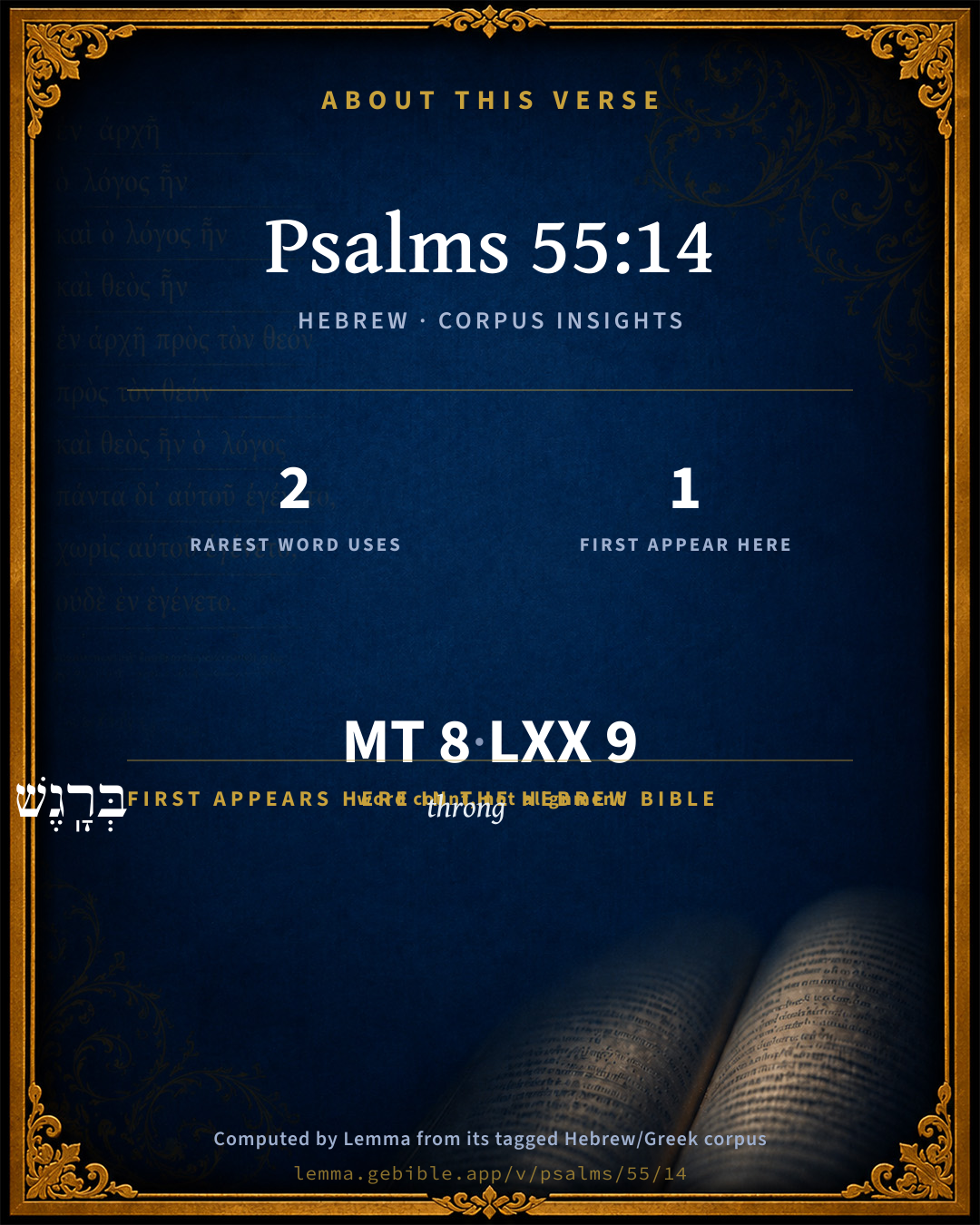
The rarest word here is בְּרָֽגֶשׁ throng H7285 — appearing just 2 times in the whole Hebrew Bible.

First appearance in Scripture

This word makes its first canonical appearance in the Hebrew Bible here:

  • בְּרָֽגֶשׁ throng H7285

Shared distinctive vocabulary

בְּרָֽגֶשׁ throng H7285 occurs in 2 verses of the Hebrew Bible. Also found in:

Grammatical profile

  • 2 verbs
  • 4 nouns
  • 1 adverb
  • 1 particle

Verb forms

  • נַמְתִּ֣יק Hiphil · Imperfect
  • נְהַלֵּ֥ךְ Piel · Imperfect

Hebrew & Septuagint length

In English translation the verse runs 12 words from the Hebrew and 17 from the Septuagint (LXX English) — closely comparable.

A rough comparison of the two English renderings, which tokenize alike — not a word-level alignment.

Word counts can differ between the Hebrew and the Greek without any difference in meaning — e.g. the Hebrew direct-object marker אֵת has no separate Greek word, and Greek often adds the article ὁ.

In the original languages it is 8 Hebrew tokens and 9 Greek tokens — but the two are counted differently (Hebrew bundles its prefixes and suffixes into one token; the Greek is in lemma form), so that isn’t a like-for-like length.

Cross-references

4

Topical passages linked to Psalms 55:14 in the Treasury of Scripture Knowledge — connected by theme and wording, ordered by reader-vote popularity; previews shown in the World English Bible.

  • Psalms 42:4 These things I remember, and pour out my soul within me, How I used to go with the crowd, and led them to the house of God, With the voice of joy and praise, a multitude keeping a holy day.
  • Ezekiel 33:31 They come to you as the people comes, and they sit before you as my people, and they hear your words, but don't do them; for with their mouth they show much love, but their heart goes after their gain.
  • Psalms 122:1 I was glad when they said to me, "Let's go to Yahweh's house!"
  • Isaiah 2:3 Many peoples shall go and say, "Come, let's go up to the mountain of Yahweh, To the house of the God of Jacob; And he will teach us of his ways, And we will walk in his paths. For out of Zion the law shall go forth, And the word of Yahweh from Jerusalem.

Cross-references courtesy of OpenBible.info (CC BY 4.0).

Hebrew and Greek witnesses Masoretic Hebrew ↔ Greek Septuagint

The same verse in the two great witnesses to the Old Testament, shown verse-for-verse.

You’re reading Greek Psalm 54 (Hebrew Psalm 55). The Septuagint counts the superscription, so verse numbers can differ from the Hebrew — chapter-level alignment, not verse-by-verse. Numbering follows Rahlfs.

These are two independent witnesses, not word-aligned to each other, and the Septuagint is shown in lemma (dictionary) form.

Hebrew Psalms 55:14 Masoretic · Westminster Leningrad Codex

אֲשֶׁ֣ר יַ֭חְדָּו נַמְתִּ֣יק ס֑וֹד בְּבֵ֥ית אֱ֝לֹהִ֗ים נְהַלֵּ֥ךְ בְּרָֽגֶשׁ

We took sweet fellowship together. We walked in God's house with company.

World English Bible · Public Domain

Greek LXX Greek Psalm 54:14 Septuagint · lemma form

σύ δέ ἄνθρωπος ἰσόψυχος ἡγεμών ἐγώ καί γνωστός ἐγώ

who in companionship with me sweetened our food: we walked in the house of God in concord.

LXX2012 (modern English Septuagint) · Public Domain

On this verse, The Cambridge Bible for Schools and Colleges discusses the Septuagint’s reading. Read the note in Commentary ↓

Hebrew: Westminster Leningrad Codex (CC BY 4.0). Greek: Septuagint (public domain); English from LXX2012 (modern English Septuagint) (Public Domain). How the Septuagint differs from the Hebrew →

Commentary

Notes on Psalms 55:14 from classic Christian and Jewish commentators (each source and its license shown beneath its notes). The classic Christian expositions comment on the surrounding passage and are grouped to its opening verse, so a note may address several verses; the Jewish commentaries on the Tanakh (Rashi and others) are per-verse, so they appear only where the commentator wrote on this verse.

Lemma curates 59 commentaries, every one of them public domain or Creative Commons licensed, each selected and text-cleaned for this edition rather than reprinted as found. About our sources →

Trapp's Complete Commentary

John Trapp

Psa 55:14 We took sweet counsel together, [and] walked unto the house of God in company.

Ver. 14. We took sweet counsel together] It was my great delight to confer and consult with him, especially about the things of God and the exercises of religion; which is or should be sacratissimum inter homines vinculum, the straitest tie of all. Religioa religando.

And walked unto the house of God in company] But so do those false Italians, who carry a pocket Church book with a pistol hid in the binding, which, turning to such a page, dischargeth; a plot to entrap him whom they hate, even while they are in their devotions together, when there is the least suspicion (II Mercurio Italico, Introd.).

John Trapp, A Commentary or Exposition upon All the Books of the Old and New Testament (1647–1656) — public domain. Text from a community e-Sword module.

The Biblical Illustrator

Joseph S. Exell

Psa_55:14

We took sweet counsel together, and walked unto the house of God in company.

The union of religion with friendship recommended

I. Religion will, in a very high degree, multiply and exalt the present pleasures of friendship. The pleasure of sympathy, we know, always hears a direct proportion to the magnitude and intrinsic interest of the subject by which it is excited. It will be readily granted, that when the subjects of our contemplation possess intrinsic dignity, when our thoughts themselves are high and employed upon high things, we feel greater pleasure in their interchange, and mark with warmer satisfaction the sympathy of those whom we esteem. But for grandeur of extent and depth of interest united, where is the subject that will bear a moments comparison with religion?

II. The pleasure which we take in the sympathy of our friends on any subject will be affected, not only by its inherent dignity and importance, but also by the relation which it bears to ourselves personally, by the individual interest, greater or less, which we have in it. Those circumstances and events in which we feel ourselves most immediately and deeply concerned; our prospects in life, for instance, our plans of usefulness or enjoyment, the fortunes and interests of our connections, the characters and conduct of our friends--these are the subjects which are reserved most carefully for the private ear of friendship, on which we look for corresponding emotions of sympathy with the greatest anxiety, and hail them with the most lively pleasure. To have the same desires and the same aversions, has been said to constitute true friendship; to the perfection of which, therefore, it must be necessary, that these desires and aversions exist in corresponding strength, where the exciting causes are the same. The deeper the interest felt, and the more complete the sympathy, the greater will be the pleasure derived from it. But what is there of more essential importance to our happiness than religion?

III. As the pleasures of religious sympathy are likely to be greater in proportion to the superior dignity and deeper interest of the exciting cause; so also will they be heightened by reflection on the purity and excellence of the source from which they spring. Combined pleasures heighten and improve each other. Do we receive gratification from a worthy object, from one which we know ought to excite it? The consideration of the worth of that object, and the moral approbation consequent thereon, increase the gratification. Sympathetic feelings of satisfaction and pleasure may be called forth very strongly by a trifling and unworthy cause; but when this is the case, such pleasure will unavoidably be diminished by reflection; it will not bear examination; it cannot stand the test of time. Not so the pleasures of religious sympathy; the sources of these are always high and exalted; the subjects of them ever worthy the contemplation of the immortal soul. (A. R. Beard.)

Religion the assuager of the pains, and consoler of the sorrow, of friendship

I. In the tedious hours of absence, how powerful is the influence of religion to calm the anxieties, and keep alive the sympathies, of friendship.

Friends who have a lively faith, a firm confidence in an omnipresent God, need never consider themselves as separate or far distant from each other. Mountains may intervene, oceans may roll between them; one may dwell on the bosom of the boundless deep, the other far inland, in the valley amongst the hills; yet are they not apart; they have a bond of union of which the world thinks not; they are, and feel themselves, united in Him who is never far from any one of us, but in whom, at every instant of time, we live, and move, and have our being. God is with them as their common father, benefactor, and friend,

II. Religion will have power to console us when obliged to witness the temporal sufferings of those whom we love. Who is there that does not grieve to trace the expression of pain or sorrow in the countenance of a friend, especially when he feels himself unable to remove the source from which it springs? A friend is cast down in the world, and we possess not the means of raising him; he is tortured by disease, to which we can bring no relief; these, indeed, are severe trials, yet religion will teach us how to bear and to improve them. It is from her we learn that the Father of our race doth never willingly afflict or grieve His children --that He chastens them not for His own pleasure, but for their profit, that they may be made partakers of His holiness. These, surely, are consolatory words to him who is called to witness the sufferings of a friend; words that may serve at once to console his own mind, and to suggest to him the best topics of consolation.

III. Religion will bring consolation to us, when suffering under a painful sense of the moral imperfections of our friends. She will carry our view forward to that blessed country where sin and sorrow shall be no more, where the great enemy shall cease from troubling, and the good man, freed from the assaults of temptation, shall be at rest. Then shall the good qualities of the virtuous friend shine forth with unclouded lustre, and the attachment formed on earth be continued in heaven, unalloyed by sorrow and undisturbed by sin.

IV. Even to him who mourns the utter moral degradation and consequent estrangement of a friend, religion will bring some comfort. She will soothe him with the consciousness of having done everything to prevent a catastrophe so mournful. She will provide him with a sure refuge in that Friend who cannot become unworthy of him, and will not desert him. (A. R. Beard.)

The Biblical Illustrator, edited by Joseph S. Exell (c. 1880s–1900s) — public domain. Text from a community e-Sword module.

J. A. Alexander on Psalms

Joseph Addison Alexander

15. (Psa 55:14). (With) whom we take sweet counsel; in the house of God we march with noise. The future forms can only be accounted for by supposing that he here anticipates a violation of the laws of friendship which had not yet visibly occurred. The false friend, of whom he is complaining, seems to be one with whom he is still intimate, but whose defection he clearly fore saw. As if he had said, "With this man I must still continue to be associated, although he is eventually to betray me." In this particular, the case described resembles that of our Lord and Judas Iscariot, which may indeed be considered as included in the general description. The form of the first clause is idiomatic and peculiar: who (or as to whom) together we will sweeten counsel, or rather confidential intercourse. See above, on Psa 25:14. The other clause may possibly mean, we march to the house of God. But the strict sense of the particle may be retained and the whole referred to solemn processions within the sacred enclosure or court of the tabernacle. With noise, i.e. with festive tumult. See above, on Psa 42:4.

Joseph Addison Alexander, The Psalms Translated and Explained (1850) — public domain. Text from a community e-Sword module.

Jamieson, Fausset & Brown

Robert Jamieson, A. R. Fausset & David Brown

in company--literally, "with a crowd," in a festal procession.

Jamieson, Fausset & Brown — Commentary Critical and Explanatory on the Whole Bible (1871) — public domain (CC PDM 1.0). Text via the HelloAO Bible API.

Adam Clarke's Commentary

Verse 14. Walked unto the house of God in company.] Or with haste; for the rabbins teach that we should walk hastily TO the temple, but slowly FROM it.

Adam Clarke's Commentary on the Bible (1810–1826) — public domain. Text from a community e-Sword/MySword module.

Ellicott's Commentary for English Readers

(14) And walked . . .—i.e., joined the great public processions to the temple. (Comp. Psa_44:4.) The word rendered “company” occurs again (Psa_64:2. Authorised Version, “insurrection.” Comp. the same root, Psa_2:1.) The intimacy of these former friends was public as well as private.

A Bible Commentary for English Readers, edited by Charles John Ellicott (1878–1897) — public domain. Text from a community e-Sword module.

The Cambridge Bible for Schools and Colleges

gen. ed. J. J. S. Perowne

14. We were wont to take sweet counsel together,

To walk in the house of God with the throng.

Ours was an habitual intimacy of the closest and most sacred kind, in confidential intercourse in private, in companionship in the worship of God in public. The throng is the festal procession or assembly of worshippers; the “multitude keeping holyday” of Psa_42:4 (where however the word for throng is different). The P.B.V. as friends follows the LXX ἐν ὁμονοίᾳ, ‘in concord,’ Vulg. cum consensu.

The Cambridge Bible for Schools and Colleges (gen. ed. J. J. S. Perowne; Cambridge University Press, 1878–1918) — public domain. Text from a community e-Sword module.

John Gill's Exposition

Let death seize upon them,.... Ahithophel and his accomplices, Judas and the men with him; as a mighty man, as the king of terrors, and shake them to pieces. Or, "let him exact upon them" (a); as a creditor upon the debtor, and demand the debt of punishment for sin: or let him come upon them at an unawares; let them not die a natural, but a violent death. The Targum mentions Doeg and Ahithophel;

and let them, go down quick into hell: as Korah, Dathan, and Abiram, went down quick or alive into the earth; so let these men die, and descend into the grave, in their full strength; and accordingly Absalom and Ahithophel died sudden and violent deaths, Sa2 17:23; and so did Judas, Mat 27:5; and the beast and false prophet, another part of the antitype, will be taken and cast alive into the lake of fire, Rev 19:20;

for wickedness is in their dwellings; and dwells in them; wherever they go or sojourn, this goes and abides with them, being the reigning principle in their hearts and lives;

and among them; in the midst of them; their inward part is very wickedness. The Targum is, "in their bodies". But rather the sense is, in their hearts; wickedness was both in their houses and in their hearts, and is the reason of the imprecation on them; which arises not from a revengeful spirit, but from a zeal for the glory of God; and is to be considered as a prophecy of what would be, and not to be drawn into an example for private Christians to act by.

(a) "exigat debitum", Pagninus; "aget vel agat exactorem", Junius & Tremellius, Piscator, Cocceius, Gejerus, Amama.

John Gill's Exposition of the Whole Bible (1746–1763) — public domain (CC PDM 1.0). Text via the HelloAO Bible API.

Albert Barnes' Notes on the Bible

We took sweet counsel together - Margin, “who sweetened counsel.” Literally, “We sweetened counsel together;” that is, We consulted together; we opened our minds and plans to each other; in other words, We found that happiness in each other which those do who freely and confidentially communicate their plans and wishes - who have that mutual satisfaction which results from the approval of each other’s plans.

And walked unto the house of God in company - We went up to worship God together. The word rendered “company” means properly a noisy crowd, a multitude. The idea here is not that which would seem to be conveyed by our translation - that they went up to the house of God in company “with each other,” but that both went with the great company - the crowd - the multitude - that assembled to worship God. They were engaged in the same service, they united in the worship of the same God; associated with those that loved their Maker; belonged to the companionship of those who sought his favor. There is nothing that constitutes a stronger bond of friendship and affection than being united in the worship of God, or belonging to his people. Connexion with a church in acts of worship, ought always to constitute a strong bond of love, confidence, esteem, and affection; the consciousness of having been redeemed by the same blood of the atonement should be a stronger tie than any tie of natural friendship; and the expectation and hope of spending an eternity together in heaven should unite heart to heart in a bond which nothing - not even death - can sever.

Albert Barnes' Notes on the Bible (1834–1885) — public domain. Text from a community e-Sword/MySword module.

Matthew Poole's English Annotations

We took sweet counsel together; I imparted my secret thoughts and designs to him with great delight and satisfaction.

We walked unto the house of God; we agreed no less in exercises of piety, than in acts of state and policy. In company; or, in comfort, or with consent; as all the ancients render it. He seemed as forward in religion as I.

Matthew Poole's English Annotations on the Holy Bible (1683–1685) — public domain. Text from a community e-Sword/MySword module.

The Treasury of David

Charles H. Spurgeon

Ver. 14. We took sweet counsel together. It was not merely the counsel which men take together in public or upon common themes, their fellowship had been tender and confidential. The traitor had been treated lovingly, and trusted much. Solace, mutual and cheering, had grown out of their intimate communings. There were secrets between them of no common kind. Soul had been in converse with soul, at least on David's part. However feigned might have been the affection of the treacherous one, the betrayed friend had not dealt with him coldly, or guarded his utterance before him. Shame on the wretch who could belie such fellowship, and betray such confidence!

And walked unto the house of God in company. Religion had rendered their intercourse sacred, they had mingled their worship, and communed on heavenly themes. If ever any bonds ought to be held inviolable, religious connections should be. There is a measure of impiety, of a detestable sort, in the deceit which debases the union of men who make profession of godliness. Shall the very altar of God be defiled with hypocrisy? Shall the gatherings of the temple be polluted by the presence of treachery? All this was true of Ahithophel, and in a measure of Judas. His union with the Lord was on the score of faith, they were joined in the holiest of enterprises, he had been sent on the most gracious of errands. His cooperation with Jesus to serve his own abominable ends stamped him as the firstborn of hell. Better had it been for him had he never been born. Let all deceitful professors be warned by his doom, for like Ahithophel he went to his own place by his own hand, and retains a horrible preeminence in the calendar of notorious crime. Here was one source of heart break for the Redeemer, and it is shared in by his followers. Of the serpent's brood some vipers still remain, who will sting the hand that cherished them, and sell for silver those who raised them to the position which rendered it possible for them to be so abominably treacherous.

Ver. 14. We took sweet counsel. From qtx to be sweet, and the ordinary notion of dwo for secret, the phrase dwo qytmg will literally be read, we made our secret sweet. And so it may be an elegance, to signify the pleasure of his friendship, or of communicating secrets to him. Henry Hammond.

Ver. 14. The first clause speaks of private intimacy, the next of association in public acts, and especially in the great festivals and processions of the temple. J. J. Stewart Perowne, 1864.

Ver. 14. In company. In the end of the verse vgrk may be rendered with a noise: and so the Chaldee seems to have taken it, which reads with haste; and to that agree the Jewish doctors, who tell us men are to go in haste and with speed to the synagogue, but return thence very leisurely. Henry Hammond.

Ver. 14. The social companionships which grow out of religion.

1. They are on a good foundation.

2. They yield profit--counsel.

3. They yield pleasure--sweet.

4. They lead to enthusiasm--walked in company.

5. They ought to be sacredly maintained.

6. But they need to be carefully watched.

Psalms 55:15*

Charles H. Spurgeon's The Treasury of David (1869–1885) — public domain. Psalms only. Text from a community e-Sword/MySword module.

Whedon's Commentary on the Bible

Daniel D. Whedon

14. We took sweet counsel together—Their mutual counsel on public affairs had been made sweet by friendship and confidence. The word “counsel” is rendered secret, secret counsel, Psa_25:14; Psa_64:2; Pro_3:32. Thus far their personal and political life had been blended. The secrets of government and state policy were well known to Ahithophel. But more than this was their religions life. “We… walked unto the house of God in company.”

Daniel D. Whedon (gen. ed.), Commentary on the Old and New Testaments (1874–1909) — public domain. Text from a community e-Sword module.

The Pulpit Commentary

We took sweet counsel together. (comp. 2Sa_15:12 2Sa_16:23 1Ch_27:33) And walked unto the house of God in company; rather, in the throng (Cheyne, Revised Version); i.e. in the midst of the crowd of worshippers. When David went up to the house of God, who is more likely to have accompanied him than his chief "counsellor"?

The Pulpit Commentary (1880–1919), ed. H.D.M. Spence-Jones & Joseph S. Exell — public domain. Text from a community e-Sword module.

Rashi

Rabbi Shlomo Yitzchaki (Rashi)

a man of my equal A man as important as I.

and my esteemed one Heb. ומידעי, like אלוּפי, my prince, an expression of (Exod. 33:17): “and I recognized you (ואדעך),” which is translated וְרַבִּיתָךְ “and I made you great.” Menachem (p. 94), however, explained that “For no enemy would revile me that I should bear” is connected to (verse 7): “If only I had wings like a dove! I would fly away and be at rest.” If I could raise my wings, I would fly away and wander on account of the distress of the wicked [inflicted upon me], for when I would leave the midst of the assembly of the profligate to lodge in the desert forever, then no enemy would revile me; I would not [have to] bear my disgrace and my shame, and I would not hide from him as I hid from them when I was among them. However, this interpretation is impossible, because of the verses following it, namely: And you are a man of my equal, my prince, and my esteemed one (verse 14); that together we would devise counsel; in the house of God we would walk with a multitude (verse 15). Therefore, Dunash (p. 94) interprets it in another manner, and this is its interpretation: For it is not an enemy who reviles me that I should bear my abuse, and it is not my enemy who opens his mouth wide against me, but my prince and my esteemed one, that together we would take counsel; in the house of God we would walk with a multitude. This thing is known, that the abuse of a friend is harder for a person [to bear] than the abuse of an enemy. Moreover, one can hide from his enemy, but one cannot hide from his friend when he tells him all that is in his heart. The context corroborates this [interpretation].

Rashi on the Tanakh — English translations: “The Judaica Press complete Tanach with Rashi, translated by A. J. Rosenberg” (CC BY 4.0); “Pentateuch with Rashi's commentary by M. Rosenbaum and A.M. Silbermann, 1929-1934” (public domain); “The Metsudah Tanach series, Lakewood, N.J” (CC BY 4.0); and “The Book of Joshua, Metsudah Publications, 1997” (CC BY 4.0). Text via Sefaria.

Lesson kit

Teaching starters — assembled from the data on this page, not authored interpretation. Every prompt links to the verse data it draws on. Edit before teaching.

Psalms, in the Wisdom, opens this verse with 8 words (8 distinct Hebrew lemmas). Its most distinctive word is regesh (“throng”). A historical commentator’s framing appears above. Read the whole chapter for the surrounding context.

Discussion questions

  1. What does “throng” (regesh) contribute to the verse as a whole?
  2. This is the first place “throng” appears in Scripture (first appears here). What does its debut here establish?
  3. How does Psalms 64:2, which shares the word «throng», read alongside this verse?
  4. These translations render this verse differently; the difference is in the English rendering, not the original. What questions does that raise?
  5. «נַמְתִּ֣יק» is a Hiphil Imperfect verb. How does that grammatical form shape the action described?
  6. Compare how Trapp's Complete Commentary and The Biblical Illustrator read this verse. Where do they agree or differ?

Things to notice

Reading settings

Reading text

Shown beneath each verse's original-language words.

Old Testament
Old Testament edition

Read the OT as the Masoretic Hebrew (MT) or the Greek Septuagint (LXX).

English shown for the Greek Septuagint (in the Hebrew ↔ Greek comparison).

Comparing translations? Open the Compare panel on any verse page to stack up to four side by side.