Deuteronomy 12:22

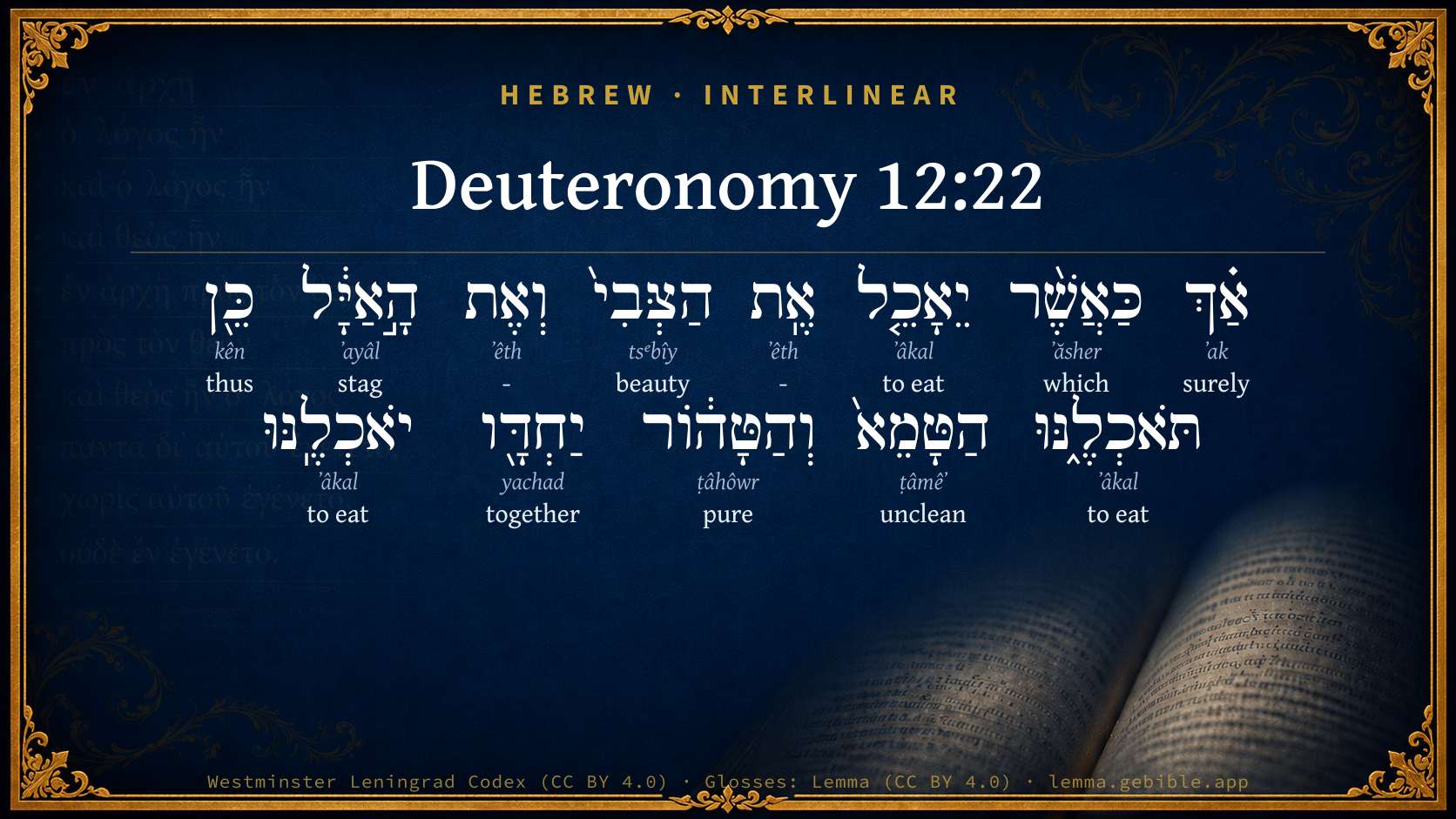
Hebrew (Westminster Leningrad Codex) Deuteronomy 12:22 appears in the Hebrew Old Testament. The text above is from the Westminster Leningrad Codex. Each word links to its Strong’s number, a concise gloss, and parsing drawn from the Open Scriptures Hebrew Bible morphology. Click any word for its full Brown-Driver-Briggs (BDB) entry.
Download image
Cite this verse

Deuteronomy 12:22 (World English Bible). Public Domain. Lemma interlinear Bible study tool, https://lemma.gebible.app/v/deuteronomy/12/22.

Show BibTeX & RIS
BibTeX
RIS
English Translation
Even as the gazelle and as the hart is eaten, so you shall eat of it: the unclean and the clean may eat of it alike.
World English Bible · Public Domain
Download a study sheet

One document with this verse’s original text, its word-by-word gloss line, the meaning frame, cross-references with their text, attributed commentary, and full source and license credits — printable, and it pastes into notes with its structure intact.

This verse Autodidact and up

Study sheet (.html) Plain text (.txt)

A passage Seminary Student

Up to 50 verses in one chapter. A passage sheet keeps up to 6 commentary sources and 12 cross-references per verse, in the order this page ranks them, and says so on the sheet whenever that leaves anything out. Ask for a single verse and you get the Autodidact verse sheet above.

Everything on this page stays free to read, with no account — the sheet is a download of what is already on screen, not access to it.

Want to remove ads? Support Godless Engineer
Compare translations 3

The same verse in 3 English versions, stacked beneath the original-language interlinear above. Click any original word for its lexicon entry.

Each is an independent rendering of the whole verse — the interlinear is not word-aligned to these translations.

Highlighted words mark where these versions differ — a whole-verse word diff, not a word-by-word alignment.

  • World English Bible Public Domain
    Even as the gazelle and as the hart is eaten, so you shall eat of it: the unclean and the clean may eat of it alike.
  • King James Version Public Domain
    Even as the roebuck and the hart is eaten, so thou shalt eat them: the unclean and the clean shall eat of them alike.
  • unfoldingWord Literal Text CC BY-SA 4.0
    Surely as the gazelle and the deer are eaten, so you will eat it; the unclean and the clean alike may eat it.

unfoldingWord Literal Text — © unfoldingWord, licensed CC BY-SA 4.0. Word-aligned USFM3 via Door43 (git.door43.org/unfoldingWord/en_ult).

Versions to compare (up to 4)

3 of 4 selected

Show all 18 translations

Every available English version of this verse, each an independent rendering of the whole verse.

  • World English Bible Public Domain
    Even as the gazelle and as the hart is eaten, so you shall eat of it: the unclean and the clean may eat of it alike.
  • Berean Standard Bible Public Domain
    Indeed, you may eat it as you would eat a gazelle or deer; both the ceremonially unclean and the clean may eat it.
  • Majority Standard Bible Public Domain
    Indeed, you may eat it as you would eat a gazelle or deer; both the ceremonially unclean and the clean may eat it.
  • King James Version Public Domain
    Even as the roebuck and the hart is eaten, so thou shalt eat them: the unclean and the clean shall eat of them alike.
  • American Standard Version (1901) Public Domain
    Even as the gazelle and as the hart is eaten, so thou shalt eat thereof: the unclean and the clean may eat thereof alike.
  • Revised Version (1885) Public Domain
    Even as the gazelle and as the hart is eaten, so thou shalt eat thereof: the unclean and the clean shall eat thereof alike.
  • Geneva Bible (1599) Public Domain
    Euen as the roe bucke, and the hart is eaten, so shalt thou eat them. both the vncleane and the cleane shall eate of them alike.
  • Douay-Rheims (1899) Public Domain
    Even as the roe and the hart is eaten, so shalt thou eat them: both the clean and unclean shall eat of them alike.
  • Young's Literal Translation Public Domain
    only, as the roe and the hart is eaten, so dost thou eat it; the unclean and the clean doth alike eat it.
  • Literal Standard Version CC BY-SA 4.0
    only, as the roe and the deer is eaten, so do you eat it; the unclean and the clean alike eat it.
  • Unlocked Literal Bible CC BY-SA 4.0
    Like the gazelle and the deer are eaten, so you will eat of it; the unclean and the clean persons may eat of it alike.
  • unfoldingWord Literal Text CC BY-SA 4.0
    Surely as the gazelle and the deer are eaten, so you will eat it; the unclean and the clean alike may eat it.
  • Darby Bible Public Domain
    Even as the gazelle and the hart is eaten, so thou shalt eat them: the unclean and the clean alike may eat of them.
  • World Messianic Bible Public Domain
    Even as the gazelle and as the deer is eaten, so you shall eat of it. The unclean and the clean may eat of it alike.
  • Webster's Bible Public Domain
    Even as the roebuck and the hart is eaten, so thou shalt eat them: the unclean and the clean shall eat of them alike.
  • Free Bible Version CC BY-SA 4.0
    In fact you can eat it like you would eat a gazelle or deer—whether you're ceremonially clean or not, you can eat it.
  • Bible in Basic English Public Domain
    It will be your food, like the gazelle and the roe; the unclean and the clean may take of it.
  • JPS Tanakh (1917) Public Domain
    Howbeit as the gazelle and as the hart is eaten, so thou shalt eat thereof; the unclean and the clean may eat thereof alike.

Literal Standard Version (2020), Covenant Press — licensed CC BY-SA 4.0. Text via the HelloAO Bible API (eBible.org). Unlocked Literal Bible (unfoldingWord) — licensed CC BY-SA 4.0. Text via the HelloAO Bible API (eBible.org). unfoldingWord Literal Text — © unfoldingWord, licensed CC BY-SA 4.0. Word-aligned USFM3 via Door43 (git.door43.org/unfoldingWord/en_ult). Free Bible Version, Dr. Jonathan Gallagher — licensed CC BY-SA 4.0. Text via the HelloAO Bible API (eBible.org).

Word by word

More ways to search: Search by grammar → Find every occurrence → Compare this word →

Practice this passage: Drill this verse → Learn its vocabulary →

הָ֣אַיָּ֔ל
ʼayâl
H354
“the · stag”
Particle, Definite Article + Noun, Common, Both, Singular, Absolute
Part of Speech
Particle + Noun
Type
Common
Gender
Both
Number
Singular
State
Absolute
Full BDB Definition

Origin: an intensive form of H352 (in the sense of ram)

TWOT: 45k

stag, deer, hart
  1. אַ֗ךְ ʼak H389 “surely” Particle, Accusative
  2. כַּאֲשֶׁ֨ר ʼăsher H834 “like/as · which” Preposition + Particle, Relative
  3. יֵאָכֵ֤ל ʼâkal H398 “to eat” Verb, Niphal, Imperfect, 3rd Person, Masculine, Singular
  4. אֶֽת ʼêth H853 “-” Particle, Direct Object
  5. הַצְּבִי֙ tsᵉbîy H6643 “the · beauty” Particle, Definite Article + Noun, Common, Both, Singular, Absolute
  6. וְאֶת ʼêth H853 “and · -” Conjunction + Particle, Direct Object
  7. כֵּ֖ן kên H3651 “thus” Particle, Demonstrative
  8. תֹּאכְלֶ֑נּוּ ʼâkal H398 “to eat · him” Verb, Qal, Imperfect, 2nd Person, Masculine, Singular + Suffix, Personal, 3rd Person, Masculine, Singular
  9. הַטָּמֵא֙ ṭâmêʼ H2931 “the · unclean” Particle, Definite Article + Adjective, Adjective, Masculine, Singular, Absolute
  10. וְהַטָּה֔וֹר ṭâhôwr H2889 “and · the · pure” Conjunction + Particle, Definite Article + Adjective, Adjective, Masculine, Singular, Absolute
  11. יַחְדָּ֖ו yachad H3162 “together” Adverb
  12. יֹאכְלֶֽנּוּ ʼâkal H398 “to eat · him” Verb, Qal, Imperfect, 3rd Person, Masculine, Singular + Suffix, Personal, 3rd Person, Masculine, Singular

About this verse

These counts appear in no published source. They are computed here, from the morphology-tagged text and Lemma’s own curated glosses. What Lemma adds →

13
words
10
distinct lemmas
Pentateuch
section

Notable vocabulary

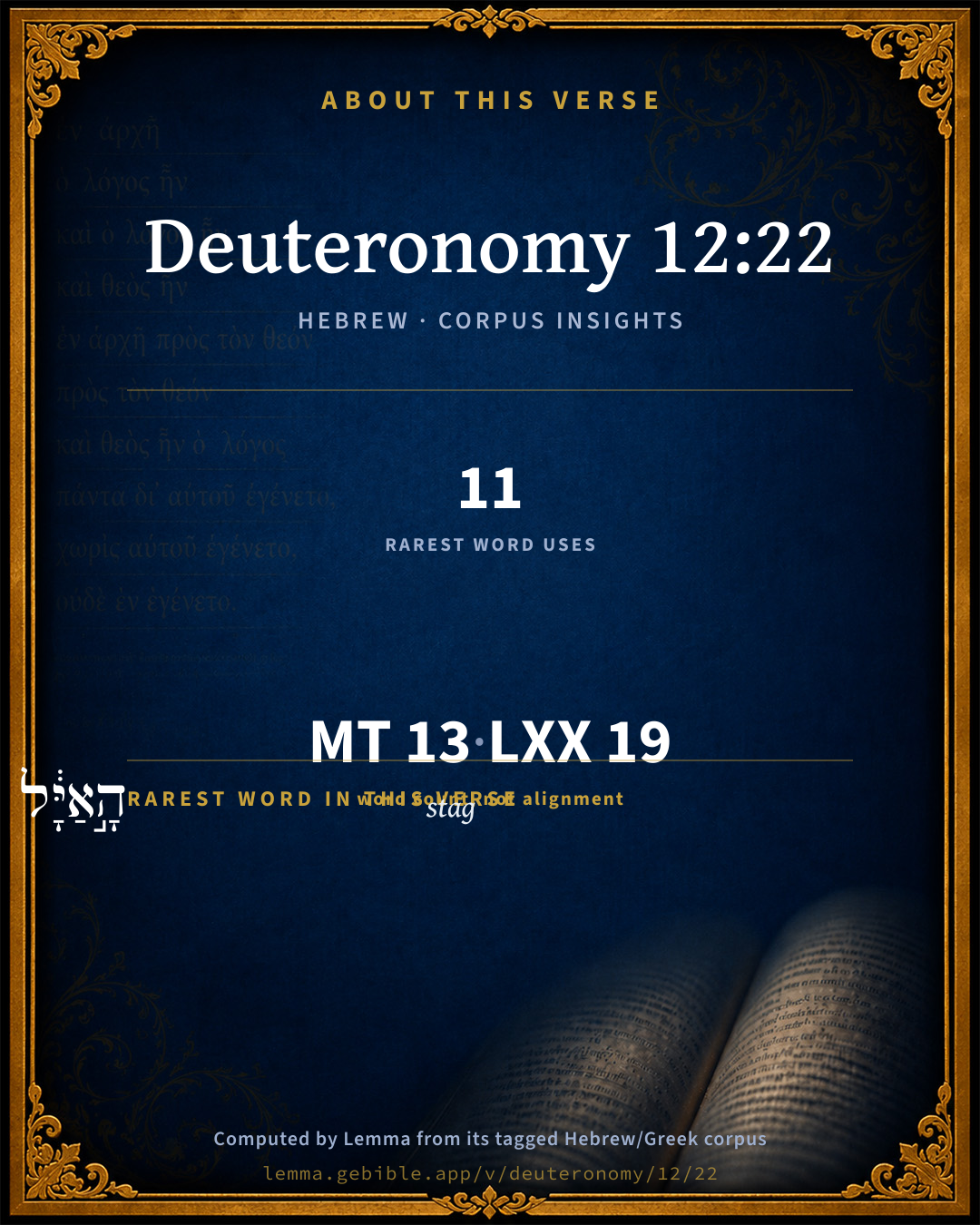
The rarest word here is הָ֣אַיָּ֔ל stag H354 — appearing just 11 times in the whole Hebrew Bible.

Shared distinctive vocabulary

הָ֣אַיָּ֔ל stag H354 occurs in 11 verses of the Hebrew Bible. Also found in:

Grammatical profile

  • 3 verbs
  • 2 nouns
  • 2 adjectives
  • 1 adverb
  • 5 particles

Verb forms

  • יֵאָכֵ֤ל Niphal · Imperfect
  • תֹּאכְלֶ֑נּוּ Qal · Imperfect
  • יֹאכְלֶֽנּוּ Qal · Imperfect

Repetition

A word recurs within this verse — often emphatic in Hebrew:

  • יֵאָכֵ֤ל to eat H398 ×3

Hebrew & Septuagint length

In English translation the verse runs 26 words from the Hebrew and 26 from the Septuagint (LXX English) — the same length.

A rough comparison of the two English renderings, which tokenize alike — not a word-level alignment.

Word counts can differ between the Hebrew and the Greek without any difference in meaning — e.g. the Hebrew direct-object marker אֵת has no separate Greek word, and Greek often adds the article ὁ.

In the original languages it is 13 Hebrew tokens and 19 Greek tokens — but the two are counted differently (Hebrew bundles its prefixes and suffixes into one token; the Greek is in lemma form), so that isn’t a like-for-like length.

Cross-references

1

Topical passages linked to Deuteronomy 12:22 in the Treasury of Scripture Knowledge — connected by theme and wording, ordered by reader-vote popularity; previews shown in the World English Bible.

  • Deuteronomy 12:15–16 Notwithstanding, you may kill and eat flesh within all your gates, after all the desire of your soul, according to the blessing of Yahweh your God which he has given you: the unclean and the clean may eat of it, as of the gazelle, and as of the hart.

Cross-references courtesy of OpenBible.info (CC BY 4.0).

Hebrew and Greek witnesses Masoretic Hebrew ↔ Greek Septuagint

The same verse in the two great witnesses to the Old Testament, shown verse-for-verse.

These are two independent witnesses, not word-aligned to each other, and the Septuagint is shown in lemma (dictionary) form.

Hebrew Deuteronomy 12:22 Masoretic · Westminster Leningrad Codex

אַ֗ךְ כַּאֲשֶׁ֨ר יֵאָכֵ֤ל אֶֽת הַצְּבִי֙ וְאֶת הָ֣אַיָּ֔ל כֵּ֖ן תֹּאכְלֶ֑נּוּ הַטָּמֵא֙ וְהַטָּה֔וֹר יַחְדָּ֖ו יֹאכְלֶֽנּוּ

Even as the gazelle and as the hart is eaten, so you shall eat of it: the unclean and the clean may eat of it alike.

World English Bible · Public Domain

Greek LXX Deuteronomy 12:22 Septuagint · lemma form

ὡς ἐσθίω ὁ δορκάς καί ὁ ἔλαφος οὕτως ἐσθίω αὐτός ὁ ἀκάθαρτος ἐν σύ καί ὁ καθαρός ὡσαύτως ἐσθίω

As the doe and the stag are eaten, so shall you eat it; the unclean in you and the clean shall eat it in like manner.

LXX2012 (modern English Septuagint) · Public Domain

Hebrew: Westminster Leningrad Codex (CC BY 4.0). Greek: Septuagint (public domain); English from LXX2012 (modern English Septuagint) (Public Domain). How the Septuagint differs from the Hebrew →

Targum (Aramaic paraphrase)

2

The Targum is the ancient Jewish Aramaic paraphrase of the Hebrew Scriptures — an interpretive translation, not the Hebrew text itself. Onkelos (literal) and Pseudo-Jonathan (expansive) render the Torah, and Jonathan the Prophets. Coverage is partial: where no permissively-licensed English translation exists for a verse, only the Aramaic is shown. This is verse-level text, not a word-by-word alignment to the Hebrew.

  1. Targum Onkelos Torah (Genesis–Deuteronomy)
    בְּרַם כְּמָא דִי מִתְאֲכֵל בְּשַׂר טַבְיָא וְאַיְלָא כֵּן תֵּיכְלִנֵהּ מְסָאָבָא וְדַכְיָא כַּחֲדָא יֵכְלִנֵהּ

    (no public-domain English translation for this verse)

    Targum Onkelos — Aramaic: “Onkelos Genesis” (public domain); “Onkelos Exodus” (public domain); “Onkelos Leviticus” (public domain); “Onkelos Numbers” (public domain); “Onkelos Deuteronomy” (public domain). English: “Sefaria Community Translation” (CC0 1.0 (public-domain dedication)); “J.W. Etheridge. The Targums of Onkelos and Jonathan Ben Uzziel on the Pentateuch. London: Longmans, Green, 1862” (public domain). Text via Sefaria.

  2. Targum Pseudo-Jonathan Torah (Genesis–Deuteronomy)
    בְּרַם הֵיכְמָא דְמִתְאָכֵל בִּישְרָא דְטַבְיָא וְאַיְלָא הֵיכְדֵין תֵּיכְלוּנֵיהּ דִּמְסָאַב לְמִקְרַב לְקוּדְשַׁיָא וְדִדְכֵי לְמִקְרַב לְקוּדְשָׁא כַּחֲדָא תֵּיכְלוּן

    as the flesh of the antelope or hart so may you eat it; he who is unclean that he may not offer holy things, and he who is clean that he may offer them, may eat of it alike.

    Targum Pseudo-Jonathan — Aramaic: “Targum Jonathan on Genesis” (public domain); “Targum Jonathan on Exodus” (public domain); “Targum Jonathan on Leviticus” (public domain); “Targum Jonathan on Numbers” (public domain); “Targum Jonathan on Deuteronomy” (public domain). English: “The Targum of Jonathan ben Uzziel, trans. J. W. Etheridge, London, 1862” (public domain). Text via Sefaria.

Commentary

Notes on Deuteronomy 12:22 from classic Christian and Jewish commentators (each source and its license shown beneath its notes). The classic Christian expositions comment on the surrounding passage and are grouped to its opening verse, so a note may address several verses; the Jewish commentaries on the Tanakh (Rashi and others) are per-verse, so they appear only where the commentator wrote on this verse.

Lemma curates 59 commentaries, every one of them public domain or Creative Commons licensed, each selected and text-cleaned for this edition rather than reprinted as found. About our sources →

Trapp's Complete Commentary

John Trapp

Deu 12:22 Even as the roebuck and the hart is eaten, so thou shalt eat them: the unclean and the clean shall eat [of] them alike.

Ver. 22. Even as the roebuck,] i.e., As common and profane meats; for these creatures were rejected for sacrifice.

John Trapp, A Commentary or Exposition upon All the Books of the Old and New Testament (1647–1656) — public domain. Text from a community e-Sword module.

Joseph Benson's Commentary

Deu 12:22. As the roe-buck — As common or unhallowed food. They might eat of such cattle as were appointed for sacrifices, no less than of those not so appointed. The unclean — Because there was no holiness in such meat for which the unclean might be excluded from it.

Joseph Benson's Commentary on the Old and New Testaments (1811–1818) — public domain. Text from a community e-Sword module.

Jamieson, Fausset & Brown

Robert Jamieson, A. R. Fausset & David Brown

Even as the roebuck and the hart is eaten, so shalt thou eat them, &c.--Game when procured in the wilderness had not been required to be brought to the door of the tabernacle. The people were now to be as free in the killing of domestic cattle as of wild animals. The permission to hunt and use venison for food was doubtless a great boon to the Israelites, not only in the wilderness, but on their settlement in Canaan, as the mountainous ranges of Lebanon, Carmel, and Gilead, on which deer abounded in vast numbers, would thus furnish them with a plentiful and luxuriant repast.

Jamieson, Fausset & Brown — Commentary Critical and Explanatory on the Whole Bible (1871) — public domain (CC PDM 1.0). Text via the HelloAO Bible API.

John Gill's Exposition

Even as the roebuck and the hart is eaten,.... Which were not only clean creatures, as before observed, but were commonly and frequently eaten, there being plenty of them in those parts:

so thou shalt eat them; their oxen and calves, their sheep and lambs, their goats and their kids:

the unclean and the clean shall eat of them alike; no difference being to be made on that account, with respect to common food; See Gill on Deu 12:15 which all alike might partake of, notwithstanding any ceremonial uncleanness that any might be attended with.

John Gill's Exposition of the Whole Bible (1746–1763) — public domain (CC PDM 1.0). Text via the HelloAO Bible API.

Haydock's Catholic Bible Commentary

Alike. This must be understood of those who had contracted only a smaller stain, which did not communicate the uncleanness to others, but debarred people from approaching to sacred things. (Calmet) --- Those who had touched the dead, &c., were not allowed to eat with people, who were not under any such legal uncleanness. (Menochius)

George Leo Haydock (1774–1849), Haydock's Catholic Family Bible and Commentary, 1859 edition — public domain. Excludes Psalms (Douay-Rheims chapter numbering differs from Protestant) and Deuterocanonical books (Catholic canon only).

Matthew Poole's English Annotations

As the roebuck and the hart; as common or unhallowed food, though they be of the same kind with the sacrifices which are offered to God.

The unclean and the clean shall eat of them alike, because there was no holiness in such meat for which the unclean might be excluded from it.

Matthew Poole's English Annotations on the Holy Bible (1683–1685) — public domain. Text from a community e-Sword/MySword module.

John Wesley's Explanatory Notes

As the roe-buck - As common or unhallowed food, tho' they be of the same kind with the sacrifices which are offered to God. The unclean - Because there was, no holiness in such meat for which the unclean might be excluded from it.

John Wesley, Explanatory Notes Upon the Whole Bible (1754–1765) — public domain. Text via the GEBible commentary corpus.

Keil & Delitzsch

C. F. Keil & F. Delitzsch

Only the flesh that was slaughtered was to be eaten as the hart and the roebuck (cf. Deu 12:15), i.e., was not to be made into a sacrifice. יחדּו, together, i.e., the one just the same as the other, as in Isa 10:8, without the clean necessarily eating along with the unclean.

Keil & Delitzsch — Biblical Commentary on the Old Testament (1861–1891) — public domain (CC PDM 1.0). Text via the HelloAO Bible API. (Old Testament only.)

Rashi

Rabbi Shlomo Yitzchaki (Rashi)

אך כאשר יאכל את הצבי וגו׳ BUT ONLY AS THE GAZELLE [AND THE HART] IS EATEN, [SO THOU SHALT EAT THEM] — i.e. thou art not admonished to eat them in a state of cleanness as is the case with sacrifices which you slaughter in a holy place; if, however, you will argue: How is the case with the gazelle and the hart? Their fat is permitted as food; so, too, is the fat of non-consecrated domestic animals (חולין) permitted! Then I reply: Scripture says אך (which word has a limitative force and thus indicates that חולין are not to be treated like the gazelle and the hart in every respect) (cf. Bekhorot 15a).

Rashi on the Tanakh — English translations: “The Judaica Press complete Tanach with Rashi, translated by A. J. Rosenberg” (CC BY 4.0); “Pentateuch with Rashi's commentary by M. Rosenbaum and A.M. Silbermann, 1929-1934” (public domain); “The Metsudah Tanach series, Lakewood, N.J” (CC BY 4.0); and “The Book of Joshua, Metsudah Publications, 1997” (CC BY 4.0). Text via Sefaria.

Ramban (Nachmanides)

Rabbi Moshe ben Nachman (Ramban / Nachmanides)

ACH’ (BUT) ONLY AS THE GAZELLE AND AS THE HART IS EATEN, SO THOU SHALT EAT THEM. This means as he explains [at the end of this verse], the unclean and the clean may eat thereof alike. Since He had commanded in the wilderness that they may not eat of the herd and flock except as peace-offerings and He warned them that the soul that eateth of the flesh of the sacrifice of peace-offerings, that pertain unto the Eternal, having his uncleanness upon him, that soul shall be cut off, he states here that [upon coming into the Land] one may eat the meat of unconsecrated animals with the full desire of his soul, and [further that] he may eat it from one vessel together with an unclean person just as, in the wilderness, they may eat the gazelle and the hart which may not be offered upon the altar. Now, the expression as the gazelle and as the hart does not mean that one may eat the fat of unconsecrated animals just as he may eat the fat of the gazelle and the hart [from which all the fat may be eaten], since the verse speaks only of the manner of eating [as if to say:] in the same way that you eat the gazelle and the hart so may you eat the meat which you slaughter in all places. The verse does not state “whatever is eaten of the gazelle and the hart, you may eat of the unconsecrated animals.” Therefore, [in order to avoid the misconception that all fat of unconsecrated animals may be eaten] he explains everywhere the unclean and the clean may eat thereof alike, and says nowhere [only] “they may eat it as the gazelle and the hart,” in order [to make it clear] that the fat should not be included [in the comparison of unconsecrated animals to the hart and gazelle].Now the word ach [but — ‘But’ only as the gazelle etc.] constitutes an admonition: since at first it was forbidden to eat [meat] except for the peace-offerings that were slaughtered in [the court of] the Tabernacle, and now, when he made it permissible to slaughter and eat in their cities after all the desire of thy soul, it might have appeared that one may eat it as unconsecrated meat and [if one wishes] even as consecrated meat, as was originally permitted [before the Tabernacle was erected], offering [the blood and the fat] on a bamah (high place). Therefore he stated and warned, But only as the gazelle and the hart, so thou shalt eat them, meaning that you may offer of them neither fat nor blood [on the bamah] and that you should not handle it in the manner of consecrated meat and not warn unclean people away from them at all.He had to mention Only you should not eat the blood for many reasons. For at first He said with reference to the prohibition of eating blood, and I have given it to you upon the altar to make atonement for your souls, from which it might appear that blood that does not atone, [such as that of] an unconsecrated animal, would not be prohibited; therefore, it was necessary to prohibit it clearly. In the case of fat, however, Scripture did not mention [such a reason for] its prohibition thereof; and [in the case of an unconsecrated animal] not all fat which is burned on the altar as the sacrificial portion of the offering is forbidden, nor is every part [of an offering] that is not burned on the altar permitted to be eaten [in the case of an unconsecrated animal], as I have written in its place., 3:9. Hence it was unnecessary to say that certain fats of an unconsecrated animal may not be eaten. Moreover, since he commanded here that we slaughter [the unconsecrated animal] and warned that we eat it in the same manner as the gazelle and the hart, it might have appeared that we are to cover its blood just as we have been commanded concerning the gazelle and the hart;, 17:13). This law does not apply to cattle. Now, since Scripture compares the unconsecrated animal to the gazelle and the hart which are in the class of wild animals we might have reasoned that the law of covering the blood also applies to unconsecrated animals; therefore it became necessary etc. therefore it became necessary [to repeat the prohibition against blood in order] to permit the pouring out of the blood upon the earth as water without covering it, [a permissibility that was not apparent in the original prohibition in Leviticus 17:11]. This is the sense of the expression ‘upon’ the earth, not “into” the earth [which would have implied] that “we cover it with dust.” And since it was necessary to mention the permission of [pouring out] the blood [without covering it] he introduced it by stating the prohibition [against eating it]. Additionally, Scripture feared lest we [mistakenly] reason concerning blood as follows: In the wilderness at a time when all their herds and flocks were peace-offerings, the meat was forbidden to be eaten until the priest would sprinkle the blood upon the altar, for such is the law of the offerings; thus the blood prevented them from eating the meat; and He further commanded concerning the gazelle and the hart that, because they are not brought as offerings, we must cover their blood with dust, and so also the blood of a fowl because a fowl may not be offered as a peace-offering. And if so [it would logically follow that] we be required to cover the blood of cattle that were slaughtered because one desired meat, or that we eat [the blood] together with the meat by stabbing the animal [instead of ritual slaughtering, in which case a large flow of blood would be avoided] and the blood would not be seen in the open field, Verse 5. for it would be more seemly that it be permissible even to eat pure blood than to pour it out upon the ground so that they shall not offer their sacrifices unto the satyrs, after whom they go astray., Verse 7. To pour blood upon the ground would give the appearance of a sacrifice to satyrs. Therefore he said that one should slaughter the herd and flock [by means of ritual slaughtering despite the abundant flow of blood] and not eat the blood with the meat through stabbing or by cutting a limb from a living animal; instead, one is to pour the blood upon the earth and not be apprehensive over it, but he must not eat it, neither alone nor with the meat. For this reason it was necessary to mention this law once more. in the case of a blemished firstling, because at first [when the firstling was yet perfect] the blood thereof was to be sprinkled upon the altar, and, therefore, it was necessary to state that when it is blemished [and thus no longer fit for the altar] they should not treat its blood with sanctity, nor with permissibility, but they are to pour it out like water and not eat it.It appears to me as a reason for this matter that at first when they were in the desert, a howling wilderness, 32:10. a place where satyrs dance there, and all those who came forth from Egypt were accustomed [to sacrifice to these satyrs], He forbade that the blood be seen in the open field and also to slaughter at all, except before the Tabernacle of G-d in order to wean them from that sin. But upon coming into the Land, when it was necessary to permit them meat of desire due to the distance from the Sanctuary, he did not fear that the blood of the herd and flock might be poured upon the ground in their homes. However, in the case of the wild animal and fowl which one traps in the field and forest, and it is customary to slaughter them there and bring them home already slaughtered, he left the commandment as it was, to cover their blood with dust, in order that they should not offer it to the satyrs. Now the Midrash of our Rabbis on the verses, Only be steadfast in not eating the blood, and Thou shalt not eat it, that it may go well with thee is a very fitting one and is appropriate to the language of Scripture, that they had a great passion for [eating blood]. 76. Therefore all these admonitions were necessary, and so much more was it necessary to mention the prohibition [against eating blood] although he did not mention the prohibition of eating [forbidden] fat.Now, it is true that this comment of our Rabbis suffices as a reason for the many admonitions that Scripture states [about blood]. Yet the expression which he said, Only be steadfast in not eating the blood is not clear to me, for what steadfastness and courage are there required to guard against [eating] blood? It would have been proper that he indicate its stringency by stating, “Take heed to yourself not to eat the blood.” Now, we find the term “steadfastness” with reference to [all] the commandments, as the Holy One, blessed be He, said to Joshua, Only be steadfast and very courageous, to observe to do according to all the law, which Moses My servant commanded thee, and so did Joshua say to Israel, Therefore be ye very courageous to keep and to do all that is written in the Book of the Law of Moses., 23:6. Now these expressions [found in Joshua] refer to all the commandments, to keep, alluding to the negative commandments, and to do, alluding to the positive commandments. But pertaining to a single commandment there is nowhere found such an expression, for, indeed, what need is there for “steadfastness” in a matter which requires only “to sit and not do” something forbidden by one of the negative commandments? But it appears to me that he mentioned steadfastness [in this prohibition against eating blood] for the reason that they were attached to blood in Egypt: that they always slaughtered their sacrifices to the satyrs, as it is written, And they shall no more offer their sacrifices unto the satyrs, after whom they go astray, Verse 7. To pour blood upon the ground would give the appearance of a sacrifice to satyrs. and it is further stated, They sacrificed unto demons, no-gods. Now, the worship [of these satyrs] consisted of eating from the blood of the sacrifices, because the blood would cause the demons to assemble and they [the worshippers] would eat over it and from it, as if they were invited by the demons to eat at the table of those demons and they become attached to them. This has already been mentioned in the book Moreh Nebuchim. This is not the main reason for the prohibition of eating blood, for Scripture itself explains the reason thereof, that the blood is the life, as is mentioned in the section Acharei Moth. But from this verse here it is clear that they were engrossed in it, and very much in pursuit of it, and they used to prophesy by means of it and tell of things to come. Therefore the verse proceeds and warns that if one should hear from blood-eaters any future event and the sign or the wonder come to pass his heart should not be enticed but instead hold fast to his integrity and his belief in G-d, and he should by no means eat of the blood nor cover up this practice [i.e., justifying it by some means]; he is not to be afraid of their words, nor be dismayed at their looks, for they are vanity, a work of delusion. Thus he warned here in the same manner that was used in admonishing concerning the false prophet because of his deceptions.

Ramban (Nachmanides) on the Tanakh — English translation: “Commentary on the Torah by Ramban (Nachmanides). Translated and annotated by Charles B. Chavel. New York, Shilo Pub. House, 1971-1976” (CC BY 4.0). Text via Sefaria.

Lesson kit

Teaching starters — assembled from the data on this page, not authored interpretation. Every prompt links to the verse data it draws on. Edit before teaching.

Deuteronomy, in the Pentateuch, opens this verse with 13 words (10 distinct Hebrew lemmas). Its most distinctive word is ʼayâl (“stag”). A historical commentator’s framing appears above. Read the whole chapter for the surrounding context.

Discussion questions

  1. How does “stag” (ʼayâl) shape what this verse is saying?
  2. Deuteronomy 12:15 shares the word «stag» with this verse. How do the two illuminate each other?
  3. “to eat” occurs 3× in this one verse. What is the effect of the repetition?
  4. These translations render this verse differently. What is at stake in choosing one wording over another?
  5. The verb «יֵאָכֵ֤ל» is Niphal Imperfect. How does its form color the action?
  6. Reading how Trapp's Complete Commentary and Joseph Benson's Commentary read this verse, where do the two commentators agree and where do they part?

Things to notice

Reading settings

Reading text

Shown beneath each verse's original-language words.

Old Testament
Old Testament edition

Read the OT as the Masoretic Hebrew (MT) or the Greek Septuagint (LXX).

English shown for the Greek Septuagint (in the Hebrew ↔ Greek comparison).

Comparing translations? Open the Compare panel on any verse page to stack up to four side by side.