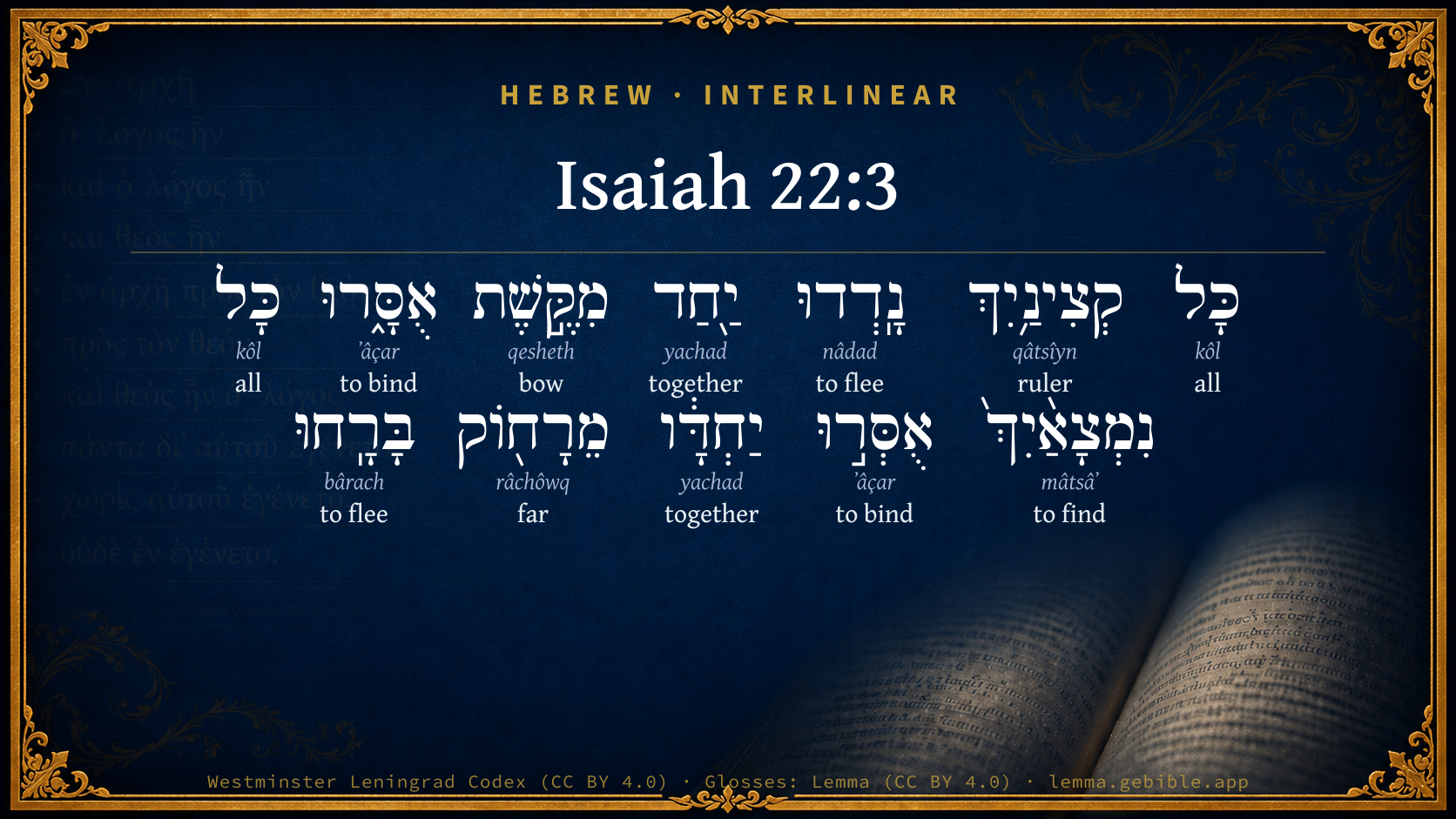
Isaiah 22:3

Hebrew (Westminster Leningrad Codex) Isaiah 22:3 appears in the Hebrew Old Testament. The text above is from the Westminster Leningrad Codex. Each word links to its Strong’s number, a concise gloss, and parsing drawn from the Open Scriptures Hebrew Bible morphology. Click any word for its full Brown-Driver-Briggs (BDB) entry.
Download image
Cite this verse

Isaiah 22:3 (World English Bible). Public Domain. Lemma interlinear Bible study tool, https://lemma.gebible.app/v/isaiah/22/3.

Show BibTeX & RIS
BibTeX
RIS
English Translation
All your rulers fled away together, they were bound by the archers; all who were found of you were bound together; they fled afar off.
World English Bible · Public Domain
Download a study sheet

One document with this verse’s original text, its word-by-word gloss line, the meaning frame, cross-references with their text, attributed commentary, and full source and license credits — printable, and it pastes into notes with its structure intact.

This verse Autodidact and up

Study sheet (.html) Plain text (.txt)

A passage Seminary Student

Up to 50 verses in one chapter. A passage sheet keeps up to 6 commentary sources and 12 cross-references per verse, in the order this page ranks them, and says so on the sheet whenever that leaves anything out. Ask for a single verse and you get the Autodidact verse sheet above.

Everything on this page stays free to read, with no account — the sheet is a download of what is already on screen, not access to it.

Want to remove ads? Support Godless Engineer
Compare translations 3

The same verse in 3 English versions, stacked beneath the original-language interlinear above. Click any original word for its lexicon entry.

Each is an independent rendering of the whole verse — the interlinear is not word-aligned to these translations.

Highlighted words mark where these versions differ — a whole-verse word diff, not a word-by-word alignment.

  • World English Bible Public Domain
    All your rulers fled away together, they were bound by the archers; all who were found of you were bound together; they fled afar off.
  • King James Version Public Domain
    All thy rulers are fled together, they are bound by the archers: all that are found in thee are bound together, which have fled from far.
  • unfoldingWord Literal Text CC BY-SA 4.0
    All of your leaders have fled together; without a bow, they have been bound. All of your found ones have been bound together; they had fled far away.

unfoldingWord Literal Text — © unfoldingWord, licensed CC BY-SA 4.0. Word-aligned USFM3 via Door43 (git.door43.org/unfoldingWord/en_ult).

Versions to compare (up to 4)

3 of 4 selected

Show all 18 translations

Every available English version of this verse, each an independent rendering of the whole verse.

  • World English Bible Public Domain
    All your rulers fled away together, they were bound by the archers; all who were found of you were bound together; they fled afar off.
  • Berean Standard Bible Public Domain
    All your rulers have fled together, captured without a bow. All your fugitives were captured together, having fled to a distant place.
  • Majority Standard Bible Public Domain
    All your rulers have fled together, captured without a bow. All your fugitives were captured together, having fled to a distant place.
  • King James Version Public Domain
    All thy rulers are fled together, they are bound by the archers: all that are found in thee are bound together, which have fled from far.
  • American Standard Version (1901) Public Domain
    All thy rulers fled away together, they were bound by the archers; all that were found of thee were bound together; they fled afar off.
  • Revised Version (1885) Public Domain
    All thy rulers fled away together, they were bound by the archers: all that were found of thee were bound together, they fled afar off.
  • Geneva Bible (1599) Public Domain
    All thy princes shall flee together from the bowe: they shalbe bound: all that shall be found in thee, shall be bound together, which haue fled from farre.
  • Douay-Rheims (1899) Public Domain
    All the princes are fled together, and are bound hard: all that were found, are bound together, they are fled far off.
  • Young's Literal Translation Public Domain
    All thy rulers fled together from the bow, Bound have been all found of thee, They have been kept bound together, Afar off they have fled.
  • Literal Standard Version CC BY-SA 4.0
    All your rulers fled from the bow together, || All found of you have been bound, || They have been kept bound together, || They have fled far off.
  • Unlocked Literal Bible CC BY-SA 4.0
    All your rulers fled away together, but they were captured without using a bow; all of them were captured together, though they had fled far away.
  • unfoldingWord Literal Text CC BY-SA 4.0
    All of your leaders have fled together; without a bow, they have been bound. All of your found ones have been bound together; they had fled far away.
  • Darby Bible Public Domain
    All thy rulers have fled together, they are taken prisoners without the bow: all that are found of thee are made prisoners together; they were fleeing far off.
  • World Messianic Bible Public Domain
    All your rulers fled away together. They were bound by the archers. All who were found by you were bound together. They fled far away.
  • Webster's Bible Public Domain
    All thy rulers have fled together, they are bound by the archers: all that are found in thee are bound together, who have fled from far.
  • Free Bible Version CC BY-SA 4.0
    All your leaders ran away together; they were captured without resistance. All your people trying to escape were captured together, even though they had run a long way away.
  • Bible in Basic English Public Domain
    All your rulers... have gone in flight; all your strong ones have gone far away.
  • JPS Tanakh (1917) Public Domain
    All thy rulers are fled together, without the bow they are bound; all that are found of thee are bound together, they are fled afar off.

Literal Standard Version (2020), Covenant Press — licensed CC BY-SA 4.0. Text via the HelloAO Bible API (eBible.org). Unlocked Literal Bible (unfoldingWord) — licensed CC BY-SA 4.0. Text via the HelloAO Bible API (eBible.org). unfoldingWord Literal Text — © unfoldingWord, licensed CC BY-SA 4.0. Word-aligned USFM3 via Door43 (git.door43.org/unfoldingWord/en_ult). Free Bible Version, Dr. Jonathan Gallagher — licensed CC BY-SA 4.0. Text via the HelloAO Bible API (eBible.org).

Word by word

More ways to search: Search by grammar → Find every occurrence → Compare this word →

Practice this passage: Drill this verse → Learn its vocabulary →

קְצִינַ֥יִךְ
qâtsîyn
H7101
“rulers · your”
Noun, Common, Masculine, Plural, Construct + Suffix, Personal, 2nd Person, Feminine, Singular
Part of Speech
Noun
Type
Common
Gender
Masculine
Number
Plural
State
Construct
Full BDB Definition

Origin: from H7096 in the sense of determining

TWOT: 2054a

chief, ruler, commander - chief, commander (in war) - dictator - ruler (of one in authority)
  1. כָּל kôl H3605 “all of” Noun, Common, Masculine, Singular, Construct
  2. נָֽדְדוּ nâdad H5074 “to flee” Verb, Qal, Perfect, 3rd Person, Common, Plural
  3. יַ֖חַד yachad H3162 “together” Adverb
  4. מִקֶּ֣שֶׁת qesheth H7198 “from · bow” Preposition + Noun, Common, Feminine, Singular, Absolute
  5. אֻסָּ֑רוּ ʼâçar H631 “to bind” Verb, Pual, Perfect, 3rd Person, Common, Plural
  6. כָּל kôl H3605 “all of” Noun, Common, Masculine, Singular, Construct
  7. נִמְצָאַ֨יִךְ֙ mâtsâʼ H4672 “finding · you” Verb, Niphal, Participle Active, Masculine, Plural, Construct + Suffix, Personal, 2nd Person, Feminine, Singular
  8. אֻסְּר֣וּ ʼâçar H631 “to bind” Verb, Pual, Perfect, 3rd Person, Common, Plural
  9. יַחְדָּ֔ו yachad H3162 “together” Adverb
  10. מֵרָח֖וֹק râchôwq H7350 “from · far” Preposition + Adjective, Adjective, Masculine, Singular, Absolute
  11. בָּרָֽחוּ bârach H1272 “to flee” Verb, Qal, Perfect, 3rd Person, Common, Plural

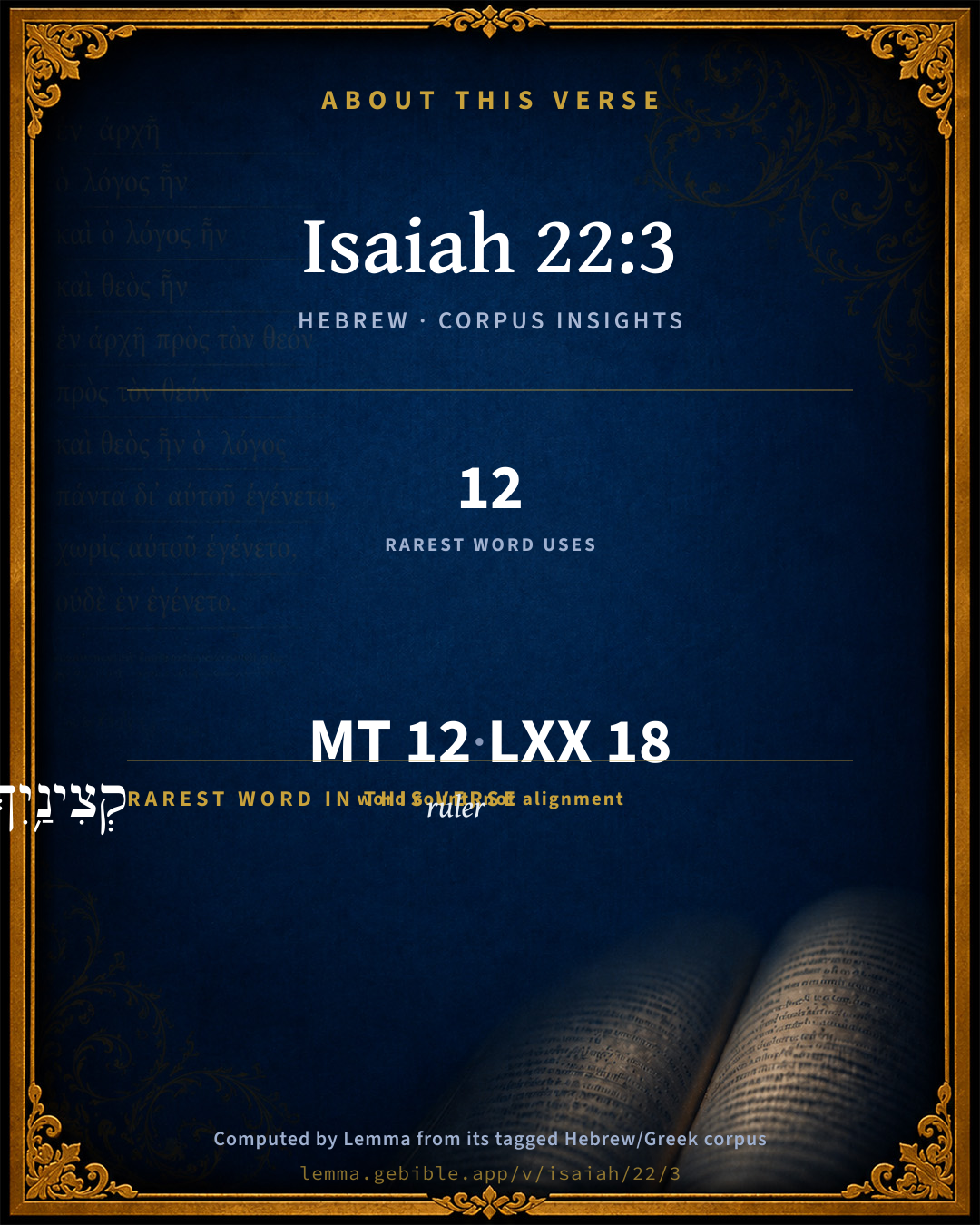
About this verse

These counts appear in no published source. They are computed here, from the morphology-tagged text and Lemma’s own curated glosses. What Lemma adds →

12
words
9
distinct lemmas
Prophets
section

Notable vocabulary

The rarest word here is קְצִינַ֥יִךְ ruler H7101 — appearing just 12 times in the whole Hebrew Bible.

Shared distinctive vocabulary

קְצִינַ֥יִךְ ruler H7101 occurs in 12 verses of the Hebrew Bible. Also found in:

Grammatical profile

  • 5 verbs
  • 4 nouns
  • 1 adjective
  • 2 adverbs

Verb forms

  • נָֽדְדוּ Qal · Perfect
  • אֻסָּ֑רוּ Pual · Perfect
  • נִמְצָאַ֨יִךְ֙ Niphal · Participle Active
  • אֻסְּר֣וּ Pual · Perfect
  • בָּרָֽחוּ Qal · Perfect

Repetition

Words recur within this verse — often emphatic in Hebrew:

  • כָּל all H3605 ×2
  • יַ֖חַד together H3162 ×2
  • אֻסָּ֑רוּ to bind H631 ×2

Hebrew & Septuagint length

In English translation the verse runs 25 words from the Hebrew and 21 from the Septuagint (LXX English) — closely comparable.

A rough comparison of the two English renderings, which tokenize alike — not a word-level alignment.

Word counts can differ between the Hebrew and the Greek without any difference in meaning — e.g. the Hebrew direct-object marker אֵת has no separate Greek word, and Greek often adds the article ὁ.

In the original languages it is 12 Hebrew tokens and 18 Greek tokens — but the two are counted differently (Hebrew bundles its prefixes and suffixes into one token; the Greek is in lemma form), so that isn’t a like-for-like length.

Cross-references

5

Topical passages linked to Isaiah 22:3 in the Treasury of Scripture Knowledge — connected by theme and wording, ordered by reader-vote popularity; previews shown in the World English Bible.

  • 2 Kings 25:4–7 Then a breach was made in the city, and all the men of war [fled] by night by the way of the gate between the two walls, which was by the king's garden (now the Chaldeans were against the city round about); and [the king] went by the way of the Arabah.
  • 2 Kings 25:18–21 The captain of the guard took Seraiah the chief priest, and Zephaniah the second priest, and the three keepers of the threshold:
  • Isaiah 3:1–8 For, behold, the Lord, Yahweh of Hosts, takes away from Jerusalem and from Judah supply and support, The whole supply of bread, And the whole supply of water;
  • Jeremiah 39:4–7 It happened that, when Zedekiah the king of Judah and all the men of war saw them, then they fled, and went forth out of the city by night, by the way of the king's garden, through the gate between the two walls; and he went out toward the Arabah.
  • Jeremiah 52:24–27 The captain of the guard took Seraiah the chief priest, and Zephaniah the second priest, and the three keepers of the threshold:

Cross-references courtesy of OpenBible.info (CC BY 4.0).

Hebrew and Greek witnesses Masoretic Hebrew ↔ Greek Septuagint

The same verse in the two great witnesses to the Old Testament, shown verse-for-verse.

These are two independent witnesses, not word-aligned to each other, and the Septuagint is shown in lemma (dictionary) form.

Hebrew Isaiah 22:3 Masoretic · Westminster Leningrad Codex

כָּל קְצִינַ֥יִךְ נָֽדְדוּ יַ֖חַד מִקֶּ֣שֶׁת אֻסָּ֑רוּ כָּל נִמְצָאַ֨יִךְ֙ אֻסְּר֣וּ יַחְדָּ֔ו מֵרָח֖וֹק בָּרָֽחוּ

All your rulers fled away together, they were bound by the archers; all who were found of you were bound together; they fled afar off.

World English Bible · Public Domain

Greek LXX Isaiah 22:3 Septuagint · lemma form

πᾶς ὁ ἄρχων σύ φεύγω καί ὁ ἁλίσκω σκληρῶς δέω εἰμί καί ὁ ἰσχύω ἐν σύ πόρρω φεύγω

All your princes have fled, and your captives are tightly bound, and the mighty men in you have fled far away.

LXX2012 (modern English Septuagint) · Public Domain

On this verse, Albert Barnes' Notes on the Bible discusses the Septuagint’s reading. Read the note in Commentary ↓

Hebrew: Westminster Leningrad Codex (CC BY 4.0). Greek: Septuagint (public domain); English from LXX2012 (modern English Septuagint) (Public Domain). How the Septuagint differs from the Hebrew →

Targum (Aramaic paraphrase)

1

The Targum is the ancient Jewish Aramaic paraphrase of the Hebrew Scriptures — an interpretive translation, not the Hebrew text itself. Onkelos (literal) and Pseudo-Jonathan (expansive) render the Torah, and Jonathan the Prophets. Coverage is partial: where no permissively-licensed English translation exists for a verse, only the Aramaic is shown. This is verse-level text, not a word-by-word alignment to the Hebrew.

  1. Targum Jonathan Prophets (Joshua–Malachi)
    כָּל שִׁלְטוֹנַיִךְ אִטַלְטַלוּ כַחֲדָא מִן קֳדָם מְתַח קַשְׁתָּא גְלוֹ כָּל דְאִשְׁתַּכַּח בִּיךְ אִיתְקְטְלוּ כַחֲדָא מֵרָחִיק עֲרַקוּ:

    All thy rulers have been led forth; from before the bent bow, they are gone into captivity together: all that were found in thee have been slain, together they have fled afar.

    Targum Jonathan — Aramaic: “Mikraot Gedolot” (public domain). English: “Sefaria Community Translation” (CC0 1.0 (public-domain dedication)); “London "Chaldee Paraphrase," 1871” (public domain). Text via Sefaria.

Commentary

Notes on Isaiah 22:3 from classic Christian and Jewish commentators (each source and its license shown beneath its notes). The classic Christian expositions comment on the surrounding passage and are grouped to its opening verse, so a note may address several verses; the Jewish commentaries on the Tanakh (Rashi and others) are per-verse, so they appear only where the commentator wrote on this verse.

Lemma curates 59 commentaries, every one of them public domain or Creative Commons licensed, each selected and text-cleaned for this edition rather than reprinted as found. About our sources →

Trapp's Complete Commentary

John Trapp

Isa 22:3 All thy rulers are fled together, they are bound by the archers: all that are found in thee are bound together, [which] have fled from far.

Ver. 3. All thy rulers are fled together.] Vagantur, As not knowing what to do, or whither to turn themselves.

All that are found in thee are bound together.] Either in fetters, {Jer 52:11} or with fear. {Psa 76:5}

Which have fled from far.] Or, They fly far away, even as fast and as far as they can out of danger.

John Trapp, A Commentary or Exposition upon All the Books of the Old and New Testament (1647–1656) — public domain. Text from a community e-Sword module.

Tyndale Open Study Notes

Tyndale Open Resources

22:3 Leaders might try to flee, but they would not escape (see 2 Kgs 25:4-6).

Tyndale Open Study Notes — © Tyndale Open Resources, licensed CC BY-SA 4.0. Text via the HelloAO Bible API.

Geneva Bible (1599)

Geneva Bible translators

Which have fled from other places to Jerusalem for succor.

And led into captivity.

Geneva Bible (1599) marginal notes — public domain. Text via Bolls.life.

Jamieson, Fausset & Brown

Robert Jamieson, A. R. Fausset & David Brown

rulers--rather, "generals" (Jos 10:24; Jdg 11:6, Jdg 11:11).

bound--rather, "are taken."

by the archers--literally, "by the bow"; so Isa 21:17. Bowmen were the light troops, whose province it was to skirmish in front and (Kg2 6:22) pursue fugitives (Kg2 25:5); this verse applies better to the attack of Nebuchadnezzar than that of Sennacherib.

all . . . in thee--all found in the city (Isa 13:15), not merely the "rulers" or generals.

fled from far--those who had fled from distant parts to Jerusalem as a place of safety; rather, fled afar.

Jamieson, Fausset & Brown — Commentary Critical and Explanatory on the Whole Bible (1871) — public domain (CC PDM 1.0). Text via the HelloAO Bible API.

Adam Clarke's Commentary

Verse 3. All thy rulers - are bound by the archers - "All thy leaders - are fled from the bow"] There seems to be somewhat of an inconsistency in the sense according to the present reading. If the leaders were bound, אסרו usseru, how could they flee away? for their being bound, according to the obvious construction and course of the sentence, is a circumstance prior to their flight. I therefore follow Houbigant, who reads הסרו huseru, remoti sunt, "they are gone off." גלו galu, transmigraverunt, Chaldee; which seems to confirm this emendation.

Adam Clarke's Commentary on the Bible (1810–1826) — public domain. Text from a community e-Sword/MySword module.

Ellicott's Commentary for English Readers

(3) They are bound by the archers.—Better, fettered without the bow. The taunting charge of cowardice is carried farther. The rulers had ventured on a sortie, and had been captured without a struggle, not even drawing their bows in their defence.

A Bible Commentary for English Readers, edited by Charles John Ellicott (1878–1897) — public domain. Text from a community e-Sword module.

The Cambridge Bible for Schools and Colleges

gen. ed. J. J. S. Perowne

3. thy rulers] thy chieftains,—the same word as in Isa_1:10, there in its civil, here in its military sense.

they are bound by the archers] Better: without bow (which they had thrown away) they were taken prisoners.

all that are found in thee] all of thine that were found. which have fled from far] Rather as R.V. they fled afar off. The text of the verse is possibly in some disorder.

The Cambridge Bible for Schools and Colleges (gen. ed. J. J. S. Perowne; Cambridge University Press, 1878–1918) — public domain. Text from a community e-Sword module.

John Gill's Exposition

All thy rulers are fled together,.... Either the rulers of Jerusalem, civil and ecclesiastical, that should have been at the head of the people, and have encouraged them, fled together to the housetops, or to the temple and strongholds; or the generals and officers of their militia, one and all of them fled, as if they had done it by joint consultation and consent; or the rulers of the several cities of Judea, which, when invaded by Sennacherib, stayed not to defend them, but left them and fled:

they are bound by the archers; or, "from the bow" (m); from using it; were in such a consternation, and under such a panic, that they had no strength nor heart to draw the bow, but were as if they were bound, and held from it: or for fear of the bow, or the archers in the Assyrian army, and therefore fled from them, as the Tigurine version renders it, joining it to the preceding clause, "they fled from the bow, they are bound"; or, as Ben Melech, for fear of the bow, they delivered themselves up, and were bound; so Aben Ezra:

all that are found in thee are bound together; that is, from the bow, as before; not only the princes, but the common people. These clauses have led many interpreters to conclude that this must be understood of the taking of the city by Nebuchadnezzar, when Zedekiah was bound in chains, and carried to Babylon, Jer 52:11,

which have fled from far; from the furthest part of the land of Judea to Jerusalem, for shelter and safety.

(m) "ab arcu", Vatablus.

John Gill's Exposition of the Whole Bible (1746–1763) — public domain (CC PDM 1.0). Text via the HelloAO Bible API.

Albert Barnes' Notes on the Bible

All thy rulers are fled together - The general idea in this verse is plain. It is designed to describe the consternation which would take place on the approach of the invader, and especially the timidity and flight of those on whom the city relied for protection and defense. Hence, instead of entering calmly and firmly on the work of defense, no inconsiderable part of the rulers of the city are represented as fleeing from the city, and refusing to remain to protect the capital. The word rendered ‘thy rulers’ (קציניך qitsiynayik) denotes either the civil rulers of the city, or military leaders. It is most usually applied to the latter Jos 10:24; Jdg 11:6, Jdg 11:11; Dan 11:18, and probably refers here to military commanders.

They are bound by the archers - Hebrew as in the margin, ‘Of the bow.’ There has been a great variety in the interpretation of this passage. The Septuagint reads it, Σκληρῶς δεδεμένοι εἰσί sklērōs dedemenoi eisi - ‘And the captives are bound with severity.’ The Chaldee, ‘And the captives migrate from before the extending of the bow.’ Jarchi renders it, ‘Who from the fear of arrows were bound so that they shut themselves up in the city.’ Houbigant and Lowth render it, ‘They are fled from the bow,’ reading it הסרוּ hâserû instead of the present Hebrew text אסרוּ 'usrû, but without the slightest authority. Vitringa renders it, ‘They were bound from treading, that is, extending, or using the bow;’ or ‘They were bound by those who tread, that is, use the bow;’ indicating that they were so bound that they could not use the bow in defense of the city. I think that the “connection” here requires that the word אסרוּ 'usrû should be used in the sense of being “bound” or influenced by fear - they were so intimidated, so much under the influence of terror, so entirely unmanned and disabled by alarm, that they could not use the bow; or this was caused “by” the bow, that is, by the bowmen or archers who came to attack the city. It is true that no other instance occurs in which the word is used in precisely this sense, but instances in abundance occur where strong passion is represented as having a controlling or disabling influence over the mind and body; where it takes away the energy of the soul, and makes one timid, feeble, helpless, as if bound with cords, or made captive. The word אסר 'âsar commonly means to bind with cords, or to fetter; to imprison Gen 42:24; Jdg 16:5; 2Ki 17:4 : to yoke 1Sa 6:7, 1Sa 6:10; and then to bind with a vow Num 30:3. Hence, it may mean to “bind” with fear or consternation.

Which have fled from far - That is, either they have fled far away; or they had fled from far in order to reach Jerusalem as a place of safety. Probably the latter is the sense.

Albert Barnes' Notes on the Bible (1834–1885) — public domain. Text from a community e-Sword/MySword module.

Matthew Poole's English Annotations

Thy rulers; Zedekiah and his chief commanders, whose flight he foretells.

They are bound by the archers, Heb. from the bow, i.e. so as they were disenabled from using the bow; which is a usual Hebraism; as from a king is put for from being a king, 1Sa 15:23; and from seeing, Psa 69:23, is rendered that they cannot see, Rom 11:10. But this word is by some, and may very well be, joined to the foregoing clause; for the words in the Hebrew lie thus, All thy rulers are fled together from the bow, (or, bow-men, as this word is rendered, Isa 21:17)

they are bound; which seems most plain and unforced, and suits best with the following words, as also with the prophet’s use of the same phrase, Isa 21:15, they fled from the bent bow, &c. All that are found in thee; that remained there with Zedekiah in the siege; for those who had fled to the Chaldeans saved their lives and liberties. Are bound together in fetters, Jer 52:11.

Which have fled from far; which fled to Jerusalem from the remotest parts of the land. But he rather speaks of those who fled from Jerusalem, and from their enemies, whereof some had fled away, but were pursued and overtaken by their enemies, and bound, as others had been. And the words seem to be well rendered, they fled far away, as this very word is used, Isa 23:7; which may be understood either of the same persons who fled, but were taken in their flight, as was now said; or of others, who fled away, when others abode, there and were bound.

Matthew Poole's English Annotations on the Holy Bible (1683–1685) — public domain. Text from a community e-Sword/MySword module.

Whedon's Commentary on the Bible

Daniel D. Whedon

3. Thy rulers are fled — This verse describes conquest and captivity.

Daniel D. Whedon (gen. ed.), Commentary on the Old and New Testaments (1874–1909) — public domain. Text from a community e-Sword module.

The Pulpit Commentary

All thy rulers are fled together; rather, all thy chief men. We must make allowance for Oriental hyperbole. The meaning is that numbers of the principal men, regarding resistance as vain, had endeavored to make their escape from the doomed town, but had been captured and bound by the enemies" archers. All that are found in thee; rather, belonging to thee. The reference is to those who had made their escape and were fleeing far away. The archers seize them, and bind them all together. We often see a number of captives bound together by a single rope in the Egyptian bas-reliefs. Which have fled from far; rather, which were flying far away.

The Pulpit Commentary (1880–1919), ed. H.D.M. Spence-Jones & Joseph S. Exell — public domain. Text from a community e-Sword module.

John Wesley's Explanatory Notes

Rulers - Zedekiah and his chief commanders, whose flight he foretells. Found - That remain there with Zedekiah in the siege; for those who had fled to the Chaldeans saved their lives and liberties. Bound - In fetters, Jer. lii, 11. Fled - Who fled from Jerusalem, but were pursued and overtaken by their enemies, and bound, as others had been.

John Wesley, Explanatory Notes Upon the Whole Bible (1754–1765) — public domain. Text via the GEBible commentary corpus.

J. A. Alexander on Isaiah

Joseph Addison Alexander

“All thy chiefs fled together-from the bow, they were bound, all that were found of thee were bound together, from afar they fled.” This verse describes the people as flying from the enemy, and being nevertheless taken. We may either read, they are bound (i.e., made prisoners) by the bow (i.e., the archers, as light-armed troops), or without the bow (i.e., not in battle, as the slain were not slain with the sword); or it may mean without resistance, without drawing a bow. Some understand it to mean, they are restrained (by fear) from (using) the bow. ‘All that were found of thee’ may be in antithesis to thy chiefs, as if he had said, not only thy chiefs but all the rest. Some understand this as describing the voluntary confinement of the people in Jerusalem during a siege; others apply it to their vain endeavors to escape from its privations and dangers. It is best to give the verse its largest meaning as descriptive of the hardships and concomitant evils, not of one siege merely but of sieges in general.

Joseph Addison Alexander, The Prophecies of Isaiah (1846–1847; New York: Scribner, 1870–1878) — public domain. Text from a community e-Sword module.

unfoldingWord translationNotes

Door43 World Missions Community

but they were captured without using a bow

This can be stated in active form. AT: "but the enemy captured your rulers who were not even carrying a bow" (See: Active or Passive)

all of them were captured together

This can be stated in active form. AT: "the enemy captured all of them together" (See: Active or Passive)

Therefore I said

Here "I" refers to Isaiah.

of the daughter of my people

Here "daughter" represents the people and may imply Isaiah's feeling of love for them. AT: "of my people whom I love" or "of my people" (See: Metonymy and Assumed Knowledge and Implicit Information)

translationWords

rule

bow and arrow

comfort

people group

unfoldingWord translationNotes — © Distant Shores Media and the Door43 World Missions Community, licensed CC BY-SA 4.0. Source: git.door43.org/Door43/en_tn.

Rashi

Rabbi Shlomo Yitzchaki (Rashi)

All your officers wandered together Zedekiah and his officers, who went out to flee at night (II Kings 25:4).

because of the bow they were bound who, because of fear of the archers, were bound to be confined within the city, and all those found therein were bound together with chains, and the majority of them fled from afar prior to this.

Rashi on the Tanakh — English translations: “The Judaica Press complete Tanach with Rashi, translated by A. J. Rosenberg” (CC BY 4.0); “Pentateuch with Rashi's commentary by M. Rosenbaum and A.M. Silbermann, 1929-1934” (public domain); “The Metsudah Tanach series, Lakewood, N.J” (CC BY 4.0); and “The Book of Joshua, Metsudah Publications, 1997” (CC BY 4.0). Text via Sefaria.

Ibn Ezra

Rabbi Abraham ibn Ezra

מקשת אסרו Because of the bow they were bound. When they saw the bow of the enemy, they surrendered out of fear, and became prisoners.

מרחוק ברחו ׳ Which have fled from far. The relative אשר which is to be supplied; comp. עם אשר לבבם שלם ═ עם לבבם שלם in behalf of those whose heart is perfect (2 Chr. 16:9)

Ibn Ezra on the Tanakh — English translations: “Sefaria Community Translation” (CC0 1.0 (public-domain dedication)); “Yalkut, Sifsei Chachomim Chumash, Metsudah Publications, 2009” (CC BY 4.0); and “Commentary of Ibn Ezra on Isaiah - trans. by M. Friedlander, 1873” (public domain). Text via Sefaria.

Lesson kit

Teaching starters — assembled from the data on this page, not authored interpretation. Every prompt links to the verse data it draws on. Edit before teaching.

Isaiah, in the Prophets, opens this verse with 12 words (9 distinct Hebrew lemmas). Its most distinctive word is qâtsîyn (“ruler”). A historical commentator’s framing appears above. Read the whole chapter for the surrounding context.

Discussion questions

  1. How does “ruler” (qâtsîyn) shape what this verse is saying?
  2. Joshua 10:24 shares the word «ruler» with this verse. How do the two illuminate each other?
  3. “all” occurs 2× in this one verse. What is the effect of the repetition?
  4. These translations render this verse differently; the difference is in the English rendering, not the original. What questions does that raise?
  5. The verb «נָֽדְדוּ» is Qal Perfect. How does its form color the action?
  6. Reading how Trapp's Complete Commentary and Tyndale Open Study Notes read this verse, where do the two commentators agree and where do they part?

Things to notice

Reading settings

Reading text

Shown beneath each verse's original-language words.

Old Testament
Old Testament edition

Read the OT as the Masoretic Hebrew (MT) or the Greek Septuagint (LXX).

English shown for the Greek Septuagint (in the Hebrew ↔ Greek comparison).

Comparing translations? Open the Compare panel on any verse page to stack up to four side by side.