Zechariah 10:4

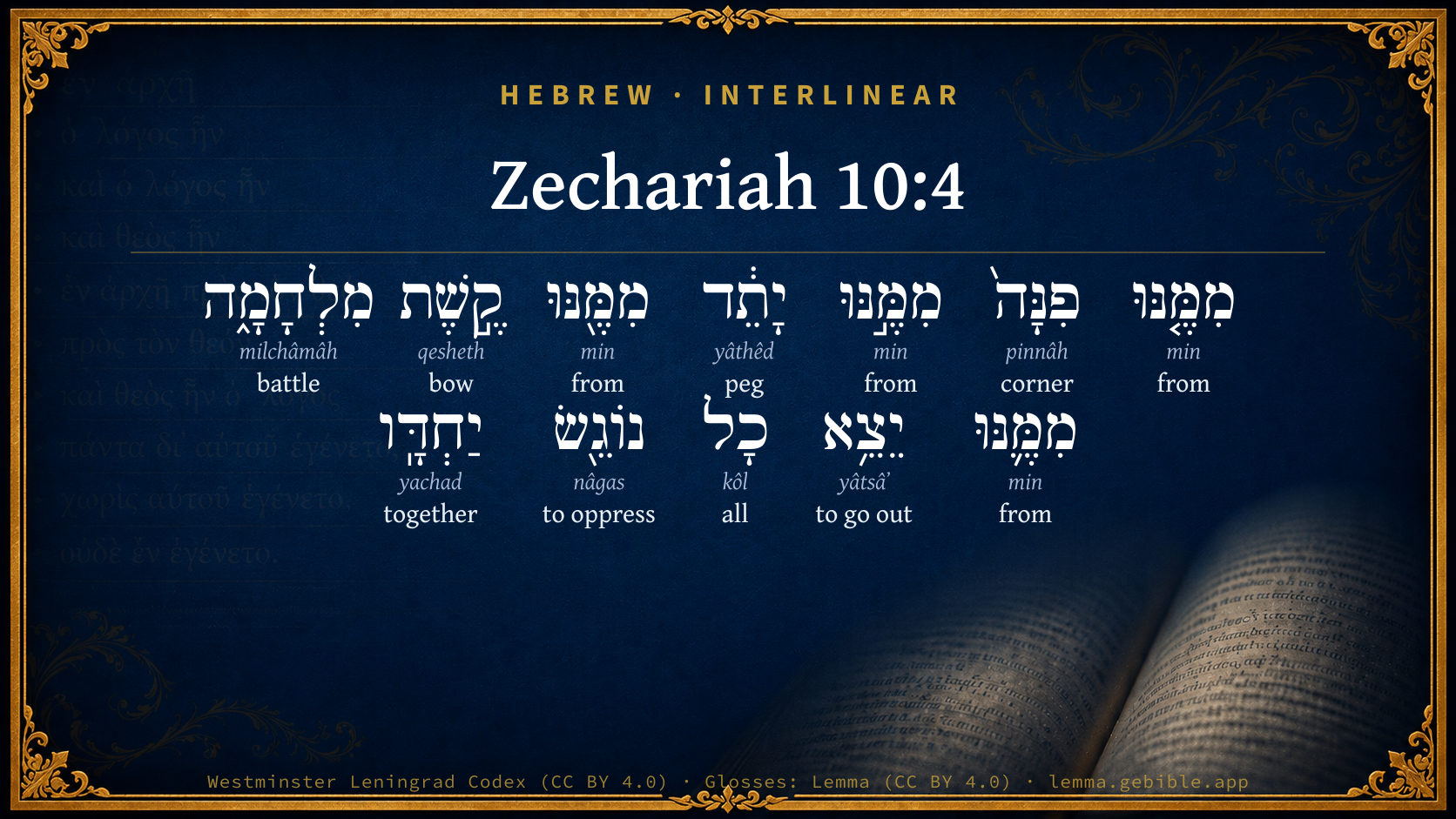
Hebrew (Westminster Leningrad Codex) Zechariah 10:4 appears in the Hebrew Old Testament. The text above is from the Westminster Leningrad Codex. Each word links to its Strong’s number, a concise gloss, and parsing drawn from the Open Scriptures Hebrew Bible morphology. Click any word for its full Brown-Driver-Briggs (BDB) entry.
Download image
Cite this verse

Zechariah 10:4 (World English Bible). Public Domain. Lemma interlinear Bible study tool, https://lemma.gebible.app/v/zechariah/10/4.

Show BibTeX & RIS
BibTeX
RIS
English Translation
From him will come forth the corner-stone, From him the nail, From him the battle bow, From him every ruler together.
World English Bible · Public Domain
Download a study sheet

One document with this verse’s original text, its word-by-word gloss line, the meaning frame, cross-references with their text, attributed commentary, and full source and license credits — printable, and it pastes into notes with its structure intact.

This verse Autodidact and up

Study sheet (.html) Plain text (.txt)

A passage Seminary Student

Up to 50 verses in one chapter. A passage sheet keeps up to 6 commentary sources and 12 cross-references per verse, in the order this page ranks them, and says so on the sheet whenever that leaves anything out. Ask for a single verse and you get the Autodidact verse sheet above.

Everything on this page stays free to read, with no account — the sheet is a download of what is already on screen, not access to it.

Want to remove ads? Support Godless Engineer
Compare translations 3

The same verse in 3 English versions, stacked beneath the original-language interlinear above. Click any original word for its lexicon entry.

Each is an independent rendering of the whole verse — the interlinear is not word-aligned to these translations.

Highlighted words mark where these versions differ — a whole-verse word diff, not a word-by-word alignment.

  • World English Bible Public Domain
    From him will come forth the corner-stone, From him the nail, From him the battle bow, From him every ruler together.
  • King James Version Public Domain
    Out of him came forth the corner, out of him the nail, out of him the battle bow, out of him every oppressor together.
  • unfoldingWord Literal Text CC BY-SA 4.0
    From Judah will come the cornerstone; from him will come the peg; from him will come the war bow; from him will come every ruler together.

unfoldingWord Literal Text — © unfoldingWord, licensed CC BY-SA 4.0. Word-aligned USFM3 via Door43 (git.door43.org/unfoldingWord/en_ult).

Versions to compare (up to 4)

3 of 4 selected

Show all 18 translations

Every available English version of this verse, each an independent rendering of the whole verse.

  • World English Bible Public Domain
    From him will come forth the corner-stone, From him the nail, From him the battle bow, From him every ruler together.
  • Berean Standard Bible Public Domain
    The cornerstone will come from Judah, the tent peg from him, as well as the battle bow and every ruler together.
  • Majority Standard Bible Public Domain
    The cornerstone will come from Judah, the tent peg from him, as well as the battle bow and every ruler together.
  • King James Version Public Domain
    Out of him came forth the corner, out of him the nail, out of him the battle bow, out of him every oppressor together.
  • American Standard Version (1901) Public Domain
    From him shall come forth the corner-stone, from him the nail, from him the battle bow, from him every ruler together.
  • Revised Version (1885) Public Domain
    From him shall come forth the corner stone, from him the nail, from him the battle bow, from him every exactor together.
  • Geneva Bible (1599) Public Domain
    Out of him shall the corner come foorth: out of him the nayle, out of him ye bowe of battell, and out of him euery appointer of tribute also.
  • Douay-Rheims (1899) Public Domain
    Out of him shall come forth the corner, out of him the pin, out of him the bow of battle, out of him every exacter together.
  • Young's Literal Translation Public Domain
    From him `is' a corner-stone, From him a nail, from him a battle-bow, From him goeth forth every exactor together.
  • Literal Standard Version CC BY-SA 4.0
    From him [is] a cornerstone, || From him a nail, from him a battle-bow, || From him goes forth every exactor together.
  • Unlocked Literal Bible CC BY-SA 4.0
    From Judah will come the cornerstone; from him will come the tent peg; from him will come the war bow; from him will come every ruler together.
  • unfoldingWord Literal Text CC BY-SA 4.0
    From Judah will come the cornerstone; from him will come the peg; from him will come the war bow; from him will come every ruler together.
  • Darby Bible Public Domain
    From him shall come forth the corner-stone, from him the nail, from him the battle bow, from him every exactor together.
  • World Messianic Bible Public Domain
    From him will come the cornerstone, from him the tent peg, from him the battle bow, from him every ruler together.
  • Webster's Bible Public Domain
    Out of him came forth the corner, out of him the nail, out of him the battle-bow, out of him every oppressor together.
  • Free Bible Version CC BY-SA 4.0
    From the people of Judah will come the cornerstone, from them the tent-peg, the bow used in battle—all their rulers together.
  • Bible in Basic English Public Domain
    From him will come the keystone, from him the nail, from him the bow of war, from him will come every ruler;
  • JPS Tanakh (1917) Public Domain
    Out of them shall come forth the corner-stone, out of them the stake, out of them the battle bow, out of them every master together.

Literal Standard Version (2020), Covenant Press — licensed CC BY-SA 4.0. Text via the HelloAO Bible API (eBible.org). Unlocked Literal Bible (unfoldingWord) — licensed CC BY-SA 4.0. Text via the HelloAO Bible API (eBible.org). unfoldingWord Literal Text — © unfoldingWord, licensed CC BY-SA 4.0. Word-aligned USFM3 via Door43 (git.door43.org/unfoldingWord/en_ult). Free Bible Version, Dr. Jonathan Gallagher — licensed CC BY-SA 4.0. Text via the HelloAO Bible API (eBible.org).

Word by word

More ways to search: Search by grammar → Find every occurrence → Compare this word →

Practice this passage: Drill this verse → Learn its vocabulary →

נוֹגֵ֖שׂ
nâgas
H5065
“oppressing”
Verb, Qal, Participle Active, Masculine, Singular, Absolute
Part of Speech
Verb
Stem
Qal
Form
Participle Active
Gender
Masculine
Number
Singular
State
Absolute
Full BDB Definition

Origin: a primitive root

TWOT: 1296

to press, drive, oppress, exact, exert demanding pressure - (Qal) - to press, drive - to exact - driver, taskmaster, ruler, oppressor, tyrant, lord, exactor of tribute (participle) - (Niphal) to be hard pressed
  1. מִמֶּ֤נּוּ min H4480 “from · us” Preposition + Suffix, Personal, 1st Person, Common, Plural
  2. פִנָּה֙ pinnâh H6438 “corner” Noun, Common, Feminine, Singular, Absolute
  3. מִמֶּ֣נּוּ min H4480 “from · us” Preposition + Suffix, Personal, 1st Person, Common, Plural
  4. יָתֵ֔ד yâthêd H3489 “peg” Noun, Common, Feminine, Singular, Absolute
  5. מִמֶּ֖נּוּ min H4480 “from · us” Preposition + Suffix, Personal, 1st Person, Common, Plural
  6. קֶ֣שֶׁת qesheth H7198 “bow of” Noun, Common, Feminine, Singular, Construct
  7. מִלְחָמָ֑ה milchâmâh H4421 “battle” Noun, Common, Feminine, Singular, Absolute
  8. מִמֶּ֛נּוּ min H4480 “from · us” Preposition + Suffix, Personal, 1st Person, Common, Plural
  9. יֵצֵ֥א yâtsâʼ H3318 “to go out” Verb, Qal, Imperfect, 3rd Person, Masculine, Singular
  10. כָל kôl H3605 “all of” Noun, Common, Masculine, Singular, Construct
  11. יַחְדָּֽו yachad H3162 “together” Adverb

About this verse

These counts appear in no published source. They are computed here, from the morphology-tagged text and Lemma’s own curated glosses. What Lemma adds →

12
words
9
distinct lemmas
Prophets
section

Notable vocabulary

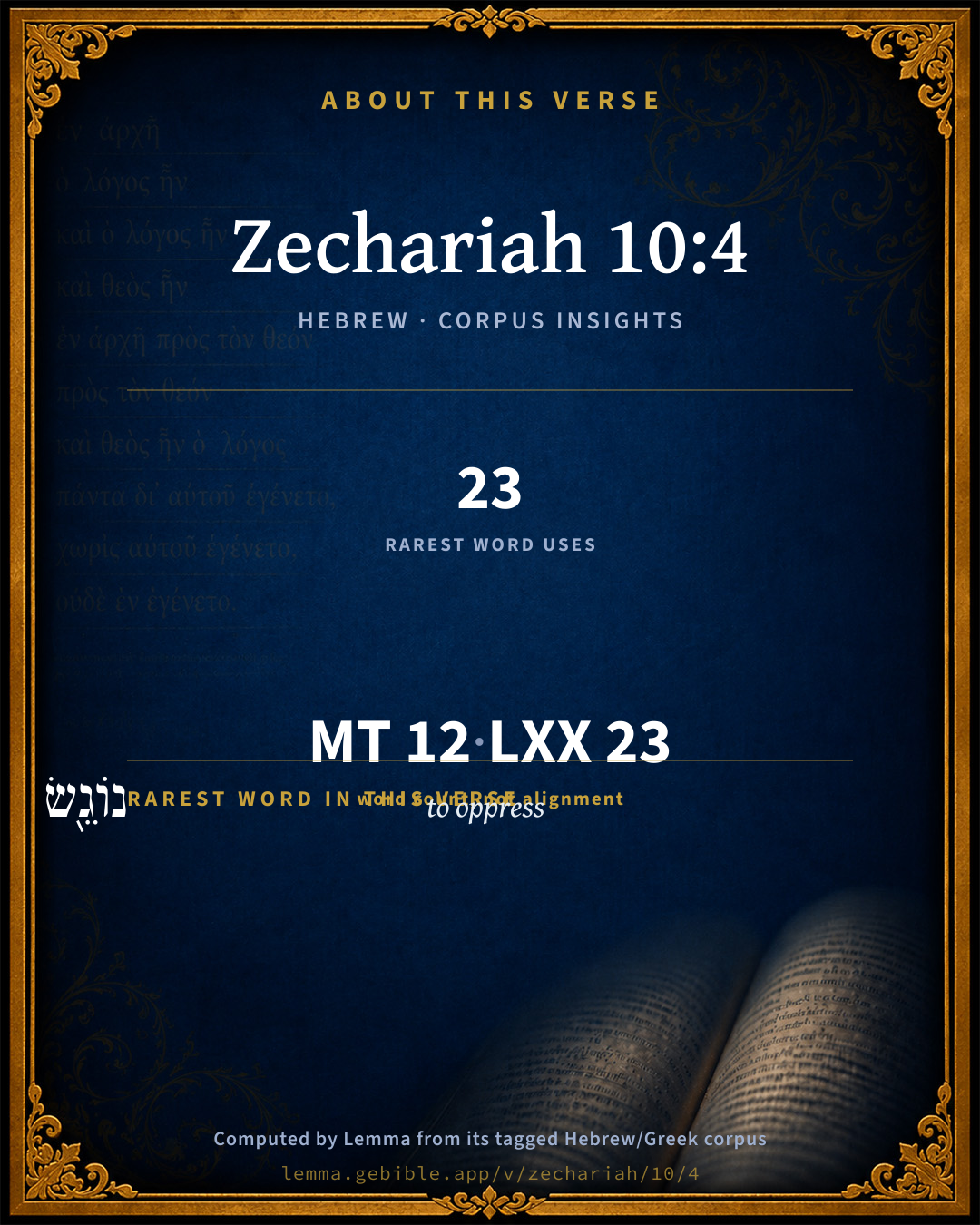
The rarest word here is נוֹגֵ֖שׂ to oppress H5065 — appearing just 23 times in the whole Hebrew Bible.

Shared distinctive vocabulary

נוֹגֵ֖שׂ to oppress H5065 occurs in 23 verses of the Hebrew Bible. Also found in:

Grammatical profile

  • 2 verbs
  • 5 nouns
  • 4 prepositions
  • 1 adverb

Verb forms

  • יֵצֵ֥א Qal · Imperfect
  • נוֹגֵ֖שׂ Qal · Participle Active

Repetition

A word recurs within this verse — often emphatic in Hebrew:

  • מִמֶּ֤נּוּ from H4480 ×4

Hebrew & Septuagint length

In English translation the verse runs 21 words from the Hebrew and 31 from the Septuagint (LXX English) — the Septuagint runs noticeably longer here. See the side-by-side →

A rough comparison of the two English renderings, which tokenize alike — not a word-level alignment.

Word counts can differ between the Hebrew and the Greek without any difference in meaning — e.g. the Hebrew direct-object marker אֵת has no separate Greek word, and Greek often adds the article ὁ.

In the original languages it is 12 Hebrew tokens and 23 Greek tokens — but the two are counted differently (Hebrew bundles its prefixes and suffixes into one token; the Greek is in lemma form), so that isn’t a like-for-like length.

Cross-references

24

Topical passages linked to Zechariah 10:4 in the Treasury of Scripture Knowledge — connected by theme and wording, ordered by reader-vote popularity; previews shown in the World English Bible.

  • Zechariah 9:10 I will cut off the chariot from Ephraim, And the horse from Jerusalem; And the battle bow will be cut off; And he will speak peace to the nations: And his dominion will be from sea to sea, And from the River to the ends of the earth.
  • Numbers 24:17 I see him, but not now; I see him, but not near: There shall come forth a star out of Jacob, A scepter shall rise out of Israel, Shall strike through the corners of Moab, Break down all the sons of tumult.
  • Ezra 9:8 Now for a little moment grace has been shown from Yahweh our God, to leave us a remnant to escape, and to give us a nail in his holy place, that our God may lighten our eyes, and give us a little reviving in our bondage.
  • Zechariah 9:8 I will encamp around my house against the army, That none pass through or return; And no oppressor will pass through them any more: For now I have seen with my eyes.
  • Revelation 19:13–15 He is clothed in a garment sprinkled with blood. His name is called "The Word of God."
  • Genesis 49:24 But his bow abode in strength, The arms of his hands were made strong, By the hands of the Mighty One of Jacob, (From there is the shepherd, the stone of Israel),
  • 1 Samuel 14:38 Saul said, Draw near here, all you chiefs of the people; and know and see in which this sin has been this day.
  • Psalms 118:22 The stone which the builders rejected has become the head of the corner.
  • Isaiah 19:13 The princes of Zoan are become fools, the princes of Memphis are deceived; they have caused Egypt to go astray, who are the corner-stone of her tribes.
  • Isaiah 22:23–25 I will fasten him as a nail in a sure place; and he shall be for a throne of glory to his father's house.
  • Isaiah 41:14–16 Don't be afraid, you worm Jacob, and you men of Israel; I will help you, says Yahweh, and your Redeemer is the Holy One of Israel.
  • Isaiah 49:2 and he has made my mouth like a sharp sword; in the shadow of his hand has he hid me: and he has made me a polished shaft; in his quiver has he kept me close:
  • Isaiah 54:16 Behold, I have created the smith who blows the fire of coals, and brings forth a weapon for his work; and I have created the waster to destroy.
  • Jeremiah 1:18 For, behold, I have made you this day a fortified city, and an iron pillar, and brazen walls, against the whole land, against the kings of Judah, against the princes of it, against the priests of it, and against the people of the land.
  • Micah 5:5–8 He will be our peace when Assyria invades our land, And when he marches through our fortresses, Then we will raise against him seven shepherds, And eight leaders of men.
  • Zechariah 1:20–21 Yahweh showed me four craftsmen.
  • Zechariah 9:13–16 For indeed I bend Judah as a bow for me. I have filled the bow with Ephraim; And I will stir up your sons, Zion, Against your sons, Greece, And will make you like the sword of a mighty man.
  • Zechariah 12:6–8 In that day I will make the chieftains of Judah like a pan of fire among wood, and like a flaming torch among sheaves; and they will devour all the surrounding peoples, on the right hand and on the left; and Jerusalem will yet again dwell in their own place, even in Jerusalem.
  • Matthew 9:38 Pray therefore that the Lord of the harvest will send out laborers into his harvest."
  • 2 Corinthians 10:4–5 for the weapons of our warfare are not of the flesh, but mighty before God to the throwing down of strongholds,
  • Ephesians 4:8–11 Therefore he says, "When he ascended on high, he led captivity captive, and gave gifts to men."
  • Ephesians 6:10–17 Finally, be strong in the Lord, and in the strength of his might.
  • 2 Timothy 2:4 No soldier on service entangles himself in the affairs of life, that he may please him who enrolled him as a soldier.
  • Revelation 17:14 These will war against the Lamb, and the Lamb will overcome them, for he is Lord of lords, and King of kings. They also will overcome who are with him, called and chosen and faithful."

Cross-references courtesy of OpenBible.info (CC BY 4.0).

Hebrew and Greek witnesses Masoretic Hebrew ↔ Greek Septuagint

The same verse in the two great witnesses to the Old Testament, shown verse-for-verse.

Here the Septuagint runs noticeably longer than the Hebrew — LXX2012 (modern English Septuagint) 31 words vs World English Bible 21. A rough length comparison of the two English translations, not a word-level alignment — read both below.

These are two independent witnesses, not word-aligned to each other, and the Septuagint is shown in lemma (dictionary) form.

Hebrew Zechariah 10:4 Masoretic · Westminster Leningrad Codex

מִמֶּ֤נּוּ פִנָּה֙ מִמֶּ֣נּוּ יָתֵ֔ד מִמֶּ֖נּוּ קֶ֣שֶׁת מִלְחָמָ֑ה מִמֶּ֛נּוּ יֵצֵ֥א כָל נוֹגֵ֖שׂ יַחְדָּֽו

From him will come forth the corner-stone, From him the nail, From him the battle bow, From him every ruler together.

World English Bible · Public Domain

Greek LXX Zechariah 10:4 Septuagint · lemma form

καί ἐκ αὐτός ἐπιβλέπω καί ἐκ αὐτός τάσσω καί ἐκ αὐτός τόξον ἐν θυμός ἐκ αὐτός ἐκἔρχομαι πᾶς ὁ ἐκἐλαύνω ἐν ὁ αὐτός

And from him he looked, and from him he set the battle in order, and from him came the bow in anger, and from him shall come forth every oppressor together.

LXX2012 (modern English Septuagint) · Public Domain

On this verse, The Pulpit Commentary discusses the Septuagint’s reading. Read the note in Commentary ↓

Hebrew: Westminster Leningrad Codex (CC BY 4.0). Greek: Septuagint (public domain); English from LXX2012 (modern English Septuagint) (Public Domain). How the Septuagint differs from the Hebrew →

Targum (Aramaic paraphrase)

1

The Targum is the ancient Jewish Aramaic paraphrase of the Hebrew Scriptures — an interpretive translation, not the Hebrew text itself. Onkelos (literal) and Pseudo-Jonathan (expansive) render the Torah, and Jonathan the Prophets. Coverage is partial: where no permissively-licensed English translation exists for a verse, only the Aramaic is shown. This is verse-level text, not a word-by-word alignment to the Hebrew.

  1. Targum Jonathan Prophets (Joshua–Malachi)
    מִנֵיהּ מַלְכֵּיהּ מִנֵיהּ מְשִׁיחֵיהּ מִנֵיהּ תְּקוֹף קְרָבֵיהּ מִנֵיהּ יִתְרַבּוּן כָּל פַּרְנָסוֹהִי כַּחֲדָא:

    (no public-domain English translation for this verse)

    Targum Jonathan — Aramaic: “Mikraot Gedolot” (public domain). English: “Sefaria Community Translation” (CC0 1.0 (public-domain dedication)); “London "Chaldee Paraphrase," 1871” (public domain). Text via Sefaria.

Commentary

Notes on Zechariah 10:4 from classic Christian and Jewish commentators (each source and its license shown beneath its notes). The classic Christian expositions comment on the surrounding passage and are grouped to its opening verse, so a note may address several verses; the Jewish commentaries on the Tanakh (Rashi and others) are per-verse, so they appear only where the commentator wrote on this verse.

Lemma curates 59 commentaries, every one of them public domain or Creative Commons licensed, each selected and text-cleaned for this edition rather than reprinted as found. About our sources →

Trapp's Complete Commentary

John Trapp

Zec 10:4 Out of him came forth the corner, out of him the nail, out of him the battle bow, out of him every oppressor together.

Ver. 4. Out of him came forth the corner] Angulus, not Angelus, as some Vulgate Latin translations have it: and a Lapide justly finds fault with it. A like fault Surius and Caranza (his fellow popelings) are content to wink at, nay, to defend in the Laodicean Council, because it makes for their angel worship. For whereas the Council truly saith, ου δει χριστιανους αγγελους ονομαζειν, Christians must not pray to angels. They make the words to be Non oportet Christianos ad angulos congregationes facere. Christians ought not to hold their meetings in corners; and they make the title say the same thing. But is this fair dealing thus to falsify antiquity for their own ends, and to maintain their own errors? As for the text,

Out of him came forth, &c.] That is, Out of Judah shall be had all things necessary, both at home (and here the prophet proceeds from the foundation to the nails, or fastening of the house together) and abroad; both for the mastering of the enemy by the battle bow, &c., and the making of him tributary: for

Out of him shall come every exactor] sc. Of homage and tribute, as the fruit of their victory. Danaeus senseth it thus. Out of Judah shall go every oppressor which did vex his people before, God driving him forth.

John Trapp, A Commentary or Exposition upon All the Books of the Old and New Testament (1647–1656) — public domain. Text from a community e-Sword module.

The Biblical Illustrator

Joseph S. Exell

Zec_10:4

Out of Him came forth the comer: out of Him the nail: out of Him the battle bow: out of Him every oppressor together

The duty and dignity of magistrates

Laws are in Scripture called the foundations of the commonwealth.

Magistrates are the pillars. When the Lord returns to a people in mercy, He doth give them righteous laws and gracious rulers. In this chapter you have the Lord returning unto His own people in mercy. There is a double visitation of God: one of His enemies in wrath; the other of His people in mercy. Though the appearances of God in this visitation were glorious, yet He makes themselves to be the instruments of it. God doth it, but He doth it by themselves, The text sets forth a glorious promise that God makes unto His people when they are delivered.

1. Out of Him shall come forth the comer. The word employed in the Hebrew is commonly a metaphor used for magistrates and governors. There are three things wherein the analogy doth lie.

(1) The cornerstone laid in the foundation. It upholds the building. The main weight of the building lies in the cornerstone.

(2) The cornerstone joins and couples the wall. It is a uniting stone.

(3) The cornerstone adorneth the building. More labour is spent in polishing the cornerstone than in the ordinary stones of a building.

2. Out of Him shall come forth the nail. This also is a metaphor used for governors. There is a double proposition in this metaphor.

(1) The beams of the building are fastened and united by nails one to another. So that the cornerstone unites the foundation, and the nails unite the roof.

(2) Upon the nails all the vessels hang: all the necessary utensils of the house. Upon the magistrate, as a nail, all the building of the commonwealth shall hang, even from the highest to the lowest.

3. Out of Him shall come forth the battle bow. The bow was an instrument of war much in use in ancient times, and therefore is here put for all the weapons of war, all their ammunition for, and all their discipline of war. When the Lord returns unto them in mercy, for their deliverance, they should have strength of their own against all the neighbour nations. They should be successful in war, because the Lord is with them.

4. Out of Him every oppressor, or exactor, which I put both together. The word means tax gatherer. Some make it signify, to exact a mans work. An exactor of labour and of tribute are both fitly to be understood here; for God doth not only deliver His people from the power of the enemy, but doth also put the enemies into their power; so that they shall rule over the nations. This shall be the glorious condition of the Church.

You have then, in these words, the state of the people set forth after their deliverance.

1. In reference to their political state. They shall never want a governor, a faithful magistrate.

2. In their polemical state. They shall have all sorts of warlike provisions in themselves, and shall be very successful in war. Doctrine--When the Lord returns to His people in mercy, He will give them governors that shall be for the supporting, uniting, and adorning of the commonwealth.

I. To support the commonwealth.

1. Magistrates are called the foundations of the earth.

2. The breath of your nostrils.

3. The shoulders upon which all the weight is borne.

4. The arms of the people.

But how may magistrates support the commonwealth?

(1) He must take care that he uphold religion. Peace without godliness is but a vain, mock peace. Every magistrate ought to rule with God.

(2) He must so rule that God may not break in in judgment upon the people.

(3) He must so rule as not to destroy the foundation of his authority.

(4) He must uphold the laws.

(5) Magistrates must uphold their own authority.

(6) They must uphold the peoples liberties.

(7) They must defend and preserve the property of the people.

II. To unite the commonwealth. How can rulers aid in uniting a people?

1. Religion is the great bond of union; let it be your great care that there be a unity in religion.

2. Let magistrates take heed to agree among themselves.

3. Labour for union amongst the ministers.

4. Take away all oppression and partiality in judgment. (W. Strong.)

The Biblical Illustrator, edited by Joseph S. Exell (c. 1880s–1900s) — public domain. Text from a community e-Sword module.

Joseph Benson's Commentary

Zec 10:4. Out of him — From God, came forth — Or rather, shall come forth the corner — The prince or ruler, who is in a body politic, as a corner stone in a building; the nail — Which fastens the tents of war, or the timber together in a house; the battle-bow — All warlike provision both of men and arms. Out of him every oppressor — Officer, exactor, or collector of tribute. It was from God that Nebuchadnezzar mightily prevailed and oppressed Israel; and it was from God also that Judah grows up to such power as to be able to cope with his adversaries, and to impose tribute on them. Newcome reads, From him shall go forth every ruler together, observing, that the word which we translate oppressor is also used in a good sense Isa 60:17 : that is, Judah shall furnish both civil and military governors. Blayney’s interpretation of the verse is, Out of it, that is, out of the house of Judah, shall go forth a corner, the commander-in- chief; out of it a nail, the officers next in rank; the bow of battle, the archers; out of it all that draw near together; so he renders כל נוגשׁ יחרו, instead of every oppressor, or ruler, together. “In the house, or building,” says he, “the words would denote the stones of common use, placed contiguous, or close in order, one by another. Correspondently in the army must be meant, the close-imbodied phalanx, or main body of men of war, advancing on together in regular order to meet the enemy.”

Joseph Benson's Commentary on the Old and New Testaments (1811–1818) — public domain. Text from a community e-Sword module.

Tyndale Open Study Notes

Tyndale Open Resources

10:4-12 A true shepherd is promised.

10:4 A cornerstone is the first-laid foundation stone upon which a building’s superstructure rests (see Job 38:6; Ps 118:22; Isa 28:16; Eph 2:20). • Just as a tent peg anchors a tent to the ground, so Judah will provide the future leaders needed to stabilize the Hebrew nation. • Many understand cornerstone, tent peg, and bow for battle as titles for the Messiah (cp. Isa 22:20-23; Zech 9:13).

Tyndale Open Study Notes — © Tyndale Open Resources, licensed CC BY-SA 4.0. Text via the HelloAO Bible API.

Geneva Bible (1599)

Geneva Bible translators

Out of Judah shall the chief governor proceed, who shall be as a corner to uphold the building, and as a nail to fasten it together.

Over their enemies.

Geneva Bible (1599) marginal notes — public domain. Text via Bolls.life.

Jamieson, Fausset & Brown

Robert Jamieson, A. R. Fausset & David Brown

Out of him--Judah is to be no more subject to foreigners, but from itself shall come its rulers.

the corner--stone, Messiah (Isa 28:16). "Corners" simply express governors (Sa1 14:38, Margin; Isa 19:13, Margin). The Maccabees, Judah's governors and deliverers from Antiochus the oppressor, are primarily meant; but Messiah is the Antitype. Messiah supports and binds together the Church, Jews and Gentiles.

the nail-- (Jdg 4:21; Isa 22:23). The large peg inside an Oriental tent, on which is hung most of its valuable furniture. On Messiah hang all the glory and hope of His people.

bow-- (Zac 9:13). Judah shall not need foreign soldiery. Messiah shall be her battle-bow (Psa 45:4-5; Rev 6:2).

every oppressor--rather, in a good sense, ruler, as the kindred Ethiopic term means. So "exactor," in Isa 60:17, namely, one who exacts the tribute from the nations made tributary to Judah [LUDOVICUS DE DIEU].

Jamieson, Fausset & Brown — Commentary Critical and Explanatory on the Whole Bible (1871) — public domain (CC PDM 1.0). Text via the HelloAO Bible API.

Adam Clarke's Commentary

Verse 4. Out of him came forth the corner] This is spoken of the tribe of Judah: all strength, counsel, and excellence came from that tribe. The corner stone, the ornament and completion of the building; the nail, by which the tents were fastened, and on which they hung their clothes, armour, &c., the battlebow, the choicest archers.

Every oppressor together.] Those heroes and generals, by whom, under God, their foes should be totally routed. Newcome translates, "Every ruler together." Perhaps all this is spoken of the Messiah.

Adam Clarke's Commentary on the Bible (1810–1826) — public domain. Text from a community e-Sword/MySword module.

John Calvin's Commentaries

There is here a confirmation of the last verse, but the metaphors are different; for he says, that the Jews would be fortified by every defense necessary for their security; nor is he inconsistent with himself. In the last chapter he indeed taught us, that though exposed to all kinds of wrongs, they would yet be safe through aid from heaven; but now he promises that there would come from them the corner-stone, the nail, the bow, and the exactor; and this seems a different doctrine; but it is the same as though he had promised, that though they stood in need of many helps, they would yet be sufficiently furnished, as God would be ready to aid them whenever there was need.

By the corner-stone he means the firmness of the building; from the Jews then shall be the corner-stone; that is, there shall ever be among that people those capable of carrying on the public government: then, from thee the nail; beams, we know, and other parts of the building, are fastened by nails, and we know also, that the ceiling is thereby made secure. Zechariah then mentions here all the supports which sustain a building from its very foundation. He afterwards adds, the bow of war, that is, what is necessary to overcome enemies; and, lastly, the exactor, one who has power over bordering nations, and demands tribute or tax from them, as conquerors are wont to do from their subjects.

We now see what the Prophet means — that when God would manifest his care for his people and openly show his favor, the Jews would be fortified by all kinds of help, so as to be well established, and that they would possess so much public authority as to have strength enough to resist all enemies; in short, that they would gain the fruit of conquest, and constrain all nations to be tributaries to them.

If any one asks when has this been fulfilled, my answer is, that some preludes of this were given when God raised up the Maccabees, and made the Jews again to live according to their own laws, and to enjoy their own rights; but no doubt the Prophet includes the whole course of redemption. As then God redeemed his people only to a small extent until Christ appeared, it is no wonder that Zechariah, in speaking of full and complete redemption, extends his words to the kingdom of Christ, and this was necessary. We hence learn, that the Church stands abundantly firm, and is also furnished with all needful things, while it continues under the protection of God, and that it is endued with sufficient power to resist all its enemies. It follows —

John Calvin's Commentaries (1540-1563) — public domain. Text from the Calvin Translation Society English edition (1840s-50s) via the Christian Classics Ethereal Library (ccel.org). Calvin's coverage is partial (roughly two-thirds of the Bible); uncommented books and verses are honest gaps, never fabricated. The 19th-century editor's footnotes and remarks are omitted so the notes are faithfully Calvin's own voice.

Ellicott's Commentary for English Readers

(4) Out of him.—Literally, from him. It is much disputed whether “him” means the Lord of Hosts or Judah. It appears to us best to take it as referring to “Judah”—i.e., to the whole Jewish nation.

Came forth.—Better, shall proceed. (Comp. Jer_30:19; Jer_30:21.)

Corner, or corner-stone, denotes a chieftain, on whom the whole national fabric is put together (1Sa_14:38; Isa_19:13).

Nail.—Also a chieftain, as him on which everything hangs, or depends (Isa_22:23); or the figure may be taken from the tent-peg which holds firm the ropes which support the tent.

Oppressor.—Either in the sense of ruler, as being one who keeps people to their work, or else it means oppressor of the heathen, and is so used in contrast with the heathen “oppressor” of Zec_9:8.

Together, or altogether, is added by way of emphasis. The meaning of the passage is that when the Lord of Hosts visits His flock, He will cause to arise from them such rulers and leaders as may be necessary to enable them to successfully resist their enemies.

A Bible Commentary for English Readers, edited by Charles John Ellicott (1878–1897) — public domain. Text from a community e-Sword module.

The Cambridge Bible for Schools and Colleges

gen. ed. J. J. S. Perowne

4. out of him came forth] Rather, from him (Judah) shall come forth. Comp. Jer_30:21. Some, however, take it to mean “from Him, Jehovah, shall proceed,” &c. Comp. Eph_4:11.

the corner] i.e. the corner-stone, which was the stay and ornament of the whole building. Isa_28:16; Eph_2:20.

the nail] or peg, from which, firmly fixed and stable, the furniture of the house could be suspended. Isa_22:23-24.

oppressor] or, ruler, as in R. V. margin, a sense which the word will bear in Isa_3:12; Isa_60:17. Every ruler, civil and military, “the corner-stone,” “the nail,” “the battle-bow,” shall proceed from Judah, blessed by God, or from God, as His gift to Judah, as the need of the state requires. Calvin, however, and others would give the word its more common sense, and understand, civil rulers for the well-being of the state, “the corner,” “the nail;” military leaders, for its defence and extension, “the battle-bow;” governors to keep in subjection provinces annexed and conquered by the battle-bow, “the oppressor.”

The Cambridge Bible for Schools and Colleges (gen. ed. J. J. S. Perowne; Cambridge University Press, 1878–1918) — public domain. Text from a community e-Sword module.

John Gill's Exposition

Out of him came forth the corner,.... Or "cornerstone"; by which is meant a king or ruler, as the Targum, Jarchi, and Kimchi; and is no other than the King Messiah, who was to come out of Judah, and did spring from that tribe, Ch1 5:2 and this is a reason why God will visit the house of Judah, or the Jews, in the latter day, because the Messiah was promised and sent unto them, salvation was of them, though they rejected him; but the Lord will have mercy on them; the Redeemer shall come to Zion in a spiritual manner, and turn away iniquity from them, and then all Israel shall be saved by him. The epithet of a "corner" stone well agrees with him, that being not only the ornament, but the strength and support of the building, which knits, cements, and keeps the whole together: Christ is a beautiful and precious cornerstone, which gives glory and lustre to the church, and is the support, yea, the foundation of it; and who joins and unites together men and angels; Jews and Gentiles; Old and New Testament saints; saints above and below; saints in all ages and places, and of all nations and denominations; and is the Head of the corner, being superior to men and angels, to the kings of the earth, and to the church of God; see Eph 2:20.

Out of him the nail; the Targum is, "out of him his Messiah"; which shows that this text was formerly understood of Christ by the Jews; Jarchi and Kimchi interpret it of a prince and governor; so Eliakim the governor is said to be "as a nail in a sure place", Isa 22:23 who was a type of Christ; and this agrees with Christ himself. The allusion is either to a nail, by which the timber in the building is compacted together, and the whole is strengthened, as the church is by Christ: or to a nail to which the cords of tents are fastened, as those of shepherds, travellers, or soldiers; the church is as such a tent; Christ is the nail to which its cords are fastened, which denotes the stability and security of it: or to a nail fixed in a wall, on which things are hung; on Christ are hung all the vessels of mercy; the covenant of grace, and all its promises and blessings; and all the glory of his Father's house, of his building, the temple, and of the salvation of his people, is to be hung on him.

Out of him the battle bow; or "warrior", as Jarchi interprets it; the Lord is a man of war; Christ makes war in righteousness; the armies of heaven follow him; he is at the head of them, and fights the battles of his people, and is victorious, and makes them more than conquerors; their spiritual armour is from him, and they are armed by him, Rev 19:11

out of him every oppressor together: or "exactor" (n); which is used in a good sense, Isa 60:17 as it must be here, since all the rest of the epithets are; and may design the apostles of Christ, who preached the doctrines of grace and righteousness, and required of men the obedience of faith; and these came out of Judah and Jerusalem, and went into all the world, demanding faith in and obedience to the Son of God.

(n) "exactor", Montanus, Vatablus, Tigurine version, Junius & Tremellius, Calvin, Drusius, De Dieu, Cocceius, Burkius.

John Gill's Exposition of the Whole Bible (1746–1763) — public domain (CC PDM 1.0). Text via the HelloAO Bible API.

Albert Barnes' Notes on the Bible

Out of him came forth - Or rather, “From him is the corner,” as Jeremiah, “Their nobles shall be from themselves, and their governor shall go forth from the midst of them” Jer 30:21. Her strength, though given by God, was to be inherent in her, though from her too was to come He who was to be “the head-corned-stone,” the sure Foundation and Crowner of the whole building.

From thee the nail - An emblem of fixedness in itself, (as Isaiah says, “I will fasten him a nail to a sure place” Isa 22:23) and of security given to others dependent on Him, as Isaiah says further, “And they shall hang upon him all the glory of his father’s house, the offspring and the issue, from the vessels of cups to the vessels of flagons” Isa 22:24; all, of much or little account, the least and the greatest. Osorius: “Christ is the cornerstone; Christ is the nail fixed in the wall, whereby all vessels are supported. The word of Christ is the bow, whence the arrows rend the king’s enemies.”

From it every exactor shall go forth together - God had promised Zec 9:8 that no “oppressor,” or “exactor Isa 14:2, shall pass through them anymore.” He seems to repeat it here. “From thee shall go forth every oppressor together; go forth,” not to return: as lsaiah had said, “Thy children shall make haste to return; thy destroyers and they that made thee waste shall go forth of thee” Isa 49:17. “From it, its cornerstone; from it, the sure nail; from it, the battle bow; from it,” he no longer unites closely with it, that which should be from it, or of it, but - “from it shall go forth every oppressor together;” one and all, as we say; a confused pele-mele body, as Isaiah, “all that are found of thee are bound together” Isa 22:3; “together shall they all perish” Isa 31:3; or, in separate clauses, “they are all of them put to shame; together they shall go into confusion” Isa 45:16.

Albert Barnes' Notes on the Bible (1834–1885) — public domain. Text from a community e-Sword/MySword module.

Haydock's Catholic Bible Commentary

Corner, to connect the building. The Machabees were not of the tribe of Juda; but it was the chief, and gave name to the rest. Judas was also a figure of Christ, the chief corner-stone, and he should be born of that tribe. --- Pin, to fasten down the tent, or to hang things upon. These comparisons were not deemed mean, 1 Esdras ix. 8., and Isaias xxii. 23. --- Exactor. The term may have a good as well as a bad sense. Taxes must be paid for the support of lawful governments. Judas forced other nations to pay tribute. (Calmet) --- The same term in Ethiopia, means "a king." (De Dieu)

George Leo Haydock (1774–1849), Haydock's Catholic Family Bible and Commentary, 1859 edition — public domain. Excludes Psalms (Douay-Rheims chapter numbering differs from Protestant) and Deuterocanonical books (Catholic canon only).

Matthew Poole's English Annotations

Out of him, or out from him, from Judah, rather from the God of Judah,

came forth the corner, which in buildings is strength and beauty; here it is the prince or ruler, which is in a polity as a corner-stone in buildings.

Out of him the nail; from God the nail which fastens the tents of war, or fastens the timber together in a house.

The battle bow; all warlike provision both of men and arms, synecdochically expressed by bow.

Out of him every oppressor, or officer, exactor, collector of tribute. It was from God that Nebuchadnezzar mightily prevailed, and in the course of his victories oppressed Israel; and it is from God also that Judah is at last made free, grows up to such power as to be able to cope with his adversaries, to beat them, and to impose tribute on them. He sets up and pulls down as he pleaseth, Psa 9.

Matthew Poole's English Annotations on the Holy Bible (1683–1685) — public domain. Text from a community e-Sword/MySword module.

Whedon's Commentary on the Bible

Daniel D. Whedon

4. Henceforth the nation will be governed by native rulers.

Out of him — Does the pronoun refer to Judah or to Jehovah? On this point commentators are not agreed; the former is the more probable, the thought being that in the future the rulers called corner, nail, etc., will come forth not from the foreign nations but from Judah.

Corner — R.V., “corner stone.” The term is applied to the Messiah in Isa_28:16, but here it is equivalent to leader (Isa_19:13; 1Sa_14:38). The leader stands out prominently like the corner.

Nail — The origin of the metaphor is not quite clear. It may, perhaps, be traced to the pin with which the tent is fastened down (Jdg_4:21-22), or to the peg on which articles and vessels are hung on the wall. Here it represents those in the community on whose counsel and support others depend, the leaders (Isa_22:23).

Battle bow — Military leaders, or, perhaps, warriors in general.

Every oppressor — R.V., “every ruler”; margin, “exactor.” The same word is translated in Exo_3:7; Exo_5:10, etc., “taskmaster”; here it appears to be used in the general sense ruler (compare Isa_3:12; Isa_14:2; Isa_60:17), though the idea may be implied that these rulers will oppress the enemies who now oppress the Jews.

Together — The force of this word is not certain; it cannot be taken with the verb, “shall go forth together,” since the two are separated in Hebrew; taken with “every ruler” it would seem to indicate that the prophet expects more than one ruler to come forth. Some commentators take it with the next verse (see below).

Zec_10:5 seems to be an expansion of 3b.

Mighty men — Heroes, courageous warriors.

Tread down — See on Zec_9:15, where, however, a different verb is used.

In the mire — Perhaps better, with a slight alteration, as the mire (compare Mic_7:10). They will fight so bravely because Jehovah will be with them.

The riders on horses — Of the hostile army. The present Hebrew text of Zec_10:5 is awkward, and most recent commentators suggest one or more alterations, all of them very simple. Marti would read 5a, “together shall they tread down in battle the mighty men as dirt in the streets.”

Zec_10:6 contains a promise that Ephraim will share in the blessings.

I will strengthen — The verb is a derivative of the noun mighty men (Zec_10:5), equivalent to I will make heroes.

Joseph — Ephraim (Zec_10:7; Zec_9:13), Israel, the northern kingdom.

I will save — From oppression; this deliverance will be the first blessing.

I will bring them again to place them — R.V., “I will bring them back”; from exile. The form of the verb is peculiar, but the translation of R.V. fits better into the context. The deliverance is wrought, not because they deserve it, but because Jehovah has decided to have mercy on them once more.

As though I had not cast them off — The exile seemed to prove that Jehovah had cast them off, but in the glorious future all traces of the divine disfavor will disappear. In spite of their sins Jehovah is still their God, and when in distress they cry unto him he will hear them. For “I will hear them” G.A. Smith translates, “I will hold converse with them.”

Daniel D. Whedon (gen. ed.), Commentary on the Old and New Testaments (1874–1909) — public domain. Text from a community e-Sword module.

The Pulpit Commentary

The firmness and security of Judah, thus "visited," is announced in terms admitting of further application. Out of him came forth (shall come). Out of Judah, mentioned in ver. 3. Others, not so suitably, explain, "out of Jehovah," in contrast to Hos_8:4. The succeeding figures are taken from the building and furnishing of a house. The corner. The cornerstone. (Isa_28:16) From Judah herself shall come the prince on whom the whole edifice shall rest; i.e. primarily, she shall be independent of foreign rulers; and secondly, from Judah shall come the Messiah, "the Headstone of the corner". (Mat_21:42 Eph_2:20 Heb_7:14) Septuagint (taking the noun as a verb), kai ap autou epebleye , "et ex ipso respexit" (Jerome). The nail. The word (yathed) is taken for the peg that fastens the cord of a tent, for a nail used in building with timber, or a peg for hanging up arms and utensils on the walls of a house. In whichever sense we take it here, it implies one who consolidates or upholds the political constitution. (Isa_22:23, Isa_22:24) The battle bow. The people shall themselves have arms and military skill to protect them against all assailants. Oppressor; rather, ruler, as Isa_3:12 Isa_60:17. Judah shall have every leader necessary for all emergencies. Septuagint, pav o exelaunwn en tw autw , "he that expelleth together;" Vulgate, omnis exactor simul. If the word be taken in the sense of these versions and the Authorized Version, the clause would mean that the Israelites shall subjugate their enemies, and oppress them, and exact tribute from them. The word (noges) usually means "taskmaster.

Vers. 4, 5. The strength of states.

I CAPABLE RULERS. "Cornerstone," on which the fabric rests. The stability of the whole depends on the foundation.

II JUST ADMINISTRATION. "Nail what binds and fixes. The laws must not only be just, but justly applied. Forms of government vary according to the circumstances and needs of the people. There is much truth in Pope"s saying, "Whate"er is best administered is best.

III AMPLE RESOURCES. "Battle bow" may stand for implements of war. Means of defence. The weapons are nothing compared to the men who wield them. True citizens, devoted to the right, giving themselves and their all for the defence of truth and liberty, and for the advancement of the general good.

IV NATIONAL INDEPENDENCE. Enlightenment. Love of freedom and justice. Purity of domestic life. Superiority to passion and vain glory. Courage in duty. Power not only to hold their own, but to bear themselves generously towards the vanquished, and to overcome evil with good. "What constitutes a state? Not high-raised battlements or laboured mound, Thick walls or moated gate; Not cities proud, with spire and turret crowned, Nor bays, nor broad arm"d ports, Where, laughing at the storm, rich navies ride; But men, high-minded Christian men. F.

The Pulpit Commentary (1880–1919), ed. H.D.M. Spence-Jones & Joseph S. Exell — public domain. Text from a community e-Sword module.

John Wesley's Explanatory Notes

Out of him - From God. The corner - The prince or ruler, who is in a polity as a corner-stone in buildings. The nail - Which fastens the tents of war, or the timber together in a house. The battle bow - All warlike provision. Every oppressor - Or collector of tribute. It was from God that Nebuchadnezzar mightily prevailed, and opprest Israel; and it is from God also, that Judah grows up to such power, as to be able to cope with his adversaries, and to impose tribute on them.

John Wesley, Explanatory Notes Upon the Whole Bible (1754–1765) — public domain. Text via the GEBible commentary corpus.

Scofield Reference Notes

C. I. Scofield

came

The tense is future: "From him Judah shall be the cornerstone Exo 17:6. (See Scofield "1Pe 2:8") from him the nail Isa 22:23; Isa 22:24 from him the battle-bow," etc. The whole scene is of the events which group about the deliverance of the Jews in Palestine in the time of the northern invasion under the "Beast"; Dan 7:8; Rev 19:20 and "Armageddon,"; Rev 16:14; Rev 19:17.

The final deliverance is wholly effected by the return of the Lord Rev 19:11-21, but previously He strengthens the hard-pressed Israelites; Mic 4:13; Zec 9:13-15; Zec 10:5-7; Zec 12:2-6; Zec 14:14.

That there may have been a precursive fulfilment in the Maccabean victories can neither be affirmed nor denied from Scripture.

The Scofield Reference Bible (1917 edition), notes by C. I. Scofield — public domain. Text from a community e-Sword module.

unfoldingWord translationNotes

Door43 World Missions Community

General Information:

It is unclear whether Yahweh is speaking, or if Zechariah is speaking for Yahweh in verses 3-5.

From Judah will come the cornerstone

"The cornerstone will come from Judah." The most important ruler is spoken of as if he where the main foundation stone of a building. AT: "One of the descendants of Judah will become the most important ruler" (See: Metaphor)

the cornerstone ... the tent peg ... the war bow

Possible meanings for these three things are 1) they may be symbolic language that refers to the Messiah who will come from the tribe of Judah or 2) they may refer to different leaders who will come from Judah. (See: Symbolic Language)

from him will come the tent peg

"the tent peg will come from him." The tent pegs held the ropes that supported tents in which people lived. Here the most important ruler is spoken of as if he where the main peg that holds a tent in place. AT: "the leader who will hold the nation together will come from Judah" (See: Metaphor)

from him will come the war bow

"the war bow will come from him." Here the most important ruler is spoken of as if he where the a war bow that was used in battle. AT: "the military leader will come from Judah" (See: Metaphor)

from him will come every ruler together

"every ruler will come from Judah"

They will be like warriors ... streets in battle

The rulers from Judah are spoken of as if they were victorious warriors. AT: "They will be mighty in battle, trampling their enemies into the mud of the streets" (See: Simile)

who trample their enemies into the mud of the streets in battle

To trample them into the mud is an idiom that means to completely defeat them. AT: "who defeat their enemies completely" (See: Idiom)

Yahweh is with them

Here "with them" is an idiom that means he is present to help them. AT: "Yahweh will help them" (See: Idiom)

they will shame those who ride warhorses

Here shame accompanies and represents defeat. AT: "they will defeat their enemies who ride warhorses" (See: Metonymy)

translationWords

cornerstone

tent

shame

unfoldingWord translationNotes — © Distant Shores Media and the Door43 World Missions Community, licensed CC BY-SA 4.0. Source: git.door43.org/Door43/en_tn.

Rashi

Rabbi Shlomo Yitzchaki (Rashi)

Out of them shall come the cornerstone Out of them shall come their kings; out of them shall come their princes, and out of them shall come those who wage their wars.

Rashi on the Tanakh — English translations: “The Judaica Press complete Tanach with Rashi, translated by A. J. Rosenberg” (CC BY 4.0); “Pentateuch with Rashi's commentary by M. Rosenbaum and A.M. Silbermann, 1929-1934” (public domain); “The Metsudah Tanach series, Lakewood, N.J” (CC BY 4.0); and “The Book of Joshua, Metsudah Publications, 1997” (CC BY 4.0). Text via Sefaria.

Lesson kit

Teaching starters — assembled from the data on this page, not authored interpretation. Every prompt links to the verse data it draws on. Edit before teaching.

Zechariah, in the Prophets, opens this verse with 12 words (9 distinct Hebrew lemmas). Its most distinctive word is nâgas (“to oppress”). The Greek Septuagint runs longer here. A historical commentator’s framing appears above. Read the whole chapter for the surrounding context.

Discussion questions

  1. The word nâgas carries the sense “to oppress.” How does it shape the verse?
  2. Exodus 3:7 shares the word «to oppress» with this verse. How do the two illuminate each other?
  3. “from” occurs 4× in this one verse. What is the effect of the repetition?
  4. Compared with the Hebrew, the Septuagint runs longer here. What questions does that raise?
  5. The translations on this page render this verse differently — a whole-verse word diff, not a word-by-word alignment. What might account for the different wordings?
  6. The verb «יֵצֵ֥א» is Qal Imperfect. How does its form color the action?
  7. Reading how Trapp's Complete Commentary and The Biblical Illustrator read this verse, where do the two commentators agree and where do they part?

Things to notice

Reading settings

Reading text

Shown beneath each verse's original-language words.

Old Testament
Old Testament edition

Read the OT as the Masoretic Hebrew (MT) or the Greek Septuagint (LXX).

English shown for the Greek Septuagint (in the Hebrew ↔ Greek comparison).

Comparing translations? Open the Compare panel on any verse page to stack up to four side by side.