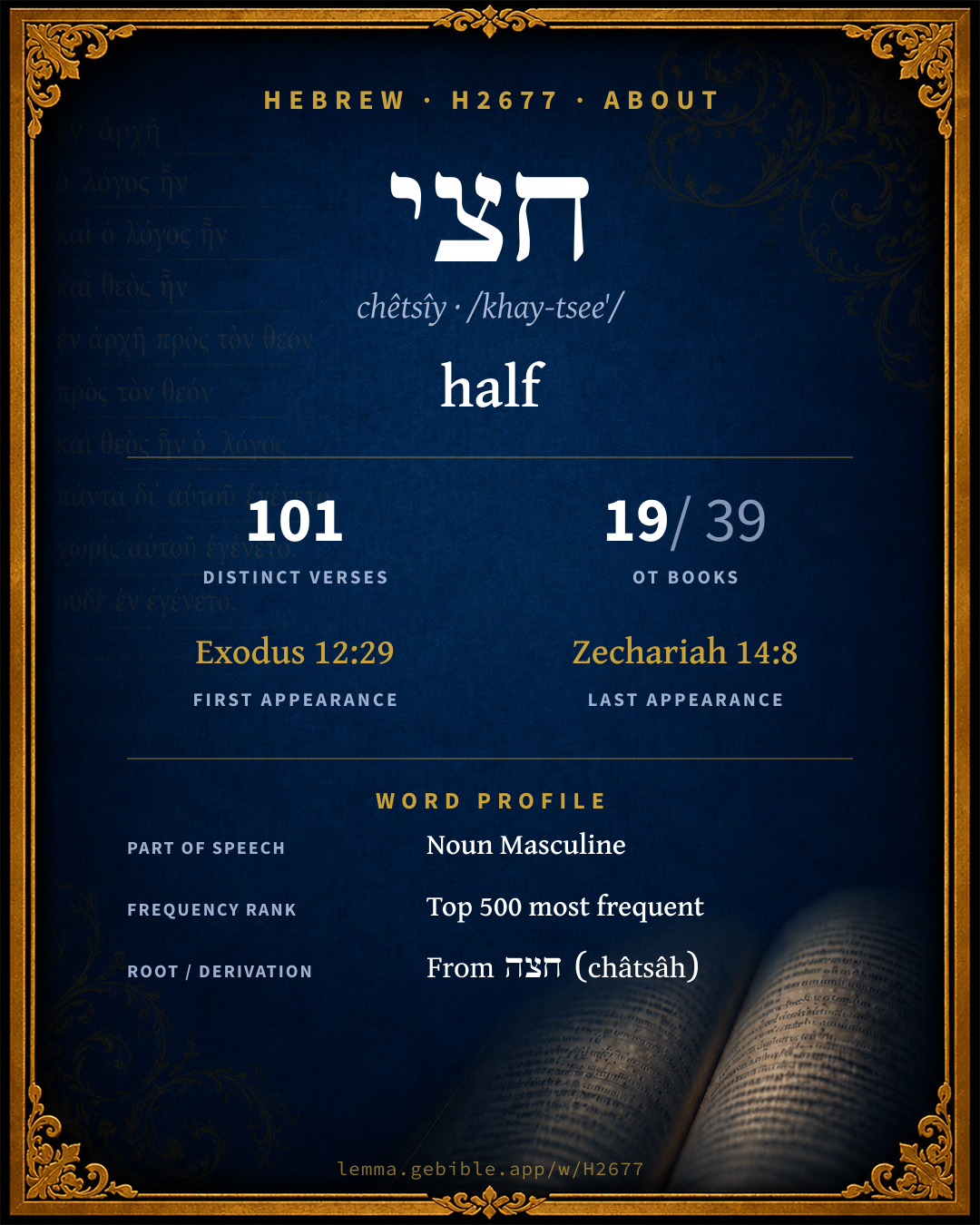
חֲצִי
half
‘half’ is one of 2 main senses fuller range ↓
Full lexicon entry — Brown-Driver-Briggs (BDB)
From Brown-Driver-Briggs (BDB)
Where this word appears
See every Construct-state word in the Hebrew Bible →
Grammar key — what these labels mean
Part of speech
- Noun
- A naming word — a person, place, thing, or idea.
Noun type
- Common
- A common noun — a general class of person, place, or thing (“king,” “city,” “water”), not a specific name.
State
- Construct
- A noun bound to a following noun in a possessive / “of” relationship (the construct chain).
- Absolute
- The independent form of a noun, not bound to a following word.
Gender
- Masculine
- Grammatically masculine.
Number
- Singular
- One.
Grammatical forms
- Noun, Common, Masculine, Singular, Construct 100 times (81%)
- Noun, Common, Masculine, Singular, Absolute 23 times (19%)
Parsed forms decoded from the imported morphology (morphhb / Westminster Leningrad Codex — WLC text public domain, morphhb tagging CC BY 4.0), counted across 123 parsed occurrences — not distinct verses.
Every verse where H2677 appears — 101 distinct verses across 19 books. Click any verse to open its interlinear word-by-word view. Verse text shown in the World English Bible for context — . Each verse’s Hebrew form is shown with its reference; the English is not keyword-highlighted, since the data carries no word-level English alignment. Use “Compare translations” on any verse to read it across multiple English versions. This concordance covers the Hebrew Bible; Septuagint (Greek Old Testament) occurrences are not indexed here.
Exodus 13 verses
- Exodus 12:29 בַּ/חֲצִ֣י prep + n c ms cs It happened at midnight, that Yahweh struck all the firstborn in the land of Egypt, from the firstborn of Pharaoh who sat on his throne to the firstborn of the captive who was in the dungeon; and all the firstborn of cattle.
- Exodus 24:6 חֲצִ֣י וַ/חֲצִ֣י n c ms cs conj + n c ms cs Moses took half of the blood and put it in basins, and half of the blood he sprinkled on the altar.
- Exodus 25:10 וָ/חֵ֜צִי וָ/חֵ֨צִי֙ וָ/חֵ֖צִי conj + n c ms conj + n c ms conj + n c ms "They shall make an ark of acacia wood. Its length shall be two and a half cubits, its breadth a cubit and a half, and a cubit and a half its height.
- Exodus 25:17 וָ/חֵ֨צִי֙ וָ/חֵ֖צִי conj + n c ms conj + n c ms You shall make a mercy seat of pure gold. Two and a half cubits shall be its length, and a cubit and a half its breadth.
- Exodus 25:23 וָ/חֵ֖צִי conj + n c ms "You shall make a table of acacia wood. Two cubits shall be its length, and a cubit its breadth, and one and a half cubits its height.
- Exodus 26:12 חֲצִ֤י n c ms cs The overhanging part that remains of the curtains of the tent, the half curtain that remains, shall hang over the back of the tent.
- Exodus 26:16 וַ/חֲצִ֣י conj + n c ms cs Ten cubits shall be the length of a board, and one and a half cubits the breadth of each board.
- Exodus 27:5 חֲצִ֥י n c ms cs You shall put it under the ledge around the altar beneath, that the net may reach halfway up the altar.
- Exodus 36:21 וַ/חֲצִ֣י conj + n c ms cs Ten cubits was the length of a board, and a cubit and a half the breadth of each board.
- Exodus 37:1 וָ/חֵ֜צִי וָ/חֵ֨צִי֙ וָ/חֵ֖צִי conj + n c ms conj + n c ms conj + n c ms Bezalel made the ark of acacia wood. Its length was two and a half cubits, and its breadth a cubit and a half, and a cubit and a half its height.
- Exodus 37:6 וָ/חֵ֨צִי֙ וָ/חֵ֖צִי conj + n c ms conj + n c ms He made a mercy seat of pure gold. Its length was two and a half cubits, and a cubit and a half its breadth.
- Exodus 37:10 וָ/חֵ֖צִי conj + n c ms He made the table of acacia wood. Its length was two cubits, and its breadth was a cubit, and its height was a cubit and a half.
- Exodus 38:4 חֶצְיֽ/וֹ n c ms cs + sfx pers 3ms He made for the altar a grating of a network of brass, under the ledge around it beneath, reaching halfway up.
Numbers 8 verses
- Numbers 12:12 חֲצִ֥י n c ms cs Let her not, I pray, be as one dead, of whom the flesh is half consumed when he comes out of his mother's womb.
- Numbers 15:9 חֲצִ֥י n c ms cs then shall he offer with the bull a meal-offering of three tenth parts [of an ephah] of fine flour mixed with half a hin of oil:
- Numbers 15:10 חֲצִ֣י n c ms cs and you shall offer for the drink-offering half a hin of wine, for an offering made by fire, of a sweet savor to Yahweh.
- Numbers 28:14 חֲצִ֣י n c ms cs Their drink-offerings shall be half a hin of wine for a bull, and the third part of a hin for the ram, and the fourth part of a hin for a lamb: this is the burnt offering of every month throughout the months of the year.
- Numbers 32:33 וְ/לַ/חֲצִ֣י conj + prep + n c ms cs Moses gave to them, even to the children of Gad, and to the children of Reuben, and to the half-tribe of Manasseh the son of Joseph, the kingdom of Sihon king of the Amorites, and the kingdom of Og king of Bashan, the land, according to the cities of it with [their] borders, even the cities of the land round about.
- Numbers 34:13 וַ/חֲצִ֥י conj + n c ms cs Moses commanded the children of Israel, saying, This is the land which you shall inherit by lot, which Yahweh has commanded to give to the nine tribes, and to the half-tribe;
- Numbers 34:14 וַ/חֲצִי֙ conj + n c ms cs for the tribe of the children of Reuben according to their fathers' houses, and the tribe of the children of Gad according to their fathers' houses, have received, and the half-tribe of Manasseh have received, their inheritance:
- Numbers 34:15 וַ/חֲצִ֣י conj + n c ms cs the two tribes and the half-tribe have received their inheritance beyond the Jordan at Jericho eastward, toward the sunrise.
Deuteronomy 3 verses
- Deuteronomy 3:12 וַ/חֲצִ֤י conj + n c ms cs This land we took in possession at that time: from Aroer, which is by the valley of the Arnon, and half the hill-country of Gilead, and the cities of it, gave I to the Reubenites and to the Gadites:
- Deuteronomy 3:13 לַ/חֲצִ֖י prep + n c ms cs and the rest of Gilead, and all Bashan, the kingdom of Og, gave I to the half-tribe of Manasseh; all the region of Argob, even all Bashan. (The same is called the land of Rephaim.
- Deuteronomy 29:8 וְ/לַ/חֲצִ֖י conj + prep + n c ms cs and we took their land, and gave it for an inheritance to the Reubenites, and to the Gadites, and to the half-tribe of the Manassites.
Joshua 25 verses
- Joshua 1:12 וְ/לַ/חֲצִ֖י conj + prep + n c ms cs To the Reubenites, and to the Gadites, and to the half-tribe of Manasseh, spoke Joshua, saying,
- Joshua 4:12 וַ/חֲצִ֨י conj + n c ms cs The children of Reuben, and the children of Gad, and the half-tribe of Manasseh, passed over armed before the children of Israel, as Moses spoke to them:
- Joshua 8:33 חֶצְי/וֹ֙ וְ/הַֽ/חֶצְי֖/וֹ n c ms cs + sfx pers 3ms conj + ptcl def.art + n c ms cs + sfx pers 3ms All Israel, and their elders and officers, and their judges, stood on this side of the ark and on that side before the priests the Levites, who bore the ark of the covenant of Yahweh, as well the foreigner as the native; half of them in front of Mount Gerizim, and half of them in front of Mount Ebal; as Moses the servant of Yahweh had commanded at the first, that they should bless the people of Israel.
- Joshua 10:13 בַּ/חֲצִ֣י prep + n c ms cs The sun stood still, and the moon stayed, Until the nation had avenged themselves of their enemies. Isn't this written in the book of Jashar? The sun stayed in the midst of the sky, and didn't hurry to go down about a whole day.
- Joshua 12:2 וַ/חֲצִ֣י conj + n c ms cs Sihon king of the Amorites, who lived in Heshbon, and ruled from Aroer, which is on the edge of the valley of the Arnon, and [the city that is in] the middle of the valley, and half Gilead, even to the river Jabbok, the border of the children of Ammon;
- Joshua 12:5 וַ/חֲצִי֙ conj + n c ms cs and ruled in Mount Hermon, and in Salecah, and in all Bashan, to the border of the Geshurites and the Maacathites, and half Gilead, the border of Sihon king of Heshbon.
- Joshua 12:6 וְ/לַ/חֲצִ֖י conj + prep + n c ms cs Moses the servant of Yahweh and the children of Israel struck them: and Moses the servant of Yahweh gave it for a possession to the Reubenites, and the Gadites, and the half-tribe of Manasseh.
- Joshua 13:7 וַ/חֲצִ֖י conj + n c ms cs Now therefore divide this land for an inheritance to the nine tribes, and the half-tribe of Manasseh.
- Joshua 13:25 וַ/חֲצִ֕י conj + n c ms cs Their border was Jazer, and all the cities of Gilead, and half the land of the children of Ammon, to Aroer that is before Rabbah;
- Joshua 13:29 לַ/חֲצִ֖י לַ/חֲצִ֛י prep + n c ms cs prep + n c ms cs Moses gave [inheritance] to the half-tribe of Manasseh: and it was for the half-tribe of the children of Manasseh according to their families.
- Joshua 13:31 וַ/חֲצִ֤י לַ/חֲצִ֥י conj + n c ms cs prep + n c ms cs and half Gilead, and Ashtaroth, and Edrei, the cities of the kingdom of Og in Bashan, were for the children of Machir the son of Manasseh, even for the half of the children of Machir according to their families.
- Joshua 14:2 וַ/חֲצִ֥י conj + n c ms cs by the lot of their inheritance, as Yahweh commanded by Moses, for the nine tribes, and for the half-tribe.
- Joshua 14:3 וַ/חֲצִ֣י conj + n c ms cs For Moses had given the inheritance of the two tribes and the half-tribe beyond the Jordan: but to the Levites he gave no inheritance among them.
- Joshua 18:7 וַ/חֲצִי֩ conj + n c ms cs For the Levites have no portion among you; for the priesthood of Yahweh is their inheritance: and Gad and Reuben and the half-tribe of Manasseh have received their inheritance beyond the Jordan eastward, which Moses the servant of Yahweh gave them.
- Joshua 21:5 וּ/מֵ/חֲצִ֨י conj + prep + n c ms cs The rest of the children of Kohath had by lot out of the families of the tribe of Ephraim, and out of the tribe of Dan, and out of the half-tribe of Manasseh, ten cities.
- Joshua 21:6 וּ֠/מֵ/חֲצִי conj + prep + n c ms cs The children of Gershon had by lot out of the families of the tribe of Issachar, and out of the tribe of Asher, and out of the tribe of Naphtali, and out of the half-tribe of Manasseh in Bashan, thirteen cities.
- Joshua 21:27 מֵ/חֲצִ֞י prep + n c ms cs To the children of Gershon, of the families of the Levites, out of the half-tribe of Manasseh [they gave] Golan in Bashan with its suburbs, the city of refuge for the manslayer, and Be-eshterah with its suburbs; two cities.
- Joshua 22:1 וְ/לַ/חֲצִ֖י conj + prep + n c ms cs Then Joshua called the Reubenites, and the Gadites, and the half-tribe of Manasseh,
- Joshua 22:7 וְ/לַ/חֲצִ֣י וּ/לְ/חֶצְי֗/וֹ conj + prep + n c ms cs conj + prep + n c ms cs + sfx pers 3ms Now to the one half-tribe of Manasseh Moses had given [inheritance] in Bashan; but to the other half gave Joshua among their brothers beyond the Jordan westward; moreover when Joshua sent them away to their tents, he blessed them,
- Joshua 22:9 וַ/חֲצִ֣י conj + n c ms cs The children of Reuben and the children of Gad and the half-tribe of Manasseh returned, and departed from the children of Israel out of Shiloh, which is in the land of Canaan, to go to the land of Gilead, to the land of their possession, which they owned, according to the commandment of Yahweh by Moses.
- Joshua 22:10 וַ/חֲצִ֣י conj + n c ms cs When they came to the region about the Jordan, that is in the land of Canaan, the children of Reuben and the children of Gad and the half-tribe of Manasseh built there an altar by the Jordan, a great altar to look on.
- Joshua 22:11 וַ/חֲצִי֩ conj + n c ms cs The children of Israel heard say, Behold, the children of Reuben and the children of Gad and the half-tribe of Manasseh have built an altar in the forefront of the land of Canaan, in the region about the Jordan, on the side that pertains to the children of Israel.
- Joshua 22:13 חֲצִ֥י n c ms cs The children of Israel sent to the children of Reuben, and to the children of Gad, and to the half-tribe of Manasseh, into the land of Gilead, Phinehas the son of Eleazar the priest,
- Joshua 22:15 חֲצִ֥י n c ms cs They came to the children of Reuben, and to the children of Gad, and to the half-tribe of Manasseh, to the land of Gilead, and they spoke with them, saying,
- Joshua 22:21 וַ/חֲצִ֖י conj + n c ms cs Then the children of Reuben and the children of Gad and the half-tribe of Manasseh answered, and spoke to the heads of the thousands of Israel,
Judges 1 verse
Ruth 1 verse
1 Samuel 1 verse
2 Samuel 3 verses
- 2 Samuel 10:4 חֲצִ֣י בַּ/חֵ֖צִי n c ms cs prep det + n c ms So Hanun took David's servants, and shaved off the one half of their beards, and cut off their garments in the middle, even to their buttocks, and sent them away.
- 2 Samuel 18:3 חֶצְיֵ֨/נוּ֙ n c ms cs + sfx pers 1cp But the people said, You shall not go forth: for if we flee away, they will not care for us; neither if half of us die, will they care for us: but you are worth ten thousand of us; therefore now it is better that you are ready to help us out of the city.
- 2 Samuel 19:40 חֲצִ֖י n c ms cs So the king went over to Gilgal, and Chimham went over with him: and all the people of Judah brought the king over, and also half the people of Israel.
1 Kings 7 verses
- 1 Kings 3:25 הַ/חֲצִי֙ הַ/חֲצִ֖י ptcl def.art + n c ms ptcl def.art + n c ms The king said, Divide the living child in two, and give half to the one, and half to the other.
- 1 Kings 7:31 וַ/חֲצִ֣י conj + n c ms cs The mouth of it within the capital and above was a cubit: and the mouth of it was round after the work of a pedestal, a cubit and a half; and also on the mouth of it were engravings, and their panels were foursquare, not round.
- 1 Kings 7:32 וַ/חֲצִ֥י conj + n c ms cs The four wheels were underneath the panels; and the axles of the wheels were in the base: and the height of a wheel was a cubit and half a cubit.
- 1 Kings 7:35 חֲצִ֧י n c ms cs In the top of the base was there a round compass half a cubit high; and on the top of the base the stays of it and the panels of it were of the same.
- 1 Kings 10:7 הַ/חֵ֑צִי ptcl def.art + n c ms However I didn't believe the words, until I came, and my eyes had seen it: and, behold, the half was not told me; your wisdom and prosperity exceed the fame which I heard.
- 1 Kings 13:8 חֲצִ֣י n c ms cs The man of God said to the king, If you will give me half your house, I will not go in with you, neither will I eat bread nor drink water in this place;
- 1 Kings 16:21 לַ/חֵ֑צִי חֲצִ֨י וְ/הַ/חֲצִ֖י prep det + n c ms n c ms cs conj + ptcl def.art + n c ms Then were the people of Israel divided into two parts: half of the people followed Tibni the son of Ginath, to make him king; and half followed Omri.
1 Chronicles 11 verses
- 1 Chronicles 5:18 וַ/חֲצִ֥י conj + n c ms cs The sons of Reuben, and the Gadites, and the half-tribe of Manasseh, of valiant men, men able to bear buckler and sword, and to shoot with bow, and skillful in war, were forty-four thousand seven hundred and sixty, that were able to go forth to war.
- 1 Chronicles 5:23 חֲצִי֙ n c ms cs The children of the half-tribe of Manasseh lived in the land: they increased from Bashan to Baal Hermon and Senir and Mount Hermon.
- 1 Chronicles 5:26 וְ/לַ/חֲצִ֖י conj + prep + n c ms cs The God of Israel stirred up the spirit of Pul king of Assyria, and the spirit of Tilgath Pilneser king of Assyria, and he carried them away, even the Reubenites, and the Gadites, and the half-tribe of Manasseh, and brought them to Halah, and Habor, and Hara, and to the river of Gozan, to this day.
- 1 Chronicles 6:61 חֲצִ֧י n c ms cs To the rest of the sons of Kohath [were given] by lot, out of the family of the tribe, out of the half-tribe, the half of Manasseh, ten cities.
- 1 Chronicles 6:71 חֲצִי֙ n c ms cs To the sons of Gershom [were given], out of the family of the half-tribe of Manasseh, Golan in Bashan with its suburbs, and Ashtaroth with its suburbs;
- 1 Chronicles 12:31 וּ/מֵ/חֲצִי֙ conj + prep + n c ms cs Of the half-tribe of Manasseh eighteen thousand, who were mentioned by name, to come and make David king.
- 1 Chronicles 12:37 וַ/חֲצִ֣י conj + n c ms cs On the other side of the Jordan, of the Reubenites, and the Gadites, and of the half-tribe of Manasseh, with all manner of instruments of war for the battle, one hundred twenty thousand.
- 1 Chronicles 19:4 בַּ/חֵ֖צִי prep det + n c ms So Hanun took David's servants, and shaved them, and cut off their garments in the middle, even to their buttocks, and sent them away.
- 1 Chronicles 26:32 וַ/חֲצִי֙ conj + n c ms cs His brothers, men of valor, were two thousand seven hundred, heads of fathers' [houses], whom king David made overseers over the Reubenites, and the Gadites, and the half-tribe of the Manassites, for every matter pertaining to God, and for the affairs of the king.
- 1 Chronicles 27:20 לַ/חֲצִי֙ prep + n c ms cs of the children of Ephraim, Hoshea the son of Azaziah: of the half-tribe of Manasseh, Joel the son of Pedaiah:
- 1 Chronicles 27:21 לַ/חֲצִ֤י prep + n c ms cs of the half-tribe of Manasseh in Gilead, Iddo the son of Zechariah: of Benjamin, Jaasiel the son of Abner:
2 Chronicles 1 verse
Nehemiah 12 verses
- Nehemiah 3:9 חֲצִ֖י n c ms cs Next to them repaired Rephaiah the son of Hur, the ruler of half the district of Jerusalem.
- Nehemiah 3:12 חֲצִ֖י n c ms cs Next to him repaired Shallum the son of Hallohesh, the ruler of half the district of Jerusalem, he and his daughters.
- Nehemiah 3:16 חֲצִ֖י n c ms cs After him repaired Nehemiah the son of Azbuk, the ruler of half the district of Beth Zur, to the place over against the tombs of David, and to the pool that was made, and to the house of the mighty men.
- Nehemiah 3:17 חֲצִי n c ms cs After him repaired the Levites, Rehum the son of Bani. Next to him repaired Hashabiah, the ruler of half the district of Keilah, for his district.
- Nehemiah 3:18 חֲצִ֖י n c ms cs After him repaired their brothers, Bavvai the son of Henadad, the ruler of half the district of Keilah.
- Nehemiah 4:6 חֶצְיָ֑/הּ n c ms cs + sfx pers 3fs So we built the wall; and all the wall was joined together to half [the height] of it: for the people had a mind to work.
- Nehemiah 4:16 חֲצִ֣י וְ/חֶצְיָ֗/ם n c ms cs conj + n c ms cs + sfx pers 3mp It happened from that time forth, that half of my servants worked in the work, and half of them held the spears, the shields, and the bows, and the coats of mail; and the rulers were behind all the house of Judah.
- Nehemiah 4:21 וְ/חֶצְיָ֗/ם conj + n c ms cs + sfx pers 3mp So we worked in the work: and half of them held the spears from the rising of the morning until the stars appeared.
- Nehemiah 12:32 וַ/חֲצִ֖י conj + n c ms cs and after them went Hoshaiah, and half of the princes of Judah,
- Nehemiah 12:38 וַ/חֲצִ֨י conj + n c ms cs The other company of those who gave thanks went to meet them, and I after them, with the half of the people, on the wall, above the tower of the furnaces, even to the broad wall,
- Nehemiah 12:40 וַ/חֲצִ֥י conj + n c ms cs So stood the two companies of those who gave thanks in the house of God, and I, and the half of the rulers with me;
- Nehemiah 13:24 חֲצִי֙ n c ms and their children spoke half in the speech of Ashdod, and could not speak in the Jews' language, but according to the language of each people.
Esther 3 verses
- Esther 5:3 חֲצִ֥י n c ms cs Then said the king to her, What will you, queen Esther? and what is your request? it shall be given you even to the half of the kingdom.
- Esther 5:6 חֲצִ֥י n c ms cs The king said to Esther at the banquet of wine, What is your petition? and it shall be granted you: and what is your request? even to the half of the kingdom it shall be performed.
- Esther 7:2 חֲצִ֥י n c ms cs The king said again to Esther on the second day at the banquet of wine, What is your petition, queen Esther? and it shall be granted you: and what is your request? even to the half of the kingdom it shall be performed.
Psalms 1 verse
Isaiah 2 verses
- Isaiah 44:16 חֶצְי/וֹ֙ חֶצְי/וֹ֙ n c ms cs + sfx pers 3ms n c ms cs + sfx pers 3ms He burns part of it in the fire; with part of it he eats flesh; he roasts roast, and is satisfied; yes, he warms himself, and says, Aha, I am warm, I have seen the fire.
- Isaiah 44:19 חֶצְי֞/וֹ n c ms cs + sfx pers 3ms None calls to mind, neither is there knowledge nor understanding to say, I have burned part of it in the fire; yes, also I have baked bread on the coals of it; I have roasted flesh and eaten it: and shall I make the residue of it an abomination? shall I fall down to the stock of a tree?
Jeremiah 1 verse
Ezekiel 3 verses
- Ezekiel 16:51 כַּ/חֲצִ֥י prep + n c ms cs Neither has Samaria committed half of your sins; but you have multiplied your abominations more than they, and have justified your sisters by all your abominations which you have done.
- Ezekiel 40:42 וָ/חֵ֨צִי֙ וָ/חֵ֔צִי conj + n c ms conj + n c ms There were four tables for the burnt offering, of hewn stone, a cubit and a half long, and a cubit and a half broad, and one cubit high; whereupon they laid the instruments with which they killed the burnt offering and the sacrifice.
- Ezekiel 43:17 חֲצִ֣י n c ms cs The ledge shall be fourteen [cubits] long by fourteen broad in the four sides of it; and the border about it shall be half a cubit; and the bottom of it shall be a cubit round about; and the steps of it shall look toward the east.
Daniel 2 verses
- Daniel 9:27 וַ/חֲצִ֨י conj + n c ms cs He shall make a firm covenant with many for one week: and in the midst of the week he shall cause the sacrifice and the offering to cease; and on the wing of abominations [shall come] one who makes desolate; and even to the full end, and that determined, shall [wrath] be poured out on the desolate.
- Daniel 12:7 וָ/חֵ֗צִי conj + n c ms I heard the man clothed in linen, who was above the waters of the river, when he held up his right hand and his left hand to heaven, and swore by him who lives forever that it shall be for a time, times, and a half; and when they have made an end of breaking in pieces the power of the holy people, all these things shall be finished.
Zechariah 3 verses
- Zechariah 14:2 חֲצִ֤י n c ms cs For I will gather all nations against Jerusalem to battle; and the city will be taken, the houses rifled, and the women ravished. half of the city will go out into captivity, and the rest of the people will not be cut off from the city.
- Zechariah 14:4 מֵֽ/חֶצְי/וֹ֙ חֲצִ֥י וְ/חֶצְי/וֹ prep + n c ms cs + sfx pers 3ms n c ms cs conj + n c ms cs + sfx pers 3ms His feet will stand in that day on the Mount of Olives, which is before Jerusalem on the east; and the Mount of Olives will be split in two, from east to west, making a very great valley. Half of the mountain will move toward the north, and half of it toward the south.
- Zechariah 14:8 חֶצְיָ֗/ם וְ/חֶצְיָ֖/ם n c ms cs + sfx pers 3mp conj + n c ms cs + sfx pers 3mp It will happen in that day, that living waters will go out from Jerusalem; half of them toward the eastern sea, and half of them toward the western sea; in summer and in winter will it be.
About this entry
At a glance — auto-summarized from this page’s data, not written by a person. Every figure links to its source below. This summary describes the numbers; it doesn’t interpret them.
At its core, חצי (chêtsîy) means “half.” The King James Version usually renders it “half,” while modern versions prefer “half of” (unfoldingWord Literal Text) — see the renderings breakdown. Spanning 101 verses in 19 books, it ranks among the common words of the Hebrew Bible. Its uses concentrate in Joshua (25% of all occurrences). Carrying more than one sense, it rewards its full sense range. Each statement above links to its evidence; the full detail follows below.
Gloss history
Strong's 1890 vs modern scholarship
About this word
Strong's H2677 catalogs a Hebrew word from the Hebrew Old Testament.
These counts are not copied from any lexicon or concordance. They are computed here, from the morphology-tagged Hebrew Old Testament. What Lemma adds →
- 101
- distinct verses
- The word appears in 101 distinct verses.
- 19 / 39
- OT books
- The word appears in 19 of 39 Old Testament books.
- #356
- by frequency
- Top 500 most frequent Hebrew words (rank 356 of 8,640 Hebrew words by occurrence).
View all 101 occurrences in the concordance →
By section of the Old Testament
By traditional corpus
Conventional, traditional groupings — biblical authorship is debated, so this is a traditional corpus grouping, not an authorship claim. Each share is this word’s portion of its verses in that division of the Hebrew canon. Each figure is a share of the word’s 101 distinct verses.
- Prophets (Nevi'im) 46 verses · 46%
- Writings (Ketuvim) 31 verses · 31%
- Torah (Pentateuch) 24 verses · 24%
How translations render this word
Counts come from each version’s own published word-to-Strong’s tagging or interlinear alignment — an approximate guide to how each version renders this word, not a word-level alignment the data otherwise carries. Because each total is that version’s own tagged count, the per-version totals vary from one another and need not match the appearance or distinct-verse counts above. These counts may also differ from a printed concordance because Lemma counts each distinctly tagged rendering and does not collapse phrase taggings into a single head-word total. This is a fixed set of word-tagged versions (KJV, ASV, BSB, ULT) and does not change with the reading translation you choose elsewhere. Each version’s license is shown beside its name below (and on Sources).
- King James Version: Half 87×, Midst 8×, Other half 3×
- American Standard Version: Half 59×, The 14×, Cubit and a half 8×
- Berean Standard Bible: Half 58×, Half-tribe 23×, Half cubits 4×
- unfoldingWord Literal Text: Half of 67×, Half 28×, Middle of 8×
King James Version Public Domain
Renders H2677 across 125 tagged occurrences — most commonly:
Plus 20 renderings that appear only once — usually multi-word phrases or single function words the recovered tagging swept in, not distinct renderings.
American Standard Version Public Domain
Renders H2677 across 119 tagged occurrences — most commonly:
Plus 20 renderings that appear only once — usually multi-word phrases or single function words the recovered tagging swept in, not distinct renderings.
Berean Standard Bible Public Domain
Renders H2677 across 120 tagged occurrences — most commonly:
Plus 15 renderings that appear only once — usually multi-word phrases or single function words the recovered tagging swept in, not distinct renderings. Not rendered by a distinct English word in 3 further occurrences.
unfoldingWord Literal Text CC BY-SA 4.0
Renders H2677 across 125 tagged occurrences — most commonly:
Plus 9 renderings that appear only once — usually multi-word phrases or single function words the recovered tagging swept in, not distinct renderings.
Senses in the full BDB
What do BDB’s symbols mean?
BDB uses these scholarly abbreviations:
| Symbol | Meaning |
|---|---|
| 𝔊 | the Septuagint (the ancient Greek translation, LXX) |
| 𝔙 | the Vulgate (the Latin translation) |
| 𝔖 | the Syriac version (the Peshitta) |
| 𝔗 | the Targum (the Aramaic translation) |
| ψ | the Psalms |
| √ | root (the underlying root or stem) |
| ‖ | parallel passage (a synonymous or contrasted parallel) |
| † | the dagger: every passage where the word occurs is cited |
The 2 senses and sub-senses the full Brown-Driver-Briggs lexicon distinguishes for this word, in lexicon order (not ranked by frequency), with BDB’s own verbatim wording and sub-sense lettering. Shown in Hebrew script with BDB’s own scholarly abbreviations. The condensed entry is in the Lexicon Entry tab. See also the Forms in the corpus table below.
- 1. half of anything:—blood of offering Ex 24:6(×2) (JE), beard 2 S 10:4, a hin Nu 15:9, 10; 28:14 (P); curtain Ex 26:12 (P); week ח׳ השׁבוע Dn 9:27 etc.; ח׳ אַמָּה half a cubit Ex 26:16; 36:21 (P) +; especially ח׳ שׁבט half a tribe Nu 32:33; 34:13, 14, 15 (P) +; half of people 2 S 18:3; 19:41; 1 K 16:21(×3) +, etc. so ח׳ הַמְּנֻחוֹת 1Ch 2:52 and ח׳ הַמָּנַחְתִּי v 54 (v. Be and מָנַחַת sub נוח).—On כבחצי 1 S 14:14 v. We Dr. e.g. Exodus 24:6
- 2. middle ח׳ הלילה Ex 12:29 (J) midnight, so Ju 16:3(×2) Ru 3:8; of garments 2 S 10:4; 1 Ch 19:4; altar Ex 27:5; of the Mt. of Olives Zc 14:4; ח׳ יָמַי ψ 102:25 the midst of my days (when they are but half done), Je 17:11. e.g. Exodus 12:29
Senses from the full Brown-Driver-Briggs lexicon (Brown, Driver, Briggs; Oxford 1906 — public domain), digitized via Sefaria, supplemented by the OpenScriptures HebrewLexicon (CC BY 4.0). Full attribution on Sources.
Word origin
n.m. Nu 12:12 half (NH id.; Ph. חצי; on format. v. Lag BN 113)—abs. חֲצִי 1 K 3:25(×2) + 3 times; הַחֵ֑צִי 1 K 10:7, cf. 16:21; וָחֵ֔צִי Ez 40:42; וָחֵצִי Dn 12:7 + 13 times (usually c. Pashta or Tiphcha), cf. בַּחֵ֖צִי 2 S 10:4 1 Ch 19:4; cstr. חֲצִי Ex 12:29 + 84 times; sf. חֶצְיוֹ Ex 38:4 + 7 times + Jos 8:33 וְהַחֶצְיוֹ (but art. suspicious v. Ges§ 127 R 3, 4); חֶצְיָהּ Ne 3:38; חֶצְיֵנוּ 2 S 18:3; חֶצְיָם Zc 14:8(×2) + 2 times—
— Brown-Driver-Briggs (Oxford 1906, public domain), digitized via Sefaria, supplemented by the OpenScriptures HebrewLexicon (CC BY 4.0). See Sources.
Derived from חצה (châtsâh) (H2673) — to divide.
Jastrow Dictionary
A second Hebrew/Aramaic lexicon for comparison, covering Aramaic and post-biblical (Talmudic, Targumic, Midrashic) usage that the biblical-Hebrew BDB does not. Matched by lemma rather than by Strong’s number, so a lemma may carry more than one Jastrow headword (shown separately below), and the entries cover usage well beyond the Bible.
חצי
- v. חָצַץ)
- 1. to split, divide. B. Bath. 3ᵃ שרצו לַחֲצוֹת, v. מְחִיצָה.
- 2. to pick one’s teeth. Tosef. Bets. III, 18, v. חָצַץ I.
- to order a division, to assign half, divide. B. Kam. 34ᵃ פחת שפחתתו מיתה מַחֲצִין בחי Ms. M. a. Rashi (ed. שפחתו) half of the loss of value which death has caused, is collected from the living animal; Y. ib. I, end, 2ᶜ מחצין את הנזק the loss is divided.
חֲצֵי
- , to pick out (of birds, v. P. Sm. 1349); to pick one’s teeth. Targ. Prov. XXX, 17.—Y. Ḥall. IV, end, 60ᵇ מִיחֲצִי שיניי (not ניח׳) to pick my teeth with; Y. Dem. III, 23ᵇ bot. מיחצד, מחצדן (corr. acc.).
חֵצִי
- preced. wds.) half. B. Kam. IV, 9 חֲ׳ נזק half the damage. Gitt. IV, 5 מי שחֶצְיוֹ עבד וכ׳ he who is half a slave and half a freedman (having been emancipated by one of the partners); a. v. fr.—Pl. חֲצָיִים, חֲצָיִין, חֲצָאִים, חֲצָאִין. Sifra Vayikra, N’dab., ch. X, Par. 9 לא יביאנה ח׳ he must not offer it in parts. Ned. 83ᵃ אין נזירות לח׳ there is no nazaritism by halves, i.e. one cannot vow to be a nazarite by partial abstinence; ואין קרבן לח׳ nor is there a sacrifice for partial nazaritism. Y. Hor. I, 46ᵇ top אין הפסח לה׳ the Passover offering does not take place in divisions (of clean and unclean parties). Kerith. 5ᵃ מפטם לח׳ taking only a part of each ingredient; Y. Yoma IV, 41ᵈ bot. פיטמה ח׳; a. fr.
A Dictionary of the Targumim, the Talmud Babli and Yerushalmi, and the Midrashic Literature (Marcus Jastrow; London, Luzac, 1903) — Public Domain. Digitized via Sefaria. Digitized via Sefaria. Full attribution on Sources.
Forms in the corpus
The 54 distinct written forms H2677 takes in the Hebrew Bible, most frequent first — each parse links to that state’s occurrences in the concordance. Hebrew forms include their vowel points and cantillation, so a single lemma takes many written forms.
Same root — word family
Other BDB entries built from the same root as H2677, grouped by Strong’s listed origin. These share a root / origin per the lexicon — not necessarily a shared meaning. Each links to that word’s own entry.
Derives from
Shares the same root
- חצות châtsôwth H2676 half
- חצץ châtsats H2686 to divide
- מחצה mechĕtsâh H4275 half
- מחצית machătsîyth H4276 middle
Proper names from this root
People and places named from this root — a name, not an additional meaning of the word.
- יחצאל Yachtsᵉʼêl H3183 Jahzeel
- יחציאל Yachtsîyʼêl H3185 Jahziel
- חצי המנחות Chătsîy ham-Mᵉnuchôwth H2679 Manahethites
Compare all same-root words → Showing 4 of 9 — not the complete family. 3 of the same-root words are proper names (people or places). They share a root, not necessarily a meaning.
Septuagint verse parallels
This word appears in 86 verses that also exist in the Greek Old Testament (Septuagint), out of the 101 Hebrew verses it occurs in. You can read those verses in Greek by switching the Old Testament edition to the Septuagint.
Read these verses in the Septuagint
- Exodus 12:29
- Numbers 12:12
- Deuteronomy 3:12
- Joshua 1:12
- Judges 16:3
- Ruth 3:8
- 1 Samuel 14:14
- 2 Samuel 10:4
- 1 Kings 3:25
- 1 Chronicles 5:18
- 2 Chronicles 9:6
- Esther 5:3
This is a verse-level parallel only — the same verses exist in both the Hebrew and Greek Old Testaments. No word-level Hebrew↔Greek correspondence is claimed: the data carries no such alignment, so no Greek word is shown as this Hebrew word’s translation. Coverage is not total — the Septuagint omits the deuterocanon and renumbers the Psalms, so some Hebrew verses have no direct Greek parallel.