Exodus 25:23

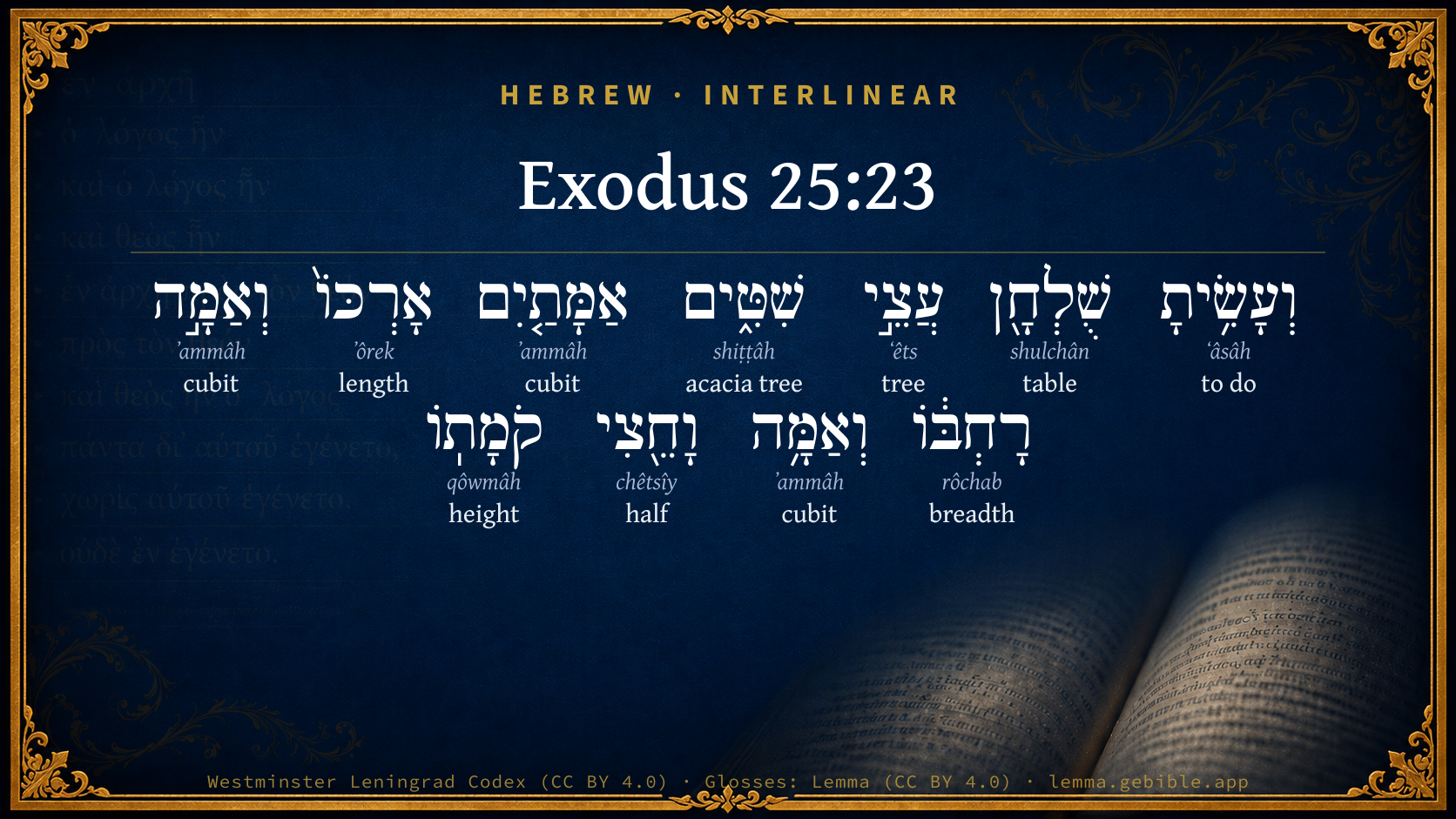
Hebrew (Westminster Leningrad Codex) Exodus 25:23 appears in the Hebrew Old Testament. The text above is from the Westminster Leningrad Codex. Each word links to its Strong’s number, a concise gloss, and parsing drawn from the Open Scriptures Hebrew Bible morphology. Click any word for its full Brown-Driver-Briggs (BDB) entry.
Download image
Cite this verse

Exodus 25:23 (World English Bible). Public Domain. Lemma interlinear Bible study tool, https://lemma.gebible.app/v/exodus/25/23.

Show BibTeX & RIS
BibTeX
RIS
English Translation
"You shall make a table of acacia wood. Two cubits shall be its length, and a cubit its breadth, and one and a half cubits its height.
World English Bible · Public Domain
Highlights
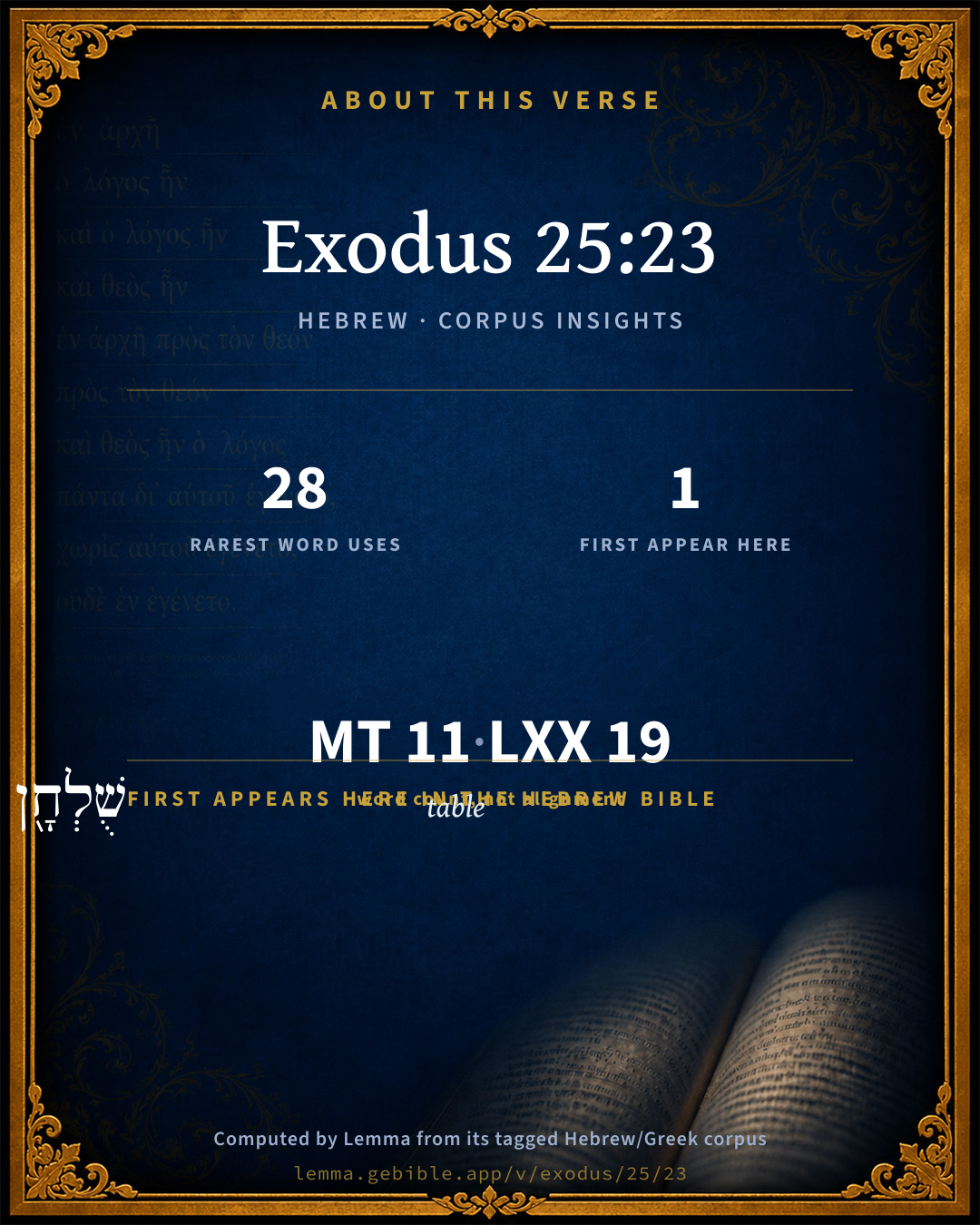
  • 1 first appearance in the Hebrew Bible
Full analysis ↓
Download a study sheet

One document with this verse’s original text, its word-by-word gloss line, the meaning frame, cross-references with their text, attributed commentary, and full source and license credits — printable, and it pastes into notes with its structure intact.

This verse Autodidact and up

Study sheet (.html) Plain text (.txt)

A passage Seminary Student

Up to 50 verses in one chapter. A passage sheet keeps up to 6 commentary sources and 12 cross-references per verse, in the order this page ranks them, and says so on the sheet whenever that leaves anything out. Ask for a single verse and you get the Autodidact verse sheet above.

Everything on this page stays free to read, with no account — the sheet is a download of what is already on screen, not access to it.

Want to remove ads? Support Godless Engineer
Compare translations 3

The same verse in 3 English versions, stacked beneath the original-language interlinear above. Click any original word for its lexicon entry.

Each is an independent rendering of the whole verse — the interlinear is not word-aligned to these translations.

Highlighted words mark where these versions differ — a whole-verse word diff, not a word-by-word alignment.

  • World English Bible Public Domain
    "You shall make a table of acacia wood. Two cubits shall be its length, and a cubit its breadth, and one and a half cubits its height.
  • King James Version Public Domain
    Thou shalt also make a table of shittim wood: two cubits shall be the length thereof, and a cubit the breadth thereof, and a cubit and a half the height thereof.
  • unfoldingWord Literal Text CC BY-SA 4.0
    And you shall make a table from wood of acacias. Its length: two cubits, and its width: a cubit, and its height: a cubit and a half.

unfoldingWord Literal Text — © unfoldingWord, licensed CC BY-SA 4.0. Word-aligned USFM3 via Door43 (git.door43.org/unfoldingWord/en_ult).

Versions to compare (up to 4)

3 of 4 selected

Show all 18 translations

Every available English version of this verse, each an independent rendering of the whole verse.

  • World English Bible Public Domain
    "You shall make a table of acacia wood. Two cubits shall be its length, and a cubit its breadth, and one and a half cubits its height.
  • Berean Standard Bible Public Domain
    You are also to make a table of acacia wood two cubits long, a cubit wide, and a cubit and a half high.
  • Majority Standard Bible Public Domain
    You are also to make a table of acacia wood two cubits long, a cubit wide, and a cubit and a half high.
  • King James Version Public Domain
    Thou shalt also make a table of shittim wood: two cubits shall be the length thereof, and a cubit the breadth thereof, and a cubit and a half the height thereof.
  • American Standard Version (1901) Public Domain
    And thou shalt make a table of acacia wood: two cubits `shall be' the length thereof, and a cubit the breadth thereof, and a cubit and a half the height thereof.
  • Revised Version (1885) Public Domain
    And thou shalt make a table of acacia wood: two cubits shall be the length thereof, and a cubit the breadth thereof, and a cubit and a half the height thereof.
  • Geneva Bible (1599) Public Domain
    Thou shalt also make a Table of Shittim wood, of two cubites long, and one cubite broade, and a cubite and an halfe hie:
  • Douay-Rheims (1899) Public Domain
    Thou shalt make a table also of setim wood, of two cubits in length, and a cubit in breadth, and a cubit and half in height.
  • Young's Literal Translation Public Domain
    `And thou hast made a table of shittim wood, two cubits its length, and a cubit its breadth, and a cubit and a half its height,
  • Literal Standard Version CC BY-SA 4.0
    And you have made a table of shittim wood, two cubits its length, and a cubit its breadth, and a cubit and a half its height,
  • Unlocked Literal Bible CC BY-SA 4.0
    You must make a table of acacia wood. Its length must be two cubits; its width must be one cubit, and its height must be a cubit and a half.
  • unfoldingWord Literal Text CC BY-SA 4.0
    And you shall make a table from wood of acacias. Its length: two cubits, and its width: a cubit, and its height: a cubit and a half.
  • Darby Bible Public Domain
    And thou shalt make a table of acacia-wood, two cubits the length thereof, and a cubit the breadth thereof, and a cubit and a half the height thereof.
  • World Messianic Bible Public Domain
    “You shall make a table of acacia wood. Its length shall be two cubits, and its width a cubit, and its height one and a half cubits.
  • Webster's Bible Public Domain
    Thou shalt also make a table of shittim wood: its length shall be two cubits, and its breadth a cubit, and its hight a cubit and a half.
  • Free Bible Version CC BY-SA 4.0
    Then you are to make a table of acacia wood two cubits long by a cubit wide by a cubit and a half high.
  • Bible in Basic English Public Domain
    And you are to make a table of the same wood, two cubits long, a cubit wide and a cubit and a half high,
  • JPS Tanakh (1917) Public Domain
    And thou shalt make a table of acacia-wood: two cubits shall be the length thereof, and a cubit the breadth thereof, and a cubit and a half the height thereof.

Literal Standard Version (2020), Covenant Press — licensed CC BY-SA 4.0. Text via the HelloAO Bible API (eBible.org). Unlocked Literal Bible (unfoldingWord) — licensed CC BY-SA 4.0. Text via the HelloAO Bible API (eBible.org). unfoldingWord Literal Text — © unfoldingWord, licensed CC BY-SA 4.0. Word-aligned USFM3 via Door43 (git.door43.org/unfoldingWord/en_ult). Free Bible Version, Dr. Jonathan Gallagher — licensed CC BY-SA 4.0. Text via the HelloAO Bible API (eBible.org).

Word by word

More ways to search: Search by grammar → Find every occurrence → Compare this word →

Practice this passage: Drill this verse → Learn its vocabulary →

שִׁטִּ֑ים
shiṭṭâh
H7848
“acacia trees”
Noun, Common, Feminine, Plural, Absolute
Part of Speech
Noun
Type
Common
Gender
Feminine
Number
Plural
State
Absolute
Full BDB Definition

Origin: meaning the sticks of wood [from the same as H7850 ]

TWOT: 2371

acacia tree, acacia wood
  1. וְעָשִׂ֥יתָ ʻâsâh H6213 “and · to do” Conjunction + Verb, Qal, Sequential Perfect, 2nd Person, Masculine, Singular
  2. שֻׁלְחָ֖ן shulchân H7979 “table” Noun, Common, Masculine, Singular, Absolute
  3. עֲצֵ֣י ʻêts H6086 “trees of” Noun, Common, Masculine, Plural, Construct
  4. אַמָּתַ֤יִם ʼammâh H520 “cubits” Noun, Common, Feminine, Dual, Absolute
  5. אָרְכּוֹ֙ ʼôrek H753 “length · his” Noun, Common, Masculine, Singular, Construct + Suffix, Personal, 3rd Person, Masculine, Singular
  6. וְאַמָּ֣ה ʼammâh H520 “and · cubit” Conjunction + Noun, Common, Feminine, Singular, Absolute
  7. רָחְבּ֔וֹ rôchab H7341 “breadth · his” Noun, Common, Masculine, Singular, Construct + Suffix, Personal, 3rd Person, Masculine, Singular
  8. וְאַמָּ֥ה ʼammâh H520 “and · cubit” Conjunction + Noun, Common, Feminine, Singular, Absolute
  9. וָחֵ֖צִי chêtsîy H2677 “and · half” Conjunction + Noun, Common, Masculine, Singular, Absolute
  10. קֹמָתֽוֹ qôwmâh H6967 “height · his” Noun, Common, Feminine, Singular, Construct + Suffix, Personal, 3rd Person, Masculine, Singular

About this verse

These counts appear in no published source. They are computed here, from the morphology-tagged text and Lemma’s own curated glosses. What Lemma adds →

11
words
9
distinct lemmas
Pentateuch
section

First appearance in Scripture

This word makes its first canonical appearance in the Hebrew Bible here:

  • שֻׁלְחָ֖ן table H7979

Shared distinctive vocabulary

שִׁטִּ֑ים acacia tree H7848 occurs in 28 verses of the Hebrew Bible. Also found in:

Grammatical profile

  • 1 verb
  • 10 nouns

Verb forms

  • וְעָשִׂ֥יתָ Qal · Sequential Perfect

Repetition

A word recurs within this verse — often emphatic in Hebrew:

  • אַמָּתַ֤יִם cubit H520 ×3

Hebrew & Septuagint length

In English translation the verse runs 27 words from the Hebrew and 27 from the Septuagint (LXX English) — the same length.

A rough comparison of the two English renderings, which tokenize alike — not a word-level alignment.

Word counts can differ between the Hebrew and the Greek without any difference in meaning — e.g. the Hebrew direct-object marker אֵת has no separate Greek word, and Greek often adds the article ὁ.

In the original languages it is 11 Hebrew tokens and 19 Greek tokens — but the two are counted differently (Hebrew bundles its prefixes and suffixes into one token; the Greek is in lemma form), so that isn’t a like-for-like length.

Cross-references

10

Topical passages linked to Exodus 25:23 in the Treasury of Scripture Knowledge — connected by theme and wording, ordered by reader-vote popularity; previews shown in the World English Bible.

  • Exodus 37:10–16 He made the table of acacia wood. Its length was two cubits, and its breadth was a cubit, and its height was a cubit and a half.
  • Hebrews 9:2 For there was a tabernacle prepared. In the first part were the lampstand, the table, and the show bread; which is called the Holy Place.
  • 1 Kings 7:48 Solomon made all the vessels that were in the house of Yahweh: the golden altar, and the table whereupon the show bread was, of gold;
  • 2 Chronicles 4:8 He made also ten tables, and placed them in the temple, five on the right side, and five on the left. He made one hundred basins of gold.
  • Exodus 40:22–23 He put the table in the tent of meeting, on the side of the tent northward, outside of the veil.
  • Leviticus 24:6 You shall set them in two rows, six on a row, on the pure gold table before Yahweh.
  • Numbers 3:31 Their charge shall be the ark, the table, the lamp stand, the altars, the vessels of the sanctuary with which they minister, and the screen, and all its service.
  • 1 Chronicles 28:16 and the gold by weight for the tables of show bread, for every table; and silver for the tables of silver;
  • 2 Chronicles 4:19 Solomon made all the vessels that were in the house of God, the golden altar also, and the tables whereon was the show bread;
  • Ezekiel 40:41–42 Four tables were on this side, and four tables on that side, by the side of the gate; eight tables, whereupon they killed [the sacrifices].

Cross-references courtesy of OpenBible.info (CC BY 4.0).

Hebrew and Greek witnesses Masoretic Hebrew ↔ Greek Septuagint

The same verse in the two great witnesses to the Old Testament, shown verse-for-verse.

These are two independent witnesses, not word-aligned to each other, and the Septuagint is shown in lemma (dictionary) form.

Hebrew Exodus 25:23 Masoretic · Westminster Leningrad Codex

וְעָשִׂ֥יתָ שֻׁלְחָ֖ן עֲצֵ֣י שִׁטִּ֑ים אַמָּתַ֤יִם אָרְכּוֹ֙ וְאַמָּ֣ה רָחְבּ֔וֹ וְאַמָּ֥ה וָחֵ֖צִי קֹמָתֽוֹ

"You shall make a table of acacia wood. Two cubits shall be its length, and a cubit its breadth, and one and a half cubits its height.

World English Bible · Public Domain

Greek LXX Exodus 25:23 Septuagint · lemma form

καί ποιέω τράπεζα χρυσίον καθαρός δύο πῆχυς ὁ μῆκος καί πῆχυς ὁ εὖρος καί πῆχυς καί ἥμισυς ὁ ὕψος

And you shall make a golden table of pure gold, in length two cubits, and in breadth a cubit, and in height a cubit and a half.

LXX2012 (modern English Septuagint) · Public Domain

On this verse, The Biblical Illustrator discusses the Septuagint’s reading. Read the note in Commentary ↓

Hebrew: Westminster Leningrad Codex (CC BY 4.0). Greek: Septuagint (public domain); English from LXX2012 (modern English Septuagint) (Public Domain). How the Septuagint differs from the Hebrew →

Targum (Aramaic paraphrase)

2

The Targum is the ancient Jewish Aramaic paraphrase of the Hebrew Scriptures — an interpretive translation, not the Hebrew text itself. Onkelos (literal) and Pseudo-Jonathan (expansive) render the Torah, and Jonathan the Prophets. Coverage is partial: where no permissively-licensed English translation exists for a verse, only the Aramaic is shown. This is verse-level text, not a word-by-word alignment to the Hebrew.

  1. Targum Onkelos Torah (Genesis–Deuteronomy)
    וְתַעְבֵּד פָּתוֹרָא דְאָעֵי שִׁטִּין תַּרְתֵּין אַמִין אֻרְכֵּהּ וְאַמְתָא פְתָיֵהּ וְאַמְתָא וּפַלְגָא רוּמֵהּ:

    (no public-domain English translation for this verse)

    Targum Onkelos — Aramaic: “Onkelos Genesis” (public domain); “Onkelos Exodus” (public domain); “Onkelos Leviticus” (public domain); “Onkelos Numbers” (public domain); “Onkelos Deuteronomy” (public domain). English: “Sefaria Community Translation” (CC0 1.0 (public-domain dedication)); “J.W. Etheridge. The Targums of Onkelos and Jonathan Ben Uzziel on the Pentateuch. London: Longmans, Green, 1862” (public domain). Text via Sefaria.

  2. Targum Pseudo-Jonathan Torah (Genesis–Deuteronomy)
    וְתַעֲבֵיד פְּתוֹרָא דְקֵיסֵי שִׁיטִין תַּרְתֵּין אַמִּין אוּרְכֵּיהּ וְאַמְתָא פּוּתְיֵהּ וְאַמְתָא וּפַלְגָא רוּמֵיהּ

    And thou shalt make a table of sitta wood; two cubits its length, and a cubit its breadth, and a cubit and a half its height.

    Targum Pseudo-Jonathan — Aramaic: “Targum Jonathan on Genesis” (public domain); “Targum Jonathan on Exodus” (public domain); “Targum Jonathan on Leviticus” (public domain); “Targum Jonathan on Numbers” (public domain); “Targum Jonathan on Deuteronomy” (public domain). English: “The Targum of Jonathan ben Uzziel, trans. J. W. Etheridge, London, 1862” (public domain). Text via Sefaria.

Commentary

Notes on Exodus 25:23 from classic Christian and Jewish commentators (each source and its license shown beneath its notes). The classic Christian expositions comment on the surrounding passage and are grouped to its opening verse, so a note may address several verses; the Jewish commentaries on the Tanakh (Rashi and others) are per-verse, so they appear only where the commentator wrote on this verse.

Lemma curates 59 commentaries, every one of them public domain or Creative Commons licensed, each selected and text-cleaned for this edition rather than reprinted as found. About our sources →

Trapp's Complete Commentary

John Trapp

Exo 25:23 Thou shalt also make a table [of] shittim wood: two cubits [shall be] the length thereof, and a cubit the breadth thereof, and a cubit and a half the height thereof.

Ver. 23. Of shittim wood.] Which corrupteth not. {Isa 41:19} Christ’s hody could not putrify in the grave.

John Trapp, A Commentary or Exposition upon All the Books of the Old and New Testament (1647–1656) — public domain. Text from a community e-Sword module.

The Biblical Illustrator

Joseph S. Exell

Exo_25:23-30

Set upon the table shewbread.

The table of shewbread

I. The first lesson we learn here is taught us by the nature of the bread upon the table. This we know, on the very best authority, was a symbol of Christ. Jesus taught us this distinctly and clearly when He said, I am the Bread of Life. That bread upon the table points to Jesus. How apt a type, or emblem of Him, it was! The bread was a prepared substance. A compound substance. A necessary substance. As suitable as necessary.

II. Our second lesson is furnished by observing the way in which this bread was manifested. Two things were required to this end, viz., the light which shone from the golden candlestick, and the table to lift up, or elevate the bread so that it could be distinctly seen. If the candlestick were not lighted, and casting forth its illuminating beams, the bread might be upon the table, but darkness would envelope it. The officiating priest could never see it. And so it is only the light of revelation, the illuminating influence of the Holy Ghost, which can make manifest Christ, the true bread from heaven, to the souls of famishing sinners.

III. The third lesson it teaches us is suggested by the abundance of the supply placed upon it. The table bore twelve loaves. There was one for each of the tribes. No part of Gods family was overlooked, or neglected, in the symbolical provision thus made for their necessities. And what was true, in this respect, of the symbol, is equally true of the thing symbolized. Jesus, whom the bread upon the golden table represented, is an infinite Saviour. The resources of His sufficiency are exhaustless.

IV. We are taught a lesson by the time for the renewing of the bread upon it. By an ordinance of God this was always to be done upon the Sabbath. Thus God would put honour upon the Sabbath, and associate it, in the minds of His people, with the thought of obtaining the supply of their spiritual necessities.

V. We learn a lesson from the continual freshness of the bread set out upon it. Christ never grows old. His people are often weary of other things; they grow weary of themselves--weary of their sins and sorrows, and weary of the world and its vanities--but they never, never grow weary of Jesus. Having once eaten of the bread which He gives, which He constitutes, it is literally true that they never hunger for the husks the world can offer.

VI. We gather our sixth and last lesson from the covering of frankincense which we see spread out over the top of the bread. When we remember that these loaves were a figure of Christ, and that frankincense is a token of that which is pleasing, or grateful, we seem to have exhibited, in beautiful symbol before us, the acceptableness of Christ and His work to the Father. (R. Newton, D.D.)

The table in Gods house

Table, gives us the idea of fellowship, social intercourse, friendship, satisfaction; all which we find in the house of God. Truly our fellowship is with the Father, and with His Son Jesus Christ. What a sacred privilege it is to eat bread in the presence of God. And not only to eat in His presence, but to eat the Presence Bread. He shall eat the bread of his God, both of the most holy and of the holy. At Gods table there is social intercourse. The saints commune one with another and all commune with God. We are all partakers of that one bread. Sweet is the intercourse of God with His people at the table of His grace. It is a proof of friendship. I have eaten my honeycomb with my honey; I have drunk my wine with my milk: eat O friends; drink, yea, drink abundantly, O beloved. Here we find sacred satisfaction. I will abundantly bless her provision. I will satisfy her poor with bread. They shall be abundantly satisfied with the fatness of Thy house. The meek shall eat and be satisfied. Thou preparest a table before me in the presence of mine enemies: Thou anointest my head with oil, my cup runneth over. There is no stint where God is the host. In His house there is bread enough and to spare. He fills our cup to overflowing with consolation, and with joy. Those who dwell in Gods house will never come to an empty table, nor find God absent from His throne of mercy. Surely goodness--to supply my wants--and mercy,--to pardon my sins--shall follow me all the days of my life: and I will dwell in the house of the Lord for ever. (R. E. Sears.)

The tables of grace and glory

The incorruptible wood may be an emblem of grace, the gold an emblem of glory. Gods table on earth is the table of His grace. His table in the heavenly world is the table of His glory. If we are guests at the table of grace, we shall be entertained at the table of glory. Grace is glory began. Glory is grace perfected. Grace is the earnest of our inheritance. Glory is the possession of the estate. By grace we are prepared for glory. When the work of grace is completed, we shall hear the welcome, Come up higher. By faith we sit at the table of grace. At the table of glory faith will be changed to sight. Both tables are furnished with the same provision. Christ the true Bread of Life is the spiritual food of the believer on earth: and in heaven we shall eat the same Divine celestial Bread. The Bread of God is the nourishment of the spiritual life; and it is the joy of the eternal life. (R. E. Sears.)

The table of shewbread

Made of acacia wood, and plated with gold, it was three feet long, one foot and six inches wide, two feet and three inches high. Around its verge was an ornamental cincture of solid gold, similar to that which adorned the ark. Beneath this was a border of wood four inches and a half wide, plated, of course, with gold, and adorned with another crown of gold. The table was furnished with golden rings at the corners, and with staves which were put through these rings when the table was to be carried on the shoulders of the Levites, but removed when the tabernacle had been erected in a new encampment, and the bearers had deposited their burden in its appointed position. The rings were attached at the same height as the wooden border; but the specifications do not intimate how far above the ground this was affixed. (E. E. Atwater.)

The shewbread, etc

.:--The table was furnished with two dishes for bread, two for frankincense, and probably two for wine. Twelve flat loaves of bread in two piles, constantly stood on it, fresh loaves being brought every Sabbath, and the loaves which were removed being eaten by the priests only. The number of the loaves doubtless indicates that the whole covenant people, the twelve tribes of Israel, were to participate in this offering to their covenant God. On the top of each pile was a dish of frankincense, and near by were cups of wine, as seems probable from the description of the dishes as suitable to pour with (Exo_25:29 margin). The Septuagint calls them bowls and cups; and the Jewish tradition is, that they contained wine for a libation or drink-offering, such as accompanied every food-offering at the altar in the court. The table of shewbread was in some sense an altar, being the appointed place where certain offerings to Jehovah were to be placed before Him. The materials of these sacrifices were the same as those of the food-offerings and drink-offerings in the court. Corn and wine, or bread and wine, being the product of the life-work of the Hebrews, represented, in the symbolism of the Tabernacle, the fruit of work in the higher sphere where one labours not for perishable food, but for that which endureth unto everlasting life. This is the true bread from heaven of which wheat, manna, and other kinds of food, are figures; it is not only the life-product of those who have been born again, but their chief enjoyment, the sufficient reward of all their labour. Knowing, however, that God has even more desire for the sanctification of His people than they themselves have, they wish Him to enjoy with them the fruits of this spiritual husbandry. It is this fellowship of God with His people in the enjoyment of their sanctification which the shewbread represents. (E. E. Atwater.)

Significance of the golden table

May not the golden table point to the abundant supply of good things prepared in the heavenly temple, for all those whom Christ will make kings and priests unto God for ever? There a table is spread before His face, that is continually furnished with new wine and heavenly manna, with which the ransomed of the Lord will be refreshed, and made glad: In Thy presence is fulness of joy; at Thy right hand there are pleasures for evermore. (W. Brown.)

The shewbread

The bread was made of fine flour (Lev_24:5-9), and was unleavened. Twelve cakes, in piles of six each, always stood on the table; hence it was called the perpetual bread. It was also named the bread arranged in order, the meaning of which is obvious. Its more significant name we will notice presently. On the top of each pile was placed frankincense, probably in the cups we have spoken of. It is thought by some that this frankincense was burned once a week, when the bread was being renewed; and by others that it was ever burning, which does not appear very likely, as the quantity consumed would be very great; but there may have been some means by which it was very slowly consumed, and kept always burning; in that case the holy place would be ever fragrant. The bread was called the shewbread (Hebrew, bread of faces, or presence bread) because it was before the symbol of Gods presence--the veil only intervening. The bread was renewed every Sabbath by fresh loaves; those which were removed belonged to the priests, and could be eaten only by them, and in the holy place and nowhere else. All thank-offerings were holy--this one was peculiarly so: It is most holy unto Him of the offerings made by fire. (Lev_24:9). Only the shewbread and the incense offerings were presented in the holy place; all the other offerings were brought to the brazen altar in the court. The ceremonies connected with all the sacrifices were soon over, except in the case of the shewbread, which was a ceaseless offering. The bread was ever on the table before the Lord. (W. Brown.)

The shewbread

This bread was made of fine flour. Fine flour is bread-corn which has been bruised until it is smooth and even. Christ is the bread-corn bruised, and in Him there is no roughhess or unevenness. In us there is much unevenness; we are soft and smooth one day, and changed and rough the next. But it was not so with Christ. The circumstances in which He was placed were ever changing, yet He remained always the same--unchanged and unchangeable. Leaven is the emblem of evil: it is a corrupt and a corrupting thing (Mat_16:6-12; Mar_8:15; Luk_12:1; 1Co_5:6-8; Gal_5:9). Christ was before God during the whole of His life, as the bread was before God in the Tabernacle seven days. The number seven is the symbol of perfection; it is a complete period. And as God discovered no leaven in the bread during the time it was before Him on the table, so He found no evil in Jesus during His life on earth; and as the bread was taken from the table and given to the priests, so Christ is given to the saints, the spiritual priests, that they may live on Him. He is our food, our daily bread. And as we must have bread every day on our tables, whatever else of sweet or savoury food we may have beside, so we must have Christ to feed upon every day. We may have many other things and many other friends, but we cannot do without Christ. No one can be healthy and strong who does not get good food; and no soul can be truly healthy that does not feed on Jesus Christ. To eat a book is to consider it well, and to eat the flesh and to drink the blood of Christ is to consider Him with faith and love; it is to receive Him into the heart. This is the soul-refreshing, soul-satisfying, and imperishable food of the Fathers house. Feeding on this blessed food will keep us from longing after the husks that swine feed on. In Christ God has provided a feast for fainting and famishing souls; and hungry souls thankfully receive Him, but others turn away. None but priests could feed on this bread (Mat_12:4; Mar_2:26). And a man must now be a priest before he can enter into the true Tabernacle and eat the food of the Fathers house. Not even the priests could eat the shewbread outside of the Tabernacle: they must eat it in the holy place (Lev_24:9). So a man must be holy to find full enjoyment in Christ. Happiness and holiness are twin sisters, and they travel side by side: they are never separated, so you cannot have one without the other. The more we feast on this heavenly bread, the holier and happier we must become. Eating and drinking are acts which one cannot perform for another. The food may be very good, but it does not minister strength and nourishment to my body till I eat it; by this act I make it my own. So we must receive Christ by faith, receive Him for ourselves. (G. Rodgers.)

The Biblical Illustrator, edited by Joseph S. Exell (c. 1880s–1900s) — public domain. Text from a community e-Sword module.

Joseph Benson's Commentary

Exo 25:23. Thou shalt make a table of shittim-wood — This table was to stand, not in the holy of holies (nothing was in that but the ark with its appurtenances) but in the outer part of the tabernacle, called the sanctuary, or holy place.

Joseph Benson's Commentary on the Old and New Testaments (1811–1818) — public domain. Text from a community e-Sword module.

Whedon's Commentary on the Bible

Daniel D. Whedon

THE TABLE OF SHOWBREAD, Exo_25:23-30.

23. Two cubits — While the height of it was to be the same as that of the ark, (Exo_25:10,) the length and breadth were each half a cubit less. The form is represented in the adjoining cut.

Daniel D. Whedon (gen. ed.), Commentary on the Old and New Testaments (1874–1909) — public domain. Text from a community e-Sword module.

Tyndale Open Study Notes

Tyndale Open Resources

25:23-30 The table of acacia wood stood on the north side of the main room of the sanctuary, the Holy Place (26:35). It reminded the people that God would provide sustenance for them. Above all, that sustenance was his presence (25:30).

Tyndale Open Study Notes — © Tyndale Open Resources, licensed CC BY-SA 4.0. Text via the HelloAO Bible API.

Matthew Henry's Commentary

Here is, 1. A table ordered to be made of wood overlaid with gold, which was to stand, not in the holy of holies (nothing was in that but the ark with its appurtenances), but in the outer part of the tabernacle, called the sanctuary, or holy place, Heb 9:2, Heb 9:23, etc. There must also be the usual furniture of the sideboard, dishes and spoons, etc., and all of gold, Exo 25:29. 2. This table was to be always spread, and furnished with the show-bread (Exo 25:30), or bread of faces, twelve loaves, one for each tribe, set in two rows, six in a row; see the law concerning them, Lev 24:5, etc. The tabernacle being God's house, in which he was pleased to say that he would dwell among them, he would show that he kept a good house. In the royal palace it was fit that there should be a royal table. Some make the twelve loaves to represent the twelve tribes, set before God as his people and the corn of his floor, as they are called, Isa 21:10. As the ark signified God's being present with them, so the twelve loaves signified their being presented to God. This bread was designed to be, (1.) A thankful acknowledgement of God's goodness to them, in giving them their daily bread, manna in the wilderness, where he prepared a table for them, and, in Canaan, the corn of the land. Hereby they owned their dependence upon Providence, not only for the corn in the field, which they gave thanks for in offering the sheaf of first-fruits, but for the bread in their houses, that, when it was brought home, God did not blow upon it, Hag 1:9. Christ has taught us to pray every day for the bread of the day. (2.) A token of their communion with God. This bread on God's table being made of the same corn with the bread on their own tables, God and Israel did, as it were, eat together, as a pledge of friendship and fellowship; he supped with them, and they with him. (3.) A type of the spiritual provision which is made in the church, by the gospel of Christ, for all that are made priests to our God. In our Father's house there is bread enough and to spare, a loaf for every tribe. All that attend in God's house shall be abundantly satisfied with the goodness of it, Psa 36:8. Divine consolations are the continual feast of holy souls, notwithstanding there are those to whom the table of the Lord, and the meat thereof (because it is plain bread), are contemptible, Mal 1:12. Christ has a table in his kingdom, at which all his saints shall for every eat and drink with him, Luk 22:30.

Matthew Henry's Commentary on the Whole Bible (1708–1710) — public domain (CC PDM 1.0). Text via the HelloAO Bible API.

Jamieson, Fausset & Brown

Robert Jamieson, A. R. Fausset & David Brown

table of shittim wood--of the same material and decorations as the ark [see on Exo 25:5], and like it, too, furnished with rings for the poles on which it was carried [Exo 25:26]. The staves, however, were taken out of it when stationary, in order not to encumber the priests while engaged in their services at the table. It was half a cubit less than the ark in length and breadth, but of the same height. [See on Exo 25:10.]

Jamieson, Fausset & Brown — Commentary Critical and Explanatory on the Whole Bible (1871) — public domain (CC PDM 1.0). Text via the HelloAO Bible API.

Adam Clarke's Commentary

Verse 23. Thou shalt also make a table of shittim wood] The same wood, the acacia, of which the arkstaves, c., were made. On the subject of the ark, table of shew-bread, c., Dr. Cudworth, in his very learned and excellent treatise on the Lord's Supper, has the following remarks:-

"When God had brought the children of Israel out of Egypt, resolving to manifest himself in a peculiar manner present among them, he thought good to dwell amongst them in a visible and external manner and therefore, while they were in the wilderness, and sojourned in tents, he would have a tent or tabernacle built to sojourn with them also. This mystery of the tabernacle was fully understood by the learned Nachmanides, who, in few words, but pregnant, expresseth himself to this purpose: 'The mystery of the tabernacle was this, that it was to be a place for the shechinah, or habitation of Divinity, to be fixed in' and this, no doubt, as a special type of God's future dwelling in Christ's human nature, which was the TRUE SHECHINAH: but when the Jews were come into their land, and had there built them houses, God intended to have a fixed dwelling-house also; and therefore his movable tabernacle was to be turned into a standing temple. Now the tabernacle or temple, being thus as a house for God to dwell in visibly, to make up the notion of dwelling or habitation complete there must be all things suitable to a house belonging to it; hence, in the holy place, there must be a table, and a candlestick, because this was the ordinary furniture of a room, as the fore-commended Nachmanides observes. The table must have its dishes, and spoons, and bowls, and covers belonging to it, though they were never used; and always be furnished with bread upon it. The candlestick must have its lamps continually burning. Hence also there must be a continual fire kept in this house of God upon the altar, as the focus of it; to which notion I conceive the Prophet Isaiah doth allude, Isa 31:9: Whose fire is in Zion, and his furnace in Jerusalem; and besides all this, to carry the notion still farther, there must be some constant meat and provision brought into this house; which was done in the sacrifices that were partly consumed by fire upon God's own altar, and partly eaten by the priests, who were God's family, and therefore to be maintained by him. That which was consumed upon God's altar was accounted God's mess, as appeareth from Mal 1:12, where the altar is called God's table, and the sacrifice upon it, God's meat: Ye say, The table of the LORD is polluted; and the fruit thereof, even HIS MEAT, is contemptible. And often, in the law, the sacrifice is called God's לחם lechem, i.e., his bread or food. Wherefore it is farther observable, that besides the flesh of the beast offered up in sacrifice, there was a minchah, i.e., a meat-offering, or rather bread-offering, made of flour and oil; and a libamen or drink-offering, which was always joined with the daily sacrifice, as the bread and drink which was to go along with God's meat. It was also strictly commanded that there should be salt in every sacrifice and oblation, because all meat is unsavoury without salt, as Nachmanides hath here also well observed; 'because it was not honourable that God's meat should be unsavoury, without salt.' Lastly, all these things were to be consumed on the altar only by the holy fire which came down from heaven, because they were God's portion, and therefore to be eaten or consumed by himself in an extraordinary manner." See Clarke on Ex 25:22.

Adam Clarke's Commentary on the Bible (1810–1826) — public domain. Text from a community e-Sword/MySword module.

Ellicott's Commentary for English Readers

(23) Of shittim wood.—See the last Note on Exo_25:5. No other wood was to be employed, either for the sanctuary itself, or for its furniture.

THE TABLE OF SHEWBREAD.

(23-30) Thou shalt also make a table.—The ark and mercy seat, which covered it, constituted the entire furniture of the inner sanctuary, or “Holy of Holies” (Exo_40:20-21). When this had been shown to Moses the next thing to be done was to set before him the furniture of the outer sanctuary, or holy place. This consisted of three articles—(1) The table of shewbread, described in the present passage; (2) the golden candlestick, described in Exo_25:31-40; and (3) the altar of incense, described in Exo_30:1-10. The “table of shewbread” was a receptacle for the twelve loaves, which were to be “set continually before the Lord” (Lev_24:8) as a thank-offering on the part of His people—a perpetual acknowledgment of His perpetual protection and favour. It was to be just large enough to contain the twelve loaves, set in two rows, being a yard long, and a foot and a-half broad. The vessels belonging to the table (Exo_25:29) were not placed on it.

A Bible Commentary for English Readers, edited by Charles John Ellicott (1878–1897) — public domain. Text from a community e-Sword module.

John Gill's Exposition

And thou shalt make unto it a border of art hand's breadth round about,.... Jarchi says, their wise men are divided about this; some say it was above, round about the table; others say it was below, fixed from foot to foot at the four corners of the table, and the board of the table lay upon the border:

and thou shalt make a golden crown to the border thereof round about; this was not the same spoke of in the former verse, but another; that was above, and upon the table, this below and under it; or rather that was, as it may be better expressed, a lip, rim, or border, that went round within the table (u); and this crown, surrounded that on the edge of it.

(u) So R. Sol. Urbin. Ohel Moed, fol. 61. 2.

John Gill's Exposition of the Whole Bible (1746–1763) — public domain (CC PDM 1.0). Text via the HelloAO Bible API.

Albert Barnes' Notes on the Bible

(Compare Exo 37:10-16.) The table and the candlestick figured on the Arch of Titus at Rome are those of the Maccabaean times, but made as nearly as possible after the ancient models reproduced under the direction of Solomon and Zerubbabel. The details and size of the figure, and the description of Josephus, appear to agree very nearly with the directions here given to Moses, and to illustrate them in several particulars. Josephus says that the table was like the so-called Delphic tables, richly ornamented pieces of furniture in use amongst the Romans, which were sometimes, if not always, covered with gold or silver.

Exo 25:24

See Exo 25:11 note. The moulding of the table is still seen at the ends of the sculptured figure.

Exo 25:25

A border - Rather a framing, which reached from leg to leg so as to make the table firm, as well as to adorn it with a second moulding of gold. Two fragments of such framing are still seen in the sculpture attached to the legs halfway down.

Exo 25:27

Over against the border - Rather, Over against the framing; that is, the rings were to be placed not upon the framing itself, but at the extremities of the legs answering to each corner of it.

Exo 25:29

Dishes - deep vessels like “bowls,” similar to the large silver vessels (or chargers) which were filled with fine flour, and formed part of the offerings of the Princes of Israel (Num 7:13 following).

Spoons - Rather, the small gold cups that were filled with frankincense in the offerings of the Princes Num 7:14, and represented on the table in the sculpture.

Covers ... bowls - Or flagons and chalices, such as were used for the rite of the drink offering, which appears to have regularly accompanied every Meat offering (Lev 23:18; Num 6:15; Num 28:14, etc.). The subject is important in its bearing upon the meaning of the showbread: the corrected rendering of the words tends to show that it was a true Meat offering.

To cover withal - See the margin. The first part of the verse might be better rendered: And thou shalt make its bowls and its incense-cups and its flagons and its chalices for pouring out “the drink offerings.”

Exo 25:30

The showbread table was placed in the holy place on the north side Exo 26:35. Directions for preparing the showbread are given in Lev 24:5-9. It consisted of twelve large cakes of unleavened bread, which were arranged on the table in two piles, with a golden cup of frankincense on each pile. It was renewed every Sabbath day. The stale loaves were given to the priests, and the frankincense appears to have been lighted on the altar for a memorial. The showbread, with all the characteristics and significance of a great national Meat offering, in which the twelve tribes were represented by the twelve cakes, was to stand before Yahweh “perpetually,” in token that He was always graciously accepting the good works of His people, for whom atonement had been made by the victims offered on the altar in the court of the sanctuary. The showbread or bread which is set forth would be more fairly rendered “bread of the presence.” See the notes at Lev 24:5-9.

Albert Barnes' Notes on the Bible (1834–1885) — public domain. Text from a community e-Sword/MySword module.

Haydock's Catholic Bible Commentary

A table: on which were to be placed the twelve loaves of proposition; or, as they are called in the Hebrew, the face bread; because they were always to stand before the face of the Lord in his temple: as a figure of the eucharistic sacrifice and sacrament, in the church of Christ; (Challoner) which shews that Christ must be present in the eucharist. (Worthington) --- By this bread, renewed at the public expense every sabbath-day, the Israelites made profession that they were indebted for their food to God’s providence; and in gratitude, offered him this sacrifice, with incense and wine, ver. 29. The priests alone were to eat these loaves (1 Kings xxi.) at the expiration of the week. (Tirinus)

George Leo Haydock (1774–1849), Haydock's Catholic Family Bible and Commentary, 1859 edition — public domain. Excludes Psalms (Douay-Rheims chapter numbering differs from Protestant) and Deuterocanonical books (Catholic canon only).

The Pulpit Commentary

Vers. 23-30. THE TABLE OF SHEW-BREAD. From the description of the ark, which constituted the sole furniture of the most holy place, God proceeded to describe the furniture of the holy place, or body of the tabernacle, which was to consist of three objects

1. A table, called the table of shew-bread ("bread of presence" or "bread of setting-forth").

2. A candelabrum, or lamp-stand; and

3. An altar for the offering of incense. Of these the table seems to havebeen regarded as of primary importance; and its description is therefore made to follow immediately on that of the ark. It was of acacia wood, overlaid with pure gold, and was of the most ordinary shape oblong-square, i.e. , with four legs, one at each corner. The only peculiar features of the table, besides its material, were the border, or edging, which surrounded it at the top, the framework which strengthened the legs (ver. 25), and the rings by which it was to be carried from place to place.

Two cubits shall be the length thereof, etc. The table was to be three feel long, one foot six inches broad, and two feet three inches high. It was thus quite a small table, narrow for its length, and about two inches below the ordinary height.

Vers. 23-30. The symbolism of the table of shew-bread.

Before the holy of holies, within which was the Divine Presence, dwelling in thick darkness behind the veil, was to be set perpetually this golden table, bearing bread and wine and frankincense. The bread and wine and frankincense constituted a perpetual thank-offering, offered by Israel as a nation to the high and holy God. The idea was that of a constant memorial, (Lev_24:8) a continual acknowledgment of the Divine goodness on the part of the nation. The essence of the offering was the bread we know of the wine only by implication; the frankincense is distinctly mentioned (ib, ver. 7), but is altogether subordinate. Israel, grateful to God for maintaining and supporting its life, physical and spiritual, expressed its gratitude by this one and only never ceasing offering. It was intended to teach

I THAT GRATITUDE WAS DUE TO GOD FROM HIS PEOPLE PERPETUALLY. Men are so cold by nature, so selfish, so little inclined to real thankfulness, that it was well they should be reminded, as they were by the shew-bread, of thankfulness being a continuous, unending duty, a duty moreover owed by all. No tribe was ever exempt, however reduced in numbers, however little esteemed, however weak and powerless. The twelve loaves were perpetually before the Lord.

II THAT GRATITUDE MUST BE SHOWN BY OFFERINGS. The best offering is that of a "pure heart;" but no man of a pure heart, who possessed aught, was ever yet content to offer merely "the calves of his lips men instinctively give of their best to God. Bread, the staff of life wine, that maketh glad the heart of man frankincense, the mostprecious of spices, are fitting gifts to him. The offering of bread signifies the devotion of our strength of wine, the devotion of our feelings of frankincense, the devotion of our most sublimised spiritual aspirations to the eternal. Israel, as a nation, perpetually offered these offerings, and thereby inculcated on each individual of the nation the duty of doing the same, separately and individually, for private, as the nation did for public, benefits.

III THAT NO OFFERING COULD BE ACCEPTABLE TO GOD, UNLESS ALL ITS SURROUNDINGS WERE PURE AND HOLY. The loaves were to be of the finest flour. (Lev_24:5) The frankincense was to be "pure frankincense" (ib, ver. 7). The table was to be overlaid with "pure gold". (Exo_26:24) All the utensils of the table were to be of the same (ib, ver. 29). Nothing "common or unclean" was to come into contact with the offering, which was "the most holy unto the Lord" of all the offerings made to him. (Lev_24:8) The purity and perfection of all the material surroundings of the offering suggested the need of equal purity in those who offered it.

HOMILIES BY D. YOUNG Chap. 3:6,

The Pulpit Commentary (1880–1919), ed. H.D.M. Spence-Jones & Joseph S. Exell — public domain. Text from a community e-Sword module.

John Wesley's Explanatory Notes

This table was to stand not in the holy of holies, (nothing was in that but the ark with its appurtenances) but in the outer part of the tabernacle, called the sanctuary or holy place. This table was to be always furnished with the shew-bread, or bread of faces, twelve loaves, one for each tribe, set in two rows, six in a row. As the ark signified God's being present with them, so the twelve loaves signified their being presented to God. This bread was designed to be, a thankful acknowledgment of God's goodness to them in giving them their daily bread, a token of their communion with God; this bread on God's table being made of the same corn as the bread on their own tables. And a type of the spiritual provision which is made in the church, by the gospel of Christ, for all that are made priests to our God.

John Wesley, Explanatory Notes Upon the Whole Bible (1754–1765) — public domain. Text via the GEBible commentary corpus.

Keil & Delitzsch

C. F. Keil & F. Delitzsch

The Table of Shew-Bread (cf. Exo 37:10-16). - The table for the shew-bread (Exo 25:30) was to be made of acacia-wood, two cubits long, one broad, and one and a half high, and to be plated with pure gold, having a golden wreath round, and a "finish (מסגּרת) of a hand-breadth round about," i.e., a border of a hand-breadth in depth surrounding and enclosing the four sides, upon which the top of the table was laid, and into the four corners of which the feet of the table were inserted. A golden wreath was to be placed round this rim. As there is no article attached to זר־זהב in Exo 25:25 (cf. Exo 37:12), so as to connect it with the זר in Exo 25:24, we must conclude that there were two such ornamental wreaths, one round the slab of the table, the other round the rim which was under the slab. At the four corners of the four feet, near the point at which they joined the rim, four rings were to be fastened for בּתּים, i.e., to hold the poles with which the table was carried, as in the case of the ark.

Keil & Delitzsch — Biblical Commentary on the Old Testament (1861–1891) — public domain (CC PDM 1.0). Text via the HelloAO Bible API. (Old Testament only.)

Scofield Reference Notes

C. I. Scofield

shittim wood

i.e. acacia.

The Scofield Reference Bible (1917 edition), notes by C. I. Scofield — public domain. Text from a community e-Sword module.

Kretzmann's Popular Commentary

Paul E. Kretzmann

The Table for the Showbread

v. 23. Thou shalt also make a table of shittim wood; two cubits shall be the length thereof, and a cubit the breadth thereof, that being the size of the plate, and a cubit and a half the height thereof.

v. 24. And thou shalt overlay it with pure gold, and make thereto a crown of gold round about, heavy cross-pieces, or molding, connecting the legs of the table.

v. 25. And thou shalt make unto it a border of an handbreadth round about, a heavy molding at the edge of the plate, and thou shalt make a golden crown to the border thereof round about, a special rim which stood up above the plate of the table, to prevent the objects on the table from rolling or sliding off.

v. 26. And thou shalt make for it four rings of gold, doubtless cast like those of the ark, and put the rings in the four corners that are on the four feet thereof.

v. 27. Over against the border, next to the heavy molding at the top, shall the rings be for places of the staves to bear the table, containers for the poles which were used in moving the table.

v. 28. And thou shalt make the staves of shittim wood, the same material from which those of the ark were made, and overlay them with gold, that the table may be borne with them.

v. 29. And thou shalt make the dishes thereof, the large plates for the showbread, and spoons thereof, the small vessels for the incense, Num 7:14, and covers thereof, and bowls thereof, pitchers and goblets for the drink-offering, to cover withal, that is, formed so as to make pouring possible; of pure gold shalt thou make them.

v. 30. And thou shalt set upon the table showbread before Me alway, the bread of the face of the Lord, twelve cakes made of fine flour, set forth in two heaps of six each. These vessels and sacrifices were to remind Israel of the fruits of good works which all believers were to work always. The covenant people of the New Testament will also offer the sacrifices of heart, lips, and hands as a sweet savor unto the Lord.

Paul E. Kretzmann, Popular Commentary of the Bible (1921–1924) — public domain. Text from a community e-Sword module.

unfoldingWord translationNotes

Door43 World Missions Community

General Information:

Yahweh continues to tell Moses what the people must do.

two cubits ... one cubit ... a cubit and a half

A cubit is 46 centimeters. AT: "2 cubits ... 1 cubit ... 1.5 cubits" or "92 centimeters ... 46 centimeters ... 69 centimeters" (See: Biblical Distance and Fractions)

translationWords

acacia

gold

unfoldingWord translationNotes — © Distant Shores Media and the Door43 World Missions Community, licensed CC BY-SA 4.0. Source: git.door43.org/Door43/en_tn.

Rashi

Rabbi Shlomo Yitzchaki (Rashi)

קמתו THE HEIGHT THEREOF — i. e. the height of its legs together with the thickness of the table-board.

Rashi on the Tanakh — English translations: “The Judaica Press complete Tanach with Rashi, translated by A. J. Rosenberg” (CC BY 4.0); “Pentateuch with Rashi's commentary by M. Rosenbaum and A.M. Silbermann, 1929-1934” (public domain); “The Metsudah Tanach series, Lakewood, N.J” (CC BY 4.0); and “The Book of Joshua, Metsudah Publications, 1997” (CC BY 4.0). Text via Sefaria.

Lesson kit

Teaching starters — assembled from the data on this page, not authored interpretation. Every prompt links to the verse data it draws on. Edit before teaching.

Exodus, in the Pentateuch, opens this verse with 11 words (9 distinct Hebrew lemmas). Its most distinctive word is shiṭṭâh (“acacia tree”). A historical commentator’s framing appears above. Read the whole chapter for the surrounding context.

Discussion questions

  1. How does “acacia tree” (shiṭṭâh) shape what this verse is saying?
  2. The word “table” first appears here in Scripture. What is being introduced at this debut?
  3. Exodus 25:5 shares the word «acacia tree» with this verse. How do the two illuminate each other?
  4. “cubit” occurs 3× in this one verse. What is the effect of the repetition?
  5. The translations on this page render this verse differently — a whole-verse word diff, not a word-by-word alignment. What might account for the different wordings?
  6. The verb «וְעָשִׂ֥יתָ» is Qal Sequential Perfect. How does its form color the action?
  7. Reading how Trapp's Complete Commentary and The Biblical Illustrator read this verse, where do the two commentators agree and where do they part?

Things to notice

Reading settings

Reading text

Shown beneath each verse's original-language words.

Old Testament
Old Testament edition

Read the OT as the Masoretic Hebrew (MT) or the Greek Septuagint (LXX).

English shown for the Greek Septuagint (in the Hebrew ↔ Greek comparison).

Comparing translations? Open the Compare panel on any verse page to stack up to four side by side.