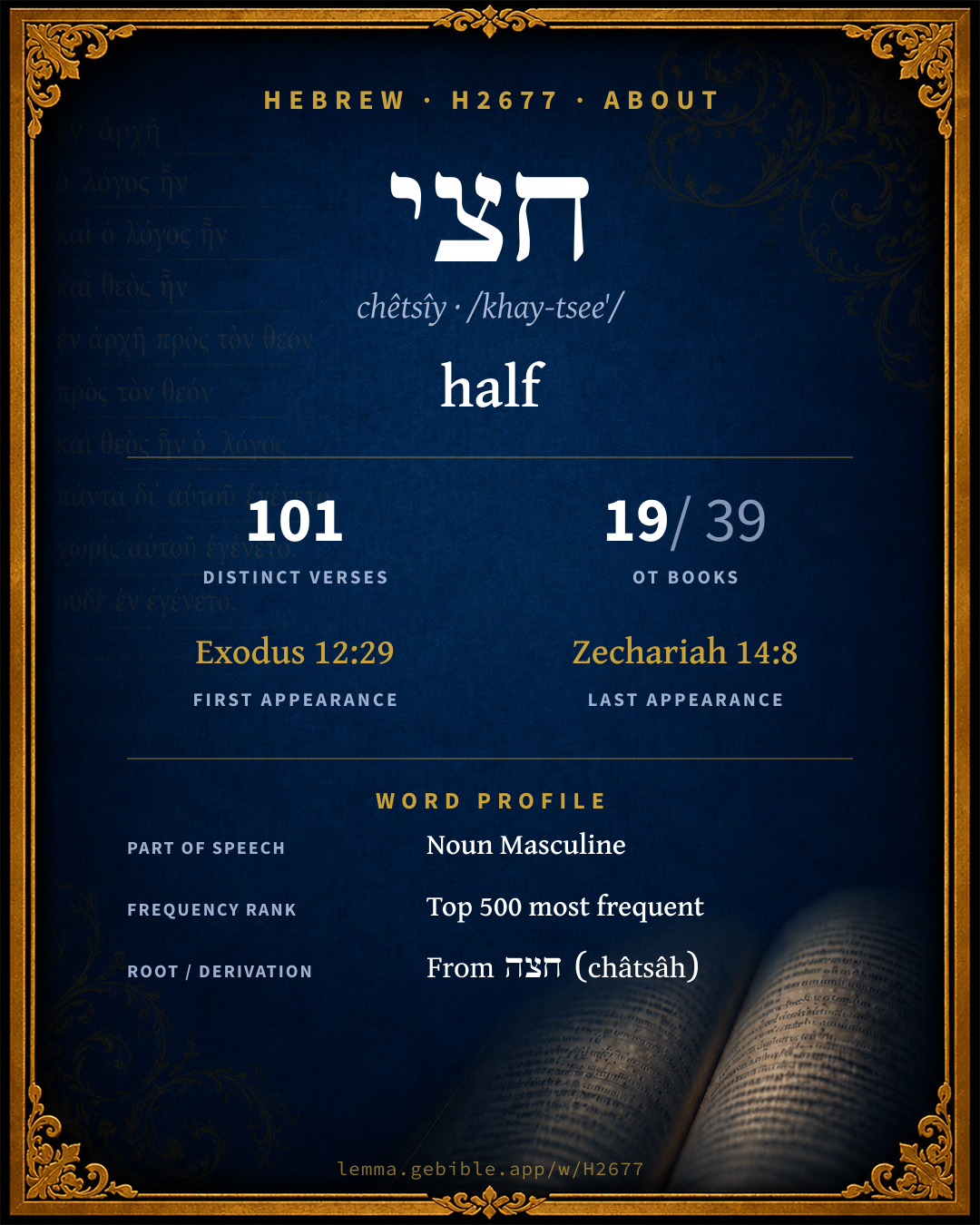
חֲצִי
half
‘half’ is one of 2 main senses fuller range ↓
Full lexicon entry — Brown-Driver-Briggs (BDB)
From Brown-Driver-Briggs (BDB)
Where this word appears
See every Construct-state word in the Hebrew Bible →
Grammar key — what these labels mean
Part of speech
- Noun
- A naming word — a person, place, thing, or idea.
Noun type
- Common
- A common noun — a general class of person, place, or thing (“king,” “city,” “water”), not a specific name.
State
- Construct
- A noun bound to a following noun in a possessive / “of” relationship (the construct chain).
- Absolute
- The independent form of a noun, not bound to a following word.
Gender
- Masculine
- Grammatically masculine.
Number
- Singular
- One.
Every verse where H2677 appears in the Book of 2 Samuel — 3 distinct verses. Click any verse to open its interlinear word-by-word view. Verse text shown in the World English Bible for context — . Each verse’s Hebrew form is shown with its reference; the English is not keyword-highlighted, since the data carries no word-level English alignment. Use “Compare translations” on any verse to read it across multiple English versions. This concordance covers the Hebrew Bible; Septuagint (Greek Old Testament) occurrences are not indexed here.
2 Samuel
- 2 Samuel 10:4 חֲצִ֣י בַּ/חֵ֖צִי n c ms cs prep det + n c ms So Hanun took David's servants, and shaved off the one half of their beards, and cut off their garments in the middle, even to their buttocks, and sent them away.
- 2 Samuel 18:3 חֶצְיֵ֨/נוּ֙ n c ms cs + sfx pers 1cp But the people said, You shall not go forth: for if we flee away, they will not care for us; neither if half of us die, will they care for us: but you are worth ten thousand of us; therefore now it is better that you are ready to help us out of the city.
- 2 Samuel 19:40 חֲצִ֖י n c ms cs So the king went over to Gilgal, and Chimham went over with him: and all the people of Judah brought the king over, and also half the people of Israel.
About this entry
At a glance — auto-summarized from this page’s data, not written by a person. Every figure links to its source below. This summary describes the numbers; it doesn’t interpret them.
At its core, חצי (chêtsîy) means “half.” The King James Version usually renders it “half,” while modern versions prefer “half of” (unfoldingWord Literal Text) — see the renderings breakdown. Spanning 101 verses in 19 books, it ranks among the common words of the Hebrew Bible. Its uses concentrate in Joshua (25% of all occurrences). Carrying more than one sense, it rewards its full sense range. Each statement above links to its evidence; the full detail follows below.
Gloss history
Strong's 1890 vs modern scholarship
About this word
Strong's H2677 catalogs a Hebrew word from the Hebrew Old Testament.
These counts are not copied from any lexicon or concordance. They are computed here, from the morphology-tagged Hebrew Old Testament. What Lemma adds →
- 101
- distinct verses
- The word appears in 101 distinct verses.
- 19 / 39
- OT books
- The word appears in 19 of 39 Old Testament books.
- #356
- by frequency
- Top 500 most frequent Hebrew words (rank 356 of 8,640 Hebrew words by occurrence).
View all 101 occurrences in the concordance →
By section of the Old Testament
By traditional corpus
Conventional, traditional groupings — biblical authorship is debated, so this is a traditional corpus grouping, not an authorship claim. Each share is this word’s portion of its verses in that division of the Hebrew canon. Each figure is a share of the word’s 101 distinct verses.
- Prophets (Nevi'im) 46 verses · 46%
- Writings (Ketuvim) 31 verses · 31%
- Torah (Pentateuch) 24 verses · 24%
How translations render this word
Counts come from each version’s own published word-to-Strong’s tagging or interlinear alignment — an approximate guide to how each version renders this word, not a word-level alignment the data otherwise carries. Because each total is that version’s own tagged count, the per-version totals vary from one another and need not match the appearance or distinct-verse counts above. These counts may also differ from a printed concordance because Lemma counts each distinctly tagged rendering and does not collapse phrase taggings into a single head-word total. This is a fixed set of word-tagged versions (KJV, ASV, BSB, ULT) and does not change with the reading translation you choose elsewhere. Each version’s license is shown beside its name below (and on Sources).
- King James Version: Half 87×, Midst 8×, Other half 3×
- American Standard Version: Half 59×, The 14×, Cubit and a half 8×
- Berean Standard Bible: Half 58×, Half-tribe 23×, Half cubits 4×
- unfoldingWord Literal Text: Half of 67×, Half 28×, Middle of 8×
King James Version Public Domain
Renders H2677 across 125 tagged occurrences — most commonly:
Plus 20 renderings that appear only once — usually multi-word phrases or single function words the recovered tagging swept in, not distinct renderings.
American Standard Version Public Domain
Renders H2677 across 119 tagged occurrences — most commonly:
Plus 20 renderings that appear only once — usually multi-word phrases or single function words the recovered tagging swept in, not distinct renderings.
Berean Standard Bible Public Domain
Renders H2677 across 120 tagged occurrences — most commonly:
Plus 15 renderings that appear only once — usually multi-word phrases or single function words the recovered tagging swept in, not distinct renderings. Not rendered by a distinct English word in 3 further occurrences.
unfoldingWord Literal Text CC BY-SA 4.0
Renders H2677 across 125 tagged occurrences — most commonly:
Plus 9 renderings that appear only once — usually multi-word phrases or single function words the recovered tagging swept in, not distinct renderings.
Senses in the full BDB
What do BDB’s symbols mean?
BDB uses these scholarly abbreviations:
| Symbol | Meaning |
|---|---|
| 𝔊 | the Septuagint (the ancient Greek translation, LXX) |
| 𝔙 | the Vulgate (the Latin translation) |
| 𝔖 | the Syriac version (the Peshitta) |
| 𝔗 | the Targum (the Aramaic translation) |
| ψ | the Psalms |
| √ | root (the underlying root or stem) |
| ‖ | parallel passage (a synonymous or contrasted parallel) |
| † | the dagger: every passage where the word occurs is cited |
The 2 senses and sub-senses the full Brown-Driver-Briggs lexicon distinguishes for this word, in lexicon order (not ranked by frequency), with BDB’s own verbatim wording and sub-sense lettering. Shown in Hebrew script with BDB’s own scholarly abbreviations. The condensed entry is in the Lexicon Entry tab. See also the Forms in the corpus table below.
- 1. half of anything:—blood of offering Ex 24:6(×2) (JE), beard 2 S 10:4, a hin Nu 15:9, 10; 28:14 (P); curtain Ex 26:12 (P); week ח׳ השׁבוע Dn 9:27 etc.; ח׳ אַמָּה half a cubit Ex 26:16; 36:21 (P) +; especially ח׳ שׁבט half a tribe Nu 32:33; 34:13, 14, 15 (P) +; half of people 2 S 18:3; 19:41; 1 K 16:21(×3) +, etc. so ח׳ הַמְּנֻחוֹת 1Ch 2:52 and ח׳ הַמָּנַחְתִּי v 54 (v. Be and מָנַחַת sub נוח).—On כבחצי 1 S 14:14 v. We Dr. e.g. Exodus 24:6
- 2. middle ח׳ הלילה Ex 12:29 (J) midnight, so Ju 16:3(×2) Ru 3:8; of garments 2 S 10:4; 1 Ch 19:4; altar Ex 27:5; of the Mt. of Olives Zc 14:4; ח׳ יָמַי ψ 102:25 the midst of my days (when they are but half done), Je 17:11. e.g. Exodus 12:29
Senses from the full Brown-Driver-Briggs lexicon (Brown, Driver, Briggs; Oxford 1906 — public domain), digitized via Sefaria, supplemented by the OpenScriptures HebrewLexicon (CC BY 4.0). Full attribution on Sources.
Word origin
n.m. Nu 12:12 half (NH id.; Ph. חצי; on format. v. Lag BN 113)—abs. חֲצִי 1 K 3:25(×2) + 3 times; הַחֵ֑צִי 1 K 10:7, cf. 16:21; וָחֵ֔צִי Ez 40:42; וָחֵצִי Dn 12:7 + 13 times (usually c. Pashta or Tiphcha), cf. בַּחֵ֖צִי 2 S 10:4 1 Ch 19:4; cstr. חֲצִי Ex 12:29 + 84 times; sf. חֶצְיוֹ Ex 38:4 + 7 times + Jos 8:33 וְהַחֶצְיוֹ (but art. suspicious v. Ges§ 127 R 3, 4); חֶצְיָהּ Ne 3:38; חֶצְיֵנוּ 2 S 18:3; חֶצְיָם Zc 14:8(×2) + 2 times—
— Brown-Driver-Briggs (Oxford 1906, public domain), digitized via Sefaria, supplemented by the OpenScriptures HebrewLexicon (CC BY 4.0). See Sources.
Derived from חצה (châtsâh) (H2673) — to divide.
Jastrow Dictionary
A second Hebrew/Aramaic lexicon for comparison, covering Aramaic and post-biblical (Talmudic, Targumic, Midrashic) usage that the biblical-Hebrew BDB does not. Matched by lemma rather than by Strong’s number, so a lemma may carry more than one Jastrow headword (shown separately below), and the entries cover usage well beyond the Bible.
חצי
- v. חָצַץ)
- 1. to split, divide. B. Bath. 3ᵃ שרצו לַחֲצוֹת, v. מְחִיצָה.
- 2. to pick one’s teeth. Tosef. Bets. III, 18, v. חָצַץ I.
- to order a division, to assign half, divide. B. Kam. 34ᵃ פחת שפחתתו מיתה מַחֲצִין בחי Ms. M. a. Rashi (ed. שפחתו) half of the loss of value which death has caused, is collected from the living animal; Y. ib. I, end, 2ᶜ מחצין את הנזק the loss is divided.
חֲצֵי
- , to pick out (of birds, v. P. Sm. 1349); to pick one’s teeth. Targ. Prov. XXX, 17.—Y. Ḥall. IV, end, 60ᵇ מִיחֲצִי שיניי (not ניח׳) to pick my teeth with; Y. Dem. III, 23ᵇ bot. מיחצד, מחצדן (corr. acc.).
חֵצִי
- preced. wds.) half. B. Kam. IV, 9 חֲ׳ נזק half the damage. Gitt. IV, 5 מי שחֶצְיוֹ עבד וכ׳ he who is half a slave and half a freedman (having been emancipated by one of the partners); a. v. fr.—Pl. חֲצָיִים, חֲצָיִין, חֲצָאִים, חֲצָאִין. Sifra Vayikra, N’dab., ch. X, Par. 9 לא יביאנה ח׳ he must not offer it in parts. Ned. 83ᵃ אין נזירות לח׳ there is no nazaritism by halves, i.e. one cannot vow to be a nazarite by partial abstinence; ואין קרבן לח׳ nor is there a sacrifice for partial nazaritism. Y. Hor. I, 46ᵇ top אין הפסח לה׳ the Passover offering does not take place in divisions (of clean and unclean parties). Kerith. 5ᵃ מפטם לח׳ taking only a part of each ingredient; Y. Yoma IV, 41ᵈ bot. פיטמה ח׳; a. fr.
A Dictionary of the Targumim, the Talmud Babli and Yerushalmi, and the Midrashic Literature (Marcus Jastrow; London, Luzac, 1903) — Public Domain. Digitized via Sefaria. Digitized via Sefaria. Full attribution on Sources.
Forms in the corpus
The 54 distinct written forms H2677 takes in the Hebrew Bible, most frequent first — each parse links to that state’s occurrences in the concordance. Hebrew forms include their vowel points and cantillation, so a single lemma takes many written forms.
Same root — word family
Other BDB entries built from the same root as H2677, grouped by Strong’s listed origin. These share a root / origin per the lexicon — not necessarily a shared meaning. Each links to that word’s own entry.
Derives from
Shares the same root
- חצות châtsôwth H2676 half
- חצץ châtsats H2686 to divide
- מחצה mechĕtsâh H4275 half
- מחצית machătsîyth H4276 middle
Proper names from this root
People and places named from this root — a name, not an additional meaning of the word.
- יחצאל Yachtsᵉʼêl H3183 Jahzeel
- יחציאל Yachtsîyʼêl H3185 Jahziel
- חצי המנחות Chătsîy ham-Mᵉnuchôwth H2679 Manahethites
Compare all same-root words → Showing 4 of 9 — not the complete family. 3 of the same-root words are proper names (people or places). They share a root, not necessarily a meaning.
Septuagint verse parallels
This word appears in 86 verses that also exist in the Greek Old Testament (Septuagint), out of the 101 Hebrew verses it occurs in. You can read those verses in Greek by switching the Old Testament edition to the Septuagint.
Read these verses in the Septuagint
- Exodus 12:29
- Numbers 12:12
- Deuteronomy 3:12
- Joshua 1:12
- Judges 16:3
- Ruth 3:8
- 1 Samuel 14:14
- 2 Samuel 10:4
- 1 Kings 3:25
- 1 Chronicles 5:18
- 2 Chronicles 9:6
- Esther 5:3
This is a verse-level parallel only — the same verses exist in both the Hebrew and Greek Old Testaments. No word-level Hebrew↔Greek correspondence is claimed: the data carries no such alignment, so no Greek word is shown as this Hebrew word’s translation. Coverage is not total — the Septuagint omits the deuterocanon and renumbers the Psalms, so some Hebrew verses have no direct Greek parallel.