
2 Samuel 19:40

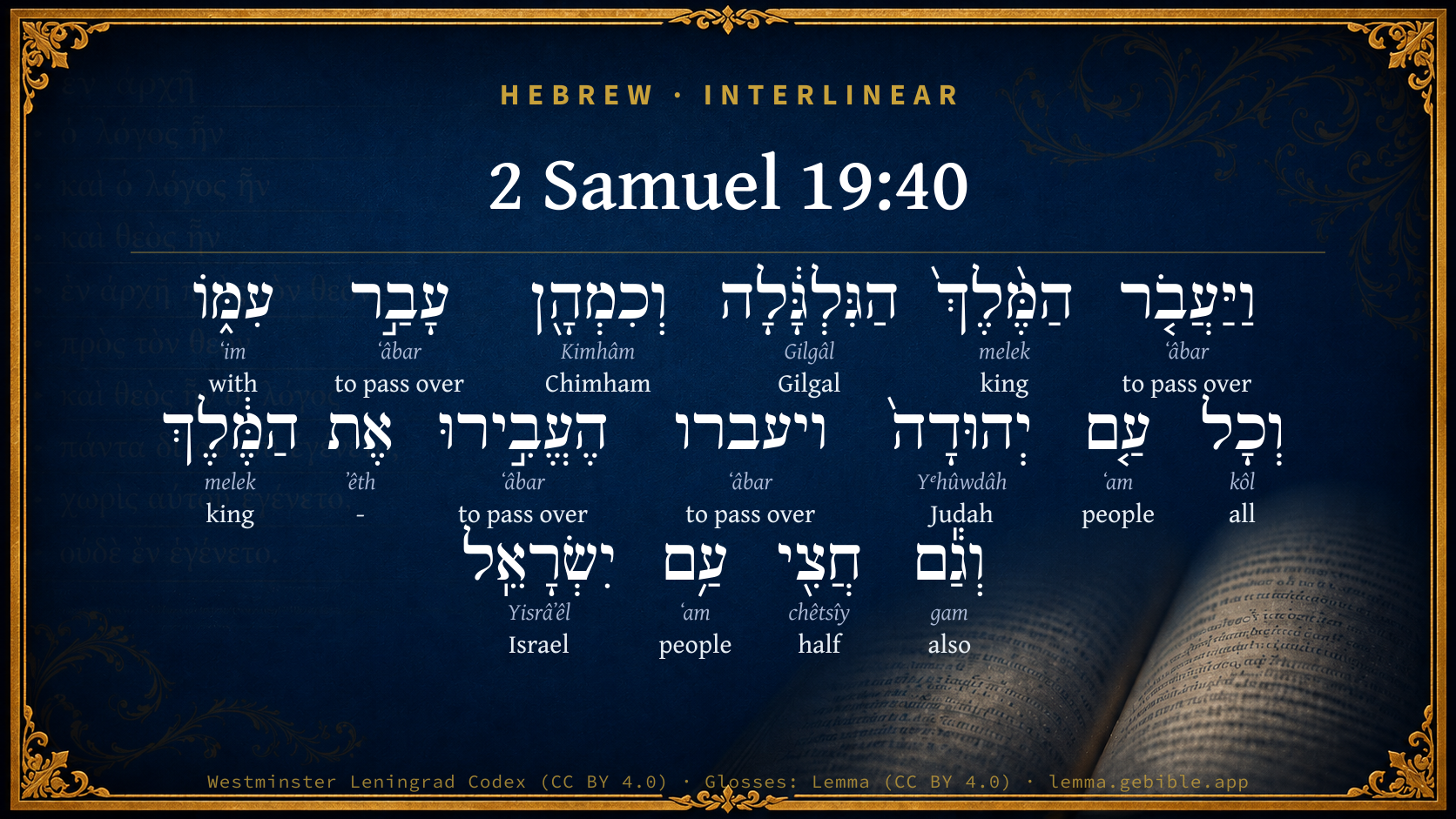
Hebrew (Westminster Leningrad Codex) 2 Samuel 19:40 appears in the Hebrew Old Testament. The text above is from the Westminster Leningrad Codex. Each word links to its Strong’s number, a concise gloss, and parsing drawn from the Open Scriptures Hebrew Bible morphology. Click any word for its full Brown-Driver-Briggs (BDB) entry.
Download image
Cite this verse

2 Samuel 19:40 (World English Bible). Public Domain. Lemma interlinear Bible study tool, https://lemma.gebible.app/v/2-samuel/19/40.

Show BibTeX & RIS
BibTeX
RIS
English Translation
So the king went over to Gilgal, and Chimham went over with him: and all the people of Judah brought the king over, and also half the people of Israel.
World English Bible · Public Domain
Download a study sheet

One document with this verse’s original text, its word-by-word gloss line, the meaning frame, cross-references with their text, attributed commentary, and full source and license credits — printable, and it pastes into notes with its structure intact.

This verse Autodidact and up

Study sheet (.html) Plain text (.txt)

A passage Seminary Student

Up to 50 verses in one chapter. A passage sheet keeps up to 6 commentary sources and 12 cross-references per verse, in the order this page ranks them, and says so on the sheet whenever that leaves anything out. Ask for a single verse and you get the Autodidact verse sheet above.

Everything on this page stays free to read, with no account — the sheet is a download of what is already on screen, not access to it.

Want to remove ads? Support Godless Engineer
Compare translations 3

The same verse in 3 English versions, stacked beneath the original-language interlinear above. Click any original word for its lexicon entry.

Each is an independent rendering of the whole verse — the interlinear is not word-aligned to these translations.

Highlighted words mark where these versions differ — a whole-verse word diff, not a word-by-word alignment.

  • World English Bible Public Domain
    So the king went over to Gilgal, and Chimham went over with him: and all the people of Judah brought the king over, and also half the people of Israel.
  • King James Version Public Domain
    Then the king went on to Gilgal, and Chimham went on with him: and all the people of Judah conducted the king, and also half the people of Israel.
  • unfoldingWord Literal Text CC BY-SA 4.0
    And the king passed on to Gilgal, and Chimham passed on with him. And all of the people of Judah brought the king over, and also half of the people of Israel.

unfoldingWord Literal Text — © unfoldingWord, licensed CC BY-SA 4.0. Word-aligned USFM3 via Door43 (git.door43.org/unfoldingWord/en_ult).

Versions to compare (up to 4)

3 of 4 selected

Show all 18 translations

Every available English version of this verse, each an independent rendering of the whole verse.

  • World English Bible Public Domain
    So the king went over to Gilgal, and Chimham went over with him: and all the people of Judah brought the king over, and also half the people of Israel.
  • Berean Standard Bible Public Domain
    Then the king went on to Gilgal, and Chimham crossed over with him. All the troops of Judah and half the troops of Israel escorted the king.
  • Majority Standard Bible Public Domain
    Then the king crossed over to Gilgal, and Chimham crossed over with him. All the troops of Judah and half the troops of Israel escorted the king.
  • King James Version Public Domain
    Then the king went on to Gilgal, and Chimham went on with him: and all the people of Judah conducted the king, and also half the people of Israel.
  • American Standard Version (1901) Public Domain
    So the king went over to Gilgal, and Chimham went over with him: and all the people of Judah brought the king over, and also half the people of Israel.
  • Revised Version (1885) Public Domain
    So the king went over to Gilgal, and Chimham went over with him: and all the people of Judah brought the king over, and also half the people of Israel.
  • Geneva Bible (1599) Public Domain
    Then the King went to Gilgal, and Chimham went with him, and all the people of Iudah conducted the King, and also halfe ye people of Israel.
  • Douay-Rheims (1899) Public Domain
    So the king went on to Galgal, and Chamaam with him. Now all the people of Juda had brought the king over, and only half of the people of Israel were there.
  • Young's Literal Translation Public Domain
    And the king passeth over to Gilgal, and Chimham hath passed over with him, and all the people of Judah, and they bring over the king, and also the half of the people of Israel.
  • Literal Standard Version CC BY-SA 4.0
    And the king passes over to Gilgal, and Chimham has passed over with him, and all the people of Judah, and they bring over the king, and also the half of the people of Israel.
  • Unlocked Literal Bible CC BY-SA 4.0
    So the king crossed over to Gilgal, and Kimham crossed over with him. All the army of Judah brought the king over, and also half the army of Israel.
  • unfoldingWord Literal Text CC BY-SA 4.0
    And the king passed on to Gilgal, and Chimham passed on with him. And all of the people of Judah brought the king over, and also half of the people of Israel.
  • Darby Bible Public Domain
    And the king went on to Gilgal, and Chimham went on with him; and all the people of Judah conducted the king, and also half the people of Israel.
  • World Messianic Bible Public Domain
    So the king went over to Gilgal, and Chimham went over with him. All the people of Judah brought the king over, and also half the people of Israel.
  • Webster's Bible Public Domain
    Then the king went on to Gilgal, and Chimham went on with him: and all the people of Judah conducted the king, and also half the people of Israel.
  • Free Bible Version CC BY-SA 4.0
    Then the king carried on to Gilgal, and Chimham went with him. The whole army of Judah and half the army of Israel accompanied the king.
  • Bible in Basic English Public Domain
    So the king went over to Gilgal, and Chimham went with him: and all the people of Judah, as well as half the people of Israel, took the king on his way.
  • JPS Tanakh (1917) Public Domain
    (19-41) So the king went over to Gilgal, and Chimham went over with him; and all the people of Judah brought the king over, and also half the people of Israel.

Literal Standard Version (2020), Covenant Press — licensed CC BY-SA 4.0. Text via the HelloAO Bible API (eBible.org). Unlocked Literal Bible (unfoldingWord) — licensed CC BY-SA 4.0. Text via the HelloAO Bible API (eBible.org). unfoldingWord Literal Text — © unfoldingWord, licensed CC BY-SA 4.0. Word-aligned USFM3 via Door43 (git.door43.org/unfoldingWord/en_ult). Free Bible Version, Dr. Jonathan Gallagher — licensed CC BY-SA 4.0. Text via the HelloAO Bible API (eBible.org).

Word by word

More ways to search: Search by grammar → Find every occurrence → Compare this word →

Practice this passage: Drill this verse → Learn its vocabulary →

וְכִמְהָ֖ן
Kimhâm
H3643
“and · Chimham”
Conjunction + Noun, Proper
Part of Speech
Conjunction + Noun
Type
Proper
Full BDB Definition

Origin: from H3642

TWOT: None

Chimham = "their longing" - a follower and probably a son of Barzillai the Gileadite who returned from beyond Jordan with David; apparently David bestowed on him a possession in Bethlehem on which in later times an inn was standing (noun proper masculine) - apparently the inn in Bethlehem located on the possession given by David to Chimham the follower or son of Barzillai the Gileadite (noun proper locative)
  1. וַיַּעֲבֹ֤ר ʻâbar H5674 “and · to pass over” Conjunction + Verb, Qal, Sequential Imperfect, 3rd Person, Masculine, Singular
  2. הַמֶּ֨לֶךְ֙ melek H4428 “the · king” Particle, Definite Article + Noun, Common, Masculine, Singular, Absolute
  3. הַגִּלְגָּ֔לָה Gilgâl H1537 “the · Gilgal · toward” Particle, Definite Article + Noun, Proper + Suffix, Demonstrative
  4. עָבַ֣ר ʻâbar H5674 “to pass over” Verb, Qal, Perfect, 3rd Person, Masculine, Singular
  5. עִמּ֑וֹ ʻim H5973 “with · him” Preposition + Suffix, Personal, 3rd Person, Masculine, Singular
  6. וְכָל kôl H3605 “and · all of” Conjunction + Noun, Common, Masculine, Singular, Construct
  7. עַ֤ם ʻam H5971 “people of” Noun, Common, Masculine, Singular, Construct
  8. יְהוּדָה֙ Yᵉhûwdâh H3063 “Judah” Noun, Proper
  9. ויעברו ʻâbar H5674 “and · to pass over” Conjunction + Verb, Hiphil, Sequential Imperfect, 3rd Person, Masculine, Plural
  10. הֶעֱבִ֣ירוּ ʻâbar H5674 “to pass over” Verb, Hiphil, Perfect, 3rd Person, Common, Plural
  11. אֶת ʼêth H853 “-” Particle, Direct Object
  12. הַמֶּ֔לֶךְ melek H4428 “the · king” Particle, Definite Article + Noun, Common, Masculine, Singular, Absolute
  13. וְגַ֕ם gam H1571 “and · also” Conjunction + Particle, Accusative
  14. חֲצִ֖י chêtsîy H2677 “half of” Noun, Common, Masculine, Singular, Construct
  15. עַ֥ם ʻam H5971 “people of” Noun, Common, Masculine, Singular, Construct
  16. יִשְׂרָאֵֽל Yisrâʼêl H3478 “Israel” Noun, Proper

About this verse

These counts appear in no published source. They are computed here, from the morphology-tagged text and Lemma’s own curated glosses. What Lemma adds →

17
words
12
distinct lemmas
Historical
section

Notable vocabulary

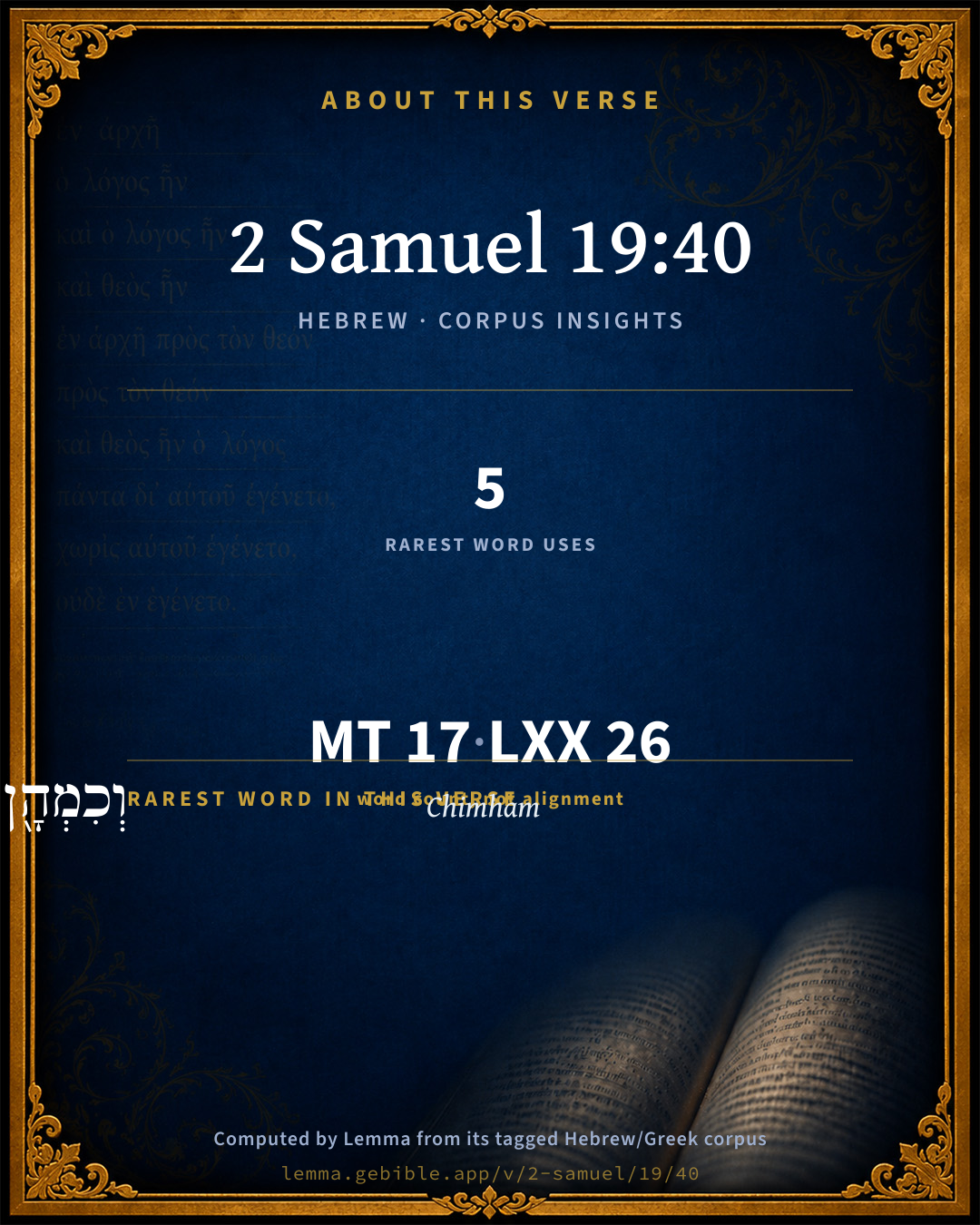
The rarest word here is וְכִמְהָ֖ן Chimham H3643 — appearing just 5 times in the whole Hebrew Bible.

Shared distinctive vocabulary

וְכִמְהָ֖ן Chimham H3643 occurs in 4 verses of the Hebrew Bible. Also found in:

Grammatical profile

  • 4 verbs
  • 10 nouns
  • 1 preposition
  • 2 particles

Verb forms

  • וַיַּעֲבֹ֤ר Qal · Sequential Imperfect
  • עָבַ֣ר Qal · Perfect
  • ויעברו Hiphil · Sequential Imperfect
  • הֶעֱבִ֣ירוּ Hiphil · Perfect

Repetition

Words recur within this verse — often emphatic in Hebrew:

  • וַיַּעֲבֹ֤ר to pass over H5674 ×4
  • הַמֶּ֨לֶךְ֙ king H4428 ×2
  • עַ֤ם people H5971 ×2

Hebrew & Septuagint length

In English translation the verse runs 30 words from the Hebrew and 31 from the Septuagint (LXX English) — closely comparable.

A rough comparison of the two English renderings, which tokenize alike — not a word-level alignment.

Word counts can differ between the Hebrew and the Greek without any difference in meaning — e.g. the Hebrew direct-object marker אֵת has no separate Greek word, and Greek often adds the article ὁ.

In the original languages it is 17 Hebrew tokens and 26 Greek tokens — but the two are counted differently (Hebrew bundles its prefixes and suffixes into one token; the Greek is in lemma form), so that isn’t a like-for-like length.

Cross-references

3

Topical passages linked to 2 Samuel 19:40 in the Treasury of Scripture Knowledge — connected by theme and wording, ordered by reader-vote popularity; previews shown in the World English Bible.

  • Genesis 49:10 The scepter will not depart from Judah, Nor the ruler's staff from between his feet, Until he comes to whom it belongs. To him will the obedience of the peoples be.
  • 2 Samuel 19:11–15 King David sent to Zadok and to Abiathar the priests, saying, Speak to the elders of Judah, saying, Why are you the last to bring the king back to his house? seeing the speech of all Israel is come to the king, [to bring him] to his house.
  • Matthew 21:9 The multitudes who went before him, and who followed kept shouting, "Hosanna to the son of David! Blessed is he who comes in the name of the Lord! Hosanna in the highest!"

Cross-references courtesy of OpenBible.info (CC BY 4.0).

Hebrew and Greek witnesses Masoretic Hebrew ↔ Greek Septuagint

The same verse in the two great witnesses to the Old Testament, shown verse-for-verse.

These are two independent witnesses, not word-aligned to each other, and the Septuagint is shown in lemma (dictionary) form.

Hebrew 2 Samuel 19:40 Masoretic · Westminster Leningrad Codex

וַיַּעֲבֹ֤ר הַמֶּ֨לֶךְ֙ הַגִּלְגָּ֔לָה וְכִמְהָ֖ן עָבַ֣ר עִמּ֑וֹ וְכָל עַ֤ם יְהוּדָה֙ ויעברו הֶעֱבִ֣ירוּ אֶת הַמֶּ֔לֶךְ וְגַ֕ם חֲצִ֖י עַ֥ם יִשְׂרָאֵֽל

So the king went over to Gilgal, and Chimham went over with him: and all the people of Judah brought the king over, and also half the people of Israel.

World English Bible · Public Domain

Greek LXX 2 Samuel 19:40 Septuagint · lemma form

καί διαβαίνω πᾶς ὁ λαός ὁ ἰορδάνης καί ὁ βασιλεύς διαβαίνω καί καταφιλέω ὁ βασιλεύς ὁ βερζελλι καί εὐλογέω αὐτός καί ἐπιστρέφω εἰς ὁ τόπος αὐτός

And the king went over to Galgala, and Chamaam went over with him: and all the men of Juda went over with the king, and also half the people of Israel.

LXX2012 (modern English Septuagint) · Public Domain

Hebrew: Westminster Leningrad Codex (CC BY 4.0). Greek: Septuagint (public domain); English from LXX2012 (modern English Septuagint) (Public Domain). How the Septuagint differs from the Hebrew →

Targum (Aramaic paraphrase)

1

The Targum is the ancient Jewish Aramaic paraphrase of the Hebrew Scriptures — an interpretive translation, not the Hebrew text itself. Onkelos (literal) and Pseudo-Jonathan (expansive) render the Torah, and Jonathan the Prophets. Coverage is partial: where no permissively-licensed English translation exists for a verse, only the Aramaic is shown. This is verse-level text, not a word-by-word alignment to the Hebrew.

  1. Targum Jonathan Prophets (Joshua–Malachi)
    וַעֲבַר כָּל עַמָא יַת יַרְדְנָא וּמַלְכָּא עֲבַר וּנְשַׁק מַלְכָּא לְבַרְזִלַי וּבָרְכֵיהּ וְתַב לְאַתְרֵיהּ:

    (no public-domain English translation for this verse)

    Targum Jonathan — Aramaic: “Mikraot Gedolot” (public domain). English: “Sefaria Community Translation” (CC0 1.0 (public-domain dedication)); “London "Chaldee Paraphrase," 1871” (public domain). Text via Sefaria.

Commentary

Notes on 2 Samuel 19:40 from classic Christian and Jewish commentators (each source and its license shown beneath its notes). The classic Christian expositions comment on the surrounding passage and are grouped to its opening verse, so a note may address several verses; the Jewish commentaries on the Tanakh (Rashi and others) are per-verse, so they appear only where the commentator wrote on this verse.

Lemma curates 59 commentaries, every one of them public domain or Creative Commons licensed, each selected and text-cleaned for this edition rather than reprinted as found. About our sources →

Trapp's Complete Commentary

John Trapp

2Sa 19:40 Then the king went on to Gilgal, and Chimham went on with him: and all the people of Judah conducted the king, and also half the people of Israel.

Ver. 40. And also half the people of Israel.] i.e., A part of them; so many as well could, and had a mind to it.

John Trapp, A Commentary or Exposition upon All the Books of the Old and New Testament (1647–1656) — public domain. Text from a community e-Sword module.

Joseph Benson's Commentary

2Sa 19:40. All the people of Judah — That is, the elders and great men of Judah. Also half the people of Israel — Whereas the men of Judah came entirely and unanimously to the king, the Israelites, of the other tribes, came in but slowly, and by halves, as being no less guilty of rebellion than the tribe of Judah; but not encouraged to come in by such a gracious message as they were. And this is here mentioned as the occasion both of the contention here following, and of the sedition, chap. 20.

Joseph Benson's Commentary on the Old and New Testaments (1811–1818) — public domain. Text from a community e-Sword module.

Whedon's Commentary on the Bible

Daniel D. Whedon

QUARREL AT GILGAL BETWEEN JUDAH AND ISRAEL OVER THE KING’S RETURN, 2Sa_19:40-43.

40. Gilgal — In the Jordan plain just east of Jericho; the ancient camping-ground of Israel under Joshua, and the spot where the kingdom was confirmed to Saul when he returned successful from a war fought beyond the Jordan. Compare notes on 1Sa_11:12-15.

Daniel D. Whedon (gen. ed.), Commentary on the Old and New Testaments (1874–1909) — public domain. Text from a community e-Sword module.

Keil & Delitzsch

C. F. Keil & F. Delitzsch

Quarrel between Israel and Judah about the restoration of the king. - Sa2 19:40. David went across to Gilgal (in the plain of the Jordan: Jos 4:19), and Chimham (Chimhan is a modified form for Chimham: Sa2 19:37) had gone over with him, and all the people of Judah had brought the king over (the Keri העבירוּ is an easier reading than the Chethib ויּעבירוּ, "and as for the people, they had," etc.), and also "half the people of Israel," namely, beside the thousand Benjaminites who came with Shimei (Sa2 19:17), other Israelites who dwelt in the neighbourhood.

Sa2 19:41

All the men of Israel, i.e., the representatives of the other tribes of Israel, came to meet the king in Gilgal; and being annoyed at the fact that the men of Judah had anticipated them, they exclaimed, "Why have our brethren the men of Judah stolen thee away?" i.e., fetched thee thus secretly without saying a word to us. "All David's men" were all his faithful adherents who had fled with him from Jerusalem (Sa2 15:17.).

Sa2 19:42

The men of Judah replied against (על) the men of Israel: "The king stands near to us" (inasmuch as he belonged to their tribe), "and wherefore then art thou angry at this matter? Have we eaten from the king (i.e., derived any advantage from our tribe-relationship to him, as the Benjaminites did from Saul, according to Sa1 22:7), or received anything for ourselves therefrom?" נשּׂאת is an infinitive abs. Niph. with a feminine termination, borrowed from ה;ל literally, "or has taking been taken for us."

Sa2 19:43

The Israelites were annoyed at this answer, and retorted, "I (Israel) have ten portions in the king, and also more than thou in David; and wherefore hast thou despised me?" They considered that they had ten shares in the king, because they formed ten tribes, in opposition to the one tribe of Judah, as the Levites did not come into consideration in the matter. Although David was of the tribe of Judah, he was nevertheless king of the whole nation, so that the ten tribes had a larger share than one tribe. הקלּתני refers to the fact, that Judah took no notice at all of the tribes of Israel when fetching back the king. וגו ולא־היה, "and was not my speech the first to fetch back my king?" (On the fact itself, see Sa2 19:10-11.) לי is an emphatic dat. commodi, and is to be taken in connection with להשׁיב, notwithstanding the accents. "And the speech of the men of Judah became fiercer (more violent) than the speech of the men of Israel." With these words the historian sums up briefly the further progress of the dispute, for the purpose of appending the account of Sheba's rebellion, to which it gave rise.

Keil & Delitzsch — Biblical Commentary on the Old Testament (1861–1891) — public domain (CC PDM 1.0). Text via the HelloAO Bible API. (Old Testament only.)

Tyndale Open Study Notes

Tyndale Open Resources

19:40 Gilgal, a natural stop along David’s westward route, was also a politically significant location: It was where the people had proclaimed Saul king (1 Sam 11:15) and Samuel later announced the end of Saul’s reign (1 Sam 13:13-15). David’s kingship now had a new beginning at Gilgal.

Tyndale Open Study Notes — © Tyndale Open Resources, licensed CC BY-SA 4.0. Text via the HelloAO Bible API.

Geneva Bible (1599)

Geneva Bible translators

Which had taken part with the King.

Where the tribe of Judah tarried to receive him.

Geneva Bible (1599) marginal notes — public domain. Text via Bolls.life.

Matthew Henry's Commentary

David came over Jordan attended and assisted only by the men of Judah; but when he had advanced as far as Gilgal, the first stage on this side Jordan, half the people of Israel (that is, of their elders and great men) had come to wait upon him, to kiss his hand, and congratulate him on his return, but found they came too late to witness the solemnity of his first entrance. This put them out of humour, and occasioned a quarrel between them and the men of Judah, which was a damp to the joy of the day, and the beginning of further mischief. Here is, 1. The complaint which the men of Israel brought to the king against the men of Judah (Sa2 19:41), that they had performed the ceremony of bringing the king over Jordan, and not given them notice, that they might have come to join in it. This reflected upon them, as if they were not so well affected to the king and his restoration as the men of Judah were, whereas the king himself knew that they had spoken of it before the men of Judah thought of it, Sa2 19:11. It seemed likewise as if they intended to monopolize the king's favours when he had come back, and to be looked upon as his only friends. See what mischief comes from pride and jealousy. 2. The excuse which the men of Judah made for themselves, Sa2 19:42. (1.) They plead relations to the king: "He is near of kin to us, and therefore in a matter of mere ceremony, as this was, we may claim precedency. It was into our country that he was to be brought, and therefore who so fit as we to bring him?" (2.) They deny the insinuated charge of self-seeking in what they had done: "Have we eaten at all of the king's cost? No, we have all borne our own charges. Hath he given us any gift? No, we have no design to engross the advantages of his return; you have come time enough to share in them." Too many that attend princes do so only for what they can get. 3. The men of Israel's vindication of their charge, Sa2 19:43. They pleaded, "We have ten parts in the king" (Judah having Simeon only, whose lot lay within his, to join with him), "and therefore it is a slight upon us that our advice was not asked about bringing back the king." See how uncertain the multitude is. They were lately striving against the king, to drive him out; now they are striving about him, which shall honour him most. A good man and a good cause will thus recover their credit and interest, though, for a time, they may seem to have lost them. See what is commonly the origin of strife, nothing so much as impatience of contempt or the least seeming slight. The men of Judah would have done better if they had taken their brethren's advice and assistance; but, since they did not, why should the men of Israel be so grievously offended? If a good work be done, and well done, let us not be displeased, nor the work disparaged, though we had no hand in it. 4. The scripture takes notice, by way of blame, which of the contending parties managed the cause with most passion: The words of the men of Judah were fiercer than those of the men of Israel. Though we have right and reason on our side, yet, if we express ourselves with fierceness, God takes notice of it and is much displeased with it.

Matthew Henry's Commentary on the Whole Bible (1708–1710) — public domain (CC PDM 1.0). Text via the HelloAO Bible API.

Jamieson, Fausset & Brown

Robert Jamieson, A. R. Fausset & David Brown

the king went on to Gilgal, . . . and all the people of Judah conducted the king, and also half the people of Israel--Whether from impatience to move on or from some other cause, David did not wait till all the tribes had arrived to conduct him on his return to the capital. The procession began as soon as Amasa had brought the Judahite escort, and the preference given to this tribe produced a bitter jealousy, which was nearly kindling a civil war fiercer than that which had just ended. A war of words ensued between the tribes--Israel resting their argument on their superior numbers; "they had ten parts in the king," whereas Judah had no more than one. Judah grounded their right to take the lead, on the ground of their nearer relationship to the king. This was a claim dangerous to the house of David; and it shows the seeds were already sown for that tribal dissension which, before long, led to the dismemberment of the kingdom.

Next: 2 Samuel Chapter 20

Jamieson, Fausset & Brown — Commentary Critical and Explanatory on the Whole Bible (1871) — public domain (CC PDM 1.0). Text via the HelloAO Bible API.

Ellicott's Commentary for English Readers

(40) All the people.—The tribe of Judah, deeply moved by the measures and words of David, had united generally in his restoration; the other tribes, who had first proposed to return to their allegiance (2Sa_19:9-10), had not had time to join in the present movement, or had not generally known of it, and only Shimei with his one thousand Benjamites, and doubtless others living near, together with the tribes east of the Jordan, represented altogether as “half the people of Israel,” were able to come together.

A Bible Commentary for English Readers, edited by Charles John Ellicott (1878–1897) — public domain. Text from a community e-Sword module.

John Gill's Exposition

Then the king went on to Gilgal,.... Which, according to Josephus (n), was fifty furlongs from Jordan, six miles and a quarter:

and Chimham went on with him; after Barzillai had left them, and accompanied the king to Jerusalem:

and all the people of Judah conducted the king; to Jerusalem; who came to meet him, Sa2 19:15,

and also half the people of Israel; or a part of them, as the word used signifies, and not always an equal half, so Kimchi observes; even such of Israel as went out with David at first, and the a thousand men of Benjamin that came to meet him, Sa2 19:17.

(n) Antiqu. l. 5. c. 1. sect. 4.

John Gill's Exposition of the Whole Bible (1746–1763) — public domain (CC PDM 1.0). Text via the HelloAO Bible API.

Haydock's Catholic Bible Commentary

There; coming up, for the most part, after the king had crossed the river. They had intended to have escorted him from Mahanaim. (Haydock)

George Leo Haydock (1774–1849), Haydock's Catholic Family Bible and Commentary, 1859 edition — public domain. Excludes Psalms (Douay-Rheims chapter numbering differs from Protestant) and Deuterocanonical books (Catholic canon only).

Matthew Poole's English Annotations

Conducted the king; attended upon him on his journey towards Jerusalem.

And also half the people of Israel; whereas the men of Judah came entirely and unanimously to the king, as is noted here, and above, 2Sa 19:14, the Israelites of the other tribes came in but slowly, and by halves, as being no less guilty of the rebellion than the tribe of Judah; but not encouraged and invited to come in by such a particular and gracious message as they were. And this is here mentioned as the occasion both of the contention here following, and of the sedition, 2Sa 20.

Matthew Poole's English Annotations on the Holy Bible (1683–1685) — public domain. Text from a community e-Sword/MySword module.

The Pulpit Commentary

Half the people of Israel. The northern tribes had been the first to debate the question of the king"s recall (ver. 9), while the men of Judah hung back. But at the instigation of the high priests and of Amasa, who was actually in command, they determined upon David"s restoration, and acted so promptly and so independently of the rest of Israel that, when they reached Gilgal, only the delegates of a few tribes were in time to join them. As we read in ver. 41 of "all the men of Israel," it is evident that the rest had rapidly followed. It would have been well if the tribe of Judah had informed the rest of their purpose, as the bringing of David back would then have been the act of all Israel; but tribal jealousies were the cause of Israel"s weakness throughout the time of the judges, and broke out into open disunion upon the death of Solomon.

The Pulpit Commentary (1880–1919), ed. H.D.M. Spence-Jones & Joseph S. Exell — public domain. Text from a community e-Sword module.

John Wesley's Explanatory Notes

Half - Whereas the men of Judah came entirely and unanimously to the king, the Israelites of the other tribe came in but slowly, and by halves, as being no less guilty of the rebellion, than the tribe of Judah; but not encouraged to come in by such a gracious message as they were. And this is here mentioned as the occasion both of the contention here following, and of the sedition, chap. xx, 1-22.

John Wesley, Explanatory Notes Upon the Whole Bible (1754–1765) — public domain. Text via the GEBible commentary corpus.

unfoldingWord translationNotes

Door43 World Missions Community

crossed over to Gilgal

They crossed over the Jordan River. AT: "crossed over the river to Gilgal" (See: Ellipsis)

Kimham

See how you translated this name in 2 Samuel 19:37.

All the army of Judah brought the king over, and also half the army of Israel

"All the army of Judah and half the army of Israel brought the king over"

brought the king over

They crossed over the Jordan River with the king. AT: "escorted the king over the river" (See: Ellipsis)

Why have our brothers, the men of Judah ... and all David's men with him?

The men of Israel use this question to express that they feel betrayed by the people of Judah. This question can be written as a statement. AT: "It is not right that our brothers, the men of Judah, who did not support you as king, had the privilege of bringing you and your family back across the Jordan River." (See: Rhetorical Question)

stolen you away

The men of Israel speak of how the men of Judah escorted the king across the river as if the king were something they stole that did not belong to them. AT: "taken you away from us" (See: Metaphor)

the Jordan

the Jordan River

translationWords

Gilgal

Judah

Israel

brother

David

unfoldingWord translationNotes — © Distant Shores Media and the Door43 World Missions Community, licensed CC BY-SA 4.0. Source: git.door43.org/Door43/en_tn.

Lesson kit

Teaching starters — assembled from the data on this page, not authored interpretation. Every prompt links to the verse data it draws on. Edit before teaching.

2 Samuel, in the Historical, opens this verse with 17 words (12 distinct Hebrew lemmas). Its most distinctive word is Kimhâm (“Chimham”). A historical commentator’s framing appears above. Read the whole chapter for the surrounding context.

Discussion questions

  1. How does “Chimham” (Kimhâm) shape what this verse is saying?
  2. How does 2 Samuel 19:37, which shares the word «Chimham», read alongside this verse?
  3. What does the repetition of “to pass over” (4× in this one verse) do in this verse?
  4. The translations on this page render this verse differently — a whole-verse word diff, not a word-by-word alignment. What might account for the different wordings?
  5. «וַיַּעֲבֹ֤ר» is a Qal Sequential Imperfect verb. How does that grammatical form shape the action described?
  6. Compare how Trapp's Complete Commentary and Joseph Benson's Commentary read this verse. Where do they agree or differ?

Things to notice

Reading settings

Reading text

Shown beneath each verse's original-language words.

Old Testament
Old Testament edition

Read the OT as the Masoretic Hebrew (MT) or the Greek Septuagint (LXX).

English shown for the Greek Septuagint (in the Hebrew ↔ Greek comparison).

Comparing translations? Open the Compare panel on any verse page to stack up to four side by side.