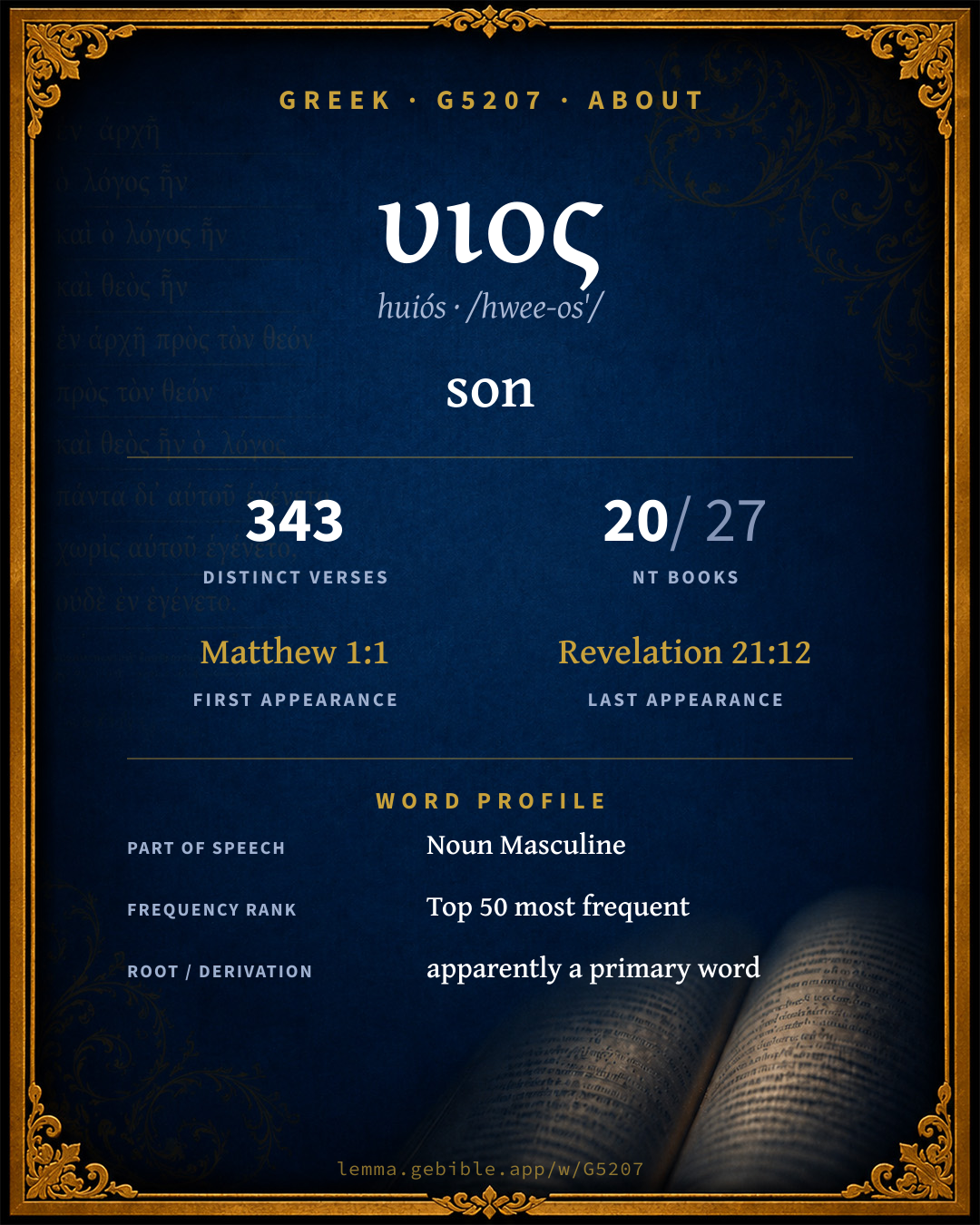
υἱός
son
‘son’ is one of 8 main senses fuller range ↓
Full lexicon entry — Thayer's Greek Lexicon
From Thayer's Greek Lexicon
Where this word appears
See every Nominative-case word in the Greek New Testament →
Grammar key — what these labels mean
Part of speech
- Noun
- A naming word — a person, place, thing, or idea.
Case
- Nominative
- The case of the subject (and the predicate nominative).
- Accusative
- The case of the direct object and of extent.
- Genitive
- The case of source, possession, or “of” — answers “whose / from what.”
- Dative
- The case of the indirect object, means, or location — “to / for / with / in.”
- Vocative
- The case of direct address (“O Lord”).
Gender
- Masculine
- Grammatically masculine.
Number
- Singular
- One.
- Plural
- More than one.
44 verses where G5207 appears in the Nominative case in the Book of Luke. Filtered view — show all forms. Click any verse to open its interlinear word-by-word view. Verse text shown in the World English Bible for context — . Each verse’s Greek form is shown with its reference; the English is not keyword-highlighted, since the data carries no word-level English alignment. Use “Compare translations” on any verse to read it across multiple English versions. This concordance covers the Greek New Testament; Septuagint (Greek Old Testament) occurrences of this word are not indexed here.
Luke
- Luke 1:32 υἱὸς n nom sg masc He will be great, and will be called the Son of the Most High. The Lord God will give him the throne of his father, David,
- Luke 1:35 υἱὸς n nom sg masc The angel answered her, "The Holy Spirit will come on you, and the power of the Most High will overshadow you. Therefore also the holy one who is born from you will be called the Son of God.
- Luke 3:22 υἱός n nom sg masc and the Holy Spirit descended in a bodily form as a dove on him; and a voice came out of the sky, saying "You are my beloved Son. In you I am well pleased."
- Luke 3:23 υἱός n nom sg masc Jesus himself, when he began to teach, was about thirty years old, being the son (as was supposed) of Joseph, the son of Heli,
- Luke 4:3 υἱὸς n nom sg masc The devil said to him, "If you are the Son of God, command this stone to become bread."
- Luke 4:9 υἱὸς n nom sg masc He led him to Jerusalem, and set him on the pinnacle of the temple, and said to him, "If you are the Son of God, cast yourself down from here,
- Luke 4:22 υἱός n nom sg masc All testified about him, and wondered at the gracious words which proceeded out of his mouth, and they said, "Isn't this Joseph's son?"
- Luke 4:41 υἱὸς n nom sg masc Demons also came out from many, crying out, and saying, "You are the Christ, the Son of God!" Rebuking them, he didn't allow them to speak, because they knew that he was the Christ.
- Luke 5:24 υἱὸς n nom sg masc But that you may know that the Son of Man has authority on earth to forgive sins" (he said to the paralyzed man), "I tell you, arise, and take up your cot, and go to your house."
- Luke 6:5 υἱὸς n nom sg masc He said to them, "The Son of Man is lord of the Sabbath."
- Luke 6:35 υἱοὶ n nom pl masc But love your enemies, and do good, and lend, expecting nothing back; and your reward will be great, and you will be children of the Most High; for he is kind toward the unthankful and evil.
- Luke 7:12 υἱὸς n nom sg masc Now when he drew near to the gate of the city, behold, one who was dead was carried out, the only son of his mother, and she was a widow. Many people of the city were with her.
- Luke 7:34 υἱὸς n nom sg masc The Son of Man has come eating and drinking, and you say, 'Behold, a gluttonous man, and a drunkard; a friend of tax collectors and sinners!'
- Luke 9:26 υἱὸς n nom sg masc For whoever will be ashamed of me and of my words, of him will the Son of Man be ashamed, when he comes in his glory, and the glory of the Father, and of the holy angels.
- Luke 9:35 υἱός n nom sg masc A voice came out of the cloud, saying, "This is my beloved Son. Listen to him!"
- Luke 9:44 υἱὸς n nom sg masc "Let these words sink into your ears, for the Son of Man will be delivered up into the hands of men."
- Luke 9:58 υἱὸς n nom sg masc Jesus said to him, "The foxes have holes, and the birds of the sky have nests, but the Son of Man has no place to lay his head."
- Luke 10:6 υἱὸς n nom sg masc If a son of peace is there, your peace will rest on him; but if not, it will return to you.
- Luke 10:22 υἱὸς υἱὸς υἱὸς n nom sg masc n nom sg masc n nom sg masc Turning to the disciples, he said, "All things have been delivered to me by my Father. No one knows who the Son is, except the Father, and who the Father is, except the Son, and he to whomever the Son desires to reveal him."
- Luke 11:11 υἱὸς n nom sg masc "Which of you fathers, if your son asks for bread, will give him a stone? Or if he asks for a fish, he won't give him a snake instead of a fish, will he?
- Luke 11:19 υἱοὶ n nom pl masc But if I cast out demons by Beelzebul, by whom do your children cast them out? Therefore will they be your judges.
- Luke 11:30 υἱὸς n nom sg masc For even as Jonah became a sign to the Ninevites, so will also the Son of Man be to this generation.
- Luke 12:8 υἱὸς n nom sg masc "I tell you, everyone who confesses me before men, him will the Son of Man also confess before the angels of God;
- Luke 12:40 υἱὸς n nom sg masc Therefore be ready also, for the Son of Man is coming in an hour that you don't expect him."
- Luke 12:53 υἱῷ υἱὸς n dat sg masc n nom sg masc They will be divided, father against son, and son against father; mother against daughter, and daughter against her mother; mother-in-law against her daughter-in-law, and daughter-in-law against her mother-in-law."
- Luke 14:5 υἱὸς n nom sg masc He answered them, "Which of you, if your son or an ox fell into a well, wouldn't immediately pull him out on a Sabbath day?"
- Luke 15:13 υἱὸς n nom sg masc Not many days after, the younger son gathered all of this together and traveled into a far country. There he wasted his property with riotous living.
- Luke 15:19 υἱός n nom sg masc I am no more worthy to be called your son. Make me as one of your hired servants."'
- Luke 15:21 υἱός υἱός n nom sg masc n nom sg masc The son said to him, 'Father, I have sinned against heaven, and in your sight. I am no longer worthy to be called your son.'
- Luke 15:24 υἱός n nom sg masc for this, my son, was dead, and is alive again. He was lost, and is found.' They began to celebrate.
- Luke 15:25 υἱὸς n nom sg masc "Now his elder son was in the field. As he came near to the house, he heard music and dancing.
- Luke 15:30 υἱός n nom sg masc But when this, your son, came, who has devoured your living with prostitutes, you killed the fattened calf for him.'
- Luke 16:8 υἱοὶ υἱοὺς n nom pl masc n acc pl masc "His lord commended the dishonest manager because he had done wisely, for the children of this world are, in their own generation, wiser than the children of the light.
- Luke 17:24 υἱὸς n nom sg masc for as the lightning, when it flashes out of the one part under the sky, shines to the other part under the sky; so will the Son of Man be in his day.
- Luke 17:30 υἱὸς n nom sg masc It will be the same way in the day that the Son of Man is revealed.
- Luke 18:8 υἱὸς n nom sg masc I tell you that he will avenge them quickly. Nevertheless, when the Son of Man comes, will he find faith on the earth?"
- Luke 19:9 υἱὸς n nom sg masc Jesus said to him, "Today, salvation has come to this house, because he also is a son of Abraham.
- Luke 19:10 υἱὸς n nom sg masc For the Son of Man came to seek and to save that which was lost."
- Luke 20:34 υἱοὶ n nom pl masc Jesus said to them, "The children of this age marry, and are given in marriage.
- Luke 20:36 υἱοί υἱοὶ n nom pl masc n nom pl masc For they can't die any more, for they are like the angels, and are children of God, being children of the resurrection.
- Luke 20:44 υἱός n nom sg masc "David therefore calls him Lord, so how is he his son?"
- Luke 22:22 υἱὸς n nom sg masc The Son of Man indeed goes, as it has been determined, but woe to that man through whom he is betrayed!"
- Luke 22:69 υἱὸς n nom sg masc From now on, the Son of Man will be seated at the right hand of the power of God."
- Luke 22:70 υἱὸς n nom sg masc They all said, "Are you then the Son of God?" He said to them, "You say it, because I AM."
About this entry
At a glance — auto-summarized from this page’s data, not written by a person. Every figure links to its source below. This summary describes the numbers; it doesn’t interpret them.
The Greek noun υιος centers on the idea of “son.” Thayer's distinguishes 8 senses for it. Spanning 343 verses in 20 books, it ranks among the common words of the Greek New Testament. Debuting at Matthew 1:1, it then recurs through the corpus. Sharing its root, it stands alongside υιοθεσια. For the data behind this summary, explore the sense tree and the renderings breakdown below.
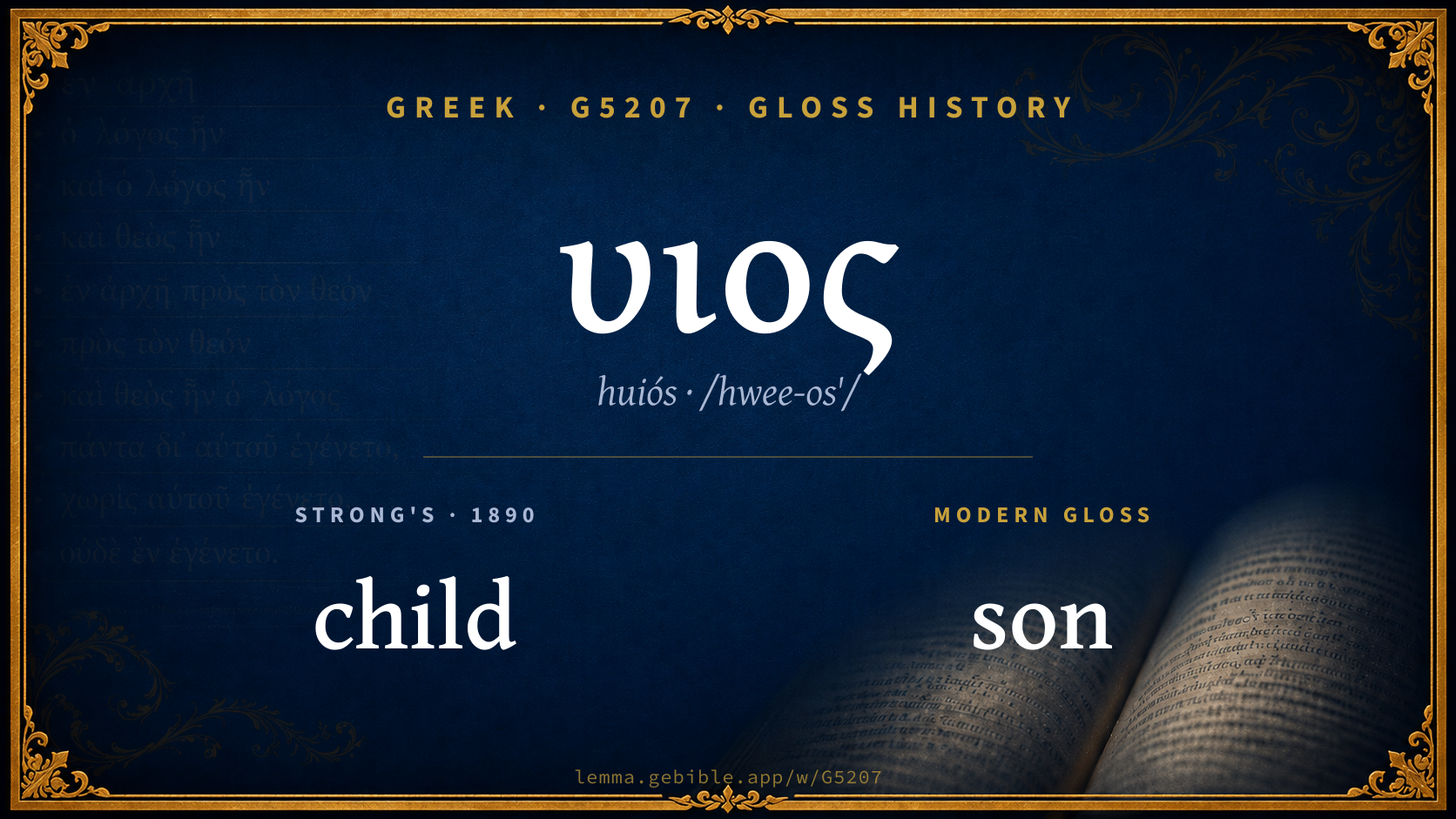
Gloss history
Strong's 1890 vs modern scholarship
About this word
Strong's G5207 catalogs a Greek word from the Greek New Testament.
These counts are not copied from any lexicon or concordance. They are computed here, from the morphology-tagged Greek New Testament. What Lemma adds →
- 343
- distinct verses
- The word appears in 343 distinct verses.
- 20 / 27
- NT books
- The word appears in 20 of 27 New Testament books.
- #49
- by frequency
- Top 50 most frequent Greek words (rank 49 of 5,347 Greek words by occurrence).
View all 343 occurrences in the concordance →
By section of the New Testament
By traditional corpus
Conventional, traditional groupings — biblical authorship is debated, so this is a traditional corpus grouping, not an authorship claim. Some books belong to more than one corpus (Luke is in both the Gospels and the Lukan corpus, and so on), so these shares overlap and need not total 100%. Each figure is a share of the word’s 343 distinct verses.
- Gospels 235 verses · 69%
- Lukan (Luke–Acts) 92 verses · 27%
- Johannine 79 verses · 23%
- Pauline corpus 35 verses · 10%
- General (Catholic) Epistles 23 verses · 7%
- Hebrews 21 verses · 6%
- Revelation 8 verses · 2%
How translations render this word
Counts come from each version’s own published word-to-Strong’s tagging or interlinear alignment — an approximate guide to how each version renders this word, not a word-level alignment the data otherwise carries. Because each total is that version’s own tagged count, the per-version totals vary from one another and need not match the appearance or distinct-verse counts above. These counts may also differ from a printed concordance because Lemma counts each distinctly tagged rendering and does not collapse phrase taggings into a single head-word total. This is a fixed set of word-tagged versions (KJV, ASV, BSB, ULT) and does not change with the reading translation you choose elsewhere. Each version’s license is shown beside its name below (and on Sources).
- King James Version: Son 291×, Children 47×, Sons 24×
- American Standard Version: Son 276×, Sons 55×, Children 13×
- Berean Standard Bible: Son 301×, Sons 52×, Guests 3×
- unfoldingWord Literal Text: Son 305×, Sons 69×, Of 8×
King James Version Public Domain
Renders G5207 across 382 tagged occurrences — most commonly:
Plus 6 renderings that appear only once — usually multi-word phrases or single function words the recovered tagging swept in, not distinct renderings.
American Standard Version Public Domain
Renders G5207 across 382 tagged occurrences — most commonly:
Plus 18 renderings that appear only once — usually multi-word phrases or single function words the recovered tagging swept in, not distinct renderings.
Berean Standard Bible Public Domain
Renders G5207 across 365 tagged occurrences — most commonly:
Plus 4 renderings that appear only once — usually multi-word phrases or single function words the recovered tagging swept in, not distinct renderings. Not rendered by a distinct English word in 3 further occurrences.
unfoldingWord Literal Text CC BY-SA 4.0
Renders G5207 across 390 tagged occurrences — most commonly:
Plus 8 renderings that appear only once — usually multi-word phrases or single function words the recovered tagging swept in, not distinct renderings.
8 senses in Thayer's, in lexicon order
The 8 senses Thayer's distinguishes for this word, in lexicon order (not ranked by frequency or importance). The full entry — with sub-senses — is in the Lexicon Entry tab.
- rarely used for the young of animals
- generally used of the offspring of men
- in a restricted sense, the male offspring (one born by a father and of a mother)
- in a wider sense, a descendant, one of the posterity of any one,
- used to describe one who depends on another or is his follower
- son of man
- son of God
- and of angels and of Jesus Christ
Word origin
Origin: apparently a primary word
Apparently a primary word; a son (sometimes of animals) used very widely of immediate remote or figurative kinship : - child foal son.
— Strong’s Exhaustive Concordance (1890), public domain.
Forms in the corpus
The 14 distinct written forms G5207 takes in the Greek New Testament, most frequent first — each parse links to that case’s occurrences in the concordance.
| Form | Parsing | Example | Uses |
|---|---|---|---|
| υἱὸς hyiòs | Noun, Nominative, Singular, Masculine | Matthew 1:20 | 128 |
| υἱὸν hyiòn | Noun, Accusative, Singular, Masculine | Matthew 1:21 | 63 |
| υἱοῦ hyioû | Noun, Genitive, Singular, Masculine | Matthew 1:1 | 35 |
| υἱός hyiós | Noun, Nominative, Singular, Masculine | Matthew 3:17 | 32 |
| υἱοὶ hyioì | Noun, Nominative, Plural, Masculine | Matthew 5:9 | 26 |
| υἱόν hyión | Noun, Accusative, Singular, Masculine | Matthew 1:23 | 22 |
| υἱῶν hyiō̂n | Noun, Genitive, Plural, Masculine | Matthew 17:25 | 17 |
| υἱῷ hyiō̂ | Noun, Dative, Singular, Masculine | Matthew 21:9 | 15 |
| υἱοὺς hyioùs | Noun, Accusative, Plural, Masculine | Matthew 26:37 | 12 |
| υἱὲ hyiè | Noun, Vocative, Singular, Masculine | Matthew 8:29 | 9 |
| υἱοί hyioí | Noun, Nominative, Plural, Masculine | Matthew 17:26 | 7 |
| υἱοῖς hyioîs | Noun, Dative, Plural, Masculine | Mark 3:28 | 7 |
| υἱέ hyié | Noun, Vocative, Singular, Masculine | Matthew 20:31 | 2 |
| υἱούς hyioús | Noun, Accusative, Plural, Masculine | Luke 15:11 | 1 |
Same root — word family
Other Thayer's entries built from the same root as G5207, grouped by Strong’s listed origin. These share a root / origin per the lexicon — not necessarily a shared meaning. Each links to that word’s own entry.
Derived from this word
Compare all same-root words → They share a root, not necessarily a meaning.
Septuagint usage
The same Greek word υιος appears 4,475 times in the Greek Old Testament (Septuagint), across 3,343 verses in 34 books.
- 4,475
- LXX occurrences
- Tagged occurrences of this Greek word in the Septuagint.
- 3,343
- verses
- Distinct Septuagint verses containing this word.
- 34 / 39
- OT books
- The word appears in 34 of the 39 Old Testament books.
Sample Septuagint occurrences
- Genesis 4:17 υἱός
- Exodus 1:1 υἱός
- Leviticus 1:2 υἱός
- Numbers 1:2 υἱός
- Deuteronomy 1:3 υἱός
- Joshua 1:1 υἱός
- Judges 1:1 υἱός
- Ruth 1:1 υἱός
- 1 Samuel 1:1 υἱός
- 2 Samuel 1:4 υἱός
- 1 Kings 1:5 υἱός
- 2 Kings 1:18 υἱός
Septuagint occurrences (same lexeme)
Every verse where the same Strong’s number (G5207) appears in the Greek Septuagint — showing the first 50 of 3,343. Verse text shown in the World English Bible for context; the Greek form is the matched word — the English is not keyword-highlighted.
- Genesis 4:17 υἱός Cain knew his wife. She conceived, and gave birth to Enoch. He built a city, and called the name of the city, after the name of his son, Enoch.
- Genesis 4:25 υἱός Adam knew his wife again. She gave birth to a son, and named him Seth. For, she said, "God has appointed me another child instead of Abel, for Cain killed him."
- Genesis 4:26 υἱός There was also born a son to Seth, and he named him Enosh. Then men began to call on Yahweh's name.
- Genesis 5:4 υἱός The days of Adam after he became the father of Seth were eight hundred years, and he became the father of sons and daughters.
- Genesis 5:7 υἱός Seth lived after he became the father of Enosh eight hundred seven years, and became the father of sons and daughters.
- Genesis 5:10 υἱός Enosh lived after he became the father of Kenan, eight hundred fifteen years, and became the father of sons and daughters.
- Genesis 5:13 υἱός Kenan lived after he became the father of Mahalalel eight hundred forty years, and became the father of sons and daughters
- Genesis 5:16 υἱός Mahalalel lived after he became the father of Jared eight hundred thirty years, and became the father of sons and daughters.
- Genesis 5:19 υἱός Jared lived after he became the father of Enoch eight hundred years, and became the father of sons and daughters.
- Genesis 5:22 υἱός Enoch walked with God after he became the father of Methuselah three hundred years, and became the father of sons and daughters.
- Genesis 5:26 υἱός Methuselah lived after he became the father of Lamech seven hundred eighty-two years, and became the father of sons and daughters.
- Genesis 5:28 υἱός Lamech lived one hundred eighty-two years, and became the father of a son,
- Genesis 5:30 υἱός Lamech lived after he became the father of Noah five hundred ninety-five years, and became the father of sons and daughters.
- Genesis 5:32 υἱός Noah was five hundred years old, and Noah became the father of Shem, Ham, and Japheth.
- Genesis 6:2 υἱός that God's sons saw that men's daughters were beautiful, and they took for themselves wives of all that they chose.
- Genesis 6:4 υἱός The Nephilim were in the earth in those days, and also after that, when God's sons came to men's daughters. They bore children to them: the same were the mighty men who were of old, men of renown.
- Genesis 6:10 υἱός Noah became the father of three sons: Shem, Ham, and Japheth.
- Genesis 6:18 υἱός But I will establish my covenant with you. You shall come into the ark, you, your sons, your wife, and your sons' wives with you.
- Genesis 7:7 υἱός Noah went into the ark with his sons, his wife, and his sons' wives, because of the waters of the flood.
- Genesis 7:13 υἱός In the same day Noah, and Shem, Ham, and Japheth, the sons of Noah, and Noah's wife, and the three wives of his sons with them, entered into the ark;
- Genesis 8:16 υἱός "Go forth from the ark, you, and your wife, and your sons, and your sons' wives with you.
- Genesis 8:18 υἱός Noah went forth, with his sons, his wife, and his sons' wives with him.
- Genesis 9:1 υἱός God blessed Noah and his sons, and said to them, "Be fruitful, and multiply, and replenish the earth.
- Genesis 9:8 υἱός God spoke to Noah, and to his sons with him, saying,
- Genesis 9:18 υἱός The sons of Noah who went forth from the ark were Shem, Ham, and Japheth. Ham is the father of Canaan.
- Genesis 9:19 υἱός These three were the sons of Noah, and from these, the whole earth was populated.
- Genesis 9:24 υἱός Noah awoke from his wine, and knew what his youngest son had done to him.
- Genesis 10:1 υἱός Now this is the history of the generations of the sons of Noah and of Shem, Ham, and Japheth. Sons were born to them after the flood.
- Genesis 10:2 υἱός The sons of Japheth: Gomer, Magog, Madai, Javan, Tubal, Meshech, and Tiras.
- Genesis 10:3 υἱός The sons of Gomer: Ashkenaz, Riphath, and Togarmah.
- Genesis 10:4 υἱός The sons of Javan: Elishah, Tarshish, Kittim, and Dodanim.
- Genesis 10:6 υἱός The sons of Ham: Cush, Mizraim, Put, and Canaan.
- Genesis 10:7 υἱός The sons of Cush: Seba, Havilah, Sabtah, Raamah, and Sabteca. The sons of Raamah: Sheba and Dedan.
- Genesis 10:20 υἱός These are the sons of Ham, after their families, after their languages, in their lands, in their nations.
- Genesis 10:21 υἱός To Shem, the father of all the children of Eber, the elder brother of Japheth, to him also were children born.
- Genesis 10:22 υἱός The sons of Shem: Elam, Asshur, Arpachshad, Lud, and Aram.
- Genesis 10:23 υἱός The sons of Aram: Uz, Hul, Gether, and Mash.
- Genesis 10:25 υἱός To Eber were born two sons. The name of the one was Peleg, for in his days was the earth divided. His brother's name was Joktan.
- Genesis 10:29 υἱός Ophir, Havilah, and Jobab. All these were the sons of Joktan.
- Genesis 10:31 υἱός These are the sons of Shem, after their families, after their languages, in their lands, after their nations.
- Genesis 10:32 υἱός These are the families of the sons of Noah, after their generations, in their nations. Of these were the nations divided in the earth after the flood.
- Genesis 11:5 υἱός Yahweh came down to see the city and the tower, which the children of men built.
- Genesis 11:10 υἱός This is the history of the generations of Shem. Shem was one hundred years old, and became the father of Arpachshad two years after the flood.
- Genesis 11:11 υἱός Shem lived after he became the father of Arpachshad five hundred years, and became the father of sons and daughters.
- Genesis 11:13 υἱός Arpachshad lived after he became the father of Shelah four hundred three years, and became the father of sons and daughters.
- Genesis 11:15 υἱός and Shelah lived after he became the father of Eber four hundred three years, and became the father of sons and daughters.
- Genesis 11:17 υἱός Eber lived after he became the father of Peleg four hundred thirty years, and became the father of sons and daughters.
- Genesis 11:19 υἱός Peleg lived after he became the father of Reu two hundred nine years, and became the father of sons and daughters.
- Genesis 11:21 υἱός Reu lived after he became the father of Serug two hundred seven years, and became the father of sons and daughters.
- Genesis 11:23 υἱός Serug lived after he became the father of Nahor two hundred years, and became the father of sons and daughters.
These are occurrences of the same Greek lexeme (G5207) in the Septuagint — not a translation of any one Hebrew word. The store carries no word-level Hebrew↔Greek alignment, so no Hebrew original is asserted here. Counts come from the recovered LXX Strong's tagging — high-frequency vocabulary is well covered, while rare or late forms may be untagged — so they reflect tagged occurrences and may slightly undercount.