
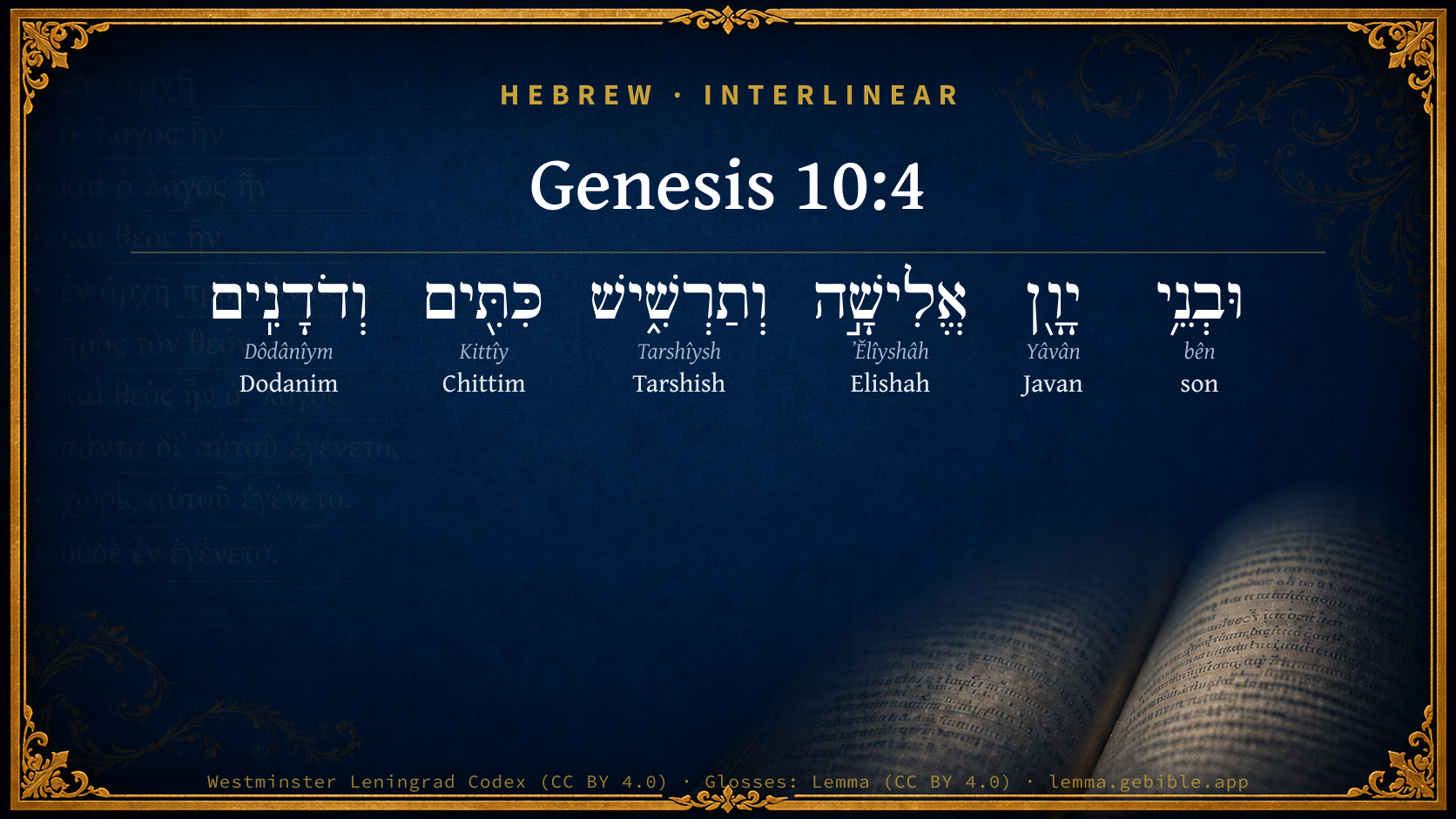
Genesis 10:4

Hebrew (Westminster Leningrad Codex) Genesis 10:4 appears in the Hebrew Old Testament. The text above is from the Westminster Leningrad Codex. Each word links to its Strong’s number, a concise gloss, and parsing drawn from the Open Scriptures Hebrew Bible morphology. Click any word for its full Brown-Driver-Briggs (BDB) entry.
Download image
Cite this verse

Genesis 10:4 (World English Bible). Public Domain. Lemma interlinear Bible study tool, https://lemma.gebible.app/v/genesis/10/4.

Show BibTeX & RIS
BibTeX
RIS
English Translation
The sons of Javan: Elishah, Tarshish, Kittim, and Dodanim.
World English Bible · Public Domain
Highlights
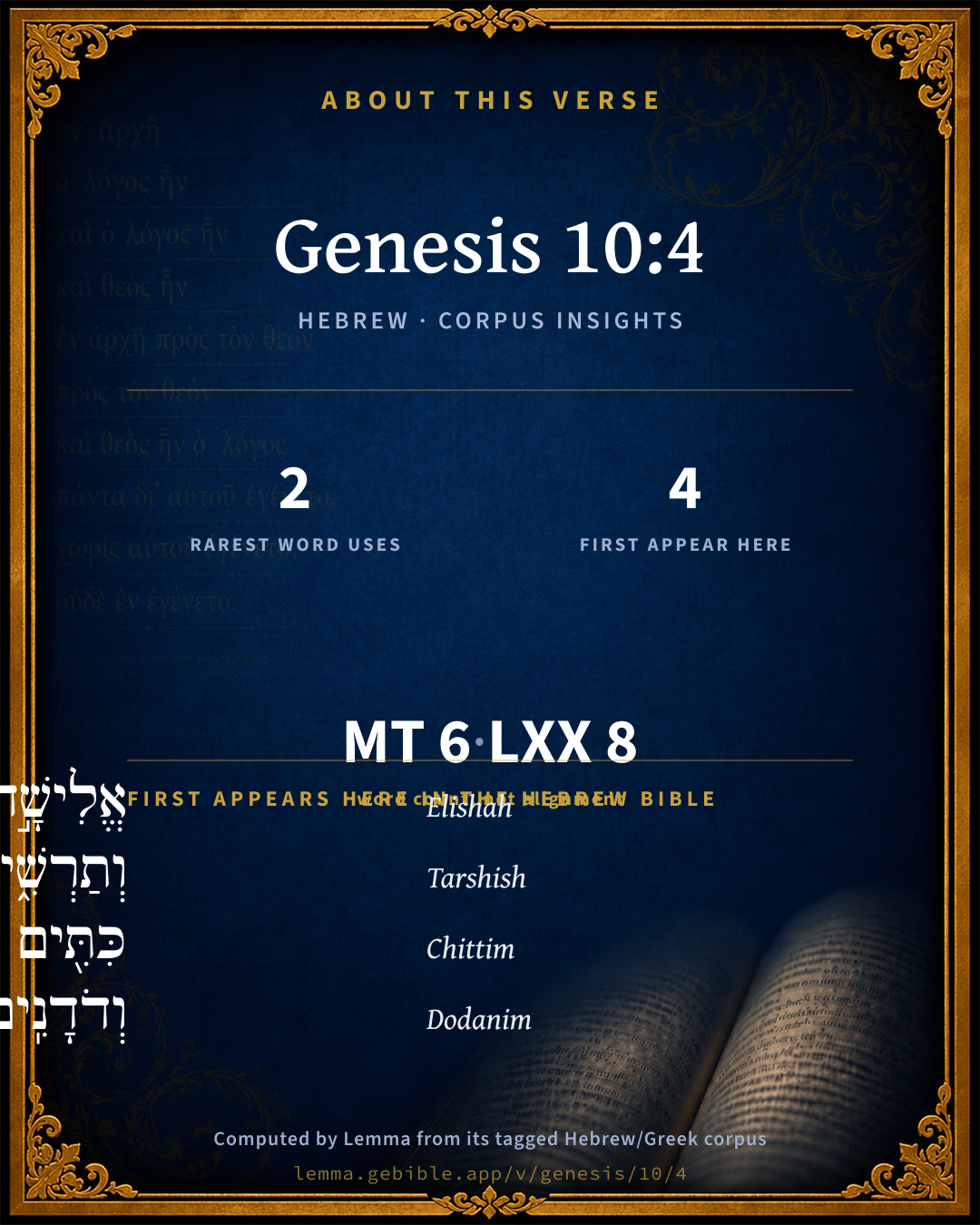
  • 4 first appearances in the Hebrew Bible
Full analysis ↓
Download a study sheet

One document with this verse’s original text, its word-by-word gloss line, the meaning frame, cross-references with their text, attributed commentary, and full source and license credits — printable, and it pastes into notes with its structure intact.

This verse Autodidact and up

Study sheet (.html) Plain text (.txt)

A passage Seminary Student

Up to 50 verses in one chapter. A passage sheet keeps up to 6 commentary sources and 12 cross-references per verse, in the order this page ranks them, and says so on the sheet whenever that leaves anything out. Ask for a single verse and you get the Autodidact verse sheet above.

Everything on this page stays free to read, with no account — the sheet is a download of what is already on screen, not access to it.

Want to remove ads? Support Godless Engineer
Compare translations 3

The same verse in 3 English versions, stacked beneath the original-language interlinear above. Click any original word for its lexicon entry.

Each is an independent rendering of the whole verse — the interlinear is not word-aligned to these translations.

Highlighted words mark where these versions differ — a whole-verse word diff, not a word-by-word alignment.

  • World English Bible Public Domain
    The sons of Javan: Elishah, Tarshish, Kittim, and Dodanim.
  • King James Version Public Domain
    And the sons of Javan; Elishah, and Tarshish, Kittim, and Dodanim.
  • unfoldingWord Literal Text CC BY-SA 4.0
    And the sons of Javan Elishah and Tarshish, the Kittim and the Dodanim.

unfoldingWord Literal Text — © unfoldingWord, licensed CC BY-SA 4.0. Word-aligned USFM3 via Door43 (git.door43.org/unfoldingWord/en_ult).

Versions to compare (up to 4)

3 of 4 selected

Show all 18 translations

Every available English version of this verse, each an independent rendering of the whole verse.

  • World English Bible Public Domain
    The sons of Javan: Elishah, Tarshish, Kittim, and Dodanim.
  • Berean Standard Bible Public Domain
    And the sons of Javan: Elishah, Tarshish, the Kittites, and the Rodanites.
  • Majority Standard Bible Public Domain
    And the sons of Javan: Elishah, Tarshish, the Kittites, and the Rodanites.
  • King James Version Public Domain
    And the sons of Javan; Elishah, and Tarshish, Kittim, and Dodanim.
  • American Standard Version (1901) Public Domain
    And the sons of Javan: Elishah, and Tarshish, Kittim, and Dodanim.
  • Revised Version (1885) Public Domain
    And the sons of Javan; Elishah, and Tarshish, Kittim, and Dodanim.
  • Geneva Bible (1599) Public Domain
    Also the sonnes of Iauan, Elishah and Tarshish, Kittim, and Dodanim.
  • Douay-Rheims (1899) Public Domain
    And the sons of Javan: Elisa and Tharsis, Cetthim, and Dodanim.
  • Young's Literal Translation Public Domain
    And sons of Javan `are' Elishah, and Tarshish, Kittim, and Dodanim.
  • Literal Standard Version CC BY-SA 4.0
    And sons of Javan [are] Elishah, and Tarshish, Kittim, and Dodanim.
  • Unlocked Literal Bible CC BY-SA 4.0
    The sons of Javan were Elishah, Tarshish, Kittim, and Dodanim.
  • unfoldingWord Literal Text CC BY-SA 4.0
    And the sons of Javan Elishah and Tarshish, the Kittim and the Dodanim.
  • Darby Bible Public Domain
    And the sons of Javan: Elishah, and Tarshish, Kittim, and Dodanim.
  • World Messianic Bible Public Domain
    The sons of Javan were: Elishah, Tarshish, Kittim, and Dodanim.
  • Webster's Bible Public Domain
    And the sons of Javan; Elishah, and Tarshish, Kittim, and Dodanim.
  • Free Bible Version CC BY-SA 4.0
    The sons of Javan: Elishah, Tarshish, Kittim, and Dodanim.
  • Bible in Basic English Public Domain
    And the sons of Javan: Elishah and Tarshish, the Kittim and the Dodanim.
  • JPS Tanakh (1917) Public Domain
    And the sons of Javan: Elishah, and Tarshish, Kittim, and Dodanim.

Literal Standard Version (2020), Covenant Press — licensed CC BY-SA 4.0. Text via the HelloAO Bible API (eBible.org). Unlocked Literal Bible (unfoldingWord) — licensed CC BY-SA 4.0. Text via the HelloAO Bible API (eBible.org). unfoldingWord Literal Text — © unfoldingWord, licensed CC BY-SA 4.0. Word-aligned USFM3 via Door43 (git.door43.org/unfoldingWord/en_ult). Free Bible Version, Dr. Jonathan Gallagher — licensed CC BY-SA 4.0. Text via the HelloAO Bible API (eBible.org).

Word by word

More ways to search: Search by grammar → Find every occurrence → Compare this word →

Practice this passage: Drill this verse → Learn its vocabulary →

About this verse

These counts appear in no published source. They are computed here, from the morphology-tagged text and Lemma’s own curated glosses. What Lemma adds →

6
words
6
distinct lemmas
Pentateuch
section

Notable vocabulary

The rarest word here is וְדֹדָנִֽים Dodanim H1721 — appearing just 2 times in the whole Hebrew Bible.

First appearance in Scripture

These words make their first canonical appearance in the Hebrew Bible here:

  • אֱלִישָׁ֣ה Elishah H473
  • וְתַרְשִׁ֑ישׁ Tarshish H8659
  • כִּתִּ֖ים Chittim H3794
  • וְדֹדָנִֽים Dodanim H1721

Shared distinctive vocabulary

וְדֹדָנִֽים Dodanim H1721 occurs in 2 verses of the Hebrew Bible. Also found in:

Grammatical profile

  • 6 nouns

Hebrew & Septuagint length

In English translation the verse runs 9 words from the Hebrew and 10 from the Septuagint (LXX English) — closely comparable.

A rough comparison of the two English renderings, which tokenize alike — not a word-level alignment.

Word counts can differ between the Hebrew and the Greek without any difference in meaning — e.g. the Hebrew direct-object marker אֵת has no separate Greek word, and Greek often adds the article ὁ.

In the original languages it is 6 Hebrew tokens and 8 Greek tokens — but the two are counted differently (Hebrew bundles its prefixes and suffixes into one token; the Greek is in lemma form), so that isn’t a like-for-like length.

Cross-references

6

Topical passages linked to Genesis 10:4 in the Treasury of Scripture Knowledge — connected by theme and wording, ordered by reader-vote popularity; previews shown in the World English Bible.

  • Numbers 24:24 But ships [shall come] from the coast of Kittim, They shall afflict Asshur, and shall afflict Eber; He also shall come to destruction.
  • Isaiah 23:1 The burden of Tyre. Howl, you ships of Tarshish; for it is laid waste, so that there is no house, no entering in: from the land of Kittim it is revealed to them.
  • Isaiah 23:12 He said, You shall no more rejoice, you oppressed virgin daughter of Sidon: arise, pass over to Kittim; even there shall you have no rest.
  • Daniel 11:30 For ships of Kittim shall come against him; therefore he shall be grieved, and shall return, and have indignation against the holy covenant, and shall do [his pleasure]: he shall even return, and have regard to those who forsake the holy covenant.
  • Ezekiel 27:12 Tarshish was your merchant by reason of the multitude of all kinds of riches; with silver, iron, tin, and lead, they traded for your wares.
  • Ezekiel 27:25 The ships of Tarshish were your caravans for your merchandise: and you were replenished, and made very glorious in the heart of the seas.

Cross-references courtesy of OpenBible.info (CC BY 4.0).

Hebrew and Greek witnesses Masoretic Hebrew ↔ Greek Septuagint

The same verse in the two great witnesses to the Old Testament, shown verse-for-verse.

These are two independent witnesses, not word-aligned to each other, and the Septuagint is shown in lemma (dictionary) form.

Hebrew Genesis 10:4 Masoretic · Westminster Leningrad Codex

וּבְנֵ֥י יָוָ֖ן אֱלִישָׁ֣ה וְתַרְשִׁ֑ישׁ כִּתִּ֖ים וְדֹדָנִֽים

The sons of Javan: Elishah, Tarshish, Kittim, and Dodanim.

World English Bible · Public Domain

Greek LXX Genesis 10:4 Septuagint · lemma form

καί υἱός ιωυαν ελισα καί θαρσις κίτιος ῥόδιος

And the sons of Jovan, Elisa, and Tharseis, Cetians, Rhodians.

LXX2012 (modern English Septuagint) · Public Domain

On this verse, Ellicott's Commentary for English Readers discusses the Septuagint’s reading. Read the note in Commentary ↓

Hebrew: Westminster Leningrad Codex (CC BY 4.0). Greek: Septuagint (public domain); English from LXX2012 (modern English Septuagint) (Public Domain). How the Septuagint differs from the Hebrew →

Targum (Aramaic paraphrase)

2

The Targum is the ancient Jewish Aramaic paraphrase of the Hebrew Scriptures — an interpretive translation, not the Hebrew text itself. Onkelos (literal) and Pseudo-Jonathan (expansive) render the Torah, and Jonathan the Prophets. Coverage is partial: where no permissively-licensed English translation exists for a verse, only the Aramaic is shown. This is verse-level text, not a word-by-word alignment to the Hebrew.

  1. Targum Onkelos Torah (Genesis–Deuteronomy)
    וּבְנֵי יָוָן אֱלִישָׁה וְתַרְשִׁישׁ כִּתִּים וְדֹדָנִים

    And the sons of Yavan, Elishah and Tharshish, and Dodanim.

    Targum Onkelos — Aramaic: “Onkelos Genesis” (public domain); “Onkelos Exodus” (public domain); “Onkelos Leviticus” (public domain); “Onkelos Numbers” (public domain); “Onkelos Deuteronomy” (public domain). English: “Sefaria Community Translation” (CC0 1.0 (public-domain dedication)); “J.W. Etheridge. The Targums of Onkelos and Jonathan Ben Uzziel on the Pentateuch. London: Longmans, Green, 1862” (public domain). Text via Sefaria.

  2. Targum Pseudo-Jonathan Torah (Genesis–Deuteronomy)
    וּבְנוֹי דְיָוָן אֱלִישָׁה אַלַס וְטַרְסַס אַכַזְיָא וְדוֹרְדַנְיָא

    And the sons of Javan, Elisha, Alas, and Tarsas, Akazia, and Dordonia.

    Targum Pseudo-Jonathan — Aramaic: “Targum Jonathan on Genesis” (public domain); “Targum Jonathan on Exodus” (public domain); “Targum Jonathan on Leviticus” (public domain); “Targum Jonathan on Numbers” (public domain); “Targum Jonathan on Deuteronomy” (public domain). English: “The Targum of Jonathan ben Uzziel, trans. J. W. Etheridge, London, 1862” (public domain). Text via Sefaria.

Commentary

Notes on Genesis 10:4 from classic Christian and Jewish commentators (each source and its license shown beneath its notes). The classic Christian expositions comment on the surrounding passage and are grouped to its opening verse, so a note may address several verses; the Jewish commentaries on the Tanakh (Rashi and others) are per-verse, so they appear only where the commentator wrote on this verse.

Lemma curates 59 commentaries, every one of them public domain or Creative Commons licensed, each selected and text-cleaned for this edition rather than reprinted as found. About our sources →

Trapp's Complete Commentary

John Trapp

Gen 10:4 And the sons of Javan; Elishah, and Tarshish, Kittim, and Dodanim.

Ver. 4. Elishah.] Whence the Eolians.

Tarshish.] Whence the Cilicians, where Tarsus (Paul’s country) was.

Kittim.] Whence the Macedonians. {Num 24:24 Dan 11:30}

Dodanim.] Whence the Epirotes (Scanderberg’s country), where stands the city Dodaena.

John Trapp, A Commentary or Exposition upon All the Books of the Old and New Testament (1647–1656) — public domain. Text from a community e-Sword module.

Tyndale Open Study Notes

Tyndale Open Resources

10:4 Elishah is probably Cyprus. • Tarshish is possibly southwest Spain (see study note on Jon 1:3). • The Kittim were inhabitants of southern Cyprus. • The Rodanim were inhabitants of the island of Rhodes, later a territory of Greece.

Tyndale Open Study Notes — © Tyndale Open Resources, licensed CC BY-SA 4.0. Text via the HelloAO Bible API.

Adam Clarke's Commentary

Verse 4. Elishah] As Javan peopled a considerable part of Greece, it is in that region that we must seek for the settlements of his descendants; Elishah probably was the first who settled at Elis, in Peloponnesus.

Tarshish] He first inhabited Cilicia, whose capital anciently was the city of Tarsus, where the Apostle Paul was born.

Kittim] We have already seen that this name was rather the name of a people than of an individual: some think by Kittim Cyprus is meant: others, the isle of Chios; and others, the Romans; and others, the Macedonians.

Dodanim.] Or Rodanim, for the ד and ר may be easily mistaken for each other, because of their great similarity. Some suppose that this family settled at Dodona in Epirus; others at the isle of Rhodes; others, at the Rhone, in France, the ancient name of which was Rhodanus, from the Scripture Rodanim.

Adam Clarke's Commentary on the Bible (1810–1826) — public domain. Text from a community e-Sword/MySword module.

Ellicott's Commentary for English Readers

(4) Javan has four main divisions:—

1. Elishah, a maritime people of Greece. Traces of the name occur in Aeolis and in Elis, a district of the Peloponessus. Some boldly identify with Hellas. The isles of Elishah are mentioned in Eze_27:7.

2. Tarshish. At so early a period this could scarcely be Tartessus, but is more probably the Tyrseni, or Tyrrheni, a race once powerful in Italy, Corsica, Sardinia, and finally in Spain. Probably Tartessus, at the mouth of the Guadalquiver, in Spain, was founded by them, and took from them its name. At this time they; were apparently a small tribe of the Javanites; but while Elishah followed the sea-coast and colonised Greece, Tarshish took a course so far inland to the north of the Danube that it did not reach the sea until it had come to the northern districts of Italy.

3. Kittim. A plural, like Madai. The Kittim were a maritime race, who colonised Cyprus, the chief city of which was Kitium, and probably other islands and coast-districts of the Mediterranean. There was a Kitium also in Macedonia; and Alexander is called King of the Kittim in 1Ma_1:1.

4. Dodanim. Another plural. The right reading is probably Rodanim, as in many MSS. in 1Ch_1:7 and in the LXX., and the Samaritan here. R and D are so constantly interchanged in proper names. owing to the similarity of their shape, that no dependence can be placed upon the reading. The Rodanim would be the Rhodians.

A Bible Commentary for English Readers, edited by Charles John Ellicott (1878–1897) — public domain. Text from a community e-Sword module.

The Cambridge Bible for Schools and Colleges

gen. ed. J. J. S. Perowne

4. the sons of Javan] The names here mentioned are evidently geographical. Javan’s sons are well-known Greek colonies and settlements or communities. This example will serve to illustrate the composition of the genealogical list.

Elishah] Mentioned in Eze_27:7 as a place from which there was a trade in purple. Josephus identified it with the Æolians. Other conjectures have been Hellas, Elis, Sicily, and Carthage. Possibly, it is Alasa, the modern Cyprus.

Tarshish] Probably the ancient commercial town of Tartessus, at the mouth of the river Guadalquivir. It is classed with the isles in Psa_72:10, Isa_60:9. Its trade is mentioned in Eze_27:12. On “the ships of Tarshish” in King Solomon’s time, see 1Ki_10:22; 1Ki_22:48. There were Greek settlements at Tartessus. Cf. Herodotus, i. 163.

Kittim] Usually identified with Cyprus and its inhabitants. The chief town was Κιτίον, the modern Larnaca, and was probably occupied at an early time by Greek-speaking people. The name “Kittim” became transferred from Cyprus to other islands. Cf. Jer_2:10; Eze_27:6.

Dodanim] In 1Ch_1:7, Rodanim. The LXX and Sam. agree with 1Ch_1:7; and this reading is generally preferred, Rodanim being identified with the island of Rhodes. In Eze_27:15, “the men of Dedan” similarly appear in LXX as ῥόδιοι, i.e. the Rhodians trafficking with the city of Tyre.

The Cambridge Bible for Schools and Colleges (gen. ed. J. J. S. Perowne; Cambridge University Press, 1878–1918) — public domain. Text from a community e-Sword module.

John Gill's Exposition

And the sons of Javan,.... Another son of Japheth; four sons of Javan are mentioned, which gave names to countries, and are as follow:

Elishah, and Tarshish, Kittim, and Dodanim; the first of these, Elishah, gave name to the Elysaeans, now called Aeoles, as Josephus (l) says; hence the country Aeolia, and the Aeolic dialect, all from this name; and there are many traces of it in the several parts of Greece. Hellas, a large country in it, has its name from him; so the Targums of Jonathan and Jerusalem interpret Elishah by Allas. Elis in Peloponnesus, Eleusis in Attica, the river Elissus, or Ilissus, and the Elysian fields, are so called from him. Tarshish, second son of Javan, gave name to Tarsus, by which Cilicia was formerly called, as Josephus says (m), of which the city named Tarsus was the metropolis, the birth place of the Apostle Paul, Act 22:3. Hence the Mediterranean sea is called Tarshish, because the Cicilians were masters of it; and Tartessus in Spain might be a colony from them, as Broughton observes; and so Eusebius says, from the Tarsinns are the Iberians, or Spaniards; and which Bochart (n) approves of, and confirms by various evidences; and Hillerus, (o) makes Tarshish to be the author of the Celtae, that is, of the Spanish, French, and German nations. The third son of Javan is Kittim, whom Josephus (p) places in the island of Cyprus, a city there being called Citium, from whence was Zeno the Citian: but rather the people that sprung from him are those whom Homer (q) calls Cetii; and are placed by Strabo (r) to the west of Cilicia, in the western parts of which are two provinces, mentioned by Ptolemy (s), the one called Cetis, the other Citis: likewise this Kittim seems to be the father both of the Macedonians and the Latines; for Alexander the great is said to come from Cittim, and Perseus king of Macedon is called king of Cittim,"And it happened, after that Alexander son of Philip, the Macedonian, who came out of the land of Chettiim, had smitten Darius king of the Persians and Medes, that he reigned in his stead, the first over Greece,'' (1 Maccabees 1:1)"Beside this, how they had discomfited in battle Philip, and Perseus, king of the Citims, with others that lifted up themselves against them, and had overcome them:'' (1 Maccabees 8:5)and Macedonia is sometimes called Macetia, as it is in Gellius (t), which has something of the name of Cittim or Cetim in it; and also the Latines or Romans seem to spring from hence, who may be thought to be meant by Cittim in Num 24:24 Dan 11:30 and Eusebius says the Citians are a people from whom came the Sabines, who also are Romans; and in Latium was a city called Cetia, as says Halicarnassensis (u); and Bochart (w) has shown, that Latium and Cethem signify the same, and both have their names from words that signify to hide; "latium a latendo", and "celhem", from "to hide", see Jer 2:22 in which sense the word is frequently used in the Arabic language; and Cittim in the Jerusalem Targum is here called Italy. The last son of Javan mentioned is Dodanim; he is omitted by Josephus: his country is by the Targum of Jonathan called Dordania; and by the Jerusalem Targum Dodonia; and he and his posterity are placed by Mr. Mede in part of Peloponnessus and Epirus, in which was the city of Dodona, where were the famous temple and oracle of Jupiter Dodonaeus, under which name this man was worshipped. In Ch1 1:7 he is called Rodanim, and in the Samaritan version here; and the word is by the Septuagint translated Rodians; which have led some to think of the island of Rhodes as the seat, and the inhabitants of it as the posterity of this man; but Bochart (x) is of opinion, that they settled in the country now called France, gave the name to the river Rhodanus, and called the adjacent country Rhodanusia, and where formerly was a city of that name, much about the same tract where now stands Marseilles; but this seems too remote for a son of Javan.

(l) Ut supra. (Antiqu. l. 1. c. 6. sect. 1.) (m) Ib. (n) Phaleg. l. 3. c. 7. (o) Onomastic. Saer. p. 944. (p) Ut supra. (Antiqu. l. 1. c. 6. sect. 1.) (q) Odyss. 11. ver. 520. (r) Geograph. l. 13. p. 423. (s) Ibid. l. 5. c. 8. (t) Attic. Noct. l. 9. c. 3. (u) Hist. l. 8. p. 376. (w) Phaleg. l. 3. c. 5. col. 159, 160. (x) Phaleg. l. 3. c. 6. col. 163, 164.

John Gill's Exposition of the Whole Bible (1746–1763) — public domain (CC PDM 1.0). Text via the HelloAO Bible API.

Matthew Poole's English Annotations

Elishah, the father of the Grecians properly so called, who have preserved his name and remembrance in the cities Elis and Elissus, in a tract of ground called Elias, and in the Elysian fields. And from these came the Æolians, a people of the Lesser Asia, where many of the Grecian colonies were seated.

Tarshish was father of the Cilicians, from whom their chief city Tarsus, in Hebrew Tarshish, took its name; see Eze 27:12; Jon 1:3; Act 22:3; and from whom the whole Mediterranean Sea is called Tarshish, because the Cilicians were in a great degree masters of that sea.

Kittim, or, Chittim, the father of the Macedonians, and Italians too, as may be gathered from hence, because both their countries are called by the name of Chittim; Macedonia, 1Ma 1:1; 1Ma 8:5, and Italy, Num 24:24; Dan 11:30. See also Isa 23:1; Jer 2:10. Besides that there are other evidences in profane writers that the Italians came from the Grecians.

Dodanim is called also Rodanim, 1Ch 1:7. See Riphath in. (Gen 10:3) His posterity is uncertain. Most probably he was seated near his brethren in some part of Greece. And the Greeks seem to have worshipped him under the name of Jupiter Dodonaeus, whose famous oracle was in the city Dodona.

Matthew Poole's English Annotations on the Holy Bible (1683–1685) — public domain. Text from a community e-Sword/MySword module.

Whedon's Commentary on the Bible

Daniel D. Whedon

4. Sons of Javan — Rather, Yavan, the Ionian families.

Elishah — The AEolians, (Elis,) who occupied three fourths of Greece, and spread to the coasts and isles of Asia Minor. (Josephus, Knobel.)

Tarshish — A famous commercial people well known to the sacred and classic writers, (Isaiah, Ezekiel, Strabo, Herodotus,) whence the Greek Tartessus and Tartessis, a town and region in southern Spain at the mouth of the Guadalquivir. According to Herodotus, Tartessus was settled by a colony of Phocaean Greeks, (i, 163,) the word signifying in Phenician, younger brother, (Rawl.,) a very suitable name for a colony. Their ships were so celebrated for size and fleetness as to give the name “ships of Tarshish” to all large merchant vessels wherever sailing. The ships of Tarshish (Eze_27:12, etc.) brought gold and silver, iron, tin, and lead to Tyre, and these are precisely the articles which the classic writers, Strabo, etc., make the staple products of Spain. Knobel and Furst understand the word to refer to that Pelasgic-Hellenic race called Etruscans, Tuscans, Tyrsenians, who before the Roman dominion peopled Italy and the Sicilies, and thus carried the name to Spain. (Knobel, p. 86.) Hence, perhaps, Tarsus in Cilicia. (Josephus.)

Kittim — Cyprians, who still preserve the name in the term Kitti. Josephus says (Ant. 1:6) that the Helvens transferred the name Kittim to all the Mediterranean isles and coasts. The Cyprian Kittim is shown by its monuments to have been a Phenician colony, or at least to have had Phenician or Hamitic settlers. But there were also Hamitic Chittim, (Hittites, sons of Heth or Cheth,) see Gen_10:15, a widespread people in the age of Solomon; and the Japhetic Kittim seem to have mingled at Cyprus with the Hamitic Chittim. (Knobel.)

Dodanim — Dardanians, Trojans, or perhaps it should be Rodanim, (interchange of דand ר, in the first syllable,) as it is given in 1Ch_1:7, and in some copies by the Septuagint and Samaritan. The Rodani, or Rhodians.

Daniel D. Whedon (gen. ed.), Commentary on the Old and New Testaments (1874–1909) — public domain. Text from a community e-Sword module.

The Pulpit Commentary

And the sons of Javan; Elizhah. The isles of Elishah are praised by Ezekiel (Eze_27:7) for their blue and purple; supposed to have been Elis in the Peloponnesus, famous for its purple dyes (Bochart); Aeolis (Josephus, Knobel); Hellas (Michaelis, Rosenm Kalisch); without doubt a maritime people of Grecian stock ("Speaker"s Commentary"). And Tarshish. Tarsus in Cilicia (Josephus); but rather Tartessus in Spain (Eusehius, Michaelis, Bochart, Kalisch). Biblical notices represent Tarshish as a wealthy and flourishing seaport town towards the west (vide 1Ki_10:22; Psa_48:7 Psa_72:10; Isa_60:9; Jer_10:9; Eze_27:12) Kittim. Chittim; (Num_24:24) Citium in Cyprus (Josephus), though latterly the name appears to have been extended to Citium in Macedonia (Alexander the Great is called the king of Chittim, RAPC 1Ma 1:1 8:5), and the colonies which settled on the shores of Italy and Greece (Bochart, Keil, Kalisch). Isa_23:1, Isa_23:12; Dan_11:30 describe it as a maritime people. And Dodanim. Dordona in Epirus (Michaelis, Rosenm the Dardaniaus, or Trojan"s (Gesenius); the Daunians of South Italy (Kalisch); the Rhodani in Gaul, reading as in 1Ch_1:7. (Bochart) Josephus omits the name, and Scripture does not again mention it.

The Pulpit Commentary (1880–1919), ed. H.D.M. Spence-Jones & Joseph S. Exell — public domain. Text from a community e-Sword module.

Radak

Rabbi David Kimhi (Radak)

ובני יון, the Torah mentioned only a few of the families descended from the sons of Yaphet; we do not know why not all of them have been listed.

ודדנים, spelled with a double letter ד, whereas the same people are spelled as רודנים in Chronicles I 1,7. Seeing that the letters ד and ר look so similar to one another, it is quite possible that both spellings are used interchangeably. Someone may have mistaken the letter ד for the letter ר so that this error has been perpetuated. There can be no question that in a situation such as this, the spelling in the Torah must be considered authoritative, as Moses wrote at the dictation of G’d and with a high degree of prophetic insight. According to Josephus, the people concerned lived (in his time) along the river “Rodeno.”

Radak on the Tanakh — English translations: “Sefaria Community Translation” (CC0 1.0 (public-domain dedication)); “Eliyahu Munk, HaChut Hameshulash” (CC BY 4.0); “Rabbi Mike Feuer, Jerusalem Anthology” (CC BY 4.0); and “R. David Kimhi on the first book of Psalms, Translated by R.G. Finch, London, 1919” (public domain). Text via Sefaria.

Lesson kit

Teaching starters — assembled from the data on this page, not authored interpretation. Every prompt links to the verse data it draws on. Edit before teaching.

Genesis, in the Pentateuch, opens this verse with 6 words (6 distinct Hebrew lemmas). Its most distinctive word is Dôdânîym (“Dodanim”). A historical commentator’s framing appears above. Read the whole chapter for the surrounding context.

Discussion questions

  1. What does “Dodanim” (Dôdânîym) contribute to the verse as a whole?
  2. 4 words make their first appearance in Scripture here. What does this debut establish?
  3. How does 1 Chronicles 1:7, which shares the word «Dodanim», read alongside this verse?
  4. Compare how Trapp's Complete Commentary and Tyndale Open Study Notes read this verse. Where do they agree or differ?

Things to notice

Reading settings

Reading text

Shown beneath each verse's original-language words.

Old Testament
Old Testament edition

Read the OT as the Masoretic Hebrew (MT) or the Greek Septuagint (LXX).

English shown for the Greek Septuagint (in the Hebrew ↔ Greek comparison).

Comparing translations? Open the Compare panel on any verse page to stack up to four side by side.