
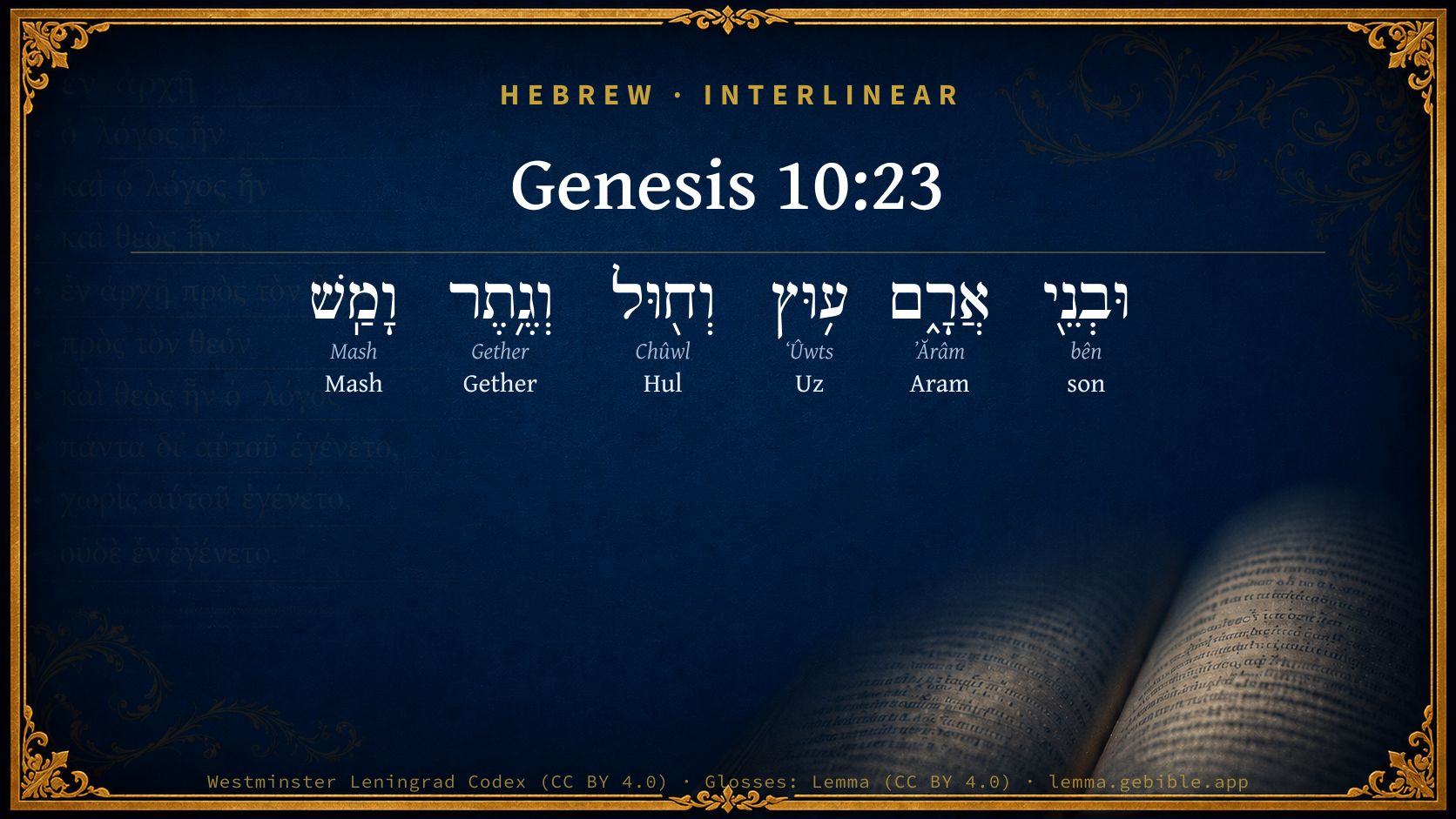
Genesis 10:23

Hebrew (Westminster Leningrad Codex) Genesis 10:23 appears in the Hebrew Old Testament. The text above is from the Westminster Leningrad Codex. Each word links to its Strong’s number, a concise gloss, and parsing drawn from the Open Scriptures Hebrew Bible morphology. Click any word for its full Brown-Driver-Briggs (BDB) entry.
Download image
Cite this verse

Genesis 10:23 (World English Bible). Public Domain. Lemma interlinear Bible study tool, https://lemma.gebible.app/v/genesis/10/23.

Show BibTeX & RIS
BibTeX
RIS
English Translation
The sons of Aram: Uz, Hul, Gether, and Mash.
World English Bible · Public Domain
Highlights
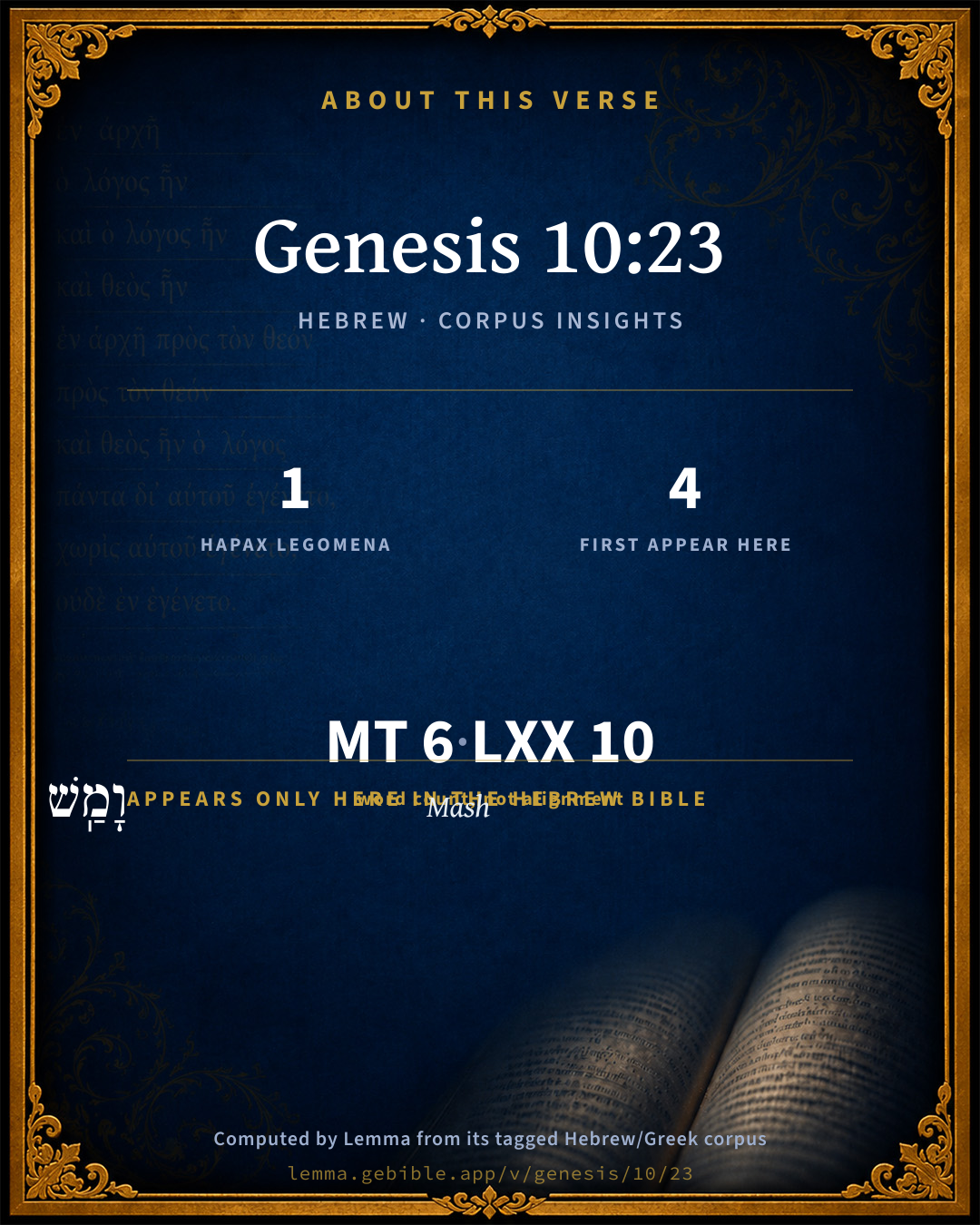
  • 1 hapax legomenon — only here in the Hebrew Bible
  • 4 first appearances in the Hebrew Bible
Full analysis ↓
Download a study sheet

One document with this verse’s original text, its word-by-word gloss line, the meaning frame, cross-references with their text, attributed commentary, and full source and license credits — printable, and it pastes into notes with its structure intact.

This verse Autodidact and up

Study sheet (.html) Plain text (.txt)

A passage Seminary Student

Up to 50 verses in one chapter. A passage sheet keeps up to 6 commentary sources and 12 cross-references per verse, in the order this page ranks them, and says so on the sheet whenever that leaves anything out. Ask for a single verse and you get the Autodidact verse sheet above.

Everything on this page stays free to read, with no account — the sheet is a download of what is already on screen, not access to it.

Want to remove ads? Support Godless Engineer
Compare translations 3

The same verse in 3 English versions, stacked beneath the original-language interlinear above. Click any original word for its lexicon entry.

Each is an independent rendering of the whole verse — the interlinear is not word-aligned to these translations.

Highlighted words mark where these versions differ — a whole-verse word diff, not a word-by-word alignment.

  • World English Bible Public Domain
    The sons of Aram: Uz, Hul, Gether, and Mash.
  • King James Version Public Domain
    And the children of Aram; Uz, and Hul, and Gether, and Mash.
  • unfoldingWord Literal Text CC BY-SA 4.0
    And the sons of Aram Uz and Hul and Gether and Mash.

unfoldingWord Literal Text — © unfoldingWord, licensed CC BY-SA 4.0. Word-aligned USFM3 via Door43 (git.door43.org/unfoldingWord/en_ult).

Versions to compare (up to 4)

3 of 4 selected

Show all 18 translations

Every available English version of this verse, each an independent rendering of the whole verse.

  • World English Bible Public Domain
    The sons of Aram: Uz, Hul, Gether, and Mash.
  • Berean Standard Bible Public Domain
    The sons of Aram: Uz, Hul, Gether, and Mash.
  • Majority Standard Bible Public Domain
    The sons of Aram: Uz, Hul, Gether, and Mash.
  • King James Version Public Domain
    And the children of Aram; Uz, and Hul, and Gether, and Mash.
  • American Standard Version (1901) Public Domain
    And the sons of Aram: Uz, and Hul, and Gether, and Mash.
  • Revised Version (1885) Public Domain
    And the sons of Aram; Uz, and Hul, and Gether, and Mash.
  • Geneva Bible (1599) Public Domain
    And the sonnes of Aram, Vz and Hul, and Gether and Mash.
  • Douay-Rheims (1899) Public Domain
    The sons of Aram: Us and Hull, and Gether: and Mess.
  • Young's Literal Translation Public Domain
    And sons of Aram `are' Uz, and Hul, and Gether, and Mash.
  • Literal Standard Version CC BY-SA 4.0
    And sons of Aram [are] Uz, and Hul, and Gether, and Mash.
  • Unlocked Literal Bible CC BY-SA 4.0
    The sons of Aram were Uz, Hul, Gether, and Meshech.
  • unfoldingWord Literal Text CC BY-SA 4.0
    And the sons of Aram Uz and Hul and Gether and Mash.
  • Darby Bible Public Domain
    And the sons of Aram: Uz, and Hul, and Gether, and Mash.
  • World Messianic Bible Public Domain
    The sons of Aram were: Uz, Hul, Gether, and Mash.
  • Webster's Bible Public Domain
    And the children of Aram; Uz, and Hul, and Gether, and Mash.
  • Free Bible Version CC BY-SA 4.0
    The sons of Aram: Uz, Hul, Gether, and Mash.
  • Bible in Basic English Public Domain
    And the sons of Aram: Uz and Hul and Gether and Mash.
  • JPS Tanakh (1917) Public Domain
    And the sons of Aram: Uz, and Hul, and Gether, and Mash.

Literal Standard Version (2020), Covenant Press — licensed CC BY-SA 4.0. Text via the HelloAO Bible API (eBible.org). Unlocked Literal Bible (unfoldingWord) — licensed CC BY-SA 4.0. Text via the HelloAO Bible API (eBible.org). unfoldingWord Literal Text — © unfoldingWord, licensed CC BY-SA 4.0. Word-aligned USFM3 via Door43 (git.door43.org/unfoldingWord/en_ult). Free Bible Version, Dr. Jonathan Gallagher — licensed CC BY-SA 4.0. Text via the HelloAO Bible API (eBible.org).

Word by word

More ways to search: Search by grammar → Find every occurrence → Compare this word →

Practice this passage: Drill this verse → Learn its vocabulary →

About this verse

These counts appear in no published source. They are computed here, from the morphology-tagged text and Lemma’s own curated glosses. What Lemma adds →

6
words
6
distinct lemmas
Pentateuch
section

Notable vocabulary

1 hapax legomenon — a word that appears only here in the entire Hebrew Bible:

  • וָמַֽשׁ Mash H4851

First appearance in Scripture

These words make their first canonical appearance in the Hebrew Bible here:

Shared distinctive vocabulary

וְח֖וּל Hul H2343 occurs in 2 verses of the Hebrew Bible. Also found in:

Grammatical profile

  • 6 nouns

Hebrew & Septuagint length

In English translation the verse runs 9 words from the Hebrew and 11 from the Septuagint (LXX English) — closely comparable.

A rough comparison of the two English renderings, which tokenize alike — not a word-level alignment.

Word counts can differ between the Hebrew and the Greek without any difference in meaning — e.g. the Hebrew direct-object marker אֵת has no separate Greek word, and Greek often adds the article ὁ.

In the original languages it is 6 Hebrew tokens and 10 Greek tokens — but the two are counted differently (Hebrew bundles its prefixes and suffixes into one token; the Greek is in lemma form), so that isn’t a like-for-like length.

Cross-references

2

Topical passages linked to Genesis 10:23 in the Treasury of Scripture Knowledge — connected by theme and wording, ordered by reader-vote popularity; previews shown in the World English Bible.

  • Job 1:1 There was a man in the land of Uz, whose name was Job. That man was blameless and upright, and one who feared God, and turned away from evil.
  • Jeremiah 25:20 and all the mixed people, and all the kings of the land of the Uz, and all the kings of the Philistines, and Ashkelon, and Gaza, and Ekron, and the remnant of Ashdod;

Cross-references courtesy of OpenBible.info (CC BY 4.0).

Hebrew and Greek witnesses Masoretic Hebrew ↔ Greek Septuagint

The same verse in the two great witnesses to the Old Testament, shown verse-for-verse.

These are two independent witnesses, not word-aligned to each other, and the Septuagint is shown in lemma (dictionary) form.

Hebrew Genesis 10:23 Masoretic · Westminster Leningrad Codex

וּבְנֵ֖י אֲרָ֑ם ע֥וּץ וְח֖וּל וְגֶ֥תֶר וָמַֽשׁ

The sons of Aram: Uz, Hul, Gether, and Mash.

World English Bible · Public Domain

Greek LXX Genesis 10:23 Septuagint · lemma form

καί υἱός αραμ ως καί ουλ καί γαθερ καί μοσοχ

And sons of Aram, Uz, and Ul, and Gater, and Mosoch.

LXX2012 (modern English Septuagint) · Public Domain

On this verse, John Gill's Exposition discusses the Septuagint’s reading. Read the note in Commentary ↓

Hebrew: Westminster Leningrad Codex (CC BY 4.0). Greek: Septuagint (public domain); English from LXX2012 (modern English Septuagint) (Public Domain). How the Septuagint differs from the Hebrew →

Targum (Aramaic paraphrase)

1

The Targum is the ancient Jewish Aramaic paraphrase of the Hebrew Scriptures — an interpretive translation, not the Hebrew text itself. Onkelos (literal) and Pseudo-Jonathan (expansive) render the Torah, and Jonathan the Prophets. Coverage is partial: where no permissively-licensed English translation exists for a verse, only the Aramaic is shown. This is verse-level text, not a word-by-word alignment to the Hebrew.

  1. Targum Onkelos Torah (Genesis–Deuteronomy)
    וּבְנֵי אֲרָם עוּץ וְחוּל וְגֶתֶר וָמַשׁ

    And the sons of Aram, Uz, and Chul, and Gether, and Mash.

    Targum Onkelos — Aramaic: “Onkelos Genesis” (public domain); “Onkelos Exodus” (public domain); “Onkelos Leviticus” (public domain); “Onkelos Numbers” (public domain); “Onkelos Deuteronomy” (public domain). English: “Sefaria Community Translation” (CC0 1.0 (public-domain dedication)); “J.W. Etheridge. The Targums of Onkelos and Jonathan Ben Uzziel on the Pentateuch. London: Longmans, Green, 1862” (public domain). Text via Sefaria.

Commentary

Notes on Genesis 10:23 from classic Christian and Jewish commentators (each source and its license shown beneath its notes). The classic Christian expositions comment on the surrounding passage and are grouped to its opening verse, so a note may address several verses; the Jewish commentaries on the Tanakh (Rashi and others) are per-verse, so they appear only where the commentator wrote on this verse.

Lemma curates 59 commentaries, every one of them public domain or Creative Commons licensed, each selected and text-cleaned for this edition rather than reprinted as found. About our sources →

Trapp's Complete Commentary

John Trapp

Gen 10:23 And the children of Aram; Uz, and Hul, and Gether, and Mash.

Ver. 23. Uz.] Haply Job’s country: for we can here but hariolari in re dubia , go by conjecture only.

John Trapp, A Commentary or Exposition upon All the Books of the Old and New Testament (1647–1656) — public domain. Text from a community e-Sword module.

Tyndale Open Study Notes

Tyndale Open Resources

10:23 The patriarchs later interacted with the descendants of Aram (see 25:20; 31:20; Deut 26:5). • Uz was the chief Aramean tribe, possibly located northeast of the Jordan; it was Job’s home (see Job 1:1; see also Lam 4:21). • Hul is unknown. He possibly founded Armenia. • Gether is unknown; he was possibly the founder of the Syrians. • Mash might be associated with Mount Masus in northern Mesopotamia or with a part of the Lebanon Mountains.

Tyndale Open Study Notes — © Tyndale Open Resources, licensed CC BY-SA 4.0. Text via the HelloAO Bible API.

Jamieson, Fausset & Brown

Robert Jamieson, A. R. Fausset & David Brown

Aram--In the general division of the earth, the countries of Armenia, Mesopotamia, and Syria, fell to his descendants.

Jamieson, Fausset & Brown — Commentary Critical and Explanatory on the Whole Bible (1871) — public domain (CC PDM 1.0). Text via the HelloAO Bible API.

Adam Clarke's Commentary

Verse 23. Uz] Who peopled Caelosyria, and is supposed to have been the founder of Damascus.

Hul] Who peopled a part of Armenia.

Gether] Supposed by Calmet to have been the founder of the Itureans, who dwelt beyond the Jordan, having Arabia Deserta on the east, and the Jordan on the west.

Mash.] Who inhabited mount Masius in Mesopotamia, and from whom the river Mazeca, which has its source in that mountain, takes its name.

Adam Clarke's Commentary on the Bible (1810–1826) — public domain. Text from a community e-Sword/MySword module.

The Cambridge Bible for Schools and Colleges

gen. ed. J. J. S. Perowne

23. the sons of Aram] These names convey nothing to us, though presumably they possessed importance in the geography of the Hebrews.

Uz] The country of Job: see Job_1:1. Generally considered to have been in the south of Palestine. The name occurs again in another genealogy, Gen_22:21, Gen_36:28; cf. Jer_25:20. In Lam_4:21, Uz is associated with Edom. These references however do not suit “a son of Aram.”

Mash] In the parallel passage (1Ch_1:17) = Meshech.

The Cambridge Bible for Schools and Colleges (gen. ed. J. J. S. Perowne; Cambridge University Press, 1878–1918) — public domain. Text from a community e-Sword module.

John Gill's Exposition

And the children of Aram,.... The four following persons are called the sons of Shem, Ch1 1:17 being his grandsons, which is not unusual in Scripture:

Uz, and Hul, and Gether, and Mash: the first of these sons of Aram, Uz, is generally thought to be the founder of Damascus; so Josephus (t) says. Usus founded Trachonitis and Damascus, which lies between Palestine and Coelesyria: there was a place called Uz in Idumea, Lam 4:21 and another in Arabia, where Job dwelt, Job 1:1 but neither of them seems to be the seat of this man and his posterity, who, in all probability, settled in Syria: his second son Hul, whom Josephus (u) calls Ulus, according to him, founded Armenia; which notion may be strengthened by observing that Cholobotene is reckoned a part of Armenia by Stephanus (w); which is no other than Cholbeth, that is, the house or seat of Chol, the same with Hul; and there are several places in Armenia, as appears from Ptolemy (x), which begin with Chol or Col, as Cholus, Cholua, Choluata, Cholima, Colsa, Colana, Colchis: but perhaps it may be better to place him in Syria, in the deserts of Palmyrene, as Junius and Grotius; since among the cities of Palmyrene, there is one called Cholle, according to Ptolemy (y). Gether, the third son, is made by Josephus (z) to be the father of the Bactrians; but these were too far off to come from this man, and were not in the lot of Shem: Bochart (a) finds the river Getri, which the Greeks call Centrites, between Armenia and the Carduchi, whereabout, he conjectures, might be the seat of this man; but perhaps it may be more probable, with Grotius and Junius, to place him in Coelesyria, where are the city Gindarus of Ptolemy (b), and a people called Gindareni, by Pliny (c); though Bishop Patrick thinks it probable that Gadara, the chief city of Peraea, placed by Ptolemy (d) in the Decapolis of Coelesyria, had its name from this man: Mr. Broughton derives Atergate and Derceto, names of a Syrian goddess, from him, which was worshipped at Hierapolis in Coelesyria, as Pliny says (e). The last of the sons of Aram, Mash, is called Meshech, in Ch1 1:17 and here the Septuagint version calls him Masoch; his posterity are supposed to settle in Armenia, about the mountain Masius, thought to be the same with Ararat, and which the Armenians call Masis; perhaps the people named Moscheni, mentioned by Pliny (f), as dwelling near Armenia and Adiabene, might spring from this man.

(t) Ut supra. (Antiqu. l. 1. c. 6. sect. 4.) (u) Ibid. (w) Apud Bochart. Phaleg. l. 2. c. 9. col. 81. (x) Geograph. l. 5. c. 13. (y) Geograph. l. 5. c. 15. (z) Ut supra. (Antiqu. l. 1. c. 6. sect. 4.) (a) Phaleg. l. 2. c. 10. (b) Geograph. l. 5. c. 15. (c) Nat. Hist. l. 5. c. 23. (d) Ut supra. (Geograph. l. 5. c. 15.) (e) Nat. Hist. l. 5. c. 23. (f) Ib. l. 6. c. 9.

John Gill's Exposition of the Whole Bible (1746–1763) — public domain (CC PDM 1.0). Text via the HelloAO Bible API.

Whedon's Commentary on the Bible

Daniel D. Whedon

23. Uz — Who gave name to the country of Job, in the north of Arabia Deserta. The manners and habits of this people may, to a considerable extent, be learned from this ancient poem.

Hul, Gether, and Mash are not identified to any degree of certainty, although some think that the last may be traced in Mysia of Asia Minor, and the Mount Masius, or Masion, and the Masei Arabs of Mesopotamia. The Arabic geographers call two districts of Syria by the name of Hul, (Chul,) and also trace to Gether the Themudites of Hedjaz and the Djasites of Jemama. (Knobel.)

Daniel D. Whedon (gen. ed.), Commentary on the Old and New Testaments (1874–1909) — public domain. Text from a community e-Sword module.

The Pulpit Commentary

And the children of Aram; Uz, from whom was named the land of Uz, (Job_1:1) south-east of Palestine, a tract of the Arabia Deserta. And Hul. In Armenia (Josephus); that part called Cholobetene, or house of Hul (Bochart); the Hylatae of Syria, near the Emesenes (Delitzsch); Coele-syria (Michaelis); Huleh, near the sources of the Jordan (Murphy). And Gether of uncertain situationand Mash traced in Mous Masius of Armenia (Bochart).

The Pulpit Commentary (1880–1919), ed. H.D.M. Spence-Jones & Joseph S. Exell — public domain. Text from a community e-Sword module.

Keil & Delitzsch

C. F. Keil & F. Delitzsch

Descendants of Aram. Uz: a name which occurs among the Nahorides (Gen 22:21) and Horites (Gen 36:28), and which is associated with the Αἰσῖται of Ptolemy, in Arabia deserta towards Babylon; this is favoured by the fact that Uz, the country of Job, is called by the lxx χώρα Αὐσῖτις, although the notion that these Aesites were an Aramaean tribe, afterwards mixed up with Nahorides and Horites, is mere conjecture. Hul: Delitzsch associates this with Cheli (Cheri), the old Egyptian name for the Syrians, and the Hylatae who dwelt near the Emesenes (Plin. 5, 19). Gether he connects with the name give in the Arabian legends to the ancestor of the tribes Themd and Ghadis. Mash: for which we find Meshech in Ch1 1:17, a tribe mentioned in Psa 120:5 along with Kedar, and since the time of Bochart generally associated with the πορος Μάσιον above Nisibis.

Keil & Delitzsch — Biblical Commentary on the Old Testament (1861–1891) — public domain (CC PDM 1.0). Text via the HelloAO Bible API. (Old Testament only.)

Radak

Rabbi David Kimhi (Radak)

ובני ארם, the detailed list begins with Aram, the youngest of Shem’s sons, seeing that the previous verse had concluded with the mention of Aram. Perhaps Terach had married one of the daughters or granddaughters of Aram. This may have been the reason why Nachor called his own firstborn Utz, as well as his grandson Aram, to perpetuate the names of his ancestry.

Radak on the Tanakh — English translations: “Sefaria Community Translation” (CC0 1.0 (public-domain dedication)); “Eliyahu Munk, HaChut Hameshulash” (CC BY 4.0); “Rabbi Mike Feuer, Jerusalem Anthology” (CC BY 4.0); and “R. David Kimhi on the first book of Psalms, Translated by R.G. Finch, London, 1919” (public domain). Text via Sefaria.

Lesson kit

Teaching starters — assembled from the data on this page, not authored interpretation. Every prompt links to the verse data it draws on. Edit before teaching.

Genesis, in the Pentateuch, opens this verse with 6 words (6 distinct Hebrew lemmas). Its most distinctive word is Mash (“Mash”). A historical commentator’s framing appears above. Read the whole chapter for the surrounding context.

Discussion questions

  1. The word Mash carries the sense “Mash.” How does it shape the verse?
  2. This verse holds 1 word here found nowhere else in the Hebrew Bible. What might the rare word draw attention to?
  3. 4 words here appear for the first time in Scripture. What is being introduced at this debut?
  4. 1 Chronicles 1:17 shares the word «Hul» with this verse. How do the two illuminate each other?
  5. These translations render this verse differently; the difference is in the English rendering, not the original. What questions does that raise?
  6. Reading how Trapp's Complete Commentary and Tyndale Open Study Notes read this verse, where do the two commentators agree and where do they part?

Things to notice

Reading settings

Reading text

Shown beneath each verse's original-language words.

Old Testament
Old Testament edition

Read the OT as the Masoretic Hebrew (MT) or the Greek Septuagint (LXX).

English shown for the Greek Septuagint (in the Hebrew ↔ Greek comparison).

Comparing translations? Open the Compare panel on any verse page to stack up to four side by side.