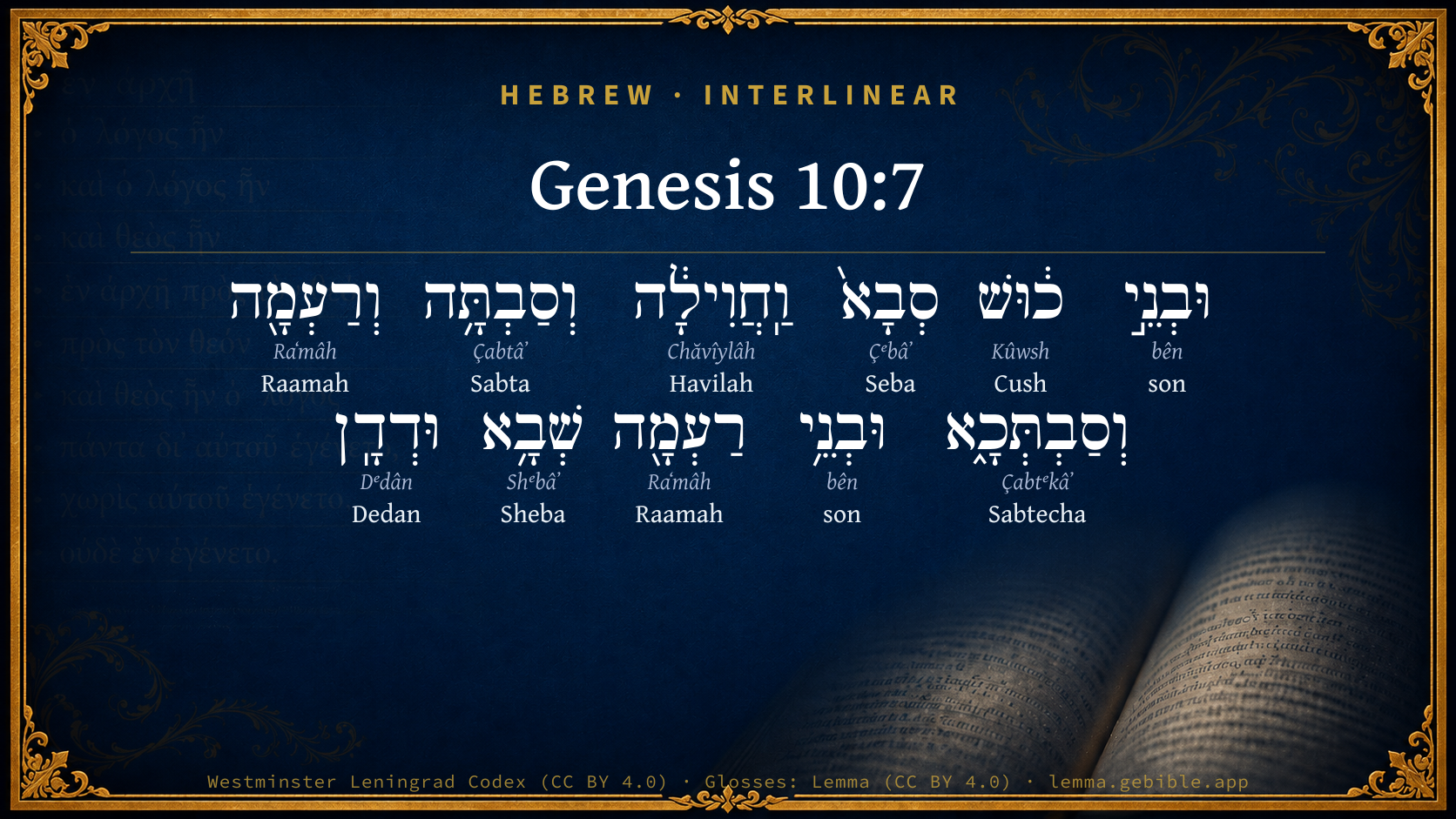
Genesis 10:7

Hebrew (Westminster Leningrad Codex) Genesis 10:7 appears in the Hebrew Old Testament. The text above is from the Westminster Leningrad Codex. Each word links to its Strong’s number, a concise gloss, and parsing drawn from the Open Scriptures Hebrew Bible morphology. Click any word for its full Brown-Driver-Briggs (BDB) entry.
Download image
Cite this verse

Genesis 10:7 (World English Bible). Public Domain. Lemma interlinear Bible study tool, https://lemma.gebible.app/v/genesis/10/7.

Show BibTeX & RIS
BibTeX
RIS
English Translation
The sons of Cush: Seba, Havilah, Sabtah, Raamah, and Sabteca. The sons of Raamah: Sheba and Dedan.
World English Bible · Public Domain
Highlights
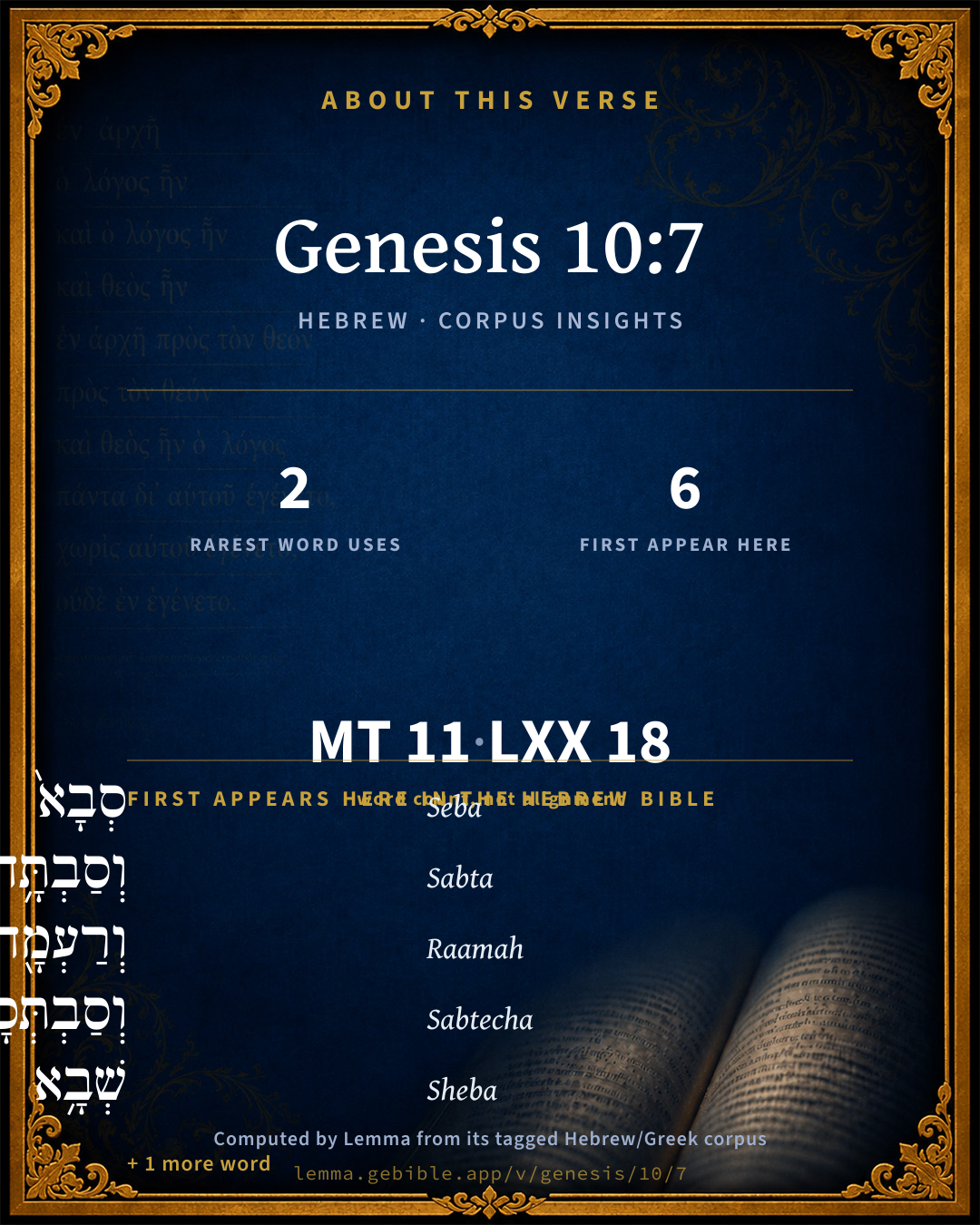
  • 6 first appearances in the Hebrew Bible
Full analysis ↓
Download a study sheet

One document with this verse’s original text, its word-by-word gloss line, the meaning frame, cross-references with their text, attributed commentary, and full source and license credits — printable, and it pastes into notes with its structure intact.

This verse Autodidact and up

Study sheet (.html) Plain text (.txt)

A passage Seminary Student

Up to 50 verses in one chapter. A passage sheet keeps up to 6 commentary sources and 12 cross-references per verse, in the order this page ranks them, and says so on the sheet whenever that leaves anything out. Ask for a single verse and you get the Autodidact verse sheet above.

Everything on this page stays free to read, with no account — the sheet is a download of what is already on screen, not access to it.

Want to remove ads? Support Godless Engineer
Compare translations 3

The same verse in 3 English versions, stacked beneath the original-language interlinear above. Click any original word for its lexicon entry.

Each is an independent rendering of the whole verse — the interlinear is not word-aligned to these translations.

Highlighted words mark where these versions differ — a whole-verse word diff, not a word-by-word alignment.

  • World English Bible Public Domain
    The sons of Cush: Seba, Havilah, Sabtah, Raamah, and Sabteca. The sons of Raamah: Sheba and Dedan.
  • King James Version Public Domain
    And the sons of Cush; Seba, and Havilah, and Sabtah, and Raamah, and Sabtechah: and the sons of Raamah; Sheba, and Dedan.
  • unfoldingWord Literal Text CC BY-SA 4.0
    And the sons of Cush Seba and Havilah and Sabtah and Raamah and Sabteca. And the sons of Raamah Sheba and Dedan.

unfoldingWord Literal Text — © unfoldingWord, licensed CC BY-SA 4.0. Word-aligned USFM3 via Door43 (git.door43.org/unfoldingWord/en_ult).

Versions to compare (up to 4)

3 of 4 selected

Show all 18 translations

Every available English version of this verse, each an independent rendering of the whole verse.

  • World English Bible Public Domain
    The sons of Cush: Seba, Havilah, Sabtah, Raamah, and Sabteca. The sons of Raamah: Sheba and Dedan.
  • Berean Standard Bible Public Domain
    The sons of Cush: Seba, Havilah, Sabtah, Raamah, and Sabteca. And the sons of Raamah: Sheba and Dedan.
  • Majority Standard Bible Public Domain
    The sons of Cush: Seba, Havilah, Sabtah, Raamah, and Sabteca. And the sons of Raamah: Sheba and Dedan.
  • King James Version Public Domain
    And the sons of Cush; Seba, and Havilah, and Sabtah, and Raamah, and Sabtechah: and the sons of Raamah; Sheba, and Dedan.
  • American Standard Version (1901) Public Domain
    And the sons of Cush: Seba, and Havilah, and Sabtah, and Raamah, and Sabteca; and the sons of Raamah: Sheba, and Dedan.
  • Revised Version (1885) Public Domain
    And the sons of Cush; Seba, and Havilah, and Sabtah, and Raamah, and Sabteca: and the sons of Raamah; Sheba, and Dedan.
  • Geneva Bible (1599) Public Domain
    And the sonnes of Cush, Seba and Hauilah, and Sabtah, and Raamah, and Sabtecha: also the sonnes of Raamah were Sheba and Dedan.
  • Douay-Rheims (1899) Public Domain
    And the sons of Chus: Saba and Hevila, and Sabatha, and Regma, and Sabatacha. The sons of Regma: Saba and Dadan.
  • Young's Literal Translation Public Domain
    And sons of Cush `are' Seba, and Havilah, and Sabtah, and Raamah, and Sabtechah; and sons of Raamah `are' Sheba and Dedan.
  • Literal Standard Version CC BY-SA 4.0
    And sons of Cush [are] Seba, and Havilah, and Sabtah, and Raamah, and Sabtechah; and sons of Raamah [are] Sheba and Dedan.
  • Unlocked Literal Bible CC BY-SA 4.0
    The sons of Cush were Seba, Havilah, Sabtah, Raamah, and Sabteka. The sons of Raamah were Sheba and Dedan.
  • unfoldingWord Literal Text CC BY-SA 4.0
    And the sons of Cush Seba and Havilah and Sabtah and Raamah and Sabteca. And the sons of Raamah Sheba and Dedan.
  • Darby Bible Public Domain
    And the sons of Cush: Seba, and Havilah, and Sabtah, and Raamah, and Sabtecha. And the sons of Raamah: Sheba and Dedan.
  • World Messianic Bible Public Domain
    The sons of Cush were: Seba, Havilah, Sabtah, Raamah, and Sabteca. The sons of Raamah were: Sheba and Dedan.
  • Webster's Bible Public Domain
    And the sons of Cush; Seba, and Havilah, and Sabtah, and Raamah, and Sabtecha; and the sons of Raamah, Sheba, and Dedan.
  • Free Bible Version CC BY-SA 4.0
    The sons of Cush: Seba, Havilah, Sabtah, Raamah, and Sabteca. The sons of Raamah: Sheba and Dedan.
  • Bible in Basic English Public Domain
    And the sons of Cush: Seba and Havilah and Sabtah and Raamah and Sabteca; and the sons of Raamah: Sheba and Dedan.
  • JPS Tanakh (1917) Public Domain
    And the sons of Cush: Seba, and Havilah, and Sabtah, and Raamah, and Sabteca; and the sons of Raamah: Sheba, and Dedan.

Literal Standard Version (2020), Covenant Press — licensed CC BY-SA 4.0. Text via the HelloAO Bible API (eBible.org). Unlocked Literal Bible (unfoldingWord) — licensed CC BY-SA 4.0. Text via the HelloAO Bible API (eBible.org). unfoldingWord Literal Text — © unfoldingWord, licensed CC BY-SA 4.0. Word-aligned USFM3 via Door43 (git.door43.org/unfoldingWord/en_ult). Free Bible Version, Dr. Jonathan Gallagher — licensed CC BY-SA 4.0. Text via the HelloAO Bible API (eBible.org).

Word by word

More ways to search: Search by grammar → Find every occurrence → Compare this word →

Practice this passage: Drill this verse → Learn its vocabulary →

About this verse

These counts appear in no published source. They are computed here, from the morphology-tagged text and Lemma’s own curated glosses. What Lemma adds →

11
words
9
distinct lemmas
Pentateuch
section

Notable vocabulary

The rarest word here is וְסַבְתָּ֥ה Sabta H5454 — appearing just 2 times in the whole Hebrew Bible.

First appearance in Scripture

These words make their first canonical appearance in the Hebrew Bible here:

  • סְבָא֙ Seba H5434
  • וְסַבְתָּ֥ה Sabta H5454
  • וְרַעְמָ֖ה Raamah H7484
  • וְסַבְתְּכָ֑א Sabtecha H5455
  • שְׁבָ֥א Sheba H7614
  • וּדְדָֽן Dedan H1719

Shared distinctive vocabulary

וְסַבְתָּ֥ה Sabta H5454 occurs in 2 verses of the Hebrew Bible. Also found in:

Grammatical profile

  • 11 nouns

Repetition

Words recur within this verse — often emphatic in Hebrew:

  • וּבְנֵ֣י son H1121 ×2
  • וְרַעְמָ֖ה Raamah H7484 ×2

Hebrew & Septuagint length

In English translation the verse runs 17 words from the Hebrew and 22 from the Septuagint (LXX English) — closely comparable.

A rough comparison of the two English renderings, which tokenize alike — not a word-level alignment.

Word counts can differ between the Hebrew and the Greek without any difference in meaning — e.g. the Hebrew direct-object marker אֵת has no separate Greek word, and Greek often adds the article ὁ.

In the original languages it is 11 Hebrew tokens and 18 Greek tokens — but the two are counted differently (Hebrew bundles its prefixes and suffixes into one token; the Greek is in lemma form), so that isn’t a like-for-like length.

Cross-references

6

Topical passages linked to Genesis 10:7 in the Treasury of Scripture Knowledge — connected by theme and wording, ordered by reader-vote popularity; previews shown in the World English Bible.

  • Ezekiel 27:22 The traffickers of Sheba and Raamah, they were your traffickers; they traded for your wares with the chief of all spices, and with all precious stones, and gold.
  • Ezekiel 27:15 The men of Dedan were your traffickers; many isles were the market of your hand: they brought you in exchange horns of ivory and ebony.
  • Genesis 2:11 The name of the first is Pishon: this is the one which flows through the whole land of Havilah, where there is gold;
  • 1 Kings 10:1 When the queen of Sheba heard of the fame of Solomon concerning the name of Yahweh, she came to prove him with hard questions.
  • Psalms 72:10 The kings of Tarshish and of the isles will bring tribute. The kings of Sheba and Seba shall offer gifts.
  • Isaiah 21:13 The burden on Arabia. In the forest in Arabia shall you lodge, you caravans of Dedanites.

Cross-references courtesy of OpenBible.info (CC BY 4.0).

Hebrew and Greek witnesses Masoretic Hebrew ↔ Greek Septuagint

The same verse in the two great witnesses to the Old Testament, shown verse-for-verse.

These are two independent witnesses, not word-aligned to each other, and the Septuagint is shown in lemma (dictionary) form.

Hebrew Genesis 10:7 Masoretic · Westminster Leningrad Codex

וּבְנֵ֣י כ֔וּשׁ סְבָא֙ וַֽחֲוִילָ֔ה וְסַבְתָּ֥ה וְרַעְמָ֖ה וְסַבְתְּכָ֑א וּבְנֵ֥י רַעְמָ֖ה שְׁבָ֥א וּדְדָֽן

The sons of Cush: Seba, Havilah, Sabtah, Raamah, and Sabteca. The sons of Raamah: Sheba and Dedan.

World English Bible · Public Domain

Greek LXX Genesis 10:7 Septuagint · lemma form

υἱός δέ χους σαβα καί ευιλα καί σαβαθα καί ρεγμα καί σαβακαθα υἱός δέ ρεγμα σαβα καί δαδαν

And the sons of Chus, Saba, and Evila, and Sabatha, and Rhegma, and Sabathaca. And the sons of Rhegma, Saba, and Dadan.

LXX2012 (modern English Septuagint) · Public Domain

On this verse, The Pulpit Commentary discusses the Septuagint’s reading. Read the note in Commentary ↓

Hebrew: Westminster Leningrad Codex (CC BY 4.0). Greek: Septuagint (public domain); English from LXX2012 (modern English Septuagint) (Public Domain). How the Septuagint differs from the Hebrew →

Targum (Aramaic paraphrase)

2

The Targum is the ancient Jewish Aramaic paraphrase of the Hebrew Scriptures — an interpretive translation, not the Hebrew text itself. Onkelos (literal) and Pseudo-Jonathan (expansive) render the Torah, and Jonathan the Prophets. Coverage is partial: where no permissively-licensed English translation exists for a verse, only the Aramaic is shown. This is verse-level text, not a word-by-word alignment to the Hebrew.

  1. Targum Onkelos Torah (Genesis–Deuteronomy)
    וּבְנֵי כוּשׁ סְבָא וַחֲוִילָה וְסַבְתָּה וְרַעְמָה וְסַבְתְּכָא וּבְנֵי רַעְמָה שְׁבָא וּדְדָן

    And the sons of Kush, Seba, and Chavilah, and Sabetha, and Raamah, and Sabtekah and the sons of Raamah, Sheba and Dedan.

    Targum Onkelos — Aramaic: “Onkelos Genesis” (public domain); “Onkelos Exodus” (public domain); “Onkelos Leviticus” (public domain); “Onkelos Numbers” (public domain); “Onkelos Deuteronomy” (public domain). English: “Sefaria Community Translation” (CC0 1.0 (public-domain dedication)); “J.W. Etheridge. The Targums of Onkelos and Jonathan Ben Uzziel on the Pentateuch. London: Longmans, Green, 1862” (public domain). Text via Sefaria.

  2. Targum Pseudo-Jonathan Torah (Genesis–Deuteronomy)
    וּבְנוֹי דְכוּשׁ סְבָא וַחֲוִילָה וְסַבְתָּ וְרַעֲמָא וְסַבְתְּכָא וְשׁוּם אַפַרְכָיוֹתְהוֹם סִינִירָאֵי וְהִנְדְקִי וּסְמִידָאֵי וְלוּבָּאֵי וְזִינְגָאֵי וּבְנוֹי דִמְוָרִיטִינוֹס זִמְדְגַד וּמְזָג

    And the sons of Kush, Seba, and Havilah, and Sabta, and Raama, and Sabteka, and the name of their provinces, Sinirai, and Hindiki, and Semadi, and Lubai, and Zingai. And the sons of Mauritinos, Zmargad and Mezag.

    Targum Pseudo-Jonathan — Aramaic: “Targum Jonathan on Genesis” (public domain); “Targum Jonathan on Exodus” (public domain); “Targum Jonathan on Leviticus” (public domain); “Targum Jonathan on Numbers” (public domain); “Targum Jonathan on Deuteronomy” (public domain). English: “The Targum of Jonathan ben Uzziel, trans. J. W. Etheridge, London, 1862” (public domain). Text via Sefaria.

Commentary

Notes on Genesis 10:7 from classic Christian and Jewish commentators (each source and its license shown beneath its notes). The classic Christian expositions comment on the surrounding passage and are grouped to its opening verse, so a note may address several verses; the Jewish commentaries on the Tanakh (Rashi and others) are per-verse, so they appear only where the commentator wrote on this verse.

Lemma curates 59 commentaries, every one of them public domain or Creative Commons licensed, each selected and text-cleaned for this edition rather than reprinted as found. About our sources →

Trapp's Complete Commentary

John Trapp

Gen 10:7 And the sons of Cush; Seba, and Havilah, and Sabtah, and Raamah, and Sabtecha: and the sons of Raamah; Sheba, and Dedan.

Ver. 7. Seba.] Of whom seem to have come the Abassines in Africa, the only region there entirely possessed by Christians. Hence came the Queen of Sheba, &c.

John Trapp, A Commentary or Exposition upon All the Books of the Old and New Testament (1647–1656) — public domain. Text from a community e-Sword module.

Tyndale Open Study Notes

Tyndale Open Resources

10:7 The sons of Cush and Raamah together total seven. • Seba was in northern Africa (see Isa 43:3; 45:14). • Havilah was in southwest Arabia. • Sabtah was in southern Arabia, in ancient Hadramaut, near the Persian Gulf. • Raamah was in southwest Arabia near Najran. • Sabteca was in ancient Samudake near the Persian Gulf. • Sheba was a kingdom in southwest Arabia with commercial colonies (see 1 Kgs 10:1-29). • Dedan was in northern Arabia.

Tyndale Open Study Notes — © Tyndale Open Resources, licensed CC BY-SA 4.0. Text via the HelloAO Bible API.

Adam Clarke's Commentary

Verse 7. Seba] The founder of the Sabaeans. There seem to be three different people of this name mentioned in this chapter, and a fourth in Ge 25:3.

Havilah] Supposed by some to mean the inhabitants of the country included within that branch of the river Pison which ran out of the Euphrates into the bay of Persia, and bounded Arabia Felix on the east.

Sabtah] Supposed by some to have first peopled an isle or peninsula called Saphta, in the Persian Gulf.

Raamah] Or Ragmah, for the word is pronounced both ways, because of the ע ain, which some make a vowel, and some a consonant. Ptolemy mentions a city called Regma near the Persian Gulf; it probably received its name from the person in the text.

Sabtechah] From the river called Samidochus, in Caramanla; Bochart conjectures that the person in the text fixed his residence in that part.

Sheba] Supposed to have had his residence beyond the Euphrates, in the environs of Charran, Eden, &c.

Dedan.] Supposed to have peopled a part of Arabia, on the confines of Idumea.

Adam Clarke's Commentary on the Bible (1810–1826) — public domain. Text from a community e-Sword/MySword module.

Ellicott's Commentary for English Readers

(7) Sons of Cush.—Of Cush there are five subdivisions, of which one is again parted into two. These are—

1. Seba.—The name at this time of an Arabian tribe, which subsequently migrated into Africa, and settled in Meroë, which, according to Josephus, still bore in his days this appellation. They also left their name on the eastern side of the Red Sea, not far to the north of the Straits of Bab-el-Mandeb.

2. Havilah, upon the river Pison (Gen_2:11), was undoubtedly a region of Arabia, situated probably upon the Persian Gulf. Havilah is again mentioned in Gen_10:29.

3. Sabtah.—Probably Hadramaut, in Arabia Felix. (See Note on Gen_10:26.)

4. Raamah, on the Persian Gulf, was divided into Dedan upon the south-west and Sheba in the centre, while Havilah lay upon the north-west side. Of these, Sheba subsequently rose to fame as the kingdom of the Himyarite Arabs.

5. Sabtechah.—Apparently still more to the south of Dedan, but placed by some on the eastern side of the gulf.

Thus, then, at the time when this table was written the southern half of Arabia was Cushite, and a swarthy race of men is still found there, especially in Yemen and Hadramaut, far darker than the light brown Arabians. Migrating from place to place along the sea-shore, the passage of the Cushites into Nubia and Abyssinia was easy. But their chief home was, at this period, in Mesopotamia, and the cuneiform inscriptions have now revealed their long struggle there with men of the race of Shem.

A Bible Commentary for English Readers, edited by Charles John Ellicott (1878–1897) — public domain. Text from a community e-Sword module.

The Cambridge Bible for Schools and Colleges

gen. ed. J. J. S. Perowne

7. And the sons of Cush] The names given in this verse are usually identified with the names of tribes, or places, on the African coast, or on the opposite shores of Arabia.

Seba] Cf. Psa_72:10; Isa_43:3; Isa_45:14, where it is named with Egypt and Cush; identified by Josephus (Ant. Jud. ii. 10, § 2) with “Meroë”; but now generally supposed to denote tribes on the coast of the Red Sea in the neighbourhood of Massowah.

Havilah] The name occurs again in Gen_10:29 among “the sons of Joktan”; possibly a branch of the same Arabian tribe which had settled on the African coast. See also Gen_2:11, Gen_25:18.

Raamah] Mentioned also in Eze_27:22 for its trade with Tyre, and with Sheba.

Sabtah … Sabteca] Unknown.

Sheba] Also in Gen_10:28, among “the sons of Joktan,” and in Gen_25:3, among “the sons of Keturah.” The trade of this people and their dependencies consisted especially of spices, precious stones, and gold (Eze_27:22). The occurrence of the name of “Sheba” here among the sons of Ham, and in Gen_10:28 among the sons of Shem, illustrates the difficulty of identification.

Dedan] Mentioned also in Gen_25:3; apparently an Arabian tribe, bordering on Edom (Eze_25:13), and occasionally brought into contact with Israel through trade. Cf. Isa_21:13; Jer_25:23; Eze_27:20.

The Cambridge Bible for Schools and Colleges (gen. ed. J. J. S. Perowne; Cambridge University Press, 1878–1918) — public domain. Text from a community e-Sword module.

John Gill's Exposition

And the sons of Cush,.... The first born of Ham, who had five sons, next mentioned, besides Nimrod, spoken of afterwards by himself:

Seba, and Havilah, and Sabtah, and Raamah, and Sabtecha; the first of these is Seba, the founder of the Sabaeans, according to Josephus (p), a people seated in Arabia Deserta, which seem to be the Sabaeans brought from the wilderness, Eze 23:42 and very probably the same that plundered Job of his cattle, Job 1:14. The second son is Havilah, who, as Josephus (q) says, was the father of the Evilaeans, now called Getuli; but the posterity of Havilah seem to be the same whom Strabo (r) calls Chaulotaeans, and whom he speaks of along with the Nabataeans and Agraeans, a people near Arabia Felix; and by Pliny (s) they are called Chavelaeans, and whom he speaks of as Arabians, and places them to the east of the Arabian Scenites. The third son is Sabtah; from him, Josephus (t) says, came the Sabathenes, who, by the Greeks, are called Astabari; the posterity of this man seemed to have settled in some part of Arabia Felix, since Ptolemy (u) makes mention of Sabbatha as the metropolis of that country, called by Pliny (w) Sabotale, or rather Sabota, as it should be read; Ptolemy places another city in this country he calls Saphtha, which seems to have its name from this man. The fourth son is Raamah or Ragmas, as Josephus calls (x) him, from whom sprung the Ragmaeans he says; and most of the ancients call him Rhegmah, the letter being pronounced as a "G", as in Gaza and Gomorrah: his posterity were also seated in Arabia Felix, near the Persian Gulf, where Ptolemy (y) places the city Rhegama, or as it is in the Greek text, Regma. The fifth son is Sabtecha, whom some make to be the father of a people in the same country, Arabia Felix, near the Persian Gulf, called Sachalitae; but Dr. Wells (z) thinks, that the descendants of this man might be from him regularly enough styled at first by the Greeks, Sabtaceni, which name might be afterwards softened into Saraceni, by which name it is well known the people of the northern parts of Arabia, where he places the descendants of this man, were formerly denominated; though Bochart (a) carries them into Carmania in Persia, there being a short cut over the straits of the Persian Gulf, out of Arabia thither, where he finds a city called Samydace, and a river, Samydachus, which he thinks may come from Sabtecha, the letters "B" and "M" being frequently changed, as Berodach is called Merodach, and Abana, Amana, and so in other names.

And the sons of Raamah; Sheba, and Dedan; no account is given of any of the posterity of the other sons of Cush, only of this his fourth son Raamah, who is said to have two sons; the first is called Sheba, from whom came the Sabaeans, according to Josephus (b); not the Sabaeans before mentioned in Arabia Deserta, but those in Arabia Felix, where Pomponius Mela (c) and Strabo (d) seat a people called Sabaeans, and whose country abounded with frankincense, myrrh, and cinnamon; the latter makes mention of a city of theirs called Mariaba, and seems to be the same that is now called Mareb, and formerly Saba (e), very likely from this man. The other son, Dedan, is called by Josephus (f) Judadas, whom he makes to be founder of the Judadaeans, a nation of the western Ethiopians; but the posterity of this man most probably settled in Arabia, and yet are to be distinguished from the Dedanim in Isa 21:13 who were Arabians also, but descended from Dedan the son of Jokshan, a son of Abraham by Keturah, Gen 25:3 as well as from the inhabitants of Dedan in Edom, Jer 25:23 it is observed, that near the city Regma before mentioned, on the same coast eastward, was another city called Dedan; and to this day Daden, from which the neighbouring country also takes its name, as Bochart (g) has observed, from Barboza, an Italian writer, in his description of the kingdom of Ormus: so that we need not doubt, says Dr. Wells (h), but that here was the settlement of Dedan the son of Raamah or Rhegma, and brother of Sheba.

(p) Ut supra. (Antiqu. l. 1. c. 6. sect. 1.) (q) Ibid. (r) Geograph. l. 16. p. 528. (s) Nat. Hist. l. 5. c. 11. (t) Ut supra. (Antiqu. l. 1. c. 6. sect. 1.) (u) Geograph. l. 6. c. 7. (w) Nat. Hist. l. 6. c. 28. (x) Ut supra. (Antiqu. l. 1. c. 6. sect. 1.) (y) Ut supra. (Geograph. l. 6. c. 7.) (z) Geography of the Old Testament, vol. 1. p. 198. (a) Phaleg l. 4. c. 4. col. 218. (b) Ut supra. (Antiqu. l. 1. c. 6. sect. 1.) (c) De Situ Orbis, l. 3. c. 8. (d) Geograph. l. 16. p. 536. (e) Via. Pocock. Specimen Arab. Hist p. 57. (f) Ut supra. (Antiqu. l. 1. c. 6. sect. 1.) (g) Phaleg. l. 4. c. 6. col. 219. (h) Ut supra, (Geography of the Old Testament, vol. 1.) p. 197.

John Gill's Exposition of the Whole Bible (1746–1763) — public domain (CC PDM 1.0). Text via the HelloAO Bible API.

Matthew Poole's English Annotations

Seba; or, Saba, or Sheba, whose seed were the Sabeans in Arabia the Desert; see Psa 72:10; Isa 43:3; and, as some think, the Abyssines in Africa.

Havilah, the father of the inhabitants of the land of Havilah, mentioned Gen 2:11; a land in the most eastern part of Arabia, this being opposed to Shur, a desert near Egypt, as the two remotest bounds of Arabia, Gen 25:18; 1Sa 15:7.

Sabtah was father of those people who were seated in the lower part of Arabia the Happy, near the Persian Gulf, who also sent forth a colony into Persia. For in those parts we meet with the Sabateni in Josephus, the Stabaei and Messabathi in Ptolemy and Pliny.

Raamah, from whom descended another people dwelling in the same Arabia. See Eze 27:22.

Sabtechah, the father of another people adjoining to them.

Sheba was father either of that people which inhabited Ethiopia, who were known by that name; see 1Ki 10:1, 4; Eze 27:22; Mat 12:42; Act 8:27; or rather of another people in Arabia. So the several sons of Cush are conveniently seated one near another. And those Ethiopians in Africa might be a colony either of these, or rather of the posterity of the former Seba.

Dedan; of whose posterity see Eze 27:15; 38:13.

Matthew Poole's English Annotations on the Holy Bible (1683–1685) — public domain. Text from a community e-Sword/MySword module.

Whedon's Commentary on the Bible

Daniel D. Whedon

7. Sons of Cush — The Cushite Ethiopians and Arabians.

Seba — Inhabitants of Meroe of the Upper Nile, situated on the peninsula (called an island by Herodotus) formed by the Astaboras and the Nile, about eight hundred miles south of Syene. It is often mentioned by the classic writers, and by the Hebrew poets and prophets, as a land of precious woods and metals, the thoroughfare of caravans that traded between Egypt and Ethiopia, and between both of these countries and India. Queen Candace, mentioned in Act_8:27, seems to have reigned here. Heeren and others consider Meroe the mother of Egyptian civilization, but Rawlinson considers it the daughter. (Herod., 2:46.)

Havilah — The Macrobian Ethiopians, who dwelt in what is now Abyssinia. There was also a Shemitic Havilah (Gen_10:29) in Arabia. The two families probably intermingled, and thus bore a common name. See note on Cush.

Sabtah — Ethiopians of Hadramont, in South Arabia, whose chief city was Sabta, Sabota, or Sabotha. Arrian mentions inhabitants of South Arabia, distinguished from true Arabs by stature, darker skin, and habits of life, such as eating fish, (ichthyophagi.) Niebuhr and other travellers and missionaries confirm these differences, and also declare that the language of this people differs wholly from the Arabic. (Knobel.)

Raamah — This name still remains in South-eastern Arabia, the Rhegma of the old geographers, where, according to Pliny and Ptolemy, dwelt a fish-eating people, (ichthyophagi.) We learn from travellers that they still exist in Omaun, distinguished from the Arabs by colour, language, and habits. (Ritter.) The merchants of Raamah and Sheba are mentioned by Ezekiel (Eze_27:22) as trading at Tyre in spices, precious stones, and gold. Sheba is to be distinguished from the Shemitic Sheba, (Gen_10:28.) The Cushite Sheba was on the Persian Gulf, traces of which may, perhaps, be found in the modern Saba, the thoroughfare of the Hebrew commerce with India. The Shemitic Sheba was an Arabic town in South Arabia, and appears as a kingdom in the days of Solomon, when the “queen of Sheba” came, with a caravan laden with gold and precious stones and “great store of spices,” to test the wisdom of the Hebrew king. Dedan is probably still to be traced in Dodan, on the east coast of Arabia. Sheba and Dedan are also given (Gen_25:3) as descendants of Abraham by Keturah. This also seems to point to an early intermingling of the Shemitic and Hamitic families.

Sabtecha — The dark-skinned Carmanians. (They were a fish-eating people,) described by the old settlers as dwelling on the coast east of the Persian Gulf. They had a river and a city Sabis.

Daniel D. Whedon (gen. ed.), Commentary on the Old and New Testaments (1874–1909) — public domain. Text from a community e-Sword module.

The Pulpit Commentary

And the sons of Cush; Seba. Meroe, in Nubia, north of Ethiopia (Josephus, "Ant.," 2. 10). And Havilah. Euji"la (LXX); may refer to an African tribe, the Avalitae, south of Babelmandeb (Keil, Lange, Murphy), or the district of Chaulan in Arabia Felix (Rosenm Kalisch, Wordsworth). Verse 29 mentions Havilah as a Shemite territory. Kalisch regards them as "the same country, extending from the Arabian to the Persian Gulf, and, on account of its vast extent, easily divided into two distinct parts" (cf. Gen_2:11) And Sabtah. The Astaborans of Ethiopia (Josephus, Gesenius, Kalisch); the Ethiopians of Arabia, whose chief city was Sabota (Knobel, Rosenm Lange, Keil). And Raamah. Regma (LXX); Ragma on the Persian Gulf, in Oman (Bochart, Rosenm Kalisch, Lange). And Sabtechah. Nigritia (Targum, Jonathan), which the name Subatok, discovered on Egyptian monuments, seems to favor (Kalisch); on the east of the Persian Gulf at Samydace of Carmania (Be-chart, Knobel, Rosenm Lange). And the sons of Raamah; Sheba. The principal city of Arabia Felix (1Ki_10:1; Job_1:15 Job_6:19; Psa_72:10, Psa_72:15; Isa_60:6; Jer_6:20; Eze_27:22; Joe_3:8) occurs again (Gen_5:28) as a son of Joktan; probably was peopled both by Hamites and Shemites. And Dedan. Daden on the Persian Gulf (vide Isa_21:13; Jer_49:8; Eze_25:13 Eze_27:12-15)

The Pulpit Commentary (1880–1919), ed. H.D.M. Spence-Jones & Joseph S. Exell — public domain. Text from a community e-Sword module.

Ramban (Nachmanides)

Rabbi Moshe ben Nachman (Ramban / Nachmanides)

AND THE SONS OF CUSH: SEBA AND HAVILAH, ETC. These sons became the heads of nations, and the two sons of Raamah [namely, Sheba and Dedan] became two nations. Nimrod the son of Cush, however, did not become the head of a nation. Therefore, Scripture wrote afterward, And Cush begot Nimrod, and did not say, “and the sons of Cush: Nimrod, and Seba, and Havilah” [which would have indicated that Nimrod, like Seba and Havilah, also became the head of a nation]. But Phut the son of Ham became only one people, and not various nations as was the case with Mitzraim and Canaan, the sons of Ham. Therefore, Scripture did not return [to tell of the progeny of Phut, as it did with the other sons of Ham, namely, Cush, Mitzraim and Canaan]. In Bereshith Rabbah we find: “Said Resh Lakish, ‘We might have thought that the family of Phut was swallowed up, but Ezekiel came and explained, Phut, and Lud, and all the Arabians,’” The meaning of the Midrash is that because Scripture did not return to tell about Phut, we might have thought that his seed intermingled with the children of Canaan and they neither became a nation, nor did they inherit a land called by their name. [The prophet Ezekiel thus clarified that the children of Phut existed as a separate nation in their own land.] However, in the case of Magog, and Madai…and Tubal, and Meshech, and Tiras, — the children of Japheth — Scripture also did not mention the families of their progeny: And so also with the sons of Shem: Elam, and Asshur, and Arpachshad, and Lud, who became heads of nations; Scripture did not mention their progeny since each one just became one people inhabiting one country, and they did not give rise to various nationalities.

Ramban (Nachmanides) on the Tanakh — English translation: “Commentary on the Torah by Ramban (Nachmanides). Translated and annotated by Charles B. Chavel. New York, Shilo Pub. House, 1971-1976” (CC BY 4.0). Text via Sefaria.

Radak

Rabbi David Kimhi (Radak)

ובני...ודדן, Rav Saadyah gaon has supplied us with a commentary on all these.

Radak on the Tanakh — English translations: “Sefaria Community Translation” (CC0 1.0 (public-domain dedication)); “Eliyahu Munk, HaChut Hameshulash” (CC BY 4.0); “Rabbi Mike Feuer, Jerusalem Anthology” (CC BY 4.0); and “R. David Kimhi on the first book of Psalms, Translated by R.G. Finch, London, 1919” (public domain). Text via Sefaria.

Lesson kit

Teaching starters — assembled from the data on this page, not authored interpretation. Every prompt links to the verse data it draws on. Edit before teaching.

Genesis, in the Pentateuch, opens this verse with 11 words (9 distinct Hebrew lemmas). Its most distinctive word is Çabtâʼ (“Sabta”). A historical commentator’s framing appears above. Read the whole chapter for the surrounding context.

Discussion questions

  1. What does “Sabta” (Çabtâʼ) contribute to the verse as a whole?
  2. 6 words here appear for the first time in Scripture. What is being introduced at this debut?
  3. 1 Chronicles 1:9 shares the word «Sabta» with this verse. How do the two illuminate each other?
  4. “son” occurs 2× in this one verse. What is the effect of the repetition?
  5. These translations render this verse differently; the difference is in the English rendering, not the original. What questions does that raise?
  6. Reading how Trapp's Complete Commentary and Tyndale Open Study Notes read this verse, where do the two commentators agree and where do they part?

Things to notice

Reading settings

Reading text

Shown beneath each verse's original-language words.

Old Testament
Old Testament edition

Read the OT as the Masoretic Hebrew (MT) or the Greek Septuagint (LXX).

English shown for the Greek Septuagint (in the Hebrew ↔ Greek comparison).

Comparing translations? Open the Compare panel on any verse page to stack up to four side by side.