
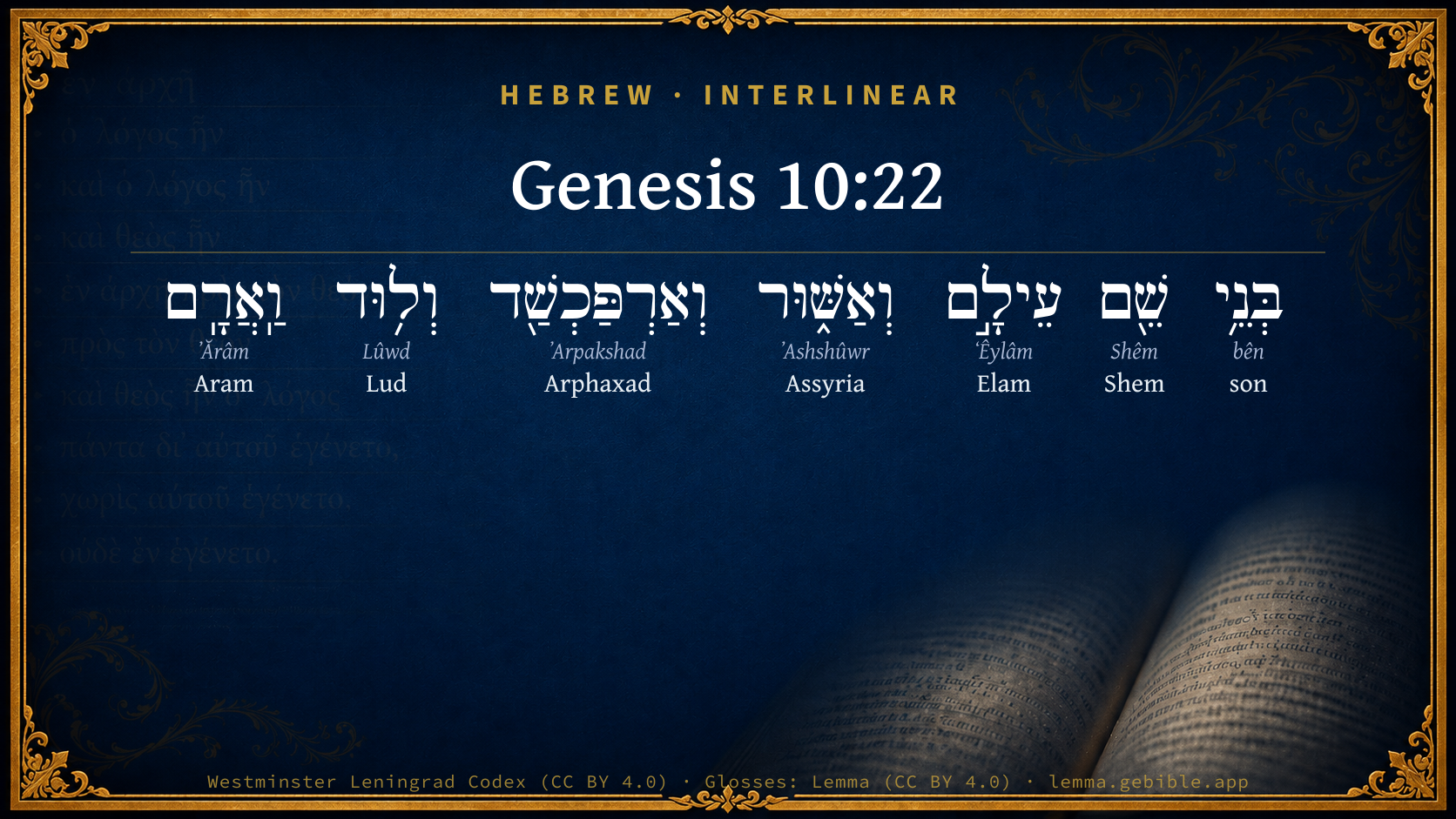
Genesis 10:22

Hebrew (Westminster Leningrad Codex) Genesis 10:22 appears in the Hebrew Old Testament. The text above is from the Westminster Leningrad Codex. Each word links to its Strong’s number, a concise gloss, and parsing drawn from the Open Scriptures Hebrew Bible morphology. Click any word for its full Brown-Driver-Briggs (BDB) entry.
Download image
Cite this verse

Genesis 10:22 (World English Bible). Public Domain. Lemma interlinear Bible study tool, https://lemma.gebible.app/v/genesis/10/22.

Show BibTeX & RIS
BibTeX
RIS
English Translation
The sons of Shem: Elam, Asshur, Arpachshad, Lud, and Aram.
World English Bible · Public Domain
Highlights Full analysis ↓
Download a study sheet

One document with this verse’s original text, its word-by-word gloss line, the meaning frame, cross-references with their text, attributed commentary, and full source and license credits — printable, and it pastes into notes with its structure intact.

This verse Autodidact and up

Study sheet (.html) Plain text (.txt)

A passage Seminary Student

Up to 50 verses in one chapter. A passage sheet keeps up to 6 commentary sources and 12 cross-references per verse, in the order this page ranks them, and says so on the sheet whenever that leaves anything out. Ask for a single verse and you get the Autodidact verse sheet above.

Everything on this page stays free to read, with no account — the sheet is a download of what is already on screen, not access to it.

Want to remove ads? Support Godless Engineer
Compare translations 3

The same verse in 3 English versions, stacked beneath the original-language interlinear above. Click any original word for its lexicon entry.

Each is an independent rendering of the whole verse — the interlinear is not word-aligned to these translations.

Highlighted words mark where these versions differ — a whole-verse word diff, not a word-by-word alignment.

  • World English Bible Public Domain
    The sons of Shem: Elam, Asshur, Arpachshad, Lud, and Aram.
  • King James Version Public Domain
    The children of Shem; Elam, and Asshur, and Arphaxad, and Lud, and Aram.
  • unfoldingWord Literal Text CC BY-SA 4.0
    The sons of Shem Elam and Asshur and Arpachshad and Lud and Aram.

unfoldingWord Literal Text — © unfoldingWord, licensed CC BY-SA 4.0. Word-aligned USFM3 via Door43 (git.door43.org/unfoldingWord/en_ult).

Versions to compare (up to 4)

3 of 4 selected

Show all 18 translations

Every available English version of this verse, each an independent rendering of the whole verse.

  • World English Bible Public Domain
    The sons of Shem: Elam, Asshur, Arpachshad, Lud, and Aram.
  • Berean Standard Bible Public Domain
    The sons of Shem: Elam, Asshur, Arphaxad, Lud, and Aram.
  • Majority Standard Bible Public Domain
    The sons of Shem: Elam, Asshur, Arphaxad, Lud, and Aram.
  • King James Version Public Domain
    The children of Shem; Elam, and Asshur, and Arphaxad, and Lud, and Aram.
  • American Standard Version (1901) Public Domain
    The sons of Shem: Elam, and Asshur, and Arpachshad, and Lud, and Aram.
  • Revised Version (1885) Public Domain
    The sons of Shem; Elam, and Asshur, and Arpachshad, and Lud, and Aram.
  • Geneva Bible (1599) Public Domain
    The sonnes of Shem were Elam and Asshur, and Arpachshad, and Lud, and Aram.
  • Douay-Rheims (1899) Public Domain
    The sons of Sem: Elam and Assur, and Arphaxad, and Lud, and Aram.
  • Young's Literal Translation Public Domain
    Sons of Shem `are' Elam, and Asshur, and Arphaxad, and Lud, and Aram.
  • Literal Standard Version CC BY-SA 4.0
    Sons of Shem [are] Elam, and Asshur, and Arphaxad, and Lud, and Aram.
  • Unlocked Literal Bible CC BY-SA 4.0
    The sons of Shem were Elam, Ashur, Arphaxad, Lud, and Aram.
  • unfoldingWord Literal Text CC BY-SA 4.0
    The sons of Shem Elam and Asshur and Arpachshad and Lud and Aram.
  • Darby Bible Public Domain
    The sons of Shem: Elam, and Asshur, and Arphaxad, and Lud, and Aram.
  • World Messianic Bible Public Domain
    The sons of Shem were: Elam, Asshur, Arpachshad, Lud, and Aram.
  • Webster's Bible Public Domain
    The children of Shem; Elam, and Ashur, and Arphaxad, and Lud, and Aram.
  • Free Bible Version CC BY-SA 4.0
    The sons of Shem: Elam, Asshur, Arphaxad, Lud, and Aram.
  • Bible in Basic English Public Domain
    These are the sons of Shem: Elam and Asshur and Arpachshad and Lud and Aram.
  • JPS Tanakh (1917) Public Domain
    The sons of Shem: Elam, and Asshur, and Arpachshad, and Lud, and Aram.

Literal Standard Version (2020), Covenant Press — licensed CC BY-SA 4.0. Text via the HelloAO Bible API (eBible.org). Unlocked Literal Bible (unfoldingWord) — licensed CC BY-SA 4.0. Text via the HelloAO Bible API (eBible.org). unfoldingWord Literal Text — © unfoldingWord, licensed CC BY-SA 4.0. Word-aligned USFM3 via Door43 (git.door43.org/unfoldingWord/en_ult). Free Bible Version, Dr. Jonathan Gallagher — licensed CC BY-SA 4.0. Text via the HelloAO Bible API (eBible.org).

Word by word

More ways to search: Search by grammar → Find every occurrence → Compare this word →

Practice this passage: Drill this verse → Learn its vocabulary →

About this verse

These counts appear in no published source. They are computed here, from the morphology-tagged text and Lemma’s own curated glosses. What Lemma adds →

7
words
7
distinct lemmas
Pentateuch
section

Notable vocabulary

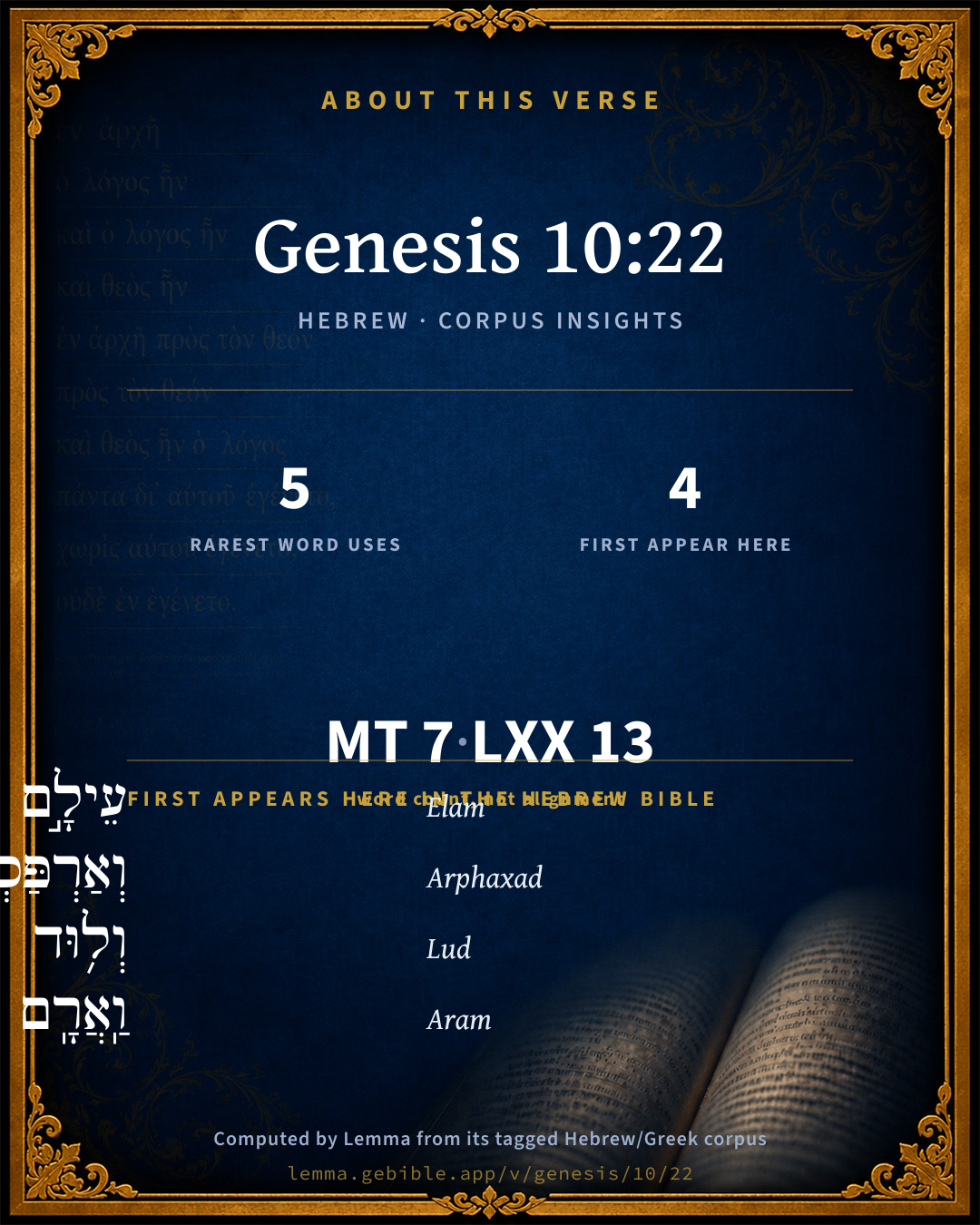
The rarest word here is וְל֥וּד Lud H3865 — appearing just 5 times in the whole Hebrew Bible.

First appearance in Scripture

These words make their first canonical appearance in the Hebrew Bible here:

  • עֵילָ֣ם Elam H5867
  • וְאַרְפַּכְשַׁ֖ד Arphaxad H775
  • וְל֥וּד Lud H3865
  • וַֽאֲרָֽם Aram H758

Shared distinctive vocabulary

וְל֥וּד Lud H3865 occurs in 5 verses of the Hebrew Bible. Also found in:

Grammatical profile

  • 7 nouns

Hebrew & Septuagint length

In English translation the verse runs 10 words from the Hebrew and 14 from the Septuagint (LXX English) — the Septuagint runs noticeably longer here. See the side-by-side →

A rough comparison of the two English renderings, which tokenize alike — not a word-level alignment.

Word counts can differ between the Hebrew and the Greek without any difference in meaning — e.g. the Hebrew direct-object marker אֵת has no separate Greek word, and Greek often adds the article ὁ.

In the original languages it is 7 Hebrew tokens and 13 Greek tokens — but the two are counted differently (Hebrew bundles its prefixes and suffixes into one token; the Greek is in lemma form), so that isn’t a like-for-like length.

Cross-references

13

Topical passages linked to Genesis 10:22 in the Treasury of Scripture Knowledge — connected by theme and wording, ordered by reader-vote popularity; previews shown in the World English Bible.

  • Isaiah 66:19 I will set a sign among them, and I will send such as escape of them to the nations, to Tarshish, Pul, and Lud, who draw the bow, to Tubal and Javan, to the isles afar off, who have not heard my fame, neither have seen my glory; and they shall declare my glory among the nations.
  • Genesis 9:26 He said, "Blessed be Yahweh, the God of Shem; Let Canaan be his servant.
  • Genesis 14:1–9 It happened in the days of Amraphel, king of Shinar, Arioch, king of Ellasar, Chedorlaomer, king of Elam, and Tidal, king of Goiim,
  • Numbers 23:7 He took up his parable, and said, From Aram has Balak brought me, The king of Moab from the mountains of the East: Come, curse me Jacob, Come, defy Israel.
  • 2 Kings 15:19 There came against the land Pul the king of Assyria; and Menahem gave Pul one thousand talents of silver, that his hand might be with him to confirm the kingdom in his hand.
  • 1 Chronicles 1:17–27 The sons of Shem: Elam, and Asshur, and Arpachshad, and Lud, and Aram, and Uz, and Hul, and Gether, and Meshech.
  • Job 1:17 While he was still speaking, there came also another, and said, "The Chaldeans made three bands, and swept down on the camels, and have taken them away, yes, and killed the servants with the edge of the sword; and I alone have escaped to tell you."
  • Isaiah 11:11 It shall happen in that day, that the Lord will set his hand again the second time to recover the remnant of his people, who shall remain, from Assyria, and from Egypt, and from Pathros, and from Cush, and from Elam, and from Shinar, and from Hamath, and from the islands of the sea.
  • Isaiah 21:2 A grievous vision is declared to me; the treacherous man deals treacherously, and the destroyer destroys. Go up, Elam; besiege, Media; all the sighing of it have I made to cease.
  • Isaiah 22:6 Elam bore the quiver, with chariots of men [and] horsemen; and Kir uncovered the shield.
  • Jeremiah 25:25 and all the kings of Zimri, and all the kings of Elam, and all the kings of the Medes;
  • Jeremiah 49:34–39 The word of Yahweh that came to Jeremiah the prophet concerning Elam, in the beginning of the reign of Zedekiah king of Judah, saying,
  • Acts 2:9 Parthians, Medes, Elamites, and people from Mesopotamia, Judea, Cappadocia, Pontus, Asia,

Cross-references courtesy of OpenBible.info (CC BY 4.0).

Hebrew and Greek witnesses Masoretic Hebrew ↔ Greek Septuagint

The same verse in the two great witnesses to the Old Testament, shown verse-for-verse.

Here the Septuagint runs noticeably longer than the Hebrew — LXX2012 (modern English Septuagint) 14 words vs World English Bible 10. A rough length comparison of the two English translations, not a word-level alignment — read both below.

These are two independent witnesses, not word-aligned to each other, and the Septuagint is shown in lemma (dictionary) form.

Hebrew Genesis 10:22 Masoretic · Westminster Leningrad Codex

בְּנֵ֥י שֵׁ֖ם עֵילָ֣ם וְאַשּׁ֑וּר וְאַרְפַּכְשַׁ֖ד וְל֥וּד וַֽאֲרָֽם

The sons of Shem: Elam, Asshur, Arpachshad, Lud, and Aram.

World English Bible · Public Domain

Greek LXX Genesis 10:22 Septuagint · lemma form

υἱός σημ αιλαμ καί ασσουρ καί αρφαξαδ καί λουδ καί αραμ καί καιναν

Sons of Sem, Elam, and Assur, and Arphaxad, and Lud, and Aram, and Cainan.

LXX2012 (modern English Septuagint) · Public Domain

On this verse, John Gill's Exposition discusses the Septuagint’s reading. Read the note in Commentary ↓

Hebrew: Westminster Leningrad Codex (CC BY 4.0). Greek: Septuagint (public domain); English from LXX2012 (modern English Septuagint) (Public Domain). How the Septuagint differs from the Hebrew →

Targum (Aramaic paraphrase)

2

The Targum is the ancient Jewish Aramaic paraphrase of the Hebrew Scriptures — an interpretive translation, not the Hebrew text itself. Onkelos (literal) and Pseudo-Jonathan (expansive) render the Torah, and Jonathan the Prophets. Coverage is partial: where no permissively-licensed English translation exists for a verse, only the Aramaic is shown. This is verse-level text, not a word-by-word alignment to the Hebrew.

  1. Targum Onkelos Torah (Genesis–Deuteronomy)
    בְּנֵי שֵׁם עֵילָם וְאַשּׁוּר וְאַרְפַּכְשַׁד וְלוּד וַאֲרָם

    the sons of Shem, Elim, and Asshur, and Arphaxad, and Lud, and Aram.

    Targum Onkelos — Aramaic: “Onkelos Genesis” (public domain); “Onkelos Exodus” (public domain); “Onkelos Leviticus” (public domain); “Onkelos Numbers” (public domain); “Onkelos Deuteronomy” (public domain). English: “Sefaria Community Translation” (CC0 1.0 (public-domain dedication)); “J.W. Etheridge. The Targums of Onkelos and Jonathan Ben Uzziel on the Pentateuch. London: Longmans, Green, 1862” (public domain). Text via Sefaria.

  2. Targum Pseudo-Jonathan Torah (Genesis–Deuteronomy)
    בְּנוֹי דְשֵׁם עֵילָם וְאַתּוּר וְאַרְפַּכְשַׁד וְלוּד וַאֲרָם

    The sons of Shem: Elim, and Athur, and Arphakshad, and Lud, and Aram.

    Targum Pseudo-Jonathan — Aramaic: “Targum Jonathan on Genesis” (public domain); “Targum Jonathan on Exodus” (public domain); “Targum Jonathan on Leviticus” (public domain); “Targum Jonathan on Numbers” (public domain); “Targum Jonathan on Deuteronomy” (public domain). English: “The Targum of Jonathan ben Uzziel, trans. J. W. Etheridge, London, 1862” (public domain). Text via Sefaria.

Commentary

Notes on Genesis 10:22 from classic Christian and Jewish commentators (each source and its license shown beneath its notes). The classic Christian expositions comment on the surrounding passage and are grouped to its opening verse, so a note may address several verses; the Jewish commentaries on the Tanakh (Rashi and others) are per-verse, so they appear only where the commentator wrote on this verse.

Lemma curates 59 commentaries, every one of them public domain or Creative Commons licensed, each selected and text-cleaned for this edition rather than reprinted as found. About our sources →

Trapp's Complete Commentary

John Trapp

Gen 10:22 The children of Shem; Elam, and Asshur, and Arphaxad, and Lud, and Aram.

Ver. 22. Elam.] Father of the Persians, that warlike people, but worshippers of the sun. We read of a Persian ambassador, who, when he was among Christians, would have these words much in his mouth, Soli Deo gloria , cunningly, under that covert, giving honour to the sun.

John Trapp, A Commentary or Exposition upon All the Books of the Old and New Testament (1647–1656) — public domain. Text from a community e-Sword module.

Tyndale Open Study Notes

Tyndale Open Resources

10:22 The descendants of Elam lived in the region of modern southwestern Iran (see 14:1, 9; Ezra 4:9; Isa 11:11). • The descendants of Asshur were later Assyrians who lived under Nimrod’s jurisdiction (see Gen 10:11). Sumerians descended from Ham were ousted by Mesopotamian Semites. • Arphaxad possibly settled northeast of Nineveh; his descendants are further described in 11:12-26. • Lud was near the Tigris River; its people were related to the Lydians (see 10:13). • Aram was a kingdom of tribes that lived in the Mesopotamian plains.

Tyndale Open Study Notes — © Tyndale Open Resources, licensed CC BY-SA 4.0. Text via the HelloAO Bible API.

Adam Clarke's Commentary

Verse 22. Elam] From whom came the Elamites, near to the Medes, and whose chief city was Elymais.

Asshur] Who gave his name to a vast province (afterwards a mighty empire) called Assyria.

Arphaxad] From whom Arrapachitis in Assyria was named, according to some; or Artaxata in Armenia, on the frontiers of Media, according to others.

Lud] The founder of the Lydians. In Asia Minor; or of the Ludim, who dwelt at the confluence of the Euphrates and Tigris, according to Arias Montanus.

Aram.] The father of the Arameans, afterwards called Syrians.

Adam Clarke's Commentary on the Bible (1810–1826) — public domain. Text from a community e-Sword/MySword module.

The Cambridge Bible for Schools and Colleges

gen. ed. J. J. S. Perowne

22. The sons of Shem] This is the account by P, corresponding to the previous mention of “the sons of Japheth,” Gen_10:2, and “the sons of Ham,” Gen_10:6.

Elam] The name of a people and a country east of the Tigris and north of the Persian Gulf. The Elamites were at one time supreme in Western Asia (see note on Gen_14:1). They do not appear to have been a Semitic race; but the place of Elam in this verse probably indicates the easternmost people with which the descendants of Shem were brought into contact.

Asshur] See note on Gen_10:11. The Assyrians were the most powerful of the Semitic peoples.

Arpachshad] This name used to be identified with Ἀῤῥαπαχῖτις, a mountainous region north of Assyria, but this does not explain the two final syllables in which we naturally recognize Chesed, or the Chasdim, viz. = the “Chaldeans,” a people dwelling in the south of Babylonia. Sayce explains the word to mean “the wall of Chesed,” i.e. “the fortress-protected country of the Chaldeans.” Cheyne thinks that the name in this passage and elsewhere is an erroneous fusion of two names, “Arpach” and “Chesed.” (Z.A.T.W. 1897, p. 190.

Lud] Presumably the Lydians of Asia Minor, though it is difficult to explain why they should be here associated with the “sons of Shem.”

Aram] The people inhabiting the whole country north-east of Palestine, the northern region of the Euphrates Valley (Aram-Naharaim) and the country of Syria proper (Aram-Dammesek).

The people denoted by Aram were destined to exercise a great influence throughout Western Asia. The Aramaean language gradually prevailed over the other Semitic dialects, and before the Christian era it had displaced even the Hebrew language among the Jews. The Aramaic tongue spoken by our Lord and the Apostles was like the language in which portions of the books of Ezra and Daniel were written.

The Cambridge Bible for Schools and Colleges (gen. ed. J. J. S. Perowne; Cambridge University Press, 1878–1918) — public domain. Text from a community e-Sword module.

John Gill's Exposition

The children of Shem,.... Whose names are

Elam and Ashur, and Arphaxad, and Lud, and Aram; and who, as Josephus (f) says, inhabited Asia, from Euphrates to the Indian ocean: his first born, Elam, was the father of the Elymaeans, from whom sprung the Persians, as the same writer observes, and his posterity are called Elamites, Act 2:10 their country Elam, and is sometimes mentioned with Media, when the Persians and Medes are intended, Isa 21:2 see also Isa 22:6, &c. in Daniel's time, Shushan, in the province of Elam, was the seat of the kings of Persia: the country of Elymais, so called from this man, is said by Pliny (g) to be divided from Susiane by the river Eulaeus, and to join with Persia; and the famous city of Elymais, the metropolis of the country, is placed by Josephus (h) in Persia. Ashur, the second son of Shem, gives name to Assyria, a country frequently mentioned in Scripture; and which, according to Ptolemy (i), was bounded on the north by part of Armenia the great, and the mountain Niphates, on the west by Mesopotamia and the river Tigris, on the south by Susiane, and on the east by part of Media. Strabo says (k) they call Babylonia, and great part of the country about it, Assyria, in which was Ninus or Nineveh, the chief city of the Assyrian empire; and which was built by Ashur, as Josephus (l) affirms, and says he gave the name of Assyrians to his subjects: Arphaxad, the third son of Shem, from him that part of Assyria, which lay northward next to Armenia, was called Arphaxitis, as it is probable that was its original name, though corruptly called by Ptolemy (m) Arrapachitis: Josephus says (n), he gave name to the Arphaxadaeans, whom he ruled over, now called Chaldeans; and indeed the name of the Chaldeans may as well be derived from the latter part of Arphaxad's name, "Chashad", as from Chesed, the son of Nahor, and brother of Abraham, as it more commonly is; since the Chaldeans were called Chasdim before Chesed was born, and were a nation when Abraham came out of Ur, before Chesed could be old or considerable enough to build towns and found a nation; see Gen 11:31 though Bochart treats this as a mere dream, yet he is obliged to have recourse to the usual refuge, that Ur was called Ur of the Chaldees, by anticipation. The fourth son of Shem was Lud, from whom sprung the Lydians, a people of Asia minor, and whose country is called Lydia, including Mysia and Caria, which all lay by the river Maeander; and Lud, in the Phoenician language, signifies bending and crooked, as that river was, being full of windings and turnings: some think that the posterity of Lud are carried too far off from those of his brethren, but know not where else to fix them. From Aram, the last son of Shem, sprung the Aramaeans, called by the Greeks Syrians, as Josephus (o) observes; and by Homer (p) and Hesiod (q) and so says Strabo (r); some by the Arimi understand the Syrians, now called Arami; and elsewhere (s) he observes, that they who are by us called Syrians, are by the Syrians themselves called Aramaeans, and this is the name they give to themselves to this day: the country inhabited by them included Mesopotamia and Syria, and particularly all those places that have the name of Aram added to them, as Padan Aram, and Aram Naharaim (which is Mesopotamia), Aram of Damascus, Aram Zobah, Aram Maacha, and Aram Beth Rehob, Gen 28:2 and the title of Psa 60:1, the Septuagint version here adds, "and Cainan", but without any authority.

(f) Antiqu. l. 1. c. 6. sect. 4. (g) Nat. Hist. l. 6. c. 27. (h) Antiqu. l. 12. c. 8. sect. 1. (i) Geograph. l. 6. c. 1. (k) Ib. l. 16. p. 507. (l) Antiqu. l. 1. c. 6. sect. 4. (m) Ut supra. (Geograph. l. 6. c. 1.) (n) Ut supra. (Antiqu. l. 1. c. 6. sect. 4.). So R. Gedaliah, in Shalshalet Hakabala, fol. 76. 2. (o) Ut supra. (Antiqu. l. 1. c. 6. sect. 4.) (p) Iliad. 2. (q) Theogonia. (r) Geograph. l. 13. p. 431. l. 16. p. 540. (s) Ib. l. 1. p. 28.

John Gill's Exposition of the Whole Bible (1746–1763) — public domain (CC PDM 1.0). Text via the HelloAO Bible API.

Matthew Poole's English Annotations

Of Elam came the Elamites or Persians: see Gen 14:9; Isa 21:2; Jer 49:34; Dan 8:2; Act 2:9.

Asshur was father of the Assyrians: see Gen 10:11.

Of Arphaxad the Chaldeans, as many conceive; or, as others, the inhabitants of that part of Assyria, from him called Arphaxitis, which Ptolemy corruptly calls Arrapachitis.

Lud was father of the Lydians, a well-known people in Asia the Less.

Of Aram the Syrians, known by the name of Aramites, both in sacred and other authors: compare with this Gen 22:21.

Matthew Poole's English Annotations on the Holy Bible (1683–1685) — public domain. Text from a community e-Sword/MySword module.

Whedon's Commentary on the Bible

Daniel D. Whedon

22. Elam — The Elymaeans who originally peopled the country west of Persia, between it and Mesopotamia, Elymais, stretching from the Caspian to the Persian Gulf; called Susiana by the old geographers, the Cissia of Herodotus. It had become important and powerful in the time of Abraham, (Gen_14:1, etc.,) although before that time, having been overrun by a Cushite race, it had lost its Shemitish language.

Asshur — Assyria; probably the word signifies plain, originally applied to the plain along the east bank of the Tigris, north of Susiana, (Elam,) which was the original seat of the great Assyrian empire. The recently discovered Assyrian monuments show that the people originally spoke a Shemitic language, although Aryan and Hamitic elements were afterwards mingled with it. (Furst, Gesch. Bib. Lit., p. 9.)

Arphaxad — Ewald interprets this word fortress of the Chaldees; Furst, country of the Chaldees, but the etymology is doubtful. Following Bochart, scholars have usually identified this name with Arrapachitis, a region on the east bank of the Tigris, north of the primitive Assyria and joining Armenia.

Lud — Supposed by eminent ethnologists to be the Lydians, a warlike race who spread westward into Asia Minor, and there founded a powerful kingdom, which was conquered by Cyrus, and swallowed up in the Medo-Persian empire. But the undoubted Aryan (Sanskrit) derivation of certain Lydian proper names (for example, Sardis, Candaules) makes the conclusion at least doubtful. The matter must be regarded as yet unsettled. (Comp. Rawl., Her., i, Essay ii; Furst, Gesch., Bib. Lit., p. 19.) The Arabic historians assign to Lud the Amalekites and the primitive Arabs, the Joktanite (Gen_10:26) and Ishmaelite (Gen_25:13) Arabs being younger branches of the nation. With this Knobel coincides, and also makes it probable that the primitive Amorites and the Philistines were Shemitic peoples of the stock of Lud. (Volktfl., p. 198, etc.)

Aram — High land, Aramea, or Syria, especially that part north of Palestine. Mesopotamia is the Aram of the two rivers, that is, Euphrates and Tigris — that part of Aram which falls between these streams; so there is an Aram of Damascus — Aram Zoba, north of Damascus, etc. It probably receives its name from Lebanon, the conspicuous mountain chain of the region. The Shemitic languages, Syriac and Chaldee, originated in Aram.

Daniel D. Whedon (gen. ed.), Commentary on the Old and New Testaments (1874–1909) — public domain. Text from a community e-Sword module.

The Pulpit Commentary

The children of Shem were twenty-six in number, of whom five were sons. Elam. Elymais, a region adjoining Snaiana and Media, stretching from the Persian Gulf to the Rod Sea; the people first met with as Persians. And Asshur. The ancestor of the Assyrians (vide ver. 11).

And Arphaxad. A region in the north of Assyria; the Arrhapacitis of Ptolemy (Rosenm Keil, Kalisch). The explanation of the name is "fortress of the Chaldaeans" (Ewald); "highland of the Chaldaeans" (Knobel). And Lud. The Lydians of Asia Minor, to which they appear to have migrated from the land of Shem (Josephus, Bochart, Keil, Kalisch). And Aram. "The high land;" Mesopotamia being the Aram of the two rivers, and Syria the Aram of Damascua

The Pulpit Commentary (1880–1919), ed. H.D.M. Spence-Jones & Joseph S. Exell — public domain. Text from a community e-Sword module.

Lesson kit

Teaching starters — assembled from the data on this page, not authored interpretation. Every prompt links to the verse data it draws on. Edit before teaching.

Genesis, in the Pentateuch, opens this verse with 7 words (7 distinct Hebrew lemmas). Its most distinctive word is Lûwd (“Lud”). The Greek Septuagint runs longer here. A historical commentator’s framing appears above. Read the whole chapter for the surrounding context.

Discussion questions

  1. How does “Lud” (Lûwd) shape what this verse is saying?
  2. 4 words make their first appearance in Scripture here. What does this debut establish?
  3. How does 1 Chronicles 1:17, which shares the word «Lud», read alongside this verse?
  4. The Septuagint runs longer here than the Hebrew. What might account for the difference?
  5. These translations render this verse differently; the difference is in the English rendering, not the original. What questions does that raise?
  6. Compare how Trapp's Complete Commentary and Tyndale Open Study Notes read this verse. Where do they agree or differ?

Things to notice

Reading settings

Reading text

Shown beneath each verse's original-language words.

Old Testament
Old Testament edition

Read the OT as the Masoretic Hebrew (MT) or the Greek Septuagint (LXX).

English shown for the Greek Septuagint (in the Hebrew ↔ Greek comparison).

Comparing translations? Open the Compare panel on any verse page to stack up to four side by side.