
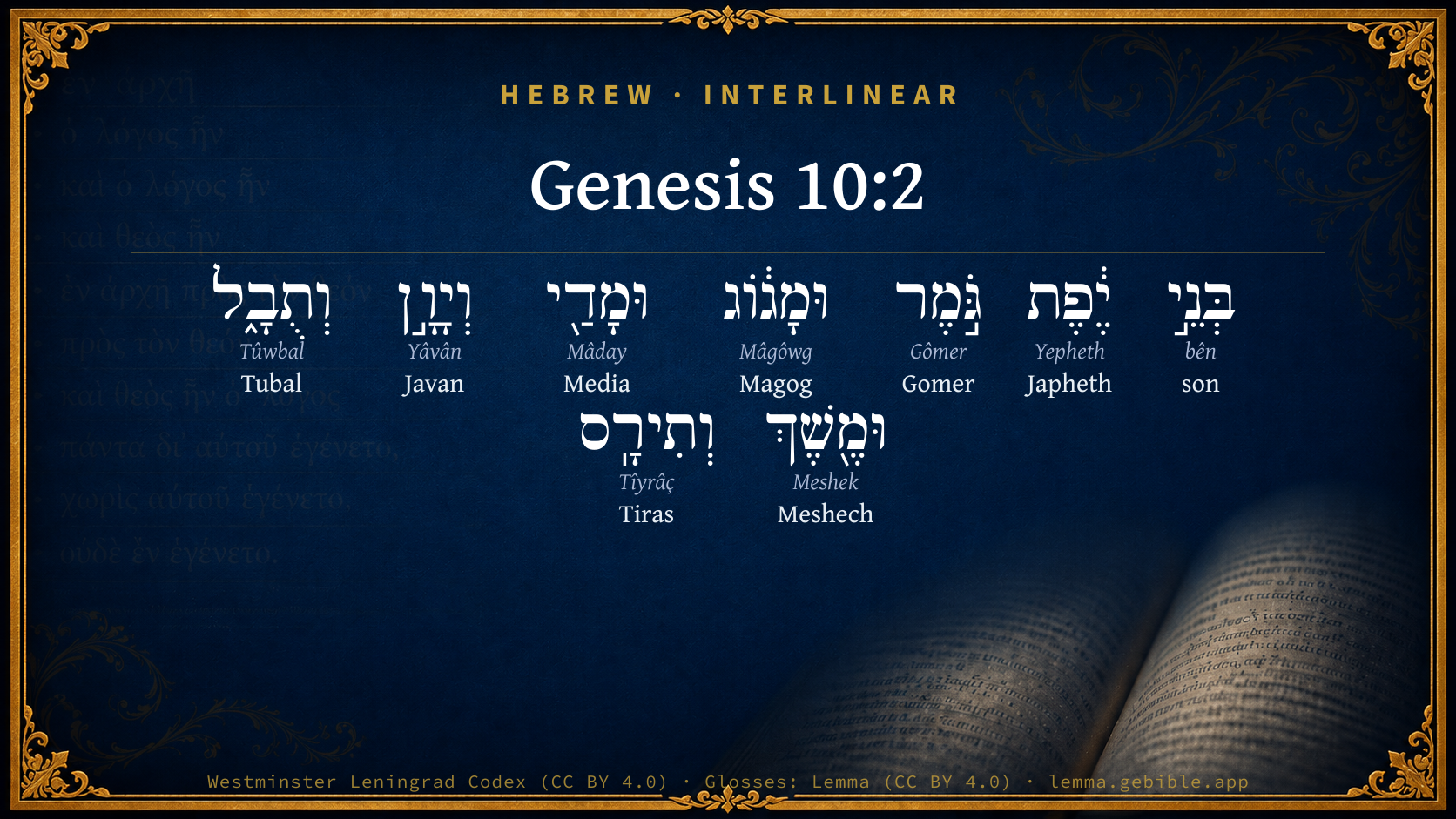
Genesis 10:2

Hebrew (Westminster Leningrad Codex) Genesis 10:2 appears in the Hebrew Old Testament. The text above is from the Westminster Leningrad Codex. Each word links to its Strong’s number, a concise gloss, and parsing drawn from the Open Scriptures Hebrew Bible morphology. Click any word for its full Brown-Driver-Briggs (BDB) entry.
Download image
Cite this verse

Genesis 10:2 (World English Bible). Public Domain. Lemma interlinear Bible study tool, https://lemma.gebible.app/v/genesis/10/2.

Show BibTeX & RIS
BibTeX
RIS
English Translation
The sons of Japheth: Gomer, Magog, Madai, Javan, Tubal, Meshech, and Tiras.
World English Bible · Public Domain
Highlights Full analysis ↓
Download a study sheet

One document with this verse’s original text, its word-by-word gloss line, the meaning frame, cross-references with their text, attributed commentary, and full source and license credits — printable, and it pastes into notes with its structure intact.

This verse Autodidact and up

Study sheet (.html) Plain text (.txt)

A passage Seminary Student

Up to 50 verses in one chapter. A passage sheet keeps up to 6 commentary sources and 12 cross-references per verse, in the order this page ranks them, and says so on the sheet whenever that leaves anything out. Ask for a single verse and you get the Autodidact verse sheet above.

Everything on this page stays free to read, with no account — the sheet is a download of what is already on screen, not access to it.

Want to remove ads? Support Godless Engineer
Compare translations 3

The same verse in 3 English versions, stacked beneath the original-language interlinear above. Click any original word for its lexicon entry.

Each is an independent rendering of the whole verse — the interlinear is not word-aligned to these translations.

Highlighted words mark where these versions differ — a whole-verse word diff, not a word-by-word alignment.

  • World English Bible Public Domain
    The sons of Japheth: Gomer, Magog, Madai, Javan, Tubal, Meshech, and Tiras.
  • King James Version Public Domain
    The sons of Japheth; Gomer, and Magog, and Madai, and Javan, and Tubal, and Meshech, and Tiras.
  • unfoldingWord Literal Text CC BY-SA 4.0
    The sons of Japheth Gomer and Magog and Madai and Javan and Tubal and Meshech and Tiras.

unfoldingWord Literal Text — © unfoldingWord, licensed CC BY-SA 4.0. Word-aligned USFM3 via Door43 (git.door43.org/unfoldingWord/en_ult).

Versions to compare (up to 4)

3 of 4 selected

Show all 18 translations

Every available English version of this verse, each an independent rendering of the whole verse.

  • World English Bible Public Domain
    The sons of Japheth: Gomer, Magog, Madai, Javan, Tubal, Meshech, and Tiras.
  • Berean Standard Bible Public Domain
    The sons of Japheth: Gomer, Magog, Madai, Javan, Tubal, Meshech, and Tiras.
  • Majority Standard Bible Public Domain
    The sons of Japheth: Gomer, Magog, Madai, Javan, Tubal, Meshech, and Tiras.
  • King James Version Public Domain
    The sons of Japheth; Gomer, and Magog, and Madai, and Javan, and Tubal, and Meshech, and Tiras.
  • American Standard Version (1901) Public Domain
    The sons of Japheth: Gomer, and Magog, and Madai, and Javan, and Tubal, and Meshech, and Tiras.
  • Revised Version (1885) Public Domain
    The sons of Japheth; Gomer, and Magog, and Madai, and Javan, and Tubal, and Meshech, and Tiras.
  • Geneva Bible (1599) Public Domain
    The sonnes of Iapheth were Gomer and Magog, and Madai, and Iauan, and Tubal, and Meshech, and Tiras.
  • Douay-Rheims (1899) Public Domain
    The sons of Japheth: Gomer, and Magog, and Madai, and Javan, and Thubal, and Mosoch, and Thiras.
  • Young's Literal Translation Public Domain
    `Sons of Japheth `are' Gomer, and Magog, and Madai, and Javan, and Tubal, and Meshech, and Tiras.
  • Literal Standard Version CC BY-SA 4.0
    Sons of Japheth [are] Gomer, and Magog, and Madai, and Javan, and Tubal, and Meshech, and Tiras.
  • Unlocked Literal Bible CC BY-SA 4.0
    The sons of Japheth were Gomer, Magog, Madai, Javan, Tubal, Meshech, and Tiras.
  • unfoldingWord Literal Text CC BY-SA 4.0
    The sons of Japheth Gomer and Magog and Madai and Javan and Tubal and Meshech and Tiras.
  • Darby Bible Public Domain
    The sons of Japheth: Gomer, and Magog, and Madai, and Javan, and Tubal, and Meshech, and Tiras.
  • World Messianic Bible Public Domain
    The sons of Japheth were: Gomer, Magog, Madai, Javan, Tubal, Meshech, and Tiras.
  • Webster's Bible Public Domain
    The sons of Japheth; Gomer, and Magog, and Madai, and Javan, and Tubal, and Meshech, and Tiras.
  • Free Bible Version CC BY-SA 4.0
    The sons of Japheth: Gomer, Magog, Madai, Javan, Tubal, Meshech, and Tiras.
  • Bible in Basic English Public Domain
    The sons of Japheth: Gomer and Magog and Madai and Javan and Tubal and Meshech and Tiras.
  • JPS Tanakh (1917) Public Domain
    The sons of Japheth: Gomer, and Magog, and Madai, and Javan, and Tubal, and Meshech, and Tiras.

Literal Standard Version (2020), Covenant Press — licensed CC BY-SA 4.0. Text via the HelloAO Bible API (eBible.org). Unlocked Literal Bible (unfoldingWord) — licensed CC BY-SA 4.0. Text via the HelloAO Bible API (eBible.org). unfoldingWord Literal Text — © unfoldingWord, licensed CC BY-SA 4.0. Word-aligned USFM3 via Door43 (git.door43.org/unfoldingWord/en_ult). Free Bible Version, Dr. Jonathan Gallagher — licensed CC BY-SA 4.0. Text via the HelloAO Bible API (eBible.org).

Word by word

More ways to search: Search by grammar → Find every occurrence → Compare this word →

Practice this passage: Drill this verse → Learn its vocabulary →

About this verse

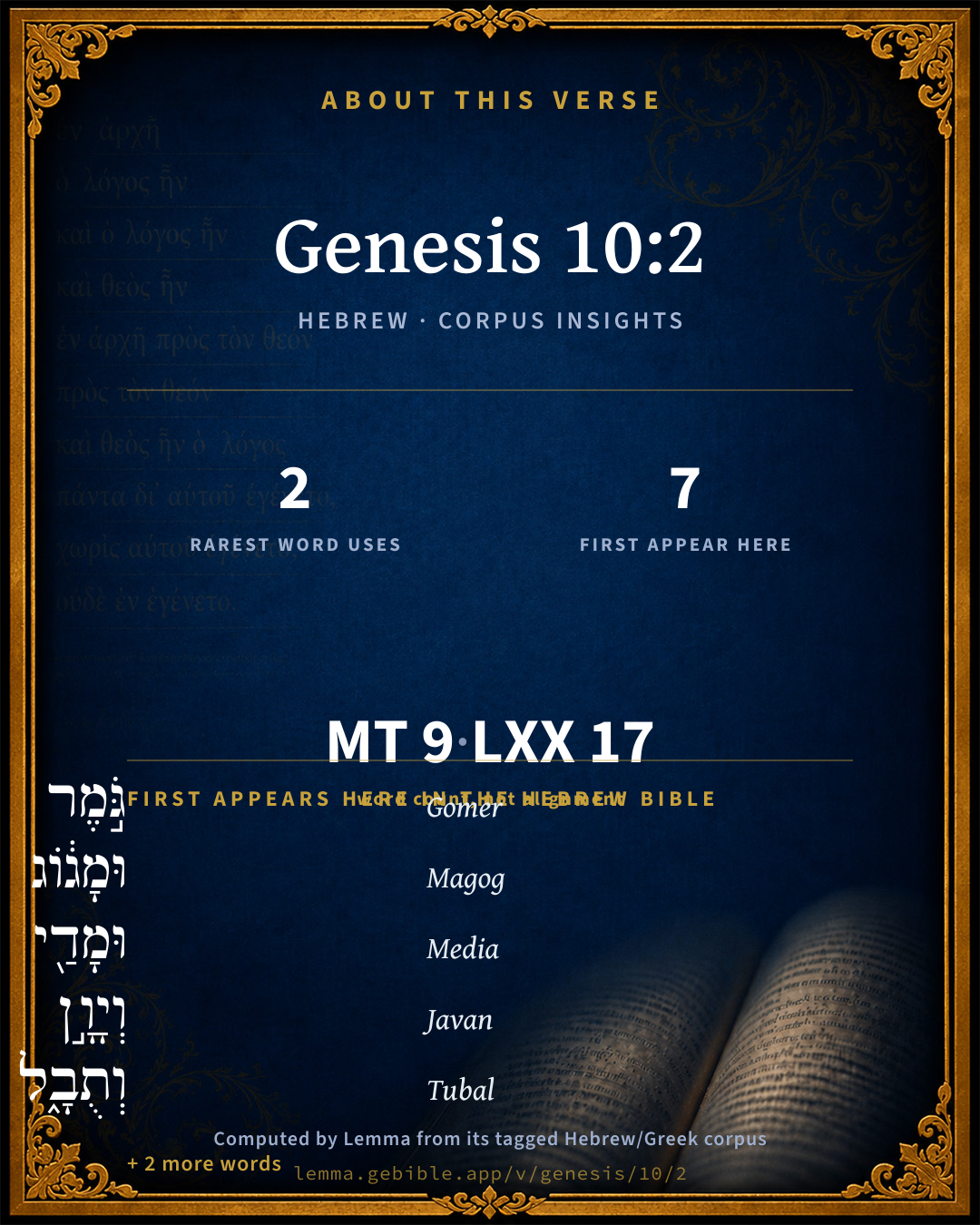
These counts appear in no published source. They are computed here, from the morphology-tagged text and Lemma’s own curated glosses. What Lemma adds →

9
words
9
distinct lemmas
Pentateuch
section

Notable vocabulary

The rarest word here is וְתִירָֽס Tiras H8494 — appearing just 2 times in the whole Hebrew Bible.

First appearance in Scripture

These words make their first canonical appearance in the Hebrew Bible here:

  • גֹּ֣מֶר Gomer H1586
  • וּמָג֔וֹג Magog H4031
  • וּמָדַ֖י Media H4074
  • וְיָוָ֣ן Javan H3120
  • וְתֻבָ֑ל Tubal H8422
  • וּמֶ֖שֶׁךְ Meshech H4902
  • וְתִירָֽס Tiras H8494

Shared distinctive vocabulary

וְתִירָֽס Tiras H8494 occurs in 2 verses of the Hebrew Bible. Also found in:

Grammatical profile

  • 9 nouns

Hebrew & Septuagint length

In English translation the verse runs 12 words from the Hebrew and 19 from the Septuagint (LXX English) — the Septuagint runs noticeably longer here. See the side-by-side →

A rough comparison of the two English renderings, which tokenize alike — not a word-level alignment.

Word counts can differ between the Hebrew and the Greek without any difference in meaning — e.g. the Hebrew direct-object marker אֵת has no separate Greek word, and Greek often adds the article ὁ.

In the original languages it is 9 Hebrew tokens and 17 Greek tokens — but the two are counted differently (Hebrew bundles its prefixes and suffixes into one token; the Greek is in lemma form), so that isn’t a like-for-like length.

Cross-references

11

Topical passages linked to Genesis 10:2 in the Treasury of Scripture Knowledge — connected by theme and wording, ordered by reader-vote popularity; previews shown in the World English Bible.

  • Ezekiel 38:2 Son of man, set your face toward Gog, of the land of Magog, the prince of Rosh, Meshech, and Tubal, and prophesy against him,
  • Ezekiel 38:6 Gomer, and all his hordes; the house of Togarmah in the uttermost parts of the north, and all his hordes; even many peoples with you.
  • 1 Chronicles 1:5–7 The sons of Japheth: Gomer, and Magog, and Madai, and Javan, and Tubal, and Meshech, and Tiras.
  • Isaiah 66:19 I will set a sign among them, and I will send such as escape of them to the nations, to Tarshish, Pul, and Lud, who draw the bow, to Tubal and Javan, to the isles afar off, who have not heard my fame, neither have seen my glory; and they shall declare my glory among the nations.
  • Revelation 20:8 and he will come out to deceive the nations which are in the four corners of the earth, Gog and Magog, to gather them together to the war; the number of whom is as the sand of the sea.
  • Ezekiel 39:1 You, son of man, prophesy against Gog, and say, Thus says the Lord Yahweh: Behold, I am against you, Gog, prince of Rosh, Meshech, and Tubal:
  • Ezekiel 27:7 Of fine linen with embroidered work from Egypt was your sail, that it might be to you for an ensign; blue and purple from the isles of Elishah was your awning.
  • Ezekiel 27:12–14 Tarshish was your merchant by reason of the multitude of all kinds of riches; with silver, iron, tin, and lead, they traded for your wares.
  • Ezekiel 27:19 Vedan and Javan traded with yarn for your wares: bright iron, cassia, and calamus, were among your merchandise.
  • Ezekiel 38:15 You shall come from your place out of the uttermost parts of the north, you, and many peoples with you, all of them riding on horses, a great company and a mighty army;
  • Genesis 10:21 To Shem, the father of all the children of Eber, the elder brother of Japheth, to him also were children born.

Cross-references courtesy of OpenBible.info (CC BY 4.0).

Hebrew and Greek witnesses Masoretic Hebrew ↔ Greek Septuagint

The same verse in the two great witnesses to the Old Testament, shown verse-for-verse.

Here the Septuagint runs noticeably longer than the Hebrew — LXX2012 (modern English Septuagint) 19 words vs World English Bible 12. A rough length comparison of the two English translations, not a word-level alignment — read both below.

These are two independent witnesses, not word-aligned to each other, and the Septuagint is shown in lemma (dictionary) form.

Hebrew Genesis 10:2 Masoretic · Westminster Leningrad Codex

בְּנֵ֣י יֶ֔פֶת גֹּ֣מֶר וּמָג֔וֹג וּמָדַ֖י וְיָוָ֣ן וְתֻבָ֑ל וּמֶ֖שֶׁךְ וְתִירָֽס

The sons of Japheth: Gomer, Magog, Madai, Javan, Tubal, Meshech, and Tiras.

World English Bible · Public Domain

Greek LXX Genesis 10:2 Septuagint · lemma form

υἱός ιαφεθ γαμερ καί μαγωγ καί μαδαι καί ιωυαν καί ελισα καί θοβελ καί μοσοχ καί θιρας

The sons of Japheth, Gamer, and Magog, and Madoi, and Jovan, and Elisa, and Thobel, and Mosoch, and Thiras.

LXX2012 (modern English Septuagint) · Public Domain

Hebrew: Westminster Leningrad Codex (CC BY 4.0). Greek: Septuagint (public domain); English from LXX2012 (modern English Septuagint) (Public Domain). How the Septuagint differs from the Hebrew →

Targum (Aramaic paraphrase)

2

The Targum is the ancient Jewish Aramaic paraphrase of the Hebrew Scriptures — an interpretive translation, not the Hebrew text itself. Onkelos (literal) and Pseudo-Jonathan (expansive) render the Torah, and Jonathan the Prophets. Coverage is partial: where no permissively-licensed English translation exists for a verse, only the Aramaic is shown. This is verse-level text, not a word-by-word alignment to the Hebrew.

  1. Targum Onkelos Torah (Genesis–Deuteronomy)
    בְּנֵי יֶפֶת גּוֹמֶר וּמָגוֹג וּמָדַי וְיָוָן וְתוּבָל וּמֶשֶׁךְ וְתִירָס

    The sons of Yepheth, Gomer, and Magog, and Madai, and Yavan, and Thuval, and Meshek, and Tiras.

    Targum Onkelos — Aramaic: “Onkelos Genesis” (public domain); “Onkelos Exodus” (public domain); “Onkelos Leviticus” (public domain); “Onkelos Numbers” (public domain); “Onkelos Deuteronomy” (public domain). English: “Sefaria Community Translation” (CC0 1.0 (public-domain dedication)); “J.W. Etheridge. The Targums of Onkelos and Jonathan Ben Uzziel on the Pentateuch. London: Longmans, Green, 1862” (public domain). Text via Sefaria.

  2. Targum Pseudo-Jonathan Torah (Genesis–Deuteronomy)
    בְּנוֹי דְיֶפֶת גוֹמֶר וּמָגוֹג וּמָדַי וְיָוָן וְתוּבָל וּמֶשֶׁךְ וְתִירָס וְשׁוּם אַפַּרְכְיוּתְהוֹן אַפְרִיקֵי וְגַרְמַנְיָא וְתַמְדִיֵי וּמַקֵדוֹנִיָא וְיַתִינְיָא וְאוּסְיָא וְתַרְקֵי

    The sons of Japheth, Gomer, and Magog, and Madai, and Javan, and Thubal, and Meshek, and Thiras. And the names of their provinces, Afriki, and Germania, and Medi, and Makadonia, and Iatinia, and Asia, and Tharki.

    Targum Pseudo-Jonathan — Aramaic: “Targum Jonathan on Genesis” (public domain); “Targum Jonathan on Exodus” (public domain); “Targum Jonathan on Leviticus” (public domain); “Targum Jonathan on Numbers” (public domain); “Targum Jonathan on Deuteronomy” (public domain). English: “The Targum of Jonathan ben Uzziel, trans. J. W. Etheridge, London, 1862” (public domain). Text via Sefaria.

Commentary

Notes on Genesis 10:2 from classic Christian and Jewish commentators (each source and its license shown beneath its notes). The classic Christian expositions comment on the surrounding passage and are grouped to its opening verse, so a note may address several verses; the Jewish commentaries on the Tanakh (Rashi and others) are per-verse, so they appear only where the commentator wrote on this verse.

Lemma curates 59 commentaries, every one of them public domain or Creative Commons licensed, each selected and text-cleaned for this edition rather than reprinted as found. About our sources →

Trapp's Complete Commentary

John Trapp

Gen 10:2 The sons of Japheth; Gomer, and Magog, and Madai, and Javan, and Tubal, and Meshech, and Tiras.

Ver. 2. The sons of Japheth.] Not all, but the chief men of renown, Ethnarchs: think the same of the other two sons of Noah: seventy-one of their posterity are here registered (fourteen of Japheth, thirty-one of Ham, and twenty-six of Shem); hence it went for current among the ancients (grounding upon Gen 10:31-32 of this chapter) that the nations were afterwards distinguished by so many tongues and countries.

John Trapp, A Commentary or Exposition upon All the Books of the Old and New Testament (1647–1656) — public domain. Text from a community e-Sword module.

Joseph Benson's Commentary

Gen 10:2. Moses begins with Japheth’s family, either because he was the eldest, or because it lay most remote from Israel, and had least concern with them at the time when he wrote; and therefore he mentions that race very briefly; hastening to give account of the posterity of Ham, who were Israel’s enemies, and of Shem, who were Israel’s ancestors: for it is the church of which the Scripture is designed to be the history: and of the nations of the world, only as they were some way or other interested in the affairs of Israel.

Joseph Benson's Commentary on the Old and New Testaments (1811–1818) — public domain. Text from a community e-Sword module.

Tyndale Open Study Notes

Tyndale Open Resources

10:2-32 This section describes the ancestral origin of the nations of the ancient Near East. Ham was at the center (10:6-20), while the descendants of Japheth and Shem spread out to the surrounding regions of Greece, Crete, Asia Minor, Mesopotamia, Madai, the Arabian peninsula, and northeast Africa. The list selectively highlights nations relevant to Israel. The total of seventy (seven times ten) names indicates completeness (see 46:27; Deut 32:8) and symbolizes the totality of the world, which would later be blessed by the descendants of Abraham (Gen 18:18). • Although Shem is mentioned first in 10:1, he is addressed last in the Table because of his connection to Abram (10:21-31; 11:10-32; 12:1). Although God established the boundaries of all nations (see Deut 32:8; Amos 9:7; Acts 17:26), Israel was his special creation—a microcosm of seventy people (Gen 46:27) called to be a blessing to a world of seventy nations (see 12:3).

10:2 The seven sons of Japheth settled in the region of Anatolia (the western plateau lands of Turkey) and spoke Indo-European languages. • Gomer was the ancestor of the later Cimmerians who lived north of the Black Sea. • Magog was probably the ancestor of those who settled in the region of Lydia (see Ezek 38:2). • The descendants of Madai were the later Medes of northwest Iran (see 2 Kgs 17:6; Jer 51:11; Dan 5:28). • The descendants of Javan were the later Ionian Greeks. • The descendants of Tubal and Meshech were sometimes allies in battle (Ezek 38:2). Both were possibly from the coastal regions of Anatolia (see Ezek 27:13). • The descendants of Tiras possibly became the Thracians that lived near the Aegean Sea.

Tyndale Open Study Notes — © Tyndale Open Resources, licensed CC BY-SA 4.0. Text via the HelloAO Bible API.

Geneva Bible (1599)

Geneva Bible translators

Of Madai and Javan came the Medes, and Greeks.

Geneva Bible (1599) marginal notes — public domain. Text via Bolls.life.

Adam Clarke's Commentary

Verse 2. The sons of Japheth] Japheth is supposed to be the same with the Japetus of the Greeks, from whom, in an extremely remote antiquity, that people were supposed to have derived their origin.

Gomer] Supposed by some to have peopled Galatia; so Josephus, who says that the Galatians were anciently named Gomerites. From him the Cimmerians or Cimbrians are supposed to have derived their origin. Bochart has no doubt that the Phrygians sprang from this person, and some of our principal commentators are of the same opinion.

Magog] Supposed by many to be the father of the Scythians and Tartars, or Tatars, as the word should be written; and in great Tartary many names are still found which bear such a striking resemblance to the Gog and Magog of the Scriptures, as to leave little doubt of their identity.

Madai] Generally supposed to be the progenitor of the Medes; but Joseph Mede makes it probable that he was rather the founder of a people in Macedonia called Maedi, and that Macedonia was formerly called Emathia, a name formed from Ei, an island, and Madai, because he and his descendants inhabited the maritime coast on the borders of the Ionian Sea. On this subject nothing certain can be advanced.

Javan] It is almost universally agreed that from him sprang the Ionians, of Asia Minor; but this name seems to have been anciently given to the Macedonians, Achaians, and Baeotians.

Tubal] Some think be was the father of the Iberians, and that a part at least of Spain was peopled by him and his descendants; and that Meshech, who is generally in Scripture joined with him, was the founder of the Cappadocians, from whom proceeded the Muscovites.

Tiras.] From this person, according to general consent, the Thracians derived their origin.

Adam Clarke's Commentary on the Bible (1810–1826) — public domain. Text from a community e-Sword/MySword module.

Ellicott's Commentary for English Readers

(2) The sons of Japheth.—Of these, seven main divisions are enumerated, some of which are subsequently sub-divided; they are—

1. Gomer, whose name reappears in the Cimmerians. Their original settlement was between Magog and Madai, that is, between the Scythians and the Medes. After remaining some time on the Caspian and Black Seas, on which latter they have left their name in the Crimea, a powerful branch of them struck across the centre of Russia, and, skirting the Baltic, became the Cimbri of Denmark (whence the name of the Chersonesus Cimbrica, given to Jutland), the Cymry of Wales, &c. Generally they are the race to which the | name is given of Celts.

2. Magog. The Scythians, who once possessed the country north and south of the Caucasus. The Russians are their modern representatives, being descended from the Sarmatians, a Scythic race, with a small admixture of Median blood.

3. Madai. The Medes, who dwelt to the south and south-west of the Caspian. Mada, in the Accadian language, means land, and it was in the Median territory that Kharsak-Kurra, “the mountain of the East,” was situated, on which the Accadians believed the ark to have rested, whence possibly Media took its name, being “the land” above all others (Chald. Gen., p. 196).

4. Javan, that is, Ionia, the land of the Greeks.

5. Tubal. The Tibareni, on the south-east of the Black Sea.

6. Meshech. The Moschi, a people of Colchis and Armenia.

7. Tiras. According to Josephus and the Targum, the Thracians. Other races have been suggested, but this is probably right; and as the Getae, the ancestors of the Goths, were Thracians, this would make the Scandinavian race the modern representatives of Tiras.

In this enumeration the race of Japheth is described as occupying Asia Minor, Armenia, the countries to the west as far as the Caspian Sea, and thence northward to the shores of the Black Sea. Subsequently it spread along the northern shores of the Mediterranean and. over all Europe. But though unnoticed by the writer its extension was equally remarkable towards the east. Parthia, Bactria, the Punjab, India, are equally Japhethite with Germany, Greece, and Rome; and in Sanscrit literature the Aryan first showed that genius, which, omitting the greatest of all books, the Semitic Bible, has made this race the foremost writers in the world.

A Bible Commentary for English Readers, edited by Charles John Ellicott (1878–1897) — public domain. Text from a community e-Sword module.

The Cambridge Bible for Schools and Colleges

gen. ed. J. J. S. Perowne

2. The sons of Japheth] These are names of peoples who for the most part seem to have dwelt in remote northern and western regions in Asia Minor.

Gomer] Mentioned also in Eze_38:6. Probably the people dwelling in the region of Pontus in Asia Minor, and called by the Greeks Cimmerians (Κιμμέριοι). Cf. 1Ch_1:5-6.

Magog] appears as the name of a country in Eze_38:2, and of a northern people in Eze_39:6, generally identified with the Scythians. Sayce conjectures that Magog is for “Mat-Gog” = “land of Gog.” The allusions to Gog and Magog in Rev_20:8 are based upon the prophetic passages in Ezekiel 38, 39.

Madai] Almost certainly “the land of the Medes.” The people of Media are referred to in the Assyrian inscriptions as “Madai” in the 9th century b.c. In the history of Israel they are first mentioned in 2Ki_17:6. Cf. Isa_13:17; Isa_21:2; 1Ch_1:5.

Javan] This is the Hebrew name for “the Greeks.” The Ionians were the Greeks of Asia Minor and of the islands of the Ægean Sea, who were first known to the peoples of Western Asia. They were called in Assyrian Javanu. For other passages in which the Greeks are mentioned in the O.T., cf. Isa_66:19; Eze_27:13; Eze_27:19; Dan_8:21; Dan_10:20; Joe_3:6; Zec_9:13.

Tubal … Meshech] These two names are mentioned, along with Javan, in Eze_27:13; Eze_39:1. They have been identified with peoples in N.E. Asia Minor, Tibarenians and Moschians.

In Isa_66:19 Tubal is classed with Javan and “the isles afar off.” In Psa_120:5, “Meshech” is used as the name of a barbarous and remote people, “Woe is me that I sojourn in Meshech.”

Tiras] Identified by Josephus (Ant. i. 6) with the Thracians, but now more frequently with a race of sea pirates of the Ægean Sea called Τυρσηνοί. Another conjecture is Tarsus; another, Tarshish; cf. 1Ch_1:6.

The Cambridge Bible for Schools and Colleges (gen. ed. J. J. S. Perowne; Cambridge University Press, 1878–1918) — public domain. Text from a community e-Sword module.

John Gill's Exposition

The sons of Japheth,.... Who though mentioned last, the genealogy begins with him, by a figure which rhetoricians call a "chiasm". The posterity of Japheth are those whom Hesiod (z) often calls "Iapetionides", and him "Iapetus". According to Josephus (a), the sons of Japheth inhabited the earth, beginning from the mountains Taurus and Amanus, and then went on in Asia unto the river Tanais, and in Europe unto Gadira. Seven of his sons are mentioned, and the first is Gomer; from whom, according to the same writer (b), came the Gomareans or Gomerites, in his time called by the Greeks Galatians, that is, the Gauls of Asia minor, who inhabited Phrygia; both Gomer and Phrygia signifying the same, as Bochart (c) observes, and the country looking as if it was torrified or burnt; and Pliny (d) makes mention of a town in Phrygia, called Cimmeris; and the Cimmerians and Cimbri are derived by some from this Gomer, whom Herodotus (e) makes mention of as in Asia and Scythia, and speaks of a country called Cimmerius, and of the Cimmerian Bosphorus; and these seem to be the Gauls before mentioned, under a different name; and it is to be observed, that the Welsh, who sprung from the Gauls, call themselves to this day Cumero, or Cymro and Cumeri. It is plain from Eze 38:6 that Gomer and his people lay to the north of Judea, and the posterity of Japheth went first into the northern parts of Asia, and then spread themselves into Europe: six more of his sons follow, and Magog, and Madai, and Javan, and Tubal, and Meshech, and Tiras; the first of these, Magog, was the father of a northern people which bore his name, see Eze 38:2 and according to Josephus (f), who is generally followed, are the same that were called Scythians; from Madai came the Medes, often spoken of in Scripture, along with the Persians; so Josephus (g) says, from him came the nation of Madaeans, whom the Greeks call Medes; and very frequently in Scripture the Medes go by the name of Madai, their original ancestor; see Dan 5:28 but Mr. Mede (h) is of opinion, that Macedonia was the seat of this Madai, which was formerly called Aemathia; that is, as he gives the etymology of it, "Madai", the country of Madai; but the former sense is generally received. Javan is by all agreed to be the father of the Grecians; hence Alexander, king of Grecia, is in Dan 8:21 called king of Javan; and one part of Greece bore the name of Ionia; and the sea that washed it is called the Ionian sea. And his posterity are "Iaonians", in Homer (i) and Aristophanes (k); and the scholiast of the latter says, that the Barbarians call all Greeks Iaonians. The next son of Japheth is Tubal or Thobel, as Josephus calls him, who says (l) the Thobelians in his time were called Iberians, a people in Asia, that dwelt near the Euxine sea; and in Albania was a place called Thabilaca, as may be seen in Ptolemy (m), and another called Thilbis, from whom might spring the Iberians in Europe, now called Spaniards; but Bochart (n) thinks that the Tibarenes are the descendants of Tubal, a people that dwelt between the Trapezuntii and Armenia the less; and he wonders that this never was thought of by any; but in that he is mistaken, for our countryman Mr. Broughton (o) makes the Tibarenes to spring from Tubal; and Epiphanius (p) many hundreds of years before him. Meshech, his next son, is mentioned along with Tubal in Eze 27:13 from him came the Mosocheni, as Josephus (q), who in his time were called Cappadocians, with whom there was a city then named Mazaca, since Caesarea (r); and these seem to be the same that Pliny (s) calls Moscheni, who inhabited the mountains Moschici, which were at the north east of Cappadocia. Some derive the Muscovites from them, which is not improbable: the last of Japheth's sons is Tiras or Thiras, which Jarchi interprets very wrongly by Paras, or Persia; much better the Targums of Jonathan and Jerusalem, and so a Jewish chronologer (t), by Thracia; for the descendants of Thiras, as Josephus (u) observes, the Greeks call Thracians; and in Thrace was a river called Atyras (w), which has in it a trace of this man's name; and Odrysus, whom the Thracians worshipped, is the same with Tiras, which god sometimes goes by the name of Thuras; and is one of the names of Mars, the god of the Thracians.

(z) In Theogonia. (a) Antiqu. l. 1. c. 6. sect. 1. (b) Ib. (c) Phaleg. l. 3. c. 8. col. 171, 172. (d) Nat. Hist. l. 5. c. 30. (e) Clio sive, l. 1. c. 16, 103. & Melpomene sive, l. 4. c. 11, 12, 13. (f) Ut supra. (Antiqu. l. 1. c. 6. sect. 1.) (g) Ib. (h) Dissert. 48. (i) Iliad. 13. ver. 685. (k) Acharneus. act. 1. scen. 3. p. 376. (l) Antiqu. l. 1. c. 6. sect. 1. (m) Geograph. l. 5. c. 12. (n) Phaleg. l. 3. c. 12. col. 180. (o) See his Works, p. 2, 58. (p) Ancorat. p. 546. (q) Ut supra. (Antiqu. l. 1. c. 6. sect. 1.) (r) Vid. Ammian. Marcellin. l. 20. p. 170. Ed. Vales. (s) Nat. Hist. l. 6. c. 9, 10. (t) Sepher Juchasin, fol. 145. 1. Vid. T. Bab. Yoma, fol. 10. 1. (u) Ut supra. (Antiqu. l. 1. c. 6. sect. 1.) (w) Plin. Nat. Hist. l. 4. c. 11.

John Gill's Exposition of the Whole Bible (1746–1763) — public domain (CC PDM 1.0). Text via the HelloAO Bible API.

Haydock's Catholic Bible Commentary

Japheth. From his being placed first, some conclude that he was the eldest; and perhaps the famed Japetus of the Greeks is the same person. (Du Hamel) --- Sem comes last, though elder than Cham, that the history of the true Church may be more connected. Though it would be a work of great labour to discover what nations sprung from the people here mentioned, yet some are sufficiently obvious; and the learned Bochart has given very plausible applications of the different names to the respective nations, in his Phaleg. or sacred Geography. Gomer is supposed to be the father of the Cimbri in Germany, from whom the French and English also probably sprung. (Haydock) --- Magog, father of the Scythians, &c. (Ezechiel. xxvi.) Madai of the Medes, Javan of the Ionians in Greece, Thubal of the Iberians and Spaniards, Mosoch of the Muscovites, Thiras of the Thracians.

George Leo Haydock (1774–1849), Haydock's Catholic Family Bible and Commentary, 1859 edition — public domain. Excludes Psalms (Douay-Rheims chapter numbering differs from Protestant) and Deuterocanonical books (Catholic canon only).

Matthew Poole's English Annotations

Japheth’s portion was at first Asia the Less, and afterwards by degrees all Europe, and the northern parts of Asia. This is he so much celebrated among the Greeks by the name of Japetus.

Gomer’s posterity are reckoned among the northern people, Eze 38:6, and were seated in the northern parts of the Lesser Asia, and afterwards about Thracia; and from him were called Gomari, and by an easy change Cimbri, or Cimmerii.

Magog was the father of the Scythians, as may be gathered from Eze 38:2-3,15; 39:3, 6.

The posterity of

Madai, wheresoever they were first placed, in Macedonia or elsewhere, afterward were fixed in Media, and were called Medes, and in the Hebrew by the name of their father Madai, as appears from 2Ki 17:6; Isa 13:17; Jer 25:25; 51:11; Dan 5:28; 6:8.

From

Javan came the Grecians, who are called by themselves Iaones, or Iones, and in the Hebrew Jevanim, and their country Greece, Javan. See Isa 66:19; Eze 27:13, 19; Dan 8:21; 10:20.

Of

Tubal came the Iberi, anciently called Thobeli, a people of Asia, near the Euxine Sea. See Eze 27:3; 32:26; 38:2-3.

Meshech was father of the Moschi, i.e. the Muscovites, or rather, as others think, the Cappadocians, who were anciently called Meschini, and Moschi, and their chief city Maraca.

And

Tiras was father of the Thracians; amongst whom is a river and haven called Athyras, and who worshipped their god Mars under the name of Thuras.

Matthew Poole's English Annotations on the Holy Bible (1683–1685) — public domain. Text from a community e-Sword/MySword module.

Whedon's Commentary on the Bible

Daniel D. Whedon

2. Gomer — The word occurs elsewhere in the Scriptures only in Eze_38:6, where it is, as here, associated with Togarmah. The name is undoubtedly preserved in the Homeric name Κιμμεριοι, the Gimiri in the cuneiform inscriptions of Darius Hystaspes, Cimmerians, Kymri or Kymbri, the original Kelts, (Celts,) and Gauls, who were found in possession of all northern and western Europe at the dawn of western civilization. This race settled first on the north of the Black Sea, where they have left traces of their name, as Crimea, Crim-Tartary; driven thence by the Scythians before the time of Herodotus, (Her., 4, 11,) they moved west and south-west to the sea. Traces of the original Celtic language are still preserved in Ireland, the Isle of Man, Wales, and the Scotch Highlands.

The Galatians of Asia Minor, the Celtic people to whom Paul wrote his famous epistle, were called Gomerites by Josephus. The Celts call themselves Kymr, and by orthoepic changes between the liquids L, M, R, as well as the palatals K and G, changes such as are constantly taking place in spoken languages, the names Gomer, Kymr, Gaul, Kelt, Galatae, Kimmeri, Crimea, Cambria, Cumberland, all come from the same root. Linguistic affinities show that these people, the earliest inhabitants of Europe of whom we definitely know, were Asiatic in origin, for the Keltic is an Indo-European language.

Magog — The name probably means “the place,” (or region,) of Gog, and appears in Eze_38:2; Eze_39:6, as the name of a people dwelling “in the sides of the north,” over whom Gog is king, identified by Josephus, Jerome, and most moderns with the Scythians, who in the time of Herodotus had their home north of the range of Caucasus, in what is now Russia. Furst interprets Magog as Great Mount, that is, Caucasus. The region between the Black and Caspian Seas was called Magog by the Arabians. They came into Europe after the Kelts, a fierce, formidable, nomadic race, who poured down upon Asia Minor and Egypt in the seventh century B.C. (Herod., 4.)

Madai — This word is nowhere else in the Bible rendered as the name of a person, but, whenever it occurs, it is translated Media, or the Medes, (see 2Ki_17:6; Est_1:3; Est_1:18-19,) a powerful nation who once dwelt south and south-west of the Caspian, east of Armenia and Assyria. The Medes are here represented in close affinity with the Kelts (Gomer) and the Greeks, (Javan,) confirming Schlegel’s theory, now deemed established by linguistic researches, that the principal European and East Indian nations are of the same Aryan stock, having in a prehistoric period migrated westward and eastward from the high land of Ivan. This theory is embodied in the word Indo-European.

Javan — יון, Yavan, translated Greece in Zec_9:13; Dan_8:21, etc.; and its plural is rendered Grecians in Joel 4:6. Ionia, the name of a western province of Asia Minor, colonized at an early period by the Greeks, and applied by the Orientals to the Greeks in general. The Rosetta Stone shows that the Egyptians called the Greeks by the same name. The word occurs with the same meaning in Sanskrit and old Persian, showing that the name existed before the rise of the Aryan, Hamitic, and Shemitic families of speech. (Knobel.) The famous Greco-Italian races, which did not arise till many centuries after the composition of this narrative, inhabiting Macedonia, Thessaly, the Greek and Italian peninsulas, and west Asia Minor, are foreshadowed in this name.

Tubal, and Meschech — These peoples are constantly associated together by Ezekiel, (Eze_27:13; Eze_32:26; Eze_38:1-2, etc.,) and by Herodotus, (Herod., 3:94, 7:78.) They are likewise, according to Rawlinson, associated in the Assyrian inscriptions. Josephus identifies Tubal with the Iberians, who once dwelt between the Caspian and Euxine Seas. Knobel considers the Tibareni to have been only a branch of the widespread Iberians, some of whom settled in the east, some in the west. The Moschi were the ancestors of the Muscovites, builders of Moskwa, or Moscow, and still give Russia its name throughout the East. Ezekiel says that they came down from the “sides of the north,” and traded in copper and slaves in the markets of Tyre. Eze_27:13.

Tiras — Thracians, who dwelt between Mt. Haemus and the AEgean, on the south-west shore of the Black Sea. They are associated with Meshech (Meshnash) on the old Egyptian monuments. (Rawlinson.)

Daniel D. Whedon (gen. ed.), Commentary on the Old and New Testaments (1874–1909) — public domain. Text from a community e-Sword module.

The Pulpit Commentary

The sons of Japheth are first mentioned not because Japheth was the eldest of the three brothers, although that was true, but because of the greater distance of the Japhetic tribes from the theocratic center, the Hamites having always been much more nearly situated to and closely connected with the Shemites than they. The immediate descendants of Japheth, whose name, jIapetov, occurs again in the mythology of a Japhetic race, were fourteen m number, seven sons and seven grandsons, each of which became the progenitor of one of the primitive nations. Gomer. A people inhabiting "the sides of the north"; (Eze_38:6) the Galatae of the Greeks (Josephus, "Ant.," 1:6); the Chomarii, a nation in Bactriana on the Oxus (Shulthess, Kalisch); but more generally the Cimmerians of Homer ("Odyss.," 11:13-19), whose abodes were the shores of the Caspian and Euxine, whence they seem to have spread themselves over Europe as far west as the Atlantic, leaving traces of their presence in the Cimhri of North Germany and the Cymri in Wales (Keil, Lange, Murphy, Wordsworth, "Speaker"s Commentary). And Magog. A fierce and warlike people presided over by Gog (an appellative name, like the titles Pharaoh and Caesar, and corresponding with the Turkish Chak, the Tartarian Kak, and the Mongolian Gog: Kalisch), whose complete destruction was predicted by Ezekiel; (Ge 38 Ge 39) generally understood to be the Scythians, whose territory lay upon the borders of the sea of Asoph, and in the Caucasus. In the Apocalypse (Gen_20:8-10) Cog and Magog appear as two distinct nations combined against the Church of God. And Madai. The inhabitants of Media (Mada in the cuneiform inscriptions), so called because believed to be situated peri meshn than (Polyb. 5:44) on the south-west shore of the Caspian And Javan. Identical with jIawn (Greek), Javana (Sanscrit), Juna (Old Persian), Jounan (Rosetta Stone); allowed to be the father of the Greeks, who in Scripture are styled Javan (vide Isa_66:19; Eze_27:13 Dan_8:21 Dan_10:20; Joe_3:6) And Tubal, and Meshech. Generally associated in Scripture as tributaries of Magog; (Eze_38:2, 3 39:1) recognized as the Iberians and Moschi in the north of Armenia, between the sources of the Tigris and Euphrates, and the Black Sea (Josephus, Knobel, Lange, Kalisch). And Tiras. The ancestor of the Thraciaus (Josephus), of the Tyrrheni, a branch of the Pelasgians (Tuch), of the Asiatic tribes round the Taurus (Kalisch), in support of which last is a circumstance mentioned by Rawlinson, that on the old Egyptian monuments Mashuash and Tuirash, and upon the Assyrian Tubal and Misek, stand together as here. Tiras occurs nowhere else in Scripture.

The Pulpit Commentary (1880–1919), ed. H.D.M. Spence-Jones & Joseph S. Exell — public domain. Text from a community e-Sword module.

John Wesley's Explanatory Notes

Moses begins with Japhet's family, either because he was the eldest, or because that lay remotest from Israel, and had least concern with them, at that time when Moses wrote; and therefore he mentions that race very briefly; hastening to give account of the posterity of Ham, who were Israel's enemies, and of Shem, who were Israel's ancestors: for it is the church that the scripture designed to be the history of, and of the nations of the world only as they were some way or other interested in the affairs of Israel.

John Wesley, Explanatory Notes Upon the Whole Bible (1754–1765) — public domain. Text via the GEBible commentary corpus.

Scofield Reference Notes

C. I. Scofield

1 Gomer 2 Magog 3 Madai 4 Javan 5 Tubal 6 Meshech 7 Tiras

1 Progenitor of the ancient Cimerians and Cimbri, from whom are descended the Celtic family.

2 From Magog are descended the ancient Scythians, or Tartars, whose descendants predominate in the modern Russia. Eze 38:2; Eze 39:6; Rev 20:8.

3 Progenitor of the ancient Medes.

4 Progenitor of those who peopled Greece, Syria, etc.

5 Tubal’s descendants peopled the region south of the black Sea, from whence they spread north and south. It is probable that Tobolsk perpetuates the tribal name. A branch of this race peopled Spain.

6 Progenitor of a race mentioned in connection with Tubal, Magog, and other northern nations. Broadly speaking, Russia, excluding the conquests of Peter the Great and his successors, is the modern land of Magog, Tubal, and Meshech.

7 Progenitor of the Thracians.

From these seven sons of Japheth are descended the goyim, or Gentile, nations, trans. "heathen" 148 times in the A.V. The name implies nothing concerning religion, meaning simply, non-Israelite, or "foreigner."

The Scofield Reference Bible (1917 edition), notes by C. I. Scofield — public domain. Text from a community e-Sword module.

unfoldingWord translationNotes

Door43 World Missions Community

From these the coastland peoples separated and went into their lands

"Javan's sons and descendants separated and moved to the coastlands and islands"

coastland peoples

This refers to people who lived along the coast and on the islands.

their lands

"their homelands." These are the places that the people moved to and lived in.

every one with its own language

"Each people group spoke its own language" or "The people groups divided themselves according to their languages"

translationWords

Tubal

Meshech

Tarshish

clan

nation

unfoldingWord translationNotes — © Distant Shores Media and the Door43 World Missions Community, licensed CC BY-SA 4.0. Source: git.door43.org/Door43/en_tn.

Rashi

Rabbi Shlomo Yitzchaki (Rashi)

ותירס AND TIRAS — This is Persia (Yoma 10a).

Rashi on the Tanakh — English translations: “The Judaica Press complete Tanach with Rashi, translated by A. J. Rosenberg” (CC BY 4.0); “Pentateuch with Rashi's commentary by M. Rosenbaum and A.M. Silbermann, 1929-1934” (public domain); “The Metsudah Tanach series, Lakewood, N.J” (CC BY 4.0); and “The Book of Joshua, Metsudah Publications, 1997” (CC BY 4.0). Text via Sefaria.

Ramban (Nachmanides)

Rabbi Moshe ben Nachman (Ramban / Nachmanides)

THE SONS OF JAPHETH: GOMER. Scripture begins with Japheth for he was the oldest. After him, it mentions Ham [even though he was the youngest] for Scripture wanted to delay the account of the generations of Shem in order to place side by side the two sections dealing with Shem’s children since it is important to dwell at length on the generations of Abraham.

Ramban (Nachmanides) on the Tanakh — English translation: “Commentary on the Torah by Ramban (Nachmanides). Translated and annotated by Charles B. Chavel. New York, Shilo Pub. House, 1971-1976” (CC BY 4.0). Text via Sefaria.

Radak

Rabbi David Kimhi (Radak)

בני יפת גמר, according to Rabbeinu Saadyah gaon, he was the founder of the nation known as Altrach.

משך, on the other hand, according to Josephus he was the founder of the nation known as Tushchana, a people professing the Christian faith nowadays, and leaders of that faith. Rome itself is within the boundaries of that nation.

ותירס, according to our sages (Yuma 10) this is Persia.

Radak on the Tanakh — English translations: “Sefaria Community Translation” (CC0 1.0 (public-domain dedication)); “Eliyahu Munk, HaChut Hameshulash” (CC BY 4.0); “Rabbi Mike Feuer, Jerusalem Anthology” (CC BY 4.0); and “R. David Kimhi on the first book of Psalms, Translated by R.G. Finch, London, 1919” (public domain). Text via Sefaria.

Lesson kit

Teaching starters — assembled from the data on this page, not authored interpretation. Every prompt links to the verse data it draws on. Edit before teaching.

Genesis, in the Pentateuch, opens this verse with 9 words (9 distinct Hebrew lemmas). Its most distinctive word is Tîyrâç (“Tiras”). The Greek Septuagint runs longer here. A historical commentator’s framing appears above. Read the whole chapter for the surrounding context.

Discussion questions

  1. How does “Tiras” (Tîyrâç) shape what this verse is saying?
  2. 7 words make their first appearance in Scripture here. What does this debut establish?
  3. How does 1 Chronicles 1:5, which shares the word «Tiras», read alongside this verse?
  4. The Septuagint runs longer here than the Hebrew. What might account for the difference?
  5. Compare how Trapp's Complete Commentary and Joseph Benson's Commentary read this verse. Where do they agree or differ?

Things to notice

Reading settings

Reading text

Shown beneath each verse's original-language words.

Old Testament
Old Testament edition

Read the OT as the Masoretic Hebrew (MT) or the Greek Septuagint (LXX).

English shown for the Greek Septuagint (in the Hebrew ↔ Greek comparison).

Comparing translations? Open the Compare panel on any verse page to stack up to four side by side.