
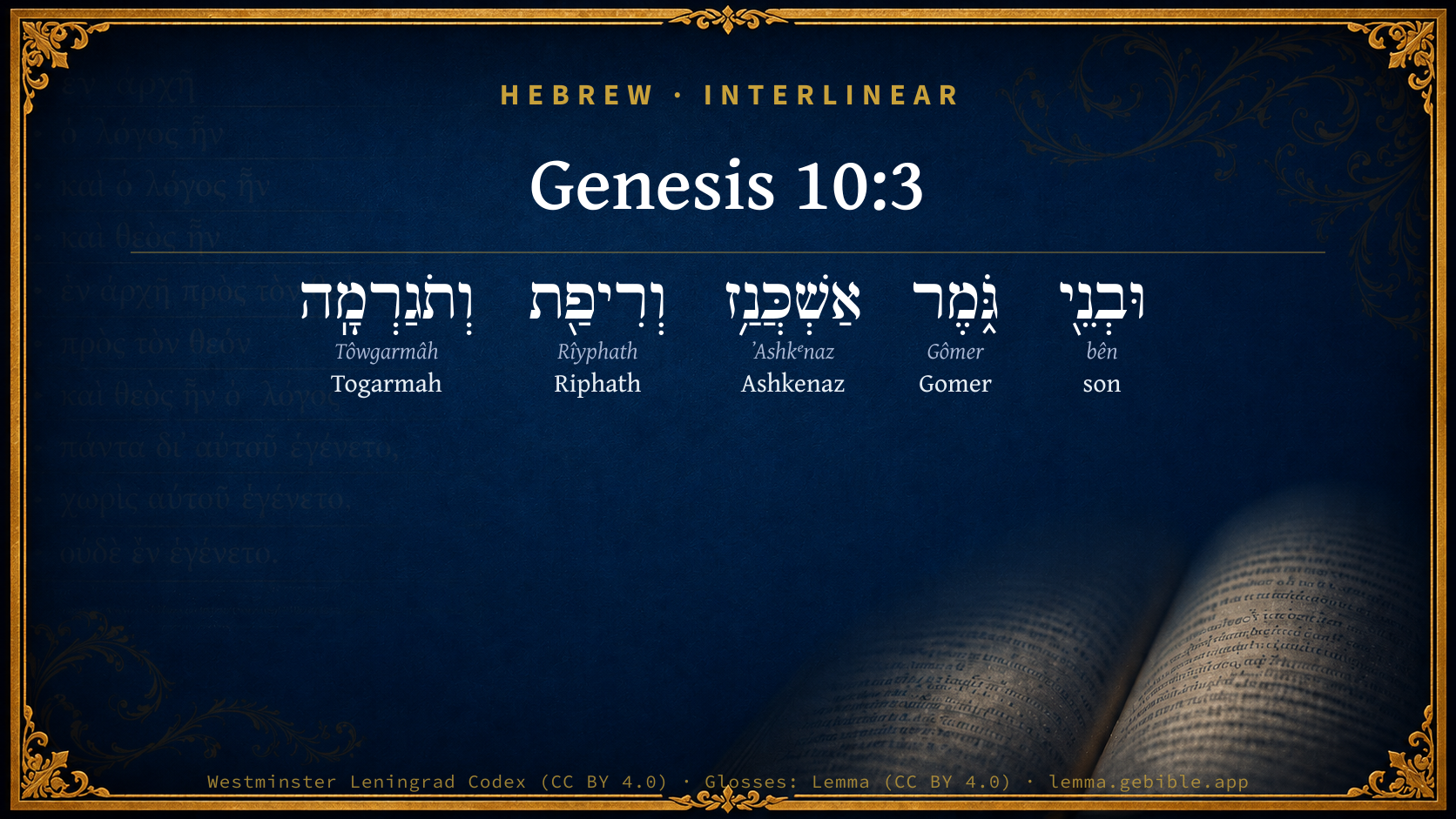
Genesis 10:3

Hebrew (Westminster Leningrad Codex) Genesis 10:3 appears in the Hebrew Old Testament. The text above is from the Westminster Leningrad Codex. Each word links to its Strong’s number, a concise gloss, and parsing drawn from the Open Scriptures Hebrew Bible morphology. Click any word for its full Brown-Driver-Briggs (BDB) entry.
Download image
Cite this verse

Genesis 10:3 (World English Bible). Public Domain. Lemma interlinear Bible study tool, https://lemma.gebible.app/v/genesis/10/3.

Show BibTeX & RIS
BibTeX
RIS
English Translation
The sons of Gomer: Ashkenaz, Riphath, and Togarmah.
World English Bible · Public Domain
Highlights
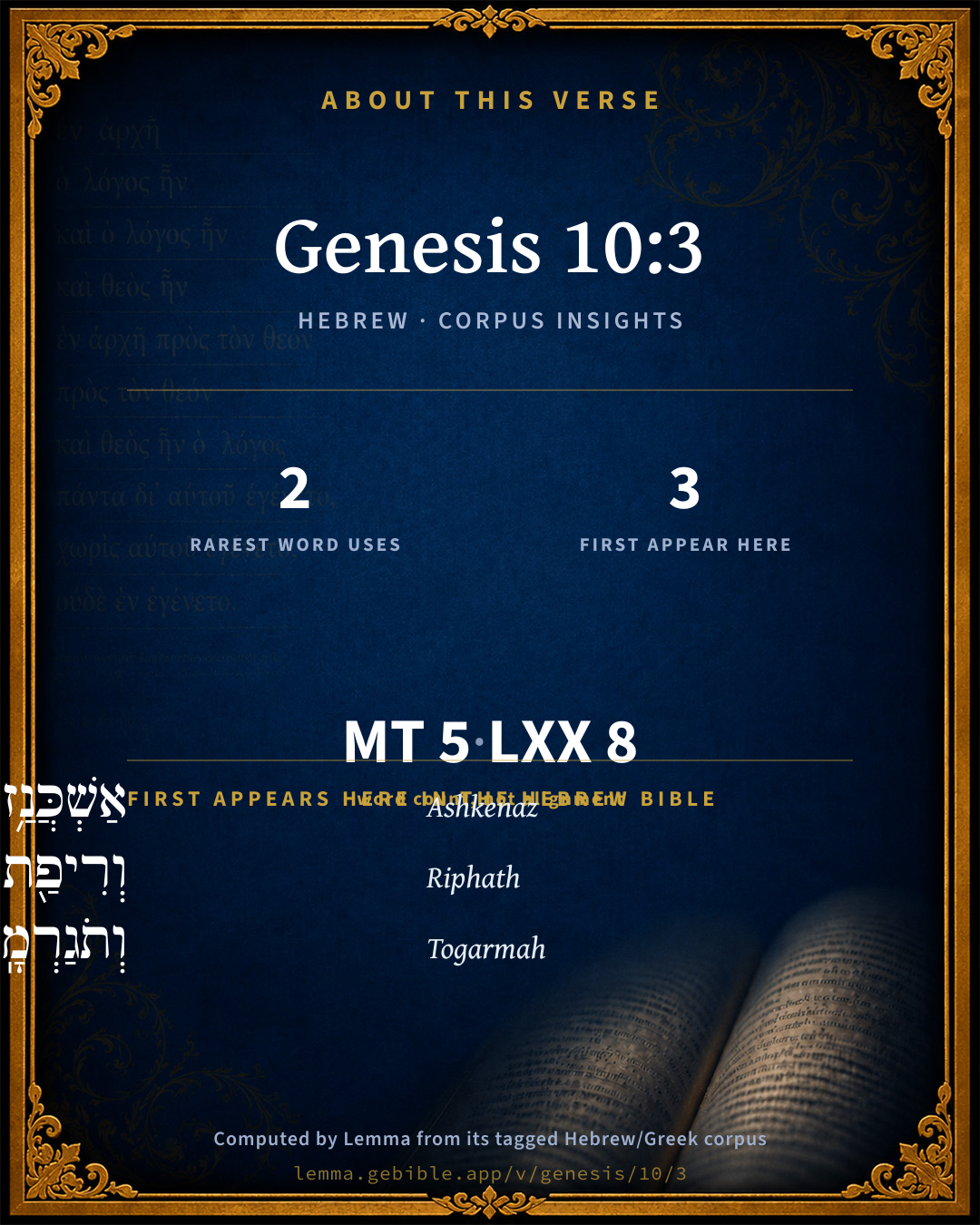
  • 3 first appearances in the Hebrew Bible
Full analysis ↓
Download a study sheet

One document with this verse’s original text, its word-by-word gloss line, the meaning frame, cross-references with their text, attributed commentary, and full source and license credits — printable, and it pastes into notes with its structure intact.

This verse Autodidact and up

Study sheet (.html) Plain text (.txt)

A passage Seminary Student

Up to 50 verses in one chapter. A passage sheet keeps up to 6 commentary sources and 12 cross-references per verse, in the order this page ranks them, and says so on the sheet whenever that leaves anything out. Ask for a single verse and you get the Autodidact verse sheet above.

Everything on this page stays free to read, with no account — the sheet is a download of what is already on screen, not access to it.

Want to remove ads? Support Godless Engineer
Compare translations 3

The same verse in 3 English versions, stacked beneath the original-language interlinear above. Click any original word for its lexicon entry.

Each is an independent rendering of the whole verse — the interlinear is not word-aligned to these translations.

Highlighted words mark where these versions differ — a whole-verse word diff, not a word-by-word alignment.

  • World English Bible Public Domain
    The sons of Gomer: Ashkenaz, Riphath, and Togarmah.
  • King James Version Public Domain
    And the sons of Gomer; Ashkenaz, and Riphath, and Togarmah.
  • unfoldingWord Literal Text CC BY-SA 4.0
    And the sons of Gomer Ashkenaz and Riphath and Togarmah.

unfoldingWord Literal Text — © unfoldingWord, licensed CC BY-SA 4.0. Word-aligned USFM3 via Door43 (git.door43.org/unfoldingWord/en_ult).

Versions to compare (up to 4)

3 of 4 selected

Show all 18 translations

Every available English version of this verse, each an independent rendering of the whole verse.

  • World English Bible Public Domain
    The sons of Gomer: Ashkenaz, Riphath, and Togarmah.
  • Berean Standard Bible Public Domain
    The sons of Gomer: Ashkenaz, Riphath, and Togarmah.
  • Majority Standard Bible Public Domain
    The sons of Gomer: Ashkenaz, Riphath, and Togarmah.
  • King James Version Public Domain
    And the sons of Gomer; Ashkenaz, and Riphath, and Togarmah.
  • American Standard Version (1901) Public Domain
    And the sons of Gomer: Ashkenaz, and Riphath, and Togarmah.
  • Revised Version (1885) Public Domain
    And the sons of Gomer; Ashkenaz, and Riphath, and Togarmah.
  • Geneva Bible (1599) Public Domain
    And the sonnes of Gomer, Ashkenaz, and Riphath, and Togarmah.
  • Douay-Rheims (1899) Public Domain
    And the sons of Gomer: Ascenez and Riphath and Thogorma.
  • Young's Literal Translation Public Domain
    And sons of Gomer `are' Ashkenaz, and Riphath, and Togarmah.
  • Literal Standard Version CC BY-SA 4.0
    And sons of Gomer [are] Ashkenaz, and Riphath, and Togarmah.
  • Unlocked Literal Bible CC BY-SA 4.0
    The sons of Gomer were Ashkenaz, Riphath, and Togarmah.
  • unfoldingWord Literal Text CC BY-SA 4.0
    And the sons of Gomer Ashkenaz and Riphath and Togarmah.
  • Darby Bible Public Domain
    And the sons of Gomer: Ashkenaz, and Riphath, and Togarmah.
  • World Messianic Bible Public Domain
    The sons of Gomer were: Ashkenaz, Riphath, and Togarmah.
  • Webster's Bible Public Domain
    And the sons of Gomer; Ashkenaz, and Riphath, and Togarmah.
  • Free Bible Version CC BY-SA 4.0
    The sons of Gomer: Ashkenaz, Riphath, and Togarmah.
  • Bible in Basic English Public Domain
    And the sons of Gomer: Ashkenaz and Riphath and Togarmah.
  • JPS Tanakh (1917) Public Domain
    And the sons of Gomer: Ashkenaz, and Riphath, and Togarmah.

Literal Standard Version (2020), Covenant Press — licensed CC BY-SA 4.0. Text via the HelloAO Bible API (eBible.org). Unlocked Literal Bible (unfoldingWord) — licensed CC BY-SA 4.0. Text via the HelloAO Bible API (eBible.org). unfoldingWord Literal Text — © unfoldingWord, licensed CC BY-SA 4.0. Word-aligned USFM3 via Door43 (git.door43.org/unfoldingWord/en_ult). Free Bible Version, Dr. Jonathan Gallagher — licensed CC BY-SA 4.0. Text via the HelloAO Bible API (eBible.org).

Word by word

More ways to search: Search by grammar → Find every occurrence → Compare this word →

Practice this passage: Drill this verse → Learn its vocabulary →

About this verse

These counts appear in no published source. They are computed here, from the morphology-tagged text and Lemma’s own curated glosses. What Lemma adds →

5
words
5
distinct lemmas
Pentateuch
section

Notable vocabulary

The rarest word here is וְרִיפַ֖ת Riphath H7384 — appearing just 2 times in the whole Hebrew Bible.

First appearance in Scripture

These words make their first canonical appearance in the Hebrew Bible here:

  • אַשְׁכֲּנַ֥ז Ashkenaz H813
  • וְרִיפַ֖ת Riphath H7384
  • וְתֹגַרְמָֽה Togarmah H8425

Shared distinctive vocabulary

וְרִיפַ֖ת Riphath H7384 occurs in 2 verses of the Hebrew Bible. Also found in:

Grammatical profile

  • 5 nouns

Hebrew & Septuagint length

In English translation the verse runs 8 words from the Hebrew and 10 from the Septuagint (LXX English) — closely comparable.

A rough comparison of the two English renderings, which tokenize alike — not a word-level alignment.

Word counts can differ between the Hebrew and the Greek without any difference in meaning — e.g. the Hebrew direct-object marker אֵת has no separate Greek word, and Greek often adds the article ὁ.

In the original languages it is 5 Hebrew tokens and 8 Greek tokens — but the two are counted differently (Hebrew bundles its prefixes and suffixes into one token; the Greek is in lemma form), so that isn’t a like-for-like length.

Cross-references

2

Topical passages linked to Genesis 10:3 in the Treasury of Scripture Knowledge — connected by theme and wording, ordered by reader-vote popularity; previews shown in the World English Bible.

  • Jeremiah 51:27 Set up a standard in the land, blow the trumpet among the nations, prepare the nations against her, call together against her the kingdoms of Ararat, Minni, and Ashkenaz: appoint a marshal against her; cause the horses to come up as the rough canker-worm.
  • Ezekiel 27:14 They of the house of Togarmah traded for your wares with horses and war-horses and mules.

Cross-references courtesy of OpenBible.info (CC BY 4.0).

Hebrew and Greek witnesses Masoretic Hebrew ↔ Greek Septuagint

The same verse in the two great witnesses to the Old Testament, shown verse-for-verse.

These are two independent witnesses, not word-aligned to each other, and the Septuagint is shown in lemma (dictionary) form.

Hebrew Genesis 10:3 Masoretic · Westminster Leningrad Codex

וּבְנֵ֖י גֹּ֑מֶר אַשְׁכֲּנַ֥ז וְרִיפַ֖ת וְתֹגַרְמָֽה

The sons of Gomer: Ashkenaz, Riphath, and Togarmah.

World English Bible · Public Domain

Greek LXX Genesis 10:3 Septuagint · lemma form

καί υἱός γαμερ ασχαναζ καί ριφαθ καί θοργαμα

And the sons of Gamer, Aschanaz, and Riphath, and Thorgama.

LXX2012 (modern English Septuagint) · Public Domain

Hebrew: Westminster Leningrad Codex (CC BY 4.0). Greek: Septuagint (public domain); English from LXX2012 (modern English Septuagint) (Public Domain). How the Septuagint differs from the Hebrew →

Targum (Aramaic paraphrase)

2

The Targum is the ancient Jewish Aramaic paraphrase of the Hebrew Scriptures — an interpretive translation, not the Hebrew text itself. Onkelos (literal) and Pseudo-Jonathan (expansive) render the Torah, and Jonathan the Prophets. Coverage is partial: where no permissively-licensed English translation exists for a verse, only the Aramaic is shown. This is verse-level text, not a word-by-word alignment to the Hebrew.

  1. Targum Onkelos Torah (Genesis–Deuteronomy)
    וּבְנֵי גּוֹמֶר אַשְׁכְּנַז וְרִיפַת וְתוֹגַרְמָה

    And the sons of Gomer, Ashkenaz, and Rephath, and Thogarmah.

    Targum Onkelos — Aramaic: “Onkelos Genesis” (public domain); “Onkelos Exodus” (public domain); “Onkelos Leviticus” (public domain); “Onkelos Numbers” (public domain); “Onkelos Deuteronomy” (public domain). English: “Sefaria Community Translation” (CC0 1.0 (public-domain dedication)); “J.W. Etheridge. The Targums of Onkelos and Jonathan Ben Uzziel on the Pentateuch. London: Longmans, Green, 1862” (public domain). Text via Sefaria.

  2. Targum Pseudo-Jonathan Torah (Genesis–Deuteronomy)
    וּבְנוֹי דְגוֹמֶר אַשְׁכְּנַז וְרִיפַת וְתוֹגַרְמָא

    And the sons of Gomer, Ashkenaz, and Riphath, and Togarma.

    Targum Pseudo-Jonathan — Aramaic: “Targum Jonathan on Genesis” (public domain); “Targum Jonathan on Exodus” (public domain); “Targum Jonathan on Leviticus” (public domain); “Targum Jonathan on Numbers” (public domain); “Targum Jonathan on Deuteronomy” (public domain). English: “The Targum of Jonathan ben Uzziel, trans. J. W. Etheridge, London, 1862” (public domain). Text via Sefaria.

Commentary

Notes on Genesis 10:3 from classic Christian and Jewish commentators (each source and its license shown beneath its notes). The classic Christian expositions comment on the surrounding passage and are grouped to its opening verse, so a note may address several verses; the Jewish commentaries on the Tanakh (Rashi and others) are per-verse, so they appear only where the commentator wrote on this verse.

Lemma curates 59 commentaries, every one of them public domain or Creative Commons licensed, each selected and text-cleaned for this edition rather than reprinted as found. About our sources →

Trapp's Complete Commentary

John Trapp

Gen 10:3 And the sons of Gomer; Ashkenaz, and Riphath, and Togarmah.

Ver. 3. Ashkenaz.] Hinc Tuiscones , or Duitschmen, say the Jews; making Ashkenaz the father of the Germans, as Gomer of the Cimbrians or Danes, and Meshec of the Muscovites. But of these things there is little certainty. See Breerwood’s Inquiries.

John Trapp, A Commentary or Exposition upon All the Books of the Old and New Testament (1647–1656) — public domain. Text from a community e-Sword module.

Tyndale Open Study Notes

Tyndale Open Resources

10:3 The descendants of Gomer came from near the Upper Euphrates region north of the Black Sea (cp. Ezek 38:1-9). • The descendants of Ashkenaz were the later Scythians who inhabited the region between the Black and Caspian Seas. • Riphath is near Carchemish. • The descendants of Togarmah are associated with Til-garimmu, the capital of Kammanu in modern Armenia (see Ezek 38:6).

Tyndale Open Study Notes — © Tyndale Open Resources, licensed CC BY-SA 4.0. Text via the HelloAO Bible API.

Adam Clarke's Commentary

Verse 3. Ashkenaz] Probably gave his name to Sacagena, a very excellent province of Armenia. Pliny mentions a people called Ascanitici, who dwelt about the Tanais and the Palus Maeotis; and some suppose that from Ashkenaz the Euxine Sea derived its name, but others suppose that from him the Germans derived their origin.

Riphath] Or Diphath, the founder of the Paphlagonians, which were anciently called Riphataei.

Togarmah.] The Sauromates, or inhabitants of Turcomania. See the reasons in Calmet.

Adam Clarke's Commentary on the Bible (1810–1826) — public domain. Text from a community e-Sword/MySword module.

Ellicott's Commentary for English Readers

(3) Gomer has three main divisions:—

1. Ashkenaz, a region in the neighbourhood of Armenia (Jer_51:27), whence, following the course of Japhethite migration, the race seems to have wandered into Germany. The derivations are all most uncertain; but the Jews call the Germans Ashkenazites, and are probably right.

2. Riphath, in 1Ch_1:6, is called Diphath (see Dodanim, below). Riphath is probably right, and the, inhabitants of the Riphæan Mountains (the Carpathians?) are the people meant. They were Celts.

3. Togarmah. Certainly Armenia.

A Bible Commentary for English Readers, edited by Charles John Ellicott (1878–1897) — public domain. Text from a community e-Sword module.

The Cambridge Bible for Schools and Colleges

gen. ed. J. J. S. Perowne

3. Ashkenaz] Mentioned in Jer_51:27 along with Ararat; and now generally identified with the region of Armenia. It is worth noticing that the mediaeval Jews explained this name as denoting Germany. Thus the Ashkenazim are the German Jews.

Riphath] In 1Ch_1:6 the name appears as “Diphath.” The letters, R (ר) and D (ד), are very similar in Hebrew. Cf. “Dodanim” for “Rodanim,” Gen_10:4. Josephus identified “Riphath” with the Paphlagonians. The name is now unknown.

Togarmah] Mentioned also in Eze_27:14, with Javan, Tubal and Meshech; and in Eze_38:6, with Gomer, and generally identified with the western part of Armenia. Cf. 1Ch_1:6.

The Cambridge Bible for Schools and Colleges (gen. ed. J. J. S. Perowne; Cambridge University Press, 1878–1918) — public domain. Text from a community e-Sword module.

John Gill's Exposition

And the sons of Gomer,.... Who was the first of the sons of Japheth, three of whose sons are mentioned, and they are as follow:

Ashkenaz, and Riphath, and Togarmah; the first of these seated himself in the lesser Asia, in Pontus and Bithynia, where were some traces of his name in the river Ascanius, and in the Ascanian lake or bay; and also in the lesser Phrygia or Troas, where was a city called Ascania, and where were the Ascanian isles (x), and the Euxine Pontus, or Axeine (y), as it was first called, which is the sea that separates Asia and Europe, and is no other than a corruption of the sea of Ashkenaz. It seems to have been near Armenia, by its being mentioned along with Minni or Armenia, in Jer 51:27. Germany is by the Jews commonly called Ashkenaz; perhaps some of the posterity of Ashkenaz in Asia might pass into Europe, and Germany might be a colony of them; so Mr. Broughton (z) observes of the sons of Gomer, that they first took their seat in Asia, and then came north and west into Muscovy and Germany. The next son of Gomer was Riphath. Josephus (a) says, that the Riphathaeans which came from him are the Paphlagonians, a people of Asia Minor, near Pontus, so that he settled near his brother Ashkenaz; perhaps his posterity are the Arimphaei of Pliny (b), and the Riphaeans of Mela (c), who inhabited near the Riphaean mountains, which might have their name from this son of Gomer, who in Ch1 1:6 is called Diphath, the letters and being very similar. His third son is called Togarmah, who had his seat in the north of Judea, see Eze 38:6 his posterity are the Phrygians, according to Josephus (d); but some place them in Galatia and Cappadocia; and Strabo (e) makes mention of a people called Trocmi, on the borders of Pontus and Cappadocia; and Cicero (f) of the Trogmi or Trogini, who may have their name from hence; for the Greek interpreters always call him Torgama or Thorgana. The Jews make the Turks to be the posterity of Togarmah. Elias Levita says (g), there are some that say that Togarmah is the land of Turkey; and Benjamin of Tudela (h) calls a Turkish sultan king of the Togarmans, that is, the Turks; and among the ten families of Togarmah, which Josephus ben Gorion (i) speaks of, the Turks are one; and perhaps this notion may not be amiss, since the company of Togarmah is mentioned with Gog, or the Turk; see Gill on Eze 38:6. The Armenians pretend to be the descendants of Togarmah, who, with them, is the son of Tiras, the son of Gomer, by his son Haik, from whom they and their country, from all antiquity, have bore the name of Haik (k).

(x) Strabo Geograph. l. 12. p. 387, 388. & l. 14. p. 468. Plin. Nat. Hist. l. 4. 12. & 5. 30, 31, 32. (y) Vid. Orphei Argonautic, ver. 84. (z) See his Works, p. 2, 58. (a) Ut supra. (Antiqu. l. 1. c. 6. sect. 1.) (b) Nat. Hist. l. 6. c. 2. (c) De Situ Orbis, l. 1. c. 2. (d) Ut supra. (Antiqu. l. 1. c. 6. sect. 1.) (e) Geograph. l. 4. p. 130. & l. 12. p. 390. (f) De Divinatione, l. 2. (g) In Tishbi, p. 259. (h) ltinerarium, p. 27, 54. (i) Hist. Heb. l. 1. c. 1. p. 3. (k) See the Universal History, vol. 1. p. 377.

John Gill's Exposition of the Whole Bible (1746–1763) — public domain (CC PDM 1.0). Text via the HelloAO Bible API.

Haydock's Catholic Bible Commentary

Ascenez father of the Germans, Thogorma father of the Turks. (Menochius)

George Leo Haydock (1774–1849), Haydock's Catholic Family Bible and Commentary, 1859 edition — public domain. Excludes Psalms (Douay-Rheims chapter numbering differs from Protestant) and Deuterocanonical books (Catholic canon only).

Matthew Poole's English Annotations

Ashkenaz, whose seed possessed Pontus and Bithynia, and the neighbouring parts, from whom they took the names of the lake and haven called Ascanius, and the sea called Axenus, or Euxinus.

Riphath is called Diphath, 1Ch 1:6; the letters Daleth and Resh being oft interchanged, as we shall see in other instances. His posterity dwelled in or near Pontus and Bithynia, where Mela and Pliny and Solinus place the Riphaei, or Riphaces, and the Paphlagonians, who were anciently called Piphataei.

Togarmah, whose posterity are joined with Gomer’s; see Eze 27:14; 38:6; and were, as some think, the Phrygians and Galatians, and of them the Gauls and Germans; or, as others, the Armenians, and of them the Turks.

Matthew Poole's English Annotations on the Holy Bible (1683–1685) — public domain. Text from a community e-Sword/MySword module.

Whedon's Commentary on the Bible

Daniel D. Whedon

3. Sons of Gomer — Sub-families of the Gomeridae, or Cimmerians, Kimbri.

Ashkenaz — Or Askenaz. Kenaz means family, family of the Asi, who lived in the north-west of Asia Minor, and from whom Asia derives its name. (Knobel.) By metathesis the name becomes Aksenaz, possibly the old name of the Black Sea, which the Greeks called αξενος, Euxine. (Lewis.) The Greek name is usually understood, however, to mean inhospitable.

Riphath — The portion of the Kelts who, according to Plutarch, crossed the Rhipoen (Carpathian) mountains, and poured over northern Europe, seem to have preserved this name.

Togarmah — The Armenians, who, according to their own historians, had Thorgon for their founder, and call themselves the house (family) of Thorgon. (Furst, Knobel.) They originally dwelt in Armenia and Asia Minor, but poured across the Hellespont into Europe before the dawn of history, and, according to Sallust, (Jugurtha, 18,) spread over the Mediterranean peninsulas even to Spain. They are mentioned by Ezekiel (chap. 27:14) as trading at the Tyrian markets in horses, horsemen, and mules, which they brought down from the Armenian highlands to the sea.

Daniel D. Whedon (gen. ed.), Commentary on the Old and New Testaments (1874–1909) — public domain. Text from a community e-Sword module.

The Pulpit Commentary

And the sons of Gomer; Ash-kenaz. Axenus, the ancient name of the Euxine, is supposed to favor Phrygia and Bithynia as the locality possessed by Aske-naz (Bochart); Iskus; equivalent to Ask, Ascanios, the oldest son of the Germanic Mannus, to point out Germany as his abode (Jewish commentators); but Jer_51:27 seems to indicate the region between the Euxine and the Caspian. Kalisch, following Josephus, identifies the name with the ancient town Rhagae, one day"s journey to the south of the Caspian. Murphy and Peele, on the authority of Diodorus Siculus, believe the Germans may have been a colony of the Ashkenians. And Riphath. Diphath (1Ch_1:6) the Paphlagonians (Josephus); more generally the tribes about the Riphaean mountains, on the north of the Caspian (Knobel, Kalisch, Clericus, Rosenm Murphy, "Speaker"s Commentary"); but both are uncertain (Keil). And Togarmah. Mentioned again in Eze_27:14 Eze_38:6; the Phrygians (Josephus) the Cappadocians (Bochart), the Armenians (Michaelis, Gesenius, Rosenm the Taurians, inhabiting the Crimea (Kalisch). The tradition preserved by Moses Chorensis, that the ancestor of the Armenians was the son of Thorgom, the son of Comer, is commonly regarded as deciding the question.

The Pulpit Commentary (1880–1919), ed. H.D.M. Spence-Jones & Joseph S. Exell — public domain. Text from a community e-Sword module.

Radak

Rabbi David Kimhi (Radak)

ובני גמר אשכנז, people say that this refers to the people living in Germany.

וריפה according to Rabbeinu Saadyah gaon these are the Gauls living in France; in Chronicles I 1,6 they are called דיפת.

Radak on the Tanakh — English translations: “Sefaria Community Translation” (CC0 1.0 (public-domain dedication)); “Eliyahu Munk, HaChut Hameshulash” (CC BY 4.0); “Rabbi Mike Feuer, Jerusalem Anthology” (CC BY 4.0); and “R. David Kimhi on the first book of Psalms, Translated by R.G. Finch, London, 1919” (public domain). Text via Sefaria.

Lesson kit

Teaching starters — assembled from the data on this page, not authored interpretation. Every prompt links to the verse data it draws on. Edit before teaching.

Genesis, in the Pentateuch, opens this verse with 5 words (5 distinct Hebrew lemmas). Its most distinctive word is Rîyphath (“Riphath”). A historical commentator’s framing appears above. Read the whole chapter for the surrounding context.

Discussion questions

  1. What does “Riphath” (Rîyphath) contribute to the verse as a whole?
  2. 3 words here appear for the first time in Scripture. What is being introduced at this debut?
  3. 1 Chronicles 1:6 shares the word «Riphath» with this verse. How do the two illuminate each other?
  4. Reading how Trapp's Complete Commentary and Tyndale Open Study Notes read this verse, where do the two commentators agree and where do they part?

Things to notice

Reading settings

Reading text

Shown beneath each verse's original-language words.

Old Testament
Old Testament edition

Read the OT as the Masoretic Hebrew (MT) or the Greek Septuagint (LXX).

English shown for the Greek Septuagint (in the Hebrew ↔ Greek comparison).

Comparing translations? Open the Compare panel on any verse page to stack up to four side by side.