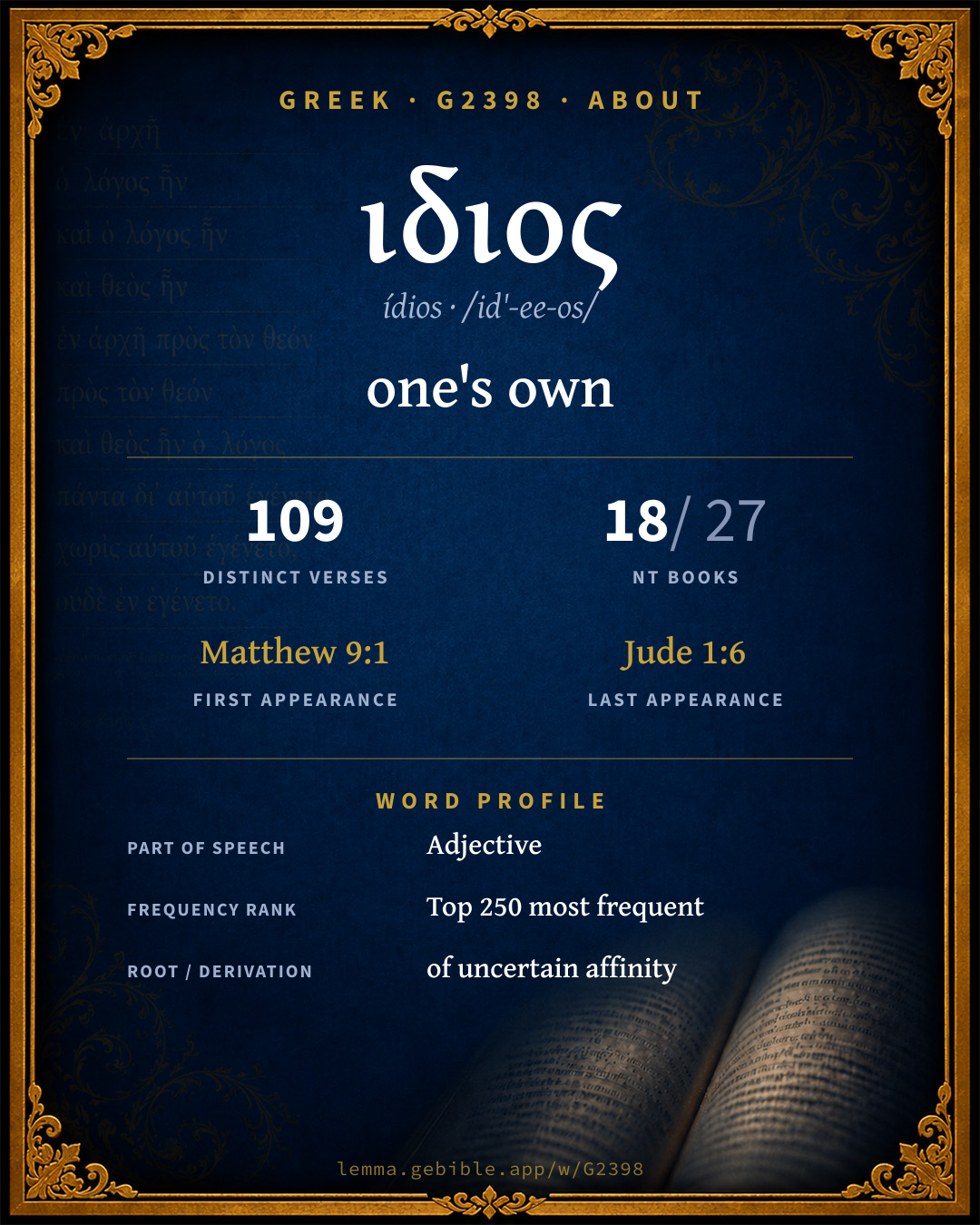
ἴδιος
one's own
Full lexicon entry — Thayer's Greek Lexicon
From Thayer's Greek Lexicon
Where this word appears
See every Accusative-case word in the Greek New Testament →
Grammar key — what these labels mean
Part of speech
- Adjective
- A word that describes or qualifies a noun.
Case
- Accusative
- The case of the direct object and of extent.
- Dative
- The case of the indirect object, means, or location — “to / for / with / in.”
- Genitive
- The case of source, possession, or “of” — answers “whose / from what.”
- Nominative
- The case of the subject (and the predicate nominative).
Gender
- Feminine
- Grammatically feminine.
- Masculine
- Grammatically masculine.
- Neuter
- Grammatically neuter.
Number
- Singular
- One.
- Plural
- More than one.
Grammatical forms 21 distinct
- Adjective, Accusative, Singular, Feminine 24 times (21%)
- Adjective, Dative, Singular, Feminine 13 times (11%)
- Adjective, Accusative, Singular, Masculine 9 times (8%)
- Adjective, Accusative, Singular, Neuter 9 times (8%)
- Adjective, Dative, Plural, Masculine 9 times (8%)
- Adjective, Accusative, Plural, Neuter 8 times (7%)
- Adjective, Genitive, Singular, Masculine 6 times (5%)
- Adjective, Accusative, Plural, Masculine 5 times (4%)
+13 more forms (31 occurrences)
Parsed forms decoded from the imported morphology (Robinson–Tischendorf, public domain), counted across 114 parsed occurrences — not distinct verses.
Every verse where G2398 appears — 109 distinct verses across 18 books. Click any verse to open its interlinear word-by-word view. Verse text shown in the World English Bible for context — . Each verse’s Greek form is shown with its reference; the English is not keyword-highlighted, since the data carries no word-level English alignment. Use “Compare translations” on any verse to read it across multiple English versions. This concordance covers the Greek New Testament; Septuagint (Greek Old Testament) occurrences of this word are not indexed here.
Matthew 11 verses
- Matthew 9:1 ἰδίαν adj acc sg fem He entered into a boat, and crossed over, and came into his own city.
- Matthew 13:57 ἰδίᾳ adj dat sg fem They were offended by him. But Jesus said to them, "A prophet is not without honor, except in his own country, and in his own house."
- Matthew 14:13 ἰδίαν adj acc sg fem Now when Jesus heard this, he withdrew from there in a boat, to a deserted place apart. When the multitudes heard it, they followed him on foot from the cities.
- Matthew 14:23 ἰδίαν adj acc sg fem After he had sent the multitudes away, he went up into the mountain by himself to pray. When evening had come, he was there alone.
- Matthew 17:1 ἰδίαν adj acc sg fem After six days, Jesus took with him Peter, James, and John his brother, and brought them up into a high mountain by themselves.
- Matthew 17:19 ἰδίαν adj acc sg fem Then the disciples came to Jesus privately, and said, "Why weren't we able to cast it out?"
- Matthew 20:17 ἰδίαν adj acc sg fem As Jesus was going up to Jerusalem, he took the twelve disciples aside, and on the way he said to them,
- Matthew 22:5 ἴδιον adj acc sg masc But they made light of it, and went their ways, one to his own farm, another to his merchandise,
- Matthew 24:3 ἰδίαν adj acc sg fem As he sat on the Mount of Olives, the disciples came to him privately, saying, "Tell us, when will these things be? What is the sign of your coming, and of the end of the age?"
- Matthew 25:14 ἰδίους adj acc pl masc "For it is like a man, going into another country, who called his own servants, and entrusted his goods to them.
- Matthew 25:15 ἰδίαν adj acc sg fem To one he gave five talents, to another two, to another one; to each according to his own ability. Then he went on his journey.
Mark 7 verses
- Mark 4:34 ἰδίαν ἰδίοις adj acc sg fem adj dat pl masc Without a parable he didn't speak to them; but privately to his own disciples he explained all things.
- Mark 6:31 ἰδίαν adj acc sg fem He said to them, "You come apart into a deserted place, and rest awhile." For there were many coming and going, and they had no leisure so much as to eat.
- Mark 6:32 ἰδίαν adj acc sg fem They went away in the boat to a desert place by themselves.
- Mark 7:33 ἰδίαν adj acc sg fem He took him aside from the multitude, privately, and put his fingers into his ears, and he spat, and touched his tongue.
- Mark 9:2 ἰδίαν adj acc sg fem After six days Jesus took with him Peter, James, and John, and brought them up onto a high mountain privately by themselves, and he was changed into another form in front of them.
- Mark 9:28 ἰδίαν adj acc sg fem When he had come into the house, his disciples asked him privately, "Why couldn't we cast it out?"
- Mark 13:3 ἰδίαν adj acc sg fem As he sat on the Mount of Olives opposite the temple, Peter, James, John, and Andrew asked him privately,
Luke 6 verses
- Luke 6:41 ἰδίῳ adj dat sg masc Why do you see the speck of chaff that is in your brother's eye, but don't consider the beam that is in your own eye?
- Luke 6:44 ἰδίου adj gen sg masc For each tree is known by its own fruit. For people don't gather figs from thorns, nor do they gather grapes from a bramble bush.
- Luke 9:10 ἰδίαν adj acc sg fem The apostles, when they had returned, told him what things they had done. He took them, and withdrew apart to a deserted place of a city called Bethsaida.
- Luke 10:23 ἰδίαν adj acc sg fem Turning to the disciples, he said privately, "Blessed are the eyes which see the things that you see,
- Luke 10:34 ἴδιον adj acc sg neut came to him, and bound up his wounds, pouring on oil and wine. He set him on his own animal, and brought him to an inn, and took care of him.
- Luke 18:28 ἴδια adj acc pl neut Peter said, "Look, we have left everything, and followed you."
John 14 verses
- John 1:11 ἴδια ἴδιοι adj acc pl neut adj nom pl masc He came to his own, and those who were his own didn't receive him.
- John 1:42 ἴδιον adj acc sg masc He brought him to Jesus. Jesus looked at him, and said, "You are Simon the son of Jonah. You shall be called Cephas" (which is by interpretation, Peter).
- John 4:44 ἰδίᾳ adj dat sg fem For Jesus himself testified that a prophet has no honor in his own country.
- John 5:18 ἴδιον adj acc sg masc For this cause therefore the Jews sought all the more to kill him, because he not only broke the Sabbath, but also called God his own Father, making himself equal with God.
- John 5:43 ἰδίῳ adj dat sg neut I have come in my Father's name, and you don't receive me. If another comes in his own name, you will receive him.
- John 7:18 ἰδίαν adj acc sg fem He who speaks from himself seeks his own glory, but he who seeks the glory of him who sent him, the same is true, and no unrighteousness is in him.
- John 8:44 ἰδίων adj gen pl neut You are of your Father, the devil, and you want to do the desires of your father. He was a murderer from the beginning, and doesn't stand in the truth, because there is no truth in him. When he speaks a lie, he speaks on his own; for he is a liar, and the father of it.
- John 10:3 ἴδια adj acc pl neut The gatekeeper opens the gate for him, and the sheep listen to his voice. He calls his own sheep by name, and leads them out.
- John 10:4 ἴδια adj acc pl neut Whenever he brings out his own sheep, he goes before them, and the sheep follow him, for they know his voice.
- John 10:12 ἴδια adj nom pl neut He who is a hired hand, and not a shepherd, who doesn't own the sheep, sees the wolf coming, leaves the sheep, and flees. The wolf snatches the sheep, and scatters them.
- John 13:1 ἰδίους adj acc pl masc Now before the feast of the Passover, Jesus knowing that his time had come that he would depart from this world to the Father, having loved his own who were in the world, he loved them to the end.
- John 15:19 ἴδιον adj acc sg neut If you were of the world, the world would love its own. But because you are not of the world, since I chose you out of the world, therefore the world hates you.
- John 16:32 ἴδια adj acc pl neut Behold, the time is coming, yes, and has now come, that you will be scattered, everyone to his own place, and you will leave me alone. Yet I am not alone, because the Father is with me.
- John 19:27 ἴδια adj acc pl neut Then he said to the disciple, "Behold, your mother!" From that hour, the disciple took her to his own home.
Acts 16 verses
- Acts 1:7 ἰδίᾳ adj dat sg fem He said to them, "It isn't for you to know times or seasons which the Father has set within His own authority.
- Acts 1:19 ἰδίᾳ adj dat sg fem It became known to everyone who lived in Jerusalem that in their language that field was called 'Akeldama,' that is, 'The field of blood.'
- Acts 1:25 ἴδιον adj acc sg masc to take part in this ministry and apostleship from which Judas fell away, that he might go to his own place."
- Acts 2:6 ἰδίᾳ adj dat sg fem When this sound was heard, the multitude came together, and were bewildered, because everyone heard them speaking in his own language.
- Acts 2:8 ἰδίᾳ adj dat sg fem How do we hear, everyone in our own native language?
- Acts 3:12 ἰδίᾳ adj dat sg fem When Peter saw it, he responded to the people, "You men of Israel, why do you marvel at this man? Why do you fasten your eyes on us, as though by our own power or godliness we had made him walk?
- Acts 4:23 ἰδίους adj acc pl masc Being let go, they came to their own company, and reported all that the chief priests and the elders had said to them.
- Acts 4:32 ἴδιον adj acc sg masc The multitude of those who believed were of one heart and soul. Not one of them claimed that anything of the things which he possessed was his own, but they had all things in common.
- Acts 13:36 ἰδίᾳ adj dat sg fem For David, after he had in his own generation served the counsel of God, fell asleep, and was laid with his fathers, and saw decay.
- Acts 20:28 ἰδίου adj gen sg masc Take heed, therefore, to yourselves, and to all the flock, in which the Holy Spirit has made you overseers, to shepherd the assembly of the Lord and God which he purchased with his own blood.
- Acts 21:6 ἴδια adj acc pl neut After saying goodbye to each other, we went on board the ship, and they returned home again.
- Acts 23:19 ἰδίαν adj acc sg fem The commanding officer took him by the hand, and going aside, asked him privately, "What is it that you have to tell me?"
- Acts 24:23 ἰδίων adj gen pl masc He ordered the centurion that Paul should be kept in custody, and should have some privileges, and not to forbid any of his friends to serve him or to visit him.
- Acts 24:24 ἰδίᾳ adj dat sg fem But after some days, Felix came with Drusilla, his wife, who was a Jewess, and sent for Paul, and heard him concerning the faith in Christ Jesus.
- Acts 25:19 ἰδίας adj gen sg fem but had certain questions against him about their own religion, and about one Jesus, who was dead, whom Paul affirmed to be alive.
- Acts 28:30 ἰδίῳ adj dat sg neut Paul stayed two whole years in his own rented house, and received all who were coming to him,
Romans 5 verses
- Romans 8:32 ἰδίου adj gen sg masc He who didn't spare his own Son, but delivered him up for us all, how would he not also with him freely give us all things?
- Romans 10:3 ἰδίαν adj acc sg fem For being ignorant of God's righteousness, and seeking to establish their own righteousness, they didn't subject themselves to the righteousness of God.
- Romans 11:24 ἰδίᾳ adj dat sg fem For if you were cut out of that which is by nature a wild olive tree, and were grafted contrary to nature into a good olive tree, how much more will these, which are the natural branches, be grafted into their own olive tree?
- Romans 14:4 ἰδίῳ adj dat sg masc Who are you who judge another's servant? To his own lord he stands or falls. Yes, he will be made to stand, for God has power to make him stand.
- Romans 14:5 ἰδίῳ adj dat sg masc One man esteems one day as more important. Another esteems every day alike. Let each man be fully assured in his own mind.
1 Corinthians 13 verses
- 1 Corinthians 3:8 ἴδιον ἴδιον adj acc sg masc adj acc sg masc Now he who plants and he who waters are the same, but each will receive his own reward according to his own labor.
- 1 Corinthians 4:12 ἰδίαις adj dat pl fem We toil, working with our own hands. When people curse us, we bless. Being persecuted, we endure.
- 1 Corinthians 6:18 ἴδιον adj acc sg neut Flee sexual immorality! "Every sin that a man does is outside the body," but he who commits sexual immorality sins against his own body.
- 1 Corinthians 7:2 ἴδιον adj acc sg masc But, because of sexual immoralities, let each man have his own wife, and let each woman have her own husband.
- 1 Corinthians 7:4 ἰδίου ἰδίου adj gen sg neut adj gen sg neut The wife doesn't have authority over her own body, but the husband. Likewise also the husband doesn't have authority over his own body, but the wife.
- 1 Corinthians 7:7 ἴδιον adj acc sg neut Yet I wish that all men were like me. However each man has his own gift from God, one of this kind, and another of that kind.
- 1 Corinthians 7:37 ἰδίου ἰδίᾳ adj gen sg neut adj dat sg fem But he who stands steadfast in his heart, having no necessity, but has power over his own heart, to keep his own virgin, does well.
- 1 Corinthians 9:7 ἰδίοις adj dat pl neut What soldier ever serves at his own expense? Who plants a vineyard, and doesn't eat of its fruit? Or who feeds a flock, and doesn't drink from the flock's milk?
- 1 Corinthians 11:21 ἴδιον adj acc sg neut For in your eating each one takes his own supper before others. One is hungry, and another is drunken.
- 1 Corinthians 12:11 ἰδίᾳ adj dat sg fem But the one and the same Spirit works all of these, distributing to each one separately as he desires.
- 1 Corinthians 14:35 ἰδίους adj acc pl masc If they desire to learn anything, let them ask their own husbands at home, for it is shameful for a woman to chatter in the assembly.
- 1 Corinthians 15:23 ἰδίῳ adj dat sg neut But each in his own order: Christ the first fruits, then those who are Christ's, at his coming.
- 1 Corinthians 15:38 ἴδιον adj acc sg neut But God gives it a body even as it pleased him, and to each seed a body of its own.
Galatians 3 verses
- Galatians 2:2 ἰδίαν adj acc sg fem I went up by revelation, and I laid before them the Gospel which I preach among the Gentiles, but privately before those who were respected, for fear that I might be running, or had run, in vain.
- Galatians 6:5 ἴδιον adj acc sg neut For each man will bear his own burden.
- Galatians 6:9 ἰδίῳ adj dat sg masc Let us not be weary in doing good, for we will reap in due season, if we don't give up.
Ephesians 2 verses
1 Thessalonians 2 verses
- 1 Thessalonians 2:14 ἰδίων adj gen pl masc For you, brothers, became imitators of the assemblies of God which are in Judea in Christ Jesus; for you also suffered the same things from your own countrymen, even as they did from the Jews;
- 1 Thessalonians 4:11 ἴδια adj acc pl neut and that you make it your ambition to lead a quiet life, and to do your own business, and to work with your own hands, even as we charged you;
1 Timothy 9 verses
- 1 Timothy 2:6 ἰδίοις adj dat pl masc who gave himself as a ransom for all; the testimony in its own times;
- 1 Timothy 3:4 ἰδίου adj gen sg masc one who rules his own house well, having children in subjection with all reverence;
- 1 Timothy 3:5 ἰδίου adj gen sg masc (but if a man doesn't know how to rule his own house, how will he take care of the assembly of God?)
- 1 Timothy 3:12 ἰδίων adj gen pl masc Let deacons be husbands of one wife, ruling their children and their own houses well.
- 1 Timothy 4:2 ἰδίαν adj acc sg fem through the hypocrisy of men who speak lies, branded in their own conscience as with a hot iron;
- 1 Timothy 5:4 ἴδιον adj acc sg masc But if any widow has children or grandchildren, let them learn first to show piety towards their own family, and to repay their parents, for this is acceptable in the sight of God.
- 1 Timothy 5:8 ἰδίων adj gen pl masc But if anyone doesn't provide for his own, and especially his own household, he has denied the faith, and is worse than an unbeliever.
- 1 Timothy 6:1 ἰδίους adj acc pl masc Let as many as are bondservants under the yoke count their own masters worthy of all honor, that the name of God and the doctrine not be blasphemed.
- 1 Timothy 6:15 ἰδίοις adj dat pl masc which in its own times he will show, who is the blessed and only Ruler, the King of kings, and Lord of lords;
2 Timothy 2 verses
- 2 Timothy 1:9 ἰδίαν adj acc sg fem who saved us and called us with a holy calling, not according to our works, but according to his own purpose and grace, which was given to us in Christ Jesus before times eternal,
- 2 Timothy 4:3 ἰδίας adj acc pl fem For the time will come when they will not listen to the sound doctrine, but, having itching ears, will heap up for themselves teachers after their own lusts;
Titus 4 verses
- Titus 1:3 ἰδίοις adj dat pl masc but in his own time revealed his word in the message with which I was entrusted according to the commandment of God our Savior;
- Titus 1:12 ἴδιος adj nom sg masc One of them, a prophet of their own, said, "Cretans are always liars, evil beasts, and idle gluttons."
- Titus 2:5 ἰδίοις adj dat pl masc to be sober-minded, chaste, workers at home, kind, being in subjection to their own husbands, that God's word may not be blasphemed.
- Titus 2:9 ἰδίοις adj dat pl masc Exhort servants to be in subjection to their own masters, and to be well-pleasing in all things; not contradicting;
Hebrews 4 verses
- Hebrews 4:10 ἰδίων adj gen pl neut For he who has entered into his rest has himself also rested from his works, as God did from his.
- Hebrews 7:27 ἰδίων adj gen pl fem who doesn't need, like those high priests, to daily offer up sacrifices, first for his own sins, and then for the sins of the people. For this he did once for all, when he offered up himself.
- Hebrews 9:12 ἰδίου adj gen sg neut nor yet through the blood of goats and calves, but through his own blood, entered in once for all into the Holy Place, having obtained eternal redemption.
- Hebrews 13:12 ἰδίου adj gen sg neut Therefore Jesus also, that he might sanctify the people through his own blood, suffered outside of the gate.
James 1 verse
1 Peter 2 verses
- 1 Peter 3:1 ἰδίοις adj dat pl masc In like manner, wives, be in subjection to your own husbands; so that, even if any don't obey the Word, they may be won by the behavior of their wives without a word;
- 1 Peter 3:5 ἰδίοις adj dat pl masc For this is how the holy women before, who hoped in God, also adorned themselves, being in subjection to their own husbands:
2 Peter 7 verses
- 2 Peter 1:3 ἰδίᾳ adj dat sg fem seeing that his divine power has granted to us all things that pertain to life and godliness, through the knowledge of him who called us by his own glory and virtue;
- 2 Peter 1:20 ἰδίας adj gen sg fem knowing this first, that no prophecy of Scripture is of private interpretation.
- 2 Peter 2:16 ἰδίας adj gen sg fem but he was rebuked for his own disobedience. A mute donkey spoke with man's voice and stopped the madness of the prophet.
- 2 Peter 2:22 ἴδιον adj acc sg neut But it has happened to them according to the true proverb, "The dog turns to his own vomit again," and "the sow that had washed to wallowing in the mire."
- 2 Peter 3:3 ἰδίας adj acc pl fem knowing this first, that in the last days mockers will come, walking after their own lusts,
- 2 Peter 3:16 ἰδίαν adj acc sg fem as also in all of his letters, speaking in them of these things. In those are some things hard to be understood, which the ignorant and unsettled twist, as they also do to the other Scriptures, to their own destruction.
- 2 Peter 3:17 ἰδίου adj gen sg masc You therefore, beloved, knowing these things beforehand, beware lest, being carried away with the error of the wicked, you fall from your own steadfastness.
Jude 1 verse
About this entry
At a glance — auto-summarized from this page’s data, not written by a person. Every figure links to its source below. This summary describes the numbers; it doesn’t interpret them.
The Greek adjective ιδιος centers on the idea of “one's own.” Debuting at Matthew 9:1, it then recurs through the corpus. Spanning 109 verses in 18 books, it ranks among the common words of the Greek New Testament. Sharing its root, it stands alongside ιδιωτης. For the data behind this summary, explore the sense tree and the renderings breakdown below.
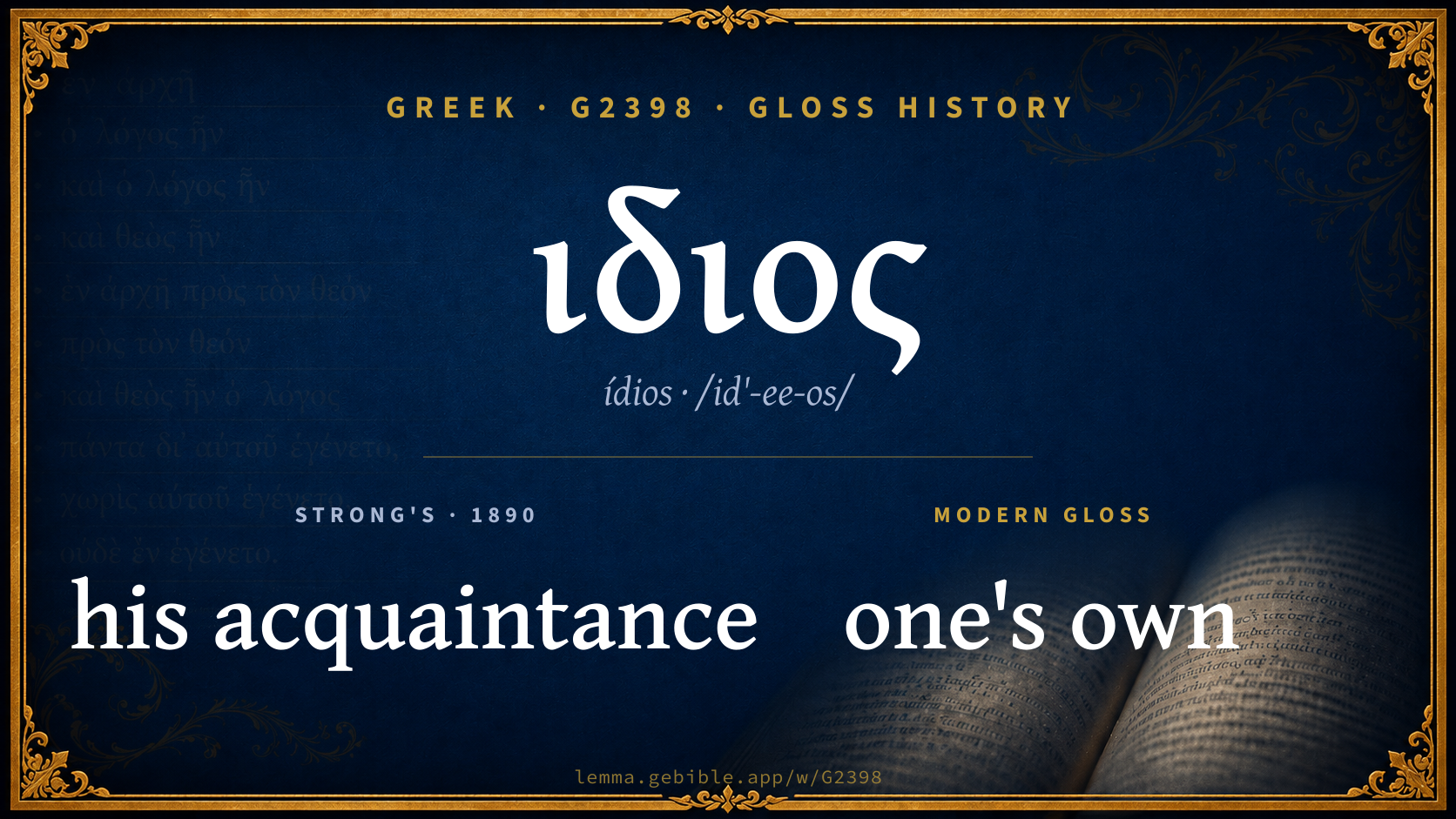
Gloss history
Strong's 1890 vs modern scholarship
About this word
Strong's G2398 catalogs a Greek word from the Greek New Testament.
These counts are not copied from any lexicon or concordance. They are computed here, from the morphology-tagged Greek New Testament. What Lemma adds →
- 109
- distinct verses
- The word appears in 109 distinct verses.
- 18 / 27
- NT books
- The word appears in 18 of 27 New Testament books.
- #145
- by frequency
- Top 250 most frequent Greek words (rank 145 of 5,347 Greek words by occurrence).
View all 109 occurrences in the concordance →
Most concentrated in
- Acts 16 verses 15%
- John 14 verses 13%
- 1 Corinthians 13 verses 12%
By section of the New Testament
By traditional corpus
Conventional, traditional groupings — biblical authorship is debated, so this is a traditional corpus grouping, not an authorship claim. Some books belong to more than one corpus (Luke is in both the Gospels and the Lukan corpus, and so on), so these shares overlap and need not total 100%. Each figure is a share of the word’s 109 distinct verses.
- Pauline corpus 40 verses · 37%
- Gospels 38 verses · 35%
- Lukan (Luke–Acts) 22 verses · 20%
- Johannine 14 verses · 13%
- General (Catholic) Epistles 11 verses · 10%
- Hebrews 4 verses · 4%
How translations render this word
Counts come from each version’s own published word-to-Strong’s tagging or interlinear alignment — an approximate guide to how each version renders this word, not a word-level alignment the data otherwise carries. Because each total is that version’s own tagged count, the per-version totals vary from one another and need not match the appearance or distinct-verse counts above. These counts may also differ from a printed concordance because Lemma counts each distinctly tagged rendering and does not collapse phrase taggings into a single head-word total. This is a fixed set of word-tagged versions (KJV, ASV, BSB, ULT) and does not change with the reading translation you choose elsewhere. Each version’s license is shown beside its name below (and on Sources).
- King James Version: Own 74×, His 4×, Due 3×
- American Standard Version: Own 62×, Apart 6×, His 6×
- Berean Standard Bible: Own 70×, Privately 10×, His 3×
- unfoldingWord Literal Text: Own 88×, Themselves 6×, Himself 5×
King James Version Public Domain
Renders G2398 across 98 tagged occurrences — most commonly:
Plus 11 renderings that appear only once — usually multi-word phrases or single function words the recovered tagging swept in, not distinct renderings. Not rendered by a distinct English word in 15 further occurrences.
American Standard Version Public Domain
Renders G2398 across 108 tagged occurrences — most commonly:
Plus 27 renderings that appear only once — usually multi-word phrases or single function words the recovered tagging swept in, not distinct renderings.
Berean Standard Bible Public Domain
Renders G2398 across 95 tagged occurrences — most commonly:
Plus 9 renderings that appear only once — usually multi-word phrases or single function words the recovered tagging swept in, not distinct renderings. Not rendered by a distinct English word in 19 further occurrences.
unfoldingWord Literal Text CC BY-SA 4.0
Renders G2398 across 112 tagged occurrences — most commonly:
Plus 9 renderings that appear only once — usually multi-word phrases or single function words the recovered tagging swept in, not distinct renderings.
Senses in Thayer's
The 1 sense Thayer's distinguishes for this word, in lexicon order (not ranked by frequency or importance). The full entry — with sub-senses — is in the Lexicon Entry tab.
- pertaining to one's self, one's own, belonging to one's self
Word origin
Origin: of uncertain affinity
Of uncertain affinity; pertaining to self that is one's own ; by implication private or separate : - X his acquaintance when they were alone apart aside due his (own proper several) home (her our thine your) own (business) private (-ly) proper severally their (own).
— Strong’s Exhaustive Concordance (1890), public domain.
Forms in the corpus
The 13 distinct written forms G2398 takes in the Greek New Testament, most frequent first — each parse links to that case’s occurrences in the concordance.
| Form | Parsing | Example | Uses |
|---|---|---|---|
| ἰδίαν idían | Adjective, Accusative, Singular, Feminine | Matthew 9:1 | 24 |
| ἴδιον ídion | Adjective, Accusative, Singular, Masculine | Matthew 22:5 | 18 |
| ἰδίᾳ idía | Adjective, Dative, Singular, Feminine | Matthew 13:57 | 13 |
| ἰδίου idíou | Adjective, Genitive, Singular, Masculine | Luke 6:44 | 11 |
| ἰδίοις idíois | Adjective, Dative, Plural, Masculine | Mark 4:34 | 10 |
| ἴδια ídia | Adjective, Accusative, Plural, Neuter | Luke 18:28 | 9 |
| ἰδίων idíōn | Adjective, Genitive, Plural, Masculine | Acts 24:23 | 7 |
| ἰδίῳ idíō | Adjective, Dative, Singular, Masculine | Luke 6:41 | 7 |
| ἰδίας idías | Adjective, Genitive, Singular, Feminine | Acts 25:19 | 6 |
| ἰδίους idíous | Adjective, Accusative, Plural, Masculine | Matthew 25:14 | 5 |
| ἰδίαις idíais | Adjective, Dative, Plural, Feminine | 1 Corinthians 4:12 | 2 |
| ἴδιοι ídioi | Adjective, Nominative, Plural, Masculine | John 1:11 | 1 |
| ἴδιος ídios | Adjective, Nominative, Singular, Masculine | Titus 1:12 | 1 |
Same root — word family
Other Thayer's entries built from the same root as G2398, grouped by Strong’s listed origin. These share a root / origin per the lexicon — not necessarily a shared meaning. Each links to that word’s own entry.
Derived from this word
Compare all same-root words → They share a root, not necessarily a meaning.
Septuagint usage
The same Greek word ιδιος appears 26 times in the Greek Old Testament (Septuagint), across 24 verses in 7 books.
- 26
- LXX occurrences
- Tagged occurrences of this Greek word in the Septuagint.
- 24
- verses
- Distinct Septuagint verses containing this word.
- 7 / 39
- OT books
- The word appears in 7 of the 39 Old Testament books.
Sample Septuagint occurrences
- Genesis 14:14 ἴδιος
- Deuteronomy 15:2 ἴδιος
- Esther 5:8 ἴδιος
- Job 2:11 ἴδιος
- Proverbs 5:18 ἴδιος
- Ezekiel 21:35 ἴδιος
- Daniel 1:10 ἴδιος
Septuagint occurrences (same lexeme)
Every verse where the same Strong’s number (G2398) appears in the Greek Septuagint. Verse text shown in the World English Bible for context; the Greek form is the matched word — the English is not keyword-highlighted.
- Genesis 14:14 ἴδιος When Abram heard that his relative was taken captive, he led forth his trained men, born in his house, three hundred and eighteen, and pursued as far as Dan.
- Genesis 15:13 ἴδιος He said to Abram, "Know for sure that your seed will live as foreigners in a land that is not theirs, and will serve them. They will afflict them four hundred years.
- Genesis 47:18 ἴδιος When that year was ended, they came to him the second year, and said to him, "We will not hide from my lord how our money is all spent, and the herds of cattle are my lord's. There is nothing left in the sight of my lord, but our bodies, and our lands.
- Deuteronomy 15:2 ἴδιος This is the manner of the release: every creditor shall release that which he has lent to his neighbor; he shall not exact it of his neighbor and his brother; because Yahweh's release has been proclaimed.
- Esther 5:8 ἴδιος if I have found favor in the sight of the king, and if it please the king to grant my petition, and to perform my request, let the king and Haman come to the banquet that I shall prepare for them, and I will do tomorrow as the king has said.
- Esther 6:12 ἴδιος Mordecai came again to the king's gate. But Haman hurried to his house, mourning and having his head covered.
- Job 2:11 ἴδιος Now when Job's three friends heard of all this evil that had come on him, they each came from his own place: Eliphaz the Temanite, Bildad the Shuhite, and Zophar the Naamathite, and they made an appointment together to come to sympathize with him and to comfort him.
- Job 7:10 ἴδιος He shall return no more to his house, Neither shall his place know him any more.
- Job 7:13 ἴδιος When I say, 'My bed shall comfort me, My couch shall ease my complaint;'
- Job 24:12 ἴδιος From out of the populous city, men groan. The soul of the wounded cries out, Yet God doesn't regard the folly.
- Proverbs 5:18 ἴδιος Let your spring be blessed. Rejoice in the wife of your youth.
- Proverbs 5:19 ἴδιος A loving doe and a graceful deer-- Let her breasts satisfy you at all times. Be captivated always with her love.
- Proverbs 5:20 ἴδιος For why should you, my son, be captivated with an adulteress? Why embrace the bosom of another?
- Proverbs 6:2 ἴδιος You are trapped by the words of your mouth. You are ensnared with the words of your mouth.
- Proverbs 9:12 ἴδιος If you are wise, you are wise for yourself. If you mock, you alone will bear it.
- Proverbs 11:24 ἴδιος There is one who scatters, and increases yet more. There is one who withholds more than is appropriate, but gains poverty.
- Proverbs 13:8 ἴδιος The ransom of a man's life is his riches, But the poor hear no threats.
- Proverbs 16:19 ἴδιος It is better to be of a lowly spirit with the poor, Than to divide the plunder with the proud.
- Proverbs 20:16 ἴδιος Take the garment of one who puts up collateral for a stranger; And hold him in pledge for a wayward woman.
- Proverbs 22:7 ἴδιος The rich rule over the poor. The borrower is servant to the lender.
- Proverbs 27:8 ἴδιος As a bird that wanders from her nest, So is a man who wanders from his home.
- Proverbs 27:15 ἴδιος A continual dropping on a rainy day And a contentious wife are alike:
- Ezekiel 21:35 ἴδιος
- Daniel 1:10 ἴδιος The prince of the eunuchs said to Daniel, I fear my lord the king, who has appointed your food and your drink: for why should he see your faces worse looking than the youths who are of your own age? so would you endanger my head with the king.
These are occurrences of the same Greek lexeme (G2398) in the Septuagint — not a translation of any one Hebrew word. The store carries no word-level Hebrew↔Greek alignment, so no Hebrew original is asserted here. Counts come from the recovered LXX Strong's tagging — high-frequency vocabulary is well covered, while rare or late forms may be untagged — so they reflect tagged occurrences and may slightly undercount.