
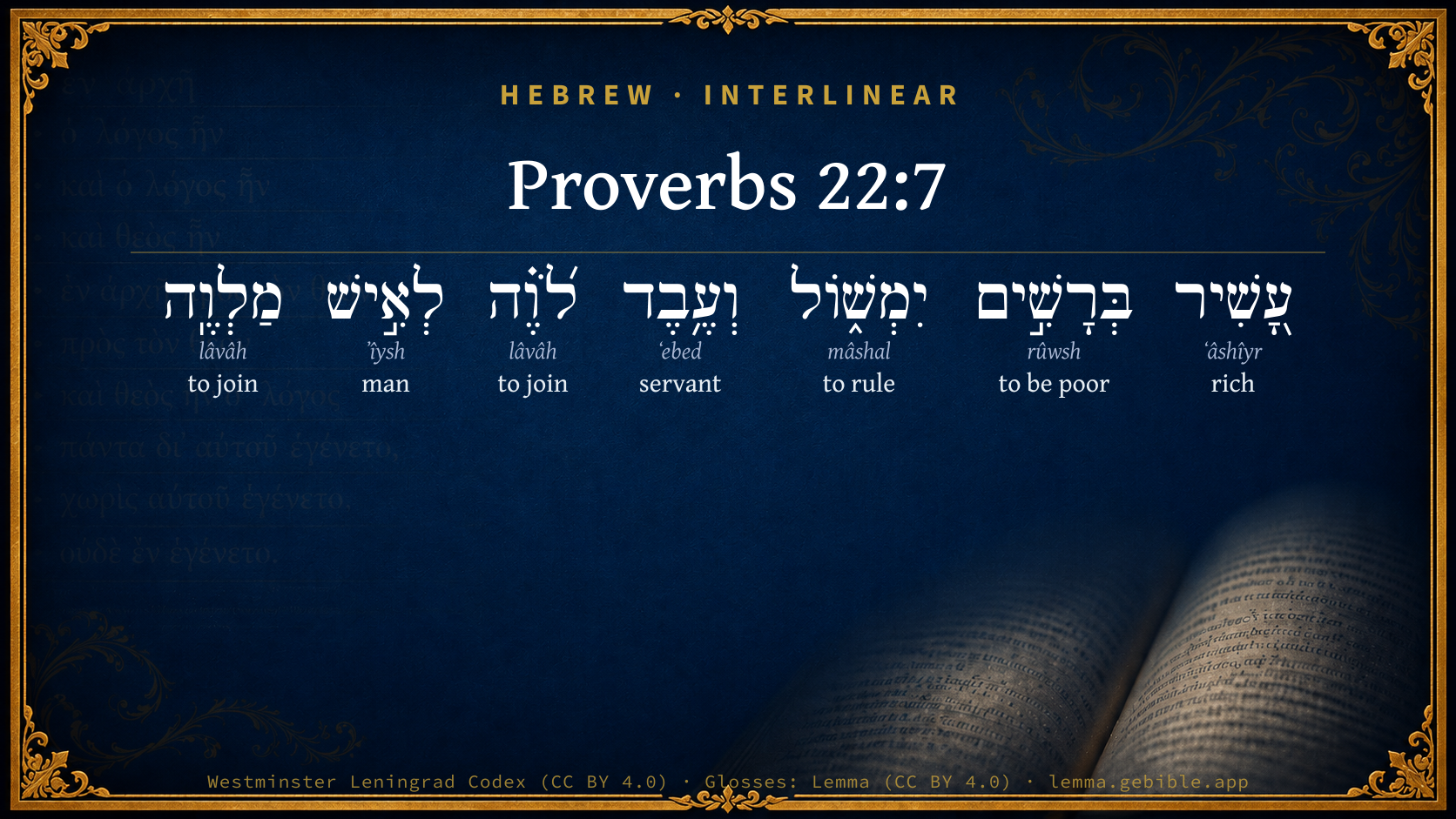
Proverbs 22:7

Hebrew (Westminster Leningrad Codex) Proverbs 22:7 appears in the Hebrew Old Testament. The text above is from the Westminster Leningrad Codex. Each word links to its Strong’s number, a concise gloss, and parsing drawn from the Open Scriptures Hebrew Bible morphology. Click any word for its full Brown-Driver-Briggs (BDB) entry.
Download image
Cite this verse

Proverbs 22:7 (World English Bible). Public Domain. Lemma interlinear Bible study tool, https://lemma.gebible.app/v/proverbs/22/7.

Show BibTeX & RIS
BibTeX
RIS
English Translation
The rich rule over the poor. The borrower is servant to the lender.
World English Bible · Public Domain
Download a study sheet

One document with this verse’s original text, its word-by-word gloss line, the meaning frame, cross-references with their text, attributed commentary, and full source and license credits — printable, and it pastes into notes with its structure intact.

This verse Autodidact and up

Study sheet (.html) Plain text (.txt)

A passage Seminary Student

Up to 50 verses in one chapter. A passage sheet keeps up to 6 commentary sources and 12 cross-references per verse, in the order this page ranks them, and says so on the sheet whenever that leaves anything out. Ask for a single verse and you get the Autodidact verse sheet above.

Everything on this page stays free to read, with no account — the sheet is a download of what is already on screen, not access to it.

Want to remove ads? Support Godless Engineer
Compare translations 3

The same verse in 3 English versions, stacked beneath the original-language interlinear above. Click any original word for its lexicon entry.

Each is an independent rendering of the whole verse — the interlinear is not word-aligned to these translations.

Highlighted words mark where these versions differ — a whole-verse word diff, not a word-by-word alignment.

  • World English Bible Public Domain
    The rich rule over the poor. The borrower is servant to the lender.
  • King James Version Public Domain
    The rich ruleth over the poor, and the borrower is servant to the lender.
  • unfoldingWord Literal Text CC BY-SA 4.0
    A rich one rules over those who are poor, and a borrower a slave to a man who lends.

unfoldingWord Literal Text — © unfoldingWord, licensed CC BY-SA 4.0. Word-aligned USFM3 via Door43 (git.door43.org/unfoldingWord/en_ult).

Versions to compare (up to 4)

3 of 4 selected

Show all 18 translations

Every available English version of this verse, each an independent rendering of the whole verse.

  • World English Bible Public Domain
    The rich rule over the poor. The borrower is servant to the lender.
  • Berean Standard Bible Public Domain
    The rich rule over the poor, and the borrower is slave to the lender.
  • Majority Standard Bible Public Domain
    The rich rule over the poor, and the borrower is slave to the lender.
  • King James Version Public Domain
    The rich ruleth over the poor, and the borrower is servant to the lender.
  • American Standard Version (1901) Public Domain
    The rich ruleth over the poor; And the borrower is servant to the lender.
  • Revised Version (1885) Public Domain
    The rich ruleth over the poor, and the borrower is servant to the lender.
  • Geneva Bible (1599) Public Domain
    The rich ruleth the poore, and the borower is seruant to the man that lendeth.
  • Douay-Rheims (1899) Public Domain
    The rich ruleth over the poor: and the borrower is servant to him that lendeth.
  • Young's Literal Translation Public Domain
    The rich over the poor ruleth, And a servant `is' the borrower to the lender.
  • Literal Standard Version CC BY-SA 4.0
    The rich rules over the poor, || And a servant [is] the borrower to the lender.
  • Unlocked Literal Bible CC BY-SA 4.0
    Rich people rule over poor people and one who borrows is a slave to the one who lends.
  • unfoldingWord Literal Text CC BY-SA 4.0
    A rich one rules over those who are poor, and a borrower a slave to a man who lends.
  • Darby Bible Public Domain
    The rich ruleth over the poor; and the borrower is servant to the lender.
  • World Messianic Bible Public Domain
    The rich rule over the poor. The borrower is servant to the lender.
  • Webster's Bible Public Domain
    The rich ruleth over the poor, and the borrower is servant to the lender.
  • Free Bible Version CC BY-SA 4.0
    The rich rule the poor, and borrowers are slaves to their lenders.
  • Bible in Basic English Public Domain
    The man of wealth has rule over the poor, and he who gets into debt is a servant to his creditor.
  • JPS Tanakh (1917) Public Domain
    The rich ruleth over the poor, and the borrower is servant to the lender.

Literal Standard Version (2020), Covenant Press — licensed CC BY-SA 4.0. Text via the HelloAO Bible API (eBible.org). Unlocked Literal Bible (unfoldingWord) — licensed CC BY-SA 4.0. Text via the HelloAO Bible API (eBible.org). unfoldingWord Literal Text — © unfoldingWord, licensed CC BY-SA 4.0. Word-aligned USFM3 via Door43 (git.door43.org/unfoldingWord/en_ult). Free Bible Version, Dr. Jonathan Gallagher — licensed CC BY-SA 4.0. Text via the HelloAO Bible API (eBible.org).

Word by word

More ways to search: Search by grammar → Find every occurrence → Compare this word →

Practice this passage: Drill this verse → Learn its vocabulary →

About this verse

These counts appear in no published source. They are computed here, from the morphology-tagged text and Lemma’s own curated glosses. What Lemma adds →

7
words
6
distinct lemmas
Wisdom
section

Notable vocabulary

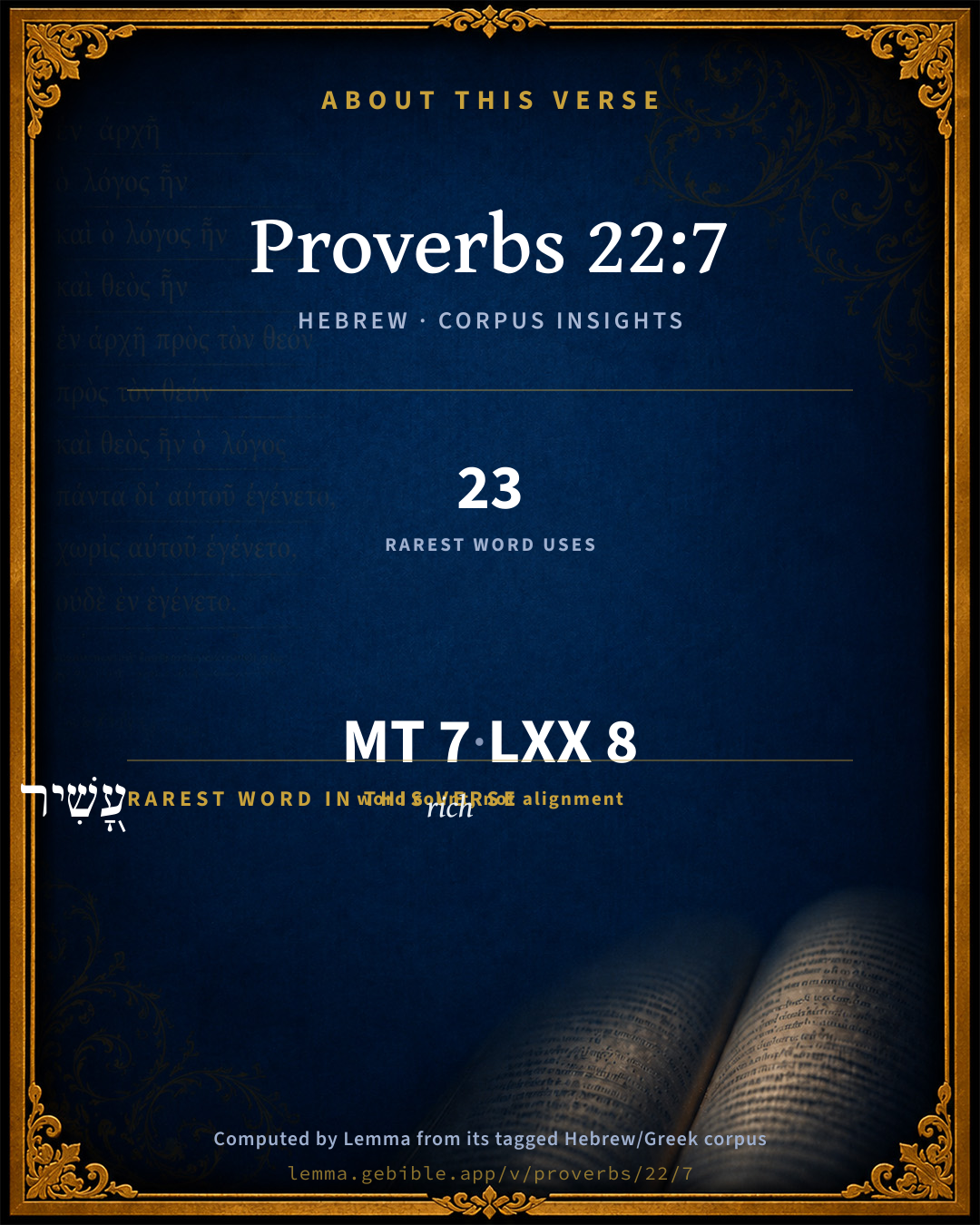
The rarest word here is עָ֭שִׁיר rich H6223 — appearing just 23 times in the whole Hebrew Bible.

Shared distinctive vocabulary

עָ֭שִׁיר rich H6223 occurs in 23 verses of the Hebrew Bible. Also found in:

Grammatical profile

  • 4 verbs
  • 2 nouns
  • 1 adjective

Verb forms

  • בְּרָשִׁ֣ים Qal · Participle Active
  • יִמְשׁ֑וֹל Qal · Imperfect
  • לֹ֝וֶ֗ה Qal · Participle Active
  • מַלְוֶֽה Hiphil · Participle Active

Repetition

A word recurs within this verse — often emphatic in Hebrew:

  • לֹ֝וֶ֗ה to join H3867 ×2

Hebrew & Septuagint length

In English translation the verse runs 13 words from the Hebrew and 15 from the Septuagint (LXX English) — closely comparable.

A rough comparison of the two English renderings, which tokenize alike — not a word-level alignment.

Word counts can differ between the Hebrew and the Greek without any difference in meaning — e.g. the Hebrew direct-object marker אֵת has no separate Greek word, and Greek often adds the article ὁ.

In the original languages it is 7 Hebrew tokens and 8 Greek tokens — but the two are counted differently (Hebrew bundles its prefixes and suffixes into one token; the Greek is in lemma form), so that isn’t a like-for-like length.

Cross-references

16

Topical passages linked to Proverbs 22:7 in the Treasury of Scripture Knowledge — connected by theme and wording, ordered by reader-vote popularity; previews shown in the World English Bible.

  • 2 Kings 4:1 Now there cried a certain woman of the wives of the sons of the prophets to Elisha, saying, Your servant my husband is dead; and you know that your servant did fear Yahweh: and the creditor is come to take to him my two children to be bondservants.
  • Matthew 18:25 But because he couldn't pay, his lord commanded him to be sold, with his wife, his children, and all that he had, and payment to be made.
  • Proverbs 22:16 Whoever oppresses the poor for his own increase and whoever gives to the rich, Both come to poverty.
  • Proverbs 14:31 He who oppresses the poor shows contempt for his Maker, But he who is kind to the needy honors him.
  • Proverbs 18:23 The poor plead for mercy, But the rich answer harshly.
  • Proverbs 22:22 Don't exploit the poor, because he is poor; And don't crush the needy in court;
  • James 2:6 But you have dishonored the poor man. Don't the rich oppress you, and personally drag you before the courts?
  • James 5:1 Come now, you rich, weep and howl for your miseries that are coming on you.
  • Nehemiah 5:4–5 There were also that said, We have borrowed money for the king's tribute [on] our fields and our vineyards.
  • Amos 5:11–12 Forasmuch therefore as you trample on the poor, And take taxes from him of wheat: You have built houses of hewn stone, But you will not dwell in them. You have planted pleasant vineyards, But you shall not drink their wine.
  • Isaiah 24:2 It shall be, as with the people, so with the priest; as with the servant, so with his master; as with the maid, so with her mistress; as with the buyer, so with the seller; as with the creditor, so with the debtor; as with the taker of interest, so with the giver of interest to him.
  • Amos 4:1 Listen to this word, you cows of Bashan, who are on the mountain of Samaria, who oppress the poor, who crush the needy, who tell their lords, "Bring, and let us drink."
  • Amos 8:4 Hear this, you who desire to swallow up the needy, And cause the poor of the land to fail,
  • Amos 8:6 That we may buy the poor for silver, And the needy for a pair of shoes, And sell the sweepings with the wheat?'"
  • Amos 2:6 Thus says Yahweh: "For three transgressions of Israel, yes, for four, I will not turn away its punishment; Because they have sold the righteous for silver, And the needy for a pair of shoes;
  • James 5:4 Behold, the wages of the laborers who mowed your fields, which you have kept back by fraud, cry out, and the cries of those who reaped have entered into the ears of the Lord of Hosts.

Cross-references courtesy of OpenBible.info (CC BY 4.0).

Hebrew and Greek witnesses Masoretic Hebrew ↔ Greek Septuagint

The same verse in the two great witnesses to the Old Testament, shown verse-for-verse.

These are two independent witnesses, not word-aligned to each other, and the Septuagint is shown in lemma (dictionary) form.

Hebrew Proverbs 22:7 Masoretic · Westminster Leningrad Codex

עָ֭שִׁיר בְּרָשִׁ֣ים יִמְשׁ֑וֹל וְעֶ֥בֶד לֹ֝וֶ֗ה לְאִ֣ישׁ מַלְוֶֽה

The rich rule over the poor. The borrower is servant to the lender.

World English Bible · Public Domain

Greek LXX Proverbs 22:7 Septuagint · lemma form

πλούσιος πτωχός ἄρχω καί οἰκέτης ἴδιος δεσπότης δανείζω

The rich will rule over the poor, and servants will lend to their own masters.

LXX2012 (modern English Septuagint) · Public Domain

On this verse, The Pulpit Commentary discusses the Septuagint’s reading. Read the note in Commentary ↓

Hebrew: Westminster Leningrad Codex (CC BY 4.0). Greek: Septuagint (public domain); English from LXX2012 (modern English Septuagint) (Public Domain). How the Septuagint differs from the Hebrew →

Commentary

Notes on Proverbs 22:7 from classic Christian and Jewish commentators (each source and its license shown beneath its notes). The classic Christian expositions comment on the surrounding passage and are grouped to its opening verse, so a note may address several verses; the Jewish commentaries on the Tanakh (Rashi and others) are per-verse, so they appear only where the commentator wrote on this verse.

Lemma curates 59 commentaries, every one of them public domain or Creative Commons licensed, each selected and text-cleaned for this edition rather than reprinted as found. About our sources →

Trapp's Complete Commentary

John Trapp

Pro 22:7 The rich ruleth over the poor, and the borrower [is] servant to the lender.

Ver. 7. The rich ruleth over the poor.] And that with rigour, as Pharaoh did over Israel, as those imperious mammonists in St James’s time that oppressed and subjugated their poorest brethren, trampling upon them with the feet of intolerable insolence and cruelty. {Jas 2:6} "Yet now our flesh is as the flesh of our brethren, our children as their children," said those poor Jews in Nehemiah, who pleads their cause most effectually. {Neh 5:7-13} Ubi quot verba, tot tela, quae nimirum animam divitum percellant, fodicent et lancinent, as one saith in another case, He sets upon them with irresistible rhetoric, and makes them restore - which yet rich oppressors are very hardly drawn to do. Every grain of riches hath a vermin of pride and ambition in it. {1Ti 6:17} {See Trapp on "1Ti 6:17"} Men’s blood riseth together with their good, and they think that everything must be as they would have it. But especially if they have "drawn the poor into their nets" {Psa 10:9} - that is, into their bonds, debts, mortgages, as Chrysostom expounds it; then they not only rob, but ravish them; to their cruelty they join dishonesty; there is neither equity nor mercy to be had at their hands.

John Trapp, A Commentary or Exposition upon All the Books of the Old and New Testament (1647–1656) — public domain. Text from a community e-Sword module.

The Biblical Illustrator

Joseph S. Exell

Pro_22:7

The rich ruleth over the poor, and the borrower is servant to the lender.

The borrower servant to the lender

The mere circumstance of being rich gives one man superiority over another who is poor. He who is forced to borrow is placed on that very account in a sort of relative inferiority to him whose position enables him to lend. These words may be compared with those attributed to the Lord Jesus, It is more blessed to give than to receive.

I. The principle may be universally acknowledged and acted upon. Though a man may have received much--a vigorous intellect, a commanding judgment, a rich imagination--he will be miserable if he can give nothing. If a man were assured that he would never be permitted to tell what he had done or recite what he had seen, he loses at once the great impetus which urges him to do much or to see much. A man is not satisfied with being rich, he must be in circumstances to give; some one must be borrower, while he is a lender. It is the giving which makes the receiving of any worth. What is the reason of this alleged supremacy of giving over receiving?

1. The resemblance which is thus acquired to our Redeemer and Creator. If God be love, there is no presumption in supposing that without objects over which the love might expand the Almighty Himself would have remained unsatisfied. Lending, not borrowing, constitutes the happiness of God. And there is more like-mindedness to Christ in giving than in receiving.

2. The giver or the lender has necessarily an advantage over the receiver or the borrower, and this explains how the one is the servant of the other. In all cases the giving seems to imply a relative superiority and the receiving a relative inferiority.

3. Notice the reflex character of benevolence which causes that whatever is bestowed is restored to us tenfold.

II. Objections urged against the statement of the text. In dividing society into the lenders and the borrowers you would exclude the vast majority of mankind from the possibility of being charitable. But being charitable is not limited to any class of society. The poor man may be a giver as well as the rich. God has not granted to the wealthy a monopoly of benevolence. (H. Melvill, B.D.)

A wholesome horror of debt

The venerable Peter Cooper of New York, whose philanthropic efforts for the elevation of the masses are well known throughout the United States, celebrated his ninety-first birthday. In conversation with a reporter who congratulated him, Mr. Cooper referred to some of the guiding principles to which he attributed his success in life. Among other weighty observations were the following remarks on the burden of debt which are worthy the attention of all, especially of young men. Mr. Cooper said: When I was twenty-one years old my employer offered to build me a shop and set me up in business, but as I always had a horror of being burdened with debt, and having no capital of my own, I declined his kind offer. He himself became a bankrupt. I have made it a rule to pay for everything as I go. If, in the course of business, anything is due from me to any one and the money is not called for, I make it my duty on the last Saturday before Christmas to take it to his business place.

The Biblical Illustrator, edited by Joseph S. Exell (c. 1880s–1900s) — public domain. Text from a community e-Sword module.

The Preacher's Complete Homiletical Commentary

Joseph S. Exell (gen. ed.)

MAIN HOMILETICS OF Pro_22:7

AN ANALOGY AFFIRMED AND A CONTRAST SUGGESTED

I. The contrast between the poor man and the borrower. The proverb at least suggests that the poor man and the borrower are not necessarily convertible terms—that a poor man may owe no man anything, and that a man may be in debt without being a poor man in the common acceptation of the word.

1. The poor man and the borrower may occupy different social relations; indeed, as a rule this is the case. The poor man may have been born to poverty, and consequently may be inured to its hardships, one of which is its subjection to the will of the rich. But the borrower may have been born to wealth, and himself accustomed to rule over the poor. The one may be so ignorant and degraded by reason of his poverty as scarcely to be conscious of the yoke he wears; whereas the servitude of the other will be galling in proportion as his education renders him sensitive to his position.

2. They may be unlike in the fact that the poor man may have had no choice but poverty—he may have been born in it, and may have had no opportunity of altering his condition; but the borrower may not have been absolutely obliged to borrow—he may have borrowed merely to speculate or to waste.

II. The point of resemblance between them. They are alike in being both dependent upon the same person—upon the rich man. This rich man may be unlike his poor brother in nothing save in his possession of gold; he may be as uneducated as he is, and, morally, far beneath him. He may be much less polished and refined than the man who borrows of him, but, whatever he is or is not does not alter the case, his money makes him the master—both the poor man and the debtor must submit to his dictation, must acknowledge their dependence on him. Both often have the painful consciousness that he holds in his hand all that makes their existence of any value to them—both often alike feel that he could at any time deprive them of their very bread.

III. The lesson of the proverb. The wise man, by thus showing how two men who are unlike in almost every other respect may be reduced to the same level in this, is probably reading a lesson against borrowing. The poor man’s subjection to the rich is a matter which it is not in his power to alter, but a man goes into debt generally of his own free will. He may often be very hardly pressed by necessity to do so, or as a matter of business it may be advisable, but the proverb at least suggests that the step should not be taken without well weighing the consequences. It is doubtless mainly directed against borrowing when a man has not resources to repay, and is not likely to have them.

OUTLINES AND SUGGESTIVE COMMENTS

1. The responsibility of the rich. How great the power of wealth. In this world it is a talent often more influential for good than intellect or genius.…

2. The temptation of the poor.… To become servile, cringing in spirit. Flunkeyism is the greatest curse of the people.…

3. The wisdom of the diligent. The industrious man is a wise man. Why? Because the more industrious he is, the more independent he becomes of wealthy men.—Dr. D. Thomas.

Very important is it to maintain an independence of mind, quite distinct from pride, which elevates the mind far above doing or conniving at evil, for the sake of pleasing a patron. Many have been forced to great entanglement of conscience, perhaps to vote contrary to their conscience, rather than lose the great man’s smile. Often also the influence of capital is an iron rule of the rich over the poor. Many, who profess to resist conscientiously state-interference, have little regard for the consciences of their dependants. The monied master exercises a control over his workmen, which shews too plainly his purpose to make them the creatures of his own will. This gigantic tyranny should be denounced with the most solemn protest. The true Christian line is to shun that proud independence, which scorns the kindly offer of needful help; but at the same time to avoid all needless obligations. “Sell not your liberty to gratify your luxury.” If possible, “owe no man anything but love.” (Rom_13:8.) “Guard against that poverty, which is the result of carelessness or extravagance. Pray earnestly, labourdiligently. Should you come to poverty by the misfortune of the times, submit to your lot humbly; bear it patiently; cast yourself in child-like dependence upon your God.”—Bridges.

The Preacher's Complete Homiletical Commentary (gen. ed. Joseph S. Exell; Funk & Wagnalls, c. 1892) — public domain (pre-1929). A full-Bible homiletical/sermon-outline anthology covering 65 of 66 books (2 John is absent from the source module). Text from a community e-Sword module.

Tyndale Open Study Notes

Tyndale Open Resources

22:7 This is a warning against being a borrower; other proverbs warn against guaranteeing others’ debts (6:1-2; 20:16).

Tyndale Open Study Notes — © Tyndale Open Resources, licensed CC BY-SA 4.0. Text via the HelloAO Bible API.

Matthew Henry's Commentary

He had said (Pro 22:2.), Rich and poor meet together; but here he finds, here he shows, that, as to the things of this life, there is a great difference; for, 1. Those that have little will be in subjection to those that have much, because they have dependence upon them, they have received, and expect to receive, support from them: The rich rule over the poor, and too often more than becomes them, with pride and rigour, unlike to God, who, though he be great, yet despises not any. It is part of the affliction of the poor that they must expect to be trampled upon, and part of their duty to be serviceable, as far as they can, to those that are kind to them, and study to be grateful. 2. Those that are but going behindhand find themselves to lie much at the mercy of those that are before hand: The borrower is servant to the lender, is obliged to him, and must sometimes beg, Have patience with me. Therefore it is part of Israel's promised happiness that they should lend and borrow, Deu 28:12. And it should be our endeavour to keep as much as may be out of debt. Some sell their liberty to gratify their luxury.

Matthew Henry's Commentary on the Whole Bible (1708–1710) — public domain (CC PDM 1.0). Text via the HelloAO Bible API.

Jamieson, Fausset & Brown

Robert Jamieson, A. R. Fausset & David Brown

The influence of wealth sets aside moral distinctions is implied, and, of course, disapproved (compare Pro 19:6; Pro 21:14, &c.).

Jamieson, Fausset & Brown — Commentary Critical and Explanatory on the Whole Bible (1871) — public domain (CC PDM 1.0). Text via the HelloAO Bible API.

Adam Clarke's Commentary

Verse 7. The rich ruleth over the poor] So it is in the order of God, and may be a blessing to both.

Adam Clarke's Commentary on the Bible (1810–1826) — public domain. Text from a community e-Sword/MySword module.

The Cambridge Bible for Schools and Colleges

gen. ed. J. J. S. Perowne

7. servant] not necessarily by being sold to him as a slave (Lev_25:30. Comp. Jer_34:13; Jer_34:17); but more generally as being compelled to do his bidding.

The Cambridge Bible for Schools and Colleges (gen. ed. J. J. S. Perowne; Cambridge University Press, 1878–1918) — public domain. Text from a community e-Sword module.

John Gill's Exposition

The rich ruleth over the poor,.... Usurps a dominion over them, and exercises it in a rigorous, oppressive, and tyrannical manner; otherwise they are generally the rich that rule, and if they rule well, in a lawful, gentle, and righteous manner, it is commendable;

and the borrower is servant to the lender; being under obligation to him, he is forced to be subject to him, and comply with his humours, and do and say as he would have him; it was a happiness promised to the Israelites, that they should lend to many nations, but not borrow, Deu 15:6; compare with this Neh 5:4.

John Gill's Exposition of the Whole Bible (1746–1763) — public domain (CC PDM 1.0). Text via the HelloAO Bible API.

Haydock's Catholic Bible Commentary

Servant. He might be sold, &c., Exodus xxii. 3., and Matthew xviii. 25. (Gell. xx. 1.) Plato (Leg. viii.) would have nothing sold on credit. These laws appear to be severe; but they are founded on wisdom, as nothing impoverishes more than the facility of borrowing.

George Leo Haydock (1774–1849), Haydock's Catholic Family Bible and Commentary, 1859 edition — public domain. Excludes Psalms (Douay-Rheims chapter numbering differs from Protestant) and Deuterocanonical books (Catholic canon only).

Matthew Poole's English Annotations

Ruleth over the poor, to wit, with rigour and tyranny, taking advantage of his necessities.

Is servant to the lender; is at his mercy, and therefore forced to comply with his pleasure. The design of the proverb is partly to correct this miscarriage of the rich, and partly to oblige all men to diligence, whereby they may deliver themselves from this servitude.

Matthew Poole's English Annotations on the Holy Bible (1683–1685) — public domain. Text from a community e-Sword/MySword module.

Whedon's Commentary on the Bible

Daniel D. Whedon

7. The rich ruleth over the poor — This proverb, also, states a general fact in forcible language. Riches give influence, power, dominion over those who are without wealth; and the man who borrows, or otherwise goes in debt, loses, in some sense, his liberty by the obligation which he is under to his creditor.

Servant — עבד, (‘hebhedh,) is the word commonly used for bondman, (slave,) though not confined to that sense.

Daniel D. Whedon (gen. ed.), Commentary on the Old and New Testaments (1874–1909) — public domain. Text from a community e-Sword module.

The Pulpit Commentary

The rich ruleth over the poor. "The rich man (singular) will rule over the poor" (plural); for there are many poor for one rich (see on ver. 3). This is the way of the world. (Pro_18:23) Aben Ezra explains the gnome as showing the advantage of wealth and the inconvenience of poverty; the former bringing power and pre-eminence, the latter trouble and servitude; and hence the moralist implies that every one should strive and labour to obtain a competency, and thus avoid the evils of impecuniosity. The borrower is servant to the lender. (For the relation between borrower and louder, or debtor and creditor, see on Pro_20:16; and comp. Mat_18:25, Mat_18:34) Delitzsch cites the German saying, "Borghart (borrower) is Lehnhart"s (leader"s) servant." We have the proverb, "He that goes a-borrowing goes a-sorrowing." The Septuagint departs from the other versions and our Hebrew text, translating, "The rich will role over the poor, and household servants will lend to their own masters a reading on which some of the Fathers have commented.

The Pulpit Commentary (1880–1919), ed. H.D.M. Spence-Jones & Joseph S. Exell — public domain. Text from a community e-Sword module.

John Wesley's Explanatory Notes

Is servant - Is at his mercy, and forced to comply with his pleasure.

John Wesley, Explanatory Notes Upon the Whole Bible (1754–1765) — public domain. Text via the GEBible commentary corpus.

Keil & Delitzsch

C. F. Keil & F. Delitzsch

7 A rich man will rule over the poor,

And the borrower is subject to the man who lends.

"This is the course of the world. As regards the sing. and plur. in 7a, there are many poor for one rich; and in the Orient the rule is generally in the hands of one" (Hitzig). The fut. denotes how it will and must happen, and the substantival clause 7b, which as such is an expression of continuance (Arab. thabât, i.e., of the remaining and continuing), denotes that contracting of debt brings naturally with it a slavish relation of dependence. לוה, properly he who binds himself to one se ei obligat, and מלוה, as Pro 19:17 (vid., l.c.), qui alterum (mutui datione) obligat, from לוה, Arab. lwy, to wind, turn, twist round (cog. root laff), whence with Fleischer is also to be derived the Aram. לות, "into connection;" so אל, properly "pushing against," refers to the radically related אלה (= ולה), contiguum esse. אישׁ מלוה is one who puts himself in the way of lending, although not directly in a professional manner. The pred. precedes its subject according to rule. Luther rightly translates: and he who borrows is the lender's servant, whence the pun on the proper names: "Borghart [= the borrower] is Lehnhart's [= lender's] servant."

Keil & Delitzsch — Biblical Commentary on the Old Testament (1861–1891) — public domain (CC PDM 1.0). Text via the HelloAO Bible API. (Old Testament only.)

Bridges on Proverbs

Charles Bridges

"The rich and the poor meet together" (Pro 22:2 ) for mutual sympathy and helpfulness; yet God has appointed one to rule, and the other to submit. And this gradation of rank in all its forms, involves distinct obligations to be carefully sought out and followed. Subjection, on the one hand, is cheerfully acknowledged as God’s own ordinance; while the sense of responsibility is enlarged on the other. The rule applies to all the domestic relations between dependants and superiors. Yet let it be the rule of order, not of pride, caprice, or selfishness. And especially, when exercised over young persons of refined minds and education, let dependence be soothed by "the law of kindness," elevating them to a rank far above the menials of the house. The golden rule of love will diffuse Christian happiness without disorder or compromise of obligation.

Too often, however, it is a rule of harshness.†1 And indeed, without a practical submission to God’s rule over us, we can scarcely be trusted with power over our fellow-men. Such obligations as that of the borrower to the lender, often force the dependant to a servile bondage. Man becomes an alien to his brother; the victim of his gratification, not the object of his sympathy.†2

Very important is it to maintain an independence of mind, quite distinct from pride, which elevates the mind far above doing or conniving at evil, for the sake of pleasing a patron. Many have been forced to great entanglement of conscience, perhaps to vote contrary to their conscience, rather than lose the great man’s smile. Often also the influence of capital is an iron rule of the rich over the poor. Many, who profess to resist conscientiously state-interference, have little regard for the consciences of their dependants. The monied master exercises a control over his workmen, which shews too plainly his purpose to make them the creatures of his own will. This gigantic tyranny should be denounced with the most solemn protest.

The true Christian line is to shun that proud independence, which scorns the kindly offer of needful help; but at the same time to avoid all needless obligations. ’Sell not your liberty to gratify your luxury.’†3 If possible, "own no man anything but love." (Rom 13:8 .) ’Guard against that poverty, which is the result of carelessness or extravagance. Pray earnestly, labor diligently. Should you come to poverty by the misfortune of the times, submit to your lot humbly; bear it patiently; cast yourself in child-like dependence upon your God.’†4

Footnotes:

†1 Pro 18:23. Amo 2:6 ; Amo 4:1 ; Amo 5:11-12 ; Amo 8:4-6 . Jas 2:6 ; Jas 5:4 . Compare Sir 13:19 .

†2 2Ki 4:1 . Neh 5:3-5 . Mat 18:25-29 . Compare the blessing, Deu 15:6 ; Deu 28:12 .

†3 Henry in loco.

†4 Geier in loco.

Charles Bridges, An Exposition of the Book of Proverbs (1846) — public domain. Text from a community e-Sword module.

Kretzmann's Popular Commentary

Paul E. Kretzmann

v. 7. The rich ruleth over the poor, his wealth giving him a large measure of power, especially if the poor are dependent upon him for loans, and the borrower is servant to the lender, for indebtedness is bound to interfere with the feeling, if not with the fact, of freedom.

Paul E. Kretzmann, Popular Commentary of the Bible (1921–1924) — public domain. Text from a community e-Sword module.

unfoldingWord translationNotes

Door43 World Missions Community

borrows ... lends

You may need to make explicit what it is that is borrowed or lent. AT: "borrows money ... lends money" (See: Assumed Knowledge and Implicit Information)

He who sows injustice will reap trouble

The writer speaks of a ruler or other powerful person treating those less powerful unjustly as if he were planting seeds that will give birth to plants that bring trouble. AT: "If a person treats those less powerful than he is unjustly, they will cause him trouble later on" (See: Metaphor)

the rod of his fury will fade away

The word "rod" is a metonym for power over other people. Possible meanings are 1) the unjust ruler will lose the power that he had that allowed him to treat other people unjustly or 2) when the people respond to the injustice he had done by harming him, he will have no power to stop them. AT: "he will no longer have the power that he had used to harm people" (See: Metonymy)

rod of his fury

The word "rod" is a metonym for power over other people. The unjust man was harming innocent people as if he were very angry with them. AT: "the rod he had used as if he were punishing people" or "the power he used to harm others" (See: Metonymy)

will fade away

The word translated "fade away" is also used of plants drying up.

translationWords

rule

servant

plant

reap

trouble

wrath

unfoldingWord translationNotes — © Distant Shores Media and the Door43 World Missions Community, licensed CC BY-SA 4.0. Source: git.door43.org/Door43/en_tn.

Rashi

Rabbi Shlomo Yitzchaki (Rashi)

A rich man will rule over the poor An ignoramus always needs a Torah scholar.

Rashi on the Tanakh — English translations: “The Judaica Press complete Tanach with Rashi, translated by A. J. Rosenberg” (CC BY 4.0); “Pentateuch with Rashi's commentary by M. Rosenbaum and A.M. Silbermann, 1929-1934” (public domain); “The Metsudah Tanach series, Lakewood, N.J” (CC BY 4.0); and “The Book of Joshua, Metsudah Publications, 1997” (CC BY 4.0). Text via Sefaria.

Lesson kit

Teaching starters — assembled from the data on this page, not authored interpretation. Every prompt links to the verse data it draws on. Edit before teaching.

Proverbs, in the Wisdom, opens this verse with 7 words (6 distinct Hebrew lemmas). Its most distinctive word is ʻâshîyr (“rich”). A historical commentator’s framing appears above. Read the whole chapter for the surrounding context.

Discussion questions

  1. What does “rich” (ʻâshîyr) contribute to the verse as a whole?
  2. Exodus 30:15 shares the word «rich» with this verse. How do the two illuminate each other?
  3. “to join” occurs 2× in this one verse. What is the effect of the repetition?
  4. These translations render this verse differently. What is at stake in choosing one wording over another?
  5. The verb «בְּרָשִׁ֣ים» is Qal Participle Active. How does its form color the action?
  6. Reading how Trapp's Complete Commentary and The Biblical Illustrator read this verse, where do the two commentators agree and where do they part?

Things to notice

Reading settings

Reading text

Shown beneath each verse's original-language words.

Old Testament
Old Testament edition

Read the OT as the Masoretic Hebrew (MT) or the Greek Septuagint (LXX).

English shown for the Greek Septuagint (in the Hebrew ↔ Greek comparison).

Comparing translations? Open the Compare panel on any verse page to stack up to four side by side.